
A clinic is a hospital’s economics compressed into one floor: fixed costs that do not move with patient volume, a chair or a machine that can only serve one person at a time, a clinician whose name is the brand, and a decision that happens within a few kilometres of the front door. Almost all clinic growth is therefore local – the map pack, the review count, whether the phone is answered, whether the price can be found, whether the recall arrives six months later. The second characteristic is that the front desk is the conversion step: no amount of advertising compensates for a call that rings out, a WhatsApp message answered the next day, or an appointment offered three weeks out when the patient is in pain today.
Unified Management Consulting works with single-speciality clinics, dental and aesthetic practices, diagnostic and imaging centres, physiotherapy and rehabilitation rooms, fertility and dermatology practices, day-procedure centres and small multi-site chains. Everything here is delivered remotely and written to be geography-neutral, with market rules on clinical advertising, consent and pricing handled inside the engagement. This is the vertical’s main page; larger institutions are covered in hospitals and healthcare groups, and the industries index lists every sector we serve.
What an engagement includes, at a glance
| Component | What We Deliver |
|---|---|
| Local search and the map pack | Profile accuracy, categories, hours, photos, review velocity – the decision happens here. |
| Service-line pages and pricing | One substantive page per procedure, with what it involves, who it suits and what it costs. |
| Front desk and appointment flow | Answered calls, one queue, real slots, reminders that reduce no-shows. |
| Reviews and reputation | A steady ask, responses that respect confidentiality, recovery before the review is written. |
| Recall and repeat visits | Six-month dental recall, chronic-care follow-up, screening intervals – consented. |
| Consent and patient data | Purpose-specific consent, retention rules, suppression for complaints and bereavement. |
| Service-line reporting | Revenue and contribution per procedure, chair utilisation, no-show rate, source of patient. |
| Practice IT | Practice software uptime, backups of patient records, segmented Wi-Fi, payment security. |
What clinics search for, and what it really means
The enquiries we receive from this sector are short and urgent, usually from a clinician-owner who has watched a competitor grow and cannot see why. The reasons are almost always one of the five below, and only one of them is an advertising problem.
| What gets searched or asked | What is actually happening | What we do about it |
|---|---|---|
| “get more patients for my clinic” | The profile loses the comparison on reviews, photos or hours | Profile rebuild, review cadence, service-line pages |
| “dental clinic marketing” | New patients arrive but recall does not, so revenue stays flat | Recall system with consent, plus treatment-plan presentation support |
| “clinic website design” | No prices, no booking, one page for every service | Service-line structure, pricing transparency, booking flow |
| “diagnostic centre marketing” | Volume comes from doctor referrals that nobody tracks | Referral tracking, corporate and home-collection programmes |
| “patient reminder system” | No-shows are eating chair capacity | Reminder channel and timing rules, rescheduling without friction |
| “clinic reception software” | Calls, WhatsApp and walk-ins handled in three places | One queue with disposition codes and response targets |
| “are Google ads worth it for a clinic” | Previous spend produced calls that were never answered | Desk capacity first, then bounded radius campaigns with call tracking |
The pattern is worth stating because it saves money: local presence and desk capacity come before media. A clinic that answers the phone in twenty seconds and shows its prices will outperform one that buys clicks, every time.
The patient journey, and where a clinic loses it
Clinic demand is local, urgent and comparative. A patient searches within a few kilometres, compares three profiles on rating, photos, distance and whether prices are visible, then calls or messages – and the outcome is decided by whether somebody competent answers and can offer a slot that works. After the visit, the journey has one more stage that most clinics leave to memory: the recall.
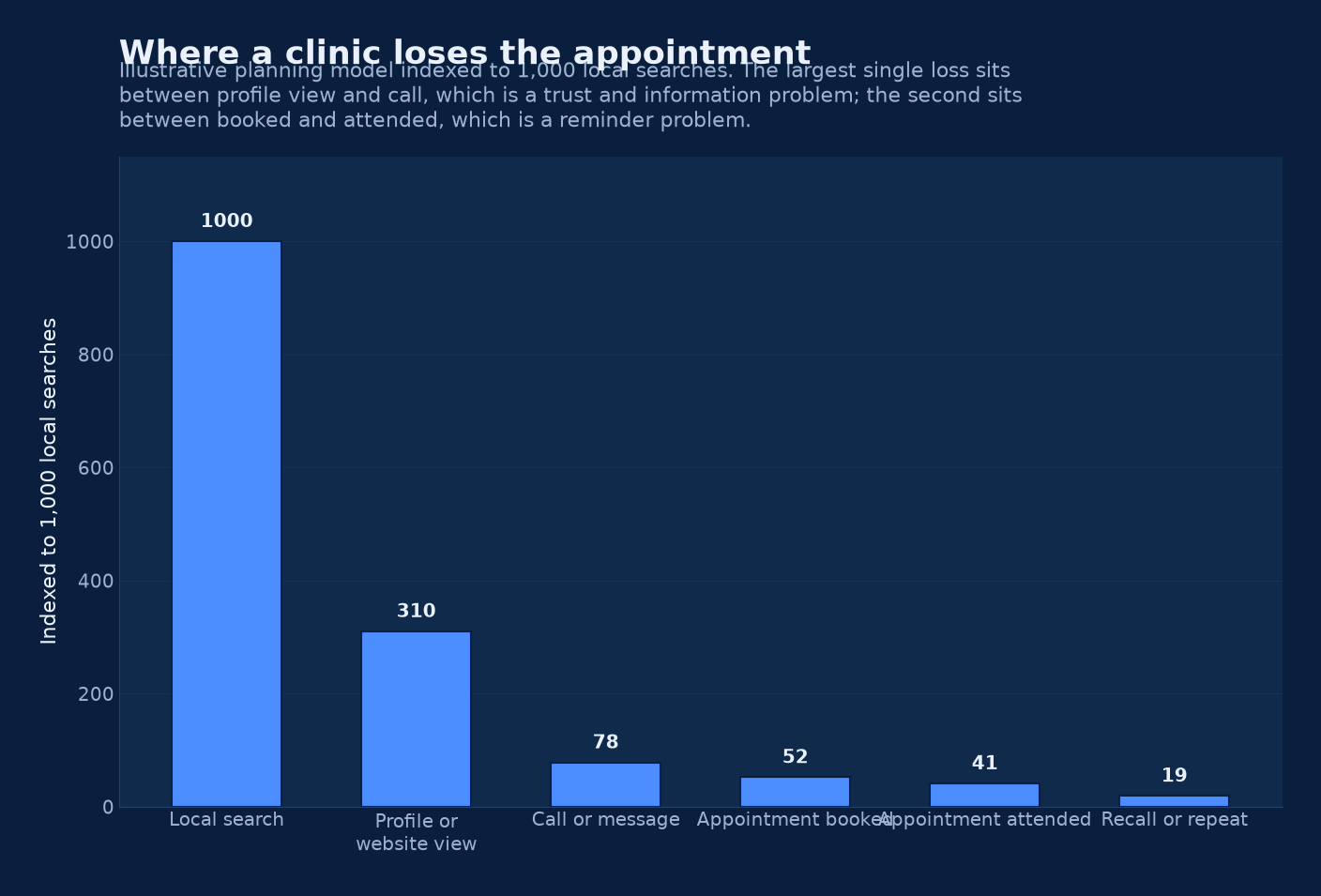
Chart values are an illustrative planning model based on typical UMC engagements and published industry benchmarks. They are not a guarantee of results on any specific project.
| Stage | Who owns it | What must exist | How it is measured |
|---|---|---|---|
| Local search | Marketing with the clinician | Accurate profile, correct categories, current photos and hours | Map-pack visibility, profile views, direction requests |
| Comparison | Front desk and clinician | Reviews with responses, visible prices, credentials, facility photos | Rating trend, review response rate, price-page views |
| Call or message | Front desk | One queue, response targets, script that is safe and warm | Answer rate, first-response time, disposition |
| Booking | Front desk with the scheduling system | Real slots, preparation instructions, confirmation channel | Booking rate per call, slot utilisation |
| Attendance | Desk and clinical team | Reminders, rescheduling without friction, wait-time honesty | Attendance and no-show rate by service line |
| Treatment plan acceptance | Clinician | Clear explanation, written plan, staging and finance options | Acceptance rate and average plan value |
| Recall and repeat | CRM with consent | Recall rules per procedure, chronic-care intervals, screening reminders | Recall compliance and repeat-visit share |
Treatment-plan acceptance is the stage most clinic programmes ignore, and it is where the revenue is: the same patient volume with better case presentation produces materially different results without a single extra rupee of advertising.
Service lines are the unit of marketing
A clinic is not one offer. A dental practice runs diagnostics, hygiene, restorative, orthodontics, implants and aesthetics, each with a different decision time, price point, consent requirement and contribution. A diagnostic centre runs walk-in tests, home collection, imaging, corporate packages and referral-driven panels. Marketing the institution produces generic enquiries; marketing the service line produces patients with an appointment in mind.
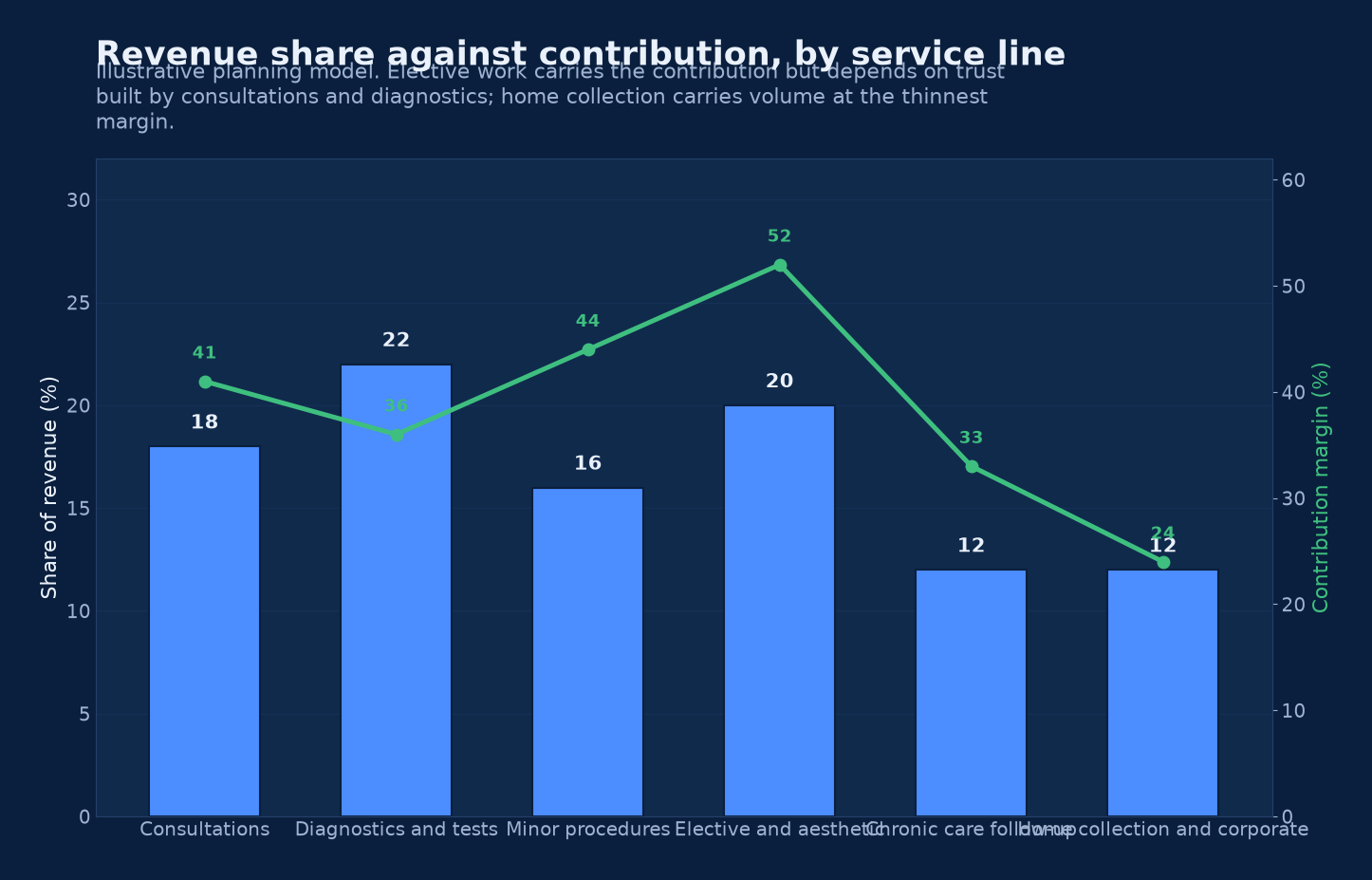
Chart values are an illustrative planning model based on typical UMC engagements and published industry benchmarks. They are not a guarantee of results on any specific project.
| Service line | Decision time | Marketing emphasis | Capacity constraint |
|---|---|---|---|
| Consultations | Days – urgent or routine | Local visibility, credentials, availability | Clinician session hours |
| Diagnostics and tests | Same day to days | Turnaround time, price transparency, home collection | Collection and processing capacity |
| Minor procedures | Days to weeks | Explained process, safety, aftercare, price | Procedure room slots |
| Elective and aesthetic | Weeks to months | Trust, credentials, before-and-after rules, financing | Clinician time and consent process |
| Chronic care follow-up | Ongoing | Recall, continuity, package clarity | Recall administration |
| Corporate and home collection | Contract cycle | B2B outreach, service-level commitments | Logistics and phlebotomy roster |
We build the service-line model with the owner in week one – price, contribution, capacity, consent requirement and recall interval per line – because every later decision about content, campaigns and desk scripts follows from it. cost rationalisation and margin recovery and market research support the cases where the mix, not the volume, is the problem.
The clinic technology stack we integrate with
Clinics run fewer systems than hospitals but depend on them just as completely, and the systems are usually bought one at a time with no plan for them to agree. The audit below is week one.
| System | What it holds | What we need from it | Common blocker |
|---|---|---|---|
| Practice management or clinic EMR | Appointments, patients, notes, invoices | Appointment and revenue extracts per service line | Cloud subscription with no export, or a desktop install |
| Scheduling and slots | Sessions, chair or room availability, waiting list | Slot supply and utilisation by clinician | Sessions configured once and never updated |
| Phone, WhatsApp and chat | Calls, messages, missed enquiries | Volume, answer rate and disposition | Personal phones, no shared inbox |
| Laboratory or imaging system | Orders, results, turnaround, reports | Turnaround times and volumes | Results delivered by email attachment |
| Billing and payments | Invoices, packages, EMI, insurance claims | Revenue per service line and payer | Packages recorded as free text |
| Patient records and consent | Clinical records, consent forms, retention | A consent field with a date and purpose | Paper consent in a drawer |
| Reviews and profiles | Ratings, reviews, responses, photos, hours | One owner and one update process | Each branch editing its own profile differently |
| Infrastructure | Wi-Fi, devices, backups, payment terminals | Uptime, segmentation, backup verification | Records backed up to the same machine they live on |
Where the practice software cannot export, we build reporting from what the desk already produces rather than waiting for a vendor upgrade – and we say plainly in the assessment which numbers will stay manual until it changes. enterprise systems integration and data warehouse and lakehouse cover the multi-site cases.
Service requirements by role
| Role | The question they ask | What we deliver | The number they watch |
|---|---|---|---|
| Clinician-owner | Am I seeing the right patients, and am I paid properly for them? | Service-line model, pricing transparency, treatment-plan support | Contribution per procedure and per chair hour |
| Practice manager | Can the desk cope with what marketing sends? | Queue design, response targets, scripts, slot configuration | Answer rate, no-show rate, chair utilisation |
| Front desk | What do I say, and who do I hand over to? | Scripts, disposition codes, escalation rules, reminder flow | Calls answered and appointments booked per shift |
| Marketing or coordinator | What do we post, and does it work? | Local content, service-line pages, campaigns, review programme | Cost per attended appointment by service line |
| Finance or accountant | Where did the money go? | Revenue per line, package reconciliation, marketing spend per patient | Revenue per available chair hour |
| IT or vendor | Who fixes it when the system is down at 9am? | Managed IT, backups, segmentation, vendor escalation | Downtime minutes and restore test results |
Local search: the channel that decides most clinic growth
For a clinic, local search is not one channel among several – it is the channel. Patients search by procedure and proximity, compare a handful of profiles, and decide in under a minute using signals that are entirely within the practice’s control: rating and review recency, photos that look like the actual clinic, hours that are true today, services listed accurately, a phone number that is answered, and a website that shows prices. Neglecting any one of them costs patients who were already searching for you.
| Element | What good looks like | What usually goes wrong | Fix cadence |
|---|---|---|---|
| Categories and services | Primary category precise, services listed completely | One generic category, services never filled in | Quarterly |
| Hours and holidays | True today, including festival and emergency changes | Hours from opening day | Before every holiday |
| Photos and video | Real rooms, real equipment, real team, current | Stock images or photos from the previous interior | Monthly additions |
| Reviews | Steady volume, responses that respect confidentiality | Burst after a campaign then silence; arguments in public replies | Weekly ask, weekly responses |
| Q&A | Common questions answered on the profile | Questions answered by strangers | Monthly review |
| Service-line pages | One page per procedure with price and process | One page listing everything | Quarterly |
| Citations and directories | Consistent name, address, phone everywhere | Old address in three directories | Quarterly sweep |
| Structured data | Medical clinic, service, physician, hours, price range | No schema, so assistants cannot answer accurately | Each release |
Delivery runs through local SEO and Google Business Profile management, SEO for procedure and condition queries, content marketing written with clinical review, and AI search optimisation because symptom questions are increasingly asked of assistants. accessibility matters here more than in most sectors – an elderly patient who cannot read the site or use the booking form is exactly the patient a clinic needs.
Paid media for clinics, inside clinical advertising rules
Clinic advertising is constrained by professional codes and platform health policy, and the constraints bite hardest in the service lines that carry the most margin: aesthetic and cosmetic work, implants, fertility, dermatology procedures and weight management. Before any campaign we produce a short claims register – permitted, qualified, prohibited – approved by the clinician who owns the risk. Then media is bounded by radius and capacity, because a campaign that fills a chair schedule the clinic cannot serve buys one-star reviews at the price of a click.
| Claim type | Typical status | How it is handled | Who approves |
|---|---|---|---|
| Service availability, location, hours | Permitted | Standard in all campaigns | Practice manager |
| Clinician credentials | Permitted with evidence | Verified against the register before use | Clinician-owner |
| Equipment and technique | Permitted with accuracy | Named correctly, no implied outcome | Clinician-owner |
| Price and packages | Permitted with transparency | Inclusions, exclusions and validity stated | Finance |
| Outcomes and success rates | Restricted | Only with methodology and caveats, often excluded entirely | Clinician-owner plus legal |
| Before-and-after imagery | Frequently prohibited | Not used in regulated markets; process photography used instead | Clinician-owner plus legal |
| Patient testimonials | Frequently prohibited | Not used; clinician expertise and patient information used instead | Clinician-owner plus legal |
Execution runs through Google Ads management bounded by radius and daypart, local campaigns for urgent-intent queries, Meta and Instagram for elective service lines where policy allows, YouTube for explained procedures, and media planning for multi-branch groups. Performance Max is used only with strict exclusions, since automated buying in healthcare finds a way to say something nobody approved.
Websites, booking and pricing transparency
A clinic website has one job with three parts: prove competence, show the price, and take the booking. Most fail at the second and third, which is why the phone carries enquiries that a page could have handled. The pages that matter are the service-line pages – one per procedure, explaining what it involves, who it suits, what it costs, how long it takes, what aftercare looks like and how to book – plus the clinician profile, the facility page and a contact route that is answered.
| Page or flow | What it must do | Failure that costs patients | Our default |
|---|---|---|---|
| Service-line pages | Explain the procedure, the price range, the process | A bullet list of services with no detail | One substantive page per procedure with clinical review |
| Clinician profiles | Credentials, interests, sessions, languages spoken | A name and a photograph | Profile linked to bookable sessions |
| Prices and packages | Clear ranges, inclusions, financing options | “Call for pricing” on everything | Structured pricing with a review date |
| Book an appointment | Real slots, two taps, confirmation by SMS or WhatsApp | A form that emails the owner’s personal inbox | Booking integrated to the scheduling system |
| Location and access | Map, parking, entrances, accessibility, transport | An address in the footer | Location page per branch |
| Test results and reports | Secure access for patients | Results sent as email attachments | Portal or secure delivery with consent |
| Performance and accessibility | Fast on a phone, usable by every patient | A heavy template with a slider | Core Web Vitals targets and accessibility testing |
Delivery runs through website development, UX and UI design, Core Web Vitals, portal development for results and records, mobile apps where a chain justifies one, information architecture for multi-branch structures and maintenance so clinical content stays current.
The front desk: the highest-leverage asset in a clinic
The desk handles calls, WhatsApp messages, walk-ins, report requests, insurance questions and payment disputes, usually with two people and no written process. It is also the place where growth is won or lost, because every unanswered call is a patient who called the next profile on the list. We design it like a system: one queue across channels, response targets by urgency, disposition codes so outcomes are countable, a callback discipline for missed calls, scripts that are clinically safe, and an escalation rule for anything that sounds urgent.
| Channel | Response target | Handling rule | Recorded outcome |
|---|---|---|---|
| Phone – urgent symptom | Immediate | Clinical escalation, never a marketing queue | Escalation logged |
| Phone – appointment | Under three rings | Offer the next two available slots | Booked, callback or lost |
| Missed call | Callback within thirty minutes | Two attempts across two channels | Reached or unreached |
| WhatsApp or chat | Under ten minutes in working hours | Assisted answers for hours, price, location; human for anything clinical | Question type and outcome |
| Walk-in | Acknowledged within a minute | Registered even if not seen, so recall can follow | Seen, booked or referred |
| Report or result request | Same day | Identity check, then secure delivery | Delivered and channel used |
| Complaint | Same day, named owner | Recovery before it becomes a review | Resolved, follow-up date |
The mechanics come from WhatsApp marketing and SMS with a shared inbox, the reminders from lifecycle campaigns, and the numbers belong in the same dashboard as the campaigns that feed the desk – which is the only way a clinic learns whether a lost patient was a demand problem or an answering problem.
Patient CRM, consent and the recall system
The recall system is the most valuable and most neglected asset in a clinic. Dental six-month recalls, chronic-care review intervals, screening reminders, post-procedure follow-ups and package completions are all predictable, all consented, and all worth more than any new-patient campaign – because the patient already knows you. Building it requires one patient identity across desk, EMR and messaging, a consent record with a date and a purpose, and suppression rules that prevent the message no clinic wants to send.
| Component | Design decision | Failure mode | Measurement |
|---|---|---|---|
| Patient identity | Phone-first matching with human review for near-matches | Three records for one patient | Match and duplicate rate |
| Consent | Purpose-specific, dated, withdrawable, captured at the desk | A tick box that proves nothing | Consent coverage of active patients |
| Recall rules | Per procedure: interval, channel, message content | Recalls sent to patients who moved or had the work done elsewhere | Recall compliance rate |
| Chronic care journeys | Review intervals, medication refills, test reminders | Ad hoc reminders from memory | Follow-up completion |
| No-show recovery | Same-day rebooking prompt, waitlist fill | An empty chair and no record of why | Recovered slots per week |
| Suppression | Complaints, bereavement, clinical objection, opt-out | A promotional message at the worst moment | Suppression coverage and audit |
| Package and plan tracking | Stages, remaining sessions, expiry | Paid packages never completed | Package completion rate |
Build and run sit with CRM development and integration, marketing automation for the journeys, SMS and WhatsApp where those are the channels patients read, email for reports and corporate programmes, and nurturing for treatment plans accepted in stages. AI governance governs anything automated that touches a patient record.
Reviews, reputation and recovery
Reviews are the clinic’s storefront. Two things decide them: the volume and recency of genuine reviews, and how the practice responds to the difficult ones. Asking is a process with a channel and a moment – after a good outcome, at the desk, by message – never an incentive, which most platforms prohibit and several regulators treat as a claim. Responding is a discipline: thank without disclosing, correct without arguing, take the conversation offline, and never identify a patient in a public reply.
| Situation | What we do | What we never do | Owner |
|---|---|---|---|
| Happy patient | Ask at the right moment, on the channel they use | Incentivise or filter who is asked | Front desk |
| Negative review, factual error | Correct politely, offer to resolve offline | Argue, or disclose any clinical detail | Practice manager |
| Negative review, real failure | Acknowledge, apologise, fix, follow up | Delete or dispute without cause | Clinician-owner |
| Complaint before a review | Named owner, same-day contact, recovery flow | Wait for the review to appear | Practice manager |
| Staff mentioned by name | Recognise internally, keep public replies generic | Publish staff personal details | Practice manager |
| Review velocity drop | Investigate the cause – usually a process change | Buy reviews, which ends the profile | Marketing |
Reputation work is part of social media management and local SEO, and it feeds the same reporting as everything else: rating trend, review volume, response rate, and the themes patients keep repeating – which are usually operational facts the practice did not know.
Diagnostic centres, referrals and corporate programmes
Diagnostic and imaging centres have a different demand shape from a consulting clinic: a large share of volume arrives through referring doctors, corporate contracts and home collection, and the competitive variables are turnaround time, report quality, price transparency and convenience rather than personal reputation. Marketing a centre is therefore three programmes at once – a referral programme with tracking, a corporate programme with service levels, and a direct consumer programme for walk-in and home collection – each measured separately.
| Programme | What it needs | Common failure | Measured by |
|---|---|---|---|
| Referring doctors | A coordinator, fast report delivery, feedback loop, easy ordering | Referrals thanked by nobody and tracked by nobody | Referring-doctor count, volume per doctor, report turnaround |
| Corporate and insurance | Package pricing, on-site camps, service-level commitments | Camps run with no follow-up path | Contracts, employees screened, conversion to further testing |
| Home collection | Zone logic, slot discipline, sample handling, cold chain | Slots promised that logistics cannot meet | On-time collection rate, sample rejection rate |
| Walk-in consumer | Price transparency, queue management, reports online | Prices only on request | Walk-in volume, average basket, repeat rate |
| Turnaround as a product | Published turnaround per test, honest exceptions | Turnaround quoted from best case | Turnaround compliance percentage |
sales and pipeline analytics applies directly to the referral and corporate pipelines, with the referring doctor as the account. market expansion consulting covers new collection centres and the zone economics around them.
Business intelligence: chair utilisation and service-line contribution
Clinic reporting is small but contested: is utilisation measured against available chair hours or booked hours, does a package recognise revenue when sold or when delivered, does a no-show cost the slot or the revenue, and which source produced the patient when the desk wrote “walk-in” for somebody who found you on a map. The dictionary comes first, then a one-page weekly view the owner actually reads.
| Metric | Definition that must be fixed | Why it is contested | Refresh |
|---|---|---|---|
| Chair or room utilisation | Booked and attended hours over available hours | Blocked sessions counted as utilisation | Weekly |
| Revenue per service line | Recognised when delivered, packages spread over stages | Packages booked as revenue on the day of sale | Weekly |
| Contribution per procedure | Revenue less clinician time, consumables and variable cost | Consumables never captured per procedure | Monthly |
| No-show rate | By service line, clinician and reminder channel | Rescheduling counted as attendance | Weekly |
| New versus returning | First visit versus recall, by source | Recall patients counted as new because of duplicate records | Monthly |
| Source of patient | Map, referral, corporate, campaign, walk-in | “Walk-in” recorded for everybody | Weekly |
| Recall compliance | Patients recalled within the interval due | No recall rules exist to comply with | Monthly |
| Turnaround time | By test or report type, with exceptions stated | Best-case quoted as standard | Daily |
The practices are BI dashboards and executive reporting for the weekly page, predictive analytics and demand forecasting for session planning and seasonality, and data warehouse and lakehouse where a chain runs several practice systems. cloud cost optimisation applies where the reporting and practice estate has moved to subscriptions.
Artificial intelligence in a clinic, sequenced by value against risk
The useful AI in a small clinical setting is administrative: answering the same thirty questions about hours, price, location and preparation; drafting the recall message for human send; summarising a patient’s history for the clinician before the consultation; transcribing and structuring notes for review; detecting the recall that is due and the package that is unfinished. The AI that is not acceptable is anything that triages a symptom, suggests a diagnosis, or speaks to a patient as though it were clinical advice.
| Use case | Value | Risk | Human in the loop |
|---|---|---|---|
| Administrative copilot on WhatsApp and web | Answers instantly, frees the desk | Low | Escalation to a human for anything clinical or urgent |
| Recall and reminder drafting | Consistent, on-brand, consent-aware | Low | Desk reviews the send list |
| Consultation preparation summary | Clinician reads less, asks better | Medium – a missed detail changes the consultation | Clinician verifies |
| Note structuring | Faster documentation, better data | Medium – omission risk | Clinician signs every note |
| Demand and session forecasting | Better rosters and slot design | Low-medium | Practice manager confirms |
| Review theme analysis | Operational facts surfaced weekly | Low | Manager decides the action |
| Symptom triage or diagnosis | Potentially high | High – safety and liability | Not deployed |
The practice set is AI readiness assessment, AI agents and automation, AI integration, AI governance, risk and compliance, enablement for a small team and ROI measurement. In a clinic the governance document can be two pages, but it must exist and name an owner.
IT support, patient data and backups
A clinic’s IT estate is small and critical: the practice system, the scheduling, the payment terminals, the imaging or lab connection, the Wi-Fi that patients and staff share, and the backups that hold every patient record the practice has ever created. The failure we see most often is not a breach – it is a practice that discovers its only copy of ten years of records lived on the same machine it was created on.
| Area | What we put in place | Why it matters | Evidence produced |
|---|---|---|---|
| Asset register | Every device and subscription with owner and criticality | Small practices lose track within a year | Register with criticality |
| Backups and restore tests | Automated, off-machine, tested on a calendar | Patient records are irreplaceable | Timed restore records |
| Network segmentation | Clinical, staff, guest and payment separated | A guest device must not reach the practice system | Crossing-rules table |
| Access control | Role-based access, MFA on administrative accounts, leaver process | Staff turnover is high in this sector | Access review log |
| Payment security | Terminals on their own path, no card data in notes or messages | Card details written into a WhatsApp thread is a breach | Process review and evidence |
| Monitoring and support | Alerts on the systems that stop the clinic, with a named responder | A 9am outage costs the morning’s appointments | Alert catalogue and response times |
| Records retention | Retention schedule per record type and market | Keeping everything forever is also a risk | Retention schedule |
The practices are managed IT and AMC, helpdesk and end-user support, backup and disaster recovery, cybersecurity, network engineering, IT audit and compliance readiness and cloud services where the practice system is hosted. Hospitals and healthcare groups covers the same ground at institutional scale.
Multi-branch chains and franchises
Chains add one hard problem: each branch competes locally while sharing a brand. The working model centralises what must be identical – brand, claims framework, pricing governance, reporting definitions, consent policy, review response standards – and localises what must differ: the branch profile, the local keywords, the photos, the clinician profiles, the community relationships and the service mix that branch actually offers.
| Layer | Central | Branch | Shared artefact |
|---|---|---|---|
| Brand and claims | Brand system, claims register, approval process | Local photography and community content | One governance document |
| Profiles and local search | Template, categories, response standards | Branch hours, photos, services, reviews | Profile checklist per branch |
| Pricing | Price governance and package structure | Local ranges within the band | Published price bands |
| Reporting | Metric dictionary and consolidated view | Branch weekly page | One set of definitions |
| CRM and recall | Consent policy, journey templates, suppression rules | Local capture at the desk | Consent register |
| IT | Baseline, backups, monitoring, vendor management | Branch devices and spares | Asset register and restore evidence |
Franchises add a co-marketing layer: who pays for what, how a lead is attributed to a branch, and what a franchisee may say locally. We write that agreement down before the first campaign, because the alternative is a dispute during the first slow month.
How an engagement runs: the first ninety days
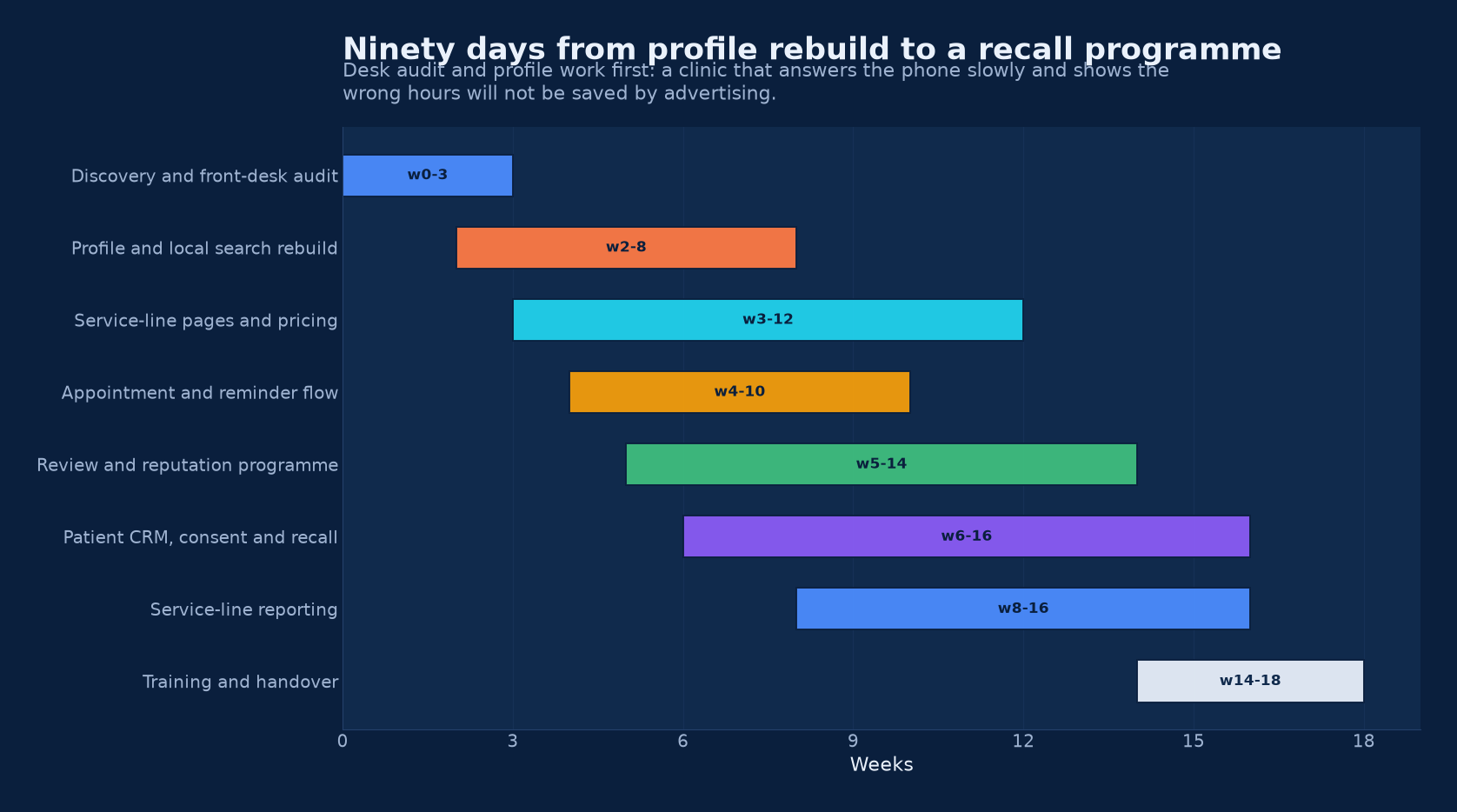
Chart values are an illustrative planning model based on typical UMC engagements and published industry benchmarks. They are not a guarantee of results on any specific project.
Weeks one to three are discovery: the front-desk audit, the service-line contribution model, the local position against the three nearest competitors, and a written verdict on what we would not start with. Profile and local search rebuild runs to week eight. Service-line pages and pricing transparency land by week twelve with clinical review. Appointment and reminder flow is live by week ten. The review and reputation programme starts at week five and never stops. Patient CRM, consent and recall build from week six to sixteen. Service-line reporting is live by week sixteen, and training plus handover close the programme at week eighteen.
| Deliverable | Week | What the clinic keeps |
|---|---|---|
| Front-desk audit and disposition codes | 3 | A desk process the team can follow |
| Service-line contribution model | 3 | Which procedures earn, and what they cost |
| Written verdict and no-go list | 3 | What we would not start with, and why |
| Profile and local search rebuild | 8 | Accurate profiles, citations, review cadence |
| Appointment and reminder flow | 10 | Slots, reminders, rescheduling rules |
| Service-line pages and pricing | 12 | Pages that answer the question and take the booking |
| Review and reputation programme | 14 | Ask process, response standards, recovery flow |
| CRM, consent and recall | 16 | One patient record, consent register, recall rules |
| Service-line reporting | 16 | The weekly page the owner reads |
| Training and handover | 18 | Runbooks, recordings, named owners |
Pricing and engagement models
| Model | Best for | What it includes | Commercial shape |
|---|---|---|---|
| Assessment only | An owner who needs the truth before spending | Desk audit, service-line model, local position, written verdict | Fixed fee, two to three weeks |
| Programme build | A clinic or small chain fixing several things at once | Profiles, pages, booking, recall, CRM, reporting, IT baseline | Fixed fee by workstream, ninety-day core |
| Managed retainer | A practice that wants it run | Local upkeep, content, campaigns, reviews, reporting, IT hours | Monthly, agreed scope, quarterly review |
| Fractional leadership | A chain between hires | Practice or marketing leadership part-time with the programme attached | Monthly, time-boxed with a handover plan |
Every model separates the assessment from the build so an owner can stop after the verdict and keep the service-line model and the desk process. Where the problem is margin or cash rather than demand, we say so and route to cost and margin recovery or cash flow and working capital.
Compliance, consent and clinical claims
Clinics carry the same claim exposure as hospitals with less administrative support behind them, which is exactly why a short written framework matters more here than anywhere else. The register is two pages: what may be said, what must be qualified, what may never be said, who approves, and where it applies.
| Area | What we check | Where it shows up | Owner |
|---|---|---|---|
| Clinical claims | Substantiation for every outcome or comparative statement | Ads, service pages, social captions | Clinician-owner |
| Before-and-after imagery | Market rules; frequently prohibited | Aesthetic and dental marketing | Clinician-owner plus legal |
| Pricing communication | Ranges, inclusions, exclusions, validity, financing terms | Site, profiles, campaigns | Finance |
| Consent and data | Purpose-specific consent, retention, patient rights, residency | CRM, WhatsApp, portal, Wi-Fi | Named data owner |
| Records and confidentiality | No patient detail in public replies or marketing | Reviews, social, case discussion | Practice manager |
| Referral and inducement rules | No payment for referrals, no prohibited incentives | Doctor relationships, corporate camps | Clinician-owner plus legal |
| Advertising to vulnerable groups | Age, consent and sensitivity rules | Fertility, paediatric, weight management | Clinician-owner |
The same framework governs automation: AI governance, risk and compliance applies to anything that messages a patient, and IT audit and compliance readiness produces the evidence an accreditation body, insurer or partner asks for.
How we measure success
| Outcome | Metric | Baseline source | Review cadence |
|---|---|---|---|
| More attended appointments | Attended appointments by service line and source | Scheduling and desk records | Weekly during build |
| Fewer lost enquiries | Answer rate, first-response time, callback completion | Desk dispositions | Weekly |
| Better utilisation | Chair or room utilisation, no-show rate | Scheduling | Weekly |
| Healthier service mix | Contribution and volume per service line | Finance and practice system | Monthly |
| Stronger local presence | Map-pack visibility, profile actions, rating trend | Search and profile data | Monthly |
| Recall working | Recall compliance, repeat-visit share, package completion | CRM | Monthly |
| Reliable systems | Downtime minutes, restore test results, response times met | Monitoring and ticket log | Monthly |
| Honest spend | Cost per attended appointment, marketing per net revenue | Finance and campaign data | Quarterly |
We publish the misses. A clinic owner who can see their own utilisation, recall compliance and cost per attended appointment does not need an agency to explain last month.
Proof: healthcare work we have delivered
Our published healthcare engagements are institution-scale, but the disciplines transfer directly to clinic settings: local demand, clinical content with review, appointment and enquiry conversion, consent-based patient CRM, and reporting built on a published dictionary.
Related Services
Healthcare case studies:
- Apollo Hospitals – digital engagement
- Medicity Hospitals – digital engagement
- Global Hospitals – digital engagement
- Medical tourism company – international patient programme
- Hospitals and healthcare groups – the institutional version of this page
Clinic work is usually confidential by nature – a single-owner practice does not want its volume published – so we share method, numbers and constraints under a non-disclosure agreement.
Every capability a clinic can draw on, by family
| Family | Capabilities | Typical clinic use |
|---|---|---|
| Demand capture | local SEO and profiles, SEO, AI search optimisation, content marketing | Map pack, procedure pages, clinical content, assistant answers |
| Paid media | Google Ads, local campaigns, Meta, Instagram, YouTube, media planning | Radius demand inside the claims framework |
| Brand and reputation | brand performance and creative production, social media management | Facility photography, explained procedures, review responses |
| Build | website development, UX and UI, accessibility, performance, patient portals, apps, maintenance | Service-line pages, booking, results delivery |
| Patient data | CRM development and integration, lifecycle campaigns, WhatsApp, SMS, email, automation | Consent, recall, reminders, packages |
| Intelligence | dashboards, forecasting, referral and corporate pipelines, warehouse and lakehouse | Utilisation, service-line contribution, recall compliance |
| Consulting | strategy, market research, expansion, cost and margin, cash flow | New branch cases, pricing, turnaround |
| Infrastructure | managed IT, helpdesk, backup and DR, cybersecurity, networks, audit, cloud | Records backups, segmentation, payment security, evidence |
| Artificial intelligence | readiness, agents, integration, governance, enablement, ROI | Administrative copilot, recall drafting, note structuring |
Local teams: clinics in Lucknow and across India
These pages are written to be geography-neutral because the work is delivered remotely. For practices that want a provider in their own market, the local pages carry regional detail, including speciality-specific programmes for dental and diagnostic centres.
- Digital marketing company for clinics in Lucknow
- Website development company for clinics in Lucknow
- Get more clinic patients in Lucknow
- Get more dental clinic patients in Lucknow
- Get more diagnostic centre patients in Lucknow
- Digital marketing company for doctors in Lucknow
- Digital marketing and IT services across Indian cities
- Contact us
Related industry verticals
Clinic and diagnostic work sits beside hospitals, doctors and pharmaceutical verticals, and the remaining verticals share one method: unit economics and capacity first, then the systems that carry it, then the campaigns.
Frequently asked questions about clinic marketing, data and IT
How quickly does a clinic programme show results?
Profile and desk fixes can move enquiries within weeks because the demand already exists. Recall and contribution work takes a quarter, because it depends on patients returning.
We are a single-doctor practice. Is this too much?
The assessment-only model exists for that: desk audit, service-line model, local position and a written verdict at a fixed fee. Most single-practitioner programmes stay at that scope plus profiles and recall.
Do you need access to our patient records?
No. We work from extracts and counts, never from identifiable clinical records, and the reporting is designed so marketing never needs clinical detail.
How do you get reviews without breaking the rules?
By asking genuine patients at the right moment, on the channel they use, with no incentive and no filtering – then responding properly to whatever arrives.
Can we show before-and-after photos?
In many markets, no, and platform policy frequently prohibits them too. We use process photography, explained procedures and clinician credentials instead, and we write the rule into the claims register.
Our practice software cannot export data. What now?
Then reporting is built from what the desk already records, and the assessment names which numbers stay manual until the software changes. We do not promise dashboards we cannot feed.
How do we reduce no-shows?
Mostly operationally: reminder channel and timing, preparation instructions, rescheduling without friction, waitlist fill for cancellations, and deposit or confirmation rules where the market allows.
Is a patient portal worth it for a clinic?
For results delivery and recall, often yes – provided something routes patients to it at the desk. A portal nobody mentions is an expense.
Do you work with diagnostic centres and labs?
Yes, with three separate programmes: referring doctors, corporate contracts, and direct consumer walk-in and home collection, each measured on its own numbers.
Can AI answer patient messages for us?
For hours, price, location and preparation – yes, with escalation rules and a human always reachable. For symptoms, diagnosis or anything urgent – no.
What about multiple branches?
One brand, one claims framework and one reporting dictionary centrally; one profile, one set of photos and one local service mix per branch. Franchise co-marketing terms are written down before the first campaign.
Do you work outside India?
Yes. Programmes are delivered remotely and written geography-neutral, with market rules on clinical advertising, consent and record retention handled inside the engagement.
What if our problem is not marketing?
Then the verdict says so. Common alternatives are pricing, session design, chair capacity or treatment-plan presentation – and we would rather name that in week three than advertise around it for a year.
Start with the desk audit and the service-line model
Give us three weeks with your scheduling data, your pricing and a day at the front desk, and we will return the service-line contribution model, the local position against your three nearest competitors, the desk process and a written verdict including what we would not start with – yours to keep either way.
Contact Unified Management Consulting to arrange a confidential first conversation.