
A hospital is not one business. It is a building that runs an emergency department with no demand forecast, an elective surgical programme with a waiting list, a set of outpatient clinics competing for the same consulting hours, a diagnostics service with the best margin in the building, and a maternity unit whose patients choose years in advance – all sharing one brand, one website, one enquiry desk and one IT room. Marketing a hospital therefore means marketing departments, and the unit of analysis is the speciality, not the institution. The second thing that makes healthcare different is constraint: claims are regulated, consent is not optional, clinical outcomes may not be promised, and a campaign that is effective but non-compliant is a campaign that gets withdrawn at the worst possible moment.
Unified Management Consulting works with single hospitals, multi-site groups, day-surgery centres, diagnostic chains and the healthcare businesses that serve them. Everything here is delivered remotely and written to be geography-neutral – market-specific rules on advertising, consent and data residency are handled inside the engagement rather than assumed away. This is the vertical’s main page; the industries index lists every sector we cover, and the smaller provider types have their own pages: restaurants and food service and hotels and hospitality show the same discipline set applied elsewhere.
What an engagement includes, at a glance
| Component | What We Deliver |
|---|---|
| Department-level demand | Cardiology, orthopaedics, maternity, oncology, emergency, diagnostics – each with its own journey, unit economics and audience. |
| Compliant acquisition | Advertising that respects clinical claims rules, consent and platform health policy in every market you run it. |
| Appointments and enquiries | A website and enquiry desk that convert a worried searcher into a booked, attended appointment. |
| Patient CRM with consent | One patient record across HIS, portal and campaigns, with a demonstrable consent basis and follow-up journeys. |
| Occupancy, OR and revenue reporting | Bed occupancy, theatre utilisation, revenue and contribution per speciality, payer mix and length of stay. |
| HIS uptime and clinical IT | Monitoring, segmentation, backups and a rehearsed downtime procedure for systems that carry patient safety. |
| Security and audit readiness | Baseline controls, vendor access, logging and the evidence pack an accreditation or insurer asks for. |
| Medical tourism and referrals | International patient journeys, referral-doctor relationships and second-opinion pathways. |
What hospitals search for, and what it really means
Enquiries from this sector arrive in two voices: the marketing lead who has been asked for numbers, and the administrator who knows the numbers will be disputed. Both are answered by the same work – a department-level model of demand, cost and contribution – and the queries below map to it.
| What gets searched or asked | What is actually happening | What we do about it |
|---|---|---|
| “hospital marketing agency” | Board asked for patient growth and nobody can attribute it | Department-level demand model with attribution agreed before spend |
| “increase hospital patient enquiries” | Enquiries exist but do not become attended appointments | Journey mapping from enquiry to attendance, then desk and reminder fixes |
| “healthcare SEO services” | Condition and speciality pages are thin or missing | Clinically reviewed condition content with local and department pages |
| “hospital website design” | No online booking, PDF price lists, one page for twenty departments | Department structure, appointment booking, portal, accessibility |
| “patient CRM for hospitals” | Records fragmented across HIS, call centre and walk-in | Identity resolution, consent capture, follow-up journeys |
| “hospital management reporting” | Occupancy and theatre numbers argued about monthly | Metric dictionary, occupancy and OR dashboards, payer-mix views |
| “HIS downtime” | No monitoring, no rehearsed downtime procedure | Managed IT with response times by system and a tested paper fallback |
The pattern across all seven is that the marketing question is downstream of an operational or data question. We say that in the assessment, in writing, before proposing a campaign – our business strategy consulting and cost and margin recovery practices exist for exactly that conversation.
The patient journey, and where it leaks
Healthcare demand starts with a symptom, a referral, a diagnosis elsewhere or a family recommendation, and ends – if it works – with an attended appointment and a follow-up relationship. Between those points sit the stages that decide whether the institution grows: being found for the right condition, being believed, being able to book without a phone queue, being reminded, and being followed up. Most hospital marketing budgets are spent at the first stage while the losses happen at the third, fourth and fifth.
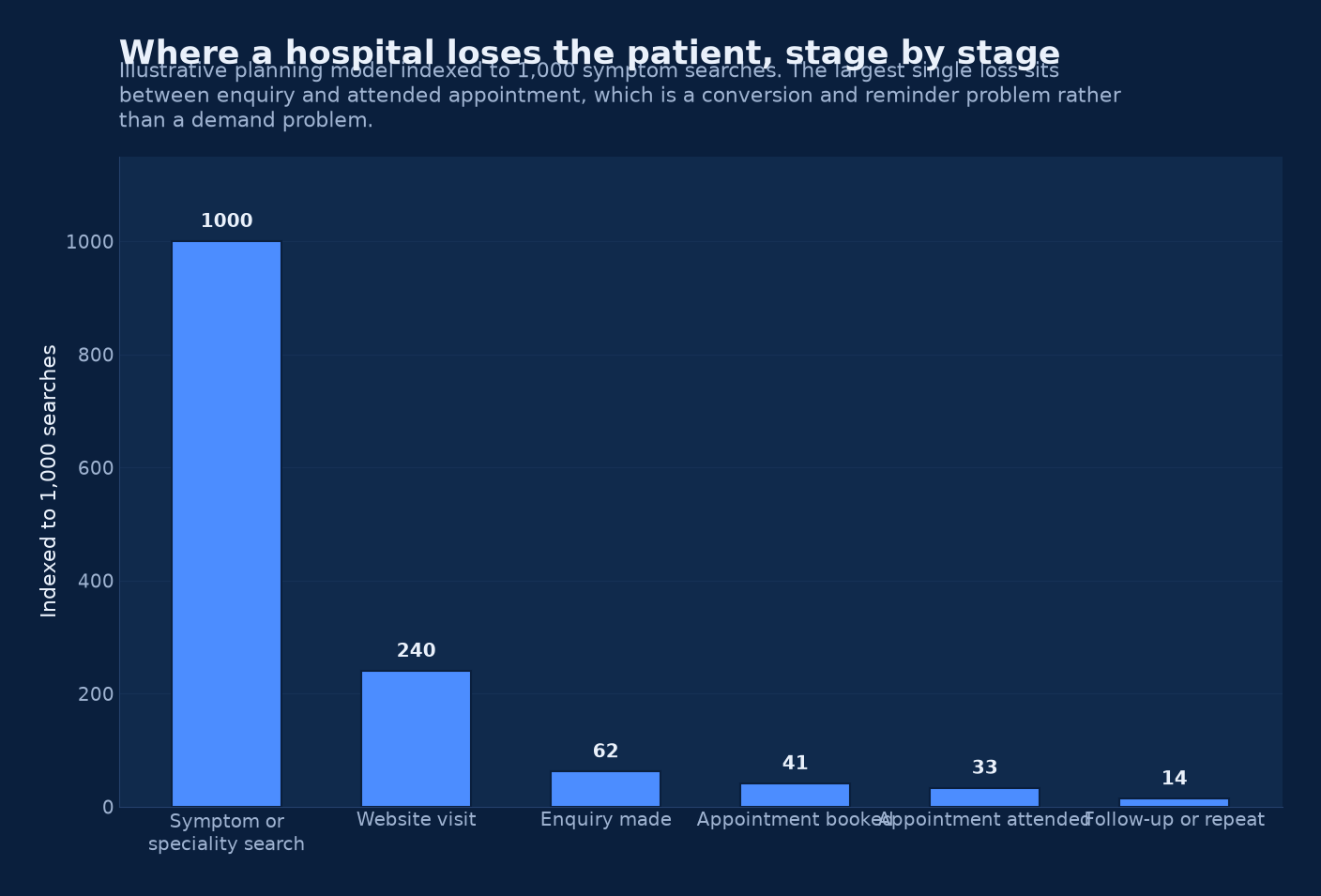
Chart values are an illustrative planning model based on typical UMC engagements and published industry benchmarks. They are not a guarantee of results on any specific project.
| Stage | Who owns it | What must exist | How it is measured |
|---|---|---|---|
| Symptom or condition search | Marketing with clinical review | Condition and speciality pages, local presence, accurate clinical content | Non-branded visibility, clicks per condition |
| Comparison and trust | Medical director and marketing | Credentials, consultant profiles, facilities, published process | Time on consultant pages, enquiry rate per visit |
| Enquiry | Enquiry desk, WhatsApp, portal | One number, one queue, response within minutes, department routing | Enquiries, first-response time, routing accuracy |
| Booking | Appointments team | Real slots from the HIS, deposit and preparation instructions | Booking rate per enquiry, slot utilisation |
| Attendance | Appointments and clinical teams | Reminders, preparation guidance, rescheduling without friction | Attendance rate, no-show rate by department |
| Follow-up and continuity | Clinical team with CRM support | Recall rules, results communication, consent-based re-engagement | Follow-up completion, readmission and recall rates |
Each stage has a different owner, which is why a hospital growth programme is an operations programme with marketing inside it. We run it that way and report it that way.
The hospital technology stack we integrate with
Nothing in a hospital growth programme works without reading the systems of record. The audit below is week one: what exists, who owns it, what it can export, and what it will never export without a vendor conversation.
| System | What it holds | What we need from it | Common blocker |
|---|---|---|---|
| HIS / EMR | Episodes, appointments, diagnoses, orders, discharge | Appointment and episode extracts per department | Vendor reporting tier, no API, on-premise only |
| LIS and RIS/PACS | Lab results, imaging orders and reports | Turnaround times and volumes for diagnostics demand | Separate vendors with separate identifiers |
| Appointment and scheduling | Slots, consultant rosters, theatre lists | Slot supply and utilisation by clinic session | Manual session setup that never matches reality |
| Call centre and WhatsApp | Enquiries, call logs, chat transcripts | Enquiry volume, disposition and routing outcome | No disposition codes, so calls are uncountable |
| Patient portal and app | Accounts, reports, requests, messages | Registration, activation and self-service rates | Portal unused because nothing routes patients to it |
| Billing and insurance | Invoices, payer mix, approvals, denials | Revenue and contribution per department and payer | Denial reasons recorded as free text |
| CRM and marketing | Consent, segments, campaigns, journeys | One patient identity plus a consent field with a date | Consent captured nowhere or in three places |
| Infrastructure | Networks, servers, backups, biomedical devices | Uptime, segmentation, asset register | Clinical and guest networks sharing one segment |
Integration work is delivered through enterprise systems integration, data warehouse and lakehouse where several systems must agree, and data engineering for AI and knowledge systems where the same data will feed models later. Where a vendor refuses export access, we price the workaround rather than promise around it.
Service requirements by role
| Role | The question they ask | What we deliver | The number they watch |
|---|---|---|---|
| Chief executive or trustee | Are we growing the right departments? | Department demand and contribution model, expansion case | Contribution per speciality and payer mix |
| Medical director | Is any of this clinically defensible? | Claims framework, clinical review process, outcome language rules | Claims approved without exception |
| Marketing lead | What do I run, and how do I prove it? | Compliant campaigns, content, enquiry desk reporting | Cost per attended appointment by department |
| Nursing or operations head | Will this change what the floor does? | Slot design, reminder flows, rescheduling rules | Attendance and no-show rates |
| Finance | Where does revenue come from and what does it cost? | Revenue, contribution, denial and payer analytics | Revenue per occupied bed day |
| IT head | Who is responsible when the HIS is slow at 3am? | Managed IT, monitoring, security baseline, downtime procedure | Downtime minutes and response times met |
Departments are the unit of marketing
A cardiology patient and a maternity patient share nothing except the building: different triggers, different decision makers, different lead times, different unit economics. Treating “the hospital” as one audience produces generic advertising that no department recognises as theirs and no finance head can attribute. Treating each department as a business line with its own journey, contribution and capacity produces a programme the medical staff will actually cooperate with – which matters, because in healthcare the clinicians are the conversion step.
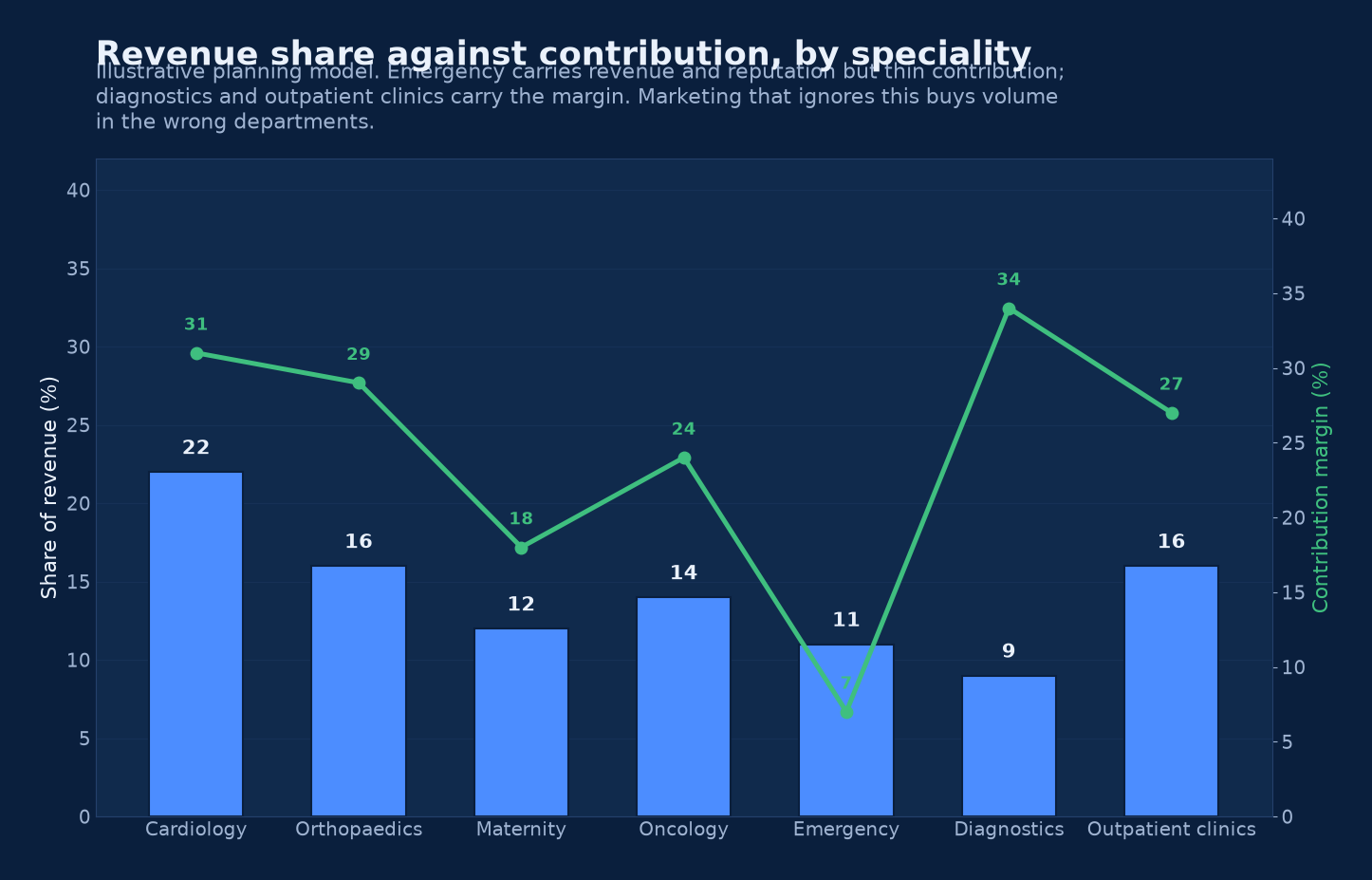
Chart values are an illustrative planning model based on typical UMC engagements and published industry benchmarks. They are not a guarantee of results on any specific project.
| Department | Demand trigger | Lead time | Marketing emphasis |
|---|---|---|---|
| Emergency and trauma | Immediate need, ambulance and walk-in | Minutes | Visibility, signage, referral relationships – not advertising |
| Cardiology and cardiac surgery | Symptom, referral, second opinion | Days to weeks | Consultant credibility, programme pages, second-opinion pathway |
| Orthopaedics and joint replacement | Chronic pain, age, referral | Weeks to months | Programme cost transparency, recovery content, insurer pathways |
| Maternity and paediatrics | Life event, planned years ahead | Months | Early relationship, packages, tours, continuity of care |
| Oncology | Diagnosis elsewhere, urgent referral | Days | Tumour board credibility, navigation support, financial counselling |
| Diagnostics and health checks | Preventive, corporate, physician-requested | Same day to weeks | Packages, corporate contracts, turnaround time |
| Outpatient clinics | Convenience, consultant preference, price | Days | Slot availability, local search, booking ease |
Capacity is the constraint that governs all of it: advertising a department whose clinic sessions are full buys enquiries that become complaints. We wire capacity checks into campaign structure and pause rules the same way we do in other sectors.
Local search, maps and being found for the right condition
Hospitals win local search on two axes at once: the institution (maps, directions, hours, phone, reviews) and the condition (clinical content that answers a specific question credibly). Both need work and neither substitutes for the other. A hospital with a perfect profile and no condition content is invisible to the majority of searches, which are symptom-led; a hospital with excellent content and a neglected profile loses the patient at the moment of decision.
| Element | What good looks like | What usually goes wrong | Fix cadence |
|---|---|---|---|
| Institution profile | Accurate hours, entrances, departments, phone routing | One phone number for a building with twenty departments | Quarterly |
| Reviews | Steady volume, responses that respect confidentiality | Responses that argue with patients publicly | Weekly responses |
| Condition content | Clinically reviewed, plain language, when-to-seek-care guidance | Thin pages written for keywords rather than patients | Monthly additions, annual clinical review |
| Consultant profiles | Credentials, interests, clinic sessions, booking link | A name and a photograph, no session information | Per roster change |
| Department pages | Services, pathways, equipment, outcomes process, FAQ | One page listing every department as a bullet | Quarterly |
| Location and access | Maps, parking, entrances, accessibility, transport | Missing accessibility information entirely | With any site change |
| Structured data | Hospital, department, physician, opening hours | No schema, so assistants cannot answer accurately | With each release |
The practice behind this is local SEO and Google Business Profile management combined with SEO and content marketing, with accessibility remediation treated as a requirement rather than an extra – a healthcare site that cannot be used by an elderly or partially sighted patient fails the people most likely to need it. AI search optimisation matters here more than in most sectors, because symptom questions are increasingly asked of assistants rather than typed into a search box.
Paid media inside clinical advertising rules
Healthcare advertising is constrained twice: by law and professional codes in the market, and by platform health policy, which is frequently stricter than either. Both must be satisfied before a campaign is built, not after. The framework we deliver is a written claims register – what may be said, what must be qualified, what may never be said – approved by the medical director, with a review step in the content process so that nobody has to remember the rules under deadline pressure.
| Claim type | Typical status | How it is handled | Who approves |
|---|---|---|---|
| Service availability and location | Permitted | Standard in all campaigns | Marketing |
| Consultant credentials | Permitted with evidence | Verified against the register before use | Medical director |
| Technology and equipment | Permitted with accuracy | Named correctly, no implied outcome | Medical director |
| Wait times and access | Permitted with care | Published as typical, not guaranteed | Operations |
| Package pricing | Permitted with transparency | Inclusions and exclusions stated in full | Finance |
| Success rates and outcomes | Restricted | Only with methodology, source and caveats | Medical director plus legal |
| Before and after imagery | Usually prohibited | Not used in regulated markets | Medical director |
| Testimonials from patients | Frequently prohibited | Not used; clinician expertise used instead | Medical director plus legal |
Media execution then follows the department model: search on condition and speciality queries with Google Ads management, local radius demand through local campaigns, awareness and recruitment work through Meta and YouTube where policy allows, and media planning and buying where several sites share one budget. Automation-led buying such as Performance Max is used only where the exclusions and asset rules can be enforced, because an automated campaign in healthcare will find a way to say something you did not approve.
Websites, appointments, portals and accessibility
A hospital website has to serve a patient in pain, a relative doing research at midnight, a referring doctor checking capability, a job applicant and a payer verifying credentials – usually within the same ten pages. The design consequence is a clear department-first structure, one obvious booking path, a real appointment integration rather than an enquiry form that pretends to be one, and accessibility treated as a clinical requirement.
| Page or flow | What it must do | Failure that costs patients | Our default |
|---|---|---|---|
| Department pages | Explain the pathway, the team, what to expect | A list of specialities with no content | One substantive page per department |
| Condition pages | Answer the question in plain language with when-to-seek-care | Keyword-stuffed thin content | Clinically reviewed content with a review date |
| Consultant profiles | Credentials, interests, sessions, bookable slots | Name and photo only | Profile linked to live session availability |
| Book an appointment | Real slots, minimal fields, confirmation and preparation | Enquiry form with a 48-hour callback promise | Booking integrated to the scheduling system |
| Patient portal | Reports, requests, messaging, records | Portal exists but nobody is routed to it | Portal promoted at every touchpoint |
| Prices and packages | Transparent inclusions, exclusions and typical ranges | PDF price list from last year | Structured pricing pages, maintained |
| Accessibility | Keyboard, screen reader, contrast, readable text size | Fails for the patients who need it most | WCAG-aligned build with testing |
Delivery runs through website development, portal development, UX and UI design, accessibility and WCAG remediation, Core Web Vitals for speed on hospital networks and older devices, mobile apps where a patient app is justified, information architecture for multi-site groups and maintenance and support so clinical content stays current.
The enquiry desk: the most underestimated conversion asset
In healthcare the enquiry desk is a clinical-adjacent function performed by people under pressure, on several channels at once, often with no disposition codes and no routing rules. It is also the single highest-leverage place in the journey: a patient who calls about chest pain and is transferred twice will not call back. We treat the desk as a designed system – one number or one queue, department routing rules, disposition codes that make outcomes countable, response-time targets by channel and urgency, a callback discipline, and scripts that are clinically safe without being cold.
| Channel | Response target | Routing rule | Recorded outcome |
|---|---|---|---|
| Phone – emergency symptoms | Immediate, no queue | To emergency guidance, never to a marketing queue | Escalation logged |
| Phone – department enquiry | Under two minutes | By department and site, with a named fallback | Disposition and callback time |
| WhatsApp or chat | Under ten minutes in working hours | Bot-assisted triage to a human for anything clinical | Question type, resolution, booking |
| Web enquiry form | Under two working hours | Auto-routed by department selection | Contact attempts and outcome |
| Referral from a doctor | Same day | To the referring-doctor coordinator | Accepted, deferred or redirected |
| International enquiry | Same day in the enquirer’s time zone | To the international patient team | Case opened, estimate sent, converted |
The desk’s numbers belong in the same dashboard as the campaigns that feed it, which is the only way a hospital learns whether a lost patient was a demand problem or a handling problem. WhatsApp marketing, SMS reminders and nurturing programmes supply the mechanics; the routing rules and disposition codes are the part that makes them measurable.
Patient CRM, consent and follow-up
A patient CRM in healthcare is mostly a consent and continuity system. The value is real – recall for chronic care, follow-up after discharge, health-check renewal, maternity pathways, corporate programme scheduling – and every one of those requires a lawful basis, a recorded date, and a way for the patient to stop. Fragmented identity is the technical obstacle: the same person exists in the HIS, the portal, the call centre log and the marketing list, and matching them is a governed process rather than a query.
| Component | Design decision | Failure mode | Measurement |
|---|---|---|---|
| Identity resolution | Match on governed keys with human review for near-matches | Merging two patients, or never merging one | Match rate, false-merge incidents |
| Consent | Purpose-specific, dated, withdrawable, per market rules | One blanket tick box that proves nothing | Consent coverage of the active base |
| Segments | Care programme, department, recall interval, corporate contract | Marketing segments built from clinical fields without a basis | Segment size and response rate |
| Recall journeys | Chronic care, post-discharge, screening intervals | Recalls sent to patients who have moved or died | Recall completion rate |
| Follow-up after discharge | Clinical instruction plus a contact route | Marketing messaging inside a clinical window | Follow-up completion and readmission |
| Suppression | Bereavement, complaints, clinical objection, opt-out | A promotional message at the worst possible moment | Suppression list coverage and audit |
This is delivered through CRM development and integration with lifecycle and retention campaigns and marketing automation for the journeys, and it is the part of the programme where AI governance, risk and compliance is most load-bearing: anything automated that touches a patient record needs a written basis, an audit trail and a named human owner.
Business intelligence: occupancy, theatres and contribution
Hospital reporting arguments are usually about definitions rather than data: is occupancy counted at midnight or averaged, does a day-case occupy a bed, is theatre utilisation measured against scheduled or available hours, does revenue follow the episode or the invoice. We fix the dictionary first, publish it, and build the dashboards on it – which is the same discipline as in every sector, with higher stakes because the numbers feed clinical capacity decisions as well as commercial ones.
| Metric | Definition that must be fixed | Why it is contested | Refresh |
|---|---|---|---|
| Bed occupancy | Occupied bed days over available bed days, with the day rule stated | Midnight census versus average, day cases included or not | Daily |
| Average length of stay | Discharge minus admission, by department and payer | Transfers between departments counted twice | Weekly |
| Theatre utilisation | Time used over time available, with the session definition | Cancelled lists and turnover time excluded | Weekly |
| Revenue per department | Gross revenue by speciality with the allocation rule stated | Shared diagnostics and pharmacy allocated arbitrarily | Monthly |
| Contribution per episode | Revenue less variable clinical cost | Consumables and implants captured inconsistently | Monthly |
| Payer mix and denials | Share by payer, denial rate and reason | Denial reasons recorded as free text | Monthly |
| Enquiry to attendance | Booked, attended and no-show by source and department | Walk-ins and referrals counted differently | Weekly |
| International patient flow | Enquiries, estimates, arrivals, revenue | Agent-sourced patients attributed to nobody | Monthly |
Forecasting on top of this – elective demand, seasonal respiratory peaks, maternity volumes, diagnostics growth – turns rostering and theatre planning from argument into arithmetic. The practices are BI dashboards and executive reporting, predictive analytics and demand forecasting and sales and pipeline analytics for the referral and corporate pipelines.
Artificial intelligence in a hospital, sequenced by value against risk
Healthcare has the largest potential gains from AI and the least tolerance for error, so sequencing is everything. We start where a mistake is cheap and a human is already in the loop: answering administrative questions, drafting discharge summary structure for clinician review, summarising referral letters, forecasting demand, detecting coding and denial patterns. We do not start with anything diagnostic, and we do not deploy anything that speaks to a patient as though it were clinical advice.
| Use case | Value | Risk | Human in the loop |
|---|---|---|---|
| Administrative FAQ and navigation copilot | Reduces desk load, answers at midnight | Low | Escalation to a human for any clinical question |
| Referral letter summarisation | Saves clinician reading time | Medium – a missed detail changes triage | Clinician reads and decides |
| Discharge summary drafting | Faster documentation | Medium – omission risk | Clinician signs every summary |
| Demand and capacity forecasting | Better rosters and theatre planning | Medium – a wrong forecast wastes capacity | Operations confirms |
| Coding and denial pattern detection | Revenue recovery | Low | Finance reviews before submission |
| Clinical decision support | Potentially high | High – regulatory and safety exposure | Not deployed without regulatory clearance and governance |
| Patient-facing symptom triage | Access improvement | High – safety and liability | Only with an approved clinical pathway and escalation |
The practice set behind this is AI readiness assessment, AI agents and automation, AI integration, AI governance, risk and compliance, enablement for clinical and administrative teams and AI ROI measurement. In healthcare the governance workstream is not a deliverable at the end; it runs from week one and never stops.
IT support and security for clinical systems
Hospital IT is a patient-safety function with a budget line. The HIS going slow at 3am is not an inconvenience; it is a clinical risk with a paper workaround that somebody must have rehearsed. The support model therefore covers availability first, then segmentation (clinical, administrative, biomedical, guest and payment networks separated), then the security baseline an accreditation body or cyber insurer will ask for, then the vendor management that keeps a dozen suppliers accountable to one owner.
| Area | What we put in place | Why it matters clinically | Evidence produced |
|---|---|---|---|
| Asset and vendor register | Every system with owner, contract, spares, criticality | Downtime response depends on knowing what failed | Register with criticality ratings |
| Monitoring and on-call | Alerts by system criticality, routed by hour | A full night shift cannot troubleshoot a database | Alert catalogue and rota |
| Network segmentation | Clinical, admin, biomedical, guest, payment separated | A guest device must not reach a clinical segment | Crossing-rules table |
| Backup and downtime procedure | Tested restores plus a rehearsed paper workflow | Care continues when systems do not | Timed restore and rehearsal record |
| Access and identity | Role-based access, MFA on administrative surfaces, joiners and leavers | Privileged access is the highest-value target | Access review log |
| Security baseline and audit | Controls mapped to the standard you must evidence | Accreditation, insurance and regulator requests | Baseline checklist and gap list |
| Biomedical and IoT | Device inventory, firmware, isolation | Infusion pumps and monitors are networked | Device register with firmware state |
The practices are managed IT and AMC, helpdesk and end-user support, network engineering, cybersecurity, backup and disaster recovery, IT audit, compliance and ISO or SOC 2 readiness, cloud services and migration and cloud security posture management where workloads have moved.
Medical tourism, international patients and referral networks
International patient flow is a distinct business with its own funnel: an enquiry from another country, a medical file review, a cost estimate, visa and travel logistics, arrival, treatment, follow-up at home. It is also the funnel most hospitals run on email and goodwill. The commercial upside is real – international episodes typically carry higher contribution – and the operational requirement is a team with a process, an estimate template that finance stands behind, and continuity after discharge, which is where most programmes quietly fail.
| Stage | What must exist | Owner | Measured by |
|---|---|---|---|
| Enquiry | One channel, time-zone-aware response, file checklist | International patient team | Response time and file completion |
| Medical review | Structured review by the relevant consultant | Medical director’s office | Review turnaround and acceptance rate |
| Estimate | Template with inclusions, exclusions and validity | Finance with clinical input | Estimate-to-arrival conversion |
| Logistics | Visa letters, travel, accommodation, interpreter | International team with partners | Arrival rate and delay incidents |
| Treatment | Named coordinator from arrival to discharge | Clinical team | Length of stay and complications process |
| Follow-up at home | Remote review, records transfer, local partner | International team | Follow-up completion and repeat referrals |
Referral-doctor relationships are the domestic equivalent and are usually managed with no system at all: a coordinator, a record of who refers what, response times that respect a clinician’s day, and feedback to the referring doctor after the consultation. sales and pipeline analytics applies directly, with the referring doctor as the account and the patient as the case. Our published work in this space includes a medical tourism company engagement and a renowned medical company in Africa.
Multi-site groups: one standard, local execution
Healthcare groups fail at centralisation in a predictable way: the centre produces a campaign that no site can staff, or the sites each run their own version and the brand becomes nine slightly different hospitals. The working model is a standard that is genuinely central – claims framework, brand system, reporting definitions, consent policy, security baseline – plus execution that is genuinely local: site pages, local profiles, department capacity, community relationships and the language of the market.
| Layer | Central | Local | Shared artefact |
|---|---|---|---|
| Claims and compliance | Claims register and approval process | Market-specific rules as an appendix | One governance document |
| Brand and content | Brand system, templates, clinical review process | Site pages, local imagery, community content | Content library |
| Reporting | Metric dictionary and consolidated views | Site dashboards and department detail | One set of definitions |
| Campaigns | Group programmes and budget | Site slots, capacity and pause rules | Campaign calendar |
| Patient data | Consent policy, identity rules, retention | Site-level capture at every touchpoint | Consent register |
| IT and security | Baseline, monitoring, vendor management | Site assets, spares, downtime rehearsal | Asset register and evidence pack |
Deployment sequence follows readiness rather than the org chart, and we publish the readiness verdict per site so the group can decide knowingly. market expansion consulting and unified top-level business management cover the advisory end of that conversation.
How an engagement runs: the first ninety days
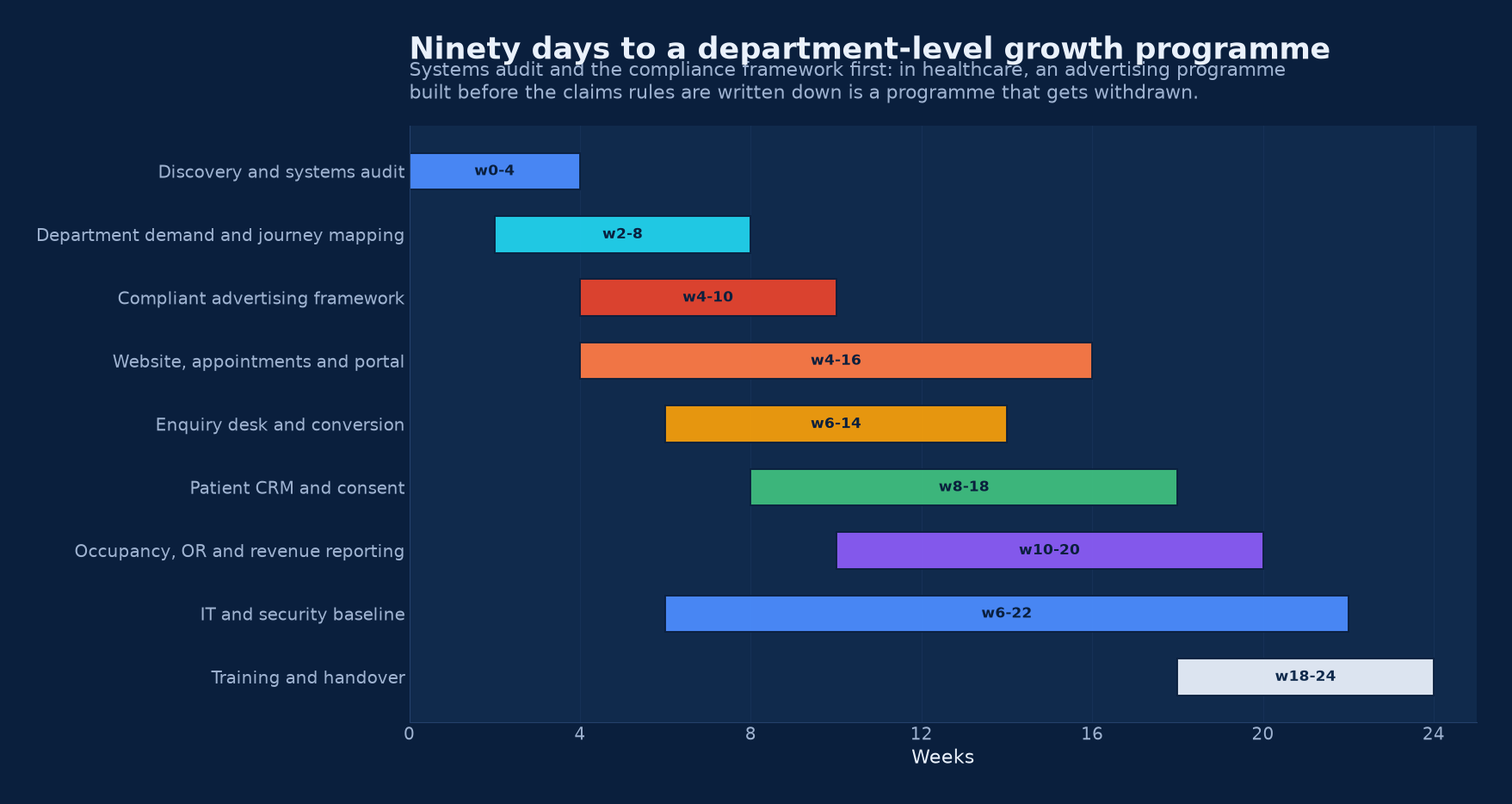
Chart values are an illustrative planning model based on typical UMC engagements and published industry benchmarks. They are not a guarantee of results on any specific project.
Weeks one to four are discovery: the systems audit, the department demand and contribution model, the journey map from search to follow-up, and the claims framework drafted with the medical director. Department demand mapping continues to week eight. The compliant advertising framework is signed off by week ten, and no paid media runs before it is. Website, appointment and portal work runs weeks four to sixteen. The enquiry desk – routing rules, disposition codes, response targets – lands by week fourteen. Patient CRM and consent build from week eight. Occupancy, theatre and contribution reporting is live by week twenty, the IT and security baseline by week twenty-two, and training and handover close the programme.
| Deliverable | Week | What the hospital keeps |
|---|---|---|
| Systems audit and data verdict | 4 | What can and cannot be exported, with options |
| Department demand and contribution model | 8 | The model finance and clinical both use |
| Claims register and approval process | 10 | What may be said, by whom approved |
| Journey map with stage owners | 8 | Who owns each leak in the funnel |
| Department, condition and consultant pages | 16 | A site that can be found and booked |
| Enquiry desk design | 14 | Routing rules, disposition codes, response targets |
| Patient CRM and consent base | 18 | Identity rules, consent register, recall journeys |
| Occupancy, OR and contribution reporting | 20 | Dashboards on a published dictionary |
| IT and security baseline | 22 | Asset register, monitoring, evidence pack |
| Training and handover | 24 | Runbooks, recordings, named owners |
Pricing and engagement models
| Model | Best for | What it includes | Commercial shape |
|---|---|---|---|
| Assessment only | A board that needs the truth before spending | Systems audit, department model, journey map, claims framework draft | Fixed fee, three to four weeks |
| Programme build | A hospital or group fixing several workstreams | Site, content, desk, CRM, reporting, IT baseline, training | Fixed fee by workstream, ninety-day core |
| Managed retainer | An institution that wants it run | Media, content, profile upkeep, reporting, IT support hours | Monthly, agreed scope, quarterly review |
| Fractional leadership | A group between hires | Marketing, IT or operations leadership part-time with the programme attached | Monthly, time-boxed with a handover plan |
Every model separates the assessment from the build so a hospital can stop after the verdict and keep the work. Where the underlying problem is financial rather than commercial, we say so and route the engagement to cash flow and working capital recovery or cost rationalisation and margin recovery instead of selling campaigns.
Compliance, consent and clinical claims
This is the section that distinguishes healthcare marketing from every other sector on this site, so it is worth stating plainly: we do not run a campaign in a market whose rules we have not read. Advertising to patients, referral inducements, outcome claims, patient testimonials, before-and-after imagery, price advertising, data residency and cross-border transfer all have market-specific constraints, and platform health policies add another layer on top.
| Area | What we do | Who signs it off | Evidence kept |
|---|---|---|---|
| Advertising claims | Claims register with permitted, qualified and prohibited | Medical director | Register version and approval date |
| Consent and lawful basis | Purpose-specific capture with date and channel | Named data owner | Consent register and retention schedule |
| Patient data | Minimisation, access control, residency per market | IT and data owner | Access reviews, residency statement |
| Referral relationships | No inducement; educational and process value only | Compliance or legal | Referral programme documentation |
| Pricing communication | Inclusions, exclusions and validity stated | Finance | Published estimate templates |
| Content review | Clinical review with a named reviewer and a review date | Clinical reviewer | Review log per page |
| Complaints and reputation | Response process that respects confidentiality | Patient relations | Response log without patient detail |
The same framework governs anything automated: AI governance, risk and compliance and IT audit and compliance readiness are run together with the marketing workstream rather than after it.
How we measure success
| Outcome | Metric | Baseline source | Review cadence |
|---|---|---|---|
| More attended appointments | Attended appointments by department and source | Scheduling and desk records | Weekly during build |
| Better department mix | Contribution and volume per speciality | Finance and HIS | Monthly |
| Fewer lost enquiries | Enquiry-to-booking and no-show rates | Desk dispositions and scheduling | Weekly |
| Stronger local presence | Condition visibility, profile actions, review trend | Search and profile data | Monthly |
| Continuity of care | Recall and follow-up completion | CRM and clinical records | Monthly |
| Reliable systems | Downtime minutes, response times met, restore test results | Monitoring and ticket log | Monthly |
| Audit readiness | Baseline controls evidenced, gaps closed | Audit checklist | Quarterly |
| Honest spend | Cost per attended appointment, marketing per net revenue | Finance and campaign data | Quarterly |
We publish the misses. A hospital scorecard that reports only improvements is a document nobody reads, and the departments that cooperate with a growth programme are the ones that can see its weaknesses.
Proof: healthcare work we have delivered
Our published healthcare engagements span large hospital groups, international patient programmes and healthcare businesses in several markets.
Related Services
Healthcare case studies:
- Apollo Hospitals – digital engagement
- Medicity Hospitals – digital engagement
- Global Hospitals – digital engagement
- Medical tourism company – international patient programme
- A renowned medical company in Africa
Where confidentiality applies – and in healthcare it usually does – we share the method, the numbers and the constraints under a non-disclosure agreement rather than publishing the institution.
Every capability a hospital can draw on, by family
| Family | Capabilities | Typical hospital use |
|---|---|---|
| Demand capture | local SEO, SEO, AI search optimisation, content marketing | Condition and department visibility, consultant profiles, clinical content |
| Paid media | Google Ads, local campaigns, Performance Max, Meta, YouTube, media planning | Department-level demand inside the claims framework |
| Brand and content | brand performance and creative production, social media management | Health education, recruitment, community presence |
| Build | website development, patient portals, UX and UI, accessibility, performance, apps, maintenance | Department sites, booking, portals, accessible experiences |
| Patient data | CRM development and integration, lifecycle campaigns, WhatsApp, SMS, email, automation | Consent, recall, follow-up, reminders |
| Intelligence | dashboards, forecasting, referral and corporate pipelines, warehouse and lakehouse | Occupancy, theatres, contribution, payer mix |
| Consulting | strategy, market research, expansion, cost and margin, cash flow, unified management | Service-line planning, new site cases, turnaround |
| Infrastructure | managed IT, helpdesk, networks, cybersecurity, backup and DR, audit, cloud | HIS uptime, segmentation, evidence packs |
| Artificial intelligence | readiness, agents, integration, governance, enablement, ROI | Administrative copilots, forecasting, coding and denial patterns |
Smaller providers, and where to go instead
A hospital is not the only healthcare organisation, and the right page depends on the size of the provider. Day clinics, specialist practices, diagnostic centres and independent consultants have different journeys, different capacity constraints and different compliance exposure – and a programme designed for a tertiary hospital will overwhelm a single-doctor practice.
Related industry verticals
Healthcare is covered across three of the nine verticals: hospitals, clinics and diagnostic centres, and doctors and medical practitioners, with pharmaceutical and life sciences work alongside. The other verticals share the same method – regulated or not – because the operating discipline is what produces the result.
Frequently asked questions about hospital marketing, data and IT
Can you guarantee more patients?
No, and nobody credible can. We commit to a measured programme: department-level demand, enquiry-to-attendance conversion, and cost per attended appointment, reported with the misses included.
How do you handle clinical claims in advertising?
With a written claims register approved by your medical director before any campaign runs, plus a review step in the content process. Restricted claims such as outcomes, testimonials and before-and-after imagery are excluded in markets that prohibit them.
Our HIS vendor will not give us data. What then?
Then the assessment reports it as a blocker with three options: negotiate access, use a scheduled export, or build reporting above the HIS from what is available. We do not build a programme on data we cannot reach.
Do you work with public and trust hospitals?
Yes. The compliance framework tightens rather than loosens: procurement rules, referral inducement prohibitions and public-sector advertising constraints are handled explicitly.
What about patient consent for marketing?
Purpose-specific, dated, withdrawable consent captured at a real touchpoint, with suppression for bereavement, complaints and clinical objection. No blanket tick boxes.
Can you improve our appointment no-show rate?
Usually yes, and it is mostly operational: reminder timing and channel, preparation instructions, rescheduling without friction, and deposit or confirmation rules where the market allows.
How do you measure marketing when patients arrive by referral?
Referral sources are recorded and attributed to the coordinator who handled them, and referral-doctor relationships are managed as a pipeline with its own reporting.
Is a patient portal worth building?
Only if something routes patients to it. A portal promoted at booking, discharge and every result reduces desk load measurably; a portal nobody mentions is an expense.
Do you support medical tourism programmes?
Yes – enquiry handling across time zones, medical file review process, estimate templates finance will stand behind, logistics, and follow-up after the patient goes home.
What IT security standard should we meet?
Whichever your accreditation, insurer or regulator asks for. We map controls to that standard and produce the evidence pack, rather than selling a generic checklist.
Can AI help our clinicians directly?
For administrative load, yes, with a clinician signing off every output. For diagnosis or triage, not without regulatory clearance and governance – and we would say so in the assessment.
How do multi-site groups avoid inconsistent marketing?
Central claims framework, brand system, reporting definitions and consent policy; local site pages, capacity and community execution. One governance document with market appendices.
Do you work outside India?
Yes. Programmes are delivered remotely and written geography-neutral, with market rules on advertising, consent, data residency and referral handled inside the engagement.
Start with the systems audit and the department contribution model
Give us four weeks with your HIS exports, your finance detail and your medical director, and we will return the department demand and contribution model, the journey map with named owners, the claims framework and a written verdict including what we would not start with – yours to keep either way.
Contact Unified Management Consulting to arrange a confidential first conversation.