
Every hotel already owns the most valuable marketing asset in its market and almost none of them can see it: the list of guests who stayed, what they bought, when they come back and what made them choose the property in the first place. It sits fragmented across the PMS, the booking engine, the POS, the spa book, the Wi-Fi portal and a spreadsheet of wedding enquiries. A hotel CRM is the discipline of unifying that data lawfully, recognising a guest across stays and channels, and running the conversations that turn one stay into five: the pre-stay upsell that lifts the booking value, the in-stay moment that earns the review, the post-stay thank-you that seeds the return, and the win-back that reaches a lapsed guest nine months later at a tenth of the cost of acquiring a stranger.
We design and build hotel CRM and loyalty programmes remotely: a consent map before a single journey, integration against your PMS, POS and booking engine, guest-profile unification with honest identity rules for OTA stays, segments that reflect how guests actually behave, journeys with owners and suppression logic, and a measurement view where repeat rate and lifetime value sit next to the acquisition numbers the board already reads. This page is the depth page for retention; acquisition lives on our paid media page, organic page and social page, and the vertical overview is the hotels and hospitality main page.
What hotel CRM and loyalty covers, at a glance
| Component | What We Deliver |
|---|---|
| Consent map and privacy review | What you may contact each guest about, by market and by source, before any journey exists. |
| Guest profile unification | One guest across PMS, booking engine, POS and outlets, with honest rules for OTA-sourced stays. |
| Segments that behave | By purpose, cadence, value and recency – not by room type. |
| Lifecycle journeys | Pre-stay upsell, pre-arrival information, in-stay moments, post-stay review and return, lapsed win-back. |
| Loyalty or benefit design | Points, tiers or benefits – chosen on your economics, not on an airline’s. |
| Direct-booking loop | Member rates and CRM audiences feeding metasearch and search so retention lowers acquisition cost. |
| Outlet and event flows | Restaurant, spa and wedding pipelines with their own cadences. |
| Retention measurement | Repeat rate, repeat-direct share, lifetime value and LTV:CAC, reconciled to the engine. |
What hoteliers ask a CRM to fix
The requests that start a CRM engagement are rarely about software. They are about memory: the property does not remember its guests, so every stay starts from zero and every booking is bought again at full acquisition cost.
| What we hear | The real problem | The workstream that answers it |
|---|---|---|
| “Our repeat rate is falling” | Nobody owns the conversation between stays | Lifecycle journeys with owners and a calendar |
| “We email everyone the same offer” | No segments, no suppression, one list | Behavioural segments plus suppression rules |
| “OTAs own our returning guests” | Returning guests re-book through the intermediary that last touched them | Direct-booking loop with member rates and CRM audiences |
| “The spa and restaurant don’t know a guest is in-house” | No shared profile across outlets | POS and PMS integration with in-stay flags |
| “We bought a CRM and it sits empty” | No data plan, no consent map, no owner | Integration and governance before journeys |
| “Legal says we cannot email old guests” | Consent unknown by source and market | Consent map and re-permission campaign, then suppression |
Note the pattern: five of the six are data and governance problems wearing a software costume. That is why our sequence starts with the consent map and the integration, not with the journey builder.
The data you already own, and what you may do with it
A hotel generates guest data at every touchpoint, and the first deliverable of a CRM programme is an inventory of it with a lawful basis and a permitted use against each source. Some of it is contractual – the booking record – some is consented – the newsletter checkbox – some is legitimate interest with an opt-out – the post-stay review request in most markets – and some you should simply not keep, like the passport scan nobody deleted.
| Source | Data it yields | Typical lawful basis | Permitted use |
|---|---|---|---|
| Booking engine and PMS | Stay history, value, lead time, party size, source channel | Contract plus legitimate interest | Service messages, stay-relevant offers, analytics |
| POS and outlets | Spend by outlet, preferences, dietary notes | Contract for the bill; consent for marketing | Outlet offers with consent; service notes in-stay |
| Wi-Fi portal and app | Device presence, dwell, return visits | Consent at login | In-stay convenience, not covert profiling |
| Newsletter and forms | Explicit interests, event enquiries | Consent | What the consent says, nothing wider |
| OTA reservations | A stay with a masked guest and no contact rights | None for marketing | Aggregate analytics only; never marketing contact |
| Reviews and social | Sentiment, public preferences | Public interest / legitimate | Service recovery and content, not profiles for sale |
The OTA row is the one that surprises management: a Booking.com stay is a revenue line, not a marketing contact, and any programme that emails those addresses is buying a fine with a newsletter. The consent map states this in writing, per market, and the suppression logic enforces it.
One guest, many records: identity resolution with honest rules
Guest profiles fragment fast: a booking under a work email, a spa appointment under a mobile number, a wedding enquiry under a partner’s name, a return stay through an OTA with no contact at all. Unification matches on the strongest available keys – email, then mobile, then name plus stay dates – and records the confidence of each merge, because a wrong merge is worse than a duplicate: it sends the anniversary offer to the wrong marriage.
- Match hierarchy: email, mobile, then name plus overlapping stay window
- Confidence score on every merge; low-confidence pairs queue for human review
- Golden record rules: which source wins for contact, for preferences, for name
- Dedupe cadence monthly, with an audit trail of every merge and split
- OTA stays attach as anonymous stay history when a later direct stay identifies the guest
- Right-to-erasure path that finds every copy, including the export someone saved
The engineering is our custom CRM development practice where a platform cannot hold the model, and configuration where it can; either way the rules above are written down before the first merge runs.
The economics of the second stay
The entire business case for hotel CRM fits in one comparison: what a guest is worth in year one, and what the same guest is worth in years two to four once the property remembers them. Revenue per guest rises with stay count – familiar guests book better rooms, eat in the outlets, skip the comparison shopping – while the cost to bring the stay about collapses, because a win-back message costs a fraction of a metasearch click and nothing at all like an OTA commission.
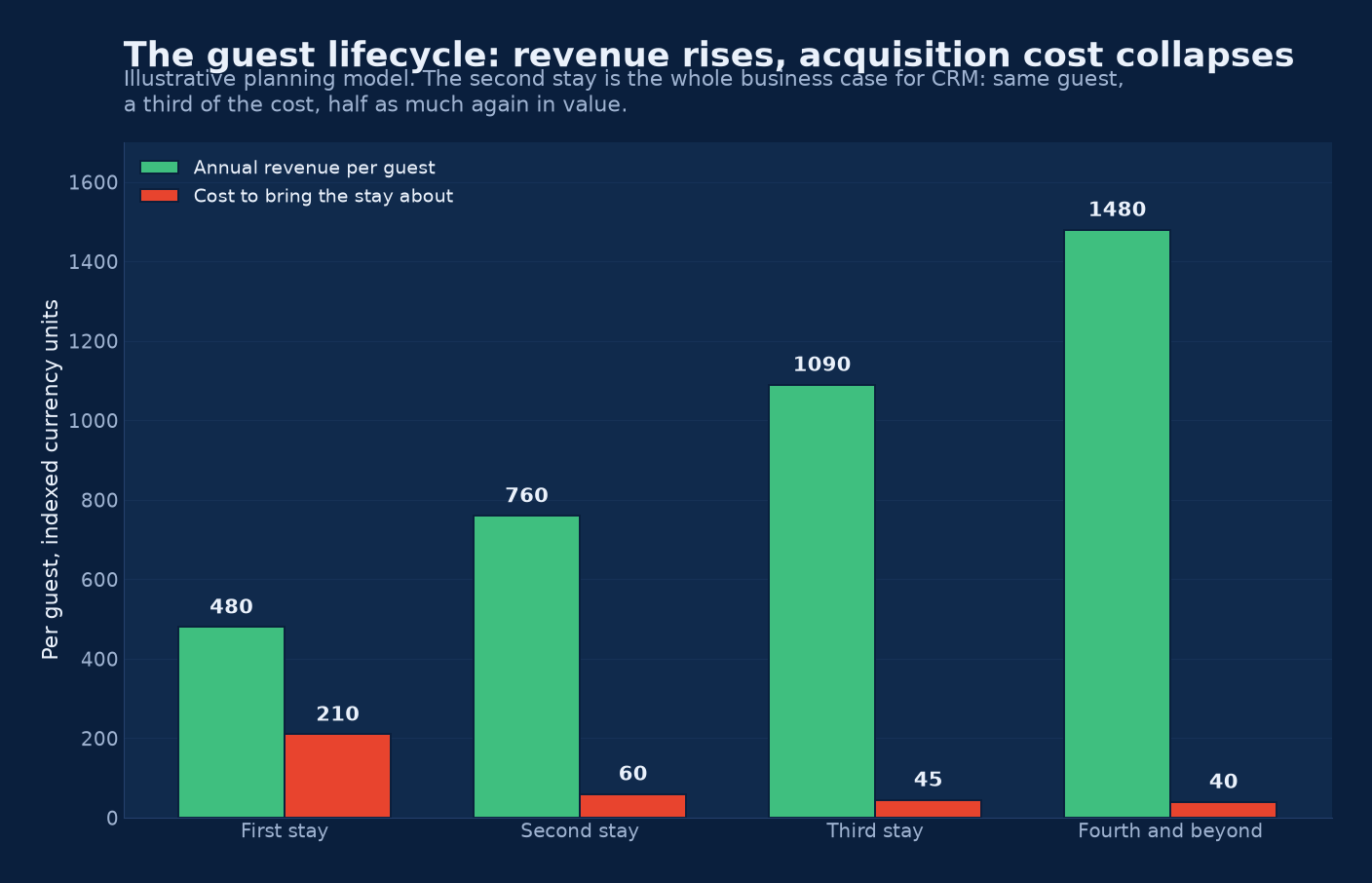
Chart values are an illustrative planning model based on typical UMC engagements and published industry benchmarks. They are not a guarantee of results on any specific project.
| Cohort | Behaviour that defines it | What it is worth | What it needs |
|---|---|---|---|
| One-stay guests | Stayed once, no return within 18 months | The largest cohort and the largest leak | A win-back reason, not a discount reflex |
| Returners | Two to three stays, self-initiated | Stable value, low cost | Recognition and small privileges |
| Loyalists | Four-plus stays or high annual value | Disproportionate revenue and referrals | Real benefits and a human who knows them |
| Outlet-only locals | Restaurant or spa regulars, never a room | The room-night opportunity hiding in the POS | A first-stay reason tied to what they love |
| Event households | Wedding or anniversary once, potentially again | Long cycle, high value | Anniversary memory and a gentle annual touch |
Segmentation by behaviour like this outperforms segmentation by demographics every time we have tested it, because behaviour is what a journey can act on.
The five journeys that pay for the programme
A hotel CRM does not need forty automations; it needs five that run flawlessly, each with an owner, a suppression list and a number it is judged on. Everything else is added once these prove themselves on your data.
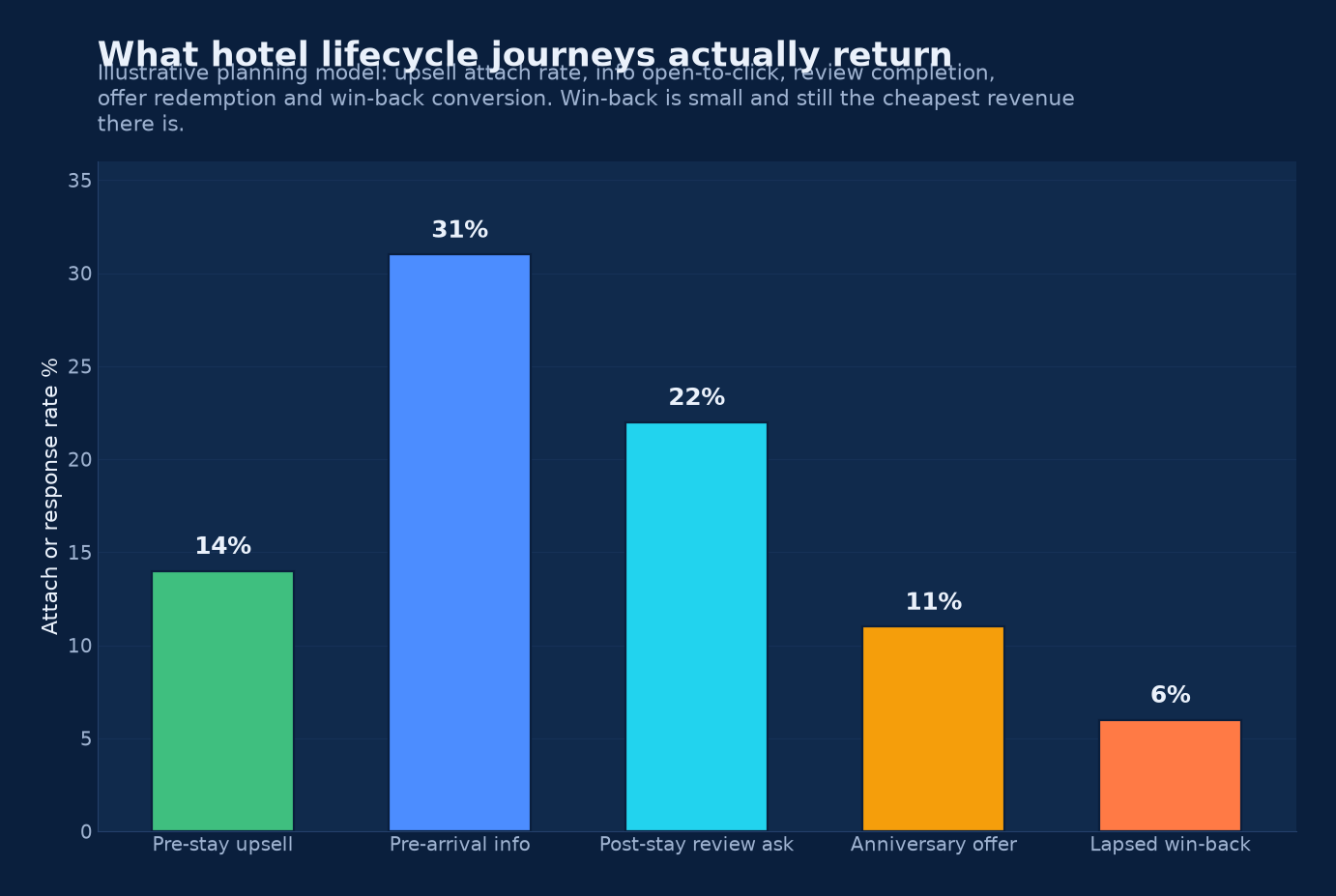
Chart values are an illustrative planning model based on typical UMC engagements and published industry benchmarks. They are not a guarantee of results on any specific project.
| Journey | Trigger | Message | Judged on |
|---|---|---|---|
| Pre-stay upsell | 7-10 days before arrival | Room upgrade, early check-in, spa slot, dinner reservation – priced, not teased | Attach rate and uplift per booking |
| Pre-arrival information | 48 hours before arrival | How to get here, park, check in; what is open; one human contact | Service-load reduction and review mentions |
| In-stay moment | Day two of a stay of three-plus nights | Outlet invitation matched to observed preferences, with consent | Outlet revenue per in-house guest |
| Post-stay review and return | Day two after departure | Thank-you, review request, and a reason to return inside the guest’s own season | Review volume and 12-month return rate |
| Lapsed win-back | 11-14 months after last stay, timed to their season | What changed since they were last here, plus a member rate | Win-back conversion and cost per recovered stay |
The discipline is in the details: suppression of in-house guests from marketing blasts, frequency caps across journeys so a guest never gets three messages in a week, and a hard rule that a journey which cannot name its owner and its number does not ship. Each journey spec also names the messages it will never send: the upsell to a guest in service recovery, the review request after a compensated failure, the win-back to a guest who left over an unresolved complaint. Suppression is not a filter applied at the end of the build; it is half of the design, and it is tested with the journey rather than after it.
Loyalty: points, tiers or benefits – chosen on your economics
Most independent hotels should not build a points programme. Points are a liability on the balance sheet, a currency to defend, and a promise that a thirty-room property cannot keep against a chain’s network. What independents can win with is recognition and benefits: a member rate that undercuts the OTA legally, late checkout and room preference that cost almost nothing and read as care, a standing preference record that makes the second stay feel like coming back rather than checking in, and outlet privileges that use capacity the property already has.
| Model | Fits | Cost shape | Risk |
|---|---|---|---|
| Points currency | Chains and large groups with network effects | Liability accrues per point; actuarial management | Devaluation anger, breakage gaming |
| Tiers by stays or value | Groups of five-plus properties | Benefit cost per tier member | Tier inflation, middle-tier churn |
| Benefits and recognition | Independents and small groups | Marginal cost of unused capacity | Being copied; needs consistency to mean something |
| Paid membership | Resorts with genuine club facilities | Revenue up front, service obligation after | Refund and expectation management |
Whichever model wins, the member rate is the hinge of the direct-booking loop: a rate the OTA cannot display, offered in exchange for the relationship, promoted in metasearch as a closed user group where the platform allows it, and reconciled in the paid media report so acquisition and retention stop arguing about whose guest it was.
Privacy, consent and the re-permission campaign
Hotel guest data crosses more borders than the guests do: a German business traveller, an Indian wedding party, a US newsletter signup, all in one table. The programme therefore starts with a consent map by market and source, states the retention period per data class, and where the historical list has no usable consent it runs a re-permission campaign – one honest email or SMS asking to stay in touch, with silence treated as no – before suppression removes the rest. Losing forty percent of a list this way is not a loss; it is the difference between a database and a liability, and the remaining sixty percent convert better than the whole ever did.
Build or configure: choosing the stack
There are three honest options and one dishonest one. Configure a hospitality CRM platform when your model fits its objects – stays, profiles, journeys – and its integrations cover your PMS. Build custom when your group’s model is genuinely different: multi-brand wallets, outlet-heavy loyalty, or data residency rules a platform cannot meet. Hybrid when the platform holds profiles and journeys but a warehouse holds the truth and the reporting. The dishonest option is a generic marketing automation tool with a hotel bolted on, where stays are shoehorned into deal objects and every report needs a translator.
| Option | Choose when | Watch-outs |
|---|---|---|
| Hospitality CRM platform | Model fits stays and journeys; PMS connector exists | Connector depth: can it read folio lines, not just reservations |
| Custom build | Multi-brand, outlet-heavy or residency-constrained models | Own the roadmap: who maintains it in year three |
| Hybrid with warehouse | Reporting truth matters more than tool convenience | Two sources of truth need one reconciliation owner |
| Generic automation tool | Almost never for stays; fine for event pipelines | Object-model mismatch shows up in every report |
The channels underneath – email, WhatsApp, SMS – are chosen per market and per consent, and the orchestration layer is our marketing automation practice where HubSpot or Marketo is the right home, with the lifecycle and retention practice owning the journey design.
Sixteen weeks to a CRM that is allowed to email people
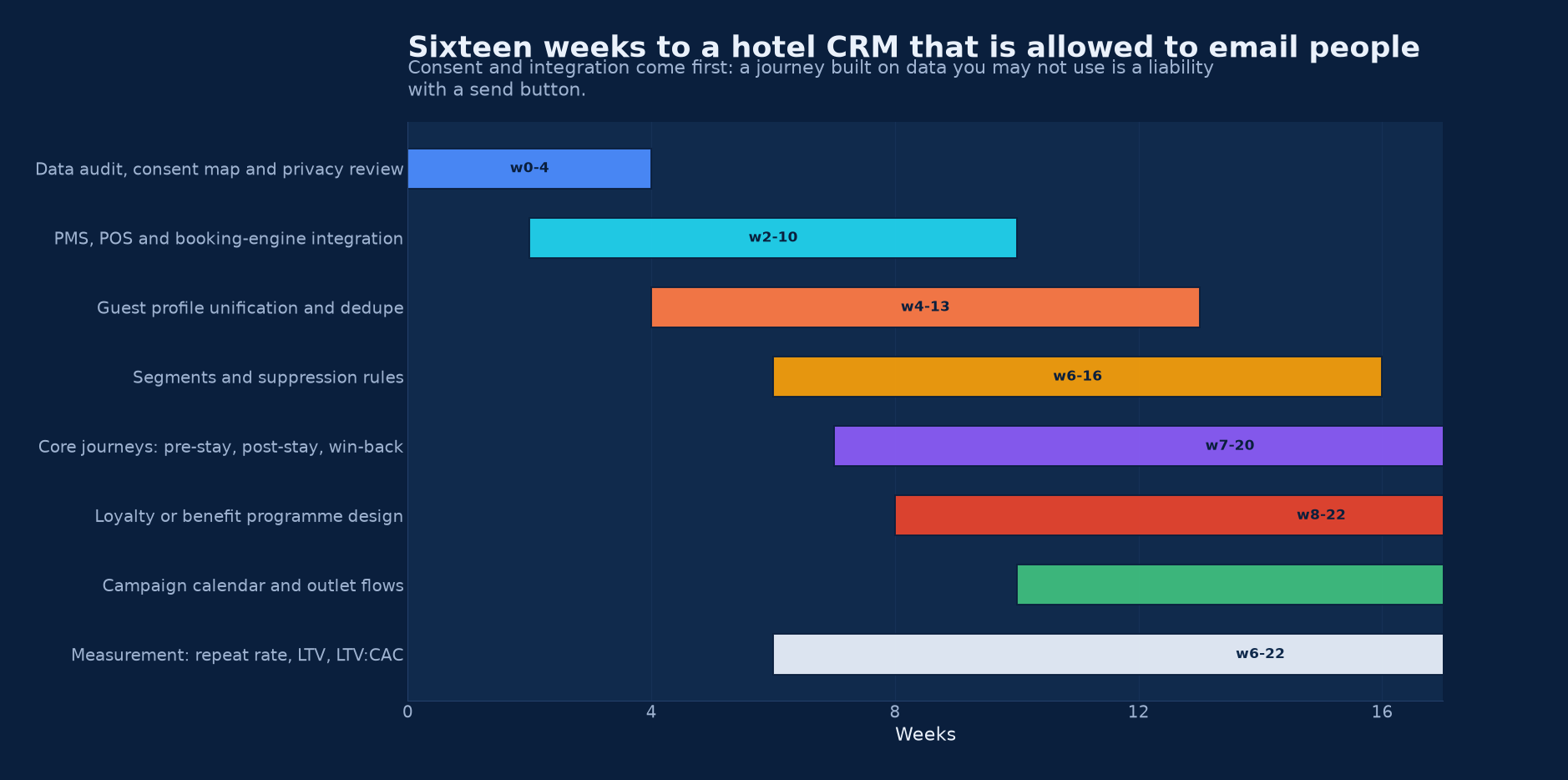
Chart values are an illustrative planning model based on typical UMC engagements and published industry benchmarks. They are not a guarantee of results on any specific project.
Weeks one to four are the consent map, privacy review and data inventory – unglamorous, decisive. Integration runs weeks two to eight against PMS, POS and the booking engine, with profile unification and dedupe following as the data lands. Segments and suppression rules are written before the first journey, because a journey without suppression is a complaint factory. The five core journeys ship from week seven in pairs, each with its owner and its number; loyalty design runs in parallel so the member rate exists when the win-back wave goes out; and the campaign calendar including outlet flows completes the quarter.
| Deliverable | Week | Evidence you receive |
|---|---|---|
| Consent map and retention schedule | 4 | Written map by market and source, signed off |
| PMS, POS, engine integration | 8 | Field-level data dictionary and test records |
| Unified profiles with merge audit | 9 | Merge log plus duplicate-rate report |
| Segments and suppression rules | 10 | Segment definitions with counts and owners |
| Five core journeys live | 13 | Journey specs, owners, numbers and first-run results |
| Loyalty or benefit model live | 14 | Member rate logic and parity-compliance note |
| Campaign calendar with outlets | 16 | Twelve-month calendar with owners per line |
| Retention measurement view | 16 | Repeat rate, LTV and LTV:CAC against baseline |
Measurement: repeat rate, LTV and the argument it ends
Retention reporting lives or dies on three numbers and one ratio: repeat rate within eighteen months, repeat-direct share (returning guests who book direct rather than through an intermediary), lifetime value by cohort, and LTV against blended acquisition cost. The ratio is the argument-ender: when the board sees that a recovered lapsed guest costs an eighth of a new one, budget follows without a presentation.
| Measure | Definition | Source | Cadence |
|---|---|---|---|
| Repeat rate 18m | Guests with a second stay inside eighteen months | PMS unified profiles | Monthly |
| Repeat-direct share | Returning guests whose second stay booked direct | PMS plus channel tags | Monthly |
| Lifetime value by cohort | Margin contribution over observed stays, modelled forward | Warehouse plus engine | Quarterly |
| LTV:CAC | Cohort LTV against blended acquisition cost | Finance plus the paid report | Quarterly |
| Journey numbers | Attach, response, redemption and win-back rates | CRM platform | Weekly trend, monthly report |
| List health | Deliverability, consent coverage, suppression volume | CRM plus ESP | Monthly |
These join the acquisition numbers in one executive view through our BI dashboards practice, because a board that sees acquisition and retention on separate pages will always overfund the louder one. The view also carries the cohort table behind the ratio, so a question raised in the room – which cohort is dragging, which market repeats, which outlet converts locals into room nights – is answered in the same meeting rather than by a follow-up report. Where a group operates several properties, the view separates property-level repeat rate from group-level wallet share, because a guest who alternates between your properties is retained even though each general manager sees a stranger.
Outlets, weddings and the local guest
A resort’s CRM that only knows room nights is blind to half its value: the local who dines monthly, the spa regular, the wedding couple whose anniversary returns them every year. Outlet flows run on POS consent with their own cadence – menus, seasons, events – and the wedding pipeline lives in the same CRM as a long-cycle record with touchpoints measured in years, not days. The local guest is also the bridge to local search: the outlet programme and the map-pack work in our hotel SEO page feed each other, because a local who follows the restaurant today is a room-night advocate when family visits. The measurement view keeps outlet revenue attached to the guest record, so a local diner who later books a room for visiting relatives is recognised as one relationship, not two accidents.
What a hotel CRM is not
Three misconceptions waste more hotel CRM budget than any technical failure. First, it is not an email tool: a platform bought to send newsletters produces newsletters, and newsletters do not move repeat rate. Second, it is not a database project with a launch date: guest data decays every week it is not governed, so a CRM is an operating discipline with an owner, a calendar and a suppression list, or it is a graveyard of automations nobody dares delete. Third, it is not personalisation theatre – inserting a first name into an offer the guest has no reason to want is not personalisation, it is familiarity without memory, and guests read it as such. Real personalisation in hospitality is small and operational: the room away from the lift because last time they asked, the almond milk at breakfast because the folio says so, the anniversary recognised without being sold to. The technology exists to make those small things reliable at scale, and the programme should be judged on whether they happen, not on how many journeys are switched on.
Corporate accounts, groups and the B2B pipeline inside the CRM
Leisure retention gets the attention, but for city and airport hotels the retention that moves the P&L is corporate: the company whose consultants sleep forty room-nights a quarter, the airline crew block, the training provider that books the same meeting room monthly. Those relationships live in sales spreadsheets today, renewed by memory and lost to a competitor’s lunch. In the CRM they become records with contracts, rate codes, consumption against commitment, renewal dates and named owners, with alerts that fire before the renewal window, not after the volume stops.
| Record type | What it carries | Alert that matters |
|---|---|---|
| Corporate account | Contract rate, commitment, consumption, booking pattern | Consumption below pace at half-term; renewal in 60 days |
| Group or crew block | Allotment, release dates, cancellation terms | Release date approaching with unsold allotment |
| Travel manager relationship | Contacts, preferences, review cadence | No contact in 90 days on an active account |
| Event agency | Historic events, margins, service notes | Season planning window opening without a proposal |
The same platform, different objects: leisure journeys speak to guests, sales flows speak to buyers, and the measurement view keeps the two revenue streams separate so neither borrows the other’s credit.
Service recovery: the journey that fires when something went wrong
The most valuable automated message a hotel CRM sends is not an offer; it is the recovery flow. A folio flag, a complaint logged at the desk or a low in-stay survey score triggers a sequence with a human in it: an apology from a named manager within hours, a remedy chosen from a pre-approved menu – not an improvised voucher – and a follow-up after departure that asks whether the fix landed before it asks for anything else. Guests who experience a failure and a good recovery return at higher rates than guests who never had a problem, which is the oldest finding in hospitality research and still the most ignored. The flow suppresses all marketing for ninety days, because nothing destroys goodwill faster than a discount offer arriving between a complaint and its resolution, and it records the failure type so operations sees the pattern the front desk already knows. Nothing in this flow is automated beyond the trigger and the suppression: the words come from a named manager, because an apology from a workflow is not an apology.
Proof and related capability
CRM and lifecycle programmes we have delivered span custom CRM builds and automation deployments across hospitality and services; in hotels the resort-group engagement pairs the retention layer with the paid programme so that member rates and metasearch pull in one direction.
Related Services
The practices this programme draws on:
Where this page sits in our hotel programme
This spoke covers retention and loyalty. The vertical’s other intents each have their own page, and the hub ties them together:
- Hotels and hospitality – the vertical main page
- Website development for hotels – the booking path retention feeds
- SEO for hotels – the earned search side of the same guest
- Google Ads for hotels – acquisition costs that retention lowers
- Social media marketing for hotels – where locals and returners live
- Hotel business intelligence – dashboards, pace and forecasting above PMS and POS
- IT support for hotels – managed IT, networks and guest Wi-Fi
- AI for hotels – guest copilots, forecasting and governance
- Digital marketing company for hotels in Lucknow – the local-intent page
If your property trades in Lucknow or elsewhere in India, the local page carries the regional detail; this page carries the programme.
Frequently asked questions about hotel CRM and loyalty
We have no CRM today. Where do we start?
With the consent map and a PMS export, not with software. The first four weeks tell you what you own, what you may use, and which platform – if any – fits the model.
Can we market to guests who booked through OTAs?
Not from the OTA record. You may invite them to a direct relationship at stay time – a check-in message, a Wi-Fi login, a review thank-you – and market only to those who consent.
Should an independent hotel run a points programme?
Usually no. Points are a balance-sheet liability and a chain-scale promise. Benefits and recognition win for independents at a fraction of the cost and risk.
How do we stop guests getting too many messages?
A global frequency cap across every journey and channel, enforced in the platform, plus suppression rules per journey. The cap is written in the governance document, not left to judgement.
What repeat rate is good?
It varies by property type: city corporate hotels naturally out-repeat resorts. The useful comparison is your own trend after the programme, against the baseline we take in week six.
How long until retention shows in revenue?
Pre-stay upsell lifts value in the first month; repeat-rate movement needs two to three quarters, because stay cycles are seasonal.
Our PMS is old. Is that fatal?
Rarely. If it exports reservations and folios on a schedule, integration is possible; the proposal states the latency honestly – nightly versus real-time – and prices accordingly.
Who owns the CRM internally?
A named owner with authority over segments and calendar, usually marketing with reservations as deputy. A CRM without an owner becomes a spam tool within two quarters.
Do you handle data residency requirements?
Yes – region-pinned storage, processing maps and retention schedules per market, designed with your counsel rather than around them.
Can WhatsApp replace email for our market?
In many markets it outperforms email on open rates, and underperforms on record-keeping and consent evidence. We choose per market and keep both where consent allows.
What about guests who ask to be forgotten?
A documented erasure path that finds every copy – CRM, ESP, exports, backups policy – and confirms completion. It is tested before it is needed, not during a request.
What does it cost?
A fixed-fee discovery and consent map first, then implementation priced by integration count and journey set. Platform licences are yours directly; we never mark them up.
Start with the consent map and a repeat-rate baseline
Give us a PMS export and four weeks, and we will return what your guest data is worth, what you may lawfully do with it, and the five journeys that would pay for the programme first.
Contact Unified Management Consulting to arrange a confidential first conversation.