
Google Ads for hotels is a different discipline from Google Ads for anything else, because the auction you are buying into sits inside a comparison shopper’s journey. A guest searching your property name on Google sees a metasearch price grid with your rate next to four intermediaries; a guest searching “beach resort in Crete” sees OTAs, map results and paid listings before any organic result. The disciplines that win there are metasearch and Hotel Ads with a clean rate feed, brand defence priced as insurance, non-brand search aimed at demand you can actually host, and retargeting that recovers the guests the other channels created. Everything is judged on one number: cost per confirmed booking, against the OTA commission it displaces.
We manage hotel paid media remotely and in your ad accounts: feeds built against your channel manager or PMS, conversion and value tracking reconciled to the booking engine, bidding strategies that respect your rate parity agreements, and reporting your revenue manager can act on. This page is the depth page for paid acquisition; the organic discipline lives on our hotel SEO page, the landing pages paid traffic lands on are built by our hotel website development page, and the vertical overview is the hotels and hospitality main page.
What hotel paid media covers, at a glance
| Component | What We Deliver |
|---|---|
| Metasearch and Hotel Ads | Your rates in the Google price grid and on trivago, Kayak and Skyscanner, with CPA or commission bidding. |
| Brand paid search | Defence of your own name against OTA and metasearch bidding, priced as insurance with a hard ceiling. |
| Non-brand paid search | Destination, amenity and event demand you can host, with landing pages built to convert it. |
| Retargeting | Meta and Google audiences that recover abandoned booking paths without fatiguing guests. |
| Feed and parity | Rooms, rates and availability feeds reconciled to the channel manager so ads never promise a rate the site denies. |
| Landing pages | Paid-traffic pages with the rate, the dates and the book button above the fold. |
| Bidding and seasonality | tCPA to tROAS progression with a budget calendar tied to your demand curve. |
| Measurement | Cost per confirmed booking reconciled to the engine, not last-click fantasy. |
What hoteliers ask paid media to fix
The complaints that start a paid-media engagement are rarely about ads. They are about money leaking to intermediaries and nobody knowing the true cost of a booking. Naming the complaint maps directly to a campaign family, and that mapping is the proposal.
| What we hear | The real problem | The campaign family that answers it |
|---|---|---|
| “OTAs take our brand searches” | Intermediaries bid on your name and win the click you should own | Brand defence with a cost ceiling and sitelink structure |
| “We are invisible next to Booking.com” | No presence in the metasearch price grid | Hotel Ads and metasearch partners with a clean rate feed |
| “Ads bring clicks but no bookings” | Traffic lands on a homepage, not on a rate | Landing pages with dates, rate and booking path above the fold |
| “Retargeting follows guests for weeks” | No frequency caps, no post-booking exclusions | Audience hygiene: exclusions, caps, sequential messaging |
| “We don’t know what a booking costs” | Conversion tracking not reconciled to the engine | Value tracking plus monthly reconciliation to confirmed revenue |
| “Spend runs flat through low season” | No seasonality rules | Budget calendar tied to the demand curve and lead times |
If your complaint is not on that list it is usually a variant of one; the architecture below is organised by problem, not by platform.
The only number that matters: cost per confirmed booking
Every acquisition route has a cost, and for a hotel the honest benchmark is the commission you pay an OTA for the same guest. An OTA booking typically costs fifteen to twenty-five percent of the booking value; a metasearch booking on a CPA model can cost eight to twelve; a brand search click that would have arrived anyway costs a few percent and is bought as insurance, not as growth. Once those numbers are on the table, budget allocation stops being a matter of taste.
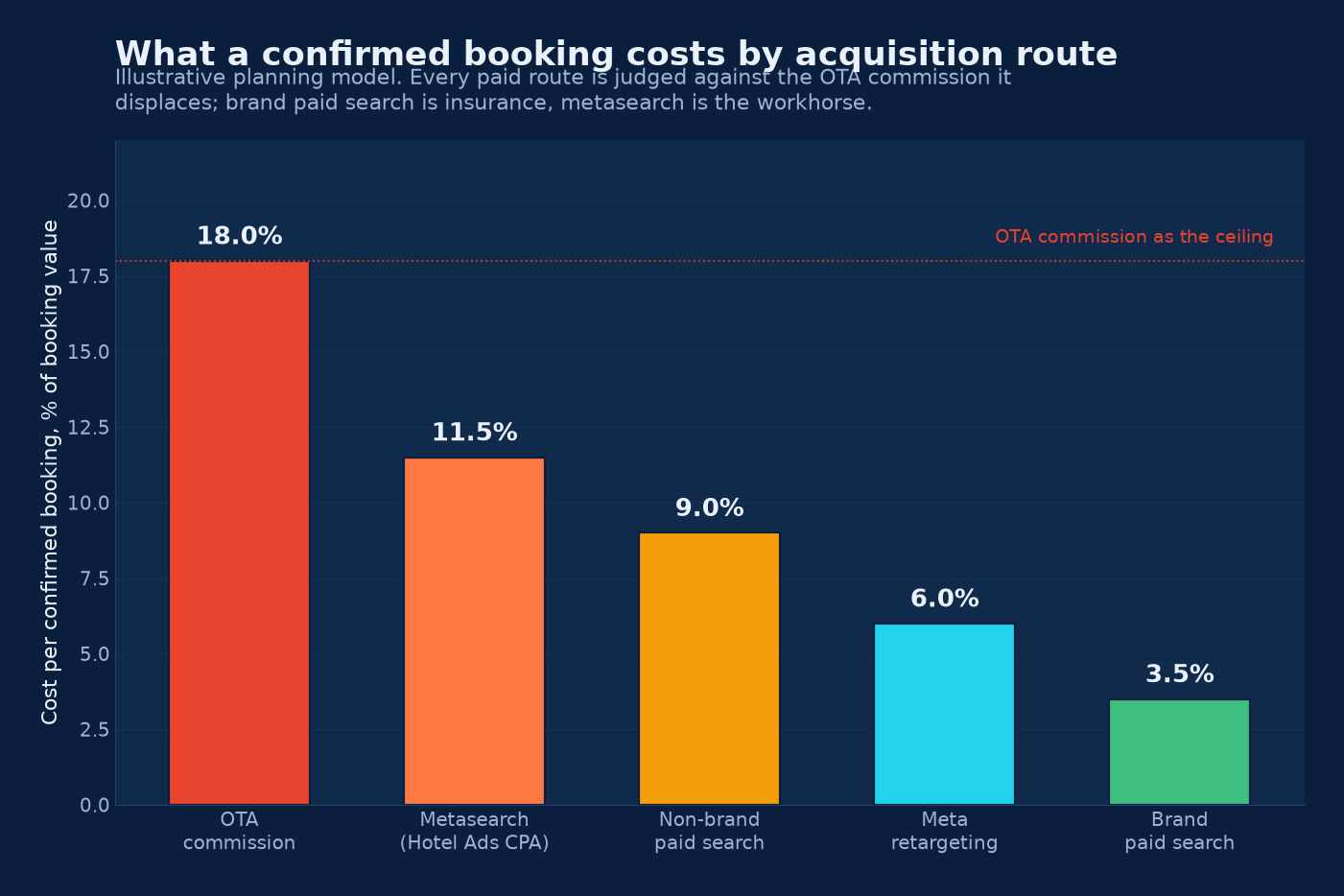
Chart values are an illustrative planning model based on typical UMC engagements and published industry benchmarks. They are not a guarantee of results on any specific project.
| Route | Typical cost per confirmed booking | Role in the mix | When to cut it |
|---|---|---|---|
| OTA distribution | 15-25% of booking value | Demand you cannot reach directly | Never fully; shrink its share |
| Metasearch / Hotel Ads | 8-12% CPA or commission | The workhorse: comparison shoppers at the moment of price truth | When feed quality degrades below parity |
| Non-brand paid search | 7-11% | Incremental destination and event demand | When landing pages cannot convert it |
| Meta retargeting | 4-8% | Recovery of demand other channels created | When frequency caps and exclusions are not enforced |
| Brand paid search | 2-5% | Insurance on your own name | Only if OTAs stop bidding on your brand, which they won’t |
We report every route against this table monthly, including the routes we recommend cutting. A paid-media programme that cannot name its worst route is not being managed.
Metasearch and Hotel Ads: the price grid is the shelf
Google’s hotel results show a price grid: your rate beside the OTAs’, with a photo, a rating and a book button. Being absent from that grid means the comparison happens without you; being present with a slower rate means paying to lose. Hotel Ads runs on a feed of rooms, rates and availability, and its quality depends almost entirely on feed hygiene and price parity – two problems that live in your channel manager, not in your ad account.
| Surface | How you appear | Bidding model | Care points |
|---|---|---|---|
| Google hotel results and Hotel Ads | Price grid plus free booking links | CPC, CPA commission or commission per stay | Feed accuracy, parity, landing speed |
| Free booking links | Organic position in the grid | No media cost | Eligibility requires a valid feed and policy compliance |
| trivago, Kayak, Skyscanner | Metasearch price lists | CPC or CPA | Market-by-market ROI; some markets are OTA-owned |
| Google Travel brand surfaces | Property knowledge panels | Earned via entity data | Consistent schema and business profiles |
The feed is the product. We build or fix the rooms-rates-availability feed against your channel manager or PMS, monitor parity continuously, and treat a parity breach as an incident because it silently doubles your effective CPA while the grid shows a rate you cannot honour. The feed discipline is the same one our shopping and Merchant Centre feed practice applies to retail catalogues, with hotel rate logic on top.
Campaign architecture: four families, four jobs
A hotel ad account that grows by accident ends up with forty campaigns and no owner. We run four families with distinct jobs and distinct budgets: metasearch for the price grid, brand defence as insurance, non-brand search for incremental demand, and retargeting for recovery. Performance Max has a place – usually as a demand-discovery layer feeding the other families – but only once conversion values are trustworthy, which is our Performance Max practice speaking, not a default setting.
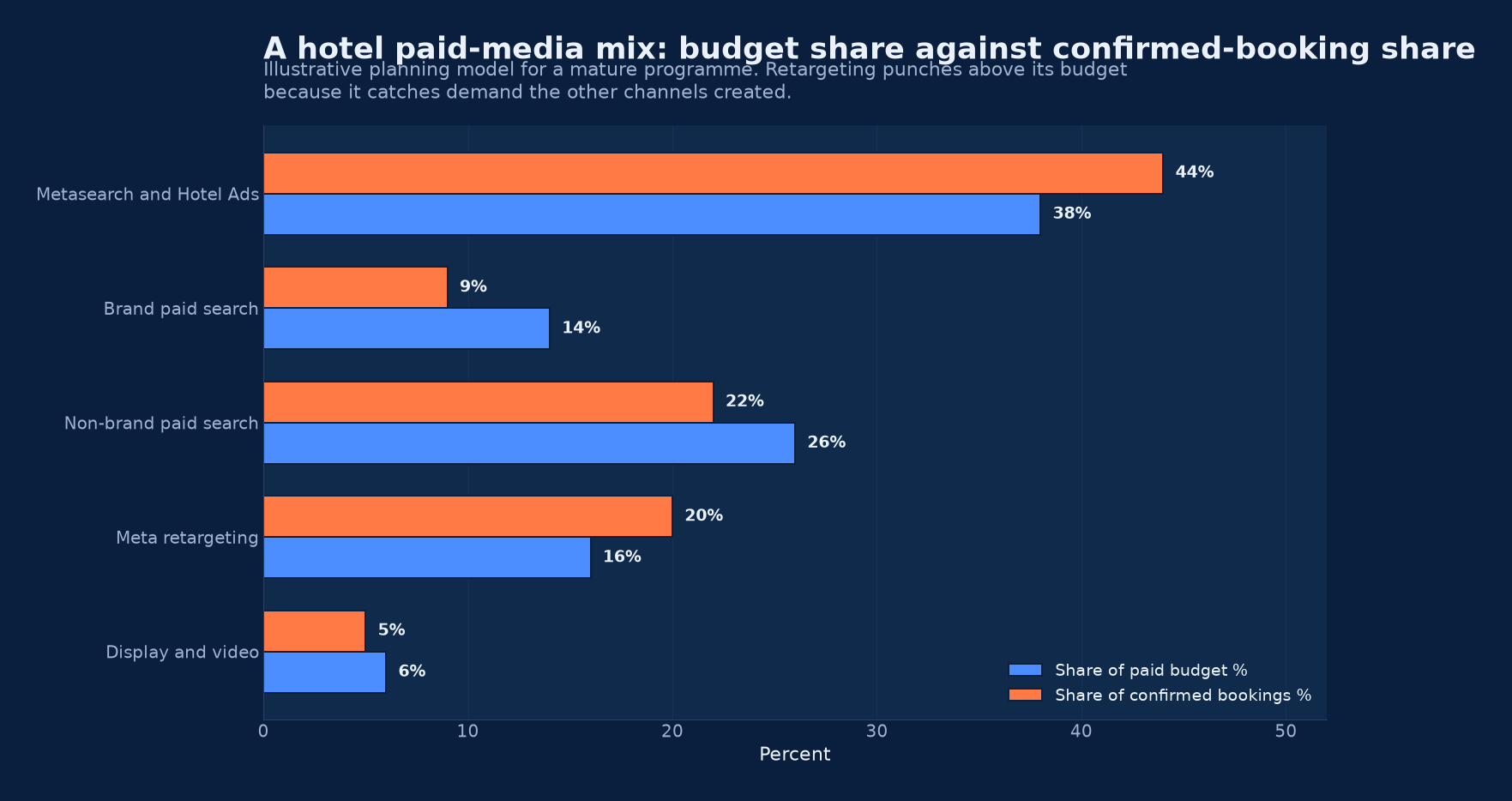
Chart values are an illustrative planning model based on typical UMC engagements and published industry benchmarks. They are not a guarantee of results on any specific project.
| Family | Job | Budget logic | Success test |
|---|---|---|---|
| Metasearch and Hotel Ads | Win the comparison at price truth | Largest share; scales with occupancy need | CPA below OTA commission at target volume |
| Brand paid search | Own your own name | Small, capped, reviewed quarterly | Incrementality: bookings that would not have come organically |
| Non-brand search | Create demand you can host | By destination and event calendar | Cost per confirmed booking and length-of-stay mix |
| Retargeting | Recover abandoned paths | Modest, with hard frequency caps | Recovery rate without fatigue complaints or post-booking waste |
Structure inside each family follows search intent, not room types: one campaign per intent and market, ad groups by query theme, negatives maintained weekly. The account should be readable by your revenue manager in five minutes, because she is the person who will act on it.
Landing pages: where paid budgets go to die
Most hotel paid-media waste is not bidding waste; it is landing-page waste. A metasearch click arrives with dates and a rate in mind and lands on a homepage with a video; a non-brand click arrives with an intent and lands on a rooms list with no prices. We specify paid landing pages as transaction surfaces: the searched dates pre-filled where the click carries them, the rate-from signal visible, the booking path one tap away, and the policy summary in one line. The build practice is our hotel website development work and the conversion discipline is our conversion rate optimisation practice; paid media without them is renting traffic for a site that cannot receive it.
- Dates and guests carried from the ad into the booking path
- Rate-from signal above the fold, labelled honestly
- One primary action per screen; navigation trimmed, not removed
- Policy and cancellation summary in one line near the book button
- Mobile-first build: most hotel paid clicks arrive on a phone in a bright street
- Load budget under 2.5 seconds LCP, or the click is bought and lost
Bidding: from tCPA to tROAS, with parity as a constraint
Bidding strategy follows data maturity. A new account with untrusted conversion tracking should not be handed to an automated strategy; it will optimise confidently towards noise. We start with manual or tCPA on verified conversions, move to tROAS once value tracking reconciles to the booking engine for two consecutive months, and keep portfolio strategies for metasearch where auction dynamics differ by market and device.
| Stage | Data required | Strategy | Exit criterion |
|---|---|---|---|
| 1. Verify | Conversion and value tracking reconciled to engine | Manual CPC or max clicks | Two months of reconciliation within tolerance |
| 2. Cost control | Stable conversion volume per campaign | tCPA by family | CPA at or below route target for six weeks |
| 3. Value optimisation | Trusted booking values including length of stay | tROAS portfolio | Sustained ROAS above the OTA-commission-equivalent line |
| 4. Seasonality | Demand calendar and lead-time curves | Seasonality adjustments on top | Continuous; reviewed against actuals monthly |
Rate parity agreements constrain bidding in ways generic playbooks ignore: in markets where a parity clause binds, metasearch CPC bids must never push your displayed rate below the OTA rate, and commission models are often the compliant route. We read your agreements before we set budgets, because a parity breach found by an OTA audit costs more than a quarter of media.
Seasonality: budgets that follow the demand curve
A hotel’s demand curve is knowable: lead times, event calendars, school holidays, weather seasons and your own occupancy history describe it well. Budgets should lead the curve, not follow it – metasearch spend rises before the search curve does, because the booking window means today’s click is next month’s stay. We encode the calendar as rules: budget multipliers by market and month, blackout windows during compression nights when you would sell out anyway, and boost windows for need periods such as midweek corporate or shoulder-season leisure.
| Period type | Paid-media posture | Reason |
|---|---|---|
| Compression nights | Metasearch and brand only, minimal | You would sell out without paid; spend buys margin, not volume |
| Shoulder season | Non-brand and metasearch boosted | Incremental demand at low marginal cost |
| Low season | Retargeting and long-lead non-brand | Cheapest reach for future stays |
| Event windows | Event-intent search with dated landing pages | High-intent, short window, high rate tolerance |
| Reopening or rebrand | Brand plus awareness layer | Rebuild the entity before harvesting it |
Measurement: reconcile to the engine or don’t report
Ad-platform conversion counts and booking-engine confirmations disagree, permanently and by design: platforms count attributed conversions, engines count stays. We reconcile monthly and publish the variance, because a report that hides it is a report that cannot be trusted. The reconciled number – cost per confirmed booking by route – is what the board sees, with platform numbers shown as leading indicators beneath it.
| Layer | Source | Cadence | Use |
|---|---|---|---|
| Clicks, impressions, CPC, grid position | Ad platforms and metasearch partners | Weekly | Auction health and feed quality |
| Attributed conversions and value | Platforms with verified tracking | Weekly | Bidding input, never the headline |
| Confirmed bookings and revenue by route | Booking engine and channel manager | Monthly | The headline number and budget decisions |
| Incrementality checks | Geo or holdout tests, brand-defence on/off | Quarterly | Whether insurance is still worth its premium |
| Variance analysis | Platform vs engine reconciliation | Monthly | Trust calibration for every number above |
The tracking build is our analytics and attribution practice, and the executive view across PMS, POS and channels is our BI dashboards practice. Paid media supplies rows to both; neither is owned by the ad account.
Twelve weeks to a programme that can be judged
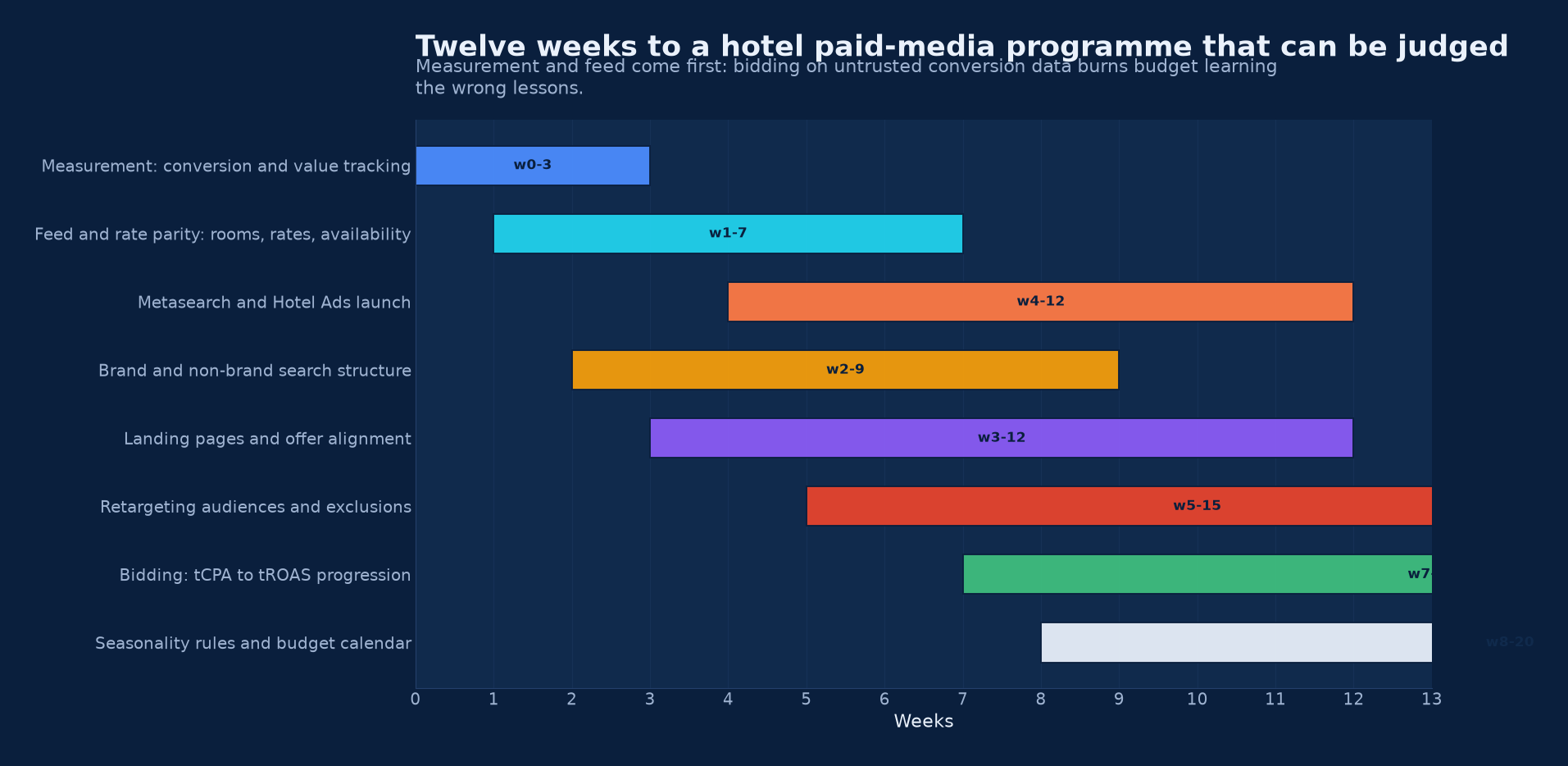
Chart values are an illustrative planning model based on typical UMC engagements and published industry benchmarks. They are not a guarantee of results on any specific project.
Weeks one to three prove the measurement: conversion actions, values, engine reconciliation. Weeks one to six build or fix the feed and parity monitoring. Metasearch launches in week four once the grid can show an honest rate; search families restructure in parallel; landing pages ship from week three as the build team delivers them. Bidding automation arrives in week seven or later, on trusted data, and the seasonality calendar is encoded by week twelve so the next budget conversation is about rules, not about hunches.
| Deliverable | Week | Evidence you receive |
|---|---|---|
| Verified conversion and value tracking | 3 | Reconciliation sheet against the engine |
| Rooms-rates-availability feed live | 6 | Feed health report and parity monitor |
| Metasearch and Hotel Ads live | 8 | Grid position report by market |
| Search families restructured | 7 | Account map with owners and budgets |
| Paid landing pages live | 9 | Speed and conversion baseline per page |
| Retargeting with exclusions | 10 | Audience definitions and frequency reports |
| Bidding progression plan | 12 | Stage gates with the data each requires |
| Seasonality rules | 12 | Budget calendar signed by your revenue manager |
Auction insight: knowing who you are actually buying against
Hotel auctions are not anonymous. On your brand terms the bidders are the OTAs, a metasearch player and occasionally a wholesaler holding rooms you sold them; on destination terms the field is every property and OTA that can host the intent, which on a good beach query is hundreds. Auction insight data tells you impression share, overlap and outranking per competitor, and read properly it changes budget decisions: a competitor whose impression share on your brand collapses when you raise bids is price-sensitive and worth deterring; one whose share never moves is buying volume at any cost and is not worth a bidding war.
| Signal | What it means | Action |
|---|---|---|
| High overlap on brand, low outranking | Intermediaries present but your ad quality wins | Hold capped bids; monitor parity of the displayed rate |
| Outranking rate falling on brand | A bidder raised aggressively or your quality slipped | Check ad relevance and landing speed before raising bids |
| Impression share capped by budget on destination | Demand exceeds the wallet | Raise budget only where cost per confirmed booking holds |
| New entrant on event terms | Somebody knows about an event you have not priced | Check the event calendar and the property’s allotments |
| Absolute top of page lost on metasearch | Grid position slipping | Feed quality and rate competitiveness, not bids, are usually the cause |
We review auction insight monthly alongside the cost-per-booking sheet, because an auction decision without a cost decision is a guess with a budget.
The guest journey paid media actually serves
Paid media for hotels is often mis-sold as a booking button, when most of its value sits earlier: in the dream stage where a destination query meets a photograph, in the planning stage where a metasearch comparison ends on your rate, and after the stay, where retargeting should stop selling and start inviting back. Mapping spend to journey stage prevents the classic error of judging a dream-stage campaign on same-day bookings and killing the channel that was feeding next quarter’s demand.
| Stage | Guest state | Paid instrument | Honest measure |
|---|---|---|---|
| Dream | Choosing a destination, not a property | Discovery and video, destination search | Assisted conversions and later-direct share |
| Plan | Comparing properties and prices | Metasearch and Hotel Ads, non-brand search | Grid position, click share, cost per booking start |
| Book | Ready to transact | Brand defence, retargeting of abandoned paths | Cost per confirmed booking |
| Stay | On property | None – ads off, experience on | Post-booking exclusion compliance |
| Return | Past guest, future demand | CRM-led lifecycle, light retargeting | Repeat-stay rate and cost per repeat booking |
The return stage is where paid hands over to the CRM and loyalty programme: a past guest reached by email costs a fraction of the same guest re-bought at auction, and the ad account should know the difference by excluding recent bookers from prospecting audiences.
Account governance: who touches what, and when
Ad accounts rot the way websites rot: silently, through small unowned changes. A rate rule adjusted during a panic, a campaign duplicated for a one-off offer and never paused, a conversion action edited by a developer testing a tag. Governance is therefore part of the service: a written change log, named owners per campaign family, a monthly hygiene review that checks negatives, exclusions, frequency caps, expired offers and feed errors, and a rule that structural changes happen in a scheduled window with a note, not at midnight during a compression night.
- Change log with owner, reason and expected effect for every structural edit
- Named owners per family: metasearch, brand, non-brand, retargeting
- Monthly hygiene review: negatives, exclusions, caps, expired assets, feed health
- Quarterly incrementality check on brand defence and retargeting
- Access review each quarter: who can edit, who can only read
- Documented rollback for every automated rule and budget schedule
The first audit tells you what the account is doing; governance is what keeps the answer the same next quarter. Our Google Ads audit practice is the entry point, and it is yours to keep whether or not we manage the account afterwards.
Compliance, brand safety and franchise rules
Hotel advertising carries fewer regulatory landmines than some sectors and more than advertisers assume: rate claims must match the bookable rate including mandatory fees in most markets, review stars in ads must reflect a genuine and current aggregate, all-inclusive and sustainability claims attract consumer-protection scrutiny, and franchise or brand-flag properties often face brand-book rules on imagery, rate display and co-op funds. We keep a compliance checklist per market in the account documentation, and where a franchise agreement constrains rate display we design the campaign inside the constraint rather than discovering it in an audit.
Paid and organic: the split that saves the budget
Paid and organic are not rivals; they are two instruments on the same demand curve, and the expensive mistake is running both at full volume on the same queries. Brand queries with strong organic positions need paid only as insurance; destination queries where organic ranks well need paid only in peak windows; queries where organic cannot rank – because OTAs own the SERP – are paid’s natural home. We maintain a query-level split sheet, reviewed quarterly with the hotel SEO programme, so each query is bought, earned or both, deliberately.
| Query position | Organic state | Paid posture |
|---|---|---|
| Brand, strong organic | Position one with sitelinks | Capped insurance only |
| Destination, strong organic | Top three with rich results | Peak windows and compression exceptions only |
| Destination, OTA-owned SERP | Page two or worse | Paid primary, organic investing |
| Event or dated intent | Dated pages rank seasonally | Paid with dated landing pages |
| Competitor names | Not pursued organically | Selective, policy-compliant, measured |
Proof and related capability
Paid programmes we run span Google Ads management, Performance Max and feed engineering across hospitality and retail; the resort-group engagement pairs metasearch with the hotel website build and the organic programme so that paid, earned and owned pull in one direction.
Related Services
The practices this programme draws on:
Where this page sits in our hotel programme
This spoke covers paid acquisition. The vertical’s other intents each have their own page, and the hub ties them together:
- Hotels and hospitality – the vertical main page
- Website development for hotels – the landing pages paid traffic needs
- SEO for hotels – the earned side of the same demand curve
- Social media marketing for hotels – content, creators and community
- Hotel business intelligence – dashboards, pace and forecasting above PMS and POS
- IT support for hotels – managed IT, networks and guest Wi-Fi
- AI for hotels – guest copilots, forecasting and governance
- BI dashboards – the measurement layer above PMS and POS
- Hotel CRM & guest loyalty – the retention programme
- Guest CRM and loyalty – the lifecycle after the booking
- Digital marketing company for hotels in Lucknow – the local-intent page
If your property trades in Lucknow or elsewhere in India, the local page carries the regional detail; this page carries the programme.
What we need from the property in week one
A paid-media programme moves only as fast as its access list. In week one we ask for ad-account admin or standard access in your billing, read access to the booking engine’s reservation report, the channel-manager or PMS feed credentials or export route, the current rate-parity agreements, and one named decision-maker with authority over budget rules. Where a property cannot grant engine access we can still run the programme on platform data, but we say plainly in the proposal that cost per confirmed booking will then be an estimate rather than a measurement, and we price the reconciliation work separately.
Nothing on that list is exotic, and every item we are denied shows up later as a blind spot in a report somebody will have to act on.
Frequently asked questions about Google Ads for hotels
Should we bid on our own brand name?
Usually yes, but as capped insurance, not as growth. We test it: switch brand campaigns off in a holdout market and measure what organic actually retains before we defend the spend.
What is a realistic cost per confirmed booking?
Metasearch on CPA models commonly lands at eight to twelve percent of booking value; non-brand search seven to eleven; retargeting lower. The benchmark that matters is your OTA commission.
Do we need Hotel Ads if we already pay OTAs?
They are different shelves. OTAs sell your rooms inside their marketplace; Hotel Ads puts your rate and your book button in the Google price grid. Most properties need both, in a managed ratio.
Our rates change daily. Can ads keep up?
Yes, with a live feed from the channel manager or PMS. Manual rate updates in an ad account cannot keep parity and should never be attempted.
What breaks first in a hotel ad account?
The feed and the landing pages, in that order. Bidding problems are usually symptoms of one of those two.
Can you work inside our franchise or brand-book rules?
Yes. We design campaigns inside rate-display and imagery constraints and document the constraint set in the account so nobody rediscovers it in an audit.
How do you handle rate parity agreements?
We read them before setting budgets. In bound markets we use compliant bidding models and monitor displayed rates continuously, because a parity breach is an expensive surprise.
Is Performance Max worth it for hotels?
Sometimes, as a discovery layer once value tracking is trusted. As a default black box replacing structured campaigns, no.
How fast will we see results?
Metasearch position changes appear within weeks; cost-per-booking trends stabilise over two to three months as bidding learns on verified data.
Who owns the ad accounts?
You do, always. We work in your accounts with your billing, so the asset and its history stay with the property.
Do you manage metasearch beyond Google?
Yes – trivago, Kayak, Skyscanner and regional players where the market math justifies them, reported on the same cost-per-confirmed-booking sheet.
What does management cost?
A fixed monthly fee by scope plus the feed work where needed. Media is never marked up, and the first deliverable is an audit you keep either way, via our Google Ads audit practice.
Start with an audit of what a booking actually costs
Give us read access to the ad accounts and three months of booking-engine numbers, and we will return the cost per confirmed booking by route – including the routes we would switch off.
Contact Unified Management Consulting to arrange a confidential first conversation.