
Hotel SEO is not generic SEO wearing a bathrobe. The results page for a hotel query is a crowded street: two online travel agencies, a metasearch price grid, a map pack with six properties, a brand site, a review site and maybe a magazine listicle all compete above and around the organic list. A property that ranks third on “boutique hotel in Lisbon” may still collect fewer clicks than one that ranks fifth with rich results, a clean map listing and a faster page. Our hotel SEO services are built for that street: technical work on a booking-driven site, local and map-pack optimisation for every property and outlet, destination and amenity content that earns the queries OTAs cannot keep, structured data that buys the rich results, and authority work that a tourism board or a travel editor will actually link to.
We work with independent hotels, resorts, serviced-apartment operators, management companies and franchise groups, and we deliver remotely: audits run against your live site, your Search Console and your booking-engine numbers, content plans are built with your revenue team, and reporting ties rankings to confirmed revenue rather than to positions. This page is the depth page for the organic discipline; the vertical overview lives on our hotels and hospitality main page, and the build that SEO stands on lives on our website development for hotels page.
What hotel SEO covers, at a glance
| Component | What We Deliver |
|---|---|
| Technical SEO for booking sites | Crawl, indexation, canonicals and speed on a site whose money pages sit behind a booking widget. |
| Local and map pack | Business profiles, citations, reviews and outlet-level pages for every property, restaurant and spa you operate. |
| Destination and amenity content | Pages that win the dream-stage queries OTAs rent but do not own: neighbourhoods, seasons, events, experiences. |
| Structured data | Hotel, Room, Offer, AggregateRating, Event and FAQ markup that earns rich results in a crowded SERP. |
| Multi-market hreflang | Language and currency variants that own their markets without cannibalising each other. |
| Authority and digital PR | Links and mentions from tourism bodies, press, airlines and travel editors. |
| Brand SERP defence | Keeping your own name yours when OTAs and metasearch bid and rank on it. |
| Revenue reporting | Rankings and clicks reconciled to bookings and revenue by landing page. |
What hotel SEO is actually asked to win
Hoteliers rarely ask for “SEO”. They ask why the OTA owns their name, why the resort page does not rank for the beach it sits on, why the events page brings no enquiries, or why direct bookings fell while traffic rose. Each of those is a different workstream, and the first job of an engagement is naming the query families behind the complaint.
| What we hear | The query family behind it | The workstream that answers it |
|---|---|---|
| “Booking.com outranks us on our own name” | Brand and property-name queries | Brand SERP defence: knowledge panel, sitelinks, reviews, fast brand pages |
| “Nobody finds us for the area” | Destination plus stay-type queries | Destination and neighbourhood content with room and offer links |
| “Our spa and restaurant bring no local guests” | Amenity and experience queries | Outlet pages with local SEO and map-pack work |
| “Weddings and meetings come through agencies only” | Meeting, wedding and event queries | Capacity pages, RFP content, event schema |
| “We rank but get no bookings” | Any family, weak conversion | Rich results, page speed and booking-path fixes with the build team |
| “German guests cannot find us in German” | Multi-language variants | hreflang architecture and localised content, not machine translation |
That table is also the proposal structure. We price the workstream that answers your complaint, not a generic retainer.
Where hotel organic demand sits, and which of it is worth winning
Not all hotel demand is equal. Brand queries are small in volume and enormous in value, and losing them is a tax on every other channel. Destination queries are the growth engine: they are where a guest who has never heard of you chooses a property. Amenity, event and long-stay queries are smaller again but convert at rates leisure queries never reach, because the searcher already knows what they want.
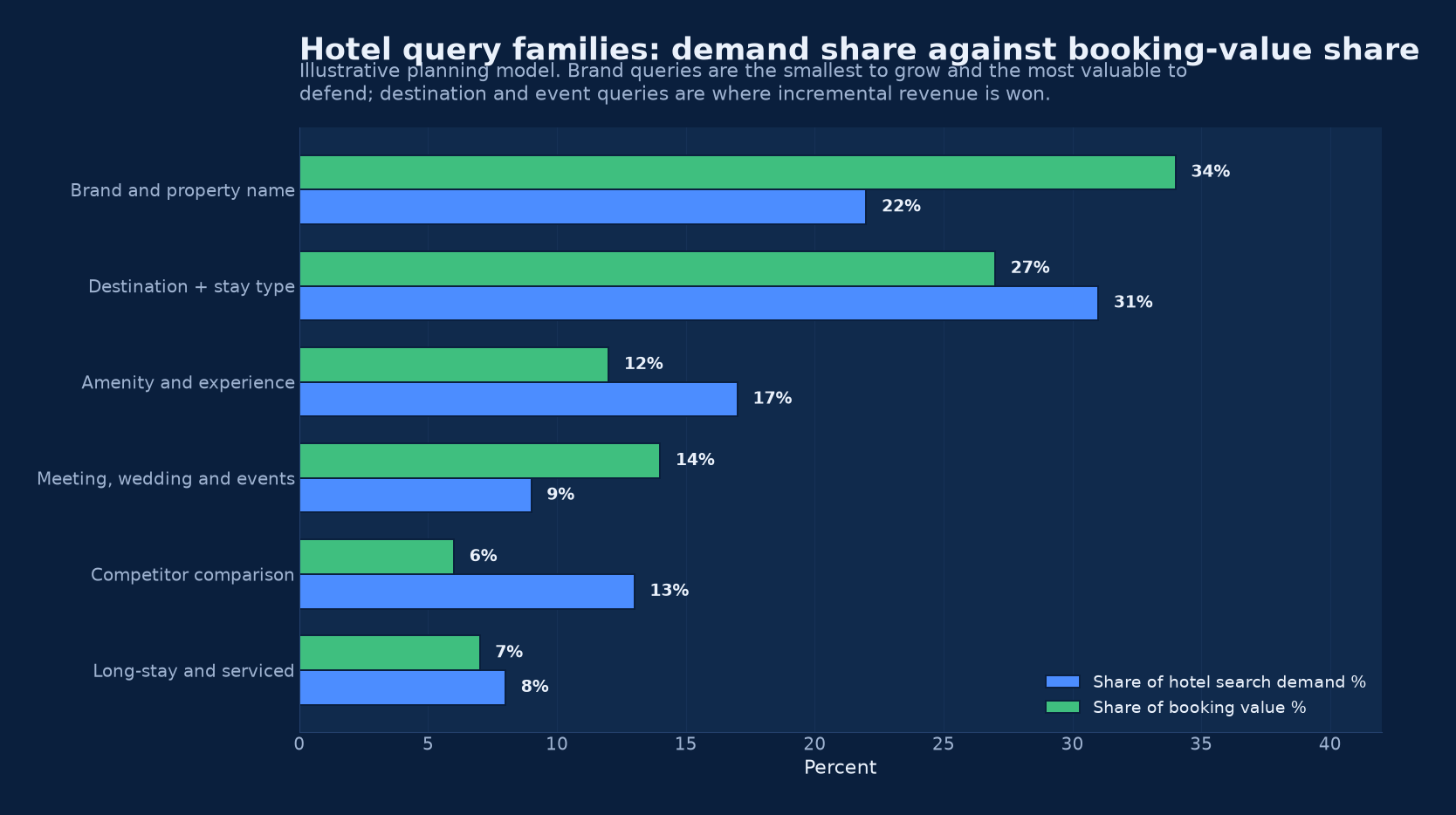
Chart values are an illustrative planning model based on typical UMC engagements and published industry benchmarks. They are not a guarantee of results on any specific project.
| Query family | Example queries | Who wins them today | Our play |
|---|---|---|---|
| Brand | hotel name, hotel name official site, hotel name phone | Usually the property, sometimes an OTA or metasearch | Defend: fast brand pages, knowledge panel, sitelinks, review stars |
| Destination | boutique hotel in X, beach resort near Y, hotel near Z station | OTAs and listicles above the fold | Destination pages, rich results, map pack, links |
| Amenity | hotel with rooftop pool X, dog friendly hotel Y, hotel with spa Z | Mixed; filters on OTA sites rank well | Amenity pages with real facts and schema |
| Events and meetings | wedding venue X, conference hotel Y with capacity | Venue marketplaces and agencies | Capacity pages, floor plans, event schema, RFP flow |
| Long-stay | serviced apartments X monthly rate, extended stay Y | Apartment platforms | Long-stay pages with rate logic and policy clarity |
We start where the value gap is widest, which is usually destination and events, and we defend brand in parallel because it is cheap to hold and expensive to lose.
The hotel SERP is a different battlefield
Measure click-through on hotel queries and you find position one earns roughly what position two earns on an informational query. The reason is visible above the organic list: price comparison units, a map pack, sponsored hotel ads and an OTA sitelink block. That is not an argument for giving up; it is an argument for earning every enhancement the SERP offers, because in a crowded street the rich result is the storefront.
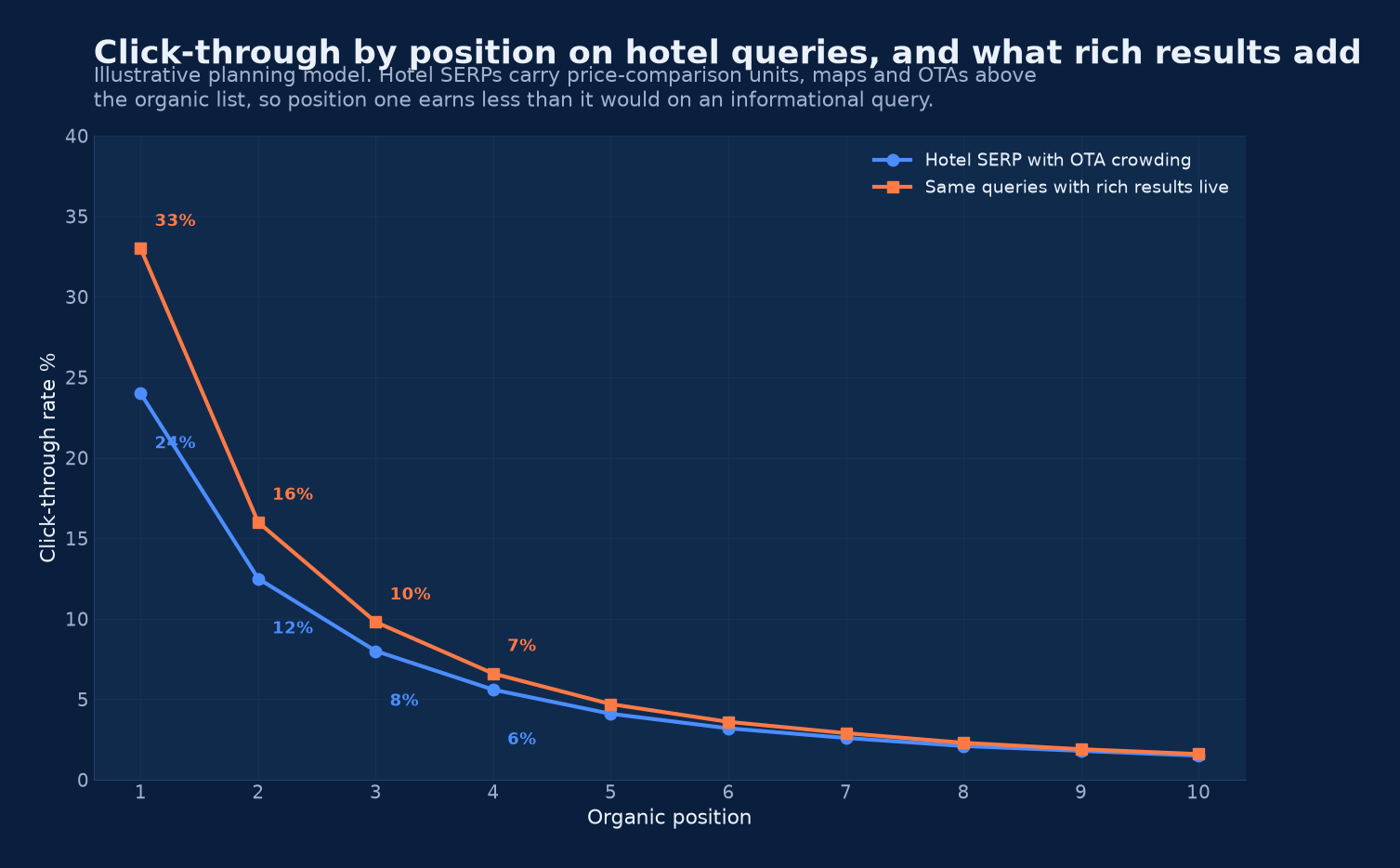
Chart values are an illustrative planning model based on typical UMC engagements and published industry benchmarks. They are not a guarantee of results on any specific project.
| SERP feature | What triggers it | What we do |
|---|---|---|
| Review stars in organic | AggregateRating markup plus genuine review velocity | Schema plus a review-gathering programme that complies with platform policy |
| Price and availability structure | Hotel and Offer markup, sometimes a feed partnership | Correct room and offer schema maintained through CMS, not hand-edited |
| FAQ expansions | FAQPage markup on genuinely helpful answers | Real FAQs from the front desk, marked up where they add value |
| Map pack with photos and rating | Business profile completeness and review flow | Outlet-level profiles, categories, photos, Q&A and posts |
| Image carousels for destination queries | Fast, well-described, genuinely good imagery | Image SEO: filenames, alt text, structured captions, modern formats |
Rich results also decay. Schema that described last year’s offers becomes a liability when the markup promises a pool that was filled in, so schema maintenance is part of the retainer, not a launch task.
Technical SEO on a booking-driven site
Hotel sites fail technical audits in predictable ways: the booking widget renders rates in JavaScript that crawlers never execute, room pages exist only inside the engine and have no indexable URL, offers are published and unpublished without redirects, language variants duplicate English content, and the media budget murders Core Web Vitals on the very pages that need to rank. Our technical workstream fixes the money path first and the blog last.
- Crawl budget mapped to money pages: rooms, offers, destination, events – not tag archives
- Indexable URLs for every sellable thing; booking-engine deep links given canonical homes
- Canonical and hreflang matrix specified once, enforced in the CMS, audited monthly
- Redirect discipline for expired offers and renamed rooms, with a standing map
- JavaScript rendering tested: what the crawler sees on the rooms page versus what a guest sees
- Core Web Vitals budget enforced on templates, via our performance practice
- Search Console monitoring with alerting on coverage drops, not a monthly glance
- Log-file analysis to prove crawlers spend their time where revenue lives
The full technical method, including migration and replatform protection, is our technical SEO and site migrations practice; this page applies it to the shapes hotel sites actually take.
Local SEO and the map pack: every outlet, not just the front door
A resort is several local businesses wearing one coat: the hotel, the restaurant, the spa, the beach club, the events lawn. Guests search for each of them differently, and the map pack answers those searches. Most properties run one business profile for the front desk and leave the outlets to chance, which is why the restaurant’s covers are empty and the spa’s category is wrong.
| Profile element | Hotel-level | Outlet-level |
|---|---|---|
| Category | Hotel or resort, plus service attributes | Restaurant, spa, gym, event venue – the primary category guests search |
| Photos | Rooms, exterior, location truth | Menus, treatment rooms, layouts, real light |
| Reviews | Stay reviews with management responses | Outlet reviews solicited at the point of experience, within platform policy |
| Posts and Q&A | Seasonal offers, policy answers | Menus of the week, hours, booking links |
| Landing page | Fast rooms page with local schema | Outlet page with menu, hours, price band and reservation path |
Citations and NAP consistency matter least where they are hardest: multi-property groups with legacy listings under old names. We run a citation cleanup as a project with a closed scope, then monitor drift, because a resort that rebrands and leaves forty stale listings is paying for them in map-pack visibility for years. The discipline is our local SEO and business profile management practice.
Content architecture: destinations, amenities, seasons and events
The content that wins hotel queries is not blog posts about travel tips; it is structured, honest, useful pages about the place and the stay. A destination page that tells the truth about distance to the beach, what the neighbourhood sounds like at night and which months the sea is swimmable will out-convert and out-rank a generic guide, because guests reward honesty with bookings and search engines reward the engagement that follows.
| Content type | Query family it wins | Must contain | Links it must carry |
|---|---|---|---|
| Destination and neighbourhood | Destination plus stay type | Honest distances, seasonal calendar, what the area is actually like | Rooms, offers, outlet pages |
| Amenity and experience | Amenity queries | Real facts: pool hours, dog policy, spa menu, gym equipment | Room categories that carry the amenity |
| Seasonal and event calendars | Seasonal and event queries | Dates, what happens, how to get there, what to book | Offers tied to the dates, rooms with availability |
| Meeting and wedding capacity | Event and planner queries | Capacities by layout, floor plans, AV, catering menus, sample timelines | RFP and enquiry path, past-event proof |
| Long-stay and serviced | Long-stay queries | Monthly rate logic, workspace facts, laundry, kitchen, policy | Long-stay offer pages and CRM capture |
Internal linking is specified with the content model, because a destination page that does not pass authority to rooms is a brochure, not a funnel. Our content marketing strategy practice owns the editorial calendar that keeps these pages alive after launch.
Structured data that earns hotel rich results
Hotel schema is a contract with the search engine: it says this is a hotel, these are its rooms, these are its offers, this is its rating. Written well it buys rich results; written carelessly it buys a manual action or a rich result that misleads guests. We implement the hotel vocabulary end to end and we validate it in the same release pipeline as the site.
| Schema type | Applied to | Care points |
|---|---|---|
| Hotel / Lodge / Resort | Property home page | Correct subtype, amenity feature list, star rating only where officially awarded |
| Room and Suite | Room pages | Bed, occupancy, size, view; matches the booking engine |
| Offer and AggregateOffer | Offers and rooms | Price currency, availability, valid dates; never a price the engine contradicts |
| AggregateRating and Review | Property and outlets | Genuine reviews only; platform policy compliant collection |
| Event | Events and weddings | Dates, location, performer or organiser, ticket or RFP path |
| FAQPage | Policy and planning FAQs | Only questions genuinely answered on the page |
| LocalBusiness variants | Outlets | Opening hours, price range, menu or service list |
We also watch the frontier: AI search surfaces cite structured, factual hotel content disproportionately, so the same markup feeds our AI search optimisation practice and the voice search work for “hotels near me with a pool” style queries.
Multi-market: hreflang without self-competition
Groups selling into several markets need language and currency variants, and variants are where hotel sites quietly cannibalise themselves: four URLs serving the same English content, hreflang annotations pointing at the wrong variant, a German page canonicalised into the English one. We specify the variant matrix – which markets get localised content versus translated content – and implement the annotation set so each variant owns exactly one market. The international method is our international and multi-region SEO practice; the build side of variants sits with the hotel website build.
Authority and digital PR a tourism editor will actually link to
Hotel link building that works is not directory spam; it is being the most quotable property in your market. That means data and stories a travel editor can use: occupancy and rate trends from your own numbers, a genuine neighbourhood guide, a sustainability report with real figures, chef and concierge expertise on record. It also means the unglamorous base: tourism board listings, convention bureau membership, airline and rail partner pages, local press that covered your reopening and never linked it.
- Original data studies from your own occupancy, rate and lead-time numbers
- Neighbourhood and season guides worth citing, built with local experts
- Expert commentary programmes for travel trade press
- Partnership pages: tourism boards, convention bureaux, airlines, event organisers
- Recovery of unlinked mentions: press that named you without linking you
- Citation cleanup after rebrands and renames, closed as a project
The method and its reporting live in our digital PR and link building practice; what changes for hotels is the source list and the evidence, not the ethics.
Brand SERP: the truce with OTAs and metasearch
On your own name, the SERP will show you, an OTA, a metasearch price grid and possibly a review site. You cannot out-spend the OTA forever, and you should not try to erase it: guests use OTAs as a trust layer. The workable position is a brand SERP where your own property controls the first result, the knowledge panel, the sitelinks and the review narrative, while paid and metasearch cover the comparison shoppers. Where brand defence needs paid cover – for example during a rate-parity dispute or a rebrand – the handoff is to our Google Ads practice, and the split is decided by measured cost per confirmed booking, not by preference.
| Brand SERP element | Owner | Action when lost |
|---|---|---|
| First organic result | Property site | Speed, title discipline, internal links to brand page |
| Knowledge panel | Entity data across the web | Consistent entity markup and authoritative profiles |
| Sitelinks | Site architecture | Clear nav and internal links to rooms, offers, contact |
| Review stars | Review platforms and schema | Policy-compliant review velocity and responses |
| OTA and metasearch blocks | Intermediaries | Paid cover where the math justifies it |
The twenty-four-week programme
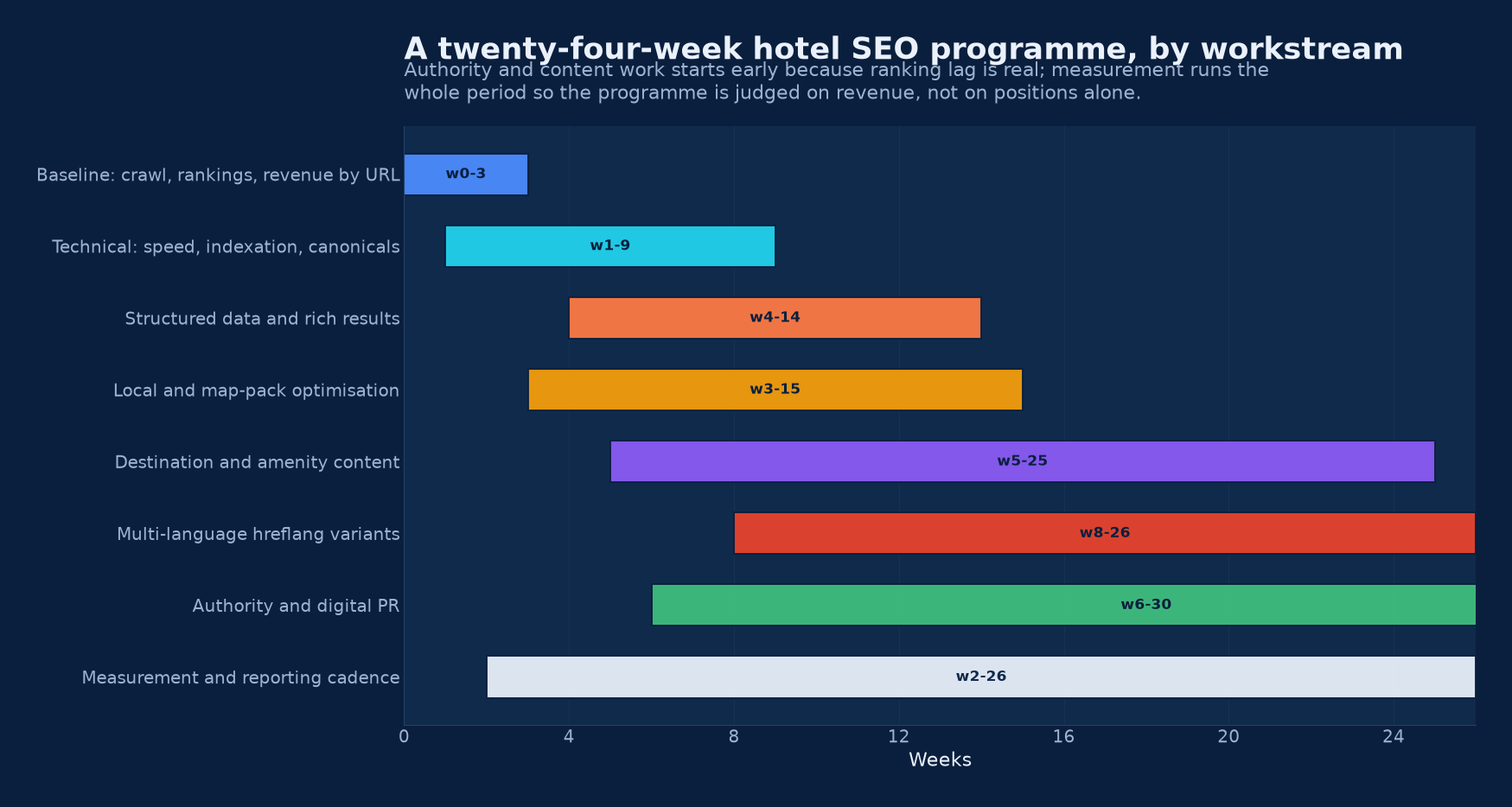
Chart values are an illustrative planning model based on typical UMC engagements and published industry benchmarks. They are not a guarantee of results on any specific project.
Weeks one to three are a baseline, not an audit shelf-warmer: crawl, rankings, Search Console history, revenue by landing page from the booking engine, backlink profile, map-pack state for every outlet. Technical fixes then land in the build pipeline rather than as a document. Content and authority work start early because ranking lag is real, and measurement runs the whole period with a monthly revenue review that both sides attend.
| Deliverable | Week | Format |
|---|---|---|
| Baseline and prioritised roadmap | 3 | Written report plus a costed backlog |
| Technical fixes shipped | 8 | Merged changes with before-and-after coverage data |
| Schema set live and validated | 10 | Release notes plus validation output |
| Map-pack programme per outlet | 12 | Profile state, review plan, citation cleanup record |
| Destination and amenity content | 20 | Published pages with internal link model |
| hreflang matrix | 18 | Annotation set plus monitoring alerts |
| Authority campaign | 24 | Placement report with traffic and revenue context |
| Revenue review cadence | ongoing | Monthly session with rankings, clicks, bookings, revenue |
Measurement: rankings are a leading indicator, revenue is the report
A hotel SEO report that ends at positions is a vanity report. Ours reconciles three sources: Search Console clicks by landing page, analytics sessions and funnel steps, and the booking engine’s confirmed bookings and revenue with channel attribution. Where the engine and analytics disagree – and they will – we reconcile rather than average, because a direct booking that the engine attributes to a voucher code is still a booking the organic path started.
| Measure | Source | Cadence | Why it matters |
|---|---|---|---|
| Clicks and average position by query family | Search Console | Weekly | Leading indicator, segmented by family not blended |
| Organic sessions reaching the booking path | Analytics | Weekly | Separates rankings that earn intent from rankings that do not |
| Confirmed bookings and revenue by landing page | Booking engine | Monthly | The number the board reads |
| Map-pack impressions and actions per outlet | Business profiles | Monthly | Local demand the website never sees |
| Referring domains and linked revenue pages | Link data | Monthly | Authority progress tied to money pages |
| Rich result eligibility and errors | Search Console | Weekly | The storefront in a crowded street |
The measurement layer above all of this – PMS, POS, channel manager in one view – is our BI dashboards practice, and the guest lifecycle that turns one stay into five is our CRM practice.
Seasonality: planning SEO around the demand calendar
Hotel demand is a calendar, not a flat line, and SEO that ignores the calendar ships its work too late to matter. A ski property’s destination queries peak eight to twelve weeks before the season opens; a beach resort’s peak searches arrive while the previous season is still running; a city hotel’s conference demand follows published event schedules. We map each property’s demand calendar from its own booking lead times and Search Console history, then schedule content refreshes, offer pages and authority pushes to land before the query curve rises, not after. The same calendar decides what not to touch: rebuilding or migrating inside a peak window is how properties lose a season, so the calendar is a constraint on the build programme as well as on the content plan.
Seasonality also changes how results should be read. Comparing this March to last March is honest; comparing this March to this February on a ski property is noise. Our reporting states the comparison basis on every number, and where a property has less than two years of history we say plainly which conclusions the data cannot yet support.
Common failure patterns we fix first
Across hotel audits the same failures recur, and knowing them in advance is most of the value of hiring someone who has seen two hundred hotel sites. Rooms that exist only inside the booking engine and therefore cannot rank. Offers published as PDFs, which no search engine can understand and no guest can book on a phone. Destination pages that were written once in 2019 and now describe a restaurant that closed. Review widgets that load third-party JavaScript on every page and cost a second of Largest Contentful Paint for content that never indexes. Language variants created by machine translation with no review, which read as spam to guests and as duplication to crawlers. A map pack listing whose photos are stock images of a different property. None of these is exotic; all of them are expensive; and all of them are fixable in a quarter if somebody owns the list.
We hand you that list in week three with an owner and a cost against each line, and we work it in the order the revenue math dictates, not in the order the problems were found.
Proof and related capability
Organic programmes we have published include a full-service B2B SEO engagement for a chemical earthing manufacturer and a WordPress-plus-SEO build for a chikankari garment house; in hospitality specifically the resort group work pairs the hotel website build with the demand programmes described here.
Related Services
The practices this programme draws on:
- Search engine optimisation services
- Technical SEO audits and site migrations
- Local SEO and Google Business Profile management
- Digital PR and link building
- International and multi-region SEO
- Content marketing strategy
- AI search optimisation (AIEO)
- Voice search optimisation
- Core Web Vitals and performance
- Website migration and replatforming
- Contact us
Where this page sits in our hotel programme
This spoke covers organic search. The vertical’s other intents each have their own page, and the hub ties them together:
- Hotels and hospitality – the vertical main page
- Website development for hotels – the build this programme stands on
- Google Ads for hotels – metasearch, PPC and paid media programme
- Social media marketing for hotels – content, creators and community
- Google Ads management – metasearch and paid search for hotels
- Hotel business intelligence – dashboards, pace and forecasting above PMS and POS
- IT support for hotels – managed IT, networks and guest Wi-Fi
- AI for hotels – guest copilots, forecasting and governance
- BI dashboards – the measurement layer above PMS and POS
- Hotel CRM & guest loyalty – the retention programme
- Guest CRM and loyalty – the lifecycle after the booking
- Digital marketing company for hotels in Lucknow – the local-intent page
- SEO company in Lucknow – local SEO for nearby properties
If your property trades in Lucknow or elsewhere in India, the local pages carry the map-pack and regional detail; this page carries the programme.
Frequently asked questions about hotel SEO
How long before hotel SEO shows in revenue?
Technical and rich-result wins can move clicks within weeks; destination-query revenue typically moves from month three to six. We forecast by query family and report against the forecast.
Can you get us above Booking.com on our own name?
On your own name, yes, that is the baseline expectation. On destination queries the OTA is a different opponent with a different budget; there we win the queries they rent but do not own.
Do reviews really affect rankings?
They affect map-pack visibility and click-through strongly, and organic trust signals indirectly. Review velocity and responses are part of the programme, collected within platform policy.
Our rooms only exist inside the booking engine. Is that a problem?
Yes. If a room has no indexable URL with real content, it cannot rank. We create canonical room pages that feed the engine rather than replace it.
Will schema get us penalised if offers change?
Stale or misleading markup is the risk, not markup itself. We maintain schema through the CMS so an expired offer stops being marked up on the day it expires.
Do you write the content or do our team?
Either. Most groups want our structure and their voice: we specify the content model, brief each page, and edit what your team drafts.
How do you handle multiple languages?
A variant matrix first – which markets get localised content, which get translation – then hreflang and canonical rules so variants own their markets without fighting each other.
What about AI search and answer engines?
The same structured, factual content that wins rich results is what AI surfaces cite. We measure AI-referred traffic separately and optimise for citation, not just clicks.
Can you work with our existing agency or in-house team?
Yes. We take the technical and structured-data workstreams, or the authority workstream, or the whole programme; the split is written down so nobody owns the same task twice.
How do you report to a board that only reads revenue?
One page: bookings and revenue by channel, organic share of direct, cost per booking, and the three movements that explain the change since last month.
Do you guarantee positions?
No, and neither should anyone. We guarantee the method, the cadence and the reporting honesty; positions are an outcome we manage, not a promise we sell.
What does it cost?
A fixed-fee baseline and roadmap first, then a monthly programme priced by workstream. Media and tools are never marked up, and the roadmap is yours to keep either way.
Start with a baseline, not a promise
Give us Search Console, analytics and three months of booking-engine numbers, and we will return a written view of which query families are worth winning and what each is worth to you.
Contact Unified Management Consulting to arrange a confidential first conversation.