
YouTube is the world’s second-largest search engine and the dominant video platform, with 2.7 billion active users watching over 1 billion hours of video daily. YouTube advertising offers unmatched reach, precise targeting, and powerful storytelling capabilities that drive brand awareness, leads, and sales at scale.
Video ads generate 66% more qualified leads than other ad formats and increase purchase intent by 97%. Our YouTube advertising services combine strategic campaign management, compelling video creative, and data-driven optimization to deliver exceptional results across the full marketing funnel.
📋 YouTube Advertising Services — Quick Summary
At a glance: everything we deliver through our YouTube advertising and video marketing services.
| Service | What We Do |
|---|---|
| Campaign Strategy | Goal definition, audience research, competitor analysis, budget planning, and KPI framework |
| Video Production | Scriptwriting, filming, editing, hook optimization, CTA design, and creative variations |
| Ad Formats | Skippable, non-skippable, bumper, discovery, Shorts, and masthead ads managed |
| Targeting | Keywords, custom intent, in-market, affinity, remarketing, customer match, and placements |
| Optimization | Creative testing, audience optimization, bid management, view-through attribution, and brand lift |
| Organic YouTube | Channel strategy, YouTube SEO, thumbnails, community engagement, and subscriber growth |
| Key Results | $0.01-$0.03 CPV, 20-40% VTR, 97% purchase intent lift, 3-5x ROAS |
| Investment | $2,000-$15,000/month management + ad spend |
YouTube Advertising Statistics: Why Video Is Essential
| Metric | Statistic | What It Means |
|---|---|---|
| Monthly active users | 2.7 billion | Largest video platform in the world |
| Daily watch time | 1 billion+ hours | More than Netflix and Facebook combined |
| Purchase intent increase | +97% | After watching a video ad |
| Average CPV (cost per view) | $0.01-$0.03 | Extremely affordable reach |
| Users who bought after YouTube ad | 89% | YouTube drives actual purchases |
| Brand awareness lift | +139% | From video ad campaigns |
| Users who discover brands on YouTube | 70% | YouTube is a discovery engine |
| Video ad recall rate | 65% | Higher than any other ad format |
Why YouTube Advertising Is Essential for Your Business
- Massive Reach: 2.7 billion active users across all demographics, ages, and interests. YouTube reaches more 18-49 year olds than any TV network.
- Intent-Based Targeting: Reach users actively searching for topics related to your business. YouTube search data combined with Google search data creates unparalleled targeting precision.
- Visual Storytelling: Video communicates complex messages more effectively than any other format. 95% of viewers retain a message from video vs. 10% from text.
- Full-Funnel: From brand awareness at the top to direct response and remarketing at the bottom. One platform covers the entire customer journey.
- Google Integration: Seamless integration with Google Ads, search data, and conversion tracking for unified campaign management.
- Cost-Effective: Average CPV of $0.01-$0.03 means you can reach thousands of prospects for a fraction of TV advertising costs.
- Measurable: Track views, engagement, clicks, conversions, and brand lift with precision. Know exactly what’s working.
- Shorts Growth: YouTube Shorts now reaches 2 billion+ monthly users, opening new ad inventory for vertical video.
Our YouTube Advertising Services
1. Campaign Strategy & Planning
- Goal Definition: Brand awareness, consideration, lead generation, direct sales, or app installs
- Audience Research: Custom audiences based on interests, intent, demographics, life events, and behaviors
- Competitor Analysis: YouTube ad landscape analysis and creative benchmarking of competitor campaigns
- Campaign Architecture: Structured campaigns for testing: separate awareness, consideration, and conversion campaigns
- Budget Planning: Strategic allocation across funnel stages with performance-based scaling
- KPI Framework: Metrics aligned with business objectives: awareness (views, reach), consideration (VTR, engagement), conversion (CPA, ROAS)
2. Video Ad Creative Production
We create video ads that capture attention in the first 5 seconds and drive action:
- Scriptwriting: Compelling scripts with strong hooks, value propositions, and clear CTAs following the ABCD framework (Attract, Brand, Connect, Direct)
- Video Production: Professional video shoots, animation, stock-based assembly, or UGC-style content
- Ad Format Optimization: Custom creative for each format: skippable in-stream, non-skippable, bumper, discovery, and Shorts ads
- Hook Optimization: First 5 seconds designed to prevent skip with pattern interrupts, questions, and bold statements
- CTA Design: Clear, compelling calls-to-action with end screens, cards, and overlay CTAs
- Creative Variations: 3-5 versions per campaign for A/B testing hooks, CTAs, and audience targeting
- Subtitles & Captions: 85% of videos are watched without sound—captions ensure your message is received
3. YouTube Ad Formats We Manage
| Ad Format | Best For | Length | Avg. CPV | Skip Option |
|---|---|---|---|---|
| Skippable In-Stream | Awareness + Consideration + DR | 12-300 sec | $0.01-$0.03 | After 5 seconds |
| Non-Skippable | Brand awareness, full message | 15-20 sec | $0.02-$0.05 | No |
| Bumper Ads | Reach and frequency | 6 seconds | CPM-based | No |
| Discovery Ads | Consideration and traffic | Variable | $0.01-$0.05 | N/A |
| Shorts Ads | Younger demographics, viral reach | Up to 60 sec | CPM-based | Swipe |
| Masthead | Massive brand launches | 24 hours | Premium CPM | No |
4. Targeting & Audience Strategy
YouTube’s targeting capabilities combined with Google’s data are unmatched:
- Keyword Targeting: Show ads to users searching for specific topics on YouTube—intent-based targeting
- Custom Intent Audiences: Target users based on their Google search behavior—recently searched for your keywords
- In-Market Audiences: Reach users actively researching products/services like yours (1,000+ categories)
- Affinity Audiences: Target users based on long-term interests and lifestyle habits
- Remarketing: Re-engage website visitors, video viewers, app users, and past customers
- Customer Match: Upload customer email lists for targeting and exclusion
- Placement Targeting: Show ads on specific YouTube channels, videos, and websites
- Life Events: Target users experiencing major life changes (moving, graduating, getting married)
- Lookalike Audiences: Find new users similar to your best customers
5. Optimization & Reporting
- Creative Testing: A/B test thumbnails, hooks, CTAs, lengths, and ad variations systematically
- Audience Optimization: Identify and scale highest-performing audience segments with budget reallocation
- Bid Optimization: Adjust bids based on performance, competition, and goals using smart bidding
- View-Through Attribution: Track conversions influenced by video views (even when users don’t click)
- Brand Lift Studies: Measure awareness, consideration, ad recall, and favorability impact through YouTube’s Brand Lift
- Monthly Reporting: Detailed performance reports with views, VTR, CPV, CPA, ROAS, and strategic recommendations
Video Marketing Beyond YouTube Ads
Organic YouTube Channel Strategy
- Channel setup, branding, banner design, and optimization for discovery
- Content strategy and video topic planning aligned with SEO keyword research
- YouTube SEO: optimized titles, descriptions, tags, chapters, and thumbnail design
- Community engagement, comment management, and subscriber growth strategies
- Playlist architecture for increased watch time and session duration
Multi-Platform Video Marketing
- Video content adapted for Instagram Reels, TikTok, and Facebook (vertical, square, landscape)
- LinkedIn video for B2B thought leadership, company culture, and brand building
- Website video embeds for landing pages, product pages, and homepage hero sections
- Email video integration for 300% higher click-through rates
- OTT/Connected TV advertising for streaming platforms (Hulu, Roku, Fire TV)
YouTube Ads Performance Benchmarks by Industry
| Industry | Avg. View-Through Rate | Avg. CPV | Avg. CPA | Our Target VTR |
|---|---|---|---|---|
| E-commerce | 20-30% | $0.02-$0.04 | $15-$40 | 30-45% |
| B2B / SaaS | 25-35% | $0.03-$0.06 | $30-$80 | 35-50% |
| Healthcare | 20-30% | $0.02-$0.05 | $20-$50 | 30-40% |
| Financial Services | 22-32% | $0.03-$0.07 | $25-$75 | 32-45% |
| Education | 25-40% | $0.01-$0.04 | $10-$35 | 35-50% |
| Real Estate | 18-28% | $0.02-$0.05 | $20-$60 | 28-40% |
YouTube Advertising Video Funnel Strategy
| Funnel Stage | Ad Format | Objective | Targeting |
|---|---|---|---|
| Awareness | Bumper + Non-skippable | Brand recall, reach | Broad affinity, demographics |
| Consideration | Skippable + Discovery | Engagement, traffic | Custom intent, in-market |
| Conversion | Skippable DR | Leads, sales, sign-ups | Remarketing, customer match |
| Loyalty | Skippable + Shorts | Retention, upsell | Customer lists, lookalikes |
YouTube Advertising ROI & Results
Our YouTube advertising clients typically achieve:
- $0.01-$0.03 average cost per view for maximum reach efficiency
- 20-40% view-through rates with optimized hooks and creative
- 97% increase in purchase intent after video ad exposure
- 3-5x ROAS for direct response YouTube campaigns
- 15-30% brand lift measured through YouTube Brand Lift studies
- 50% lower CPA compared to display advertising for consideration campaigns
- 139% increase in brand awareness from video ad campaigns
- 2-3x higher engagement rates compared to static image ads
YouTube Advertising Pricing
| Package | Includes | Management Fee |
|---|---|---|
| Starter | Campaign setup, 2 ad creatives, basic targeting, monthly reporting | $2,000-$4,000/month |
| Growth | Full funnel campaigns, 4+ creatives, video production support, A/B testing | $4,000-$8,000/month |
| Scale | Multi-platform video, organic + paid, brand lift studies, full production | $8,000-$15,000/month |
Note: Ad spend is additional and typically starts at $3,000-$5,000/month for testing.
Related Advertising Management Services
These offerings are delivered alongside this service. Advertising programmes rarely use one of them alone, and most engagements combine two or three.
- Out-of-Home & Digital OOH Advertising — corridor selection, CPM benchmarking, flighting, creative duration discipline and geofenced measurement
- Brand Performance & Creative Production — one narrative, a modular creative system, production economics, media-weighted testing and always-on optimisation
Related Digital Marketing Services
These offerings are delivered alongside this service. Channel work is usually combined rather than bought separately: paid media with measurement, organic with content, and campaigns with the lifecycle that follows them. Most engagements start with a paid assessment or audit.
- Social Media Management (Organic) Services — Organic social media management: audits, content pillars, production pipelines, publishing, community standards, amplification and reporting
- Webinar & Event Campaign Services — Webinar and event campaigns: topic and offer design, registration, promotion, attendance programmes, delivery, segmented follow-up and repurposing
- Performance Max (PMax) Management Services — Performance Max management: conversion values, asset groups, feed and audience signals, exclusions, incrementality tests and weekly governance
Frequently Asked Questions
How much should I spend on YouTube advertising?
Start with $3,000-$5,000/month in ad spend for testing, then scale based on results. YouTube ads work at any budget thanks to low CPV costs. Management fees are separate.
Do I need professional video production?
Professional quality helps, but authentic, well-scripted content often outperforms expensive productions. We help with both approaches—full production or UGC-style content.
How long until I see results?
Awareness campaigns deliver results within days. Lead generation and conversion campaigns typically optimize within 2-4 weeks as Google’s algorithm learns your ideal audience.
Can YouTube ads work for B2B?
Absolutely. YouTube’s custom intent audiences and keyword targeting reach B2B decision-makers researching solutions. B2B video ads are highly effective for demos, webinars, and thought leadership.
What’s the ideal video ad length?
For skippable ads: 15-30 seconds for awareness, 30-60 seconds for consideration, and 15-30 seconds for direct response. The first 5 seconds are always the most critical.
Do you handle video production too?
Yes. We offer end-to-end video production including scripting, filming, editing, motion graphics, and optimization for each ad format.
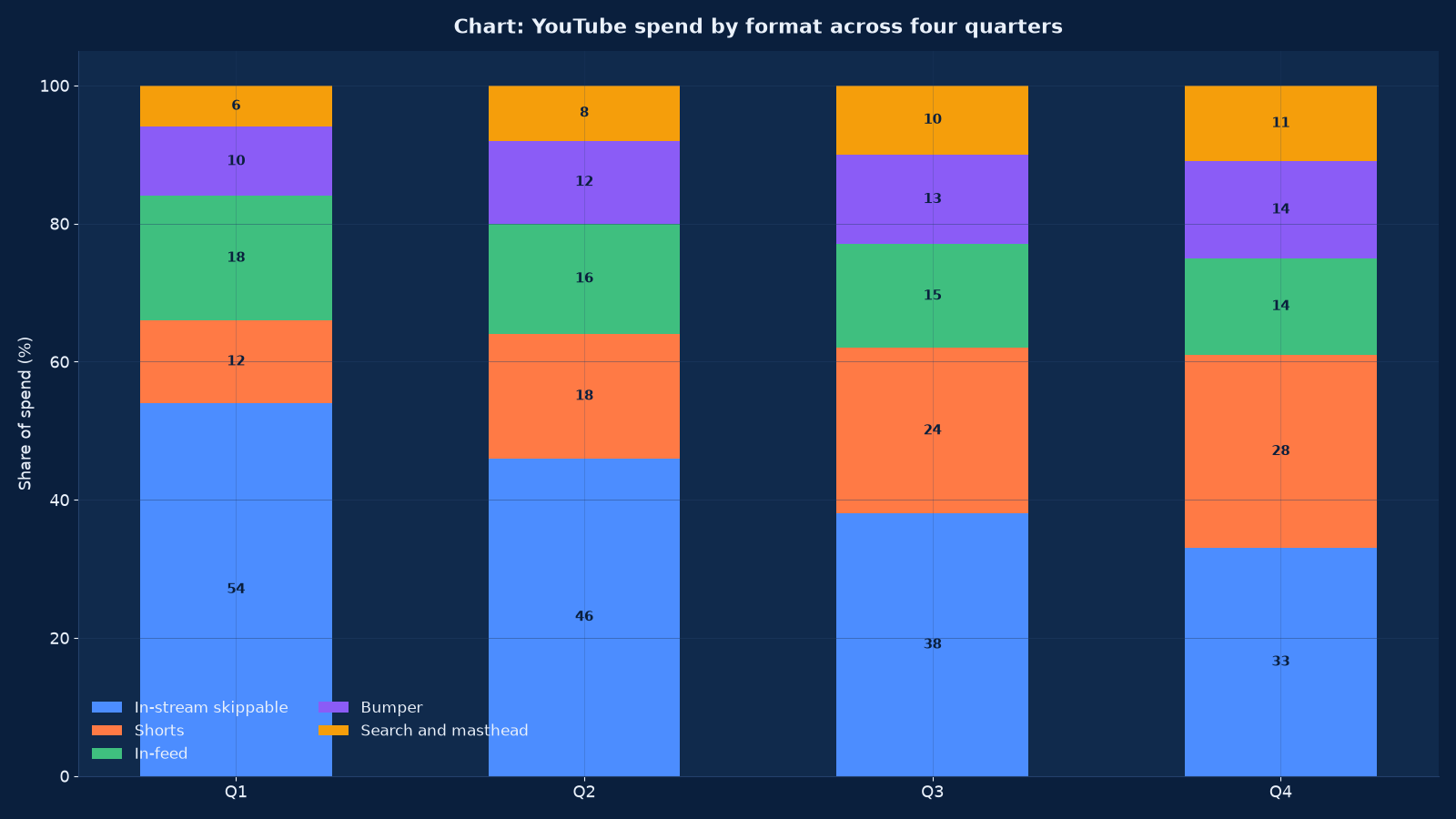
Chart values are an illustrative planning model based on typical UMC engagements and published industry benchmarks. They are not a guarantee of results on any specific project.
YouTube is a search engine, a television network and a short-form feed operating under one account. An advertiser who buys it as one of those three things is paying for the other two without knowing it, and the cure is not a better bid. It is a format portfolio with a job for each format and a measurement model that can tell them apart.
YouTube advertising and video marketing at Unified Management Consulting covers the channel end to end: channel and tracking audit, audience and custom-intent construction, script and hook development with thumbnail testing, campaign structure by funnel stage, Shorts and in-feed expansion, frequency and brand-safety control, and view-through measurement that can survive a finance conversation. We run this for consumer brands, retail and e-commerce, hospitality, clinics, education, technology sellers and manufacturers, for businesses whose video assets already exist and for those starting with nothing but a product and a claim to make.
The engagement is craft-led because on this channel craft is the targeting. A five-second hook, a thumbnail that reads at forty pixels and a first minute that earns retention do more for cost per result than any audience refinement, which is why the programme in Figure 3 puts script and thumbnail testing before campaign structure rather than after it.
What This Service Actually Covers
The service covers the channel, the creative and the measurement. It is delivered as a twelve-week build followed by a standing programme, or as a creative-and-channel engagement where the client’s internal team buys the media.
| Component | What we do | What you keep | Duration |
|---|---|---|---|
| Channel and tracking audit | Ad account, channel, conversion events, view-through windows and brand settings reviewed | A tracking position that can be defended, and a list of what cannot currently be measured | 1–2 weeks |
| Audience build | Custom intent from search behaviour, affinity, in-market, remarketing and customer lists | An audience set with a stated purpose per audience | 1–2 weeks |
| Script and hook | Scripts built around a tested first five seconds, per format | A hook library and a script template | 2–3 weeks |
| Thumbnails and titles | Designed and tested as a pair, at the size they are actually seen | A thumbnail standard and the test results behind it | 1–2 weeks |
| Campaign structure | One structure per funnel stage with the format matched to the job | A readable account where each format’s result is separable | 1–2 weeks |
| Shorts and in-feed | Short-form and discovery placements added where they earn their spend | A portfolio rather than a single-format bet | 2 weeks |
| Frequency and safety | Caps, exclusions, brand suitability settings and inventory controls | A control set with the reasoning recorded | 1 week |
| Measurement | View-through conversions, brand lift where it is justified, and a blended view | A reporting model with the attribution window stated | Ongoing |
| Creative refresh | A monthly refresh cycle tied to frequency and retention, not to a calendar | A production cadence the business can sustain | Ongoing |
| Channel assets | The organic channel treated as a library: playlists, chapters, end screens and descriptions | A channel that keeps working between campaigns | Ongoing |
Why YouTube Is Three Channels Under One Account
| Behaviour | What the viewer is doing | The format that serves it | How it is measured |
|---|---|---|---|
| Searching | Looking for an answer, a review or a how-to | Search ads and in-stream against custom intent | Click and conversion, with the query visible |
| Watching long form | Settled, often on a television or a second screen, for ten minutes or more | Skippable in-stream, bumper for reach, sponsorship-style integration | View-through conversion, retention and brand lift |
| Scrolling short form | Passing time, deciding in under a second whether to keep watching | Shorts | Hold rate, engagement and assisted conversion |
| Browsing the home feed | Choosing what to watch next | In-feed video ads | Click-through and watch time |
| Following a creator | Loyal to a person rather than a topic | Creator collaboration and placement | Engagement quality and the comment thread |
| Re-watching and saving | Returning to a known useful video | Organic channel assets and remarketing | Return visits, playlist completion and remarketing response |
An account that buys only in-stream is buying the second row of this table and paying for the others in wasted impressions. Figure 1 shows the correction: in-stream remains the largest single format at 33 per cent of spend in quarter four, but it is no longer the only one, and the formats added around it are the ones reaching the searching and scrolling behaviours that in-stream cannot.
Format Portfolio: a Job for Each Format
| Format | The job | Strength | The trap |
|---|---|---|---|
| Skippable in-stream | Carry a full argument to a viewer who chose to keep watching | Depth, storytelling and a measurable five-second decision point | A slow opening, which means the skip happens before the message |
| Non-skippable in-stream | Guaranteed delivery of a short message | Reach and message completion | Fifteen seconds spent on context rather than on the point |
| Bumper | Frequency and recall at low cost per impression | A single idea, repeated, which builds memory | Using it to explain rather than to remind |
| Shorts | Discovery and volume with a young and mobile audience | Cheap reach and a native vertical format | Horizontal creative letterboxed into a vertical slot |
| In-feed | Interception at the moment of choice | A thumbnail and title competing in a browsing context | A thumbnail designed for the ad unit rather than for the feed |
| Search | Capture of active demand, including custom intent from search behaviour | The highest intent available on the platform | Treating it as a small add-on when it is often the best-performing line |
| Masthead | Mass reach on a single day | Launch-scale awareness | A budget that could have bought a quarter of everything else |
| Creator collaboration | Borrowed trust and native delivery | Audience loyalty that no targeting can replicate | Over-scripting the creator until the delivery sounds like an advertisement |
The First Five Seconds: Hook Craft
The skip button makes the opening a measurable event. In Figure 2 the share of videos with a tested five-second hook rises from 22 to 94 per cent, and that measure moves cost per result more than any audience change does.
| Hook type | How it works | Best for |
|---|---|---|
| The question | Asks the thing the viewer is already wondering | Considered purchases and educational subjects |
| The pattern break | Opens on something visually or verbally unexpected | Consumer categories where the feed is crowded |
| The result first | Shows the outcome, then explains how | Demonstrable products and transformations |
| The stakes | Names the cost of not solving the problem | B2B, compliance, health, finance |
| The confession | Admits a limitation or a mistake | Trust-led categories and sceptical audiences |
| The demonstration | Starts the action mid-motion, with no introduction | Products whose use is the argument |
| The face | A person speaking directly to camera, close framing | Service businesses and personal brands |
- No logo sting, no production company credit, no “welcome back to the channel” in the first five seconds of an advertisement.
- State the subject immediately: a viewer who cannot tell what the video is about will skip rather than wait to find out.
- Write three to five hook variants per concept and test them; a hook library compounds across the year.
- Match the hook to the format: a bumper needs one image and one line, Shorts needs a first frame that works silent.
- Measure the five-second view rate separately from completion, because they diagnose different failures.
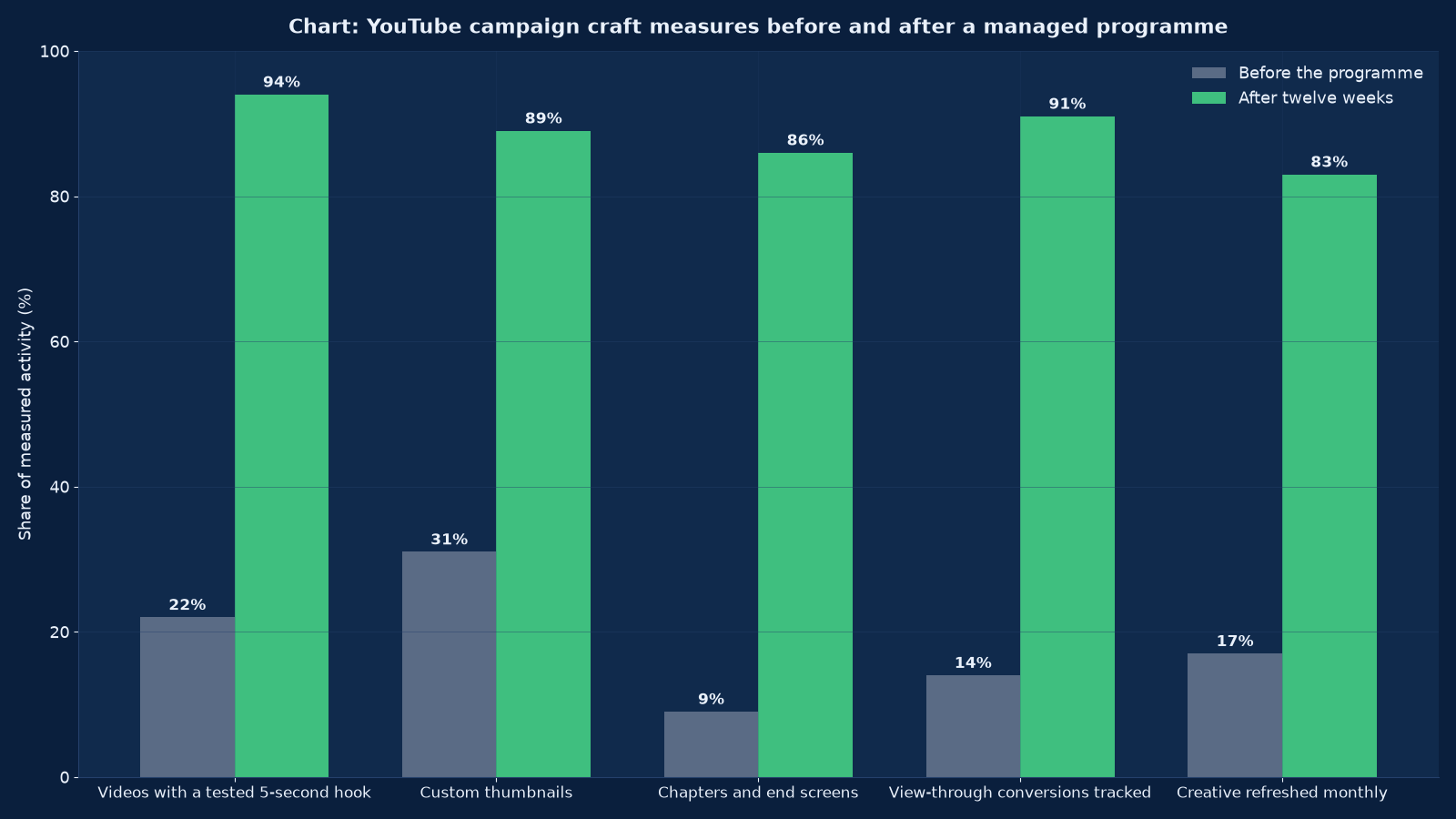
Chart values are an illustrative planning model based on typical UMC engagements and published industry benchmarks. They are not a guarantee of results on any specific project.
Thumbnails and Titles: the Feed-Level Advertisement
| Element | Standard | Why |
|---|---|---|
| Legibility at small size | Readable at forty pixels wide, on a phone, in a crowded feed | A thumbnail that only works full size never gets clicked |
| One subject | A face, a product or a result — not all three | Two subjects split attention and halve the read |
| Contrast and colour | Strong separation between subject and background | The feed is mostly dark and mostly similar |
| Text on the thumbnail | Three words at most, and never a repeat of the title | The title and the thumbnail should add to each other, not duplicate |
| Title | Specific, benefit or curiosity shaped, under about sixty characters | Truncated titles lose the part that made them worth clicking |
| Face and emotion | Where a person appears, the expression is readable | Faces draw the eye and emotion carries the promise |
| Consistency across a series | A recognisable template for a channel’s recurring formats | Recognition compounds; novelty resets it |
| Testing | Two or three variants measured on click-through rate | A thumbnail chosen by preference is a guess with a budget attached |
Audiences: Custom Intent and the Rest
| Audience type | How it is built | The job |
|---|---|---|
| Custom intent | From the search terms people use when looking for a solution like yours, across Google properties | The highest-intent audience available on the platform, and the one most accounts skip |
| Custom segments | From the websites and apps your customers visit, or your own list of URLs | Competitive and category interception |
| Affinity | From long-term interests and viewing habits | Reach and upper-funnel awareness |
| In-market | From recent behaviour indicating an active purchase | Mid-funnel demand that is already moving |
| Remarketing | From video viewers, channel engagers and site visitors | The cheapest conversions available, and the audience most often starved of frequency |
| Customer lists | From your CRM, matched and refreshed | Exclusion, lookalike modelling and retention messaging |
| Lookalike and similar | From converters rather than from visitors | Prospecting with a seed that actually predicts value |
| Placement and topic | From specific channels, videos and topics | Precision where the category conversation happens |
Audiences are built with a stated purpose each, and the purpose is written into the naming convention. An account with forty audiences and no purposes cannot tell you which decision produced which result, and every subsequent optimisation is guesswork dressed as data.
Campaign Structure by Funnel Stage
| Stage | Formats | Audiences | Objective | The measure that decides it |
|---|---|---|---|---|
| Awareness | Bumper, non-skippable, masthead where justified | Affinity, broad, custom segments | Reach and frequency | Reach against the target audience, and recall where a lift study is justified |
| Consideration | Skippable in-stream, in-feed | Custom intent, in-market, placement | Video views and site traffic | Five-second rate, hold rate and click-through |
| Conversion | Skippable in-stream, Shorts, search | Remarketing, customer lists, custom intent | Conversions with a value where one exists | Cost per conversion and the blended return |
| Retention | In-stream and Shorts to existing customers | Customer lists and purchasers | Repeat purchase, renewal or cross-sell | Revenue from the existing base, reported separately |
| Always-on discovery | Search and in-feed at a modest budget | Custom intent, remarketing | Continuous capture of active demand | Cost per conversion at low volume, watched for drift |
The stages are separated in the account rather than blended into one campaign, because a campaign optimised for conversions will spend nothing on awareness, and a campaign optimised for reach will spend nothing on conversion. Blending them produces a result that cannot be attributed to a decision.
Shorts: Discovery, Not a Discount In-Stream
| Question | The answer we work to |
|---|---|
| What is Shorts actually for? | Discovery and volume: reaching a mobile, younger, fast-scrolling audience with a native vertical format, and feeding the account conversion data it would not otherwise get. |
| Can we reuse in-stream creative? | Only if it was shot vertically and cut for a silent first frame. Letterboxed horizontal creative underperforms and the audience can see the compromise. |
| How is it measured? | Hold rate, engagement, click-through where a link exists, and assisted conversion. Direct last-click attribution systematically understates it. |
| How much budget? | In Figure 1 it grows from 12 to 28 per cent of spend across four quarters as the creative pipeline matures. Starting there is a mistake; ending below it leaves discovery unserved. |
| Does it cannibalise in-stream? | It reaches behaviours in-stream cannot, so the honest test is incremental: hold one campaign off and compare, rather than reasoning from platform reports. |
| What about the organic channel? | Shorts published organically build the channel’s audience and become the raw material for paid amplification, exactly as organic posts do elsewhere. |
Production: Getting Video Made at Volume
| Route | What it produces | Cost shape | Best for |
|---|---|---|---|
| In-house with a template system | Weekly output at consistent quality | Fixed effort, low marginal cost | Businesses with a person on camera and a repeatable subject |
| Creator collaboration | Native delivery with borrowed trust | Per creator, per usage term | Categories where peer voice beats brand voice |
| Studio shoot days | A quarter’s assets in two days | Lumpy, high per day, low per asset | Launches, product ranges and evergreen explainers |
| Screen and demonstration capture | Product walkthroughs and tutorials | Very low | Software, services and anything with an interface |
| Customer and case interviews | Proof-led video with a named outcome | Moderate, and gated by consent | B2B, healthcare, professional services |
| Archive re-cutting | New hooks and edits from existing footage | Low | Businesses with years of footage and no hook library |
| Animation and motion | Explainers for abstract subjects | High per asset, long life | Complex processes, data and concepts with no visual |
The production route is chosen against the refresh requirement rather than against taste. A programme that needs monthly refresh cannot be built on quarterly studio shoots, and one that needs evergreen explainers should not be built on creator content whose usage term expires.
Frequency, Exclusion and Brand Safety
| Control | Setting | The risk it manages |
|---|---|---|
| Frequency cap | Per user per day and per week, by campaign objective | Irritation and wasted impressions on people who have already decided |
| Conversion exclusion | Purchasers and converters excluded from prospecting | Budget spent re-acquiring existing customers |
| Inventory filter | The suitability tier chosen deliberately, not left at default | Placement against content that damages the brand |
| Brand exclusion lists | Channels, keywords and topics excluded explicitly | Adjacency to content the business would not choose |
| Content suitability for advertisers | Reviewed per campaign, with the reasoning recorded | A default setting nobody has ever examined |
| View-through window | Stated and fixed, so results are comparable over time | A window changed mid-quarter, which makes every trend meaningless |
| Creative rotation | Tied to frequency and retention rather than to a date | Saturation reported as audience exhaustion |
| Negative keyword and placement review | Monthly, from the placement report | Cheap impressions from placements that produce nothing |
Measurement: View-Through, Lift and the Blended View
| Measure | What it captures | How we use it |
|---|---|---|
| Five-second view rate | Whether the hook held | The creative verdict, reported per variant |
| Hold and completion rate | Whether the argument was watched | Diagnoses the middle of the video, which the hook rate cannot see |
| Click-through rate | Whether the call to action was understood | Separated from conversion rate, which diagnoses the destination |
| View-through conversions | Conversions after seeing but not clicking | Reported with a stated window, and never added to clicks without saying so |
| Cost per conversion | Spend per objective event | The primary optimisation measure, by format and by stage |
| Brand lift | Recall, awareness and consideration among exposed viewers | Only where the budget and the sample justify a study, and reported as directional |
| Assisted conversions | The channel’s contribution inside multi-channel paths | The honest middle ground between last-click and view-through |
| Blended return | Total revenue against total spend across all channels | The number that decides the budget, because it cannot be argued with per channel |
| Organic and paid interaction | Channel growth, watch time and the paid amplification of organic winners | Whether the channel is building an asset or renting attention |
| Creative decay | Cost per result against frequency over time | The refresh trigger |
We report view-through conversions separately and say plainly what they are. A channel whose return depends on including them is a channel whose return has not been demonstrated, and we would rather present the narrower number and the argument for it than the larger number and the doubt.
The Twelve-Week Programme
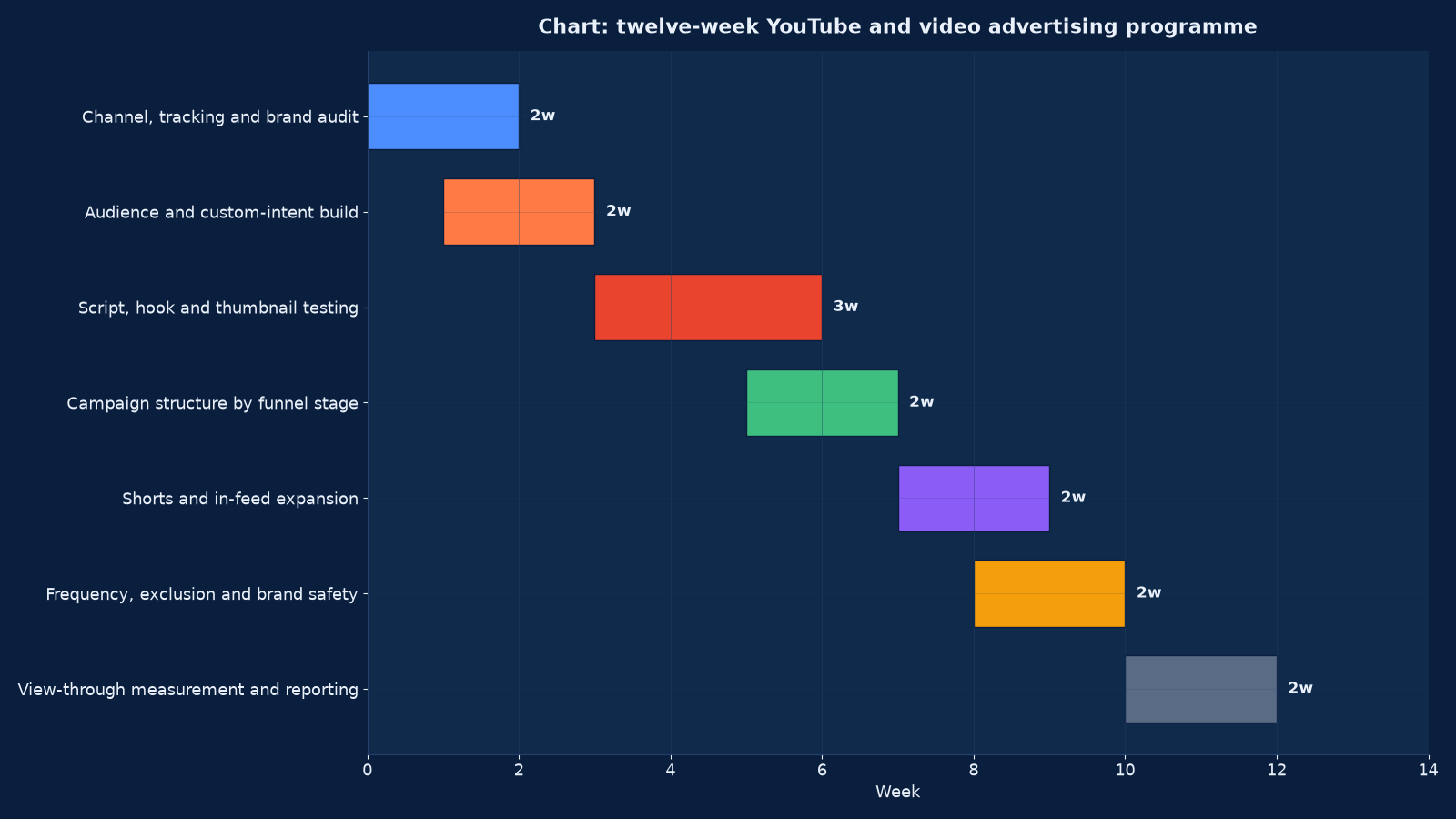
Chart values are an illustrative planning model based on typical UMC engagements and published industry benchmarks. They are not a guarantee of results on any specific project.
| Weeks | Workstream | Gate to pass |
|---|---|---|
| 1–2 | Channel, tracking and brand audit | Conversion events firing, view-through window agreed, brand settings reviewed |
| 2–3 | Audience and custom-intent build | Every audience with a stated purpose and a name that encodes it |
| 4–6 | Script, hook and thumbnail testing | Three to five hooks per concept tested, and a thumbnail variant pair measured |
| 6–7 | Campaign structure by funnel stage | Stages separated, formats matched to jobs, naming convention applied |
| 8–9 | Shorts and in-feed expansion | Native vertical creative live, with results reported separately from in-stream |
| 9–10 | Frequency, exclusion and brand safety | Caps, exclusions, inventory filter and exclusion lists set with the reasoning recorded |
| 11–12 | View-through measurement and reporting | A reporting model with the window stated, and the first monthly pack delivered |
YouTube for Different Objectives
| Objective | Format mix | Creative requirement | The measure |
|---|---|---|---|
| Launch awareness | Bumper plus non-skippable plus masthead where the budget justifies it | One idea, repeatable, with a recognisable visual | Reach against the target audience and recall |
| Product demonstration | Skippable in-stream plus search | The product in use, with the result visible | Hold rate through the demonstration and conversion |
| Considered purchase | In-stream plus in-feed plus remarketing | Objection handling, proof and a clear next step | Assisted conversions and cycle length |
| Local demand | Search plus in-stream with geographic targeting | The location, the offer and the response route | Calls, bookings and store direction requests |
| Recruitment and employer brand | In-feed plus creator collaboration | Real people and real work, not a values statement | Applications and the quality of the applicant pool |
| Retention and cross-sell | In-stream to customer lists | Recognition first, then the new thing | Revenue from the existing base |
| Education and authority | Organic long form plus search ads | Substance, chapters and a channel that answers the questions | Watch time, subscribers and inbound enquiries |
The Organic Channel as an Asset
| Asset | What it does between campaigns | The discipline |
|---|---|---|
| Evergreen explainers | Rank in search for years and answer the questions buyers ask | Chapters, transcripts and descriptions written for search, not for the algorithm |
| Playlists | Extend watch time and organise the library by buyer stage | A playlist per stage, with the strongest video first |
| End screens and cards | Route a viewer to the next useful video | Set on every video, which is why Figure 2 shows 9 per cent rising to 86 |
| Descriptions and metadata | Carry the links, the timestamps and the context | A template, so every video is consistent |
| Shorts published organically | Build subscribers and become paid creative | The same hook discipline as the paid versions |
| Comment handling | Answer questions publicly and build trust | A response standard, because the thread is read by prospective customers |
| Community posts | Keep the audience warm between uploads | Used sparingly and with a reason |
A channel with no organic library is renting attention at full price forever. The library is what makes the paid programme cheaper over time, because it supplies remarketing audiences, creative that has already been validated, and a destination that makes the click worth making.
Governance and the Refresh Cycle
| Cadence | Activity | Owner | Output |
|---|---|---|---|
| Weekly | Delivery, five-second rate, hold rate and spend checks | Us | Exceptions caught before they consume the week’s budget |
| Fortnightly | Per-creative results, refresh decisions, next shoot brief | Programme lead | A documented decision per video: scale, refresh, retire |
| Monthly | Format mix review, placement and negative review, frequency and decay check | Programme lead with the client | A revised format mix, in the shape of Figure 1 |
| Quarterly | Audience refresh, custom-intent rebuild, brand-safety review | Us | Audiences rebuilt from the last quarter’s converters |
| Annually | Channel review against the whole mix, and a production capacity review | Client with us | A budget decision taken on blended evidence |
Failure Modes We Are Called In To Fix
| What we find | Why it happened | What we do |
|---|---|---|
| Rising cost per view with no diagnosis | One format, one creative, running until exhausted | A format portfolio, a hook library and a refresh trigger tied to frequency |
| A corporate film bought as an advertisement | Marketing assets produced for the website and pushed into the channel | Ad-native scripts with a tested hook and a thumbnail designed for the feed |
| Conversions reported but nobody trusts them | View-through included silently and windows changed mid-quarter | A stated window, view-through reported separately, and a blended view alongside |
| No custom intent audiences | The account was built from affinity defaults | Custom intent from real search terms, and the results compared against affinity |
| Shorts running horizontal creative | Assets re-used without adaptation | Vertical production, and a rule against letterboxing |
| Purchasers still being advertised to | No conversion exclusion | Exclusions from customer lists and site converters, applied at campaign level |
| A channel with no organic library | Video treated as an advertising unit only | An evergreen series, playlists, chapters and end screens, built alongside the paid work |
| Brand safety left at default | Nobody has ever opened the setting | An inventory tier chosen deliberately, with exclusion lists and a monthly placement review |
YouTube and the Rest of the Stack
Video produced for this channel is the most reusable asset in marketing, provided it is made with the other destinations in mind. We plan production once and distribute deliberately.
- TikTok Advertising Management Services — the vertical short-form discipline that Shorts borrows from, and the hook testing that both channels share.
- Instagram Marketing Services — reels distribution of the same assets, edited for the platform rather than re-uploaded.
- Facebook & Meta Advertising Services — scaling proven video to an older and broader audience with different creative tolerances.
- LinkedIn Marketing Services — the B2B cut of the same argument, where the payload is credibility rather than desire.
- Google Ads Management Services — the search campaigns that catch the demand the video creates.
- Content Marketing Strategy Services — the editorial substance and the evergreen library the channel is built on.
- Influencer Marketing Services — creator selection, briefing, usage rights and measurement.
- Conversion Rate Optimisation (CRO) Services — the destination page, where a falling conversion rate usually lives rather than in the video.
- Analytics & Attribution (GA4) Services — conversion events, view-through windows, assisted paths and the blended return.
- Programmatic Advertising Services — video inventory beyond the platform, held to the same creative standards.
Evidence From Our Work
The engagements and writing below are published on this site, each described by the subject its own page documents. They are listed because YouTube programmes are usually commissioned by a business that has video assets and cannot make them perform.
- Video marketing for small businesses — how a small team produces video at the volume this channel requires, and which production routes suit which budget.
- Social media advertising for Green Hotel & Resort — a hospitality venue where atmosphere, place and people carry the video rather than a promotional script.
- Social media advertising for a Hyundai car dealership — dealership video demand generation, where the offer, the location and the response route decide the cost per walk-in.
- A fashion retail showroom: Google Ads and Meta Ads strategy — a product-led retail account where demonstration and refresh cadence decide the result.
- Social media management and paid social for a pan-African B2B industrial consultancy — a paid social and video programme for a professional B2B audience across several markets, where the payload is credibility rather than desire.
- Social media marketing strategies and best practices — the platform-selection and cadence decisions a video programme sits inside.
- Marketing attribution models: how to choose the right one — why view-through conversions must be reported separately and how a blended view settles the argument.
- Landing page optimisation: how to convert more visitors into customers — the destination that decides whether a video view becomes an enquiry.
- Digital marketing budgeting: how to plan, allocate and measure spend — how a video budget is allocated between production and media, which is where most programmes get it wrong.
- The digital marketing insight archive — further writing on video, social and measurement.
Frequently Asked Questions About YouTube Advertising & Video Marketing
Do we need a big production budget to advertise on YouTube?
No, and a large budget spent on one polished film is usually worse than a modest one spent on several tested videos. What the channel requires is a hook that holds for five seconds, a thumbnail that reads at forty pixels and a refresh cadence. Screen capture, a person on camera and re-cut archive footage all perform when they are briefed properly.
Why is our cost per view rising?
Almost always creative saturation: the same video reaching the same audience until frequency drives cost up. The fix is a refresh trigger tied to frequency and retention rather than to a calendar, plus a format portfolio so one format is not carrying the whole channel. Figure 1 shows in-stream falling from 54 to 33 per cent of spend as the other formats earned theirs.
What is custom intent and should we be using it?
An audience built from the search terms people use when looking for a solution like yours, across Google properties. It is the highest-intent audience available on the platform and the one most accounts never build, because the defaults are affinity audiences. We build it from your real keyword research and refresh it quarterly.
Are Shorts worth it for a serious business?
For discovery and volume, yes, provided the creative is genuinely vertical and native. In Figure 1 Shorts grows from 12 to 28 per cent of spend across four quarters. Letterboxed horizontal creative underperforms and should not be run at all; direct last-click attribution understates Shorts, so it is measured on hold rate and assisted conversion.
How do we prove YouTube is working when attribution is unclear?
With a stated view-through window reported separately from clicks, assisted-conversion data from the multi-channel view, and a blended return of total revenue against total spend. Where the budget justifies it, a brand lift study adds recall and consideration. We present the narrow number and the argument for the wider one rather than choosing whichever flatters the channel.
How long should our videos be?
As long as the argument needs and no longer, per format: bumpers six seconds, Shorts under a minute, in-stream usually between thirty seconds and two minutes for advertising, with longer organic videos serving search and authority. Completion rate by length band answers the question for your audience better than any general rule.
Should the ad and the organic channel be managed together?
Yes. The organic library supplies remarketing audiences, validated creative and a destination worth clicking to, and it keeps working between campaigns. Chapters, end screens, playlists and metadata are free and are the items most often skipped — in Figure 2 they rise from 9 to 86 per cent during a twelve-week programme.
How often do we need new creative?
Monthly for most accounts, tied to frequency and retention rather than to the calendar. A programme that ships quarterly sees cost per result rise from week three of each quarter, and the cheapest refresh is a new hook on the same payload rather than a new production.
Can we use creators instead of making videos ourselves?
Often effectively, especially where peer voice beats brand voice. Creators need vetting, a brief that leaves their delivery intact, usage rights in writing with a stated term, and measurement with a unique code so their result is separable from your own creative.
What about brand safety?
Choose the inventory tier deliberately rather than leaving it at default, maintain channel and keyword exclusion lists, review the placement report monthly, set frequency caps and exclude converters from prospecting. These are settings somebody has to open, and the reasoning is recorded so the next person does not undo it.
How does this work with our other channels?
Video produced once is distributed deliberately: vertical cuts for short-form platforms, the B2B cut for a professional audience, search campaigns to catch the demand the video creates, and a landing page tested for the traffic it now receives. We plan production against all the destinations at brief stage rather than re-editing afterwards.
What does it cost?
Quoted against production volume and channel complexity, with media spend separate and no percentage taken on it. A twelve-week build is a fixed fee; the standing programme is monthly and banded by the number of videos produced and the formats run.