TikTok has exploded from a dance app into a global advertising powerhouse with 1.8 billion monthly active users. TikTok ads deliver 50% lower CPMs than Facebook, 200%+ ROAS for e-commerce brands, and engagement rates that dwarf every other platform. For brands targeting Gen Z, Millennials, and increasingly Gen X, TikTok is no longer optional—it’s essential.
Our TikTok advertising services combine platform-native creative, data-driven targeting, and continuous optimization to deliver results that matter. Whether you’re an e-commerce brand leveraging TikTok Shop or a B2B company building awareness, we make TikTok work for your business.
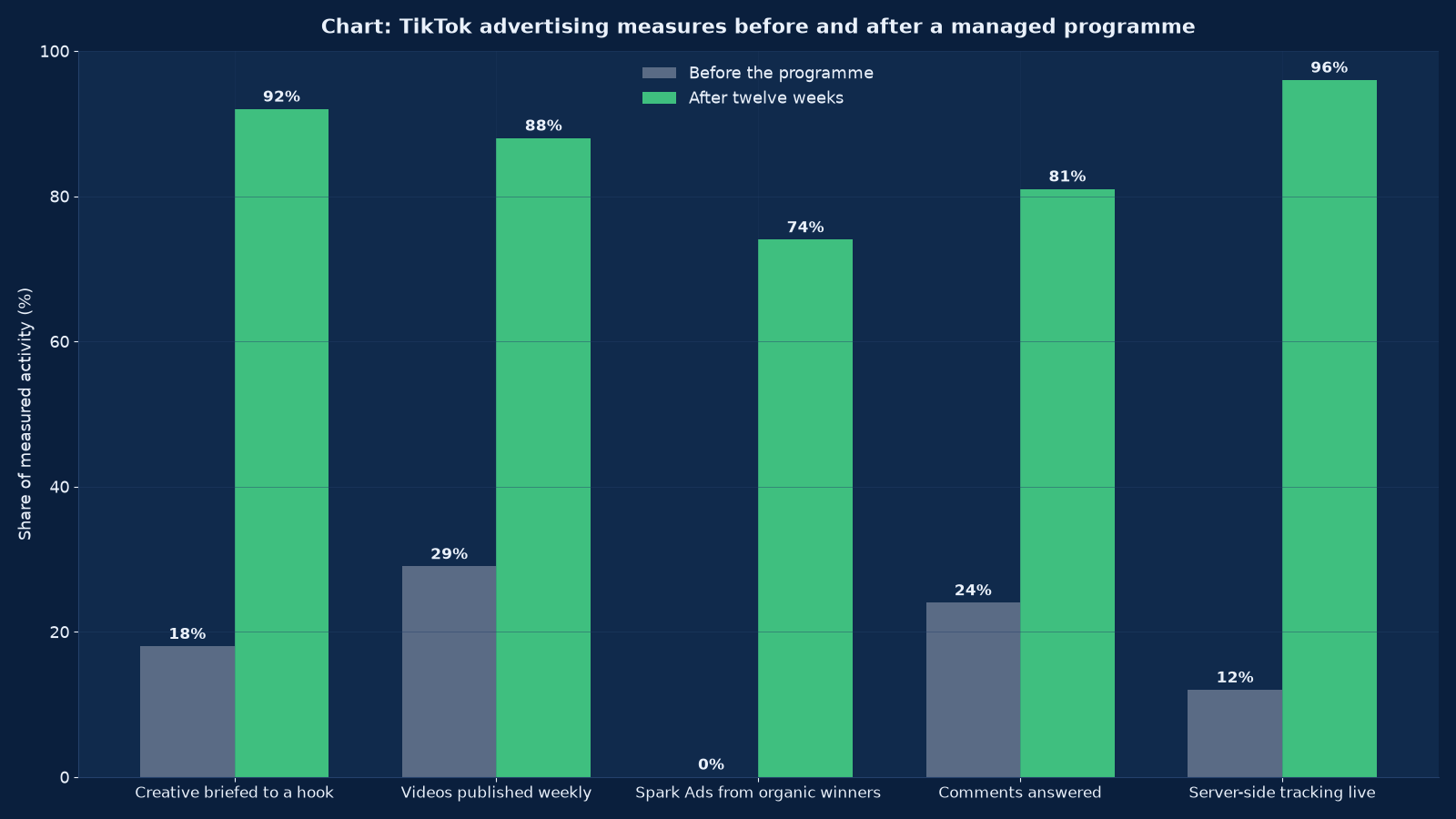
Chart values are an illustrative planning model based on typical UMC engagements and published industry benchmarks. They are not a guarantee of results on any specific project.
TikTok does not reward advertising that looks like advertising. It rewards a hook in the first second, a native format, a creator who belongs on the platform and a tracking setup that survives the signal loss. Accounts that fail usually fail on the first two and never discover that they are also failing on the last.
TikTok advertising management at Unified Management Consulting covers the whole short-form video channel: account and pixel setup with server-side events, creator and format research, creative briefs built around hooks, campaign structure and a testing plan, Spark Ads run against organic winners, scaling with frequency management, and reporting that treats creative as the variable it actually is. We run this for consumer brands, fashion and retail, hospitality, clinics, education, apps and marketplaces, for businesses entering the platform for the first time and for accounts that have been spending without a creative process.
The engagement is deliberately creative-led. On TikTok the media settings matter less than the volume and quality of native video, so the plan is built around a production cadence the client can sustain, a hook library that is tested rather than guessed, and an amplification rule that promotes what the organic audience already proved. Where a business cannot produce video internally, we build the pipeline with creators, templates and shoot days rather than asking them to invent one.
What This Service Actually Covers
The service covers tracking, creative production, media management and reporting. It is delivered as a twelve-week build followed by a standing programme, or as a creative-only engagement where the client runs the media internally.
| Component | What we do | What you keep | Duration |
|---|---|---|---|
| Account and tracking | Business Centre, ad account, pixel, events and server-side tracking | A tracking setup that survives browser signal loss | 1–2 weeks |
| Research | Category formats, sounds, structures and creator landscape | A format map with examples and the reasoning per format | 1–2 weeks |
| Creative briefs | A brief per video: hook, payload, proof, call to action | A brief template and a hook library | Ongoing |
| Production | Shoot days, creator collaborations, templates, editing | A weekly output the business can sustain after handover | Ongoing |
| Campaign structure | Objectives, ad groups, testing plan, naming | A structure where each creative’s result is separable | 1 week |
| Spark Ads | Organic winners promoted with creator authorisation | A tested creative library with performance evidence | Ongoing |
| Targeting | Broad, interest, behaviour, custom and lookalike audiences | An audience set with a stated purpose each | 1 week |
| Scaling | Budget increases tied to cost per result, refresh tied to frequency | A scaling rule rather than a reaction | Ongoing |
| Community | Comment handling to a standard, with escalation | A comment policy and a response time | Ongoing |
| Reporting | Per-creative results, refresh cadence, next wave briefs | A monthly pack that names which creative to make next | Monthly |
The output that matters most is the hook library and the refresh rule. Creative decays faster on this platform than on any other we manage, so an account without a documented production cadence is an account whose performance falls every month it stands still.
Why TikTok Behaves Differently From Other Paid Social
| Dimension | Conventional paid social | TikTok |
|---|---|---|
| What wins the auction | Targeting, bid and creative | Creative above everything; targeting is often best left broad |
| Creative format | Static, carousel, polished video | Native vertical video that looks made on the platform, not for it |
| Attention window | A few seconds in a feed | The first one to two seconds decide whether the video is watched at all |
| Creative lifespan | Weeks to months | Days to a few weeks before frequency drives cost up |
| Audience signal | Interest and behaviour targeting | Content affinity inferred from what the user watches, plus the For You feed |
| Social proof | Likes and comments as a secondary signal | The comment thread is read as part of the ad, and shapes its performance |
| Creator role | Optional | Often decisive: a creator’s native delivery outperforms brand delivery |
| Sound | Background | A primary structural element, including trending audio and voiceover |
| Measurement | Platform-reported click and conversion data | Heavy signal loss, so server-side events and a blended view are required |
The practical consequence is that a TikTok programme is a production programme with media attached. Budgeting it like a Meta campaign — a fixed set of assets refreshed quarterly — produces rising cost per result from week three onward, and the account looks “exhausted” when it is actually under-produced.
Tracking: the Prerequisite Nobody Wants To Pay For
In Figure 1 server-side tracking rises from 12 to 96 per cent. It is the least glamorous item in the programme and the one that decides whether optimisation is possible at all, because browser-side events are increasingly blocked, sampled or stripped.
| Layer | What it does | The failure without it |
|---|---|---|
| Business Centre and account structure | Holds the pixel, audiences, creator authorisations and permissions | Assets locked to an individual’s login, and an agency change that requires a recovery process |
| Pixel and events | Records view, add-to-cart, lead and purchase events | Optimisation against a proxy event, which buys volume rather than value |
| Server-side events | Sends conversion data from the server, matched by identifier | A conversion count that understates reality and a bidding model trained on missing data |
| Event deduplication | Browser and server events reconciled so nothing is double counted | Inflated conversions and an untrustworthy cost per result |
| Offline and CRM events | Qualified leads and closed deals returned to the platform | Optimising towards form fills rather than towards customers |
| Custom and lookalike audiences | Built from real converters and engagers | Audiences derived from site traffic that never converted |
| Attribution window agreement | A stated window and a stated view of blended results | Platform-reported return argued about every month |
| Consent handling | Tracking that respects the consent state of the visitor | A compliance exposure and unreliable data at the same time |
Creative: the Hook, the Payload and the Proof
Every video is briefed before it is shot. A brief has three parts, and accounts that skip the brief produce videos that are watchable and useless in roughly equal measure.
| Part | What it must do | How it is tested |
|---|---|---|
| The hook | Stop the scroll in under two seconds with a visual or verbal pattern break | Three to five hook variants per concept, judged on two-second view rate and hold |
| The payload | Deliver one idea: a demonstration, a transformation, a list, a story or a correction | Hold rate through the middle, and whether the comment thread reflects the idea |
| The proof | Show the product, the result or the person — not describe it | Click-through and conversion rate against the same hook with a weaker proof |
| The call to action | One action, stated verbally and on screen | Conversion rate per variant, not click rate alone |
| The format | A native structure: review, before and after, day in the life, three reasons, myth correction, response | Format-level performance across the account over time |
| The sound | Trending audio where it fits, or a voiceover carried by the creator | Watch-through and completion rate |
| The length | As long as the payload needs, which is usually shorter than the client expects | Completion rate and cost per result by length band |
| The caption and hashtags | Discovery and context, not keyword stuffing | Reach from non-followers |
- Shoot vertically, at the platform’s native aspect ratio, with the subject close to camera.
- Assume no sound for the first frame and no image for the first line: caption on screen, voiceover carrying the argument.
- Cast a real person. A face delivers a hook that a product shot cannot.
- One idea per video. Two ideas produce two half-watched videos.
- Never re-cut a horizontal advertisement and call it native. The audience identifies it in under a second and the comment thread says so.
- Keep a hook library: every hook that beat benchmark, with the video it came from and the result it produced.
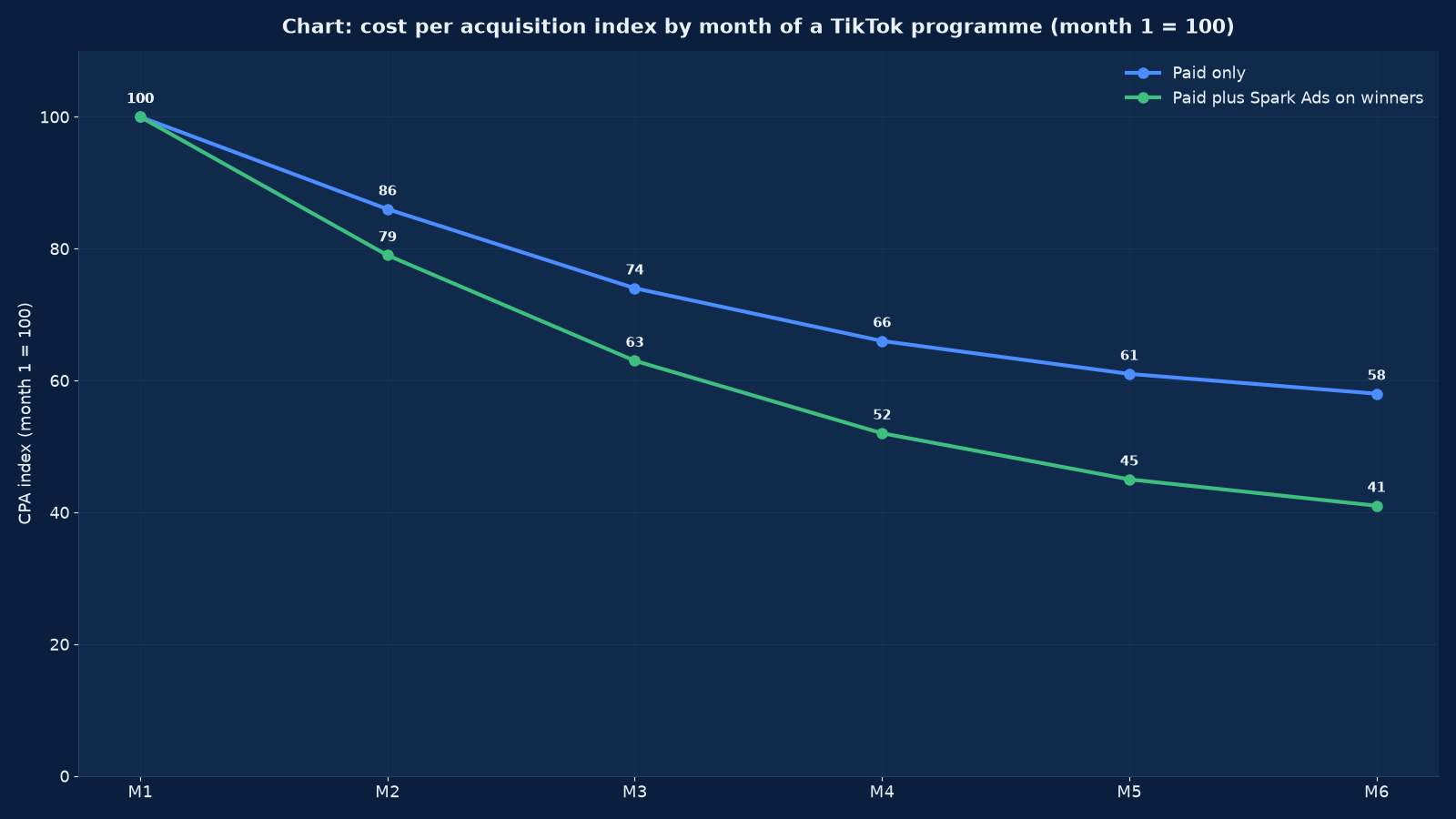
Chart values are an illustrative planning model based on typical UMC engagements and published industry benchmarks. They are not a guarantee of results on any specific project.
Spark Ads: the Highest-Return Mechanism on the Platform
Spark Ads promote an existing organic post, with the creator’s authorisation, so the engagement, the comments and the social proof travel with it. In Figure 2 that mechanism is worth roughly a third of the cost per acquisition by month six.
| Element | What is required | Why it matters |
|---|---|---|
| Organic publishing | A profile publishing weekly, so there are winners to promote | Spark Ads cannot be run on an account with no organic output |
| Creator authorisation | A code or permission from the creator whose post is promoted | Without it the post cannot be amplified, and using it unauthorised is a breach |
| Winner selection | A rule: engagement rate, hold rate or comments above the account’s benchmark | Promoting an average post spends money to prove nothing |
| Comment continuity | The original thread travels with the ad | The thread is social proof; a fresh ad unit starts from zero |
| Budget allocation | A fixed test allocation per winner, scaled on cost per result | Prevents one viral post consuming the month |
| Refresh | New winners entering as old ones saturate | The mechanism depends on a continuous organic pipeline |
| Reporting | Spark results reported against paid-only creative | Otherwise the two are averaged and the mechanism cannot be evaluated |
This is why our TikTok engagements include an organic publishing cadence even when the client only asked for advertising. Without it the most efficient mechanism on the platform is unavailable, and the account is left buying paid-only creative at a structurally higher cost.
Campaign Structure and the Testing Plan
| Layer | Design | The failure it prevents |
|---|---|---|
| Objective | One objective per campaign, matched to the funnel stage and to an event the pixel actually records | A traffic objective used for a conversion goal, which buys clicks |
| Ad groups | Separated by audience hypothesis or by creative set, never mixed | Results that cannot be attributed to a decision |
| Creatives per ad group | Three to five variants, each with a distinct hook | One video per ad group, which tests nothing, or twenty, which starves them all |
| Budget | Set at ad group level with enough volume to exit the learning phase | Budgets so small that no ad group accumulates the events needed to optimise |
| Targeting | Broad first, then interest and behaviour, then custom and lookalike | Narrow targeting applied before the creative is proven, which hides creative failure as an audience problem |
| Placements | TikTok-only unless there is a reason for the wider network | Cheap impressions from adjacent placements reported as channel performance |
| Naming | A convention that encodes objective, audience, creative set and date | An account nobody can read six weeks later |
| Exclusions | Purchasers and converters excluded from prospecting | Budget spent re-acquiring customers who already bought |
The testing plan is written before the first campaign: which variable is being tested, how many variants, what result decides it, and when the decision is made. An account without a written testing plan runs creative by preference and reports by anecdote.
Scaling and Frequency Management
| Signal | What it indicates | The action |
|---|---|---|
| Cost per result rising with frequency above three | Creative saturation | Refresh the creative; do not raise the bid |
| Click-through rate falling while hold rate is stable | The hook is stale even though the content still works | New hooks on the same payload, which is the cheapest refresh there is |
| Cost per result improving while spend is flat | The account is learning and the creative is resonating | Scale budget in steps of roughly a fifth, not by doubling |
| Comment sentiment turning | The audience has decided the ad is repetitive or inauthentic | Pause, read the thread, and change the approach rather than the budget |
| Conversion rate falling with stable click-through | The problem is downstream: the landing page or the offer | Stop scaling and fix the destination |
| A single creative carrying the account | Concentration risk | Brief variants around that creative’s hook and format immediately |
| Impressions rising with flat results | Audience exhaustion or placement drift | Review placements and exclusions before touching the creative |
Scaling on this platform is a creative problem expressed as a media number. The accounts that scale sustainably are the ones with a production cadence that keeps the hook library stocked, not the ones with the largest budget.
Creators, Branded Content and Rights
| Stage | What we do | The control |
|---|---|---|
| Fit assessment | Creators selected by audience overlap, engagement quality and past brand work, not by follower count | A written rationale per creator before contact |
| Vetting | Audience authenticity, content history and reputational risk reviewed | A vetting note, so the decision survives the person who made it |
| Brief | The hook, the payload, the must-say points, the do-not-say list and the usage rights | A brief the creator can work from without losing their own voice |
| Authorisation | Spark Ads codes and usage rights obtained in writing, with a term | No amplification of a post nobody authorised |
| Review point | One review before publishing, focused on claims and accuracy | One review, not a re-edit — over-editing destroys what made the creator work |
| Measurement | Reach, engagement, traffic, code redemptions and conversions per creator | A unique code or link per creator, so results are separable |
| Usage | Winning creator content reused in paid, on the site and in email within the granted term | Rights recorded with an expiry, so nothing is reused beyond its term |
| Disclosure | Paid partnership labels applied where required | A compliance position that protects the brand and the creator |
The Comment Thread Is Part of the Advertisement
On this platform prospective customers read the comments before they click, and the thread shapes both performance and reputation. Comment handling is therefore a media task, not a community afterthought.
| Comment type | Response standard | Why |
|---|---|---|
| A genuine question | Answered fully and quickly, by somebody who knows the answer | The answer is read by every subsequent viewer, so it works as social proof |
| Scepticism or a challenge | Answered honestly, with the limitation acknowledged where one exists | A defensive or deleted reply costs more than the challenge |
| A complaint | Acknowledged publicly, resolved privately, and logged | Public complaints handled well raise trust; handled badly they define the brand |
| Praise | Thanked, and used as evidence in the next brief | Praise names what the audience actually values |
| Trolling and abuse | Handled by a published policy: hidden, blocked or ignored | Improvised responses escalate |
| Creator-response video | Where a question recurs, answered in a new video | The most native and most effective response format there is |
| Competitor or spam | Removed where the platform allows, and never argued with | An argument with a competitor is content nobody wanted |
In Figure 1 the share of comments answered rises from 24 to 81 per cent. The measure is included because unanswered comments on a promoted post are visible to every person the advertising reaches.
The Ten-Week Programme
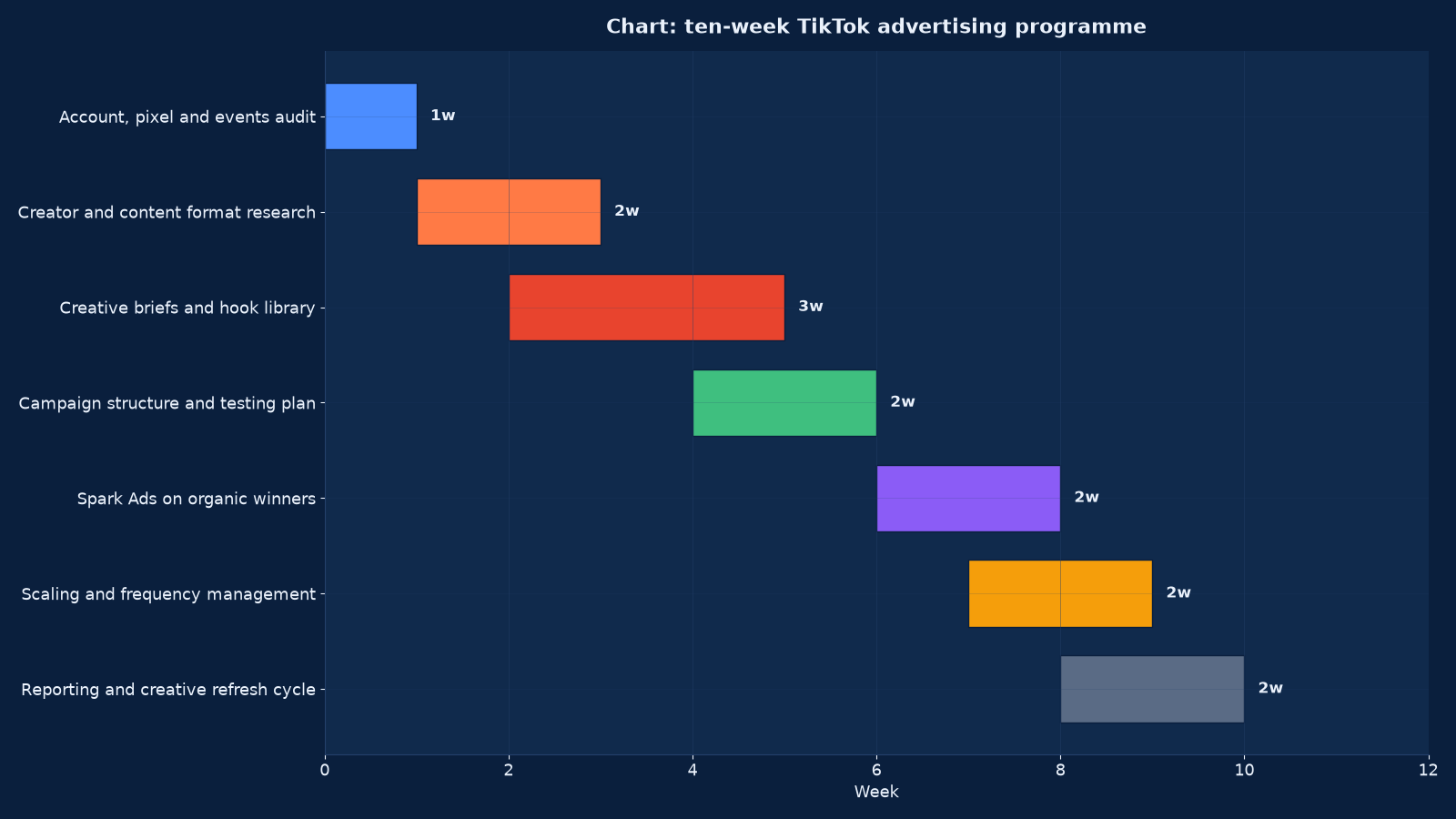
Chart values are an illustrative planning model based on typical UMC engagements and published industry benchmarks. They are not a guarantee of results on any specific project.
| Weeks | Workstream | Gate to pass |
|---|---|---|
| 1 | Account, pixel and events audit | Events firing, deduplicated, with server-side tracking live or scheduled |
| 2–3 | Creator and content format research | A format map with examples, and a creator longlist with fit rationale |
| 3–5 | Creative briefs and hook library | The first wave briefed and shot, with three to five hooks per concept |
| 5–6 | Campaign structure and testing plan | Structure live with a written testing plan and a naming convention |
| 7–8 | Spark Ads on organic winners | Authorisations obtained and the first winners promoted |
| 8–9 | Scaling and frequency management | A scaling rule and a refresh trigger tied to frequency, both documented |
| 9–10 | Reporting and creative refresh cycle | Per-creative reporting live and the next wave briefed from the results |
Ten weeks builds the machine. The following months are what produce the curve in Figure 2, because the cost advantage of an organic-plus-Spark model compounds as the hook library grows and the account accumulates conversion data.
Measurement: What to Report and What to Ignore
| Measure | Definition | How it is used |
|---|---|---|
| Two-second view rate | Share of impressions that held for two seconds | The hook verdict, and the fastest creative signal available |
| Hold and completion rate | Share watching through the payload and to the end | Whether the payload earns the attention the hook bought |
| Engagement rate | Likes, comments, shares and saves per view | Native resonance, and the input to Spark Ads selection |
| Click-through rate | Clicks per impression | Whether the call to action is understood |
| Cost per result | Spend per objective event, by creative and by ad group | The primary optimisation measure |
| Conversion rate | Results per click, and per landing session | Separates a creative problem from a destination problem |
| Frequency | Impressions per unique user | The refresh trigger |
| Blended return | Total revenue against total spend across channels | The honest view, because platform attribution understates and overstates in different directions |
| Creative productivity | Videos shipped per week, and the share that beat benchmark | Whether the production pipeline is working |
| Comment sentiment | Tone and volume of the thread | An early warning that no dashboard metric provides |
We report cost per result and creative productivity as the headline pair. Follower growth is reported and not managed to, because on this platform an audience built by advertising is worth considerably less than a creative pipeline that keeps producing winners.
TikTok for Different Categories
| Category | What works | What fails | The commercial path |
|---|---|---|---|
| Fashion and retail | Try-on, styling, transformation and creator reviews | Catalogue imagery set to music | Direct purchase, with a short cycle |
| Hospitality and food | Atmosphere, process, people and location | Polished promotional films | Booking or visit, with the location doing the convincing |
| Clinics and practices | Education, myth correction and the reality of the visit | Before-and-after claims that breach policy | A consultation booking, with trust built over several videos |
| Apps and digital products | Demonstration, use cases and creator-led walkthroughs | Feature lists read aloud | Install and activation, measured with server-side events |
| Education and courses | Outcome stories, sample teaching and objection handling | Institutional messaging | An enquiry or application, often with a long consideration |
| B2B and professional services | Expertise delivered natively, founder voice, sector commentary | Corporate advertising transplanted from LinkedIn | A considered enquiry; volume is low and value per lead is high |
| Local services | The team, the work, the area and the response | Generic brand advertising with no locality in it | A call or a booking, where response time decides the outcome |
Brand Safety, Policy and Reputation
| Risk | Control | Who owns it |
|---|---|---|
| Restricted claims | A do-not-publish list covering health, efficacy, financial and comparative claims, applied at brief stage | The approver, with a subject expert on technical claims |
| Trending audio and formats | Commercial-use rights checked before a sound is used in an ad | Production, verified before publishing |
| Creator conduct | Vetting before collaboration, and a clause covering conduct during the term | Us, with the client informed of any concern |
| Comment crises | A holding statement, one spokesperson and an escalation route | Community lead, with leadership briefed before any public response |
| Misinformation about the product | Corrected in the thread, and answered with a video where it recurs | Community lead with the subject expert |
| Data and consent | Tracking that respects consent state, with a retention rule | The data owner |
| Platform policy change | A monthly check of advertising policy against the current creative | Us, reported in the monthly pack |
| Underage audiences | Age targeting and category restrictions applied where the product requires it | Us, with the client’s compliance position recorded |
Governance and the Refresh Cadence
| Cadence | Activity | Owner | Output |
|---|---|---|---|
| Weekly | Creative shipped, campaign checks, comment handling, frequency review | Us, with the client’s approver | A weekly volume that keeps the hook library stocked |
| Fortnightly | Per-creative results, refresh decisions, next wave briefs | Programme lead | A documented decision per video: scale, refresh, retire |
| Monthly | Cost per result trend, blended return, creator performance, policy check | Programme lead with the client | A monthly pack and a revised production plan |
| Quarterly | Format research refresh, hook library review, tracking audit | Us | A format map updated against what the platform now rewards |
| Annually | Channel review against the rest of the mix | Client with us | A budget decision taken on evidence rather than on enthusiasm |
The refresh cadence is the governance item that decides whether the account is still working in month nine. Everything else can be recovered; a hook library that stopped growing in month three cannot be revived without a production restart.
Failure Modes We Are Called In To Fix
| What we find | Why it happened | What we do |
|---|---|---|
| Cost per result rising every month | The same creative running until exhaustion | A production cadence, a hook library and a refresh trigger tied to frequency |
| Video that looks like a television advertisement | Agency creative repurposed without adaptation | Native briefs, real people, and a rule against re-cutting horizontal assets |
| Conversions under-reported and bidding drifting | Browser-only tracking with no server-side events | Server-side implementation, deduplication and an event audit before any scaling |
| No organic presence, so no Spark Ads | Advertising treated as separable from the profile | A weekly publishing cadence and an authorisation process for creators |
| Narrow targeting hiding a creative problem | Targeting tightened when results fell | Broad targeting restored, creative tested properly, then audiences layered back |
| Comments unanswered on promoted posts | No community ownership | A response standard, an escalation route and the measure reported monthly |
| One creator carrying the whole account | Concentration risk not managed | A creator roster with performance history and new collaborations briefed monthly |
| Budget doubled after one good week | Scaling by reaction | A scaling rule in steps, with the learning phase respected |
TikTok and the Rest of the Stack
Short-form video is produced once and used across several channels. We plan the TikTok programme so the assets, the creators and the learning travel.
- Instagram Marketing Services — the same vertical video assets distributed as reels, with the platform-specific edit rather than a straight re-upload.
- Facebook & Meta Advertising Services — where proven short-form creative is scaled to an older and broader audience.
- YouTube Advertising & Video Marketing Services — Shorts, in-stream and the searchable long-form version of the same argument.
- Influencer Marketing Services — creator selection, vetting, briefing, authorisation and measurement.
- Social Media Marketing Services in Lucknow — the same programme for businesses whose customers are in this market.
- Content Marketing Strategy Services — the editorial substance that makes a payload worth watching rather than merely fast.
- Conversion Rate Optimisation (CRO) Services — the landing page where a click becomes a conversion, and where a falling conversion rate is usually located.
- Analytics & Attribution (GA4) Services — server-side events, deduplication and the blended view of return.
- Programmatic Advertising Services — video inventory beyond the platform, using the same creative standards.
Evidence From Our Work
The engagements and writing below are published on this site, each described by the subject its own page documents. They are listed because TikTok programmes are usually commissioned by a business that has tried the platform with re-cut advertising and found the cost per result rising.
- A fashion retail showroom: Google Ads and Meta Ads strategy — a product-led retail account where short-form creative, creator delivery and frequent refresh decide the result.
- Twelve months of social media management for a Maruti Suzuki showroom — a sustained local social programme, showing what a year of consistent native output produces for a single showroom.
- Social media advertising for Green Hotel & Resort — a hospitality venue where atmosphere, process and people carry the creative rather than promotion.
- Social media advertising for a Hyundai car dealership — dealership demand generation where the offer, the location and the response handling decide the cost per walk-in.
- Video marketing for small businesses — how a small team produces video at the volume short-form platforms require, without a studio.
- Social media marketing strategies and best practices — the platform selection and cadence decisions a TikTok programme sits inside.
- Influencer marketing for small businesses in Lucknow — creator selection, vetting and measurement in a market where audience authenticity varies widely.
- Digital marketing cost in Lucknow — the local budgeting context for a business testing a new channel.
- How AI is transforming digital marketing — where AI-assisted production genuinely speeds a creative pipeline, and where it produces material the audience rejects.
- The digital marketing insight archive — further writing on social, video and measurement.
Engagement Models and Commercials
TikTok work is quoted against creative volume and production complexity, with media spend separate, because on this channel the production is most of the effort and most of the result.
| Model | Best for | What you get | Indicative shape |
|---|---|---|---|
| Channel entry build | A business entering the platform | Tracking, research, briefs, hook library, structure, first wave of creative and the testing plan | Ten weeks, fixed fee |
| Managed programme | An ongoing channel with a stated creative volume | A stated number of videos per week, media management, comment handling, Spark Ads and monthly reporting | Monthly, banded by weekly creative volume |
| Creative only | A business that runs its own media | Briefs, production, hooks and a refresh cycle, delivered as assets with performance notes | Per video or monthly |
| Creator collaboration | A category where creator delivery outperforms brand delivery | Vetting, briefing, authorisation, Spark codes, measurement and rights | Per campaign or per creator |
| Tracking and measurement rebuild | An account whose numbers nobody trusts | Event audit, server-side implementation, deduplication, windows and a blended report | Three to four weeks, fixed fee |
| Account rescue | An account with rising costs and exhausted creative | A diagnostic, a production restart, a hook library and a refresh rule | Four to six weeks, fixed fee |
Media spend is the client’s and is quoted separately, with no percentage taken on it. Creator fees, production costs and any music or usage licensing are itemised in advance rather than absorbed into the fee, because they vary substantially by creator and by usage term.
Related Digital Marketing Services
These offerings are delivered alongside this service. Channel work is usually combined rather than bought separately: paid media with measurement, organic with content, and campaigns with the lifecycle that follows them. Most engagements start with a paid assessment or audit.
- Social Media Management (Organic) Services — Organic social media management: audits, content pillars, production pipelines, publishing, community standards, amplification and reporting
Frequently Asked Questions About TikTok Advertising
Is TikTok worth it for a business that is not a consumer brand?
Sometimes, and the honest answer depends on whether your buyers are on the platform and whether your subject can be shown rather than explained. B2B and professional services accounts work when an expert delivers native expertise; they fail when corporate advertising is transplanted unchanged. We assess the category before recommending a budget.
How much video do we need to produce?
Enough to keep a hook library stocked, which for most accounts means several videos a week rather than several a month. Creative decays in days to weeks here, and an account that ships monthly sees cost per result rise from week three. In Figure 1 weekly publishing rises from 29 to 88 per cent during a twelve-week programme.
What are Spark Ads and why do they matter?
They promote an existing organic post with the creator’s authorisation, so the engagement, comments and social proof travel with the ad. In Figure 2 the cost per acquisition index reaches 41 by month six with Spark Ads against 58 paid-only, and the gap widens because organic winners keep arriving.
Do we need creators, or can our team appear on camera?
Either can work; what matters is native delivery. A person from the business who is comfortable on camera often outperforms a creator with no category knowledge, and a creator outperforms a reluctant founder. We cast for delivery and test both.
Why does our tracking show fewer conversions than we actually get?
Because browser-side events are blocked, sampled or stripped. Server-side tracking with event deduplication is the fix, and it is a prerequisite rather than an improvement: a bidding model trained on missing data buys volume rather than value. In Figure 1 server-side tracking rises from 12 to 96 per cent.
How quickly will costs come down?
Month one is learning and production; improvement typically shows from month two and compounds to month six as in Figure 2. Accounts that expect a first-month return usually tighten targeting, which hides the creative problem and delays the fix.
Should we target narrowly to reach our customers?
Start broad. Narrow targeting applied before the creative is proven makes a creative failure look like an audience problem, and it starves the campaign of the events it needs to optimise. Custom and lookalike audiences are layered in once a creative has proved itself.
How do you handle comments, including negative ones?
To a written standard: questions answered fully and quickly, scepticism answered honestly with limitations acknowledged, complaints acknowledged publicly and resolved privately, trolling handled by policy. The thread is read as part of the advertisement, so unanswered comments on a promoted post are visible to everyone the advertising reaches.
Can we reuse our existing video assets?
Rarely without re-making them. A horizontal advertisement re-cut to vertical is identified by the audience in under a second, and the comment thread says so. Existing footage can be re-shot around, re-voiced and re-hooked, which is cheaper than a full shoot and works.
How do you measure return when attribution is unreliable?
With cost per result by creative, a stated attribution window, server-side events, and a blended view of total revenue against total spend. We report the platform’s number and the blended number side by side and explain the gap rather than choosing whichever flatters the channel.
What about brand safety and policy?
A do-not-publish list covering health, efficacy, financial and comparative claims applied at brief stage, commercial-use rights checked on trending audio, creator vetting before collaboration, disclosure labels where required, and a monthly policy check against the current creative.
What does it cost?
Quoted against weekly creative volume and production complexity, with media spend, creator fees and licensing itemised separately and no percentage taken on spend. An entry build is a fixed fee over ten weeks; the managed programme is monthly and banded by volume.
📋 TikTok Advertising Services — Quick Summary
At a glance: everything we deliver through our TikTok advertising services.
| Service | What We Do |
|---|---|
| Campaign Strategy | Audience research, creative strategy, budget planning, and funnel architecture for TikTok |
| Video Creative | Native-style TikTok video ads, UGC content, creator partnerships, and Spark Ads |
| Ad Formats | In-Feed Ads, TopView, Branded Hashtags, Branded Effects, and Spark Ads |
| Targeting | Interest, behavior, custom audiences, lookalikes, and TikTok Pixel retargeting |
| TikTok Shop | Product catalog setup, live shopping, affiliate programs, and shoppable videos |
| Influencer Partnerships | Creator identification, negotiation, campaign management, and performance tracking |
| Key Results | CPM 50% lower than Facebook, 200%+ ROAS for e-commerce, 9.5% engagement rate |
| Investment | $2,000-$10,000/month management + ad spend |
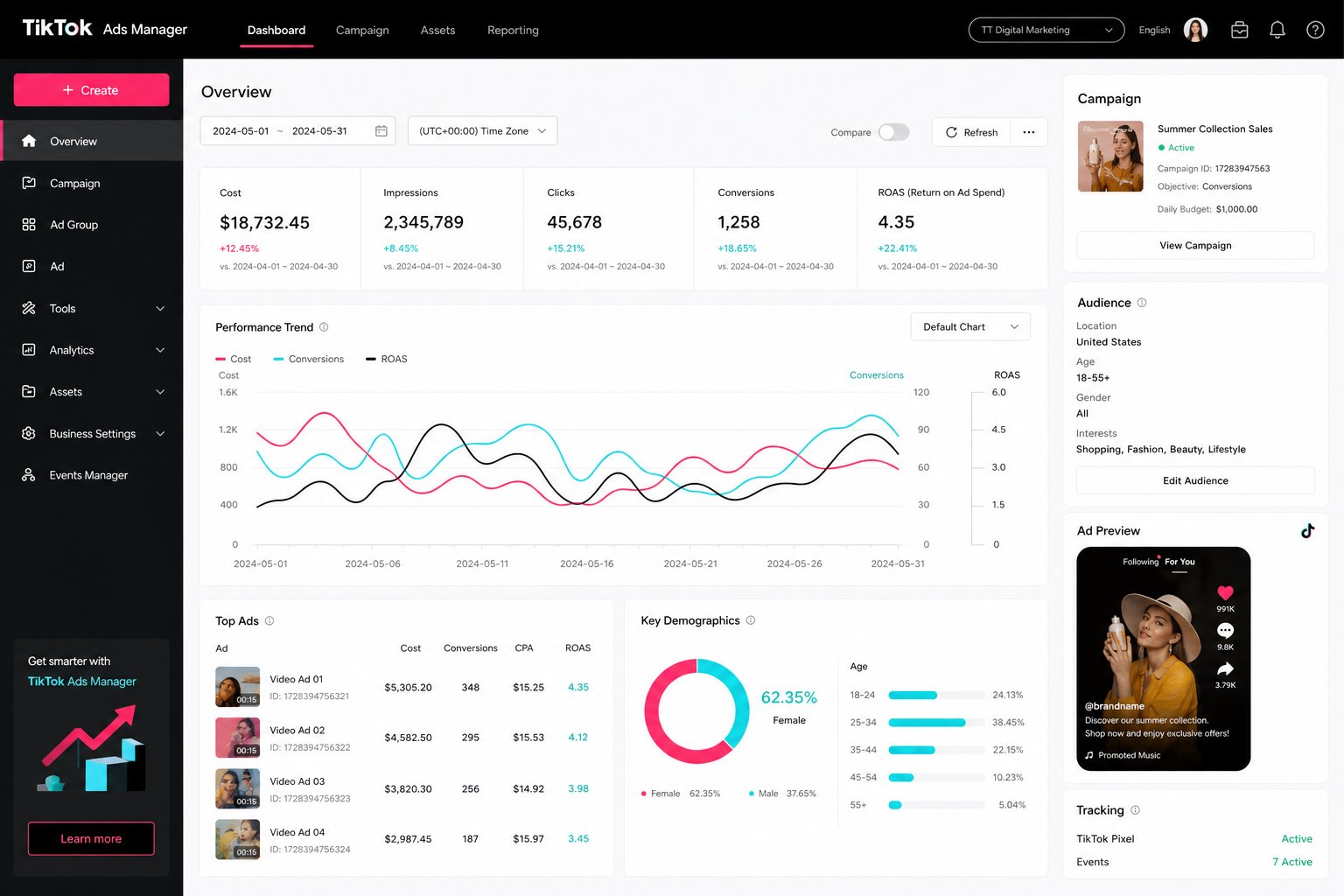
Why TikTok Advertising Is Essential
| Metric | Data | What It Means |
|---|---|---|
| Monthly active users | 1.8 billion | Massive global reach across demographics |
| Average daily usage | 95 minutes | Highest engagement of any platform |
| CPM vs Facebook | 50% lower | Significantly more affordable reach |
| Users who purchased after TikTok ad | 49% | TikTok drives real purchases |
| Average engagement rate | 5.53% | 10x higher than Instagram |
| TikTok Shop GMV growth | 300%+ YoY | E-commerce is exploding on TikTok |
Our TikTok Advertising Services
1. TikTok Campaign Strategy
- Audience Research: Deep analysis of your target audience on TikTok—interests, behaviors, creators they follow, and content they engage with
- Creative Strategy: Platform-native creative concepts that feel authentic to TikTok while delivering your brand message
- Funnel Architecture: Awareness → Consideration → Conversion campaign structure with appropriate ad formats at each stage
- Competitor Analysis: Audit of competitor TikTok advertising strategies, creative approaches, and engagement tactics
- Budget Planning: Strategic allocation across campaign objectives with performance-based scaling framework
2. TikTok Video Creative Production
- Native-Style Ads: Videos that look like organic TikTok content—authentic, entertaining, and non-intrusive
- UGC Content: User-generated content style videos with real people showcasing products naturally
- Hook Optimization: First 3 seconds designed to stop the scroll with bold visuals, questions, or pattern interrupts
- Trend Integration: Leveraging current TikTok trends, sounds, and formats for higher engagement
- Creative Variations: 5-10 variations per campaign for testing hooks, CTAs, formats, and messaging
- Spark Ads: Boosting existing organic TikTok content (yours or creators’) for authentic paid reach

3. TikTok Ad Formats We Manage
| Ad Format | Best For | Description |
|---|---|---|
| In-Feed Ads | Traffic, conversions, app installs | Native video ads in the For You Page feed |
| Spark Ads | Authentic reach, engagement | Boost existing organic posts or creator content |
| TopView | Brand awareness, product launches | First ad users see when opening TikTok |
| Branded Hashtags | UGC campaigns, viral challenges | Hashtag challenges that drive user participation |
| Branded Effects | Brand engagement, virality | Custom AR filters and effects users can apply |
| TikTok Shop Ads | Direct product sales | Shoppable video and live shopping ads |
4. TikTok Targeting & Audience Strategy
- Interest Targeting: 20+ interest categories from beauty to tech to finance
- Behavioral Targeting: Video interactions, creator interactions, hashtag interactions
- Custom Audiences: Website visitors (TikTok Pixel), app users, customer lists, engagement audiences
- Lookalike Audiences: Find new users similar to your best customers
- Creator Targeting: Target followers of specific TikTok creators
- Smart Performance Campaigns: TikTok’s AI-powered campaign type for automated optimization
5. TikTok Shop & E-commerce
- Shop Setup: Complete TikTok Shop configuration with product catalog, shipping, and payment setup
- Product Videos: Shoppable video content with product links and in-video purchase options
- Live Shopping: Live stream shopping events with real-time product showcasing and purchasing
- Affiliate Program: TikTok creator affiliate program management for performance-based partnerships
- Product Showcase: Optimized product listings with compelling images, descriptions, and reviews
6. Creator & Influencer Partnerships
- Creator Identification: Data-driven creator selection based on audience match, engagement rates, and brand fit
- Campaign Management: End-to-end management from outreach to content approval to performance tracking
- Spark Ads: Amplifying creator content through paid advertising for maximum reach
- Performance Tracking: Attribution of creator-driven traffic, engagement, and sales
TikTok Ads vs Other Platforms
| Metric | TikTok | YouTube | ||
|---|---|---|---|---|
| Avg. CPM | $5-$10 | $10-$15 | $10-$20 | $10-$25 |
| Engagement Rate | 5.53% | 0.60% | 0.15% | 1.63% |
| Best Demographic | 18-34 | 18-34 | 25-54 | 18-49 |
| E-commerce ROAS | 2-5x | 2-4x | 2-5x | 3-5x |
TikTok Advertising Results
- 50% lower CPM compared to Facebook and Instagram
- 200%+ ROAS for e-commerce brands using TikTok Shop
- 5.5% engagement rate—10x higher than Instagram
- 49% of users purchased something after seeing it on TikTok
- 300%+ growth in TikTok Shop GMV year-over-year
- 9.5% click-through rate on well-optimized Spark Ads
Frequently Asked Questions
How much should I spend on TikTok ads?
Start with $1,000-$3,000/month for testing, then scale winners. TikTok’s low CPMs mean you can reach thousands of users at a fraction of Facebook costs.
Is TikTok only for young people?
No. While 18-34 is the core demographic, 35-54 year olds are the fastest-growing segment. Many B2B and professional services brands succeed on TikTok.
Do I need to create TikTok-specific content?
Yes. TikTok rewards native, authentic content. Polished corporate ads underperform vs. genuine, entertaining content that feels like organic TikToks.
How does TikTok Shop work?
TikTok Shop allows users to discover and purchase products directly within the app through shoppable videos, live streams, and product showcase pages.
Can TikTok work for B2B?
Increasingly yes. B2B brands use TikTok for employer branding, thought leadership, and awareness among younger decision-makers entering the workforce.