Editorial note: This article is positioned as the practical companion to UMC’s more research-oriented AI content-format analysis, translating theory into editorial decisions teams can actually implement.
Content Formats That Earn AI Search Citations: A Practical Framework
Abstract
AI-powered search is changing how people discover information. Instead of receiving only a ranked list of web pages, users may receive synthesized answers with citations, recommendations, product information, local results, images, videos, and follow-up questions. This development has created a new practical concern for publishers and organizations: which content formats are most likely to be retrieved, cited, and trusted by AI search systems?
The answer is not a single format, word count, schema type, or optimization trick. Citation probability depends on the interaction between technical accessibility, topical relevance, source quality, entity clarity, user intent, evidence, freshness, authority, and the retrieval system used by a particular platform.
Google’s official guidance states that AI features in Search are rooted in core Search ranking and quality systems. It emphasizes valuable, non-commodity, people-first content; clear technical structure; high-quality images and video; and accurate local and ecommerce information.5 Academic work on Generative Engine Optimization has also explored how content modifications such as citations, statistics, quotations, fluency, and authoritative language can affect visibility in generative responses, although results should be interpreted as research evidence rather than a universal ranking formula.6
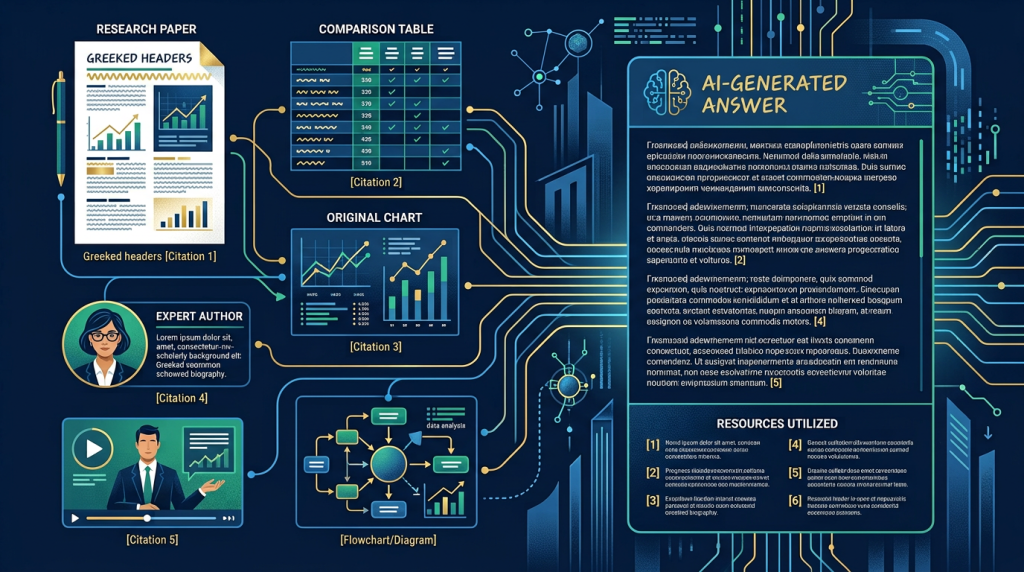
This article presents a scholarly and practical framework for the content types most likely to earn AI search citations, including original research, expert analysis, comparison tables, technical documentation, case studies, first-hand reviews, data visualizations, local content, product content, structured FAQs, and multimedia evidence.
1. What Is an AI Search Citation?
An AI search citation is a link, reference, source label, or attribution that connects an AI-generated answer to information retrieved from a website or other source. The citation may support a statement, statistic, recommendation, product attribute, comparison, local fact, or explanation.
A citation can perform several functions:
- Evidence: supports a factual claim.
- Explanation: provides additional context.
- Verification: allows the user to check the answer.
- Navigation: sends the user to a deeper resource.
- Recommendation support: explains why a product or provider is relevant.
- Authority signal: indicates that the source is considered useful or credible.
Citation does not necessarily mean that a page supplied the entire answer. AI systems may synthesize multiple sources. One page may contribute an original statistic, another may provide a definition, and a third may explain implementation details.
2. How AI Search Retrieves and Uses Content
AI search systems vary, but many use a retrieval-and-generation process. A system may interpret the user’s request, generate related searches, retrieve candidate documents, rank or filter sources, and then construct a response.
Google’s official documentation describes two relevant techniques:
- Retrieval-augmented generation: retrieving relevant and current pages from a Search index to ground an AI response.
- Query fan-out: generating multiple related searches to address different aspects of a complex question.5
This means that content should not be optimized only for one exact keyword. It should also cover the surrounding concepts, entities, questions, evidence, and decisions that make up the user’s information need.
A simplified citation pathway
User question or task
          ↓
Intent and entity interpretation
          ↓
Related query generation or retrieval
          ↓
Candidate source discovery
          ↓
Relevance, quality, authority, and freshness assessment
          ↓
Passage, table, image, video, or product selection
          ↓
Answer synthesis
          ↓
Citation, link, recommendation, or follow-up action
A page can improve its opportunity at several points in this pathway. It can become easier to discover, more relevant to the question, more authoritative as a source, clearer to interpret, and more useful after the user clicks.
3. A Citation Readiness Model
The following model is useful for evaluating whether a content asset is prepared for AI search citation.
| Citation factor | Core question | Practical evidence |
|---|---|---|
| Accessibility | Can the system discover and process the source? | Crawlability, indexation, rendering, stable URLs |
| Relevance | Does the source answer the actual user need? | Intent match, topic coverage, useful detail |
| Extractability | Can a useful claim be understood in context? | Clear headings, definitions, tables, direct statements |
| Evidence | Is the claim supported and verifiable? | Citations, data, methodology, examples |
| Distinctiveness | Does the page add information others lack? | Original research, experience, analysis, tools |
| Authority | Why should the source be trusted? | Expertise, reputation, references, reviews |
| Freshness | Is the information current? | Dates, updates, current prices, active links |
| Actionability | What can the user do next? | Product, service, booking, download, deeper guide |
A strong content asset does not need to maximize every factor equally. A breaking-news source may prioritize freshness. A technical standard may prioritize authority and precision. A local service page may prioritize verified business facts. A product page may prioritize structured attributes and availability.
4. The Top Content Formats That Earn AI Search Citations
Format 1: Original Research and Data Studies
Original research is one of the strongest citation candidates because it contributes information that cannot be obtained by merely summarizing other pages. It can include surveys, benchmarks, experiments, anonymized customer analysis, industry datasets, market studies, technical tests, or longitudinal observations.
Why it can earn citations
- It offers a unique source.
- It supplies quantitative evidence.
- It creates a reference point for other content.
- It can be cited for a specific fact or trend.
- It strengthens organizational authority.
Research page structure
- Research question.
- Population or dataset.
- Methodology.
- Sample size or coverage.
- Definitions.
- Results.
- Limitations.
- Interpretation.
- Visualizations.
- Downloadable data or methodology.
- Author and reviewer information.
- Publication and update dates.
Avoid publishing unsupported numbers simply because statistics appear citation-friendly. A number without a credible method may reduce trust rather than increase it.
Format 2: Expert Analysis and Original Point of View
Expert analysis interprets information through the lens of experience. It may explain why an industry change matters, how a policy affects operations, what a technical trade-off means, or which decision criteria are often overlooked.
Google’s guidance emphasizes a unique point of view and non-commodity content that goes beyond ordinary summaries.5
An expert article should make the author’s contribution visible. It should not simply repeat common advice. Include:
- The author’s role and experience.
- The problem observed in practice.
- The assumptions behind the conclusion.
- Evidence and examples.
- Alternative interpretations.
- Limitations.
- The conditions under which the advice changes.
Format 3: Comparison Tables and Buyer Guides
Comparison content is valuable because many AI search queries are decision-oriented. Users ask which platform, product, provider, method, or service is best for a particular situation.
A useful comparison table should identify evaluation criteria rather than declaring one universal winner.
| Evaluation criterion | Option A | Option B | Option C | Best fit |
|---|---|---|---|---|
| Implementation effort | Lower | Medium | Higher | Teams with limited resources |
| Customization | Medium | High | Very high | Complex requirements |
| Operating cost | Predictable | Usage-based | Variable | Budget-sensitive teams |
| Integration | Standard APIs | Broad ecosystem | Specialist connectors | Existing system fit |
| Support requirement | Low | Medium | High | Internal technical capacity |
The table should be accompanied by definitions, assumptions, date of assessment, evidence, and a nuanced explanation. Avoid comparison pages that simply place competitor names beside vague adjectives.
Format 4: Step-by-Step Guides and Procedural Content
Procedural content answers “how” questions. It can cover implementation, troubleshooting, setup, maintenance, compliance, migration, research, or operational workflows.
A citation-ready guide should include:
- Prerequisites.
- Tools and resources.
- Ordered steps.
- Expected results.
- Warnings and exceptions.
- Error handling.
- Screenshots or diagrams.
- Version and date information.
- Testing or validation steps.
- A recovery or rollback path.
Technical guides should be written by or reviewed by people who understand the process. A generic tutorial may be cited for a definition, but a tested guide can become a stronger source for implementation questions.
Format 5: Technical Documentation and Reference Pages
Documentation is highly structured and often addresses precise questions. It may include API references, product specifications, configuration instructions, error codes, integration requirements, data dictionaries, policies, and release notes.
Strong documentation has:
- Version control.
- Stable URLs.
- Clear navigation.
- Definitions.
- Examples.
- Prerequisites.
- Code or configuration samples.
- Error messages and solutions.
- Permissions and security notes.
- Deprecation notices.
- Update dates.
- Links to related concepts.
Documentation can be cited when an AI system needs an authoritative technical answer. It also improves the likelihood that users who click the citation find exactly what they need.
Format 6: First-Hand Reviews and Tested Evaluations
A first-hand review explains what was actually tested, by whom, under what conditions, and with what limitations. It is stronger than a generic list of features copied from a product page.
A credible review should state:
- Testing period.
- Version or product configuration.
- Use case.
- Evaluation criteria.
- Strengths and weaknesses.
- Observed results.
- Comparison basis.
- Conflicts of interest.
- Audience for whom the product is suitable.
- Audience for whom it is not suitable.
This format aligns with Google’s emphasis on experience and unique perspectives. The more specific the review, the more useful it is as a source.
Format 7: Case Studies and Implementation Stories
Case studies connect a problem, intervention, process, and outcome. They can be cited for evidence about how a solution worked in a real context.
A strong case study includes:
- Customer or organizational context.
- Initial problem.
- Constraints.
- Options considered.
- Implementation process.
- Timeline.
- Measured outcomes.
- Unexpected issues.
- What changed after implementation.
- Limitations and transferability.
Avoid vague case studies that say a client “transformed” without showing the baseline, method, time period, and outcome. Quantified results should be defined and supportable.
Format 8: Definitions, Glossaries, and Concept Explainers
Definition content is useful for foundational questions. A strong definition page does more than provide a one-sentence meaning. It clarifies what the concept includes, what it does not include, how it works, why it matters, and how it compares with related terms.
Recommended definition structure:
- One-sentence definition.
- Plain-language explanation.
- Technical explanation.
- Example.
- Related terms.
- Common misunderstanding.
- Practical application.
- Limitations.
- Further reading.
Definitions are often cited as a concise source. They should be accurate, stable, and reviewed by someone with subject expertise.
Format 9: Original Charts, Diagrams, and Data Visualizations
Visual content can earn visibility in image and video systems and can make complex information easier to interpret. Google’s official guide specifically notes that high-quality, relevant images and video create additional opportunities to appear in generative AI search experiences.5
Useful visuals include:
- Original research charts.
- Process diagrams.
- Architecture diagrams.
- Decision trees.
- Timelines.
- Maps.
- Product comparisons.
- Before-and-after visuals.
- Funnel diagrams.
- Annotated screenshots.
- Technical illustrations.
A chart should include a title, units, timeframe, source, definitions, and a meaningful interpretation. Do not turn important information into an image-only graphic; provide an accessible text explanation as well.
Format 10: FAQs With Real Questions and Complete Answers
FAQ sections can improve usability when they answer genuine customer questions. They are particularly useful at the end of service pages, product pages, technical documentation, and decision guides.
A strong FAQ answer should:
- Answer the question directly.
- Explain relevant conditions.
- Avoid unsupported guarantees.
- Link to deeper information.
- Use terminology consistently.
- Identify when the answer changes.
- State limitations.
Do not create hundreds of near-identical FAQs to target every keyword variation. Google’s guidance warns against content created at scale primarily to manipulate rankings or generative search responses.5
Format 11: Product Pages and Structured Commerce Content
Product pages can be cited when users ask what a product does, who it is for, how it compares, what it costs, or whether it is available.
A complete product page should include:
- Product name and identifiers.
- Core attributes.
- Use cases.
- Compatibility.
- Specifications.
- Price and currency.
- Availability.
- Shipping and returns.
- Warranty.
- Reviews.
- Images and video.
- Alternatives or comparison information.
- Product structured data.
- Merchant Center data where applicable.
- Clear purchase or enquiry path.
Keep product data consistent across the website, feeds, marketplaces, reviews, and business profiles. Inconsistencies reduce customer trust and may create inaccurate AI summaries.
Format 12: Local Guides and Service Pages
Local AI search frequently depends on business information, reviews, service areas, hours, categories, and local relevance. Local pages should provide real information about what the business offers and where it operates.
Include:
- Accurate name, address, phone, and website.
- Services provided.
- Service area.
- Opening hours.
- Appointment or call options.
- Local team or expertise.
- Customer reviews.
- Photos and video.
- Accessibility or parking details where relevant.
- Pricing or estimate information where appropriate.
- LocalBusiness structured data.
- Google Business Profile consistency.
Do not create false location pages. Local content should reflect real operations and customer experience.
5. Content Types by Search Intent
The best format depends on the question. A research report may be appropriate for a statistical claim, while a product page is appropriate for availability and price.
| Search intent | Citation-friendly content type | Essential properties |
|---|---|---|
| “What is…” | Definition, glossary, explainer | Accuracy, clarity, example |
| “Why does…” | Expert analysis, research, explanation | Evidence, causal caution, context |
| “How do I…” | Step-by-step guide, documentation | Prerequisites, steps, validation |
| “Which is best…” | Comparison, buyer guide, decision table | Criteria, assumptions, trade-offs |
| “Is it worth it…” | Case study, review, cost-benefit analysis | Experience, numbers, limitations |
| “Where can I…” | Local page, business profile, directory | Location, availability, reviews |
| “What should I buy…” | Product guide, catalogue, review | Attributes, price, stock, fit |
| “How much…” | Pricing guide, calculator, data study | Method, assumptions, date |
| “What happened…” | News analysis, primary source, timeline | Freshness, sourcing, chronology |
6. Passage-Level Clarity Without Manipulative Chunking
AI systems may cite a specific section or passage, but this does not mean publishers should break pages into artificial fragments. Google states that there is no requirement to create tiny chunks for AI retrieval.5
The practical principle is contextual modularity:
- Each section should address one meaningful subtopic.
- The heading should describe the subtopic.
- The opening sentence should establish context.
- Important definitions should not depend on a hidden paragraph.
- Tables should include headings and units.
- Claims should identify dates and conditions.
- Internal links should support deeper reading.
A section should be understandable when encountered through a search result, but it should still belong to a coherent page.
7. The Role of Citations, Statistics, and Quotations
Academic and experimental research has investigated whether content modifications influence visibility in generative responses. The Generative Engine Optimization research literature has examined tactics including adding citations, quotations, statistics, fluency improvements, and authoritative language.6
These findings should be applied carefully:
- Cite sources because readers need verification, not merely to decorate a page.
- Add statistics only when they are relevant, accurate, and defined.
- Use quotations when a real expert statement adds authority or interpretation.
- Use authoritative language when the claim is supported, not to exaggerate confidence.
- Do not add citations to weak or irrelevant sources.
- Do not invent quotations or use anonymous “experts.”
Evidence hierarchy
Primary research or official data
              ↓
Peer-reviewed or methodologically transparent study
              ↓
Recognized industry organization
              ↓
Named expert analysis with relevant experience
              ↓
Documented case study or first-hand test
              ↓
General commentary or unsupported opinion
The appropriate source depends on the claim. Product specifications should come from reliable product documentation. Public-health claims require authoritative medical sources. Market observations should explain their data and limitations.
8. Authoritative Content Formatting
Citation-ready content should be easy to inspect. Use formatting that increases precision:
- Definitions.
- Lists.
- Tables.
- Numbered steps.
- Direct quotations.
- Source links.
- Data notes.
- Glossaries.
- Captions.
- Version information.
- “Updated” dates.
- Author and reviewer details.
Avoid formatting that hides important information in decorative graphics, popups, or inaccessible interfaces. AI systems and users should be able to find the substance of the claim.
9. Freshness and Content Maintenance
Freshness matters most when information changes quickly. Product prices, software features, legal rules, health recommendations, event dates, opening hours, statistics, and market conditions require review schedules.
Create a maintenance table:
| Content asset | Change risk | Review frequency | Owner |
|---|---|---|---|
| Product page | Price, stock, specification | Continuous or monthly | Ecommerce team |
| Technical documentation | Version and API behavior | Each release | Engineering |
| Local service page | Hours and service area | Monthly or on change | Operations |
| Research report | Data interpretation | Annual or new evidence | Research lead |
| Legal or policy page | Regulation and wording | Formal review schedule | Legal or compliance |
| Buyer guide | Market and product changes | Quarterly | Content owner |
An “updated” label should represent a meaningful review, not a date change with no substantive improvement.
10. Technical Requirements for Citation-Ready Content
Before evaluating content quality, confirm that the page is eligible to be found.
Technical checklist:
- Crawlable URL.
- Indexable page.
- Correct canonical.
- Successful status code.
- Accessible main content.
- Functional internal links.
- Accurate XML sitemap.
- No accidental noindex.
- JavaScript content available after rendering.
- Mobile-friendly layout.
- Fast and stable page.
- Clear title and headings.
- Relevant structured data.
- Valid images and video metadata.
- Secure HTTPS connection.
- No broken redirects.
- Working analytics and conversion tracking.
Technical quality does not guarantee citation, but technical failure can remove an otherwise valuable source from consideration.
11. Measurement: Does Your Content Earn AI Citations?
Citation measurement should combine direct observation with business analytics. Available reporting differs across platforms and can change over time.
Monitor:
- Citation frequency.
- Mention frequency.
- Position or prominence of the citation.
- Source-page relevance.
- Competitor citations.
- Description accuracy.
- AI-referred sessions.
- Engagement after referral.
- Leads and purchases.
- Branded search changes.
- Customer self-reported discovery.
- Search Console generative AI reporting where available.
Citation monitoring worksheet
| Prompt | AI surface | Brand included? | Source cited? | Source relevance | Accuracy | Conversion path |
|---|---|---|---|---|---|---|
| Category question | AI Overview | Yes/No | Yes/No | High/Med/Low | High/Med/Low | URL or none |
| Comparison prompt | AI Mode | Yes/No | Yes/No | High/Med/Low | High/Med/Low | URL or none |
| Local prompt | Search AI feature | Yes/No | Yes/No | High/Med/Low | High/Med/Low | Call/book/map |
| Product prompt | AI shopping result | Yes/No | Yes/No | High/Med/Low | High/Med/Low | Product page |
Prompt results vary by user context, location, date, and system. Treat monitoring as directional evidence, not a permanent ranking report.
12. A Scholarly Content Production Workflow
A citation-oriented editorial workflow can follow this sequence:
- Define the research or customer question.
- Identify the intended audience and decision.
- Review existing literature, sources, and competing explanations.
- Determine what original value the organization can provide.
- Gather data, expert input, examples, and evidence.
- Design the content format around user intent.
- Write a direct, accurate thesis or answer.
- Add methods, qualifications, and limitations.
- Add tables, diagrams, images, or video where useful.
- Provide references and related sources.
- Review for accuracy, bias, accessibility, and clarity.
- Publish with author, date, and ownership information.
- Measure search and business outcomes.
- Update when evidence or conditions change.
This process is more robust than producing content solely from a keyword list or an AI-generated outline.
13. The Highest-Value Content Portfolio
A mature organization should not depend on one blog format. Build a portfolio:
Original research ────────┐
Expert analysis ──────────┤
Technical documentation ──┤
Case studies ─────────────┤
Product and local pages ──┼──> Trusted source ecosystem
Comparison guides ────────┤
Visual assets ────────────┤
FAQs and support content ─┘
Each format serves a different question and strengthens the others through internal links, citations, expertise, and consistent entity information.
Key Takeaways
- AI search citations are links or references that support an AI-generated answer.
- There is no universal content format that guarantees citation.
- Original research and first-hand evidence create information that cannot be easily replaced by generic summaries.
- Expert analysis is valuable when it adds interpretation, experience, and transparent limitations.
- Comparison tables work well for decision-oriented queries when criteria and assumptions are clear.
- Technical documentation is valuable for precise implementation and product questions.
- Case studies connect claims to real context and measurable outcomes.
- Definitions and FAQs should answer genuine questions directly without creating thin pages at scale.
- Original charts, diagrams, images, and video expand opportunities beyond text citations.
- Product and local content require accurate feeds, profiles, prices, hours, reviews, and structured information.
- Clear structure helps users and retrieval systems, but artificial micro-chunking is not a requirement for Google.
- Citations and statistics should be accurate, relevant, and verifiable.
- Search visibility should be measured alongside referrals, leads, sales, and customer value.
- The strongest strategy is to become a source worth retrieving, citing, visiting, and trusting.
Conclusion
The top content formats that earn AI search citations share a common characteristic: they provide useful information that can be verified, understood, and connected to a real user need.
Original research supplies evidence. Expert analysis supplies interpretation. Comparison tables support decisions. Technical documentation answers precise questions. Case studies demonstrate experience. Product and local pages provide current facts. Visual content explains what text cannot. FAQs and definitions make foundational information accessible. Strong technical foundations make all of these assets discoverable.
The future of AI search will continue to change. Interfaces, models, retrieval systems, citation behavior, and measurement tools will evolve. Durable visibility will come from content that is original rather than generic, structured rather than confusing, authoritative rather than exaggerated, current rather than abandoned, and useful rather than created only to target a phrase.
The best AI-search content is not content written to impress a machine. It is content so useful, specific, and trustworthy that a search system has a reason to cite it.
Contact Unified Management Consulting for an AI search citation audit, content-format strategy, technical SEO review, original research program, or citation-monitoring framework.
Suggested SEO Metadata
SEO title: Top Content Formats That Earn AI Search Citations | 2026 Guide
Meta description: Discover the content formats most likely to earn AI search citations, including original research, expert analysis, tables, technical guides, case studies, visuals, products, and local content.
Suggested URL slug: /content-formats-that-earn-ai-search-citations/
Primary keyword: content formats that earn AI search citations
Secondary keywords: AI search citations, AI citation optimization, generative engine optimization content, AIO content strategy, answer engine optimization, AI Overviews content, GEO content formats, citation-ready content
Sources
- Google Search Central, “Optimizing your website for generative AI features on Google Search.” 5
- Aggarwal et al., research on Generative Engine Optimization and visibility methods in generative responses.
Related AI content-format resources
- How to Rank in AI Search Results — the broader implementation guide.
- What Are AI Overviews and How to Rank in AI Overviews on Google — platform context for citation-oriented content design.
- AI Overviews Optimization Checklist: Tactical Actions — implementation support for teams operationalizing these ideas.
- How to Measure and Grow Answer Engine Traffic — how to assess whether format changes improve outcomes.