
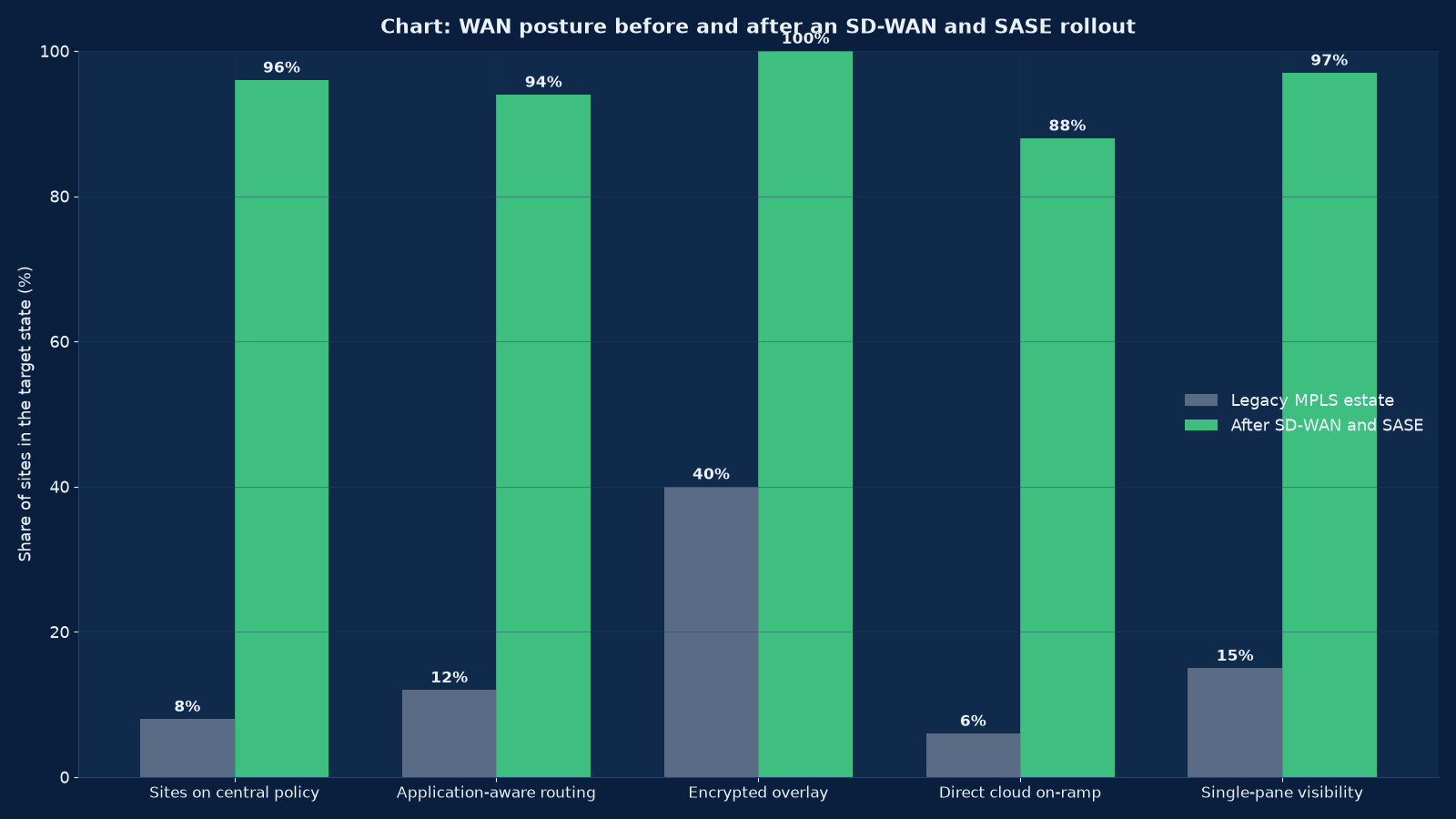
Chart values are an illustrative planning model based on typical UMC engagements and published industry benchmarks. They are not a guarantee of results on any specific project.
A traditional wide-area network routes packets. An application-aware one routes decisions, and the difference shows up in the two numbers a business actually feels: what a cloud application costs to reach, and what it feels like to use. Most estates bought multiprotocol label switching when the applications lived in their own data centre. The applications left. The WAN did not.
SD-WAN and SASE engineering at Unified Management Consulting is the redesign of a wide-area network for an estate whose applications are no longer where its users are. The software-defined layer separates the routing decision from the underlying circuits, so the network can choose a path per application, per session, on the basis of measured loss, latency and jitter rather than on a static prefix. The secure-access edge adds the security functions that used to live in a rack at each site — firewalling, filtering, inspection, identity — as a service reached from wherever the user actually is.
We deliver these programmes for organisations with distributed estates: retailers and hospitality groups with many small sites, healthcare with clinics and campuses, manufacturers with plants and warehouses, and any business that has moved applications to cloud and then discovered that its WAN sends traffic to a data centre that forwards it back out to the internet. That hairpin is the commonest and most expensive defect in a modern enterprise network, and it is invisible from any single site’s perspective.
🌐 SD-WAN & SASE — Quick Summary
| Component | What We Deliver |
|---|---|
| WAN assessment and traffic analysis | What every site actually sends, to which destinations, on which circuits, at what cost and with what experience — measured, not estimated from a circuit inventory. |
| Overlay architecture design | Hub, regional and full-mesh topologies compared against the application mix, with the underlay redundancy each site needs. |
| Circuit strategy | Which transports each site carries — fibre, broadband, wireless — and how the overlay uses them, including whether the expensive circuit can be reduced or removed. |
| Application policy design | Per-application routing, quality-of-service and steering rules, expressed as central policy applied to every site rather than as per-device configuration. |
| Cloud on-ramp design | Direct paths to the cloud regions and SaaS platforms the estate depends on, with the internet breakout points and their security consequences decided deliberately. |
| Secure access service edge scope | Which security functions move to the service edge, which stay local, and what happens to traffic when the service is unreachable. |
| Zero-trust alignment | Identity-based access applied at the WAN edge, with the segmentation the network can actually enforce. |
| Session border and voice handling | How real-time traffic is treated across the overlay, and where voice breaks out, which is not where data does. |
| Migration waves and cutovers | Sites grouped by risk and dependency, with per-site cutover windows, rollback and verification. |
| Visibility and operations handover | One view of path quality, application experience and security events, with the alert thresholds and runbooks the operating team will use. |
| Cost governance | Circuit spend, licence consumption and the five-year model, including what the estate stops paying for once the hairpin is gone. |
SD-WAN and SASE Are Two Things, and Programmes Confuse Them
The two terms are frequently used interchangeably and they are not the same thing. A software-defined WAN is a transport and policy architecture. A secure access service edge is a security delivery model. Many programmes are sold as one and delivered as the other, which is why estates end up with an elegant overlay and no security model, or a security service and a WAN that still hairpins.
| Dimension | SD-WAN | SASE | What a programme needs to decide |
|---|---|---|---|
| Primary problem solved | Path selection, circuit flexibility and central policy across sites | Delivering security functions from the cloud to users and sites wherever they are | Whether you have a transport problem, a security delivery problem, or both |
| What it replaces | Static routing over fixed circuits, and per-device configuration | Per-site security appliances and the backhaul that fed them | Which estate components are actually retired, and when |
| Where policy lives | A central controller applied to edge devices at each site | A cloud service, applied at the point where the user or site connects | Whether one policy set covers both, or two sets have to be kept consistent |
| What happens offline | The overlay usually degrades to local forwarding, and sites keep working | Security functions may be unavailable, so a local fallback has to exist | The failure behaviour at a site with no internet, which is a safety question in some sectors |
| Cost model | Circuit spend plus per-site licence or appliance | Per-user or per-site subscription, with consumption variables | Which spend goes down and which goes up, over five years |
| Typical first benefit | Better application experience and cheaper circuits | Consistent security for remote users and reduced appliance estate | Which benefit the business case is actually built on |
We design them together where both are needed, and separately where only one is, and we say which. A distributed estate whose users also work from anywhere usually needs both, with the overlay handling site transport and the service edge handling access — but the sequencing matters, because implementing security-as-a-service onto a WAN that still hairpins produces a service that inspects traffic arriving by an expensive route.
Assessment: Measuring the Traffic Before Choosing the Architecture
The case for an overlay is built on measurement rather than on dissatisfaction, because the dissatisfaction is always real and rarely diagnostic. Before any architecture is chosen we establish what the estate’s traffic actually does, which usually surprises the people who own it.
| What we measure | How | What it decides |
|---|---|---|
| Traffic composition by destination | Flow analysis at representative sites over a period that includes the worst week | Whether the applications are cloud, SaaS, data-centre or internet — and therefore whether a hairpin exists |
| Per-application experience | Latency, loss and jitter to each critical destination, trended rather than sampled once | Which applications are suffering, and whether the cause is the circuit, the path or the congestion |
| Circuit utilisation and cost | Actual utilisation against contracted bandwidth, with the monthly cost per site | Which circuits are oversized, which are undersized, and where the saving is |
| Path diversity | Whether a site’s circuits enter the building by diverse routes and from diverse carriers | The real resilience of each site, which is usually less than the contract implies |
| Peak-hour contention | Behaviour during the hour when the estate is busiest | Whether the problem is capacity or scheduling — and they have different solutions |
| Site-to-site dependency | Which sites talk to which, and what breaks if a hub is lost | The topology: full mesh, regional hub, or hybrid |
| Security posture per site | What inspection exists today, and where it is enforced | The SASE scope, and what has to remain local for sites with specific constraints |
| Change and fault history | Recurring WAN incidents and how long they took to diagnose | What visibility the operations team needs, which is a design requirement rather than a reporting preference |
The output is a traffic and cost baseline: which sites hairpin, how much of their spend buys a path to a data centre that forwards traffic back to the internet, and which applications are degraded by it. That baseline is what the business case is built on, and it is also what the programme’s success is measured against at the end.
Overlay Architecture: Topology, Hubs and Where Traffic Breaks Out
Topology is the decision that constrains everything else, and it is driven by where the applications are and how much latency the estate will tolerate. There is no correct default; there is a correct answer for a specific application mix.
| Topology | How traffic flows | Suits | The cost |
|---|---|---|---|
| Hub and spoke | All site traffic through one or two hubs | Estates whose applications are genuinely in one data centre, and where central inspection is required | Hub capacity and its resilience, plus latency for any cloud-bound traffic |
| Regional hub | Sites reach a regional hub, which reaches the core and the internet | Large distributed estates with geographic clusters of sites | More hubs to design and operate, and inter-hub capacity |
| Full mesh over the overlay | Any site reaches any site directly across the overlay | Estates with heavy site-to-site traffic — replication, shared applications, real-time collaboration | More tunnels to manage and more underlay capacity consumed |
| Cloud-first with local breakout | Internet and SaaS traffic leaves at the site; only data-centre traffic goes to the data centre | The majority of modern estates, where most traffic is cloud or internet bound | Security has to be delivered at the site or from the service edge, which is where SASE scope enters |
| Hybrid | Some sites break out locally, others backhaul, by policy | Estates with regulatory or operational reasons to treat sites differently | Two behaviours to design, test and document — but often the honest answer |
Underlay redundancy is not overlay redundancy
An overlay can only use the circuits underneath it, and a site with two circuits from the same carrier entering the building through the same duct has one physical path with two labels on it. We specify underlay diversity explicitly — different carriers, different entry routes, and where practical a wireless circuit as a third path for sites where an outage is unacceptable — because the overlay’s failover behaviour is only as good as the diversity underneath it.
Circuit Strategy: Where the Money Actually Comes From
Circuit strategy is where an overlay programme either pays for itself or does not. The mechanism is straightforward: if the overlay can steer traffic across whatever transports a site has, on the basis of measured quality rather than contracted tier, then some sites no longer need the most expensive circuit they have — and some sites need a second, cheaper one they do not have.
| Transport | Cost position | Behaviour on an overlay | Where it earns its place |
|---|---|---|---|
| Dedicated fibre or leased line | Highest | Excellent and predictable; carries the applications whose experience is contractual | Sites whose workload genuinely needs guaranteed capacity and latency |
| Business broadband | Much lower | Good enough for most traffic, with variable quality that the overlay can route around | The primary or secondary transport at the majority of distributed sites |
| Wireless — fixed or mobile | Moderate, with data considerations | Higher and more variable latency, but genuinely diverse | The third path at critical sites, and the only path where a fixed circuit cannot be delivered |
| Internet with a service edge | Low transport cost, subscription for the service | Security functions delivered from the cloud, with local breakout | Cloud and SaaS traffic that no longer needs to reach a data centre at all |
| Legacy multiprotocol label switching | Highest, usually under long contract | Can remain as one transport under the overlay during transition | The period while contracts expire, rather than as a permanent design |
The saving is real but it is not the whole case, and we present both. Reducing or removing expensive circuits at sites whose traffic is cloud-bound is usually the largest single financial benefit; the second is the removal of the hub capacity that existed only to forward that traffic. Neither should be claimed before the traffic baseline proves the hairpin exists, because estates that assume it and then measure it sometimes find that their traffic really is data-centre bound.
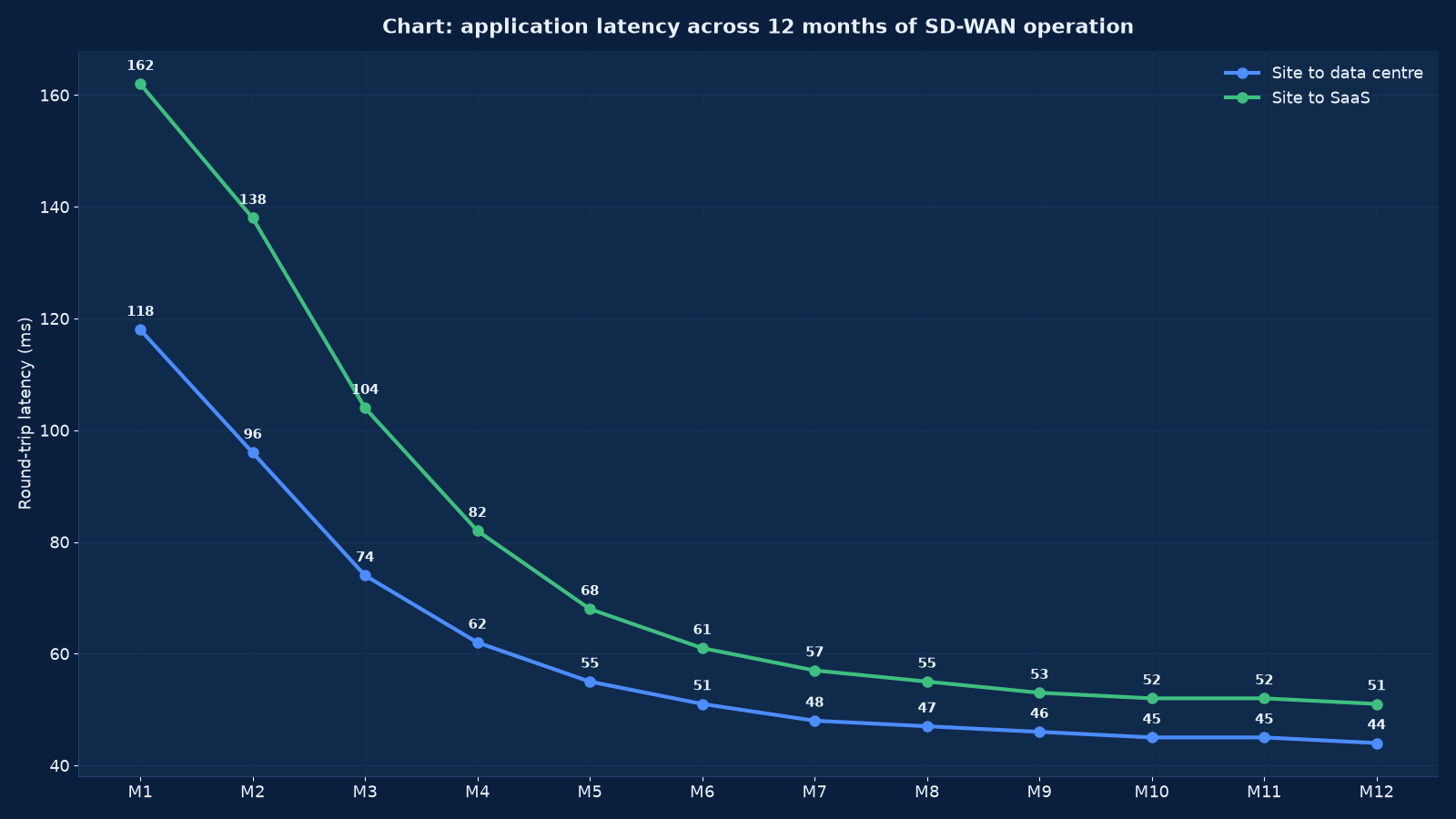
Chart values are an illustrative planning model based on typical UMC engagements and published industry benchmarks. They are not a guarantee of results on any specific project.
Application-Aware Policy: Written Once, Applied Everywhere
Application-aware policy is the operational heart of the overlay: the network recognises what a session is and treats it accordingly, instead of treating every packet as belonging to an address. Policy is written once, centrally, and applied to every site — which is also the risk, because a bad policy is applied to every site at once.
| Policy element | What it controls | Design discipline |
|---|---|---|
| Application identification | Which traffic is which application, including encrypted traffic identified by behaviour and destination | Verified against the estate’s actual applications rather than the vendor’s default list, which is always incomplete |
| Path preference | Which transport an application uses when several are available | Written as a preference with a measured quality threshold, not as a fixed route |
| Quality of service and prioritisation | How real-time traffic is treated when a path is congested | Prioritisation applied consistently end to end, including at the breakout, or it does nothing |
| Failover behaviour | What happens when a transport degrades or fails, and how fast | Tested per application class, with the detection time measured rather than assumed |
| Cloud on-ramp rules | Which destinations break out locally and which reach a cloud exchange | Decided per destination group, with the security consequence documented |
| Inspection scope | What is inspected, where, and what is exempted for performance or privacy | An explicit exemption list, because “inspect everything” is a design that fails under load |
| Change control | Who can alter policy, how it is tested and how it is rolled back | A staging site or virtual edge, and a versioned policy with a recorded change history |
We deliver policy as a documented set with an owner per rule group, which is the same discipline a firewall estate needs. A central controller makes policy changes fast, and fast unreviewed changes across every site simultaneously is the failure mode that turns an operational improvement into an incident with no local cause to find.
The Secure Access Service Edge: What Moves, What Stays, and What Happens Offline
Local internet breakout removes the hairpin and, with it, the security that used to be enforced at the point where traffic left the estate. That trade has to be made deliberately rather than inherited, and it is what the secure access service edge exists to answer.
| Function | Delivered from the service edge | Kept local at the site | The deciding question |
|---|---|---|---|
| Firewalling and filtering | Yes, for traffic breaking out to internet and cloud | East-west and site-local traffic, and anything that must not traverse the service | What must keep working when the service is unreachable |
| Threat inspection | Yes, at scale, with signatures and behaviour analysis updated centrally | Where latency or privacy constraints require it | Whether the latency of reaching the service edge is acceptable for that traffic |
| Data loss prevention and content control | Yes, closer to the cloud destinations the data is going to | Rarely | Whether the estate’s data leaves by paths that previously bypassed inspection entirely |
| Identity-based access | Yes — access decisions tied to who the user is rather than where they connect from | Device posture where the local network has to make an admission decision | Whether identity is reliable enough to be the control, which is a directory question before it is a network question |
| Remote user access | Yes, and this is where the model is strongest | Not applicable | Whether remote users currently reach the estate through a single concentrator that is both a bottleneck and a target |
| Operational technology and plant traffic | Generally no | Yes, isolated locally | Whether the traffic can tolerate a dependency on an external service at all |
The failure mode to design against is not compromise; it is unavailability. A site whose security functions live entirely in a cloud service stops working properly when that service or its connectivity is interrupted, so we specify the local fallback explicitly — what keeps running, at what reduced level of inspection, and who authorises the change. A fallback that exists only in a vendor’s architecture diagram is not a fallback.
Zero Trust and the WAN Edge: One Policy Artefact, Two Views
A zero-trust programme and an overlay programme meet at the same place: both require the network to make access decisions on something other than the address a packet arrived from. Delivering them separately produces two sets of policy that eventually contradict each other.
| Zero-trust requirement | What the WAN layer has to provide | Common gap |
|---|---|---|
| Identity as the primary control | The network must be able to tie a session to an authenticated identity at the point of access | Sites authenticating devices by network position, which survives nothing |
| Least-privilege access | Segmentation enforceable at the site edge, not only at the data centre | A flat site network where everything reaches everything |
| Assume breach | East-west traffic restricted, with lateral movement paths enumerated and closed | Segmentation designed for the perimeter only |
| Continuous verification | Device posture and session state re-evaluated, not checked once at connection | A posture check at logon and nothing after it |
| Explicit denial by default | Central policy that denies unless permitted, with a named owner per permission | Permissive rules accumulated by whoever needed access that week |
| Logging that supports investigation | Session-level records tying identity, device, application and path | Flow logs without identity, which cannot answer who did what |
We align the two designs so that the segmentation and admission model and the overlay policy are one artefact with two views, owned by the same process. Where an estate is running a security programme and a WAN programme separately, the most useful thing we can do is reconcile them before either is implemented, because reconciling them afterwards means changing a live estate twice.
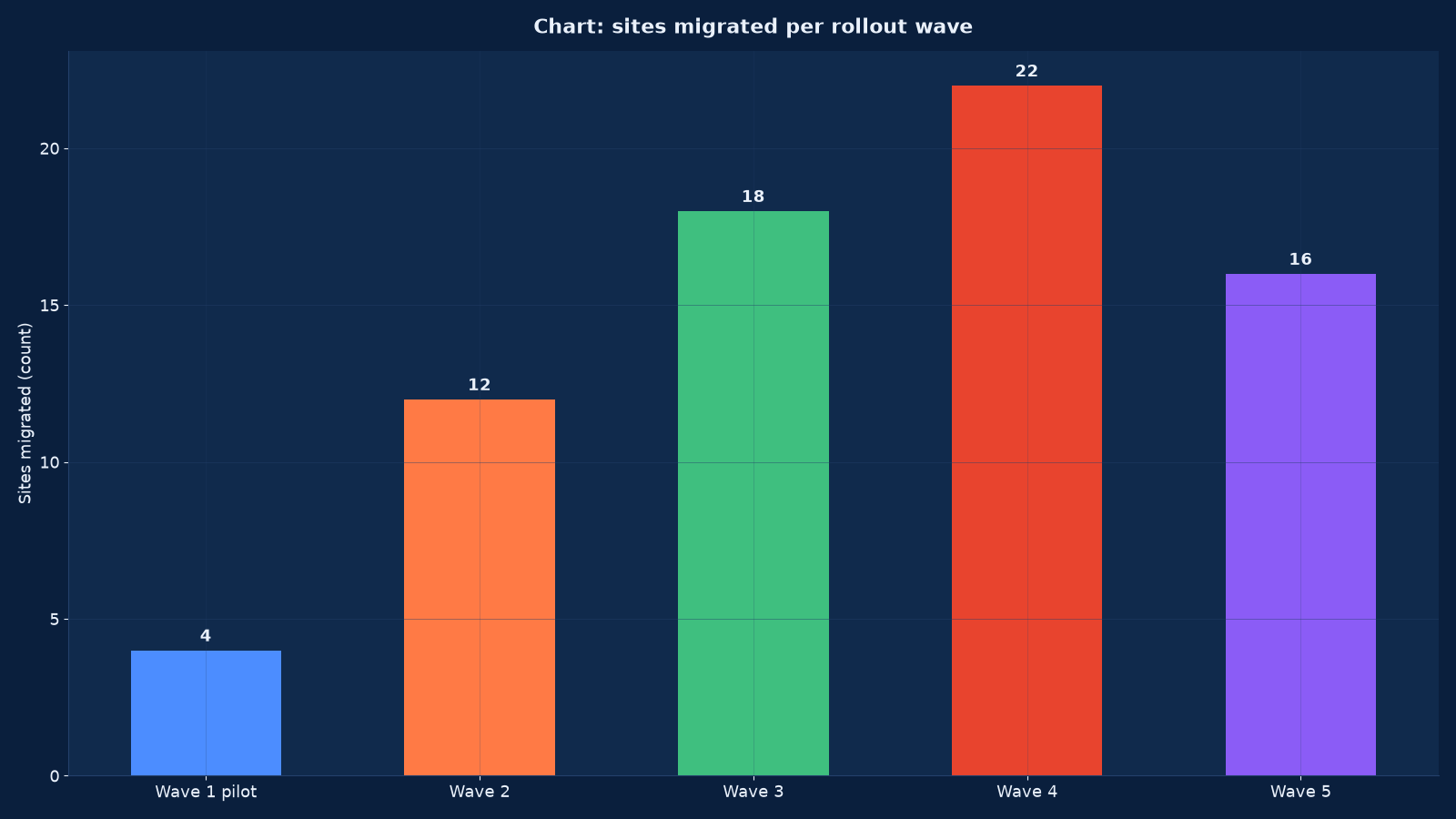
Chart values are an illustrative planning model based on typical UMC engagements and published industry benchmarks. They are not a guarantee of results on any specific project.
Rollout Waves: Grouping by Risk, Cutting Over with a Rehearsed Rollback
Rollout is where these programmes succeed or fail, and the difference is almost never technical. It is whether the estate was grouped by risk and dependency rather than by geography or by which sites were easiest, and whether each cutover had a defined rollback that somebody had rehearsed.
| Wave | Contents | Purpose | Exit criteria |
|---|---|---|---|
| Wave 0 — design proof | A staging edge plus two or three representative sites | Validate policy, failover behaviour and the operational process before production traffic depends on it | Measured failover times, policy tested against real applications, runbook written |
| Wave 1 — pilot sites | A small number of low-risk sites with a tolerant user community | Prove the cutover process and surface the estate’s specific surprises | Cutover inside the window, rollback rehearsed, and the plan revised on what was learned |
| Wave 2 — representative scale | The largest group of typical sites | Make the process repeatable and measurable at volume | Per-site duration stable, no site needing bespoke intervention |
| Wave 3 — dependent and higher-risk sites | Sites whose traffic depends on others, and those with real-time or operational technology constraints | Handle the migrations that cannot be treated as a copy of wave 2 | Dependency order respected, real-time traffic verified, plant isolation preserved |
| Wave 4 — the awkward remainder | Sites with unusual circuits, remote locations, regulatory constraints or legacy dependencies | Complete the estate without forcing these sites into a process built for typical ones | Each site’s specific constraint documented and satisfied |
| Wave 5 — decommission and reclaim | Legacy circuits and hub capacity reduced or removed | Realise the financial benefit the baseline predicted | Circuits surrendered with confirmation, cost reported against the baseline, hub capacity reclaimed |
Every cutover has a written rollback with a decision time: the point in the window after which the site reverts rather than continues to be fixed. Without that decision time, a cutover that goes badly becomes an all-night investigation on a site that is not working, which is the experience that turns a user community against a programme that would otherwise have been fine.
Voice, Real-Time Traffic and the Session Border
Real-time traffic does not behave like data on an overlay, and voice is where programmes most often discover this. The overlay’s ability to steer per application is an advantage for voice only if the steering is fast enough and the prioritisation is consistent end to end.
| Requirement | What the overlay has to do | What goes wrong otherwise |
|---|---|---|
| Latency budget | Keep one-way delay within the range conversational voice tolerates, on the path actually used | Calls that are technically connected and practically unusable |
| Jitter and loss handling | Prefer the transport with measured low jitter, and fail over on degradation rather than on outage | Audio breaking up during the seconds it takes to detect a failed circuit |
| Prioritisation consistency | Marking and queueing applied at the site, across the overlay and at the breakout | Prioritisation that stops working at the first hop that does not honour it |
| Breakout location for voice | Chosen against where the voice platform actually is, not where the data breakout is | Voice taking a longer path than necessary because it followed the data policy |
| Session border control | Sizing and placement matched to concurrent calls and to the signalling model | Call setup failures at peak, which appear only under load |
| Failover for voice specifically | A tested path that keeps calls working when the primary transport fails | A site that keeps its data and loses its phones |
| Quality measurement | Per-call and per-path quality recorded, not inferred from user complaints | A programme that cannot prove voice improved, or that it did not |
We design voice as a separate policy class with its own measurement, because the standard by which it is judged — a conversation — is unforgiving in a way that a file transfer is not. The estate’s telephony migration and its WAN programme should be sequenced together rather than run as two projects that meet by accident.
Visibility and Operations: Which Measurements Change Behaviour
An overlay produces far more telemetry than a traditional WAN, and most estates collect it without deciding what to do with it. The design question is which measurements change behaviour, because those are the only ones worth alerting on.
| What we monitor | Why it changes behaviour | Threshold principle |
|---|---|---|
| Per-path quality — latency, loss, jitter | It is what the steering decision is based on, so a degradation explains an experience change | Set per application class against its tolerance, not globally |
| Application experience | The measure the business recognises, and the one that justifies the programme | Trended against the pre-rollout baseline |
| Transport health per site | Detects a degrading circuit before it fails | Alerting on sustained degradation rather than on single samples |
| Failover events | Each one is a site that lost a transport, and repeated events mean a circuit problem | Any failover is recorded; repeats are investigated |
| Policy application state | Confirms every site is running the intended policy version | Any drift from the intended version alerts immediately |
| Security service availability | If inspection is delivered from the service edge, its availability is the site’s availability | Alerted against the documented fallback behaviour |
| Tunnel and session counts | Reveals capacity exhaustion before it produces an outage | Alerting at a forecast point rather than at the ceiling |
| Cost and consumption | Circuits and subscriptions consumed against the model | Reviewed monthly, with anomalies explained rather than absorbed |
These are the measurements a network operations function runs an estate on, and they belong in the same operating model as the rest of the network rather than in a vendor portal somebody checks occasionally. We hand over the thresholds and the runbooks with the design, because an overlay that nobody reads telemetry from is a traditional WAN with more licences.
How This Differs From Our Neighbouring Pages
An overlay sits on top of the physical network and alongside the security estate, and both relationships have to be designed rather than assumed.
| Your question | Right starting point | What it produces |
|---|---|---|
| Our sites cannot reach cloud efficiently and we do not know why | This page | A traffic and cost baseline, an overlay architecture and a wave plan that removes the hairpin |
| Who designs the routing, switching and firewall estate the overlay runs over? | Routing, Switching, Firewall and Network Engineering | The Layer 3 architecture, routing design and firewall engineering beneath the overlay |
| The circuits and the physical plant are the constraint | Our structured cabling and LAN/WAN engineering offering, built in this same programme | A plant with the pathway capacity, uplink redundancy and diverse entry routes the overlay needs |
| Segmentation and admission control have to match the overlay policy | Our network security and access control offering, built in this same programme | One policy artefact covering identity, segmentation and path selection |
| Remote and branch users need security wherever they are | Cybersecurity Services | The wider security programme the service edge delivers, with the identity model it depends on |
| Applications are moving to cloud and the WAN has to follow | Cloud Services & Migration — AWS, Azure and Google Cloud | A cloud architecture with the on-ramp design and the network consequences modelled |
| Voice is moving onto the same network | Our unified communications and VoIP offering, built in this same programme | A telephony design sequenced with the overlay rather than colliding with it |
| Nobody notices degradation until users complain | Our network operations and monitoring offering, built in this same programme | A monitoring design using the overlay’s telemetry, with thresholds tied to application tolerance |
| What does all of this cost over five years? | Cloud Cost Optimisation & FinOps Services | A cost governance model covering circuits, subscriptions and consumption together |
| Is the whole technology estate the right shape? | Enterprise Systems Integration & Tech-Stack Consolidation | A consolidation view in which the WAN programme is one component of a larger rationalisation |
Evidence From Our Work
Wide-area programmes are commercially sensitive, but the estates below show the distribution patterns they serve: multi-site healthcare with campuses in different cities, multi-property hospitality where every site has to reach a central platform, and continuous operations where a WAN degradation is immediately visible to an audience.
- Global Hospitals — Case Study — switching and routing across multiple locations with a server room build, a six-to-nine month implementation and twenty-four months of support. A multi-location clinical estate is the clearest case for central policy with local breakout, because the sites cannot be visited often and cannot be down.
- Marriott Hotel Hyderabad — Case Study — managed services and monitoring across multi-property operations, where every property reaches a central platform and guest experience depends on the path being fast.
- IT Infrastructure Management for an IT Company — Case Study — continuous monitoring, remote and on-site support and preventive maintenance for a media and broadcasting company, where real-time traffic and path quality are the whole discipline rather than a special case.
- Suri Retail Group — Case Study — a distributed retail estate, which is the pattern where circuit strategy produces the largest saving because the sites are numerous and small.
- Fern Hotel Hyderabad — Case Study — multi-property hospitality infrastructure, where each property’s connectivity is both an operational dependency and a guest-facing product.
- Enterprise Computer Networks: Trends, Operations, and Careers — the operations discipline an overlay depends on, and what it takes to staff a network that is now mostly policy.
- Tech Stack Consolidation: The Business Case for Unified Systems — why consolidation and WAN redesign are usually the same programme, and what happens when they are run separately.
- our Technology archive — further writing on network architecture, cloud connectivity and the operational discipline behind them.
Frequently Asked Questions About SD-WAN and SASE
What is the difference between SD-WAN and SASE?
SD-WAN is a transport and policy architecture: it separates the routing decision from the underlying circuits so the network can steer per application on measured quality, managed centrally. SASE is a security delivery model: firewalling, filtering, inspection and identity-based access delivered from a cloud service to users and sites wherever they are. Many estates need both, and the sequencing matters — implementing security-as-a-service onto a WAN that still hairpins gives you a service inspecting traffic that arrived by an expensive route.
Will SD-WAN reduce our circuit costs?
Usually, at sites whose traffic is cloud and internet bound rather than data-centre bound, because local breakout removes the need for the most expensive circuit at each site and the hub capacity that only existed to forward that traffic. We never claim it before measuring the traffic: some estates discover their applications really are data-centre bound, in which case the benefit is experience and agility rather than circuit spend.
What is a hairpin and why does it matter?
It is traffic from a site travelling to a central data centre in order to reach the internet or a cloud service, then coming back out. It costs money twice, adds latency, and concentrates load on a hub whose capacity was sized for a different era. It is invisible from any single site’s perspective, which is why a traffic baseline rather than a circuit inventory is the first thing we produce.
Does an overlay remove the need for firewalls at each site?
It changes what they are for. Perimeter filtering for internet-bound traffic can move to the service edge, but site-local segmentation, east-west restriction and anything that must keep working when the service is unreachable still needs a local control. We specify what stays local per site class, and what the fallback behaviour is when the service edge cannot be reached.
What happens to a site when its internet connectivity fails?
That has to be a designed answer rather than a discovered one. A well-designed overlay degrades to local forwarding so the site keeps working internally, and the security fallback defines what inspection continues at a reduced level. We test this during wave 0, because a fallback that exists only in an architecture diagram is not a fallback.
How does an overlay handle voice?
Voice becomes a separate policy class with its own path preference, prioritisation and measurement. The prioritisation has to be honoured at the site, across the overlay and at the breakout — marking that stops being respected at the first hop does nothing. Session border control has to be sized for concurrent calls at peak, and failover for voice has to be tested separately, because a site that keeps its data and loses its phones is a failed cutover.
How long does a rollout take?
For a distributed estate of the size in Figure 3 — seventy-two sites — a programme typically runs over two to three quarters including assessment, design proof, five migration waves and decommissioning. The driver is rarely the technology; it is site access, cutover windows, and how much of the estate turns out to be unusual. We group sites by risk and dependency, and the final wave is deliberately smaller because what remains is the awkward part.
Can we keep our existing circuits during the transition?
Yes, and normally you should. An overlay can use existing circuits as transports while the programme proceeds, which removes the need for a simultaneous cutover of transport and architecture. Contracts are then allowed to expire naturally, and the cost benefit is realised at renewal rather than by paying to exit early.
How does zero trust relate to all this?
They converge on the same requirement: the network has to make access decisions on identity and device posture rather than on the address a packet arrived from. We design them as one policy artefact with two views so that segmentation and overlay policy cannot drift apart. Where an estate is running a security programme and a WAN programme separately, reconciling them before implementation is much cheaper than reconciling a live estate twice.
What telemetry should we actually monitor?
The measurements that change behaviour: per-path latency, loss and jitter against each application class’s tolerance; application experience trended against the pre-rollout baseline; transport health per site so a degrading circuit is found before it fails; failover events, because repeats mean a circuit problem; policy version state per site; and service edge availability, since if inspection is delivered from the cloud its availability is your site’s availability.
Which vendor should we choose?
Choose against your estate’s specific constraints rather than against a market position: the application mix, the number and type of sites, whether you need local fallback, how your identity estate behaves, and whether the licensing model is per site or per user — which produces very different five-year costs. We evaluate across the mainstream platforms on those criteria and publish the comparison with the assumptions stated, so the decision is defensible when the renewal arrives.
What evidence do we get at the end of a programme?
The traffic and cost baseline, the overlay architecture with topology and underlay diversity decisions, the central policy set with a named owner per rule group, the service edge scope document including local fallback behaviour, per-wave migration records with cutover and rollback evidence, measured application experience against the baseline, the circuit and cost position after decommissioning, and the monitoring thresholds and runbooks handed to operations.
Find Out Whether Your WAN Still Makes Sense
The useful first question is not which overlay to buy. It is where your traffic actually goes, what it costs to get there, and how long it takes. We will measure a representative set of sites, show you the hairpin if there is one, and give you a written architecture and wave plan with the cost benefit stated against the measured baseline — including if the honest conclusion is that your traffic is genuinely data-centre bound and the benefit is agility rather than money.
Contact Unified Management Consulting to arrange a confidential first conversation.
Related Services
An overlay changes how traffic reaches everything else. These are the engagements it most often runs alongside:
- Routing, Switching, Firewall and Network Engineering — the routing, switching and firewall estate the overlay is layered onto, and the design that has to agree with it.
- Cloud Services & Migration — AWS, Azure and Google Cloud — the cloud destinations the on-ramp design exists to reach efficiently.
- Cybersecurity Services — the security programme the service edge delivers, and the identity model that makes zero-trust access possible.
- Cloud Cost Optimisation & FinOps Services — the cost governance discipline that keeps circuits, subscriptions and consumption in one model.
- Enterprise Systems Integration & Tech-Stack Consolidation — consolidation programmes that change traffic patterns and should be sequenced with the WAN rather than after it.
- Managed IT Infrastructure & IT AMC Services — operating the overlay afterwards, with the policy change control and thresholds this page specifies.
- IT Help Desk & Remote Support Services — the first line that triages site connectivity, which is only fast when path quality and policy state are visible.
- Enterprise Wireless & Wi-Fi 6 Design Services — predictive surveys, Wi-Fi 6 and 6E design, roaming and the coverage evidence taken on site
- Network Security, Segmentation & NAC Services — segmentation, NAC, firewall policy and the change control that keeps the boundary auditable
- NOC & Network Monitoring Services — 24×7 monitoring, alert thresholds, incident response and the reporting that turns uptime into a number
- Structured Cabling & LAN/WAN Design Services — structured cabling, containment, labelling, certification and the LAN and WAN design that runs over it
- Unified Communications & VoIP Services — unified communications and VoIP design, number planning, QoS, contact centre integration and call quality
- Computing, Server, Storage & Data Centre Engineering — the computing estate as a whole: inventory, sizing, consolidation, lifecycle, power, cooling and failover