
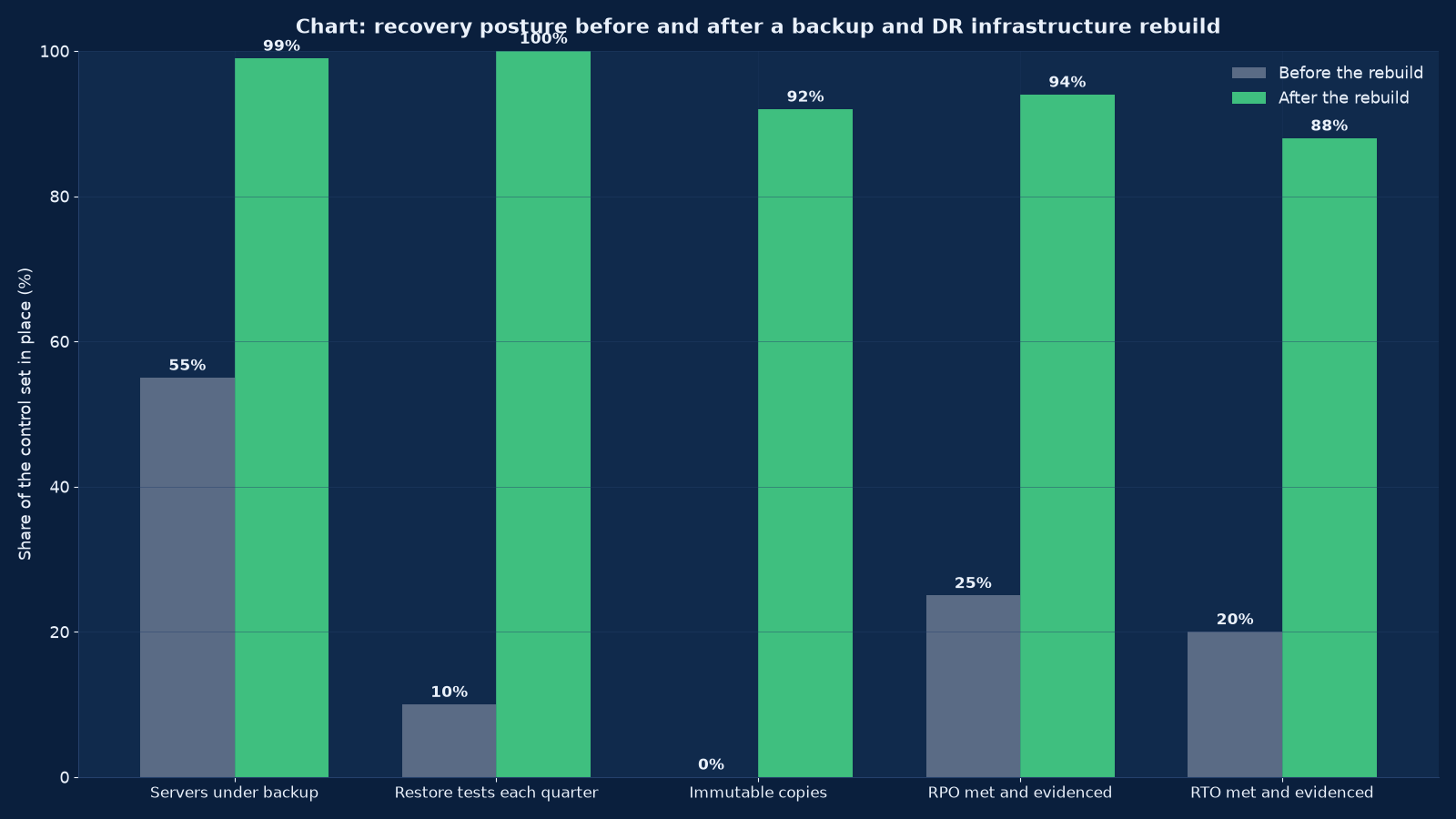
Chart values are an illustrative planning model based on typical UMC engagements and published industry benchmarks. They are not a guarantee of results on any specific project.
Every organisation has a backup policy. Very few have a measured recovery time. The gap between those two statements is the entire discipline, and it is only ever discovered in one of two ways: during a designed test, or during the incident that the test was supposed to prevent. The first is a budget line. The second is a board meeting.
Backup and disaster recovery infrastructure at Unified Management Consulting is the engineering underneath the recovery plan. It is the arithmetic that turns a business statement — “we cannot be down for more than four hours” — into a specification: which workloads are in which recovery tier, what recovery point each tier needs, what target media can deliver it, what network can fill the window, what second site can hold the replica, and what test proves the whole thing works. Most estates have bought these components separately over a decade and have never had the arithmetic done end to end.
We design and build recovery estates for organisations whose data cannot be recreated: clinical and hospital groups with imaging archives, manufacturers with plant records and engineering data, financial and insurance back offices under regulatory retention, media companies with irreplaceable footage, and any business that has realised its backups are held on media an attacker could reach with the credentials it already stole. The last of those is now the commonest reason we are called, and it changes the design fundamentally: the requirement is no longer “can we restore” but “can we restore when the person doing the restoring is not on our side”.
🛡️ Backup & Disaster Recovery Infrastructure — Quick Summary
| Component | What We Deliver |
|---|---|
| Recovery tiering | Every workload assigned a tier with an agreed recovery point and recovery time objective, signed by the business owner rather than by IT — the specification everything else is sized against. |
| Backup target architecture | Disk, deduplication appliances, immutable object targets and tape, chosen per tier against cost, retention and retrieval time, with the capacity model published. |
| Immutability and credential separation | Retention enforced by the storage layer in a mode that cannot be overridden inside the period, with backup administration separated from primary administration. |
| Backup network design | An isolated path with the throughput to fill the window, measured rather than assumed, so backups do not contend with production. |
| Replication topology | Synchronous or asynchronous replication matched to the recovery point objective, with the link capacity verified for the worst case rather than the average. |
| Second-site and failover design | What the recovery site holds, what it can run, how workloads are brought up, and in what order, with the dependency sequence written down. |
| Restore engineering | Timed restores by type — file, volume, application-consistent, full platform — on a published cadence, with results recorded as evidence. |
| Ransomware recovery design | Clean-room recovery, offline copies, credential separation, and a sequence for restoring without re-infecting the estate. |
| Capacity, retention and cost model | What each year of retention costs on each tier, with the growth forecast and the date the estate needs extending. |
| Monitoring and operating model | Job success, throughput, capacity consumption and test results reported in one place, with alert thresholds tied to the recovery objective rather than to vendor defaults. |
A Managed Backup Service Is Not Backup Infrastructure
The two things are bought by different people, for different reasons, and an estate that has one without the other does not recover. A managed backup service operates the schedule, watches the jobs and reports against an agreement. Backup infrastructure decides whether there is anywhere to put the copies that an adversary cannot delete, whether the network can fill the window, and whether the second site can actually run the workload.
| Question | Managed backup service | Backup and DR infrastructure engineering |
|---|---|---|
| Who runs the jobs and reports on them? | Yes — that is the service | Defines what the jobs must achieve and proves it can |
| Where do the copies live, and can they be deleted? | Operates whatever exists | Designs it: immutable targets, retention enforced by the storage layer, credential separation |
| Can the backup fill the window? | Reports the result | Sizes the network and the targets so the answer is yes, and measures it |
| What is the recovery time, in minutes? | Reports what a restore took | Engineers to a target and tests until the measured time meets it |
| Is there a second site, and what can it run? | Rarely in scope | Designs the replication topology, the recovery site and the failover sequence |
| Can we recover from a compromise of our own administrators? | No — inherits the estate as it is | That is the primary design constraint |
| What evidence would an auditor accept? | Produces reports from the platform | Produces the tier specification, the test records and the design that ties them together |
Organisations commonly buy the service first and discover the infrastructure gap during an incident or an audit. The gap is always the same: the copies existed but were reachable by the credentials that were compromised, or the restore worked but took four times longer than the business had assumed, or there was no second site because the primary one had never failed before. Our Backup, Disaster Recovery & Business Continuity Services is the managed service that operates a recovery estate; this page is the engineering that makes one worth operating, and the two are frequently delivered together with one team holding the recovery objective.
Recovery Objectives Are an Engineering Specification
A recovery objective is a specification, and like any specification it has to be written down, agreed by the person who owns the consequence, and then engineered to. The most common failure in this discipline is not technical: it is that nobody ever asked the business what an hour of downtime costs, so the architecture was chosen by whoever held the budget.
| Tier | Recovery point objective | Recovery time objective | Workloads typically placed here | What it costs to deliver |
|---|---|---|---|---|
| Tier 0 — critical transactional | Seconds to zero | Minutes to one hour | Payment switching, live transmission, clinical systems in use, control systems | Synchronous replication, an always-ready second site, and continuous verification |
| Tier 1 — business critical | Minutes to one hour | One to four hours | Core line-of-business applications, databases, directory services, telephony | Frequent asynchronous replication or continuous data protection, plus a warm recovery site |
| Tier 2 — important but tolerable | Four to twenty-four hours | Four to twenty-four hours | File services, departmental applications, development and test | Nightly backup with a rapid restore path and capacity reserved at the recovery site |
| Tier 3 — archival and reconstructable | Twenty-four hours to a week | Days | Historical records, reporting archives, data that can be re-created | Object or tape archive with a documented retrieval process |
The recovery time objective has three components, and only one of them is the restore
A recovery time objective is consumed by detection, by the restore itself, and by everything that has to happen afterwards: re-pointing applications, re-establishing replication, re-authenticating users, verifying integrity and getting the business to agree the service is back. Estates routinely budget the whole objective for the restore and then discover that the restore was the fastest part. We measure all three components during a test and report them separately, because the mitigation for each is different — a faster target for the restore, better monitoring for detection, and a written sequence for everything after.
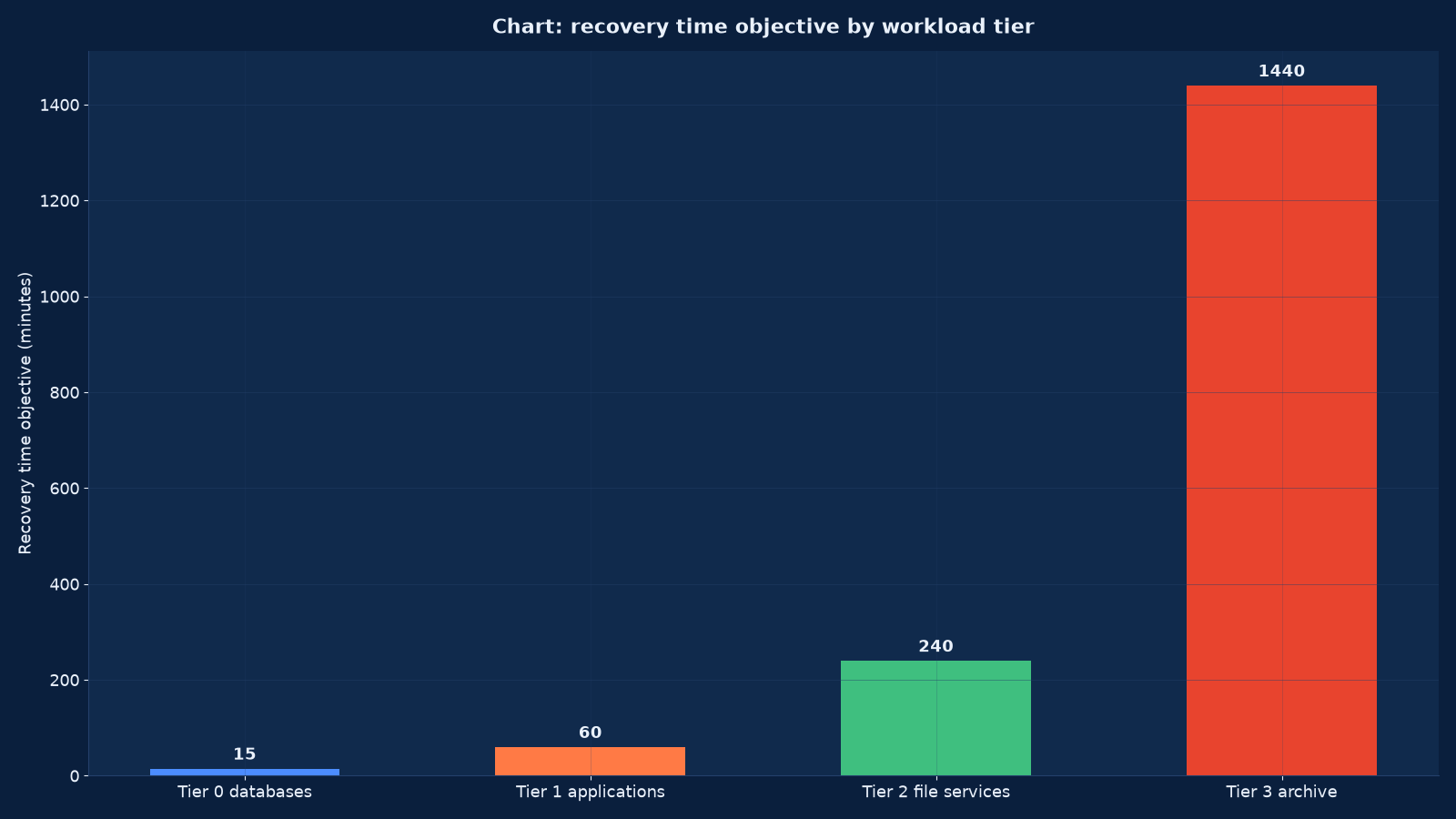
Chart values are an illustrative planning model based on typical UMC engagements and published industry benchmarks. They are not a guarantee of results on any specific project.
Backup Target Architecture: Where the Copies Actually Live
The copy has to live somewhere, and the choice of somewhere decides cost, retention length and — critically — whether an adversary can delete it. There is no single right target; there is a target per tier, and a rule that at least one copy of every tier is held where the primary estate’s credentials cannot reach.
| Target type | Cost profile | Retrieval speed | Best used for | The catch |
|---|---|---|---|---|
| Disk-based backup storage | Moderate per terabyte | Fast — minutes to hours | Recent recovery points for Tier 1 and Tier 2 workloads | Retention is limited by cost, so it holds days or weeks rather than years |
| Deduplication appliance | Lower effective cost for repetitive data | Fast for recent points, slower for aged ones | Longer retention on-premises, and efficient replication between sites | Deduplication ratios depend on the data, and rebuild times after a failure are long |
| Immutable object target | Low per terabyte at scale | Moderate | The copy that must survive a compromise, and long retention for archives | Retention must be enforced by the store in a non-overridable mode, not by a permission |
| Cloud backup and archive | Low entry cost, consumption-based | Depends on retrieval tier and egress | Off-site copies without a second data centre, and elastic retention | Retrieval and egress costs are invisible until a large restore is needed |
| Tape, vaulted offline | Lowest at scale for long retention | Slow — hours to days, including physical retrieval | The genuinely air-gapped copy and multi-decade retention obligations | Media generations end and drives must be kept readable, so migration is a recurring programme |
| Snapshot and replica on the primary array | Already owned | Fastest | Recovering from a bad change or an accidental deletion | Not a backup: it shares the failure domain and the credentials of the primary |
The design we deliver states, per tier, which targets hold which copies, for how long, with what retrieval time, and at what cost per year. That single table answers most of the questions an auditor, a board or an insurer will ask, and it is the document that turns “we have backups” into a defensible position.
Immutability and the Credential Problem
Immutability used to be a nice property. It is now the central design constraint, because the ransomware playbook includes deleting backups before encrypting primary data, and the credentials used are usually legitimate ones — harvested from an administrator account or used by a malicious insider. A recovery copy that can be deleted by anyone who can administer the estate is not a recovery copy.
| Control | What it means in practice | Why a weaker version fails |
|---|---|---|
| Retention enforced by the storage layer | Object lock or write-once retention in a compliance mode that no account can shorten inside the period | A retention setting that an administrator can change is a retention suggestion |
| Credential separation | Primary storage administration and backup administration are different accounts, different authentication paths, and ideally different people | One compromised credential reaching both estates is how a full loss happens |
| Network isolation of the recovery estate | Backup targets and management interfaces on segments not reachable from production or user networks | An attacker who reaches the production network reaches the copies |
| An offline or air-gapped copy | Tape in a vault, or a disconnected target, that no network path can reach | Every online copy shares at least one failure mode with the estate it protects |
| Encryption with external key custody | Keys held outside the backup platform, with separation of duties over key use | Keys stored alongside the data are deleted or captured with it |
| Immutable audit logging | Backup platform actions logged to a store the platform administrators cannot alter | Without it, there is no way to establish what was deleted, when, or by whom |
| Deletion requires two authorisations | Any action that destroys a recovery copy needs a second approver outside the backup team | A single account, phished once, ends the estate |
We design to a specific threat model rather than to a checklist: an adversary with domain-administrator credentials, unlimited time inside the estate, and the intent to make recovery impossible. Everything in the table above follows from that assumption, and the design is not complete until at least one copy of every tier is unreachable under it.
The Backup Network and the Window Arithmetic
A backup that cannot complete inside its window is a backup that does not exist, and the window is set by physics rather than by policy. The arithmetic is simple and rarely done: the volume of data changed per day, divided by the hours available, gives the sustained throughput required — and the network, the target and the source all have to deliver it simultaneously, with deduplication and compression either helping or consuming the CPU needed to do so.
| Constraint | How we size it | What goes wrong when it is guessed |
|---|---|---|
| Daily change volume | Measured per workload over a period that includes the worst week | A window sized on average change fails on the day a database is reindexed |
| Available window | Established with the business, per tier, excluding production peaks | Backups scheduled into the peak, degrading the systems they protect |
| Network capacity | Dedicated or isolated path, verified end to end including the fabric | Backup traffic contending with production, which produces complaints attributed to the wrong cause |
| Target ingest rate | Measured write throughput with deduplication and compression enabled as designed | A target rated for ingest of compressed data measured against uncompressed reality |
| Source impact | Agent overhead and snapshot cost on the production system | Snapshots held open during a slow backup, degrading the primary array |
| Full and synthetic full cycles | Scheduled so that the periodic full does not collide with month end | A monthly full that never completes and is silently skipped |
| Replication bandwidth | Sized for the recovery point objective at the worst-case change rate, not the average | Asynchronous replication falling further behind every day until the recovery point is meaningless |
We also design the failure behaviour of the window: what happens when a job overruns, which jobs are abandoned first, and how the estate catches up afterwards. A backup infrastructure without a stated overrun policy produces a queue of failed jobs that nobody owns, and the gap in protection is discovered months later by an auditor.
Replication Topology and What the Second Site Must Actually Run
Replication and a second site are what turn a backup into a recovery capability, and the design decision is how much data loss and how much downtime the business is willing to accept — because both are bought with money, and neither is free.
| Topology | Recovery point achieved | Recovery time achieved | Cost driver | When it is the right answer |
|---|---|---|---|---|
| Backup only, single site | The last completed backup | Hours to days | Target capacity | Where downtime is tolerable and the data is reconstructable |
| Backup plus off-site copy | The last completed backup, held elsewhere | Hours to days | Transport or cloud egress | The minimum defensible position for any data that cannot be recreated |
| Asynchronous replication to a second site | Seconds to minutes | Tens of minutes to hours | Link capacity and recovery-site compute | Tier 1 workloads where zero data loss is not affordable |
| Synchronous replication | Zero, within the supported distance | Minutes | Low-latency link, which limits distance | Tier 0 workloads where any data loss is a regulatory or safety event |
| Active-active across two sites | Zero | Seconds, with automated failover | Both sites sized for the full load | Where downtime is measured in revenue per minute and the budget exists |
| Cloud as the recovery site | The last replicated or backed-up point | Minutes to hours, depending on start-up | Consumption rather than capital | Where a second data centre cannot be justified and the workloads can run in cloud |
The recovery site’s compute is the part everybody forgets
A second site that holds the data but cannot run the workloads is a storage facility with extra steps. Compute, memory, network capacity, directory services, licensing entitlements and the application dependencies all have to exist or be startable within the recovery time objective — and the start-up time for a large estate is routinely measured in hours rather than minutes. We design the bring-up sequence explicitly: which systems start first, what depends on what, who authorises each step, and how long each takes, tested rather than estimated.
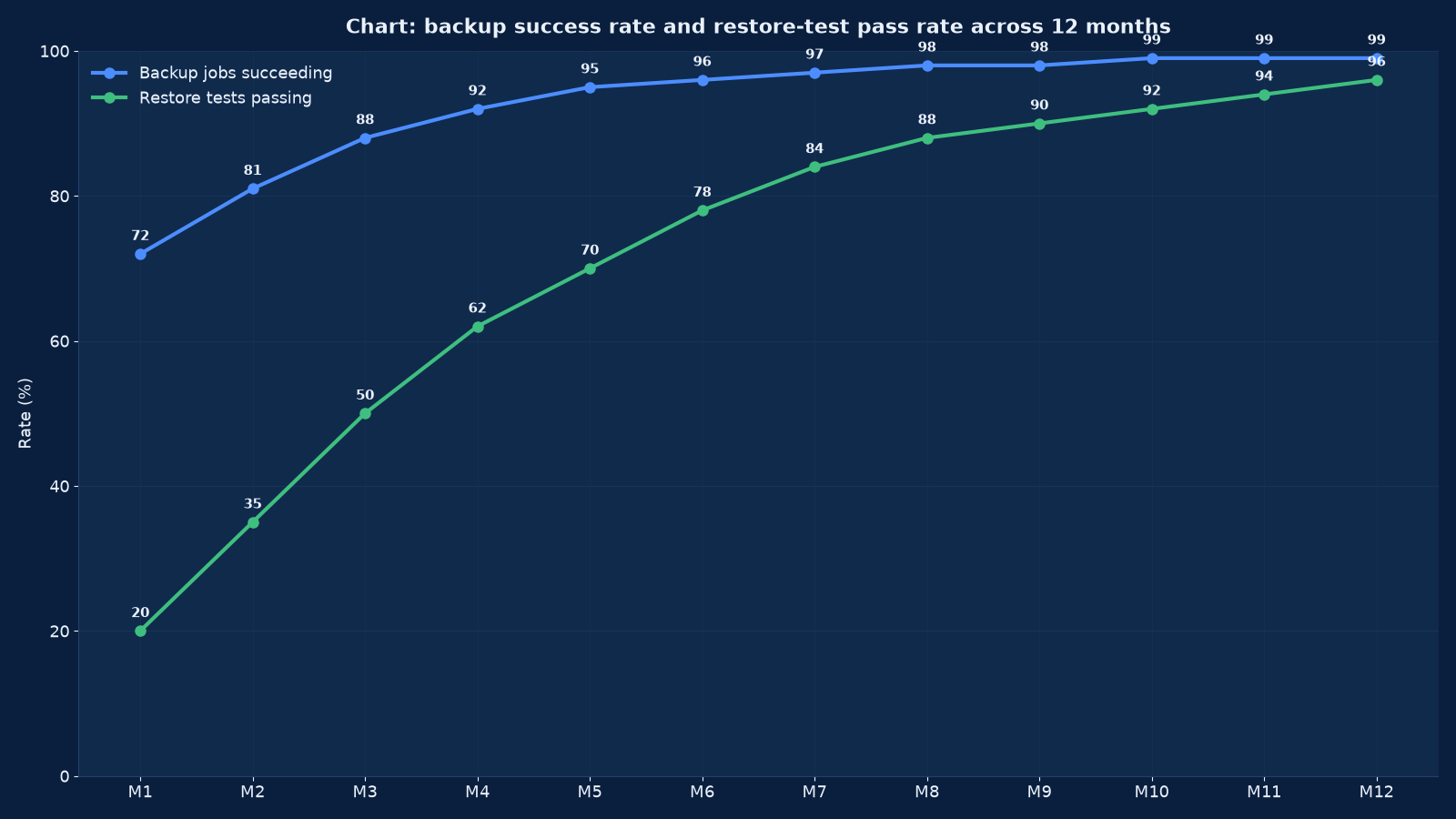
Chart values are an illustrative planning model based on typical UMC engagements and published industry benchmarks. They are not a guarantee of results on any specific project.
Restore Engineering: The Only Test That Produces Knowledge
A restore test is the only control in this discipline that produces knowledge rather than assurance. Everything else is a configuration; a restore is an observation. We define the test programme by restore type, because each type fails differently and each is needed by a different audience.
| Restore type | What it proves | Cadence | Evidence produced |
|---|---|---|---|
| Single file or item | That the everyday request works, and how long it takes | Monthly, sampling across tiers | Timed result per sample, recorded in the operating report |
| Volume or virtual machine | That a whole system can be brought back, including boot and identity | Quarterly | Timed full restore with post-restore verification checks |
| Application-consistent restore | That the database or application is usable, not just present | Quarterly, per critical application | Consistency check results and application start-up time |
| Full platform recovery at the second site | That the recovery objective is achievable end to end | Annually | A test report covering detection, bring-up sequence, recovery point and recovery time |
| Clean-room recovery from an offline copy | That recovery is possible without the primary estate or its credentials | Annually, or after any significant incident elsewhere in the sector | A sequence document that has been executed, with timings |
| Retention and deletion verification | That immutable copies cannot be deleted inside the period, and that expired data actually is | Half-yearly | Attempted-deletion results and a retention register |
Test results are reported as a trend, not as a pass mark. A restore-test pass rate rising from 20 to 96 per cent over a year — which is what Figure 3 shows — is the normal shape of a programme that is fixing what it finds. An estate reporting 100 per cent from month one is usually testing something trivial, and we say so when we see it.
Designing for the Worst Day: Ransomware Recovery
Recovering from a compromise is a different problem from recovering from a failure. In a failure the estate is intact and the data is lost; in a compromise the data may be intact and the estate is untrustworthy. The design consequence is that recovery has to be possible without relying on anything the adversary could have touched.
| Stage | What it requires from the infrastructure | What goes wrong without it |
|---|---|---|
| Detection and scoping | Immutable logs from the backup platform and the primary estate, with enough retention to establish when the compromise began | An unknown dwell time, which means an unknown point to recover to |
| Choosing the recovery point | Multiple dated recovery points across tiers, with integrity evidence per point | Restoring to a point that is already compromised, and re-infecting the estate |
| Clean-room rebuild | An isolated environment where restored systems can be verified before returning to production | Restored machines re-joining a network that still contains the adversary |
| Credential replacement | Every secret, certificate and service account replaced as part of recovery, not after it | Recovery completed with the credentials the adversary holds still valid |
| Data integrity verification | Checksums or application-level consistency checks on restored data | Silently corrupted or tampered data returned to production |
| Sequenced return to service | A written order with dependencies, so directory and network services come back before the applications that need them | Applications started before their dependencies, producing a second outage |
| Post-recovery hardening | The controls that were missing applied before the estate is declared recovered | A repeat incident within weeks, which is common |
We design the clean-room capability as part of the infrastructure rather than as an incident response improvisation, because the version improvised during an incident is built by people who have not slept, on equipment nobody has tested, under time pressure from the board. The sequence document exists before it is needed and has been executed at least once.
Capacity, Retention and the Cost of Keeping Everything
Retention is a cost that compounds, and the growth is not linear because it is driven by three things at once: the primary estate growing, the retention period being extended, and the number of recovery points being increased. Most capacity surprises in a backup estate come from one of the three being changed without the other two being re-modelled.
| Cost driver | How it behaves | The lever that controls it |
|---|---|---|
| Primary data growth | Compounds annually, and accelerates with imaging, video and analytics data | Tiering at the source, so archive data never enters the backup estate |
| Retention period | Multiplies the copy count directly; a move from three to seven years is a large capital event | Retention set by obligation rather than by habit, with legal hold handled separately |
| Recovery point frequency | More frequent points cost capacity, though less than linearly with deduplication | Frequency matched to the recovery point objective per tier, not applied uniformly |
| Change rate | The dominant variable for incremental copies, and it spikes with re-indexing, rebuilds and migrations | Change-rate monitoring with an alert when a workload’s profile shifts |
| Data reduction achieved | Highly variable by workload; databases reduce poorly | Measured per workload class rather than assumed from a vendor ratio |
| Copy sprawl | Test, development and analytics copies that are never expired | Expiry policy on every non-production copy, enforced automatically |
| Media generation | Tape and disk generations end, forcing migration | Migration funded as a recurring programme against support expiry dates |
We publish a five-year capacity and cost model with the design, showing per-tier consumption, the date each target exhausts, and the cost of extending retention. It is the document that prevents the emergency purchase, and it is also what makes the retention conversation with legal and finance possible, because the cost of keeping everything becomes a number rather than an argument.
Operating the Recovery Estate
A recovery estate is operated, not installed. The monitoring that matters is specific: not “did the job run” but “is the estate still able to meet its objective”.
| What we monitor | Threshold principle | The failure it detects early |
|---|---|---|
| Job success per tier | Any Tier 0 or Tier 1 failure alerts immediately; lower tiers on a daily summary | A silent failure in the workloads that matter most |
| Window completion | Jobs finishing inside the window, with overrun trended | A window being consumed gradually by growth until it no longer fits |
| Recovery point age | The age of the newest usable recovery point per workload, not the age of the last job | A workload whose newest point is days old despite jobs reporting success |
| Target capacity consumption | Alerting at 70 and 85 per cent with a forecast date | A target filling without anyone owning the decision to extend it |
| Replication lag | Lag against the recovery point objective, alerting when the objective is at risk | Asynchronous replication falling behind until the objective is fictional |
| Integrity verification | Scheduled checksum or validation jobs per target | Silent corruption, discovered at restore time |
| Restore test results | Pass rate trended monthly with failures investigated to root cause | A test programme that has become a formality |
| Immutability and access attempts | Any attempted deletion or retention change inside the period | An adversary probing the recovery estate before encrypting the primary |
These thresholds and the reporting around them are the same discipline a network operations centre applies to a network, and we design them to be operated by one — either the client’s or ours. A recovery estate whose monitoring nobody reads is an estate whose failures are discovered by the incident they were meant to prevent.
How This Differs From Our Neighbouring Pages
This page is the engineering of the recovery estate. Its neighbours are the service that operates it, the platforms that hold the data it protects, and the facility that has to keep running while a recovery happens.
| Your question | Right starting point | What it produces |
|---|---|---|
| Who runs our backups and reports on them? | Backup, Disaster Recovery & Business Continuity Services | A managed service against a published SLA, operating the estate this page designs |
| Where should the copies live, and can they be deleted? | This page | A target architecture with immutability, credential separation and a cost model per tier |
| What should our whole compute and storage estate look like? | Computing, Server, Storage and Data Centre Engineering | An estate roadmap, of which the recovery architecture is one part |
| Our storage tiers and fabric are the constraint | Our storage and SAN engineering offering, built in this same programme | A tiering and fabric design whose backup ingest path is sized rather than assumed |
| The recovery site needs building or extending | Our data centre design and build offering, built in this same programme | A facility whose power, cooling and network budget matches the recovery estate it will hold |
| Who watches the jobs and the replication lag at three in the morning? | Our network operations and monitoring offering, built in this same programme | A monitoring design with thresholds tied to the recovery objective |
| Can part of the recovery estate live in cloud? | Cloud Services & Migration — AWS, Azure and Google Cloud | A hybrid recovery design with retrieval and egress cost modelled |
| An auditor or insurer wants evidence | IT Audit, Compliance & ISO 27001 / SOC 2 Readiness | The tier specification, test records and control evidence assembled for the audit |
| The estate needs operating after we build it | Managed IT Infrastructure & IT AMC Services | A managed service with the runbooks and thresholds produced during the design |
Evidence From Our Work
Recovery infrastructure is confidential by nature, but the estates it protects are not, and the engagements below show the operating environments our recovery designs have to survive in: continuous-availability media, multi-site clinical data with retention obligations, and multi-property hospitality where each site holds data that must be recoverable centrally.
- IT Infrastructure Management for an IT Company — Case Study — twenty-four-by-seven proactive monitoring, remote and on-site support, preventive maintenance and security management for a media and broadcasting company under a twenty-four month renewable contract. Broadcast estates have no acceptable window for a restore, which makes the recovery point arithmetic unforgiving.
- Global Hospitals — Case Study — a multi-location healthcare network whose server room build had to carry clinical data under retention obligations across sites, where recovery design and network design are the same conversation.
- Marriott Hotel Hyderabad — Case Study — managed services and monitoring across multi-property operations, where each property must keep trading while its data is recoverable from a central estate.
- Apollo Hospitals — Case Study — a measured feasibility assessment across multiple hospital campuses, which is the same method a recovery design uses: measure the requirement, model the options, publish the assumptions.
- Enterprise Computer Networks: Trends, Operations, and Careers — the operations and monitoring discipline a recovery estate depends on, including what it takes to staff it.
- Tech Stack Consolidation: The Business Case for Unified Systems — why consolidation changes the recovery design, and the change-rate spike it produces if nobody re-measures the window.
- AI Infrastructure Capacity and Capital Intensity: What the Nscale Story Reveals — the data growth that makes retention cost compound faster than capacity budgets.
- our Technology archive — further writing on infrastructure operations, resilience and the engineering behind them.
Frequently Asked Questions About Backup and Disaster Recovery Infrastructure
We already have backups. What would this engagement add?
A measured recovery capability rather than an assumed one. In practice that means a tier specification the business has signed, a target architecture whose copies cannot be deleted by the credentials an attacker is most likely to hold, a backup network sized against the actual change rate, a replication topology matched to an agreed recovery point, and timed restore tests that produce evidence. Most estates we assess have four of those five as policy documents and none of them measured.
What is the difference between recovery point and recovery time, and which costs more?
The recovery point objective is how much data you accept losing; the recovery time objective is how long you accept being down. Recovery point is bought with replication frequency and link capacity, and zero data loss requires synchronous replication within a distance limit. Recovery time is bought with readiness at the second site — compute, licensing, dependencies and a tested bring-up sequence. For most enterprises recovery time is the more expensive of the two, because readiness has to be maintained continuously rather than configured once.
How long should we retain backups?
As long as an obligation requires and no longer, which is a legal and commercial question rather than a technical one. Retention is the largest single cost driver in a backup estate, so it should be set per data class with legal and compliance, and legal holds should be handled as a separate mechanism rather than by extending retention for everything. We model the cost of each retention option over five years so the decision is made with numbers attached.
Is cloud backup enough on its own?
It can be, for estates whose data volumes, retrieval expectations and connectivity support it, and it removes the need to build and maintain a second site. The two constraints to model carefully are retrieval cost and time for a large restore — egress and request pricing are invisible until you need a full recovery — and whether recovery is possible if internet connectivity is itself the failure. Many estates land on a hybrid: fast local copies for everyday restores, immutable cloud or tape copies for survival.
What does immutable actually mean, and how do we verify it?
It means the storage layer enforces retention in a mode that no account — including an administrator — can shorten or delete inside the period. A retention setting that can be changed by an administrator is not immutability. We verify it by attempting to delete a test object inside its retention period with the most privileged credential available, and recording the failure as evidence. That test is part of the handover, not an assumption.
How often should we test restores?
By type, on a published cadence: single-file restores monthly, volume and application-consistent restores quarterly, full platform recovery at the second site annually, and a clean-room recovery from an offline copy annually or after any significant incident elsewhere in your sector. The cadence matters less than the trend: a pass rate rising over a year means the programme is finding and fixing real problems, while a pass rate of 100 per cent from month one usually means the tests are trivial.
Can we recover if our own administrator credentials are compromised?
Only if the design assumed it. That is the threat model we build to: an adversary with domain-administrator credentials, unlimited dwell time and the intent to make recovery impossible. Surviving it requires credential separation between primary and backup administration, retention enforced by the storage layer, an isolated recovery network, immutable audit logging, and at least one copy that is offline. If any of those is missing, the honest answer is no.
What recovery tier should our databases be in?
Whichever tier matches the cost of losing the transactions since the last recovery point. For most enterprises, production databases with financial or clinical consequence are Tier 0 or Tier 1: seconds to zero recovery point and minutes to an hour recovery time, delivered through synchronous or frequent asynchronous replication with a warm second site. Reporting and historical databases are usually Tier 2 or Tier 3, and paying Tier 0 prices for them is a common and avoidable error.
How big does the backup network need to be?
It is arithmetic: daily change volume divided by the available window gives the sustained throughput required, and the network, the source and the target all have to deliver it simultaneously with deduplication and compression accounted for. We measure the change rate over a period that includes the worst week, because a window sized on average change fails on the day a database is reindexed or a migration runs.
Do we need tape in 2026?
If you want a genuinely air-gapped copy or a multi-decade retention obligation at low cost, yes — tape is still the cheapest way to hold large volumes offline, and offline is a property no online target can provide. The obligation that comes with it is a recurring migration programme, because drive generations and media formats end. Where retention is short and volumes moderate, immutable object storage usually answers the same requirement more simply.
What happens to the recovery design when we move workloads to cloud?
It changes substantially, and it should be revisited rather than extended. Cloud platforms provide their own protection mechanisms with different properties, different costs and different failure modes — snapshot-based protection within a region, cross-region replication, and immutability through object lock on the provider’s storage. The tier specification stays valid; the delivery mechanism per tier does not. We re-model rather than assume parity.
What evidence do we get at the end?
The recovery tier specification with business sign-off, the target architecture with retention and cost per tier, the immutability and credential-separation design with a deletion-attempt test result, the backup network sizing with measured change rates, the replication topology and second-site bring-up sequence, timed restore test records by type, the five-year capacity and cost model, and the operating runbooks with monitoring thresholds tied to the objectives.
Find Out What Your Recovery Time Actually Is
The most useful thing we can do in the first week is time a restore of something that matters and compare it with the number your business believes. That single measurement usually reframes the conversation, because the gap between an assumed and a measured recovery time is where the risk lives. We will assess the estate, produce the tier specification, and tell you plainly which gaps are worth funding and which are not.
Contact Unified Management Consulting to arrange a confidential first conversation.
Related Services
Recovery infrastructure sits underneath everything else. These are the engagements it most often runs alongside:
- Backup, Disaster Recovery & Business Continuity Services — the managed service that operates a recovery estate against a published SLA, using the architecture designed here.
- Computing, Server, Storage and Data Centre Engineering — the primary estate the recovery design protects, and the platform the copies come from.
- Routing, Switching, Firewall and Network Engineering — the replication links and isolated backup paths, sized for the worst case rather than the average.
- IT Audit, Compliance & ISO 27001 / SOC 2 Readiness — the retention, immutability and test evidence an auditor or an insurer will ask for.
- Managed IT Infrastructure & IT AMC Services — operating the estate afterwards, with the thresholds and runbooks produced during the design.
- Cloud Services & Migration — AWS, Azure and Google Cloud — for off-site copies and recovery sites that cannot be justified as a second data centre.
- Cybersecurity Services — the threat model, credential separation and detection capability the recovery design assumes.
- Data Centre Design & Build Services — design and build for halls, racks, power, cooling and the acceptance tests that prove them
- Hyperconverged Infrastructure (HCI) Services — hyperconverged clusters where compute, storage and availability are one licensing and one failure domain
- Server Virtualisation (VMware / Hyper-V) Services — VMware and Hyper-V clusters, host sizing, cluster policy and the runbook that survives a host failure
- Storage & SAN Engineering Services — SAN and NAS design, tiering, replication and the recovery evidence behind the capacity plan