
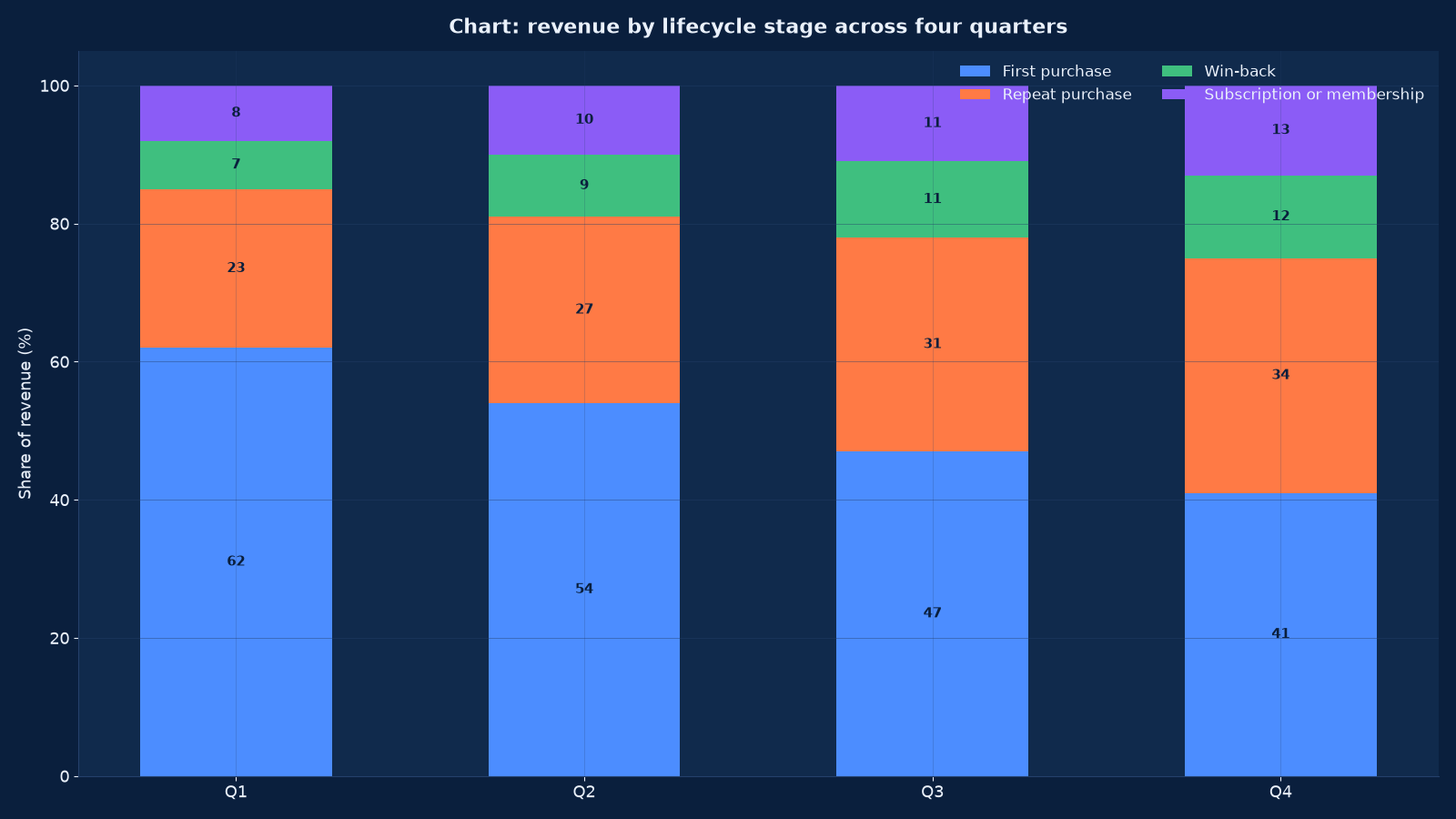
Chart values are an illustrative planning model based on typical UMC engagements and published industry benchmarks. They are not a guarantee of results on any specific project.
Acquisition buys a customer once. Lifecycle decides whether that purchase was the beginning of a relationship or the end of one. The businesses that struggle are rarely the ones with weak advertising; they are the ones whose advertising works and whose second purchase never happens.
Lifecycle and retention campaign management at Unified Management Consulting is the design and running of the automated programmes that turn one purchase into several: segmentation and recency-frequency-monetary models, welcome and post-purchase flows, replenishment and repeat-purchase triggers, win-back and sunset policies, subscription and membership motions, offer and margin guardrails, deliverability, and reporting that measures incremental revenue with a holdout rather than claiming every message sent. We build these for e-commerce and retail brands, service businesses with repeat engagements, membership and subscription operations, clinics and practices with recall cycles, and B2B firms whose renewal is the commercial event that counts.
The work is delivered either as a twelve-week build — data and consent audit, segmentation, flows, automation, reporting — or as a standing programme where the flows are owned, tuned and extended every month. Most clients need the build first, because a flow written on top of unsegmented data and an unverified list reproduces the same message to everyone and then damages the sender reputation that the whole programme depends on.
🔁 Lifecycle & Retention Campaigns — Quick Summary
| Component | What We Deliver |
|---|---|
| Data, consent and deliverability audit | Every list source verified for consent, every domain authenticated, and inbox placement measured before a single flow is written. |
| Segmentation and the RFM model | Customers classified by recency, frequency and monetary value, with lifecycle stage, category affinity and margin layered on top. |
| Welcome and onboarding flows | The first-purchase and first-contact sequences that set expectations, answer the obvious questions and produce the second action. |
| Post-purchase flows | Order confirmation, delivery, usage, review request, cross-sell and replenishment triggers, each timed to the product rather than to a template. |
| Repeat-purchase and replenishment | Consumption-based triggers for anything that runs out, and interval-based prompts for anything that recurs. |
| Win-back and sunset | Re-engagement for lapsing customers, and a policy for retiring addresses that no longer respond. |
| Subscription and membership motion | Trial-to-paid, dunning and failed-payment recovery, pause and downgrade paths, and renewal sequences. |
| Offer and margin guardrails | Discount rules by segment and stage, so retention does not become a permanent price cut. |
| Channel orchestration | Email, SMS, WhatsApp and push coordinated so a customer is not told the same thing four times in a day. |
| Reporting, holdouts and tuning | Incremental revenue measured against a control group, per-flow performance reported, and the programme tuned monthly. |
What This Service Actually Covers
The service covers the data foundation, the flows, the automation and the measurement. It is delivered as a bounded build or as a standing programme with a monthly tuning cycle.
| Component | What we do | What you keep | Duration |
|---|---|---|---|
| Data and consent audit | List sources, consent records, authentication and placement verified | A deliverability report and a consent position you can defend | 1–2 weeks |
| Segmentation | An RFM model plus lifecycle stage, affinity and margin bands | A documented segment definition anyone can query | 1–2 weeks |
| Welcome and onboarding | First-contact and first-purchase sequences written to the segment | Flows with a stated goal and a stop condition | 2–3 weeks |
| Post-purchase | Confirmation through replenishment, timed to the product | A flow map showing every touchpoint after an order | 2–3 weeks |
| Repeat and replenishment | Consumption and interval triggers per product family | Trigger logic derived from real purchase intervals | 1–2 weeks |
| Win-back and sunset | Re-engagement for lapsing customers and retirement of dead addresses | A policy, not a one-off campaign | 1 week |
| Subscription motion | Trial-to-paid, dunning, pause and renewal | Revenue recovered from failed payments, measured | 2 weeks |
| Offers and guardrails | Discount rules by segment and stage with margin floors | A rule set that prevents retention becoming a price cut | 1 week |
| Automation and CRM sync | Flows triggered from the platform of record, synced both ways | Automation that survives a marketing tool change | 2–3 weeks |
| Reporting and holdouts | Incremental revenue against a control, per-flow performance | A monthly pack that answers whether the programme pays | Ongoing |
The build deliberately starts with deliverability and consent rather than with creative. A programme that lands in spam produces no revenue regardless of how well the flows are written, and a list built without consent produces a complaint rate that damages every future campaign.
Why Retention Is a Programme and Not a Campaign
| Property | A campaign | A lifecycle programme |
|---|---|---|
| Trigger | A date on the marketing calendar | A customer event: a purchase, an interval elapsed, a payment failed, a lapse detected |
| Audience | Everyone on a list, or a broad segment | The individual, classified by stage, value and behaviour |
| Duration | Starts and stops | Runs continuously and is retired only when it stops paying |
| Message | One offer, one deadline | A sequence whose next step depends on what the customer did |
| Success measure | Revenue during the campaign window | Incremental revenue against a holdout, per flow, over time |
| Failure mode | A weak offer or a bad time | Bad data, no segmentation, or a flow nobody owns |
| What compounds | Nothing — the next campaign starts again | Purchase frequency, average order value, and the customer’s tolerance for being contacted |
This distinction is why retention budgets are so often wasted. A business running a monthly promotion to its whole list is running twelve campaigns, not a programme, and each one trains the customer to wait for the discount while contributing nothing to the underlying purchase behaviour.
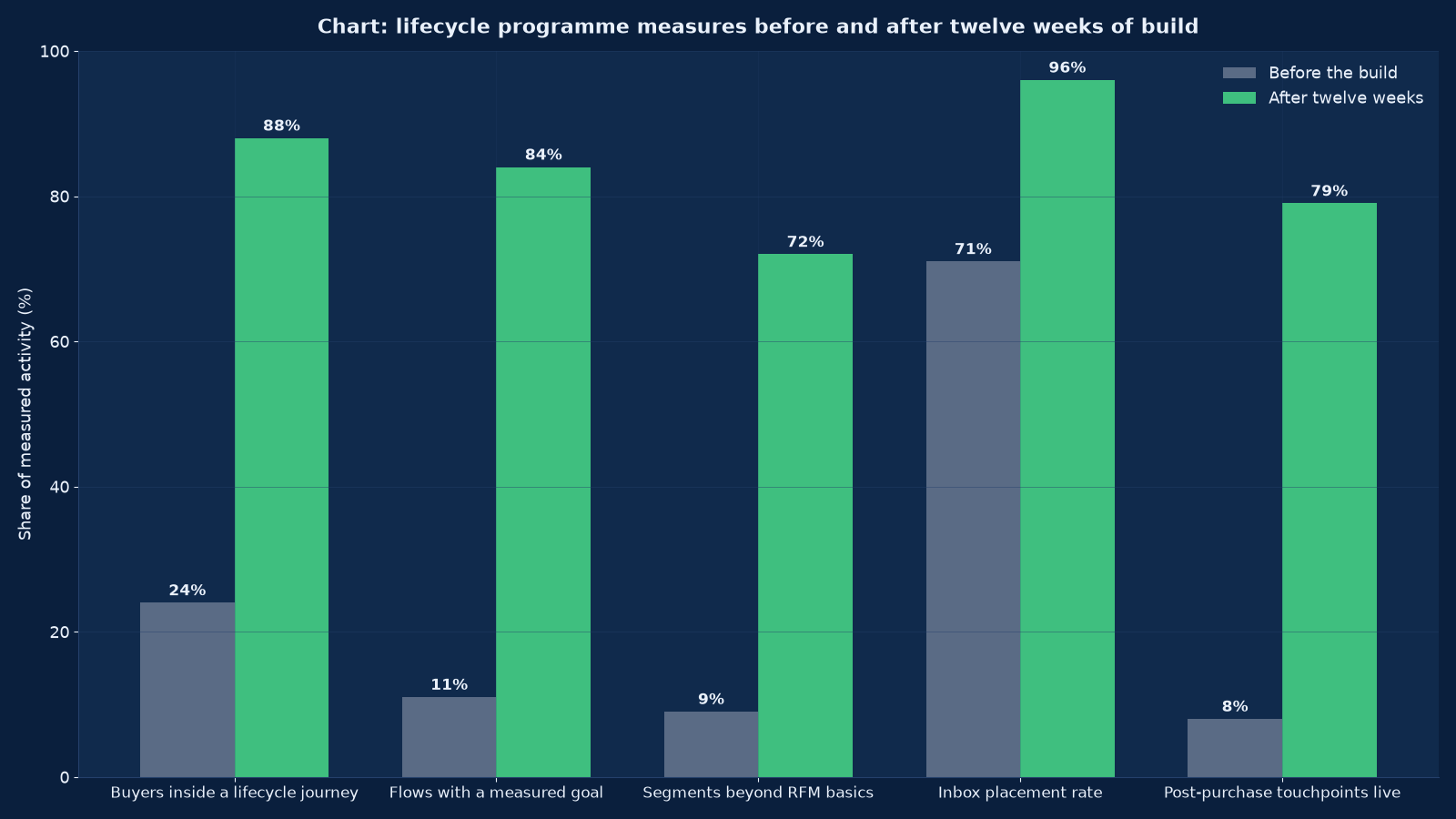
Chart values are an illustrative planning model based on typical UMC engagements and published industry benchmarks. They are not a guarantee of results on any specific project.
Data, Consent and Deliverability: the Foundation Nobody Wants To Build
| Item | What we check | Why it decides the programme’s ceiling |
|---|---|---|
| Consent records | How each address was collected, and whether the record supports the messages being sent | A list without provable consent produces complaints, and complaints produce filtering |
| Authentication | Sender policy framework, domain keys and abuse reporting configured for every sending domain | Unauthenticated mail is filtered by default now; this is not optional |
| Sending domain separation | Transactional mail separated from marketing mail | A marketing complaint rate that drags order confirmations into spam |
| List hygiene | Invalid, dormant and duplicate addresses identified and retired | Bounce and complaint rates are computed per send, so dead addresses hurt live ones |
| Inbox placement | Measured across the major mailbox providers, per domain and per flow | The difference between a 96 per cent and a 71 per cent placement rate is a third of the programme’s revenue |
| Preference centre | Frequency and topic choices offered, with an easy unsubscribe | A customer who can reduce frequency stays; one who cannot, unsubscribes |
| Data platform | Where customer and order data actually lives, and how it reaches the marketing tool | Flows triggered from stale or partial data fire at the wrong moment |
| Privacy position | Retention rules, processing basis and export and deletion handling | A programme that cannot answer a data request is a programme with a compliance problem |
In Figure 2 inbox placement rises from 71 to 96 per cent. That single change multiplies the value of every flow written afterwards, which is why the audit is not a preliminary but the highest-return part of the build.
Segmentation: Beyond Recency, Frequency and Monetary Value
RFM is the right starting model and the wrong stopping point. It describes what a customer did; it does not describe what they will respond to. The layers below are what make a flow worth sending.
| Layer | What it adds | Example use |
|---|---|---|
| Lifecycle stage | New, active, at-risk, lapsed, resurrected, never-purchased | Different welcome treatment for a first-time buyer and a returning one |
| Category affinity | What the customer buys, not just how much | Cross-sell within an affinity rather than across the whole catalogue |
| Margin band | What the customer is worth after cost | Offers and service levels set by contribution rather than by revenue |
| Purchase interval | How often this customer actually buys this product | Replenishment timed to the observed interval, not to a guessed one |
| Channel preference | Where the customer opens, clicks and responds | SMS to the customers who answer it, email to those who do not |
| Engagement level | Open, click and reply behaviour over a rolling window | Frequency reduced for the disengaged before they become complaints |
| Geography and store | Where the customer is and which location serves them | Local events and stock messages sent only where they are actionable |
| B2B attributes | Role, account size, renewal date, contract value | Renewal sequences timed to the contract rather than to the calendar |
The Flows That Matter, and What Each One Is For
| Flow | Trigger | Goal | The mistake that ruins it |
|---|---|---|---|
| Welcome | Subscription or first contact | Set expectations and produce the first purchase or booking | A discount in message one, which anchors the relationship on price |
| Abandoned browse or cart | Intent without completion | Answer the objection that stopped the purchase | A generic reminder with no product, price or availability context |
| Order confirmation and delivery | Purchase | Reduce anxiety and support queries | A transactional message with no brand and no next step |
| Post-purchase onboarding | Delivery | Get the customer to first value, which is what produces the review and the repeat | Skipping it because the sale is already recorded |
| Review and referral request | Confirmed satisfaction | Social proof and new customers at near-zero cost | Asking before the product has been used |
| Replenishment | Observed interval elapsed | The next purchase before the customer thinks of a competitor | A guessed interval, which fires too early or far too late |
| Cross-sell and affinity | Category affinity plus purchase history | A second category, which is the strongest retention signal there is | Cross-selling the whole catalogue to everyone |
| Win-back | Lapse detected against the category norm | Reactivation, or a clean exit | Repeated discounts to an address that has already decided to leave |
| Sunset | No engagement over a stated window | Retire the address to protect placement | Keeping dead addresses because the list looks bigger |
| Subscription: trial-to-paid | Trial start | A paid conversion with the value demonstrated | A reminder on the last day rather than a sequence through the trial |
| Subscription: dunning | Payment failure | Revenue recovered without losing the customer | One retry and a cancellation notice |
| Renewal | Contract date approaching | A renewal agreed before the decision becomes active | A renewal conversation started in the final week |
Each flow gets a written goal, a stop condition and a measure. A flow without a stop condition runs after the customer has already done the thing it was asking for, which is the most common reason a well-designed programme starts producing complaints.
Offer Architecture and Margin Guardrails
Retention programmes fail commercially in one of two ways: they discount everything, or they discount nothing and lose the customers who needed an excuse. The guardrails are what keep the programme between those two.
| Segment and stage | Offer treatment | Guardrail |
|---|---|---|
| New subscriber, no purchase | Value and proof before any discount | No standing discount that trains the audience to wait |
| First purchase, pre-second | A reason to return that is not a price cut: a bundle, early access, a service | Discount only where the margin supports it and only once |
| Active and frequent | Recognition, priority and exclusivity | No discount at all — these customers were going to buy |
| At-risk | A targeted incentive timed to the observed interval | One attempt, measured against a holdout, retired if it does not pay |
| Lapsed | A reactivation offer with a clear expiry | A maximum of two attempts before the sunset policy applies |
| High-margin affinity | Cross-sell within the affinity | Offers tied to contribution margin, not to revenue |
| Subscription | Plan upgrades, annual prepay and pause instead of cancel | A floor on the discount that keeps the subscription viable |
| B2B renewal | Value review, expansion and multi-year terms | No discount without a commitment in return |
Every rule is written down with its margin floor and its owner. Where a flow needs an exception, the exception is approved rather than improvised, because an unmanaged discount rule is how a retention programme quietly becomes a clearance sale.
Channel Orchestration: Email, SMS, WhatsApp and Push
| Channel | Best used for | Frequency discipline | Cost and consent reality |
|---|---|---|---|
| Sequences, long-form value, offers, receipts and win-back | Per-flow limits plus a global frequency cap | Cheap, and the only channel that carries a full sequence well | |
| SMS | Time-critical prompts: delivery, appointment, replenishment, flash offer | Low frequency, high relevance, opt-in enforced | Expensive per message, so it must be reserved for messages worth the cost |
| Conversational service, order updates and markets where it is the default channel | Template rules and a genuine service purpose | Opt-in and template approval required; used as a service channel first | |
| Push | App-based businesses: replenishment, restock, personalised prompts | The most abused channel, so the strictest cap | Free to send and expensive in uninstalls if overused |
| Direct mail | High-value B2B accounts and win-back of top-tier customers | Rare and deliberate | High cost per contact, justified only where the account value supports it |
Orchestration means one customer, one conversation, across channels. A global frequency cap and a suppression rule between flows prevent the experience that makes customers unsubscribe: the same offer arriving by email, SMS and push in one afternoon because three flows each decided it was relevant.
The Twelve-Week Build
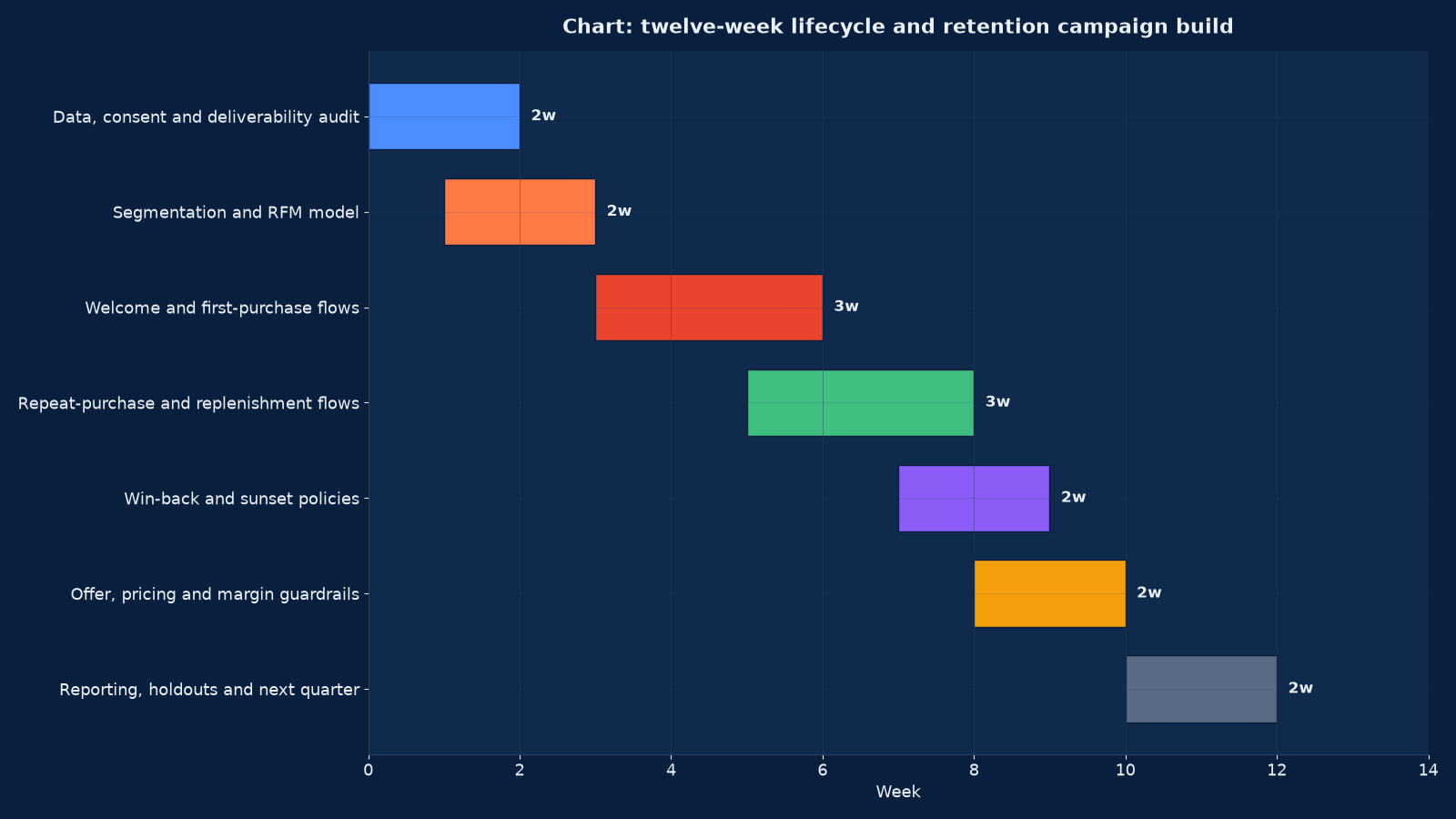
Chart values are an illustrative planning model based on typical UMC engagements and published industry benchmarks. They are not a guarantee of results on any specific project.
| Weeks | Workstream | Gate to pass |
|---|---|---|
| 1–2 | Data, consent and deliverability audit | Consent position documented, authentication live, placement measured |
| 2–3 | Segmentation and RFM model | Segments defined in the platform and queryable, with sizes and values reported |
| 4–6 | Welcome and first-purchase flows | Flows live with a stated goal, a stop condition and a measure each |
| 6–8 | Repeat-purchase and replenishment flows | Intervals derived from real purchase data, not from assumption |
| 8–9 | Win-back and sunset policies | A reactivation flow and a retirement rule both agreed and scheduled |
| 9–10 | Offer, pricing and margin guardrails | A written rule set with margin floors and an approval path for exceptions |
| 11–12 | Reporting, holdouts and next quarter | A holdout group running, incremental revenue reported, and the next quarter’s flow plan agreed |
After the build the programme is tuned monthly: flows retired or extended, intervals corrected against observed behaviour, offers adjusted against margin, and the holdout re-randomised so the incrementality measurement stays honest.
Measurement: Incremental Revenue, Not Revenue Touched
| Measure | Definition | Why it is the right one |
|---|---|---|
| Revenue per recipient | Programme revenue divided by active recipients | Normalises for list size, which otherwise flatters a growing programme |
| Incremental revenue | Programme revenue minus the holdout group’s revenue, scaled | The only measure that separates what the programme caused from what would have happened |
| Repeat purchase rate | Share of buyers making a second purchase within the window | The core retention outcome, and the one acquisition spend cannot fix |
| Purchase frequency | Orders per customer per period, against the category norm | Whether replenishment and interval flows are working |
| Average order value by segment | Value per order within each segment | Whether cross-sell is adding value or just adding items |
| Customer lifetime value | Contribution over the observed relationship | The number that sets what acquisition can afford to pay |
| Churn and lapse rate | Share moving to at-risk and lapsed per period | Whether win-back is early enough to matter |
| Reactivation rate | Lapsed customers who purchase again | Whether the win-back offer pays, measured against its holdout |
| Failed-payment recovery | Subscription revenue recovered through dunning | Pure recovered revenue, usually the fastest return in the programme |
| Unsubscribe and complaint rate | Per flow and per segment | The cost of the programme, and the early warning for over-contact |
| Placement rate | Inbox delivery by mailbox provider | The ceiling on everything else |
We report incremental revenue as the headline. It is a less flattering number than revenue touched, and it is the one that survives scrutiny from a finance director who has watched three agencies claim the same order.
Holdouts and the Attribution Argument
| Question | The honest answer |
|---|---|
| Does the programme cause revenue, or merely intercept it? | A holdout answers this: a randomly selected group that receives nothing, compared over the same window. The difference is the programme’s contribution. |
| How big should the holdout be? | Large enough to be statistically usable and small enough to be commercially tolerable. Usually a few per cent, re-randomised periodically. |
| Should the holdout be permanent? | A permanent global holdout is the cleanest measurement and the most expensive. A rolling holdout per flow is the practical compromise. |
| What about platform-reported revenue? | It overstates, because it credits the last message that touched an order the customer had already decided to make. We report it, labelled, alongside the holdout result. |
| What if there is not enough volume to measure? | Then we say so, use cohort retention curves and repeat purchase rate as the primary evidence, and build the holdout once volume supports it. |
| Does the client have to accept a lower reported number? | Yes, and that is the point. A programme measured honestly can be defended in a budget conversation; one measured generously cannot. |
Incrementality is also the discipline that decides which flows to keep. A flow that produces revenue but no incremental revenue is intercepting purchases, and the right response is to retire it and spend the frequency budget elsewhere.
Lifecycle Automation and the Systems It Depends On
Flows are only as good as the events that trigger them, and events come from systems that marketing does not own. We therefore treat the integration as part of the build rather than as somebody else’s problem.
- Marketing Automation (HubSpot & Marketo) Services — the platform, the trigger logic and the orchestration layer the flows run on.
- Custom CRM Development & Integration Services — the customer record of truth, including purchase history, stage and the sales handover.
- Email Marketing Automation Services — the sequence, template and deliverability engineering underneath the lifecycle flows.
- Email Marketing Campaign Services — the broadcast and campaign activity that runs alongside the automated programme.
- E-commerce Development & Marketing Services — the order, product and inventory events the triggers depend on.
- Enterprise Systems Integration Services — where the marketing platform, the shop and the CRM are made to agree.
- Analytics & Attribution (GA4) Services — the measurement layer that reports the programme against the rest of the channel mix.
- Conversion Rate Optimisation (CRO) Services — the pages the flows send customers to, where the second purchase is won or lost.
- SMS Marketing Services and WhatsApp Marketing Services — the channels reserved for the time-critical messages in the orchestration.
- Predictive Analytics & Demand Forecasting Services — where churn and lapse prediction replaces a fixed interval with a model.
What Differs By Business Model
A lifecycle programme for a subscription software business and one for a fashion retailer share an architecture and almost no timings. The trigger that matters, the interval, the offer rules and the definition of churn all change with the model, and a programme copied across models fires at the wrong moments with confident precision.
| Model | The event that matters | Interval logic | Churn definition |
|---|---|---|---|
| E-commerce retail | The second purchase, because it is the strongest predictor of a relationship | Derived per product family from observed repurchase behaviour | No purchase beyond the category’s normal interval |
| Subscription or membership | Trial-to-paid conversion and the failed payment | Billing cycle, with dunning inside it | Cancellation, downgrade, or a payment failure not recovered |
| Service with repeat engagements | The rebooking, and the interval between jobs | Seasonal for some trades, consumption-based for others | A customer who used the service once and did not return in the season they should have |
| Clinics and practices | The recall, timed to the clinical interval | Clinically defined, and non-negotiable | A missed recall, which is both a revenue and a care issue |
| B2B with contracts | The renewal window and adoption signals | Contract-driven, with usage as an early warning | A renewal at risk: declining usage, an unresponsive champion, a competitor evaluation |
| Marketplace or multi-vendor | The second vendor purchased from | Per category, because intervals differ wildly across vendors | A buyer active in one category and absent from the rest |
| Hospitality | The return visit and the direct-booking share | Seasonal and occasion-driven | A guest who booked once through an aggregator and never directly |
The interval question is the one most often guessed. We derive intervals from the client’s own order history and report the distribution, because a replenishment flow timed to an assumed thirty-day cycle will fire two months early or two months late for most of the catalogue, and both errors look like a creative problem from the inside.
Message Craft for Lifecycle Content
Lifecycle messages are read in a different state of mind from campaigns. The recipient has already bought, or already asked, and the message either helps or interrupts. That changes the writing.
| Element | Standard for lifecycle messages | Why |
|---|---|---|
| Subject line | Descriptive of the event, not promotional | The recipient is scanning for information about something they did |
| First line | The state of the order, the account or the interval, stated plainly | Anxiety reduction is the job of most post-purchase messages |
| One action | A single primary action per message | Two calls to action halve the completion rate of either |
| Personalisation | Real data: the product bought, the interval elapsed, the plan held | A first name is not personalisation; a correct product reference is |
| Timing | Derived from the event, with the send window respecting time zones and business hours | A replenishment prompt at the wrong hour is a notification nobody acts on |
| Frequency within a flow | Capped, with a stop condition once the goal is met | The most common complaint driver is a flow that keeps asking |
| Design | Mobile-first, fast to load, readable in a preview pane | Most lifecycle mail is read on a phone in a few seconds |
| Transactional separation | Receipts and delivery notices on their own domain and template | A marketing complaint rate should never endanger an order confirmation |
| Accessibility | Alt text, contrast, logical reading order, plain-text fallback | A message that cannot be read cannot convert, and exclusion is a real cost |
| Testing | One variable at a time, with enough volume to matter, and a documented winner | Simultaneous changes produce results nobody can act on |
Governance: Who Owns the Programme and How It Is Tuned
| Cadence | Activity | Owner | Output |
|---|---|---|---|
| Weekly | Deliverability and placement check, complaint and bounce review, flow error log | Us, with the data owner informed | An exception report; anything above threshold fixed before the next send |
| Monthly | Per-flow performance against goal, offer performance against margin, segment sizes and values | Programme owner | A tuning decision per flow: extend, adjust, retire or leave |
| Quarterly | Holdout re-randomisation and incrementality review, interval re-derivation, guardrail review | Programme owner with finance | A revised flow plan and an updated offer rule set |
| Annually | Segmentation model review, platform capability review, consent and retention review | Programme owner with legal | A documented position on data, consent and platform fitness |
The governance cadence is written into the retainer agreement with named owners, because the most common cause of programme decay is not bad creative but the absence of a scheduled decision. A flow that was right in March is wrong in September when the catalogue, the pricing or the customer mix has changed, and nothing tells you so unless somebody is looking.
Failure Modes We Are Called In To Fix
| What we find | Why it happened | What we do |
|---|---|---|
| Flows live but nothing arriving | Authentication missing or the domain reputation damaged | Audit, authenticate, separate transactional from marketing, and rebuild placement before resending |
| The whole list gets the same message | No segmentation, so no way to differentiate | An RFM model with stage, affinity and margin layers, then flows rewritten per segment |
| Revenue claimed but no incremental revenue | No holdout, and platform attribution taken at face value | A rolling holdout, honest reporting, and flows retired where they only intercept |
| Replenishment firing at the wrong time | An interval guessed rather than measured | Intervals derived from actual purchase history per product family |
| A permanent discount on every message | No offer guardrails | A written rule set with margin floors and an approval path for exceptions |
| Customers receiving four messages a day | Flows built independently with no global cap | Orchestration: a frequency cap, suppression between flows, and channel roles defined |
| Win-back sent to addresses that left two years ago | No sunset policy | A retirement rule, and a list cleaned before the next send |
| Subscription revenue lost to failed payments | One retry and a cancellation notice | A dunning sequence with retries, an update path and a save offer |
| The programme stops when the agency leaves | Flows held as tacit knowledge | Documented flow maps, segment definitions, guardrails and a tuning runbook, with training |
Evidence From Our Work
The engagements and writing below are published on this site, each described by the subject its own page documents. They are listed because lifecycle work is usually commissioned by a business that has discovered its customers buy once and never again.
- WordPress WooCommerce e-commerce development for Suri Retail Group — a multi-brand retail chain with advanced product management and payment integration: the order and customer data a lifecycle programme is triggered from.
- Ez1.in Services: a ground-up e-commerce platform rebuild — a catalogue rebuilt from scratch, where the customer record and its purchase history were designed rather than inherited.
- Digital presence work for Ethnava, a Chikankari heritage brand — a considered-purchase brand where the second order depends on storytelling and affinity rather than on a discount.
- Google Ads and Meta Ads strategy for a fashion retail showroom — acquisition spend that only pays when the customer returns, which is the argument for the programme.
- Customer retention strategies: how to keep customers coming back — the retention economics and the tactics that move repeat purchase rate.
- Email marketing trends and tactics that drive revenue — what currently works in the channel that carries most lifecycle flows.
- Marketing attribution models: how to choose the right one for your business — why platform-reported revenue overstates and how a holdout corrects it.
- Remarketing and retargeting: converting visitors who did not buy — the paid counterpart to lifecycle flows, aimed at the same behaviour.
- E-commerce marketing for Lucknow businesses — the catalogue, listing and repeat-purchase context for retail clients in this market.
- The digital marketing insight archive — further writing on retention, email and measurement.
Engagement Models and Commercials
Lifecycle work is quoted against the number of flows, the data complexity and the channels involved, not against revenue or list size.
| Model | Best for | What you get | Indicative shape |
|---|---|---|---|
| Deliverability and data audit, fixed fee | A programme that is live but underperforming | Consent position, authentication, placement measurement, list hygiene and a repair plan | Two weeks, one fee |
| Lifecycle build | A business with customers and no programme | Segmentation, twelve weeks of flows, guardrails, automation and reporting with a holdout | Twelve weeks, fixed fee |
| Programme retainer | An existing programme that needs owning and tuning | Monthly tuning, new flows, offer governance, deliverability monitoring and incrementality reporting | Monthly |
| Subscription and dunning rescue | A subscription business losing revenue to failed payments | Trial-to-paid, dunning, pause and save paths, with recovered revenue measured | Four to six weeks, fixed fee |
| Channel orchestration | A business running email, SMS and WhatsApp separately | A frequency cap, channel roles, suppression rules and one conversation per customer | Three to four weeks, fixed fee |
There is no percentage of revenue in the fee. A retention programme whose agency earns more when the client discounts more has an incentive problem, and the client eventually notices it in the offer architecture.
Frequently Asked Questions About Lifecycle & Retention Campaigns
What is the difference between lifecycle marketing and email marketing?
Email marketing is a channel; lifecycle marketing is a system of triggers. A lifecycle flow fires because a customer did something — purchased, elapsed an interval, failed a payment, lapsed — and its next step depends on what they do next. It may use email, SMS, WhatsApp or push, and it runs continuously rather than to a calendar.
Where do we start if we have nothing?
With the data, consent and deliverability audit. In Figure 2 inbox placement rose from 71 to 96 per cent during a build, and that single change multiplies the value of every flow written afterwards. Writing flows on top of an unverified list produces spam complaints and a damaged domain that takes months to recover.
How many flows do we need?
Enough to cover the customer’s actual journey, which for most businesses is welcome, post-purchase onboarding, review request, replenishment, cross-sell, win-back and sunset, plus dunning and renewal if you sell subscriptions. Each needs a written goal, a stop condition and a measure; a flow without a stop condition keeps asking for something the customer already did.
What is RFM and is it enough?
Recency, frequency and monetary value — what a customer did, and the right starting model. It is not enough on its own, because it does not say what they will respond to. We layer lifecycle stage, category affinity, margin band, observed purchase interval and channel preference on top of it.
Will this programme discount my customers into expecting offers?
Only if it is built without guardrails. Our offer architecture differentiates by segment and stage: value and proof for new subscribers, a non-price reason to return for first-time buyers, recognition rather than discount for the already-loyal, and a single measured incentive for at-risk customers, each with a margin floor.
How do you prove the programme works?
With a holdout: a randomly selected group that receives nothing, compared against the programme group over the same window. The difference is incremental revenue. Platform-reported revenue overstates because it credits the last message that touched an order the customer had already decided to make, and we report it labelled alongside the honest figure.
How do you handle SMS and WhatsApp without annoying people?
By reserving them. SMS is expensive per message and is used for time-critical prompts — delivery, appointment, replenishment — with opt-in enforced and a low frequency. WhatsApp is used as a service channel first, within its template and consent rules. A global frequency cap and suppression between flows stop the same offer arriving three times in an afternoon.
Our list has not been cleaned in years. Is it usable?
Partly, and the unusable part is doing damage. Invalid and long-dormant addresses raise bounce and complaint rates, which are computed per send and therefore hurt your live subscribers. We identify and retire them, apply a sunset policy going forward, and re-measure placement after the clean.
Does this work for a B2B business with renewals?
Yes, with different triggers. The commercial events are the contract date, the renewal window, usage and adoption signals, and the roles in the account. Renewal sequences are timed to the contract rather than to the marketing calendar, and expansion is treated as a distinct flow with its own offer rules.
Can the programme run on our existing platform?
Usually, and we prefer it. The build is about segmentation, flows, triggers and guardrails rather than about tools. Where the platform cannot support event-based triggers or two-way CRM sync, we say so before the build and treat the migration as a separate, quoted piece of work.
Who owns the programme after the build?
Your team does, with documented flow maps, segment definitions, offer guardrails, a tuning runbook and training. A lifecycle programme held as an agency’s tacit knowledge stops the day the retainer does, which is not a programme.
What does it cost?
Quoted against the number of flows, the data complexity and the channels involved. An audit is a small fixed fee; a twelve-week build a larger one; the retainer is monthly. No percentage of revenue, because an agency that earns more when you discount more has the wrong incentive.
Commission a Lifecycle and Deliverability Audit
Send us access to your marketing platform, your list sources and your last quarter of order data. Within two weeks you will have a consent and deliverability assessment with inbox placement measured per mailbox provider, a segmentation proposal with sizes and values, a flow map showing every touchpoint a customer currently receives and every one they should, an offer and margin guardrail draft, a holdout design so the programme’s incremental revenue can be proven, and a costed twelve-week build with the reporting pack specified in advance.
Contact Unified Management Consulting to arrange a confidential first conversation.
Related Services
Lifecycle and retention work is delivered with the automation, data and measurement practices around it:
- Marketing Automation (HubSpot & Marketo) Services — the platform and trigger logic the flows run on
- Custom CRM Development & Integration Services — the customer record of truth and the sales handover
- Email Marketing Automation Services — sequence, template and deliverability engineering
- Email Marketing Campaign Services — broadcast activity alongside the automated programme
- E-commerce Development & Marketing Services — the order and inventory events triggers depend on
- Enterprise Systems Integration Services — making the shop, the CRM and the marketing platform agree
- Conversion Rate Optimisation (CRO) Services — the pages flows send customers to
- Analytics & Attribution (GA4) Services — reporting the programme against the whole channel mix
- SMS Marketing Services — the time-critical prompts in the orchestration
- WhatsApp Marketing Services — the conversational service channel
- Predictive Analytics & Demand Forecasting Services — churn and lapse prediction replacing fixed intervals
- Account-Based Marketing (ABM) Services — Account-based marketing for B2B: ICP and tiering, named account lists, intent scoring, coordinated channels, sales handover and pipeline reporting
- Lead Nurturing & Drip Programme Services — Lead nurturing and drip programmes: stage definitions, lead scoring, sequences by buying stage, CRM handover, recycling rules and holdout testing
- Webinar & Event Campaign Services — Webinar and event campaigns: topic and offer design, registration, promotion, attendance programmes, delivery, segmented follow-up and repurposing