
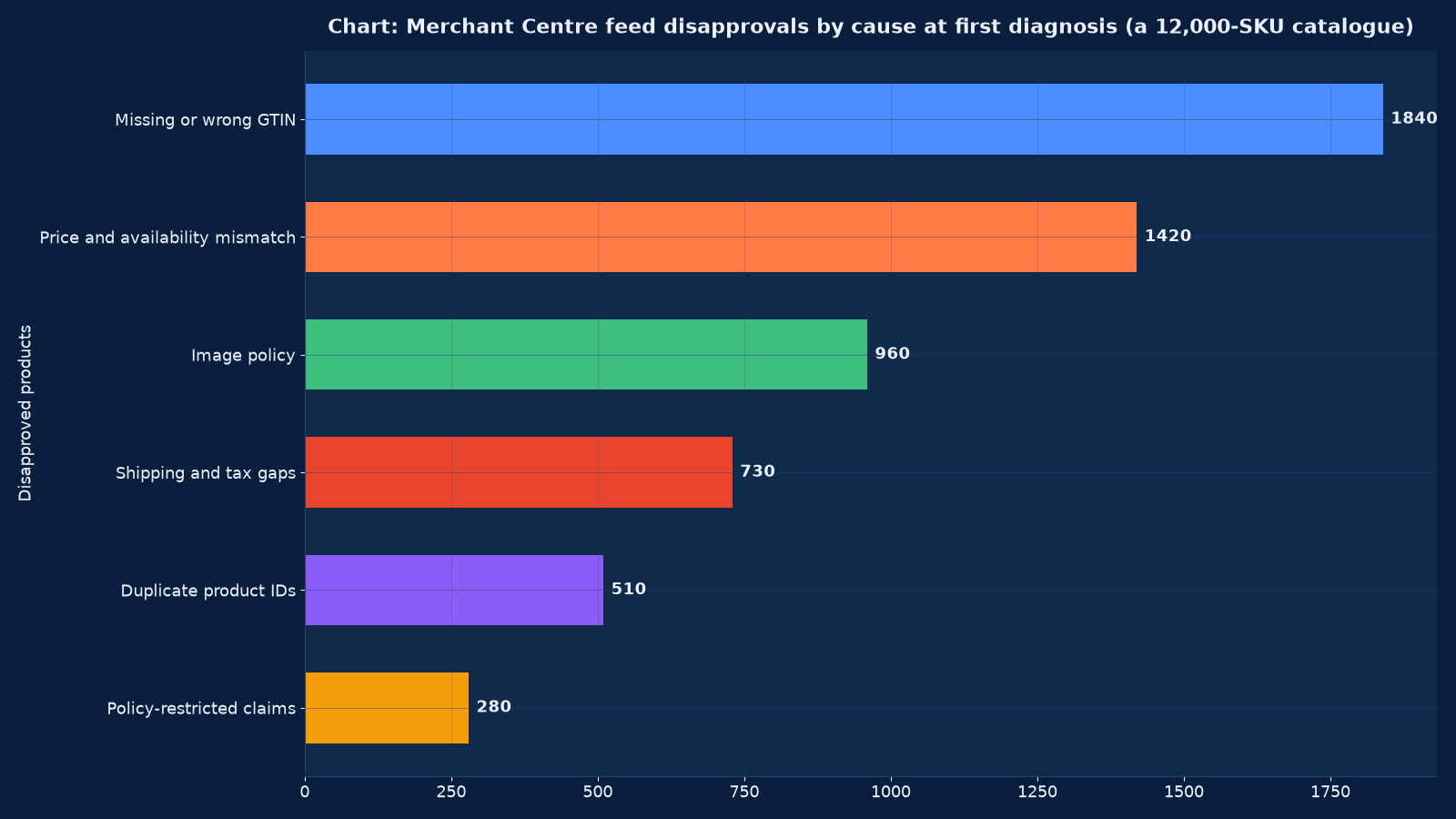
Chart values are an illustrative planning model based on typical UMC engagements and published industry benchmarks. They are not a guarantee of results on any specific project.
Nobody campaigns their way out of a broken feed. The bid strategy, the creative and the budget all sit downstream of a data file that says what the product is called, what it costs, whether it is in stock and whether the picture is allowed. When that file is wrong, the account is not underperforming. It is selling half a catalogue.
Google Shopping and Merchant Centre feed management at Unified Management Consulting is the work of making a product catalogue legible to a machine that will not guess. A feed is not an export; it is a contract between your inventory system and an auction, and every attribute in it is either correct, missing or contradicted by your website. The catalogue that arrives in Merchant Centre is the one that gets sold, and the difference between a maintained feed and a generated one is usually the difference between a campaign that scales and one that quietly shrinks to whatever subset of products survived validation.
We work with WooCommerce and Shopify estates, with custom platforms, with ERP and PIM systems as the source of truth, and with marketplaces and feeds that have been assembled by three different agencies over five years. The engagement is either a rebuild — diagnose, map, repair, wire and monitor — or a standing governance service where the feed is treated as production infrastructure with an owner, a monitoring rule and a change process. The second is what most estates actually need, because a feed that is correct in March is not correct in September unless something is watching it.
🛒 Google Shopping & Merchant Centre Feeds — Quick Summary
| Component | What We Deliver |
|---|---|
| Catalogue and disapproval diagnosis | Every product classified approved, disapproved, limited or missing, with the cause per item and the share of the catalogue each cause represents. |
| Feed source and attribute mapping | One source of truth per attribute, mapped from the system that actually owns it — the PIM, the ERP, the shop, or a rule — rather than assembled by hand. |
| Identifier repair | GTIN, MPN and brand supplied, validated and exemption-handled, so products stop being disapproved for missing identifiers. |
| Price and availability synchronisation | Automated sync with the website, with crawl-based verification, because a mismatch is the second-largest disapproval cause and the fastest way to lose an account’s standing. |
| Shipping, tax and delivery configuration | Shipping services, rates, transit times, tax settings and returns policy configured per market, matching what the checkout actually charges. |
| Image and policy remediation | Image policy compliance across the catalogue, and restricted-claim review for the categories that attract it. |
| Titles, descriptions and product types | Titles restructured around what shoppers type, descriptions completed, and Google product categories and your own product type taxonomy applied consistently. |
| Labels and custom segments | Custom labels for margin band, season, stock depth and promotion, so campaigns can bid by commercial value rather than by catalogue order. |
| Campaign wiring | Shopping and Performance Max campaigns structured against the labels, with inventory groups that reflect margin and intent. |
| Monitoring and governance | Daily diagnostics, an owner, alert thresholds, and a change process so a platform upgrade cannot silently break the feed. |
What This Service Actually Covers
The service covers the data layer of product advertising, and it is delivered either as a bounded rebuild or as standing governance. Both include the campaign wiring, because a feed that nobody has structured a campaign against produces approvals without revenue.
| Component | What we do | What you keep | Duration |
|---|---|---|---|
| Diagnosis | Full catalogue classification with the cause per disapproval | A diagnosis report with the recoverable share of the catalogue quantified | 1–2 weeks |
| Source and mapping | Attribute-by-attribute mapping to the system that owns it | A mapping specification an engineer can implement | 1–2 weeks |
| Identifier repair | GTIN, MPN, brand and exemption handling | An identifier register and a rule for new products | 1–2 weeks |
| Synchronisation | Automated price, availability and shipping sync with verification | A feed that refreshes daily and a monitor that fails loudly | 1–2 weeks |
| Content optimisation | Titles, descriptions, categories, product types and images | A title pattern and an image standard | 2–3 weeks |
| Segmentation | Custom labels by margin, season, stock and promotion | A label taxonomy documented in one place | 1 week |
| Campaign wiring | Shopping and Performance Max structured against the labels | Campaigns whose inventory groups reflect commercial value | 1–2 weeks |
| Governance | Daily diagnostics, owners, thresholds and a change process | A monitored feed rather than a hopeful one | Ongoing |
| Multi-market | Per-market feeds with local currency, language, shipping and tax | A market-by-market feed inventory | Per market |
The output is deliberately unglamorous: a specification, a monitor and a label taxonomy. Those three artefacts are what keep a catalogue sellable through a platform upgrade, a price change, a new supplier and a seasonal range, and they are what is missing when a client arrives with an account that worked two years ago.
Why the Feed Is the Campaign
In a search campaign, the advertiser chooses which queries to buy. In Shopping, the platform chooses, using the feed to decide what the product is and who it is for. The feed therefore performs the function that keywords perform elsewhere, and a weak feed cannot be compensated for by a strong bid.
| Function in a search campaign | Performed in Shopping by |
|---|---|
| Keyword list | The title, description, product type and Google product category |
| Match type and negatives | The title structure and the category accuracy |
| Ad copy | The image, the title, the price and the promotion attributes |
| Landing page relevance | The link, and whether the price and availability on it match |
| Ad schedule and geo | Shipping, availability and the market the feed is submitted to |
| Bid adjustments by segment | Custom labels and inventory groups |
| Quality signals | Feed accuracy, crawl consistency and the account’s policy history |
This is why a Shopping account with excellent campaign settings and a mediocre feed underperforms a simple account with an excellent feed, and why our first recommendation is almost never about bidding.
The Disapproval Economy: What Stops Products Selling
Figure 1 is a real first diagnosis, and the shape is typical. Disapprovals cluster in six causes, all of them fixable, none of them visible in the campaign interface unless somebody opens the diagnostics.
| Cause | Why it happens | The fix | What it costs to leave |
|---|---|---|---|
| Missing or wrong GTIN | A catalogue assembled without identifier data, or identifiers invented for products that have none | Supply real GTINs from the supplier or the packaging, use MPN plus brand where a GTIN genuinely does not exist, and declare the exemption honestly | The single largest block of invisible inventory: 1,840 products in Figure 1 |
| Price and availability mismatch | The feed is generated from a stale export, or the site changes price without the feed following | Automated sync plus crawl-based verification, with an alert on any mismatch | 1,420 products, and a policy standing that puts the whole account at risk |
| Image policy breach | Watermarks, promotional overlays, placeholder images, wrong aspect ratios, or images that do not show the product | An image standard, a batch remediation of the catalogue, and a rule at upload | 960 products, usually concentrated in one imported range |
| Shipping and tax gaps | No shipping service configured for a market, or a tax setting that does not match the checkout | Per-market shipping and tax configuration, verified against a real checkout | 730 products, and abandoned baskets where the products are approved |
| Duplicate product identifiers | Variants sharing an ID, or the same product submitted twice from two sources | One canonical ID per variant, and one source per product | 510 products competing with themselves for the same impression |
| Policy-restricted claims | Health, efficacy, comparative or superlative claims in titles and descriptions | A claim review against the category’s policy, and copy rewritten to describe rather than promise | 280 products, and in some categories the whole account |
The commercial argument for this work is not that disapprovals are embarrassing. It is that half a catalogue being invisible means the campaign’s budget is concentrated on the surviving half, which raises the cost per conversion on those products while the rest of the range earns nothing. Fixing the feed usually improves the performance of the products that were already approved, because the auction stops being fought over a narrow inventory.
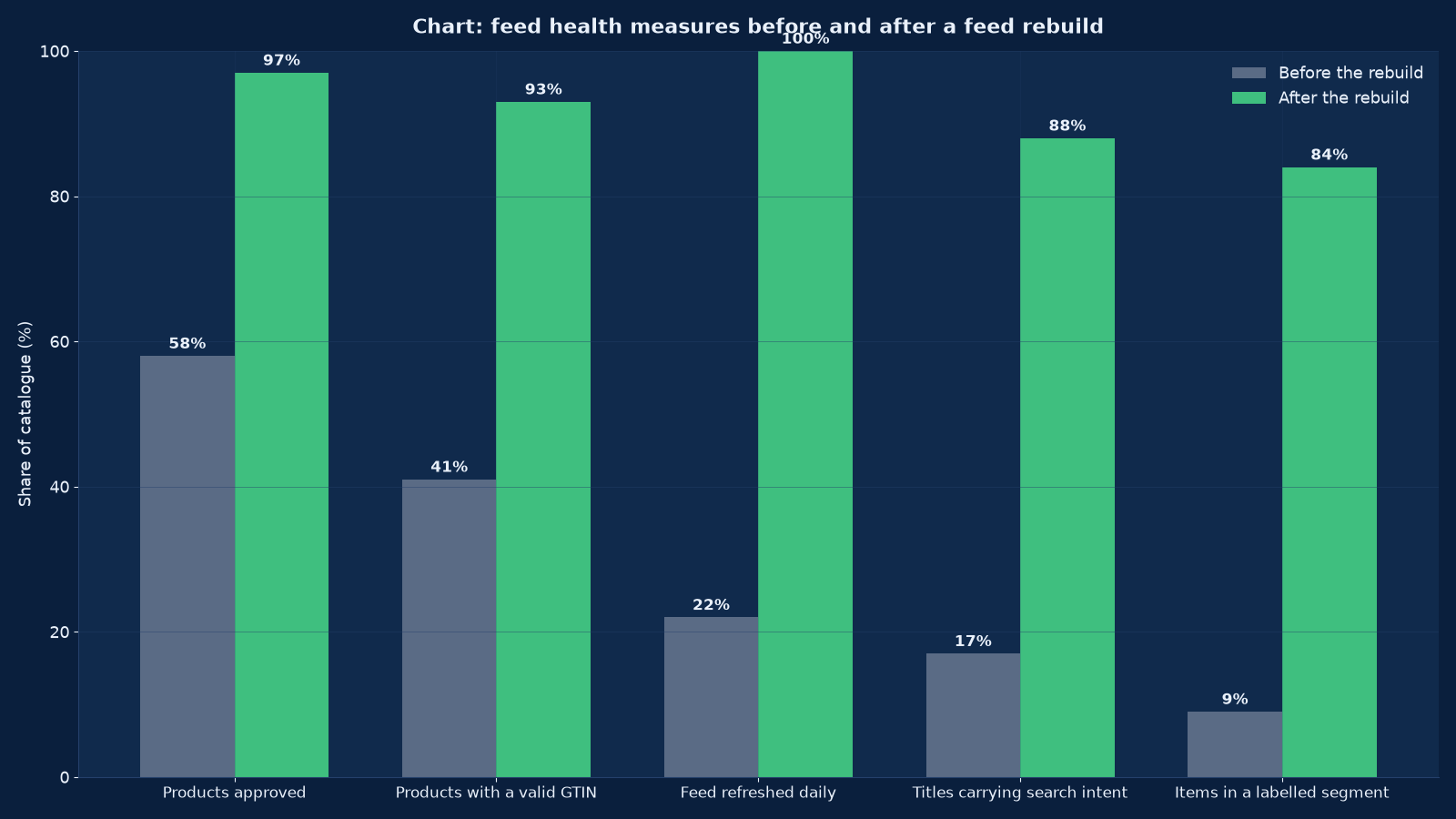
Chart values are an illustrative planning model based on typical UMC engagements and published industry benchmarks. They are not a guarantee of results on any specific project.
Feed Sources and Attribute Mapping
Most feed problems are source problems. Where an attribute is maintained in two places, one of them will be wrong, and the feed will inherit whichever was exported last. The first task is therefore to decide which system owns each attribute and to make the feed a derivation rather than a document.
| Attribute group | Correct owner | Common mistake |
|---|---|---|
| Identifiers: GTIN, MPN, brand | The PIM or the supplier data, not the shop | Identifiers typed by a merchandiser, or left blank and exempted wrongly |
| Price and availability | The commerce platform, in real time | A nightly export that is wrong for twenty-three hours |
| Titles and descriptions | A pattern applied from structured attributes | Free text edited per product, drifting into claims and inconsistency |
| Images | The media library, with a naming convention tied to the product ID | Images referenced by a URL that changes when the theme is updated |
| Categories and product types | A controlled taxonomy, one per product | Two taxonomies applied inconsistently across imported ranges |
| Shipping, tax and returns | The commerce platform’s own configuration | A feed that states free shipping while the checkout charges it |
| Custom labels | A rule based on margin, stock depth or season | Labels applied by hand once and never updated |
| Variants | The parent-child relationship from the catalogue | Variants collapsed into one product, or duplicated as separate products |
The mapping is written down as a specification: attribute, owner system, transformation, validation rule and failure behaviour. That document is what allows a feed to survive a platform migration, and it is what we hand over at the end of an engagement.
Identifiers: GTIN, MPN, Brand and the Exemption Question
Identifiers are how a product is matched to the wider catalogue, and they determine whether an item competes in a product listing or sits outside it. They are also the most commonly faked attribute in a feed, because faking them appears to work until it does not.
| Situation | Correct treatment | The risk of getting it wrong |
|---|---|---|
| A manufactured product with a barcode | The real GTIN from the packaging or the supplier | An invented GTIN is detected, and the account’s policy standing suffers |
| A product with no GTIN but a manufacturer part number | MPN plus brand, with the GTIN exemption declared | Leaving both blank when an exemption would have been granted |
| Your own brand and your own products | Brand as your own, MPN from your internal catalogue, GTIN where you have assigned one | Declaring an exemption you are not entitled to |
| Bundles and kits you assemble | A bundle identifier with its own GTIN or MPN, and the component products described in the title | Submitting a bundle under a component’s identifier |
| Made-to-order or customised goods | The exemption path for custom products, with the customisation described | A disapproval that looks like an identifier problem |
| Vintage, second-hand or one-off items | The exemption for products with no assigned identifier | Borrowing another product’s GTIN, which is the clearest breach |
| Variants of one product | One identifier per variant, with the item-group ID linking them | Variants sharing an identifier and being treated as duplicates |
Price, Availability and the Synchronisation Problem
Price and availability mismatches are treated seriously by the platform because they damage the shopper, and an account with a persistent mismatch history loses more than the affected products. The fix is automation with verification, not diligence.
| Failure | Cause | Control |
|---|---|---|
| Feed price higher than the site | A stale export, or a promotion applied on the site only | Real-time or hourly sync, with a crawl comparison on a sample each day |
| Feed price lower than the site | A price increase not propagated | The same sync, plus an alert on any variance above a stated tolerance |
| In stock in the feed, out of stock on the site | Inventory not decremented, or a feed generated from a cached product list | Availability sourced from the inventory system rather than the product record |
| Out of stock in the feed, available on the site | An over-cautious rule that suppresses low-stock items | A stock-depth threshold agreed with merchandising, applied as a label rather than a suppression |
| Currency or format mismatch | A market feed emitted in the wrong currency or with the wrong decimal separator | Per-market feed validation with the expected currency declared |
| Promotion conflicts | A promotion attribute and a changed price applied at once | One mechanism per promotion, documented in the promotion calendar |
The verification step matters more than the sync. A sync can fail quietly; a crawl that compares the feed against the live page for a rotating sample catches it the same day, and the alert names the product rather than the percentage.
Shipping, Tax and the Checkout Surprise
Shipping and tax attributes exist so the shopper sees the true delivered price before clicking. Where they disagree with the checkout, the result is an abandoned basket and, if the pattern persists, a policy problem.
| Configuration | What must be true | How we verify it |
|---|---|---|
| Shipping services | Every service the checkout offers is declared, with the countries and regions it covers | A test order per market, comparing feed and checkout |
| Rates | Flat, weight-based, price-based or table rates matching the site’s rules | A sample of baskets across the rate bands |
| Transit and handling time | Realistic per service, including handling | Compared against the site’s stated delivery promises |
| Free shipping thresholds | Declared where they exist, so the price shown is accurate | A basket above and below the threshold |
| Tax | Per-market tax settings matching the checkout’s calculation | A test order per market with the tax line compared |
| Returns policy | Present and consistent with the site’s policy page | Read against the site, not against a template |
| Local pickup or click-and-collect | Declared where offered, with the locations | Compared against the site’s store list |
Images and Policy Compliance
Image policy is the third-largest disapproval cause in Figure 1 and the easiest to fix in bulk, because the breaches are usually systematic: one imported range with watermarks, or a template that overlays a promotional badge on every product image.
| Requirement | Standard | Bulk remediation |
|---|---|---|
| The product is the subject | The image shows the product being sold, not a model, a logo or a lifestyle scene without the item | Identify the affected range and re-shoot or re-crop from existing assets |
| No promotional overlays | No text, badges, watermarks or price callouts on the image | Strip overlays at generation rather than editing thousands of files |
| Correct background and framing | A clean background for most categories, the product filling the frame | Automated cropping to the required ratios |
| Resolution and ratio | The minimum resolution per category, in every required ratio | A generation rule, not a per-product upload |
| Category-specific rules | Apparel on a model or mannequin where required, no mannequin artifacts | A per-category image standard applied at source |
| Restricted claims | No health, efficacy, before-and-after or comparative claims in copy or image | A claim review against the category policy before submission |
| Consistency across variants | Each variant’s own image, not the parent’s | Variant-level image mapping in the feed |
Policy-restricted claims are the smallest category in Figure 1 and the most dangerous, because in some product categories a repeated claim breach puts the account rather than the product at risk. Where a catalogue makes health or efficacy claims, we review the copy before submission and rewrite it to describe the product rather than promise an outcome.
Titles, Descriptions and the Words Shoppers Type
The title is the keyword strategy of a Shopping campaign. It is assembled from attributes rather than written per product, and the pattern differs by category because shoppers search differently by category.
| Category pattern | Title structure | Example shape |
|---|---|---|
| Apparel | Brand, product type, gender, colour, size, material | Brand plus category plus the attributes a shopper filters by |
| Electronics | Brand, model number, key specification, capacity or size | The model number and the spec that distinguishes it |
| Home and furniture | Brand, product type, material, dimensions, colour | Dimensions and material, which drive the purchase decision |
| Health and beauty | Brand, product type, variant, size, count | Size and count, and no efficacy claims |
| Food and grocery | Brand, product type, flavour, weight, pack count | Pack count and weight, which shoppers compare directly |
| Industrial and parts | Part number, compatibility, specification | The part number first, because that is what is searched |
| Books and media | Title, author, format, edition | Format and edition, which distinguish otherwise identical items |
- Front-load the terms a shopper types: brand and product type first, then the differentiating attribute.
- Use the character allowance deliberately; a truncated title loses the attribute that distinguishes the variant.
- No promotional language, no all-capitals, no repeated words, no claims — each is a policy risk as well as a relevance problem.
- Descriptions completed for the attributes that matter in the category, because they contribute to matching where the title cannot carry everything.
- Google product category and your own product type applied consistently, since both are used for matching and for reporting.
- Titles generated by rule, so a change to the pattern updates the catalogue rather than requiring an edit per product.
Labels, Custom Segments and Bidding by Value
Custom labels are how a feed becomes a commercial instrument rather than an inventory list. They let campaigns bid by margin, by season, by stock depth and by promotion, which is the difference between spending on everything and spending on what is worth selling.
| Label dimension | Values | What it enables |
|---|---|---|
| Margin band | High, medium, low, loss-leader | Bids and targets set by what the product earns rather than by what it costs to advertise |
| Season or collection | Current season, evergreen, clearance | Budget shifted to the range that matters this quarter |
| Stock depth | Deep, adequate, low, single unit | Suppression or reduced bids on items that cannot be fulfilled |
| Promotion | On promotion, promotion pending, no promotion | Promotion attributes and campaigns aligned to a calendar |
| Performance history | Best seller, tested, untested, declining | A budget allocation that reflects evidence rather than recency |
| Market or language | Per-market segment | Separate campaigns per market with local currency and shipping |
Labels are assigned by rule from the systems that own the underlying data, and the rules are documented. A label applied once by hand is a snapshot that becomes wrong; a label derived from margin data is a control that keeps working.
Campaign Wiring: Shopping, Performance Max and the Feed
Approvals without structure produce impressions without revenue. The campaigns have to be built against the labels, with inventory groups that reflect commercial value and intent rather than the catalogue’s own hierarchy.
| Campaign element | Design decision | The failure it prevents |
|---|---|---|
| Inventory groups | By margin band, by product family, or by intent | One group containing the whole catalogue, which cannot be steered |
| Standard Shopping against Performance Max | Which inventory each campaign serves, and how they are prevented from competing | Two campaigns bidding on the same products with different targets |
| Exclusions | Out-of-stock, clearance or low-margin segments excluded from full-price campaigns | Budget spent on products that cannot be fulfilled profitably |
| Priority and bidding | Feed-level priority where multiple feeds exist, and a bid strategy matched to conversion volume | A multi-feed account resolving unpredictably |
| Market separation | One campaign per market, with the market’s feed, currency and shipping | A single campaign serving several markets with one budget |
| Promotion handling | Promotion attributes and campaigns aligned to the promotion calendar | A promotion advertised in one place and not applied in another |
| Negative products and brands | Excluded where they should never be advertised | Restricted or loss-making ranges entering the auction |
The Ten-Week Programme
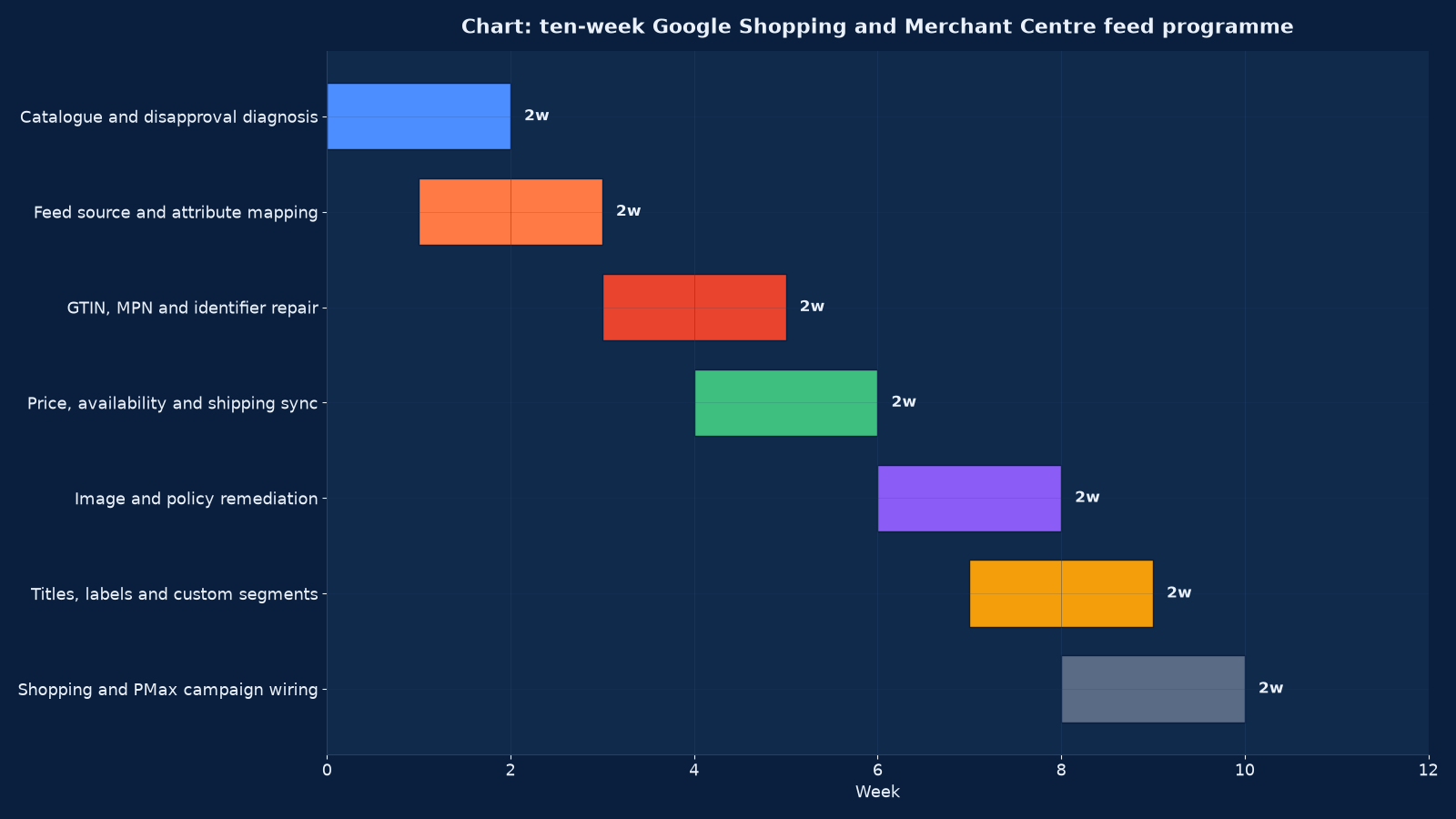
Chart values are an illustrative planning model based on typical UMC engagements and published industry benchmarks. They are not a guarantee of results on any specific project.
| Weeks | Workstream | Gate to pass |
|---|---|---|
| 1–2 | Catalogue and disapproval diagnosis | Every product classified with a cause, and the recoverable share quantified |
| 2–3 | Feed source and attribute mapping | One owner per attribute and a written specification |
| 4–5 | Identifier repair | GTIN, MPN and brand supplied or correctly exempted across the catalogue |
| 5–6 | Price, availability and shipping sync | Automated sync live, with crawl verification and an alert on variance |
| 7–8 | Image and policy remediation | Image policy breaches cleared and restricted claims reviewed |
| 8–9 | Titles, labels and custom segments | A title pattern per category and a label taxonomy applied by rule |
| 9–10 | Campaign wiring | Inventory groups built against the labels, with exclusions and market separation in place |
Ten weeks is the rebuild. Governance is continuous after it: daily diagnostics, a weekly disapproval review, a monthly label and title review, and a change process that requires any platform or catalogue change to be assessed against the feed before it is deployed. The rebuild without governance is how estates return to Figure 1 within a year.
Monitoring: What Breaks Silently
| Monitor | Frequency | Threshold that triggers action |
|---|---|---|
| Account and item issues | Daily | Any new issue affecting more than a stated share of the catalogue |
| Disapproval count by cause | Daily | A rise in any cause, which usually means a new import or a template change |
| Price and availability variance | Daily, on a rotating sample | Any variance at all, because these accumulate into a policy problem |
| Feed fetch status | Daily | A failed or skipped fetch, which stops every downstream update |
| New product coverage | Weekly | Products on the site that are absent from the feed |
| Retired product leakage | Weekly | Products in the feed that are no longer on the site |
| Image policy re-checks | On any media-library or theme change | A generation rule that has started emitting non-compliant images |
| Label integrity | Monthly | A label dimension whose values no longer match the source data |
| Performance by segment | Monthly | A segment whose return has moved enough to justify a bid or exclusion change |
| Policy standing | On notification | Any warning, addressed before it becomes a suspension |
The monitor has an owner and an escalation path, both named. A dashboard nobody reads is not governance, and the difference shows up in whether a feed defect is found in a day or in a quarter.
Multi-Market and Multi-Currency Feeds
A feed per market is not a translation exercise; it is a separate contract with its own currency, tax, shipping, language and policy context. Estates that submit one feed to several markets discover the problem as a wave of disapprovals or, worse, as approved products with prices the checkout contradicts.
| Per market | Requirement | Common failure |
|---|---|---|
| Language | Titles and descriptions in the market’s language, generated from translated attributes | One English feed submitted to several markets |
| Currency | The market’s currency, formatted correctly, matching the checkout | A converted price that drifts from the displayed one |
| Shipping and tax | Local services, rates, transit times and tax treatment | Domestic shipping rules applied to an export market |
| Identifiers | The same GTIN across markets, with market-specific MPN or brand where they differ | Re-assigning identifiers per market, which fragments the product |
| Policy context | Category restrictions that differ by market | A claim permitted in one market and restricted in another |
| Availability | Whether the product can actually be delivered to that market | Advertising products that cannot ship to the market being targeted |
| Campaigns | One campaign per market with that market’s feed | One campaign serving several markets with one budget and one bid |
Failure Modes We Are Usually Called In To Fix
| What we find | Why it happened | What we do |
|---|---|---|
| Half the catalogue disapproved and nobody knew | Diagnostics were never opened after the initial setup | Diagnose, classify, repair by cause, and put a daily monitor with an owner in place |
| A platform migration broke the feed | The feed was an export file rather than a derivation from an owned source | Rebuild as a specification with per-attribute owners and validation rules |
| Prices on the feed and the site disagreeing | A nightly export with no verification | Real-time sync plus a crawl comparison and an alert on variance |
| Invented GTINs to clear disapprovals | A quick fix applied under pressure | Remove them, supply real identifiers or the correct exemption, and accept the temporary coverage loss |
| One campaign containing twelve thousand products | No labels, so no way to segment | A label taxonomy by margin, season and stock, then inventory groups built against it |
| Titles written by hand and inconsistent | No pattern, and a merchandiser editing per product | A per-category title pattern generated from attributes |
| A promotion advertised but not applied | The promotion attribute and the price mechanism managed separately | One mechanism per promotion, tied to a calendar |
| An account warning ignored until suspension | No policy governance | A policy review of the catalogue and a standing response process |
Google Shopping and the Rest of the Stack
A feed sits between the commerce platform and the auction, so the work touches engineering, merchandising and media at once. We plan it with all three rather than treating it as a marketing task handed to a developer.
- E-commerce Development & Marketing Services — the catalogue, the platform and the product data the feed derives from.
- Google Ads Management Services — the campaigns the feed is wired into, and the search campaigns that serve the same demand.
- Large WooCommerce Development — the platform most of our catalogue work is built on, including the product-type and variant handling a feed depends on.
- Conversion Rate Optimisation (CRO) Services — the product pages the traffic lands on, where a feed-approved product still has to convert.
- Analytics & Attribution (GA4) Services — the item-level revenue data that makes margin labels and bid decisions possible.
- Website Design & Development Services — the template and media-library changes an image standard requires.
- Website Migration Services — where a feed is most often broken, and where the specification earns its keep.
- Facebook & Meta Advertising Services — the same catalogue sold through a second channel with its own attribute requirements.
Evidence From Our Work
The engagements and writing below are published on this site, each described by the subject its own page documents. They are listed because feed work is usually commissioned by a business that has already discovered its catalogue is not fully sellable and wants to know whether the problem is the platform or the data.
- WordPress WooCommerce e-commerce development for Suri Retail Group — a multi-brand retail chain built on WooCommerce with advanced product management, multi-vendor capability and payment integration: the catalogue architecture a feed derives from.
- Ez1.in Services: a ground-up e-commerce platform rebuild — a services-plus-products catalogue rebuilt from scratch, where the product model and its identifiers were designed rather than inherited.
- Google Ads and Meta Ads strategy for a fashion retail showroom — a product-led retail account where image standards, variant handling and margin segmentation decide the campaign’s reach.
- E-commerce marketing for Lucknow businesses — the catalogue, listing and channel work a shopping feed sits inside, written for the market most of our retail clients operate in.
- Google Ads guide to maximise ROI — the account fundamentals that a feed rebuild makes usable, including tracking and structure.
- Landing page optimisation: how to convert more visitors into customers — the product-page work that determines whether an approved product converts once it is clickable.
- Marketing attribution models: how to choose the right one for your business — how item-level revenue is attributed, which is what makes margin-based labels defensible.
- Schema markup and structured data — the product markup on the site that has to agree with the feed’s attributes.
- The digital marketing insight archive — further writing on paid media, retail marketing and measurement.
Engagement Models and Commercials
Feed work is quoted against catalogue size and source complexity, not against media spend, because the effort is in the data rather than in the auction.
| Model | Best for | What you get | Indicative shape |
|---|---|---|---|
| Feed diagnosis, fixed fee | An account with unexplained disapprovals or weak coverage | Full catalogue classification by cause, the recoverable share quantified, and a repair plan | One to two weeks, one fee |
| Feed rebuild | A catalogue whose feed is an export rather than a derivation | Source mapping, identifier repair, synchronisation, image and policy remediation, titles, labels and campaign wiring | Ten weeks, fixed fee |
| Feed governance retainer | A catalogue that changes: new ranges, price moves, platform updates | Daily monitoring with an owner, weekly disapproval review, monthly title and label review, and a change process | Monthly |
| Multi-market rollout | An estate selling into more than one market | A feed per market with local currency, language, shipping, tax and policy review | Fixed fee per market |
| Migration feed support | A replatform where the feed is at risk | A pre-migration specification, a validation set, and post-migration verification | Fixed fee per migration |
Every quote states the catalogue size, the source systems involved and the number of markets, because those three variables account for almost all of the effort. A client with a clean PIM and one market is not buying the same engagement as one with three agencies’ worth of exports and four markets, and quoting them identically would mean one of them is being served badly.
Frequently Asked Questions About Google Shopping & Merchant Centre Feeds
Why are half my products not showing in Shopping?
Usually one of six causes, all visible in the Merchant Centre diagnostics: missing or wrong identifiers, a price or availability mismatch with your site, an image policy breach, shipping or tax gaps, duplicate identifiers, or a restricted claim. In Figure 1 those six accounted for 5,740 disapprovals on a 12,000-item catalogue. The diagnostics name the cause per item, and the repair is systematic rather than product by product.
What is a GTIN and what if my products do not have one?
A GTIN is the barcode number assigned to a manufactured product. If yours genuinely has none — your own brand, a bundle you assemble, a made-to-order or second-hand item — the correct route is the identifier exemption with an MPN and brand, declared honestly. Inventing a GTIN clears the disapproval briefly and damages the account’s standing when it is detected.
How often should the feed refresh?
Daily at minimum, and hourly or in real time for price and availability where the platform allows it. In Figure 2 the share of catalogues refreshed daily rose from 22 to 100 per cent during the rebuild, and that figure is what keeps the others true: a weekly feed is a week wrong after every price change.
Does the feed need to match my website exactly?
For price, availability, shipping and the product’s identity, yes, and the platform crawls your pages to check. A persistent mismatch is treated as a shopper-harm issue, which is why it affects the account’s standing rather than only the affected items. We verify with a crawl comparison, not by trusting the export.
Can you fix titles in bulk?
Yes, and bulk is the only sane way. Titles are generated from a per-category pattern using the attributes that already exist — brand, product type, colour, size, material, model number — so a change to the pattern updates the catalogue. Hand-written titles are why most catalogues are inconsistent and why 17 per cent carried search intent before the rebuild in Figure 2.
What are custom labels for?
They let campaigns bid by commercial value rather than by catalogue order: margin band, season, stock depth, promotion status, performance history or market. Assigned by rule from the data that owns each dimension, they are the mechanism that turns an inventory file into a media plan.
Do I need a separate feed per country?
If you sell into more than one market, yes: each needs its own language, currency, shipping services, tax treatment and policy context, and its own campaigns. One feed submitted to several markets produces either disapprovals or approved products whose prices contradict the checkout.
How does this relate to Performance Max?
Performance Max sells the same catalogue through more networks, so it inherits every feed defect and amplifies it. We wire both against the same labels and exclusions, which prevents them from competing for the same inventory with different targets.
Our feed broke after a platform migration. Can it be recovered?
Yes, and the recovery is faster if the feed was specified rather than assembled. We rebuild from the mapping specification, or reconstruct one from the new platform’s data, then validate against a known-good product set before the campaigns are re-enabled. This is why we treat the specification as a deliverable rather than as internal documentation.
Will fixing the feed improve my return on ad spend?
Usually, and through two mechanisms rather than one. Products that were invisible start competing, and the products that were already approved stop being bid up in a narrow auction over a fraction of the catalogue. We forecast both effects and state the assumptions, rather than promising a percentage.
Who owns the feed after you finish?
Your team does, with the specification, the monitor, the label taxonomy and the change process documented and handed over. We also train whoever will maintain it, because a feed governed by an agency that leaves is a feed that breaks on the next platform upgrade.
What does this cost?
Quoted against catalogue size, the source systems involved and the number of markets, not against media spend. A diagnosis is a small fixed fee; a rebuild is a larger one over ten weeks; governance is monthly. There is no percentage of spend, because the work is in the data.
Commission a Feed Diagnosis or Rebuild
Send us read access to Merchant Centre, your catalogue size, the platform it comes from and the markets you sell into. Within two weeks you will have every product classified as approved, disapproved, limited or missing, the cause per disapproval with the recoverable share of the catalogue quantified in items and in expected revenue, an assessment of the feed’s source and whether it is a derivation or an export, a price and availability verification against your live pages, a review of titles, images and labels, and a costed ten-week rebuild with the campaign wiring included.
Contact Unified Management Consulting to arrange a confidential first conversation.
Related Services
Google Shopping and Merchant Centre feed work is delivered with the commerce, media and measurement practices around it:
- E-commerce Development & Marketing Services — the catalogue and platform the feed derives from
- Google Ads Management Services — the campaigns the feed is wired into
- Large WooCommerce Development — product types, variants and the attribute structure a feed depends on
- Conversion Rate Optimisation (CRO) Services — the product pages that decide whether an approved item converts
- Analytics & Attribution (GA4) Services — item-level revenue data for margin labels and bid decisions
- Website Design & Development Services — the template and media-library changes an image standard requires
- Website Migration Services — the change most likely to break a feed, and the specification that prevents it
- Facebook & Meta Advertising Services — the same catalogue through a second channel’s attribute requirements
- CRM Development & Integration — the customer and order data behind promotion and segmentation rules
- Google Ads Audit: Fixed-Fee Account Review — A fixed-fee Google Ads audit: wasted spend by cause, tracking and conversion review, structure, negatives, bidding and a costed repair plan
- Performance Max (PMax) Management Services — Performance Max management: conversion values, asset groups, feed and audience signals, exclusions, incrementality tests and weekly governance
- Local Services Ads & Local Campaign Management — Local Services Ads and local campaigns: eligibility and verification, service areas, profiles, reviews, lead routing, disputes and cost per job