
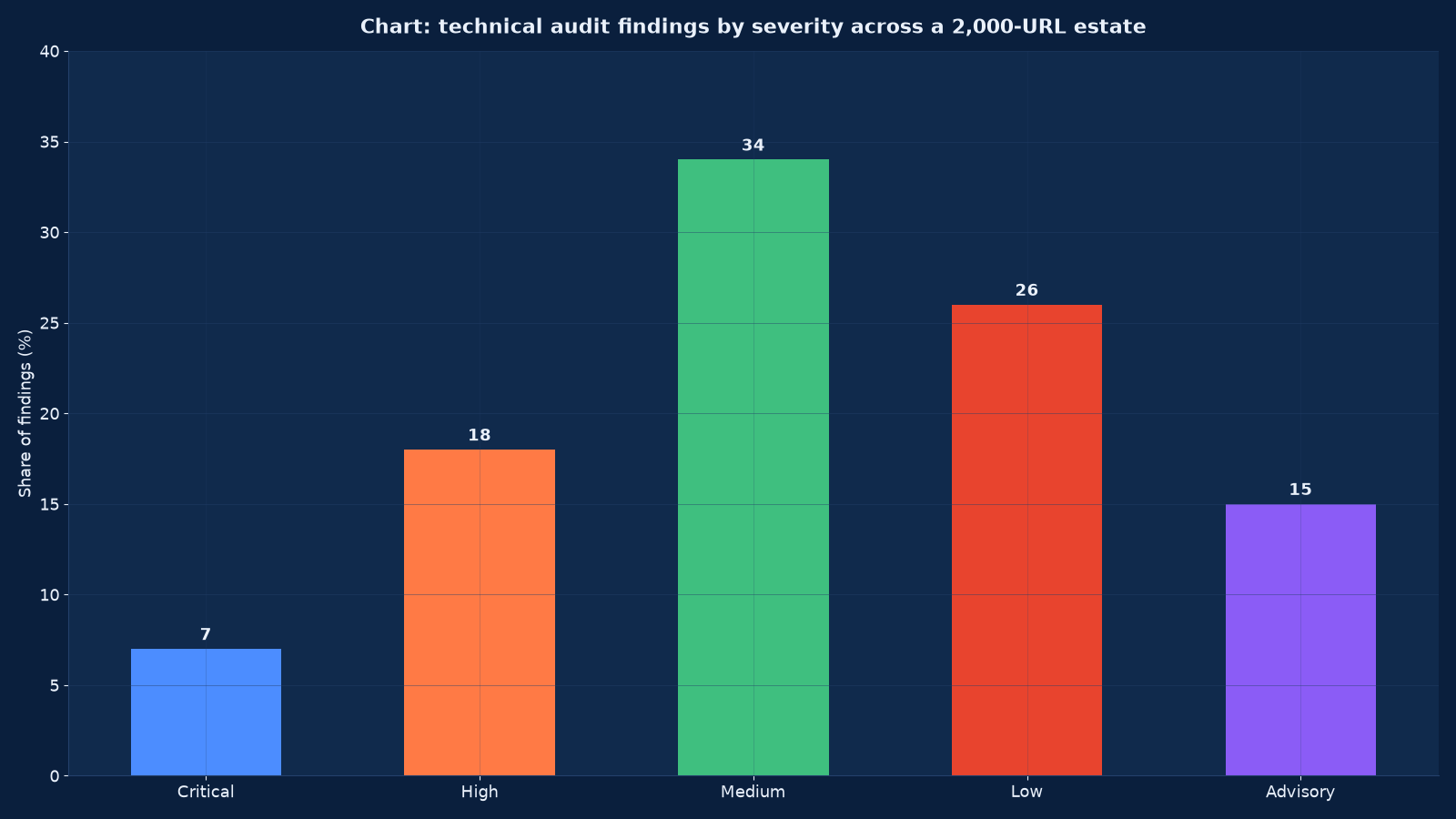
Chart values are an illustrative planning model based on typical UMC engagements and published industry benchmarks. They are not a guarantee of results on any specific project.
A technical SEO problem is never one problem. It is a crawl that cannot reach the pages, an index that holds the wrong ones, a canonical that points somewhere else, a template that renders content after the crawler has gone, and a migration that mapped four thousand URLs to the homepage. Each is small. Together they decide whether anything else you do is visible.
Technical SEO audits and site migrations at Unified Management Consulting are the engineering side of search: making sure a crawler can reach every page that matters, that the index contains the right versions of them, that each page declares itself correctly, that the rendered content matches the source, and that the site is fast enough on a mid-range phone for any of it to count. Where the estate is about to change — a replatform, a redesign, a domain move, a template rewrite, a restructuring of the URL scheme or an international rollout — the same discipline is applied before the change rather than after it, because a migration is the single most reliable way for a business to lose organic revenue overnight.
We work on WordPress and WooCommerce estates, on headless and JAMstack builds, on Laravel, .NET and Java applications, and on the enterprise platforms where the SEO team has no deploy rights at all and the work is therefore a specification, a review and a validation rather than a commit. That last case is the common one, and it is why our audit output is written for engineers: a finding, the evidence, the rule that is broken, the fix, the owner and the way to verify it afterwards. Not a list of recommendations to be forwarded to a team that has no context.
🔧 Technical SEO Audits & Site Migrations — Quick Summary
| Component | What We Deliver |
|---|---|
| Crawl and index audit | A full crawl plus server-log analysis, comparing what the crawler sees with what Google has actually indexed, and finding the gap between the two. |
| Severity-ranked findings | Every finding classified critical, high, medium, low or advisory, with the evidence attached, the rule broken, the fix, the owner and the verification method. |
| Crawl budget and indexation | Facet and parameter control, internal link depth, orphan pages, XML sitemaps, robots rules and the noindex that is hiding pages that should be found. |
| Canonicalisation and duplicates | Self-referencing canonicals, duplicate resolution across protocol, host, trailing slash, pagination, filtered views and syndicated content. |
| Rendering and JavaScript | What the crawler renders versus what a browser renders, deferred content, client-side routing and the templates that publish content after the crawl. |
| Core Web Vitals and performance | LCP, INP and CLS measured in the field and in the lab, with the specific asset, request or layout shift responsible for each failure. |
| Structured data validation | Markup checked against what is visibly on the page, with invalid, unsupported and self-contradictory types removed or corrected. |
| Migration planning and URL mapping | A complete URL inventory, a one-to-one mapping, a 301 set with no chains, and a rollback plan written before anything moves. |
| Staged migration and validation | Pre-launch validation on staging, launch-window checks, and post-launch crawl and index comparison against the baseline. |
| Post-migration monitoring | Daily indexation, rankings, crawl errors and revenue monitoring through the recovery window, with a named threshold for escalation. |
What This Service Actually Covers
The service covers two related engagements that are often bought together: an audit of an estate as it stands, and the technical governance of an estate that is about to change. Both produce engineering artefacts rather than marketing advice.
| Component | What we do | What you keep | Duration |
|---|---|---|---|
| Crawl and log analysis | Full crawl, log-file sample, index coverage comparison | A crawl dataset, a log analysis and the gap list | 1–2 weeks |
| Findings and prioritisation | Every issue classified with evidence, owner and fix | A severity-ranked register in your tracker | 1 week |
| Remediation support | Specification, review of the implementation, re-test | Verified fixes with before-and-after evidence | 2–8 weeks |
| Migration planning | URL inventory, mapping, 301 set, template and metadata rules, rollback plan | A migration specification an engineer can build from | 2–4 weeks |
| Launch governance | Staging validation, launch-window checks, go/no-go criteria | A signed validation report per environment | Per release |
| Post-migration monitoring | Indexation, rankings, crawl errors, revenue, daily through the recovery window | A monitoring pack and an escalation threshold | 4–12 weeks |
| Ongoing technical retainer | Release review, monitoring, quarterly re-audit | A standing technical check on every deploy | Monthly |
What we do not do is write your developers’ tickets for them in a system we cannot see. The register is delivered in a format your engineering team already uses, with enough evidence that a developer can reproduce the finding without asking us what we meant.
Why Technical SEO Is a Separate Discipline From Content
Content work assumes a page can be found, indexed and rendered. Technical work establishes whether that assumption holds. The two fail in different ways and are fixed by different people, which is why an audit that mixes them produces a document nobody owns.
| Question | Content and on-page answers it | Technical answers it |
|---|---|---|
| Should this page exist? | Yes, if there is demand and a reason to serve it | It should exist once, at one URL, with one canonical |
| Will it be found? | It needs links and internal links | It needs to be crawlable, not orphaned, in the sitemap, and within a sane click depth |
| Will it be indexed? | It needs to be substantially different from its neighbours | It must not be noindexed, canonicalised elsewhere, blocked, or duplicated by a parameter |
| Will it be understood? | It needs clear headings and honest structured data | The content must be in the HTML the crawler renders, not injected after it leaves |
| Will it be fast? | It needs a reasonable length and image discipline | It needs a performance budget, correct caching, and no layout shift from late assets |
| Will it survive a change? | It needs an owner and an editorial standard | It needs a URL map, a 301 set and a validation step in the release process |
The Audit: Crawl, Logs and the Index
An audit starts with three datasets that disagree with each other, and the disagreement is the finding. What the crawler can reach, what the server actually served to Googlebot, and what Google says it has indexed are three different lists, and every difference between them is a defect with a cause.
| Dataset | How we get it | What it reveals |
|---|---|---|
| Full crawl | A crawl of the live estate with rendering enabled, plus the staging environment where one exists | Status codes, redirects and chains, canonicals, metadata, internal link depth, orphan pages, duplicate titles and descriptions |
| Server logs | A sample of real request logs, filtered to crawler user agents and verified by reverse DNS | What Googlebot actually requests, how often, which templates it spends budget on, and which pages it never visits |
| Index coverage | Search Console coverage and site: queries, cross-checked against the crawl | Pages indexed that should not be, pages missing that should be, and the stated reason for each |
| Sitemaps | Every submitted sitemap, with its reported and actual counts | URLs in the sitemap that 404, noindex or redirect, and indexable pages absent from it |
| Robots and headers | robots.txt, meta robots, X-Robots-Tag, and any plugin or CDN rule that adds them | Blocks and noindex directives that were added for a reason nobody remembers |
| Rendering comparison | Raw HTML against the rendered DOM for a sample of templates | Content that exists only after JavaScript runs, and templates where the two differ materially |
The output of this stage is a single reconciled table: every URL in the estate, whether it is crawlable, whether it was crawled, whether it is indexable, whether it is indexed, and the reason for any mismatch. That table is the audit. Everything else is commentary on it.
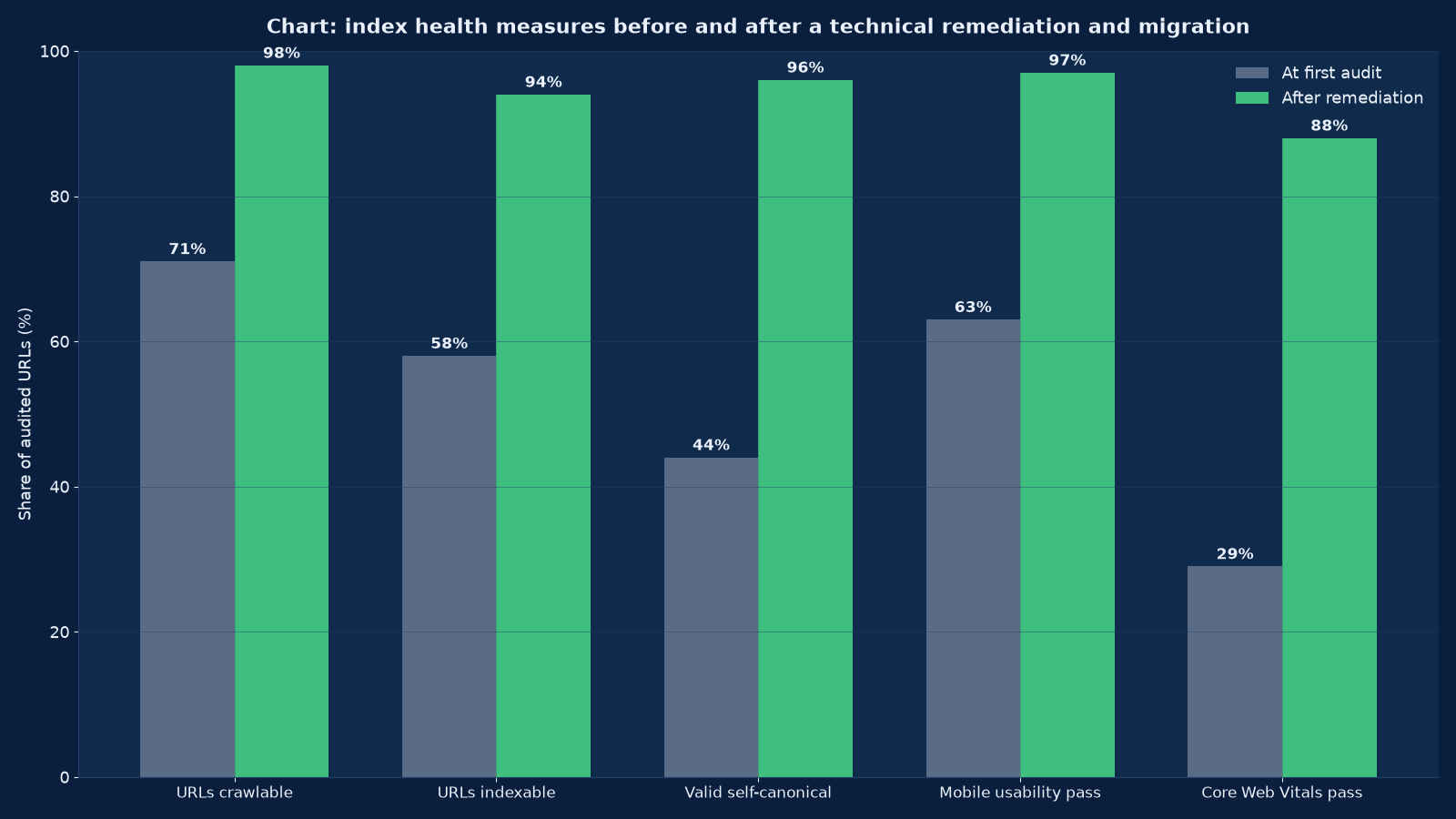
Chart values are an illustrative planning model based on typical UMC engagements and published industry benchmarks. They are not a guarantee of results on any specific project.
Severity Ranking and the Fix Order That Actually Matters
Findings are ranked by their effect on revenue rather than by how interesting they are to fix. A critical finding is one that removes pages from the index or sends authority to the wrong place. An advisory finding is a best practice whose absence costs nothing measurable today.
| Severity | Definition | Examples | Fix window |
|---|---|---|---|
| Critical | Pages are unreachable, unindexable, or authority is being lost at scale | A noindex on a template that carries revenue, a canonical pointing at the homepage, a migration 301ing everything to one URL, robots blocking a whole section | Immediately, and before any other work |
| High | A material share of the estate is affected and the effect is measurable | Redirect chains across a section, duplicate content from parameters, Core Web Vitals failing on the money templates, missing sitemap entries for indexable pages | This release or the next |
| Medium | Real defects with a bounded effect | Duplicate metadata on filtered views, orphan pages, slow assets on secondary templates, invalid structured data on a subset | This quarter |
| Low | Hygiene issues that compound if left | Inconsistent internal anchor text, missing alt text, oversized images, minor crawl-depth problems | Backlog, with an owner |
| Advisory | Best practice with no measurable current cost | Nice-to-have markup types, additional sitemap segmentation, extra monitoring | Optional |
Every finding carries the evidence: the URL list, the crawl row, the log line, the rendered comparison or the Search Console message. A finding without reproducible evidence is an opinion, and opinions do not get scheduled into a sprint.
Crawl Budget and Indexation
Crawl budget matters on large estates and is mostly irrelevant on small ones, which is worth saying because it is routinely invoked on sites with four hundred pages. Where it does matter, the cause is almost always internal links to faceted views, or a sitemap that does not match the index.
| Problem | Symptom | Fix |
|---|---|---|
| Faceted navigation crawled | Logs show most requests hitting parameter URLs; index coverage reports far more URLs than the estate has | Parameter handling, canonicals on facets, robots where appropriate, and internal links that do not point at facets |
| Orphan pages | Indexable pages the crawl cannot reach, discoverable only from the sitemap | Real internal links from a related page, not a sitemap entry pretending to be one |
| Deep click depth | Money pages five or more clicks from the homepage | Category and hub restructuring, breadcrumbs that link, related-content blocks |
| Sitemap drift | Sitemap URLs that 404, noindex or redirect; indexable URLs absent from it | Generate the sitemap from the same query that publishes the page, and validate it on every deploy |
| Redirect chains and loops | Two or more hops before a 200, wasting budget and diluting signals | One-hop redirects, mapped at source, tested in CI |
| Soft 404s | A 200 response with no content, or a ‘not found’ message with a 200 status | Correct status codes, and a real 404 template |
| Crawler trap | Infinite calendar, filter or pagination space | Bounded parameter space, nofollow or robots on the trap, and a crawl-delay-free design |
| Legacy noindex | A directive added during development and never removed | An audit of every source of robots directives, including plugin, theme, CDN and header |
Canonicalisation and Duplicate Resolution
Duplicates are rarely created deliberately. They are created by a protocol change, a host alias, a trailing-slash inconsistency, a print template, a session parameter, a pagination scheme and a syndication deal, each of which was reasonable on the day. The result is that several URLs compete for one query and none of them wins well.
| Duplicate source | Correct resolution | The wrong resolution we often inherit |
|---|---|---|
| Protocol and host variants | One canonical host, everything else 301s to it | Canonical tags pointing at four hosts, with the server still serving all of them |
| Trailing slash and case | One form, enforced by a redirect at the server | Both forms indexable and internally linked |
| Parameters and session IDs | Self-referencing canonical on the clean URL, plus parameter handling | A canonical on the parameterised URL, which tells Google to index the session |
| Pagination | Self-canonical per page, with crawlable prev and next links and unique metadata | Every page canonicalised to page one, which removes pages two to fifty from the index |
| Filtered and faceted views | Canonical to the unfiltered view where the filtered view adds nothing; indexable where it genuinely serves a query | Blanket noindex on facets that were earning traffic |
| Syndicated and republished content | Canonical to the original, agreed with the syndicator in writing | Republished content outranking the original |
| AMP and alternate templates | Reciprocal rel-alternate and canonical pairs | One half of the pair, which orphans the other |
| International variants | Self-referencing canonical per locale plus hreflang | Every locale canonicalised to the default market |
The rule we apply is that a canonical tag is a statement about which URL is preferred, not a redirect, and it does not fix a server that happily serves both. Where a duplicate should not exist at all, we remove it with a redirect rather than declaring a preference for one of two live copies.
Core Web Vitals and Performance
Field data decides the assessment, lab data finds the cause. A site can pass in Lighthouse and fail in the field, and the reverse, so we work from the CrUX-style field distribution and use lab runs to attribute each failure to a specific asset, request or layout behaviour.
| Metric | What fails it in practice | The fix that usually works |
|---|---|---|
| Largest Contentful Paint | A hero image loaded late, a render-blocking stylesheet, a font swap, or a server response above 600 milliseconds | Preload the LCP asset, serve it at the rendered size, inline critical CSS, and fix the server response before touching the front end |
| Interaction to Next Paint | A large JavaScript bundle, third-party tags, long tasks on the main thread, and heavy hydration on templates that do not need it | Reduce and defer JavaScript, break up long tasks, audit every third-party tag against its revenue contribution |
| Cumulative Layout Shift | Images without dimensions, injected banners, late-loading fonts and consent dialogs that push content down | Reserve space for every late element, set explicit dimensions, and load the consent UI without moving the page |
| Total blocking Time | Tag managers with no governance and analytics stacks added per campaign | A tag budget with a named owner, and removal of tags whose data nobody reads |
| Server response | Uncached pages, database queries per request, no page cache for anonymous traffic | Object and page caching, query review, and a CDN for static assets |
| Payload | Uncompressed images, unused CSS and JavaScript, auto-playing video | Modern formats, correct sizing, code splitting, and a performance budget enforced in CI |
We set a performance budget as a build constraint rather than a target to be recovered later: a maximum payload, a maximum number of requests, and a maximum JavaScript size per template, measured on every deploy. Without that, each release adds a little and the audit is repeated annually forever.
JavaScript, Rendering and the DOM That Gets Indexed
Rendering is where modern estates lose content. A crawler fetches HTML, queues rendering, and indexes what it finds; content injected after that point, or reachable only through client-side routing without real hrefs, may never be seen.
| Risk | How it appears | What we require |
|---|---|---|
| Client-side routing without real links | Navigation works in a browser but the crawl finds one page | Real anchor elements with real hrefs, server-rendered or pre-rendered routes |
| Content injected on interaction | An accordion, tab or modal holding the only substantive copy | Content present in the HTML, hidden with CSS rather than created on click |
| Infinite scroll as the only pagination | Items beyond the first screen unreachable | Paginated URLs that are crawlable, with infinite scroll layered on top |
| Deferred hydration | The rendered DOM differs materially from the source HTML | Server-side rendering or pre-rendering for indexable templates, hydration for the rest |
| Third-party widgets carrying content | Reviews, prices or FAQs loaded from a vendor script | First-party HTML for anything that must be indexed, with the widget as an enhancement |
| Lazy images without dimensions | Layout shift plus missing image signals | Native lazy loading with explicit width and height, and eager loading above the fold |
The test is simple and we run it on every template: fetch the URL with no JavaScript, then with rendering, and diff the two. Where the difference contains content that matters, the template needs a rendering change rather than an SEO workaround.
Structured Data Validation
Markup is cheap to add and expensive to get wrong. The failure we see most often is markup that claims something the page does not display — a rating with no visible reviews, an event with no date on the page, a product with a price that differs from the one shown.
| Type | Where it belongs | The mistake that causes action |
|---|---|---|
| Organization and WebSite | Site-wide | A logo or name that does not match the visible brand |
| BreadcrumbList | Every page with a breadcrumb trail | Breadcrumb markup whose trail does not match the visible one |
| Product and Offer | Product pages | Price or availability in markup that differs from the page |
| AggregateRating and Review | Pages that visibly display the reviews | Self-serving reviews on your own product pages, or ratings with no visible source |
| Service | Service pages | A type used where the page has no service detail to support it |
| FAQPage | Pages that visibly contain the questions and answers | Markup for questions that are not on the page, or on pages where the format does not apply |
| LocalBusiness | Location pages | An address or opening hours that differ from the visible NAP block |
| Article and author | Editorial content | An author with no profile, or a date that contradicts the page |
We validate markup with the testing tools and then re-check it against the rendered page, because a valid snippet that contradicts the visible content is worse than no snippet at all. Markup is kept in version control with the template so a redesign cannot silently break it.
Site Migrations: the Six Kinds, and What Each Breaks
Migration is where organic revenue is most often destroyed, and rarely by the thing the team was worried about. The six types below break different things, and each has a characteristic failure.
| Migration type | What it changes | The characteristic failure |
|---|---|---|
| Replatform | Templates, URL structure, metadata handling and often the content model | Metadata generated by the new platform’s defaults rather than migrated from the old one |
| Redesign | Templates and internal links, sometimes URLs | Navigation that removes the internal links money pages depended on |
| Domain move | Every URL’s host | A blanket 301 to the homepage instead of a one-to-one map, or a mixed move where some paths are not redirected |
| URL scheme change | The path of every page | Chains, and a mapping built from a sitemap rather than from the log of URLs that actually received traffic |
| Content restructuring | How pages are grouped, which exist at all | Consolidating ten ranking pages into one and losing nine sets of signals |
| International rollout | Locales, hreflang, ccTLDs or subfolders | Hreflang without self-referencing canonicals, or a locale served to the wrong market by an aggressive geo-redirect |
The single most valuable migration input is the server log. A mapping built from a sitemap covers the URLs you intended to publish; a mapping built from twelve months of logs covers the URLs that actually received traffic and links, including the ones nobody remembers creating.
URL Mapping and the 301 Set
The mapping is the migration. Everything else is a deploy. We build it as data rather than as a document, so it can be tested, diffed and loaded into the redirect layer without transcription errors.
| Step | Method | Output |
|---|---|---|
| Inventory | Union of the crawl, the sitemaps, twelve months of logs and the index coverage report | A URL list with traffic, links and index status per URL |
| Classification | Every URL marked keep, redirect, consolidate or retire, with the reason | A classified inventory that a stakeholder can challenge line by line |
| Mapping | One-to-one where possible; consolidate only where the content genuinely merges, with the target chosen by traffic and links | A mapping table: source, destination, type, reason |
| Redirect implementation | One-hop 301s, no chains, no loops, with pattern rules where the scheme changed systematically | A redirect configuration reviewed as code |
| Metadata and template rules | Titles, descriptions, canonicals, hreflang and structured data mapped per template rather than per page | A template specification the developers can implement |
| Internal link rewrite | Every internal href updated to the new URL at source, not redirected | A link-rewrite check in the release process |
| Third-party and search properties | Sitemaps resubmitted, Search Console property changes, ads and email links updated, canonical references in syndication corrected | A checklist with owners and dates |
| Rollback plan | Written before launch: what would trigger it, who decides, how long it takes | A rollback plan that has been rehearsed on staging |
The rules we do not bend
- No blanket redirect of a section to its parent unless every URL in it was genuinely retired, and the retirement is recorded.
- No redirect chains: if A goes to B and B goes to C, A must go to C.
- No 302 where a 301 is meant. Temporary redirects do not transfer signals and are frequently left in place for years.
- No migration on a Friday, and none without a monitoring plan that runs through the following week.
- No launch without a staging validation that reproduces the mapping test against the real build.
The Fourteen-Week Programme
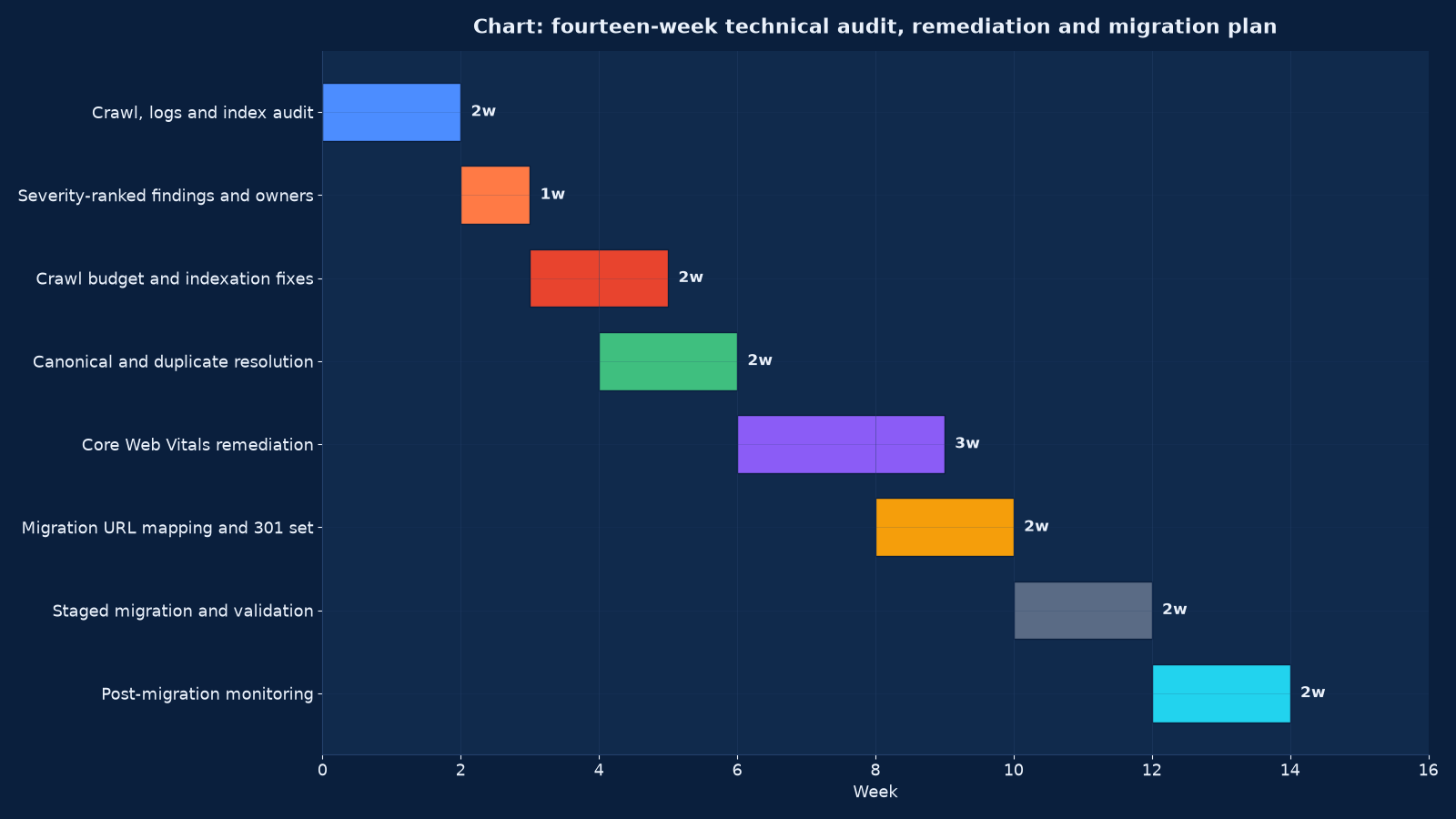
Chart values are an illustrative planning model based on typical UMC engagements and published industry benchmarks. They are not a guarantee of results on any specific project.
| Weeks | Workstream | Gate to pass before the next stage |
|---|---|---|
| 1–2 | Crawl, logs and index audit | A reconciled URL table where every mismatch has a stated cause |
| 3 | Severity-ranked findings with owners | Every critical and high finding has a named owner and a release |
| 4–5 | Crawl budget and indexation fixes | Index coverage moving in the intended direction, verified by re-crawl |
| 5–6 | Canonical and duplicate resolution | Self-canonical coverage above the agreed threshold on every template |
| 7–9 | Core Web Vitals remediation | Field data improving on the money templates, with the cause of any residual failure known |
| 9–10 | Migration URL mapping and the 301 set | The mapping tested against logs and sitemaps with no unmapped traffic-bearing URL |
| 11–12 | Staged migration and validation | Staging reproduces the mapping; go/no-go criteria met and recorded |
| 13–14 | Post-migration monitoring | Indexation, rankings and revenue within the agreed thresholds, or the escalation path invoked |
Post-Migration Monitoring and the Recovery Window
The first two weeks after a migration are the ones that decide whether it is described as a success. Monitoring is daily, the thresholds are agreed before launch, and the escalation path names a person.
| Monitored daily | Threshold | Action if breached |
|---|---|---|
| Indexed URL count | A drop beyond the expected consolidation figure | Identify the template or section, check for an unintended noindex or canonical |
| Crawl errors and 404s | Any 404 on a URL that received traffic in the last twelve months | Add the missing redirect; the mapping was incomplete |
| Redirect behaviour | Any chain, loop, or 302 where a 301 is required | Fix at source and re-test |
| Rankings on money pages | A movement beyond normal volatility on the top revenue templates | Check the page’s canonical, internal links and content parity against the old version |
| Organic sessions and revenue | A decline beyond the agreed tolerance | Invoke the escalation path; consider rollback if the cause is not found within days |
| Core Web Vitals | A regression introduced by the new templates | Raise it as a release blocker rather than an optimisation task |
| Metadata parity | Titles or descriptions differing from the mapping | Fix the template rule; a per-page patch is a symptom of a template defect |
Recovery expectations are set honestly at launch. Some fluctuation is normal for two to six weeks while the index is re-established. A decline that persists beyond that window is not “Google settling down”; it is an unmapped URL, a lost internal link, a metadata regression or a canonical that points at the wrong place, and it is findable.
What We Measure and Report
| Measure | Baseline | Target | Reported |
|---|---|---|---|
| Crawlable URLs | Share of the estate reachable by the crawler | Above 98 per cent | Per audit and after each fix wave |
| Indexable and indexed | Share indexable, and the gap between indexable and indexed | Gap explained line by line | Monthly |
| Valid self-canonicals | Share of URLs with a correct self-referencing canonical | Above 95 per cent per template | Per audit |
| Duplicate clusters | Count of URL groups competing for one query | Reducing, with the resolution recorded | Per audit |
| Core Web Vitals | Field pass rate on the money templates | Above 90 per cent of real sessions passing | Monthly |
| Redirect health | Chains, loops, 302s, and unmapped traffic-bearing URLs | Zero of each | Per release |
| Structured data validity | Valid items, and items contradicting visible content | Valid, and no contradictions | Per audit |
| Internal link depth | Share of indexable pages within three clicks | Rising | Per audit |
| Sitemap accuracy | Sitemap URLs that resolve to an indexable 200 | One hundred per cent | Per deploy |
| Organic revenue | Sessions, conversions and revenue by template | Held through a migration, grown through remediation | Monthly |
Failure Modes We Are Usually Called In To Fix
| What we find | Why it happened | What we do |
|---|---|---|
| A migration that 301s everything to the homepage | The redirect layer was configured with one pattern and nobody tested individual URLs | Rebuild the mapping from the logs, implement one-to-one redirects, and re-test every traffic-bearing URL |
| A noindex left on a production template | A staging directive copied into the live config | Audit every source of robots directives, then add a deploy check that fails the build if a money template is noindexed |
| Half the estate canonicalised elsewhere | A theme or plugin default applied site-wide | Correct the canonical logic per template and re-verify the index |
| Content that exists only after JavaScript runs | A redesign delivered as a single-page application | Server-side rendering or pre-rendering for indexable templates, verified by a no-JavaScript fetch |
| Faceted URLs filling the index | Filter links added for usability with no crawl control | Canonical, parameter and internal-link controls, plus a sitemap that lists only intended URLs |
| Core Web Vitals failing on the highest-revenue template | A hero video, a tag stack and an unoptimised image on the one page that matters most | A performance budget for that template, enforced in CI |
| Rankings down eight weeks after a launch, blamed on an algorithm update | No post-migration monitoring, so the real cause was never looked for | Reconstruct the baseline from logs and the archive, diff the templates, and find the regression — it is nearly always there |
Technical SEO and the Rest of the Stack
Technical work is a dependency for everything else on this site’s service list, and it is usually the reason a content or paid programme under-delivers. We plan it alongside those programmes rather than as a separate purchase.
- Search Engine Optimisation (SEO) Services — the full organic programme this technical work sits inside.
- Core Web Vitals & Performance Engineering — the engineering delivery of the performance findings, where a developer rather than a consultant makes the change.
- Website Migration Services — the build-side migration delivery that implements the mapping and the redirect set.
- Website Strategy & Information Architecture — the structure that determines crawl depth, internal links and which pages should exist at all.
- Headless & Decoupled Development — where rendering, routing and hydration decisions are made, and where most modern technical defects originate.
- Website Design & Development Services — the templates that carry the metadata, canonical and markup rules.
Where a migration is also a replatform, we work with the development team rather than issuing a report at them. The specification is written so that a developer can implement it without a meeting, and the validation is written so that the same developer can prove it worked.
Evidence From Our Work
The writing and engagements below are published on this site, each described by the subject its own page documents. They are listed because a technical engagement is bought on method: a client wants to see how a finding is evidenced before they hand over an estate.
- Tackling 8,000 title-tag rewrites: a case study — this practice’s own written account of a large-scale metadata remediation: the scale, the rules applied, the sequencing and the verification, which is the shape of every template-level fix on this page.
- The Search Engine Optimization Guide archive — twenty-three posts on technical SEO, on-page work, indexation and measurement, which is the library this service draws on.
- Google Search Console for business owners — how coverage, crawl and enhancement reports are used as evidence rather than as a dashboard.
- Schema markup and structured data — the markup standard, and the rule that markup must match what is visibly on the page.
- Why page speed still matters and Website speed optimisation guide — the performance work behind a Core Web Vitals finding, in the order it should be attempted.
- Keyword research for businesses: how to find the right keywords — how a URL inventory is classified keep, consolidate or retire against real demand.
- E-E-A-T for SEO — the quality context a technical fix is judged inside.
- Ez1.in Services: a ground-up e-commerce platform rebuild — a catalogue estate rebuilt from scratch, where the technical stack and URL structure were designed rather than inherited.
- WordPress development for an African medical-tourism company — a multi-market build where locale, canonical and hreflang decisions were taken at design time.
- Mobile application development for a news company — a high-traffic estate whose performance profile changes with events, which is the hardest Core Web Vitals case to hold.
- The Technology insight archive — further writing on the platforms and engineering practice these estates run on.
Engagement Models and Commercials
Technical work is either a bounded audit, a migration with a fixed date, or a standing discipline attached to a release process. We quote all three, and we will tell you which one you actually need.
| Model | Best for | What you get | Indicative shape |
|---|---|---|---|
| Technical audit, fixed fee | An estate with unexplained organic decline, or a purchase or investment decision | Crawl, logs, index reconciliation, severity-ranked findings with owners | Two to four weeks, one fee |
| Migration governance | A replatform, redesign, domain move or URL change | Inventory, mapping, 301 set, template rules, staging validation, launch checks and post-migration monitoring | Fixed fee per migration, scoped from the URL count |
| Remediation sprint | A known list of findings that needs implementing and verifying | Specifications, developer support, re-testing and evidence per fix | Two to eight weeks, fixed fee |
| Technical retainer | A team shipping releases that affect search | Release review, monitoring, quarterly re-audit and a performance budget enforced in CI | Monthly |
| International rollout support | New markets, locales or ccTLDs | URL strategy, hreflang and canonical design, per-market indexation validation | Fixed fee per phase |
An audit without remediation support is a document. We therefore quote the audit and the follow-on work separately, and clients who want only the audit get a register their own engineers can action without us.
Frequently Asked Questions About Technical SEO Audits & Site Migrations
How long does a technical audit take?
Two to four weeks for most estates: one to two weeks of crawl, log and index work, then a week to reconcile and rank the findings with owners attached. Very large or heavily rendered estates take longer, mostly because the rendering comparison has to be sampled across more templates.
Do you need access to our servers?
We need read access to Search Console, analytics, the CMS, and a sample of server logs. Direct server access is useful for header and redirect inspection but is not required; where it is not available we work from the deploy configuration and the response headers themselves.
Is crawl budget actually a problem for us?
Only if your estate is large, heavily faceted, or frequently updated. On a site with a few hundred pages, crawl budget is almost never the constraint, and an agency invoking it is usually describing something else. We answer this from your logs, with the request distribution as evidence.
What is the difference between a canonical tag and a redirect?
A redirect tells a server to send the request elsewhere and transfers signals along the way. A canonical tag is a hint about which of several live URLs you prefer, and it does not stop the others being served. Where a URL should not exist, use a redirect; where several views of one thing legitimately exist, use a canonical.
How far in advance should we involve you in a migration?
Before the URL structure is decided. The most expensive migrations are the ones where SEO is consulted after the new scheme is built, because the mapping then has to work around decisions that were reasonable without it. Involvement at design stage costs days; involvement at launch week costs revenue.
Can you guarantee we will not lose rankings in a migration?
No, and neither can anybody else. What we can commit to is a mapping built from logs rather than intentions, one-hop redirects, staging validation that reproduces the mapping, and daily monitoring with an agreed escalation threshold. Those controls are why most of our migrations hold traffic, and they are also how the ones that do not get fixed within days rather than months.
Our traffic dropped after a redesign and nobody can find the cause. Can you?
Usually, yes. We reconstruct the pre-launch baseline from logs, archives and Search Console history, diff the templates against their previous versions, and test the four things that actually cause it: an unintended noindex or canonical, lost internal links to money pages, metadata regressions, and rendering changes that removed content from the HTML. The cause is almost always one of those rather than an algorithm update.
Do you fix the issues or just report them?
Both, depending on the engagement. On estates where we have deploy access we implement and verify the fixes. Where an in-house or third-party team owns the code, we write the specification, review the implementation and re-test it, which is the more common case and works well provided the findings carry enough evidence to be actionable without a meeting.
What does a severity-ranked register look like?
One row per finding: the severity, the affected URL count and list, the evidence, the rule broken, the recommended fix, the suggested owner, the effort, and the way to verify it afterwards. It is delivered in a format your tracker accepts, because a finding that has to be retyped does not get scheduled.
How do Core Web Vitals affect rankings, honestly?
They are a tie-breaker-scale signal, not a dominant one, and they matter most where two pages are otherwise comparable. The stronger commercial argument is conversion: a slow template loses sessions and enquiries regardless of its position. We fix performance because both arguments hold, and we measure it in field data because lab scores can be misleading.
We have an international site. What is different?
Locale strategy comes first: ccTLD, subfolder or subdomain, and the reason for the choice. Then self-referencing canonicals per locale, complete hreflang with return tags in both directions, no aggressive geo-redirects that trap a crawler in one market, and per-market indexation validation. Getting the canonical and hreflang relationship wrong is the most common defect we find on multi-market estates.
Should we noindex our faceted and filtered pages?
Not by default. Some filtered views serve real queries and earn traffic; noindexing them all removes that. The correct treatment is per facet: canonical to the parent where the view adds nothing, index where it genuinely answers a search, and control the crawl either way so the budget is not spent on combinations nobody searches for.
What happens after the audit if we cannot fund all the fixes?
That is what severity ranking is for. The critical and high findings are the ones that remove pages from the index or lose authority at scale, and they are usually a small fraction of the register. We will tell you which twenty per cent of the work produces most of the recovery, and which findings can safely sit in a backlog with an owner.
Commission a Technical Audit or a Migration Review
Send us the domain, the estate size, the platform, and — if a migration is planned — the date and the nature of the change. Within four weeks you will have a reconciled crawl, log and index table with every mismatch explained, a severity-ranked findings register with owners and verification steps in your tracker’s format, a Core Web Vitals assessment attributed to specific causes, a structured-data validation, and either a remediation plan or a migration specification with a URL mapping built from twelve months of logs rather than from your sitemap.
Contact Unified Management Consulting to arrange a confidential first conversation.
Related Services
Technical SEO audits and migrations are delivered with the engineering and search practices around them:
- Search Engine Optimisation (SEO) Services — the organic programme the technical work makes possible
- Core Web Vitals & Performance Engineering — the engineering delivery of performance findings
- Website Migration Services — the build-side delivery of a replatform or redesign
- Website Strategy & Information Architecture — the structure that determines crawl depth and which pages should exist
- Headless & Decoupled Development — where rendering and routing decisions are made
- Website Design & Development Services — the templates that carry metadata, canonical and markup rules
- Analytics & Attribution (GA4) Services — the measurement that turns a finding into a revenue argument
- Content Marketing Strategy Services — the editorial programme that needs indexable pages to land on
- Local SEO & Google Business Profile Management — Local SEO and Google Business Profile management: profile rebuild, citations, reviews, local pages, map-pack tracking and attributed enquiries
- Digital PR & Link Building Services — Digital PR and link building: newsworthy campaigns, data studies, outreach to publishers, authority repair and links measured against rankings
- International & Multi-Region SEO Services — International and multi-region SEO: hreflang, country targeting, localised content, duplicate-market repair and per-market visibility reporting