
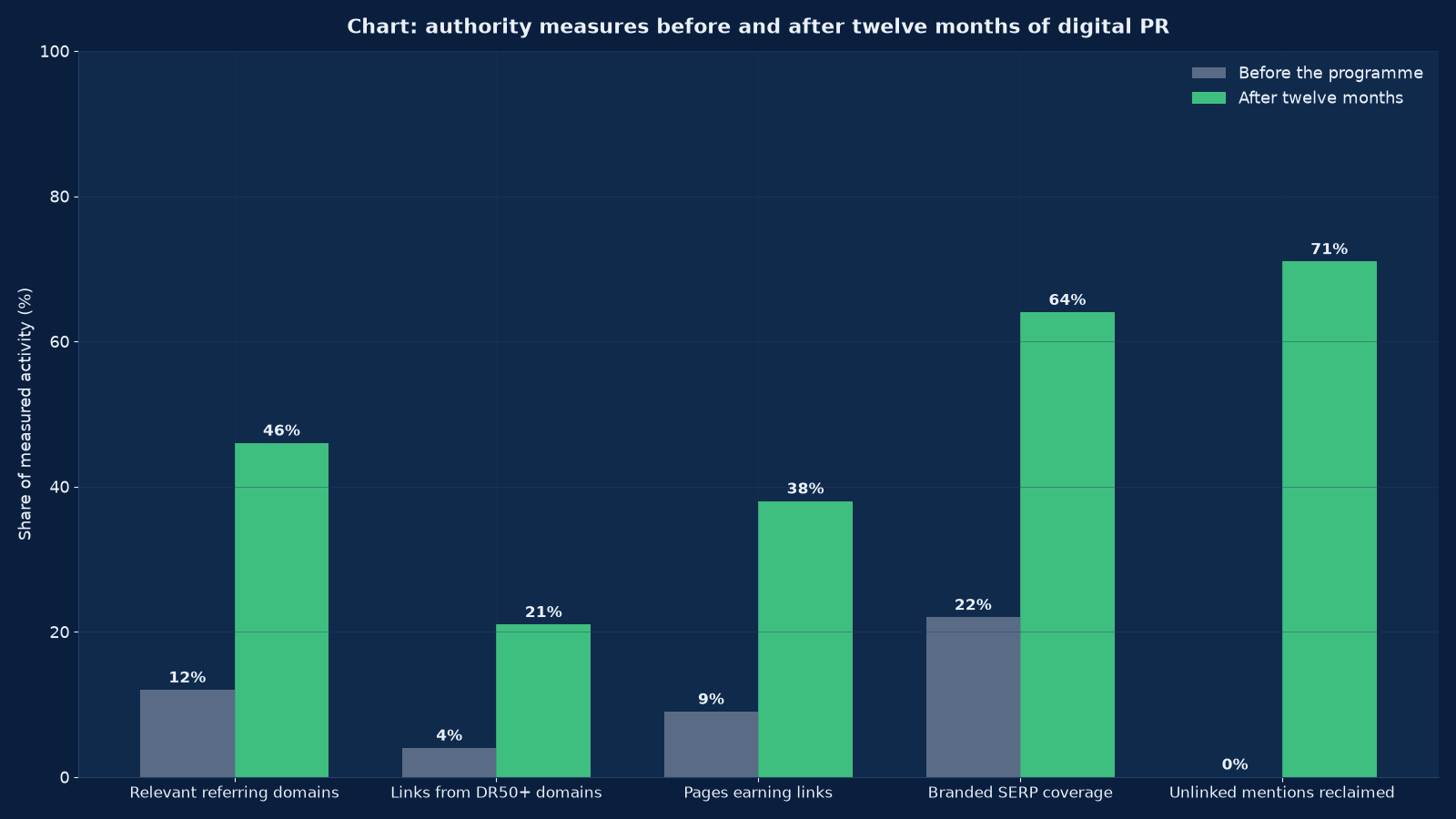
Chart values are an illustrative planning model based on typical UMC engagements and published industry benchmarks. They are not a guarantee of results on any specific project.
Link building did not die; it stopped being something you could buy in bulk. What replaced it is a communications discipline with a measurement layer attached: publish something a journalist has a reason to cover, be quotable when the story is already running, and ask for the link when the brand is mentioned without one. Everything else is a penalty waiting to be algorithmically noticed.
Digital PR and link building at Unified Management Consulting is the practice of earning links from publications that real people read, by giving those publications something they want: original data, a quotable expert, a local story, or a correction to a mention that already exists without a link. It is not outreach volume. A campaign that sends four hundred identical emails and lands three links from sites nobody visits has produced a negative asset: it has burned a sender reputation, taught a market to ignore the brand, and added links that a future audit will have to disavow.
We run this work as an editorial calendar with a measurement discipline behind it. Topics are chosen because a specific desk at a specific publication has a reason to cover them. Assets are built to a publishable standard before anybody is contacted. Journalists are mapped by beat rather than bought from a list broker. Every placement is recorded with its referral traffic, its ranking effect on the pages it points at, and its cost in hours, so the next quarter’s topics are chosen from evidence rather than enthusiasm. Where a client also runs content marketing, the two are planned together, because a page that cannot earn a link is a page that should not have been written.
📣 Digital PR & Link Building — Quick Summary
| Component | What We Deliver |
|---|---|
| Authority baseline and competitor gap | A measured starting position: referring domains by relevance and authority, the pages that already earn links, branded SERP coverage, and the topics that earn links for the businesses you compete with. |
| Topic and data asset strategy | A pipeline of campaign topics ranked by newsworthiness, by the data you can legitimately access, and by the pages they can point at. |
| Data-led studies | Original research designed, collected, cleaned, analysed and published to a standard a journalist can cite without embarrassment. |
| Expert commentary and reactive PR | A standing offer of quotable expertise, with a response process fast enough to land inside a running story rather than after it. |
| Journalist and desk mapping | Named writers and editors by beat and publication, with the stories they have actually covered, maintained as a living document rather than a purchased list. |
| Outreach execution | Personalised pitching in waves, with reply rates, follow-up discipline and a record of what was refused and why. |
| Unlinked mention reclamation | Every brand mention without a link found, assessed and converted — the highest conversion-rate activity in this discipline. |
| Local and trade coverage | Local press, hyperlocal sites, trade publications and industry bodies, which are the links a local or B2B brand can actually win. |
| Link quality control | An acceptance standard covering relevance, authority, traffic, editorial context and disclosure, plus a refusal list for anything bought, exchanged or built at scale. |
| Measurement and reporting | Placements, referral traffic, assisted rankings, branded SERP movement and hours spent, reported monthly with a decision attached. |
What This Service Actually Covers
The service is communications work with a search outcome, and it is delivered as a programme rather than a package of links. What follows is the full scope; a client rarely buys all of it in the first quarter, and the sequencing matters more than the breadth.
| Component | What we do | What you keep | Cadence |
|---|---|---|---|
| Authority audit | Referring domains scored for relevance and authority, anchor and landing-page distribution, branded SERP coverage, toxic-link exposure | A baseline document and a competitor gap analysis | Once, then quarterly |
| Topic pipeline | Twelve to twenty candidate topics with the publication, desk and angle for each | A ranked pipeline with the data each topic needs | Quarterly |
| Asset production | Research design, data collection, analysis, write-up, design and publication | A citable asset on your domain, owned outright | One to two per quarter |
| Commentary pipeline | Journalist requests monitored, expert responses drafted and approved fast | A named expert with a track record of being quoted | Weekly |
| Journalist map | Writers and editors by beat, with their recent work and preferences | A maintained contact document that survives staff turnover | Monthly refresh |
| Outreach | Personalised pitches in waves, with follow-ups and refusals recorded | A campaign log with reply rates by angle | Per campaign |
| Reclamation | Mentions found, assessed and converted to links | A reclamation register and a repeatable process | Monthly |
| Local and trade | Local press, hyperlocal sites, trade titles, associations | Relationships with the desks that cover your market | Ongoing |
| Quality control | Every placement assessed against the acceptance standard before it is counted | A refusal standard in writing | Per placement |
| Reporting | Placements, traffic, ranking effect, hours, and the decision for next month | A report a finance director can read | Monthly |
Why Link Building Failed, and What Replaced It
For about a decade, links were manufactured: directories, article submissions, comment links, reciprocal exchanges, private blog networks, and eventually paid placements dressed as editorial. Each worked until it did not, and each left an estate that has to be cleaned up before legitimate work can be measured. The replacement is not a cleverer manufacturing process. It is a different activity altogether.
| The old tactic | Why it stopped working | What we do instead |
|---|---|---|
| Directory submissions at scale | Most directories have no traffic and no editorial standard, and a large volume of them makes an estate harder to audit | A short prioritised list of directories customers actually use, corrected rather than multiplied |
| Article and press-release syndication | Syndicated content is duplicated across hundreds of domains and earns nothing durable | Original assets published once, on your domain, pitched to named writers |
| Reciprocal link exchanges | Detectable at scale, and the links are usually irrelevant | Partner and supplier listings that exist because the commercial relationship exists |
| Private blog networks | A footprint Google identifies, and an estate that has to be disavowed later | Nothing. We do not build or buy from networks, and we say so in the contract |
| Paid placements presented as editorial | Undisclosed sponsorship breaches publication policy and advertising standards, and the link carries a sponsorship attribute | Where a client wants paid coverage, it is disclosed, marked as sponsored, and reported separately from earned links |
| Exact-match anchor building | Anchor distribution is one of the clearest signals of manufactured links | Anchors that a journalist would naturally write: the brand, the URL, or the phrase the sentence needs |
| Outreach volume | Reply rates collapse when the pitch is generic, and the sender domain loses reputation | Fewer, researched pitches to named people, with the reply rate reported per angle |
The honest summary is that earned links are a by-product of being worth covering. That is why this service is staffed with people who can design research, write to a publishable standard and hold a conversation with a journalist — not with people who can send four hundred emails a day.
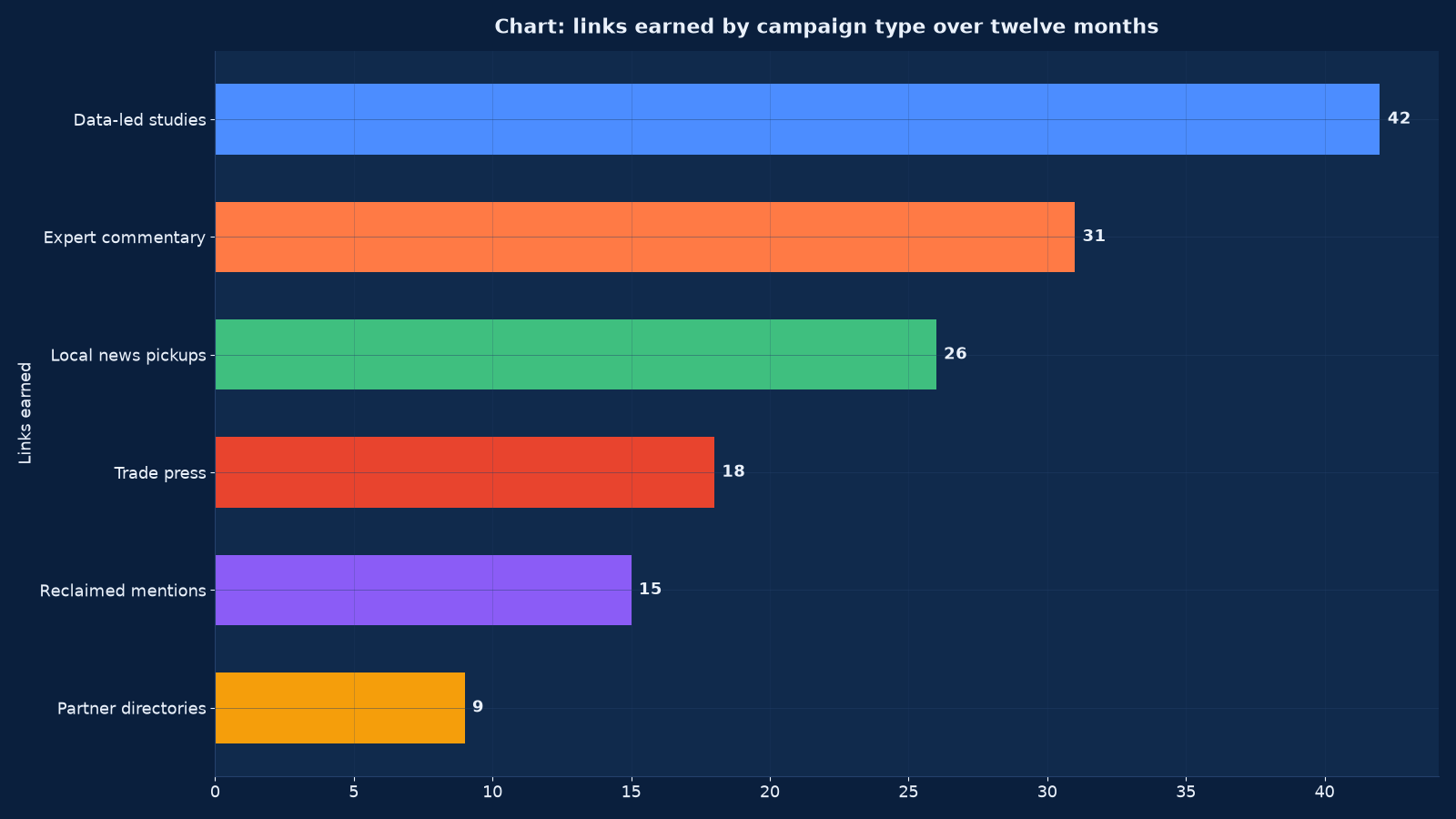
Chart values are an illustrative planning model based on typical UMC engagements and published industry benchmarks. They are not a guarantee of results on any specific project.
The Authority Baseline We Measure First
A programme without a baseline cannot be evaluated, and the metrics most agencies report — total referring domains, a domain-rating number — are the ones least connected to outcomes. We measure the distribution, because an estate with three hundred irrelevant links and an estate with forty relevant ones behave completely differently.
| Baseline measure | Definition | Why it matters |
|---|---|---|
| Relevant referring domains | Domains linking to you whose subject matter overlaps your market, as a share of all referring domains | Relevance is what makes a link worth having; a share rising over time is the primary success measure |
| High-authority links | Links from domains above a stated authority threshold, as a share of the profile | Editorial standards correlate with authority; this share separates earned from manufactured |
| Pages earning links | Share of your indexed pages with at least one external link | A profile concentrated on the homepage means the money pages are unlinked |
| Anchor distribution | Branded, URL, natural-phrase and exact-match anchors as shares | The clearest historical signal of whether links were bought |
| Branded SERP coverage | Share of your brand searches where the results are dominated by your own properties rather than third parties | A proxy for how much of your reputation you control |
| Unlinked mentions | Brand mentions found without a link, per month | The size of the cheapest available opportunity |
| Referral traffic | Sessions from linking domains, and their conversion behaviour | Separates links that send customers from links that send nothing |
| Toxic exposure | Links from spam, adult, casino or network footprints | Determines whether a disavow is needed before new work can be measured |
Topic Selection: What a Journalist Would Actually Publish
Most failed campaigns fail at topic selection, not at outreach. A topic that is interesting to the marketing team is not a topic that is interesting to a desk with a news hole to fill. We assess candidates against five questions and score them before any asset is built.
| Question | What a good answer looks like | What kills the topic |
|---|---|---|
| Is it new? | Data or a finding that has not been published, or a fresh angle on a story that is running | A restatement of industry common sense |
| Is it true and checkable? | A method that can be described in one paragraph and a dataset that can be shared | A survey of eleven customers presented as research |
| Does it have a number in it? | A count, a percentage, a price, a ranking, a change over time | An opinion piece with no measurable claim |
| Whose desk is it for? | A named publication, a named writer, and the section it would run in | “Tech blogs” as a target |
| What page does it point at? | A commercial page that the story can legitimately reference | A story with no relationship to anything you sell |
- Proprietary operational data: the numbers your business generates anyway, aggregated and anonymised — pricing dispersion, response times, failure rates, regional variation.
- Cost-of-living and local economy angles: what something costs in a specific city, and how that has changed.
- Regulatory and standards change: what a new rule means in practice, told through the businesses affected.
- Contrarian findings from real data, where the data genuinely supports the contrarian view.
- Rankings and comparisons built from published sources, with the method disclosed.
- Human stories from the workforce or the customer base, with consent and accuracy.
- Expert reaction to a running story, delivered inside the news cycle rather than after it.
Data-Led Studies: Building the Asset
A data-led study is the highest-yield asset in this discipline and the one most often done badly. The failure mode is a thin survey published as research, which earns one link from a site that publishes anything and damages the brand’s credibility with the desks that matter.
Design
The question is written before the data is collected, the population is defined, the sample size is stated honestly, and the method is described in language a journalist can lift directly. Where the data is proprietary, we establish what may be published and what is confidential before analysis begins, in writing, with the client’s legal or commercial owner.
Collection and cleaning
Sources are recorded with retrieval dates. Duplicates, outliers and impossible values are handled by a documented rule rather than by judgement applied after the result is known. Every figure that will be quoted is traceable to a row in the dataset.
Analysis and the finding
One headline finding, three supporting findings, and a chart per finding. Journalists need a sentence, a number and an image; if the study cannot produce all three, it is not finished.
Publication
The asset is published on your domain at a stable URL, with the method, the dataset or its source, the date, the author and a citation format. It is linked from the commercial pages it supports. It is not gated: a gated study earns a fraction of the links, and the gate costs more in refusals than the leads are worth.
| Study type | Effort | Typical yield | Best for |
|---|---|---|---|
| Proprietary operational data | Medium | High — nobody else has it | Businesses that generate measurable activity: logistics, clinics, marketplaces, agencies |
| Aggregated public data | Medium to high | High if the analysis is original | Markets with published statistics that have not been combined before |
| Price and cost surveys | Low to medium | High — local and national press both use them | Consumer services and regulated markets |
| Customer or workforce survey | Medium | Medium, and only with a credible sample | Brands with a large enough base to survey properly |
| Expert index or ranking | High | Medium to high, and durable | Categories where a defensible ranking can be repeated annually |
Expert Commentary and Reactive PR
Commentary is the fastest route to a link from a major publication and the one that depends least on budget. A journalist writing a story today needs somebody to quote today. The constraint is response time, not expertise.
| Element | Standard we work to | Why |
|---|---|---|
| Named expert | One or two people briefed to speak, with a biography, a headshot and a standing list of the topics they will comment on | Journalists quote people they can identify and re-contact |
| Response time | Under four hours during the working day for a live request | The story is usually filed the same day |
| Request monitoring | Journalist request services, desk newsletters, beat monitoring and direct relationships | Waiting for inbound enquiries means missing most of the market |
| Quote quality | A specific, quotable sentence with a number or a clear position, not a paragraph of hedging | Generic quotes are not used |
| Approval path | Pre-agreed boundaries so a quote does not need three sign-offs | The approval queue is where commentary dies |
| Accuracy discipline | Never speculate beyond the evidence; correct the record where a quote is misused | One bad quote ends the relationship |
| Follow-up | A record of every placement, and a thank-you that is not a pitch | The second quote is easier than the first |
Journalist and Desk Mapping
A purchased media list is a list of people who have all been pitched by everyone else. We build and maintain a map instead: the writers who cover your market, the desks they sit on, what they have published recently, what they ask for, and how they prefer to be contacted.
| Field | What we record | How it is maintained |
|---|---|---|
| Name and role | Writer, editor, producer, and the beat they cover | Checked against the publication’s masthead and bylines quarterly |
| Recent work | The last five stories relevant to your market | Refreshed before every pitch |
| Angle preference | What they have said yes to, and what they have asked not to be sent | Updated from every reply, including refusals |
| Contact route | Direct email, a request service, or a desk address | Verified before first use |
| Relationship status | Never contacted, pitched, replied, placed, or asked us to stop | Non-negotiable: an opt-out is recorded and honoured permanently |
| Publications covered | National, regional, trade, hyperlocal, broadcast, newsletter | Reviewed for gaps each quarter |
The map is a client asset. It is handed over at the end of an engagement in a format your team can keep using, because the value of a relationship built over four campaigns is lost if it lives only in an agency inbox.
Outreach: Sequence, Volume and Reply Rate
Outreach is where a good asset can still fail, so we treat it as a measured process with a reported conversion rate rather than as effort. The standard sequence is a personalised first pitch, one follow-up after four working days, and a final note after ten — then the contact is left alone for the quarter.
| Stage | What is sent | Measured by |
|---|---|---|
| Pre-pitch | Nothing. The asset is finished, published and checkable first | Whether the study can survive a journalist’s questions |
| First pitch | A short, specific email: the finding, the number, the chart, why it matters to that writer’s beat, and an offer of the expert or the dataset | Open and reply rate by angle and by desk |
| Follow-up one | A new element — an extra cut of the data, a local angle, an exclusive for one region | Reply rate of the follow-up, which is usually higher than the first pitch when the added element is real |
| Follow-up two | A closing note with the asset link, no further asks | Late placements, which do happen |
| Placement | The link, its context, its anchor, the referring traffic and the pages it supports | Cost in hours per placement, and traffic per placement |
| Refusal | The reason where one is given | A quarterly review of refusals, which is how topics improve |
Volume targets are set per desk, not per campaign. Pitching forty people who cover the subject beats pitching four hundred who do not, and the reply rate is the number we manage to. A reply rate below about five per cent means the topic or the list is wrong, not that the copy needs another draft.
Unlinked Mention Reclamation
Reclamation is the highest-conversion activity in this discipline and the one most often skipped, because it is unglamorous. A publication that has already written your brand name has already decided you are relevant; the request is to add a hyperlink, which takes the editor seconds.
| Step | Method | Outcome |
|---|---|---|
| Discovery | Brand and variant monitoring across news, blogs, forums, roundups and aggregators, including misspellings and former trading names | A monthly mention list with URLs |
| Qualification | Is the mention editorial, is the page live, does the site have an audience, is a link appropriate in context | A shortlist rather than a blanket request |
| Request | A short note to the writer or editor thanking them and asking for a link, with the exact URL to point at | A conversion rate typically several times higher than cold outreach |
| Roundups and best-of lists | Where a list exists and you are absent, pitch inclusion with the reason | Links from pages that already rank for the commercial phrase |
| Former names and acquisitions | Mentions of a brand you acquired or a name you traded under | Recovered authority that is otherwise invisible |
| Recording | Every mention, request and outcome logged | A register that shows the yield per hour, which is how the activity keeps its budget |
Digital PR for Local and Multi-Market Estates
A national campaign and a local campaign are different work with different targets, and a business that operates in several places usually needs both. Local coverage is easier to win and lower in authority; national coverage is harder and worth more. The mistake is running one and reporting it as the other.
| Estate | Approach | Targets |
|---|---|---|
| Single-site local business | Local press, hyperlocal sites, chamber and trade bodies, community sponsorships with a story attached | The local paper, the regional business title, the industry directory |
| Multi-location | A national asset plus a local cut per region, pitched to that region’s desk | One story, twenty local placements, each pointing at its own local page |
| B2B national | Trade press, data studies, expert commentary, conference and report citations | The three titles the buying committee actually reads |
| Multi-market or international | Per-market assets in the local language, local data, local desks, and hreflang-aware URLs | A market-by-market plan rather than one global campaign |
| Regulated sector | Commentary on regulatory change, with compliance sign-off on every quote | Trade and policy publications, plus the specialist newsletter audience |
For local programmes this work is planned alongside the profile and landing-page work rather than separately, because a local story that lands on a page with no local detail wastes the placement.
Link Quality: What We Accept and What We Refuse
Every placement is assessed before it is counted, and the assessment is published in the report so a client can see what we turned down as well as what we won.
| Criterion | Accept | Refuse |
|---|---|---|
| Relevance | The publication covers your market, your region or your customers’ problem | A site whose subject is unrelated but whose authority metric is high |
| Editorial context | The link sits in a sentence that would exist without you | A link in a sponsor list, a footer, or a paragraph assembled from paid contributors |
| Audience | The page receives real visits or is cited by people who do | A domain with authority and no traffic |
| Disclosure | Any paid or sponsored coverage is labelled as such | Paid placements presented as editorial |
| Anchor | Brand, URL or a natural phrase the sentence requires | Exact-match commercial anchors supplied by us |
| Permanence | The page is expected to stay live | A placement on a page with a stated expiry |
| Source | Earned through a pitch, a study, a quote or a reclamation request | Anything bought, exchanged, or produced by a network |
Where we inherit an estate with manufactured links, we assess the disavow question honestly. In most cases the correct answer is not to disavow everything: it is to identify the footprints that are actively harmful, disavow those, and let the rest age while new work changes the distribution. A disavow file that removes most of a profile usually makes the problem worse.
The Sixteen-Week Programme
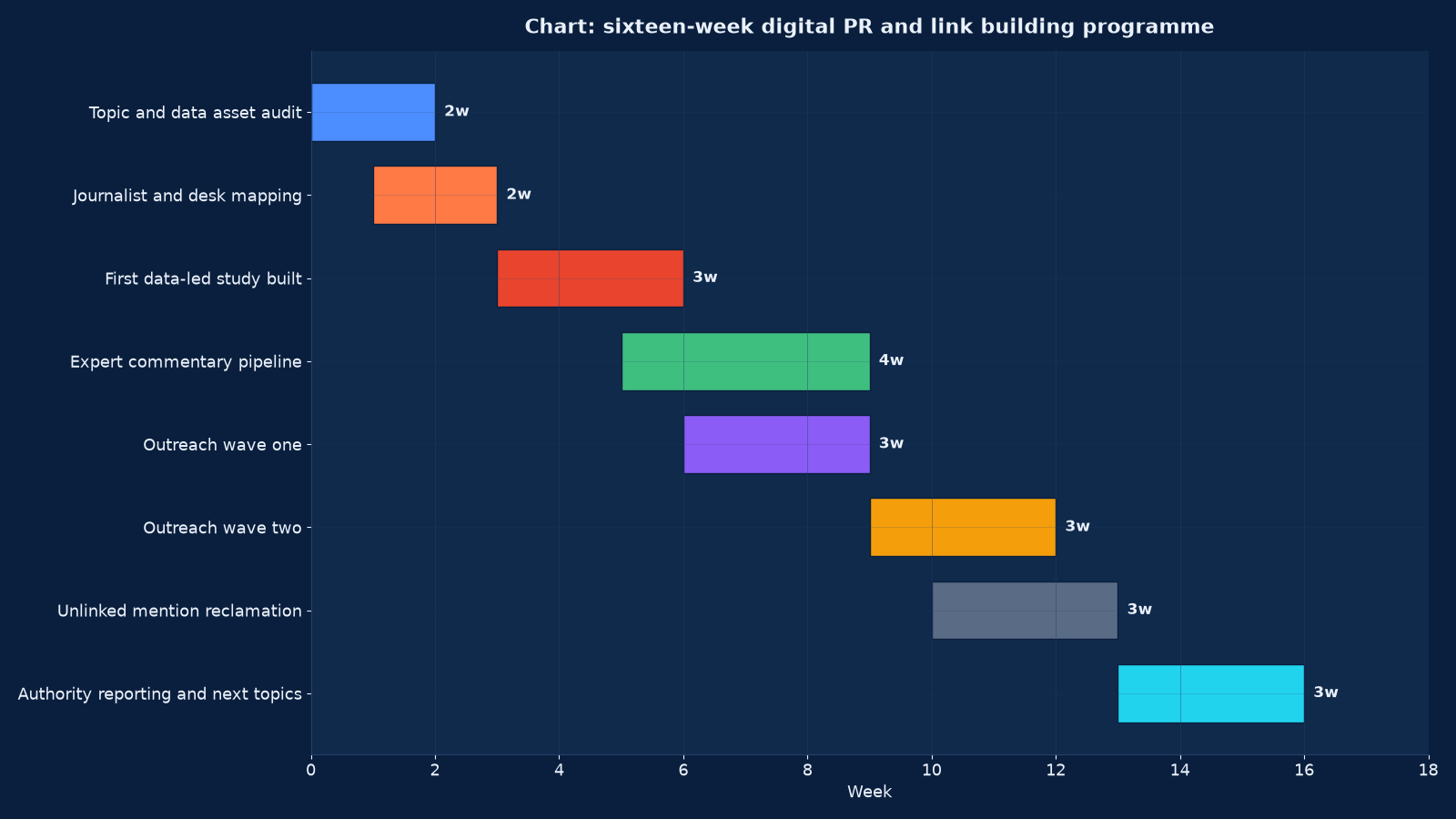
Chart values are an illustrative planning model based on typical UMC engagements and published industry benchmarks. They are not a guarantee of results on any specific project.
| Weeks | Workstream | Output |
|---|---|---|
| 1–2 | Authority baseline, competitor gap, topic and data asset audit | Baseline document and a ranked topic pipeline |
| 2–3 | Journalist and desk mapping | A contact map with beats, recent work and preferences |
| 4–6 | First data-led study: design, collection, analysis, publication | A citable asset live on your domain |
| 6–9 | Expert commentary pipeline: named expert, briefs, request monitoring, approval path | A commentary process operating to a four-hour standard |
| 7–9 | Outreach wave one | Placements with anchors, contexts and referral traffic recorded |
| 10–12 | Outreach wave two, with a regional or trade cut of the same asset | A second set of placements from one asset |
| 11–13 | Unlinked mention reclamation | A reclamation register and a monthly process |
| 14–16 | Authority reporting, hours-per-placement analysis, next topic set | A quarterly report with a decision attached and the following quarter’s pipeline |
Sixteen weeks is the time to a working programme, not to a finished one. Authority accrues over years, which is why Figure 1 is a twelve-month picture and why the honest commercial conversation is about a continuing editorial calendar rather than a campaign with an end date.
Measurement and Attribution: Proving the Work Paid
PR measurement is where programmes are cancelled, usually because the only number reported was a domain-rating figure that moved for reasons nobody could explain. We report the chain: asset, placement, referral traffic, ranking movement on the linked page, and enquiries.
| Measure | How it is captured | What it proves |
|---|---|---|
| Placements | URL, publication, date, anchor, context, whether it was earned or reclaimed | Output volume and quality |
| Referral traffic | Sessions from the linking domain, tagged where possible | Whether the publication has an audience |
| Ranking effect | Position of the linked page before and after, for its target phrases | Whether the link moved anything |
| Distribution change | Relevant-domain share and high-authority share over time | Whether the profile is improving rather than growing |
| Branded SERP coverage | Share of brand results controlled by your own properties | Reputation control |
| Hours per placement | Time recorded per campaign divided by accepted placements | Which campaign types deserve next quarter’s budget |
| Assisted enquiries | Enquiries within a window after a placement spike, where volume allows | Commercial contribution, stated with its uncertainty |
We are explicit about the limits. Attribution for a single link is rarely provable at the level a paid campaign is; the defensible claim is a distribution change plus a ranking movement on the pages that received links, plus referral traffic that converts at a rate comparable to organic. Anything stronger than that is a story, and we would rather hand over a number that survives scrutiny.
Content Assets That Earn Links Without Outreach
Some assets attract links passively, and they are worth building alongside campaigns because they keep working when nobody is pitching. They are also the assets that make future pitches credible.
| Asset | Why it earns links | Build effort |
|---|---|---|
| A calculator or estimator | It answers a question with a number, and other sites link to the tool rather than describing it | Medium to high |
| A definitive reference guide | It becomes the citation for a definition or a process | Medium |
| An annual index or ranking | Repeatable, quotable, and news-worthy on publication day | High, then lower each year |
| Original photography or diagrams | Writers need images and cite the source | Low to medium |
| A public dataset | Journalists and analysts link to the data itself | Medium |
| A glossary of a regulated market’s terms | Cited by newcomers to the market | Low |
| A transparent pricing or process page | Rare enough to be linkable | Low |
| A post-mortem or failure write-up | Honesty is unusual and therefore quotable | Low, but it needs senior sign-off |
Risk, Ethics and Disclosure
This work touches a brand’s reputation and a publication’s trust, so the rules are stated before the campaign rather than negotiated during it.
- Data privacy: no personal data is published, aggregated data is checked for re-identification risk, and customer data is used only under an agreed lawful basis with the client’s data owner signing off the release.
- Consent: no customer, employee or partner is named or photographed without consent, and consent is recorded.
- Accuracy: every published figure is traceable to its source, corrections are issued promptly, and a study with a flawed method is withdrawn rather than defended.
- Disclosure: paid coverage is labelled, sponsored content is marked, and we do not present a paid placement as an earned one.
- Opt-outs: a journalist or publication that asks not to be contacted is recorded permanently and never pitched again.
- No fabrication: we do not invent sources, attribute quotes to people who did not say them, or build sites to host links.
- Conflicts: where a campaign would place a competitor’s brand unfavourably, we decline the brief rather than run negative SEO under a client’s name.
These are contract terms, not aspirations. A client who wants a different standard is better served by an agency that will provide it, because the alternative is a programme that somebody has to unwind later.
Failure Modes We Are Usually Called In To Fix
| What we find | Why it happened | What we do |
|---|---|---|
| Four hundred referring domains, none of them relevant | A directory or PBN package bought years ago | Assess the footprints, disavow only what is actively harmful, and rebuild the distribution with earned work |
| One study per year, no placements | The asset was written for the marketing team rather than for a desk | Re-cut the same data into three angles for three different desks |
| A high reply rate and no links | Journalists are interested but the asset is not citable — no method, no chart, no clear number | Fix the asset before pitching again |
| Links that all point at the homepage | No page-level plan behind the campaign | Map every future placement to a commercial page and rebuild internal links to it |
| Exact-match anchors across a dozen links | Anchors were specified by the client or a previous agency | Stop specifying anchors, and let natural anchors change the distribution over time |
| A disavow file with most of the profile in it | A panic response to a manual action or a ranking drop | Rebuild the file to the genuinely harmful footprints and monitor recovery |
| Paid placements reported as earned | An agency counting sponsored posts as wins | Separate the two in reporting, disclose the sponsored ones, and reprice the programme honestly |
Evidence From Our Work
The writing and engagements below are published on this site, each described by the subject its own page documents. They are listed because a PR programme is usually commissioned by a client who wants to see the method rather than a promise.
- Targeted-impact link building: how to build links to the pages that matter — this practice’s own written method for the discipline on this page: how a target is chosen, how relevance is judged, and why volume is the wrong measure.
- E-E-A-T for SEO — the quality framework a link profile is now read against, and why authorship and evidence matter as much as the link.
- Keyword research for businesses: how to find the right keywords — how the pages a campaign points at are chosen, so a placement lands somewhere that can convert it.
- Google Search Console for business owners — where the ranking effect of a placement is measured, and how to separate movement from noise.
- Schema markup and structured data — the markup that makes a published study citable and machine-readable.
- Ethnava: taking a Chikankari business from offline to digital — a craft brand whose authority came from being a real participant in a local economy, which is the kind of story local desks cover.
- Social media advertising for Green Hotel Resort — a hospitality property where coverage and social proof are the same asset.
- WordPress development for an African medical-tourism company — a multi-market estate where authority has to be built per market rather than globally.
- A B2B paid-search campaign project summary — the paid side of the same pipeline, where a PR asset becomes an ad group’s landing evidence.
- The digital marketing insight archive — further writing on campaigns, channels and measurement.
Engagement Models and Commercials
Digital PR is retainer work because the relationships and the editorial calendar are the asset. We also run fixed-fee studies for clients who want one asset and will pitch it themselves, and baseline audits for teams that need to know what they are starting from.
| Model | Best for | What you get | Indicative shape |
|---|---|---|---|
| Authority audit, fixed fee | A team that needs a baseline and a gap analysis | Distribution, anchors, toxic exposure, competitor topics, and a prioritised plan | Two to three weeks, one fee |
| Quarterly campaign | A brand that wants one asset executed properly | One study or commentary campaign, end to end, with reporting | Fixed fee per campaign |
| Standing retainer | A brand that wants a continuous editorial calendar | Topics, assets, outreach, commentary, reclamation and monthly reporting | Monthly, with a quarterly topic review |
| Commentary only | A senior expert who wants to be quoted but has no process | Request monitoring, briefing, drafting and a four-hour response standard | Monthly, low hours |
| Recovery and cleanup | An estate with manufactured links or a manual action | Footprint analysis, a disavow decision with reasoning, and a rebuild plan | Fixed fee per incident |
Fees are quoted against hours and expected placements, not against a guaranteed number of links. Anybody who guarantees links is describing links they can buy, and the difference shows up in the profile two years later.
Frequently Asked Questions About Digital PR & Link Building
How is digital PR different from link building?
Link building starts from the link and works backwards to a reason for it. Digital PR starts from something worth publishing and treats the link as one of several outcomes, alongside referral traffic, brand searches and reputation. In practice the discipline is the same work measured better: an asset, a target desk, a pitch, and a recorded outcome.
How many links will we get?
We will not quote a number before the baseline exists, because the answer depends on your market, your data and your starting authority. What we will commit to is a reported count of accepted placements per quarter, with the hours each cost and the traffic each sent. A guaranteed link count is a guarantee about links that can be bought.
How long until we see ranking movement?
Reclamation and commentary placements can move a page within weeks. A data-led study usually takes one to two quarters to show in rankings, because the links arrive over time and their effect is on the distribution rather than on one page. Figure 1 is a twelve-month picture for that reason.
Do you buy links or use sponsored posts?
We do not buy links presented as editorial. Where a client wants paid coverage, it is disclosed, marked as sponsored, tracked separately and reported as paid rather than earned. Sponsored placements with a sponsorship attribute are a legitimate advertising product; undisclosed ones are a risk to your brand and to the publication.
What is a data-led study and do we have the data for one?
A study built from data you can legitimately publish: operational numbers, pricing, response times, regional variation, or aggregated public sources combined in a new way. Most businesses are sitting on one. The limiting factor is rarely data availability and usually whether anybody has written down what may be published.
What is unlinked mention reclamation, and why is it so effective?
Finding places that already wrote your brand name and asking them to link it. It works because the editor has already decided you are relevant, the request takes seconds, and there is no story to commission. It is usually the first activity we run and the one with the best hours-per-link ratio.
Our previous agency built hundreds of links. Is that a problem?
It depends entirely on what they were. A profile of irrelevant directories and network footprints suppresses rather than supports, and needs an honest assessment before new work can be measured. We audit the distribution, identify anything actively harmful, and disavow only that — removing most of a profile usually makes things worse.
Can you get us into a specific publication?
We can pitch it properly, and we will tell you the probability based on the desk’s recent work. We cannot promise it. If a publication has never covered a business of your type, the more useful conversation is about which publications do cover that type and what they need.
Does this work for B2B as well as consumer brands?
Differently. B2B targets trade titles, analyst commentary, conference and report citations, and expert reaction to regulatory change, with fewer placements of higher value. Consumer work targets national and local press with data stories and human angles. The measurement chain is the same.
Who writes the assets?
We do, to a publishable standard, with your subject-matter expert supplying the substance and approving the claims. An asset written entirely by a marketing team without operational input is usually the reason a campaign fails: journalists can tell when nobody behind the numbers has done the work.
How do we keep the relationships when you stop?
The journalist map, the campaign log, the asset templates and the reclamation register are client property and are handed over in an editable format. We also train your team during the engagement rather than at the end, so the commentary process keeps running at the four-hour standard.
What does this cost relative to paid search?
Less per month, more per quarter, and with a longer payoff. Paid search buys visibility today and stops when the budget stops; earned authority compounds and keeps sending traffic after the campaign ends. Most clients we work with run both, with PR planned against the pages that paid search has already proved convert.
Commission a Digital PR and Authority Baseline
Send us your domain, the two or three competitors whose coverage you envy, and any data you think might be publishable. Within three weeks you will have an authority baseline with the distribution rather than just the total, a competitor topic gap, an assessment of your existing link estate including anything that needs disavowing, a ranked pipeline of ten campaign topics with the desk each is for, a first data-led study scoped with its method and its effort, and a costed sixteen-week plan — including an honest statement of which topics you do not have the data to support.
Contact Unified Management Consulting to arrange a confidential first conversation.
Related Services
Digital PR and link building is delivered with the practices that give it something to point at:
- Search Engine Optimisation (SEO) Services — the technical and on-page programme that makes an earned link worth having
- Content Marketing Strategy Services — the editorial calendar the campaigns are planned inside
- Artificial Intelligence Optimisation (AIEO) Services — being cited by an answer engine, which increasingly depends on the same third-party corroboration
- Conversion Rate Optimisation (CRO) Services — making the pages that receive links convert the traffic they earn
- Analytics & Attribution (GA4) Services — the measurement chain from placement to enquiry
- Local SEO Services in Lucknow — where local coverage and profile work are planned as one programme
- Google Ads Management Services — the paid counterpart, sharing the same landing evidence
- Influencer Marketing Management Services — creator-led coverage where the audience is social rather than editorial
- Website Strategy & Information Architecture — where a study lives on the site so its authority reaches the commercial pages
- Local SEO & Google Business Profile Management — Local SEO and Google Business Profile management: profile rebuild, citations, reviews, local pages, map-pack tracking and attributed enquiries
- Technical SEO Audits & Site Migration Services — Technical SEO audits and site migrations: crawl and index control, Core Web Vitals, structured data, migration mapping and pre-launch validation
- International & Multi-Region SEO Services — International and multi-region SEO: hreflang, country targeting, localised content, duplicate-market repair and per-market visibility reporting