
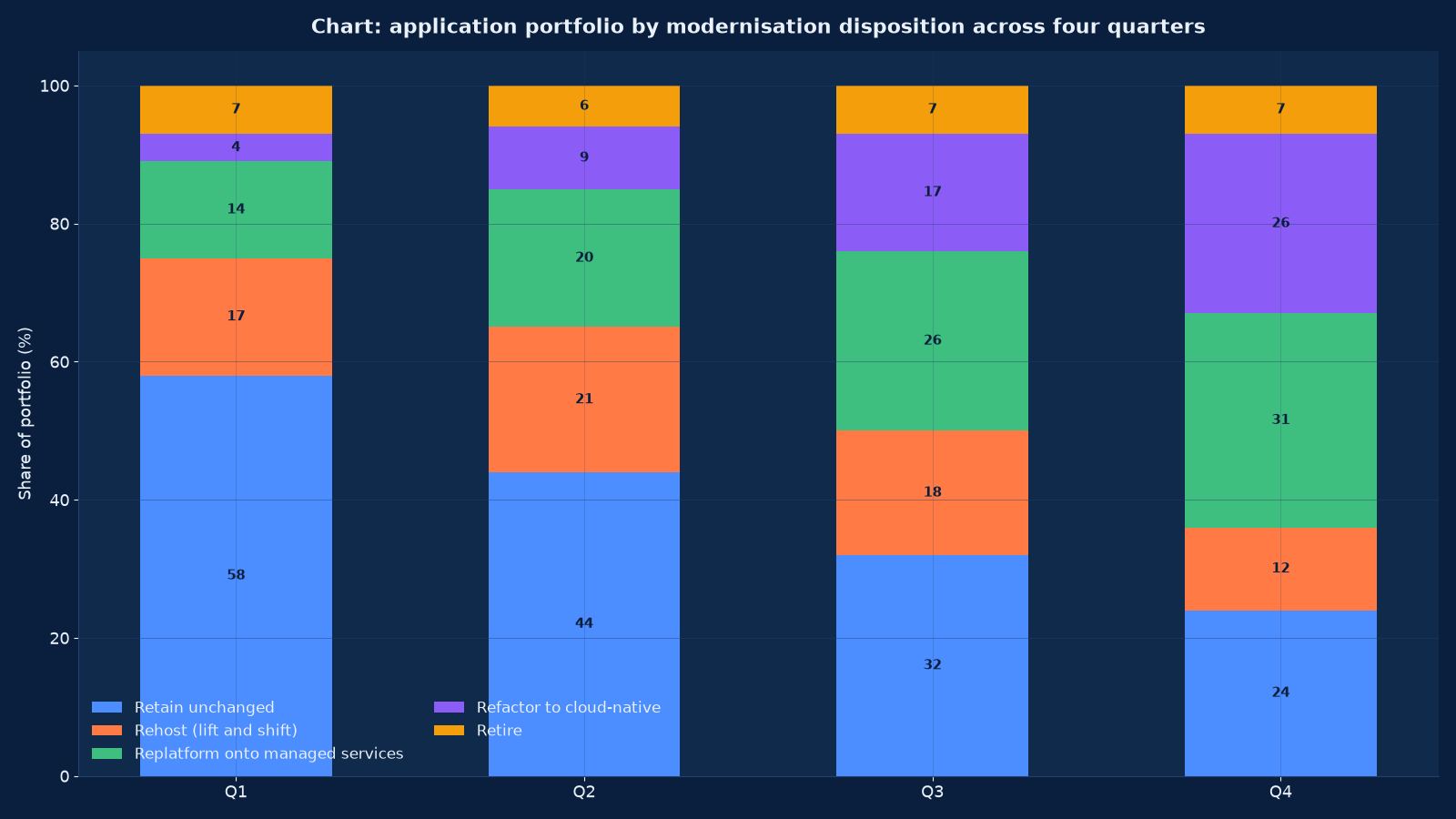
Chart values are an illustrative planning model based on typical UMC engagements and published industry benchmarks. They are not a guarantee of results on any specific project.
Every estate contains applications that are too expensive to change and too important to replace. The mistake is treating that as one problem. It is a portfolio: some applications should be retired, some replatformed, some refactored, and some left alone with a documented reason. Modernisation is the discipline of deciding which, and paying only for the decisions that earn their cost.
Cloud-native application modernisation at Unified Management Consulting is the work of moving a priority estate onto a cloud platform in a way that changes how it can be operated afterwards, not only where it runs. That means a portfolio assessment that ends in a written disposition per application, a target architecture with a landing zone, incremental extraction behind stable interfaces rather than a big-bang rewrite, data migration rehearsed until it is boring, and cutover with a rollback that has been tested rather than described.
We are explicit about the unglamorous truth of this work: rehosting an unchanged application to a virtual machine in someone else’s data centre usually increases cost before it reduces it, because you pay for the same architecture with a more granular price list. The savings arrive with replatforming onto managed services, with autoscaling that matches real demand, and with retiring applications nobody uses. Our programmes are built to reach those savings in stages, with a measured baseline at each stage so the business case can be checked rather than believed.
☁️ Cloud-Native Application Modernisation — Quick Summary
| Component | What We Deliver |
|---|---|
| Portfolio assessment and disposition | Every application assessed against business value, technical condition, change frequency, dependency and cost, ending in one of six dispositions with a written rationale per application. |
| Business case and baseline | Current cost, incident history, release lead time and capacity behaviour measured before any change, so that improvement is provable rather than asserted. |
| Target architecture and landing zone | Accounts, networking, identity, guardrails and the managed services the estate will use, designed as code and rebuilt to prove it. |
| Dependency and data mapping | Application, database, integration, file, batch and licence dependencies mapped, with the data classification and residency position for each store. |
| Strangler seams and API extraction | Incremental extraction of functionality behind stable interfaces, with the legacy core shrinking rather than being replaced overnight. |
| Managed service migration | Databases, queues, caches, identity, search and file services moved to managed equivalents with data migration rehearsals and verified restores. |
| Containerisation and pipeline rebuild | Applications packaged to a runtime contract, pipelines rebuilt with progressive delivery, and environments reproducible from code. |
| Performance and cost baselines | Load tests against the target, latency and capacity measured, and unit cost per workload compared with the pre-migration baseline. |
| Security and compliance by design | Controls applied through the landing zone and pipeline, with evidence collected continuously and the certification position reviewed before cutover. |
| Cutover rehearsal and rollback | A full rehearsal including data migration, DNS or traffic switch, verification checks and a timed rollback to the legacy path. |
| Hypercare and stabilisation | Focused support through the first weeks in production, with an exit criteria set and an agreed operating model afterwards. |
| Handover and enablement | Architecture documentation, runbooks, cost ownership, and your engineers trained into the new operating model rather than handed a finished system. |
The Six Dispositions, Honestly Applied
The industry shorthand is the six Rs. We use them because they are a useful vocabulary, and we apply them against evidence because most of the value is in the two that are least popular: replatform and retire. The table is how each disposition is decided and what it costs.
| Disposition | What it means | Choose it when | Cost and risk profile |
|---|---|---|---|
| Retain | Leave the application and its hosting unchanged, with a documented reason and a review date | The application is stable, cheap to run, low change frequency, or scheduled for retirement by a product decision | Lowest immediate cost; the risk is that the reason is never revisited and the estate accumulates retained systems nobody can explain |
| Retire | Decommission the application, migrate or archive its data, and remove its infrastructure | Usage is negligible, another system covers the capability, or the cost of keeping it exceeds the value it delivers | Negative cost once done; the risk is an undocumented dependency, which is why data and integration mapping precede the decision |
| Rehost (lift and shift) | Move the workload to cloud infrastructure without changing the application | A data centre exit has a date, hardware is end-of-life, or the application needs to be in the cloud before it can be changed | Fast and low technical risk, but usually cost-neutral or worse until further work is done; treat it as a step with a planned next stage |
| Replatform | Move to managed services and change the operational layer without rewriting business logic — managed database, managed queue, managed identity, container runtime | The application is valuable and its logic is sound, but its operational burden and cost are not | Moderate effort with the best value-for-risk ratio on most estates; the main risk is data migration, which is rehearsed rather than hoped for |
| Refactor | Change the application architecture: services extracted, state externalised, autoscaling and progressive delivery adopted | Change frequency is high, scaling is constrained by design, or the cost of a change is disproportionate to its value | Highest effort and highest benefit where the application is genuinely strategic; the risk is a rewrite that reproduces the old process faithfully |
| Repurchase or replace | Move to a software-as-a-service product instead of operating the capability yourselves | The capability is not a differentiator, a mature product exists, and the migration of data and process is affordable | Recurring licence cost replaces operating cost; the risk is data egress and vendor lock-in, which should be negotiated before signing rather than after |
A disposition is a decision with an owner and a date, not a label. Applications marked ‘retain’ are reviewed annually, and applications marked ‘rehost’ carry the next stage in the same sentence, because the rehost-only estate is the most common outcome of a programme that lost momentum.
Portfolio Assessment: How We Decide What Moves First
Assessment is per application and produces a scored sheet, not an impression. The dimensions below are weighted with you, because the right weighting depends on whether your constraint is cost, risk, delivery speed or a data centre lease.
| Dimension | What we measure | How it affects the sequence |
|---|---|---|
| Business value | Revenue supported, cost avoided, users served, and what happens if it is unavailable for a day | High value with high pain moves early; high value with low pain is a candidate for retain with a review date |
| Technical condition | Code health, test coverage, framework and runtime versions, deployment path, documentation | Poor condition plus high change frequency is the strongest case for refactor; poor condition plus low change frequency argues for retain or retire |
| Change frequency | Releases and emergency fixes per quarter, and how long a change takes | Frequent change earns the most from modernisation, because the benefit compounds |
| Dependencies | Upstream and downstream systems, shared databases, batch windows, file transfers, third-party integrations | A heavily coupled application cannot move alone; dependencies define the wave, not the org chart |
| Data profile | Volume, growth, classification, residency obligations, and how long a migration window can be | Data migration is usually the schedule constraint, so it is assessed first rather than discovered later |
| Licensing | Per-core or per-socket licensing, vendor support for cloud deployment, and the cost of the licence in the target architecture | A licence can make a technically easy move commercially impossible, and this must be known before the plan is presented |
| Infrastructure and end-of-life | Hardware age, support contracts expiring, operating system and database versions out of support | End-of-life dates create real deadlines that override preference |
| Operational burden | Incidents, manual intervention, out-of-hours calls, and the people who hold the knowledge | High burden with a single knowledgeable individual is a resilience risk as much as a cost one |
| Cost to run | Infrastructure, licence, support and the internal effort attributed to the application | Establishes the baseline the business case is measured against |
| Security and compliance exposure | Unpatched components, unsupported runtimes, weak access control, audit findings | Can force a move or a retirement ahead of the economic sequence |
The output is a portfolio sheet with a disposition, an owner, a wave, an estimated effort and a stated benefit per application. Where the assessment concludes that the honest answer for most of the estate is retain and retire, we say so and price the smaller programme accordingly.
The Economics: What Modernisation Saves and What It Costs
Cloud migration is sold on cost and delivered on complexity. The table separates the mechanisms that genuinely reduce cost from the ones that merely move it, and states how each is measured, because a saving nobody can measure is a claim.
| Mechanism | How it reduces cost | What it requires | How we measure it |
|---|---|---|---|
| Retiring unused applications | Removes infrastructure, licence and support cost entirely | Usage evidence and a data retention decision, not an opinion | Applications decommissioned, and the recurring cost removed, per quarter |
| Managed services replacing self-operated components | Removes patching, backup, failover and administration effort, which is usually larger than the infrastructure saving | A migration with rehearsed data movement and a compatibility review | Operational hours per month before and after, plus incident counts for that component |
| Autoscaling to real demand | Stops paying for peak capacity at three in the morning | Stateless design or externalised state, and tested scaling behaviour | Utilisation and cost per workload per month against the pre-migration baseline |
| Right-sizing and commitment strategy | Aligns purchased capacity with measured usage, then discounts the predictable portion | Usage telemetry for at least a full business cycle before committing | Cost per workload and the share of spend under commitment |
| Storage lifecycle and tiering | Moves cold data to cheaper classes and deletes data nobody will ever read | A retention policy with a legal and compliance sign-off | Storage cost per terabyte and the volume in each tier |
| Reduced incident and emergency work | Fewer outages means less overtime, fewer credits and less business disruption | Objectives, alerting and progressive delivery | Incident counts, restoration times and the cost attributed to them |
| Faster delivery | Shorter lead time means features arrive sooner and engineering time is spent on product rather than plumbing | Pipelines, environments from code, and a service ownership model | Deployment lead time and frequency, measured from pipeline data |
| Consolidation of runtimes and tools | Fewer platforms means fewer licences, fewer specialists and fewer configurations to maintain | A target architecture with an approved service list | Number of distinct runtimes, tools and environments over time |
Against these, the honest costs: migration effort, dual-running during transition, data egress, new licence terms, training, and the temporary loss of delivery capacity while engineers learn the target platform. A business case that omits the second list is a sales document. We build both into the same sheet, and the full commercial discipline sits with Cloud Cost Optimisation & FinOps Services and Cost Rationalisation & Margin Recovery.
Target Architecture and Landing Zone
The target architecture is designed once for the estate rather than per application, so that each migration lands in the same place with the same controls. This is the same landing zone discipline as our platform work, applied to the applications that will run inside it.
| Layer | Design decision | Why it matters to a migration |
|---|---|---|
| Accounts and subscriptions | Separation by environment and by function, with a management account holding no workloads | Blast radius, billing attribution and guardrail scope all follow the account boundary |
| Networking | Hub-and-spoke topology, private endpoints for managed services, controlled egress, hybrid connectivity to any remaining on-premises estate | Latency and dependency behaviour during dual-running depends on the network design |
| Identity | Federation to your directory, workload identity instead of embedded keys, role model derived from usage | The most common migration blocker is an application that authenticates with a hard-coded credential |
| Managed service list | An approved list of database, queue, cache, search, storage and identity services, with the version and configuration standard for each | Prevents every team choosing a different database and turns support into a finite problem |
| Data architecture | Where each data class lives, residency constraints, replication and backup topology, retention and deletion | Residency and retention decided late cause redesigns; decided early they are configuration |
| Guardrails and policy | Organisation-level deny policies, tagging standards, approved regions, encryption requirements | A migrated application should arrive compliant rather than being remediated afterwards |
| Observability contract | Metrics, logs, traces and health semantics every migrated application must produce | Without it you migrate blind and lose the ability to compare before with after |
| Pipeline and environments | One pipeline pattern, environments built from code, progressive delivery as the default | Environments that cannot be rebuilt make cutover rehearsal impossible |
| Cost governance | Budgets per application, allocation tags enforced at creation, a named cost owner | The first invoice after migration is the moment credibility is won or lost |
| Security and compliance | Control mapping to your frameworks, evidence collected continuously, the certification position reviewed before cutover | A migration that invalidates a certification is a commercial event, not a technical one |
Where the estate must keep talking to on-premises systems during and after the migration, the hybrid design is built with Routing, Switching, Firewall & Network Engineering and Computing, Server, Storage & Data Centre Engineering, because latency budgets and firewall rules decide what can be extracted first.
Strangler Seams: How an Application Is Actually Replaced
Big-bang rewrites fail often enough that we do not propose them for anything with live users. The alternative is to shrink the legacy system deliberately: identify a seam, extract the capability behind a stable interface, route traffic to the new implementation, verify, and repeat. The legacy core remains available throughout and the rollback is a routing change rather than a project.
| Stage | What happens | What makes it safe |
|---|---|---|
| Seam identification | Boundaries are chosen where coupling is lowest and value is highest: a read-only report, a notification path, a self-service journey, a calculation | Dependency mapping and code review, so the seam is chosen against evidence rather than convenience |
| Interface stabilisation | An explicit contract is placed at the seam — an API, a queue, a view — with versioning and error semantics | The contract is tested against the legacy behaviour before the new implementation exists |
| Parallel implementation | The capability is built in the target architecture, consuming the same contract | Feature parity is defined in acceptance criteria written from real usage, not from documentation |
| Shadow operation | Both implementations run, the legacy one serving users while the new one’s output is compared | Differences are investigated and either fixed or accepted with a reason, in writing |
| Traffic migration | Users are moved by cohort, percentage or feature flag, with the objective watched during each step | An error budget and a rollback that is a configuration change, rehearsed before it is needed |
| Legacy reduction | The extracted capability is removed from the legacy system, along with its tables, jobs and screens where possible | A record of what was removed, so the legacy system actually shrinks instead of accumulating both versions |
| Data reconciliation | Historical data is migrated or archived, with checksums and row counts verified | Reconciliation is run repeatedly, not once, because the migration window is never as clean as the rehearsal |
| Decommission | The legacy component is retired, its infrastructure released and its cost removed | A retention and audit decision taken before deletion, with the approval recorded |
- Every stage has a rollback that is cheaper than proceeding, which is the definition of an incremental approach.
- Shadow operation is the most underused stage and the one that catches the undocumented business rule.
- The legacy system must visibly shrink; a strangler programme that only adds code produces two systems to maintain.
- Feature parity is agreed with the people who use the capability, in writing, before the build starts.
Data Migration: The Part That Decides the Schedule
Applications can be rebuilt; data cannot be invented. Almost every modernisation schedule slips because data migration was estimated as a task rather than treated as a sub-project with rehearsals, verification and a rollback.
| Data class | Approach | Verification |
|---|---|---|
| Transactional databases | Managed service migration with continuous replication, a short freeze window, and a promoted target | Row counts, checksums on critical tables, and application-level reconciliation of a sample of business records |
| Reference and configuration data | Migrated early and versioned with the code, so environments stay reproducible | A diff against the source and against the previous environment |
| Historical and archive data | Moved to cheaper storage classes or an archive store, with the retention decision recorded | Retrieval tested, because an archive nobody can read is a deletion |
| Files and documents | Object storage with lifecycle rules, permissions mapped from the source, and paths redirected rather than re-typed | A sample retrieval per permission group and a count against the source inventory |
| Batch and reporting outputs | Rebuilt against the target data model, with outputs compared for a period before the legacy job is retired | Parallel run comparison, signed off by the person who consumes the report |
| Personal and sensitive data | Classified before movement, encrypted in transit and at rest, with residency and access reviewed | A data map showing where each class lives after migration, and who can reach it |
| Credentials and secrets | Never migrated: reissued into a managed secrets store during cutover | An inventory of issued secrets with rotation dates and consumers |
Each rehearsal is timed and recorded, because the cutover window is negotiated against the rehearsal result rather than against optimism. Where a migration window is genuinely unavailable — a hospital, a trading floor, a 24×7 contact centre — the design changes to continuous replication with a seconds-long promotion, and the cost of that design is presented as part of the option set.
Choosing Per Workload: Containers, Managed Services, Serverless
There is no single target runtime for a whole estate. The choice is per workload, driven by scaling behaviour, state, execution profile and the team that will operate it.
| Workload profile | Recommended target | Why | What to watch |
|---|---|---|---|
| Steady-traffic web application with a database | Containerised application on a managed platform, with a managed database | Predictable cost, straightforward operation, and a path to autoscaling later | Do not containerise the database; the operational burden rarely beats a managed service |
| Spiky or campaign-driven traffic | Container with horizontal autoscaling, or serverless for the request path | Capacity follows demand and is released again | Cold starts, concurrency limits and the cost of a badly designed scaling policy |
| Batch and scheduled processing | Managed batch or job service, with spot capacity where interruption is tolerable | Pay for execution rather than for idle servers | Idempotency and retry behaviour, which matter more at scale than at design time |
| Event-driven integration | Managed queue or event bus with serverless or container consumers | Decouples producers from consumers and absorbs bursts | Ordering guarantees, duplicate delivery and dead-letter handling |
| Data and analytics | Managed warehouse or lakehouse with a defined ingestion contract | Separates storage from compute and lets cost follow usage | Governance and classification, which are cheaper to design than to retrofit |
| Machine learning and AI workloads | Managed inference with a container platform for training, and quotas for accelerators | Accelerator supply and cost dominate the design | Model and data governance, which AI Governance, Risk & Compliance covers |
| Legacy monolith with low change frequency | Rehost onto managed compute, then retain with a review date | The cheapest correct answer, provided the reason is documented | The review date being honoured, which is where most estates fail |
| Third-party or vendor-hosted component | Integrate rather than migrate, with the contract and egress cost documented | You cannot refactor somebody else’s product | Vendor support for the new topology, and latency across the boundary |
Where the estate includes a content platform rather than an application, the work is a different discipline with its own risks: Website Migration & Replatforming covers URL preservation, redirects, structured data and the search consequences, and Headless & Composable Commerce covers the decoupled architecture many content migrations end up choosing.
Integration and Contract Preservation
An application rarely fails in isolation; it fails at a boundary. Modernisation changes hostnames, protocols, latency and error semantics, and every consumer of an interface has an opinion about all four.
| Boundary | What changes in a migration | How we protect it |
|---|---|---|
| Inbound APIs and consumers | Hostnames, authentication, rate limits, error formats and latency | Contracts versioned, consumers inventoried, and a compatibility period with both endpoints live |
| Outbound calls to internal systems | Network path, latency and identity | Dependency mapping before the move, and latency tested across the new path under load |
| Third-party services | IP allow-lists, callback URLs, certificates and credentials | A per-vendor checklist completed before cutover, with the vendor informed rather than surprised |
| Payment and financial gateways | Endpoint, certificate, settlement reporting and reconciliation timing | A test transaction path in the target environment, and a reconciliation run in parallel |
| Message and file exchanges | Transport, format, scheduling and error handling | Parallel exchange for at least one full cycle before the legacy path is retired |
| Reporting and analytics feeds | Source schema, extraction timing and definitions | Parallel reporting with an agreed comparison, signed off by the report’s owner |
| Identity and single sign-on | Redirect URIs, token formats, session behaviour and multi-factor policy | A staged rollout by user group, with a fallback authentication path for the transition |
| Monitoring and support tooling | Agents, dashboards, alert routing and runbook references | Observability wired before cutover, so the first week in production is not flown blind |
Integration work of this kind is a practice in its own right where the estate is large: Enterprise Systems Integration covers ERP, accounting, CRM and legacy contracts, and Custom CRM Development & Integration the application domain we most often find at the centre of a migration.
Performance, Cost and Capacity Baselines
Everything above is measured against a baseline taken before the first change. Figure 2 shows the engineering outcomes of a completed programme on a priority estate; the baseline is what makes those numbers meaningful rather than decorative.
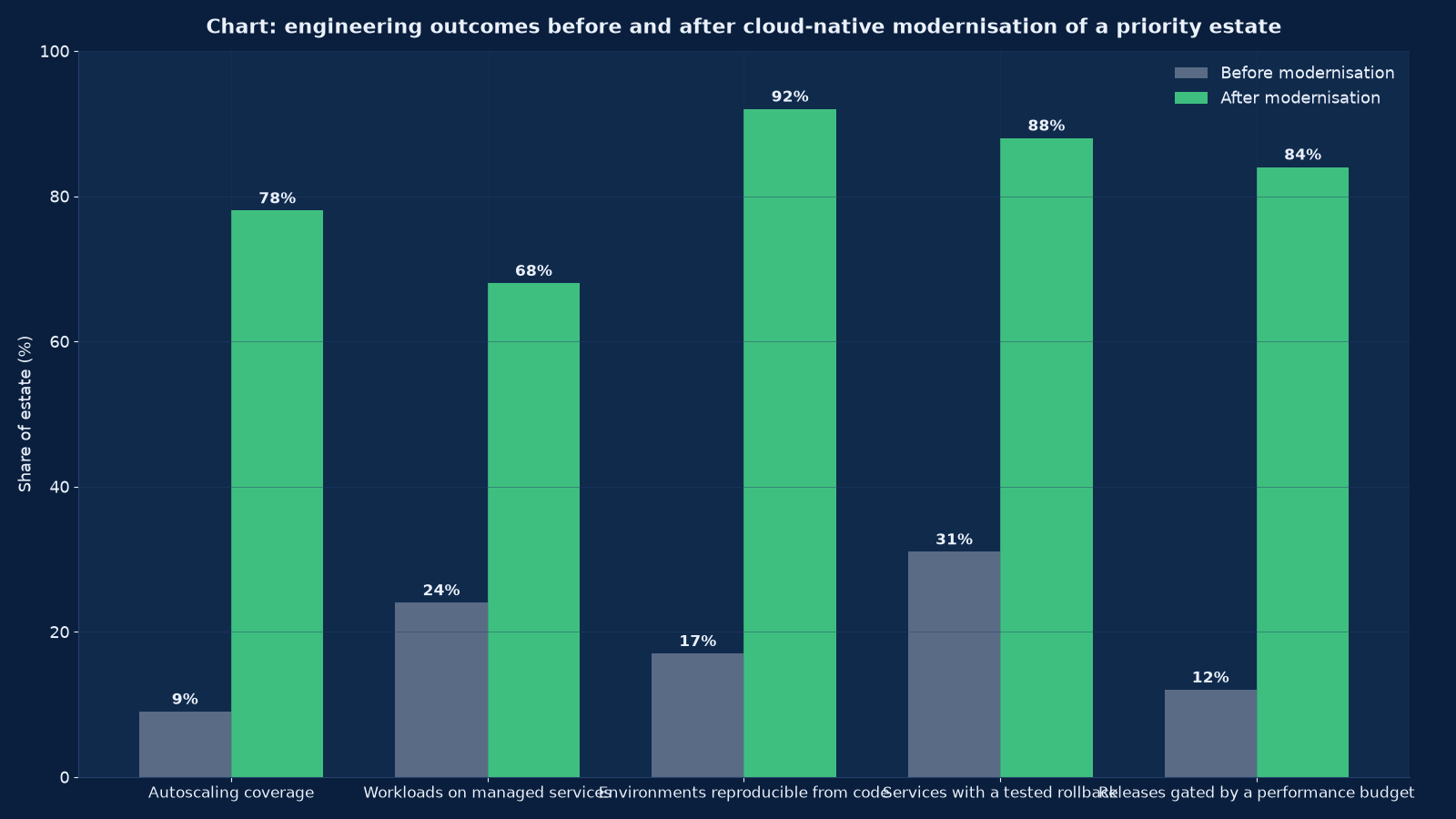
Chart values are an illustrative planning model based on typical UMC engagements and published industry benchmarks. They are not a guarantee of results on any specific project.
| Baseline measure | Taken from | Used for |
|---|---|---|
| Infrastructure and licence cost per application | Billing, asset register and support contracts | The saving claim, and the dual-running cost during transition |
| Operational effort per month | Ticket history, on-call records and the time of named individuals | The managed-service business case, which is usually larger than the infrastructure saving |
| Release lead time and frequency | Pipeline or change records, or interviews where no pipeline exists | The delivery argument, and the check that modernisation did not slow change down |
| Incident count and restoration time | Incident records and memory, gathered in interviews | The reliability comparison after cutover |
| Latency and throughput at peak | Load testing and production telemetry | The performance budget the target architecture must meet |
| Utilisation and capacity headroom | Infrastructure metrics across a full business cycle | Right-sizing and autoscaling limits in the target |
| Data volume and growth | Storage inventory and growth trend | Migration window planning and storage tier decisions |
| Security and compliance position | Existing audit reports, scan output and the certification scope | The control gap the target must close, and the audit evidence trail |
We re-measure at each stage gate. A programme that only reports at the end cannot be corrected in the middle, and the correction is usually cheaper than the discovery.
Cutover, Rollback and Hypercare
Cutover is a rehearsal that has been performed before, with an audience. The plan below is written per application, timed against the rehearsal, and includes the decision point at which the rollback is invoked rather than argued about.
| Phase | Activities | Rollback position |
|---|---|---|
| Pre-cutover | Final rehearsal, freeze on non-essential changes, communication plan issued, on-call arranged, verification checks written and tested | No change made; the legacy path is live and untouched |
| Data synchronisation | Continuous replication running, final delta applied in the window, reconciliation executed | Replication reversed or discarded; the source remains authoritative until promotion |
| Promotion | Target database promoted, caches warmed, configuration switched, secrets reissued | Source remains writable-capable for the agreed period; promotion reversed if verification fails |
| Traffic switch | DNS or load balancer moved by cohort or percentage, objective watched during each step | Traffic returned to the legacy path within the agreed time, rehearsed and timed |
| Verification | Synthetic checks on critical journeys, reconciliation of business records, third-party connectivity confirmed, reporting compared | Any failed verification invokes the rollback decision point rather than a debugging session under pressure |
| Hypercare | Dedicated support for an agreed period, daily review of objectives and error rates, fast path for defects | Legacy path kept warm for the hypercare period, with a documented decommission date |
| Decommission | Legacy infrastructure released, licences cancelled, data archived per retention policy, documentation updated | Not reversible — which is why it happens after hypercare exit criteria are met and the decision is recorded |
| Benefit verification | Cost, effort, lead time and incident measures re-taken against the baseline | Not applicable; this is the report that decides whether the next wave proceeds |
The hypercare exit criteria are agreed before cutover: a period of stable operation against the objective, no severity-one incidents, reconciliation clean, and the owning team operating without our intervention. An exit that depends on our absence is the only honest test of handover.
The Sixteen-Week Programme
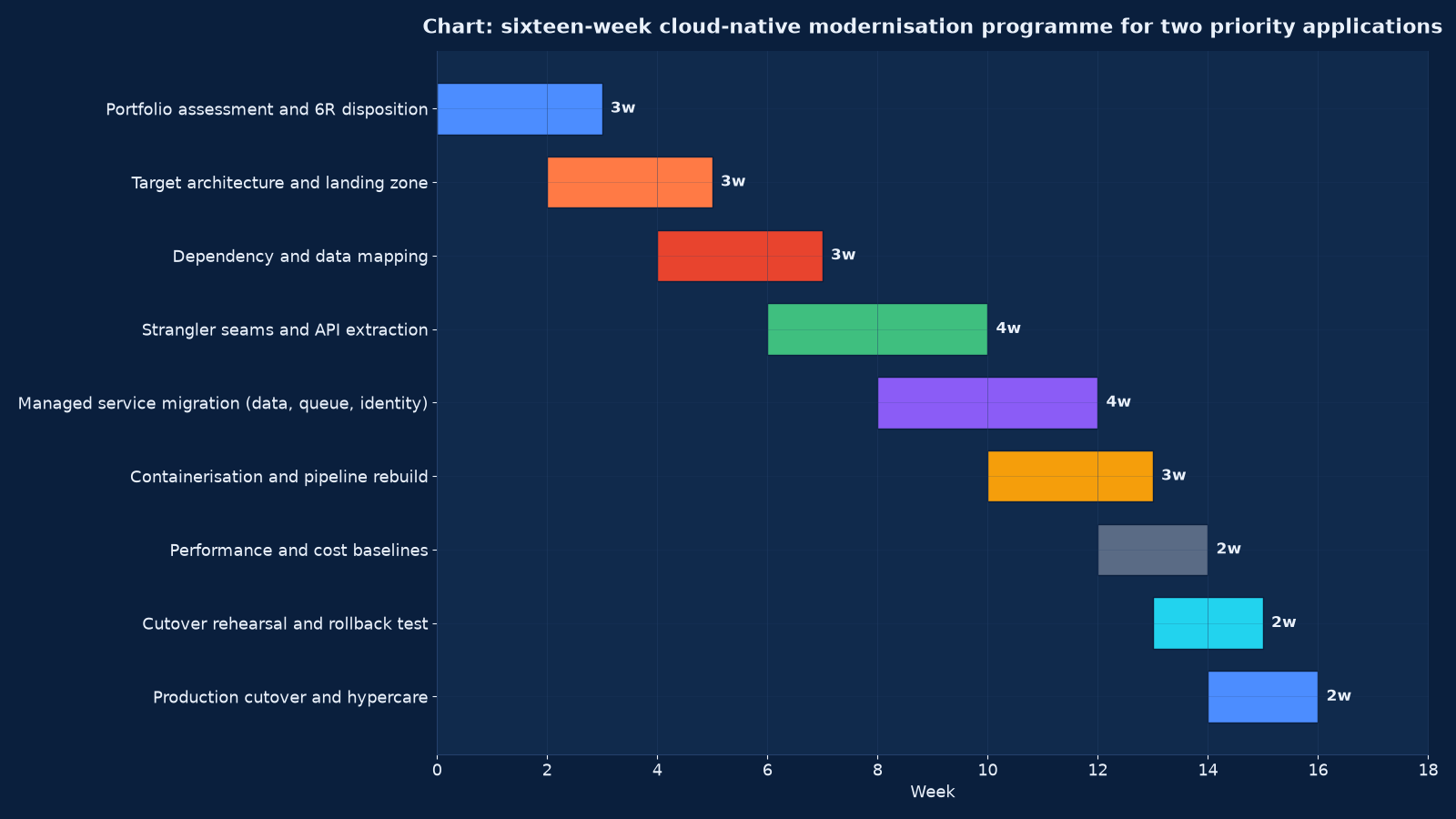
Chart values are an illustrative planning model based on typical UMC engagements and published industry benchmarks. They are not a guarantee of results on any specific project.
| Weeks | Workstream | Decision gate at the end |
|---|---|---|
| 1–3 | Portfolio assessment and disposition: value, condition, change frequency, dependencies, data, licensing, cost and operational burden | A signed disposition per application and the two priority applications chosen with a stated reason |
| 3–5 | Target architecture and landing zone: accounts, networking, identity, approved managed services, guardrails, observability and cost governance | The landing zone is rebuilt from code in a clean account and the rebuild is timed |
| 5–7 | Dependency and data mapping: application, integration, batch, file and licence dependencies, with data classification and residency | A dependency map that the application owners confirm, and a migration window that the business accepts |
| 7–10 | Strangler seams and API extraction: contracts placed, capabilities extracted, shadow operation and comparison | One capability running in parallel with differences resolved or accepted in writing |
| 9–12 | Managed service migration: database, queue, cache, identity and search, with rehearsed data movement | A timed rehearsal with reconciliation passing and the promotion path proven |
| 11–13 | Containerisation and pipeline rebuild: runtime contract, progressive delivery, environments from code | A release reaches production through the new pipeline and rolls back automatically when deliberately broken |
| 13–14 | Performance and cost baselines: load and soak tests against the target, utilisation and unit cost measured | The performance budget is met and the unit cost is compared with the baseline |
| 14–15 | Cutover rehearsal and rollback test: the full plan executed end to end in a non-production environment | A timed rehearsal with a working rollback, and a go or no-go decision taken on evidence |
| 15–16 | Production cutover and hypercare: traffic switched, verification run, hypercare operated, benefit verification reported | Hypercare exit criteria met, the legacy path decommissioned on a recorded date, and the benefit report delivered |
Two applications in sixteen weeks is the pace we recommend for a first wave: enough to prove the pattern, few enough to keep the rollback honest. Later waves run faster because the landing zone, the pipeline and the rehearsal discipline already exist.
What We Measure and Report
Ten measures, reported at each stage gate and monthly during operation. They mix delivery, reliability and cost deliberately, because a programme that improves one at the expense of the others is not a success.
| Measure | Definition | Direction of travel |
|---|---|---|
| Applications with a signed disposition | Share of the portfolio assessed and decided | 100 per cent, with retained applications carrying a review date |
| Applications retired | Decommissioned with data archived per retention policy | Rising; retirement is the cheapest saving available |
| Workloads on managed services | Share of the priority estate using a managed database, queue, cache or identity service | Rising, as in Figure 2 from 24 to 68 per cent |
| Environments reproducible from code | Environments that can be rebuilt without manual steps | Rising towards complete, because it is the precondition for rehearsing anything |
| Release lead time | Commit to production, measured from pipeline data | Falling, and reported next to change failure rate |
| Change failure rate | Deployments needing rollback or hotfix, over all deployments | Falling, with automatic rollback in place for the ones that do |
| Availability against objective | SLO attainment per migrated service | At or above the agreed objective, with error budget remaining |
| Cost per workload | Allocated infrastructure, licence and support cost, against the baseline | Falling after the transition period, with dual-running shown separately |
| Operational effort per month | Tickets, on-call pages and manual intervention attributed to the application | Falling, which is the saving most programmes forget to claim |
| Migration wave progress | Applications migrated against plan, with the reason for any slip | On plan, with slips explained by decision rather than by discovery |
The monthly report is written so that the executive sponsor can read it without an engineer present. If it cannot be, it is a status update for the delivery team and we rewrite it.
People, Skills and Organisational Change
A modernisation programme changes who does what. Treating that as a communications problem is how programmes acquire a technically complete migration that nobody operates confidently.
| Change | Who it affects | How we handle it |
|---|---|---|
| From server administration to platform engineering | Infrastructure and operations staff whose current skills are patching, provisioning and monitoring hosts | Paired working from week three, a written skills map, and a training plan against the target rather than a generic course |
| From project delivery to product ownership | Teams that currently receive specifications and deliver releases | Objectives and error budgets agreed with the business, so the team owns an outcome rather than a milestone |
| Service ownership | Every application, which must have a named owning team before it moves | Ownership assigned during assessment; an application without an owner is a retirement candidate |
| On-call and incident roles | Engineers who will carry a pager for a system they did not build | Runbooks written with them, shadow shifts before solo duty, and sustainable rota sizing |
| Finance and cost ownership | The person accountable for a bill that now varies monthly | Allocation, budgets and a monthly review introduced during the programme, not after the first surprise |
| Security and compliance | The function that must evidence controls in a new architecture | Included from the assessment, with the control mapping delivered as part of the programme — see IT Audit & Compliance (ISO, SOC 2) |
| Vendor and supplier management | Contracts, support terms and access arrangements that assumed the old topology | Reviewed during assessment, with support entitlements confirmed for the target architecture |
| Business users | The people whose process the application runs, and who notice every defect | Communication per stage, a named contact during hypercare, and a feedback route that is actually read |
- Skills gaps are mapped in week two and closed by pairing, not by a training day in week sixteen.
- Where capacity is the constraint rather than knowledge, named engineers are supplied through IT Staff Augmentation Services for the duration of the wave.
- The operating model is agreed before cutover, because a migration that lands into an undefined operating model creates an incident queue rather than a service.
- Every handover includes a test: your engineers perform a deployment, a rollback and a data restore unaided, and the result is recorded.
When Modernisation Is the Wrong Answer
We decline this work more often than most consultancies, because a migration undertaken for the wrong reason consumes the budget that the right reason would have needed later.
| Situation | Why modernisation is the wrong answer | What we recommend instead |
|---|---|---|
| The application is being replaced by a product decision | Migrating a system that will be retired within eighteen months spends money twice | Retain with a review date, and invest in the replacement’s architecture |
| The real problem is the business process | A rewritten application reproduces the process it was given, faithfully and expensively | Process work first, through Turnaround Diagnostic or Business Strategy Consulting, then decide what needs building |
| Nobody owns the application | Migration without an owner produces a new system with the same absence of accountability | Assign ownership or retire the application; ownership is a precondition, not an outcome |
| The constraint is a licence, not an architecture | Licensing renegotiation or replacement is cheaper than re-engineering | A commercial review of the licence position before any technical work |
| The estate is small and stable | Three applications with quarterly releases do not repay a platform and a pipeline | Managed hosting, monitoring and a maintenance retainer — see Managed IT Infrastructure & AMC |
| The motivation is a technology preference | Modernisation justified by fashion produces a modern system with the same operational problems | A baseline assessment to establish whether a measurable problem exists at all |
| A data centre exit is the only deadline | Rehosting meets the deadline; refactoring will not | Rehost to the deadline, then replatform in a planned second stage with the business case already measured |
| The team has no capacity to operate the target | A cloud-native estate needs different skills, and the gap does not close at cutover | Either a managed operating model or a smaller target architecture that the team can run |
Where the honest conclusion is ‘not yet’, we write it down with the conditions that would change it. That document is usually worth more than a migration, because it stops the same proposal returning every year with a different vendor attached.
Evidence From Our Work
The engagements below are published case studies and insight from this practice, each described by the subject its own page documents. They are the engagements where an existing system had to be rebuilt, replaced or moved while it continued to serve users.
- Ez1.in Services: a ground-up e-commerce platform rebuild — a services-plus-products catalogue rebuilt from the ground up, with its technical stack and system architecture documented rather than inherited.
- Ethnava: a heritage garment brand’s move from offline to digital commerce — an artisan-led offline business transitioning to full digital commerce, with information architecture and technical SEO treated as deliverables.
- PHP website development for a dance and film studio — a multi-location creative arts academy’s application, where the technical architecture and PHP stack were designed for the operating model.
- Mobile application development for a news company — a high-performance mobile estate built for event-driven traffic, where capacity behaviour is an architecture requirement.
- Enterprise IT infrastructure management for Star TV — the operating model an estate lands into after a migration, delivered as a continuous service.
- Switching, routing and server-room setup for Global Hospitals — a healthcare network’s infrastructure refresh, where the migration window and the recovery objective drive the design.
- CRM data migration: planning, cleansing, mapping and go-live control — the data migration discipline in detail, written from engagements rather than from a product manual.
- Tech stack consolidation: the business case for unified systems — why reducing the number of platforms is often worth more than modernising each one.
- The Technology insight archive — further writing on infrastructure, engineering practice and platform decisions.
Engagement Models and Commercials
Four shapes cover the work. The assessment is the entry point we recommend, because it produces the dispositions and the baseline that make the rest arguable.
| Model | Best when | Duration and structure | What you receive |
|---|---|---|---|
| Portfolio assessment and business case | You need to know what to do with the estate before committing to any migration | Three to five weeks, fixed fee | Portfolio sheet with a disposition, owner, wave, effort and benefit per application, a cost and operational baseline, licensing and dependency findings, and a staged plan with the do-nothing option priced |
| Modernisation wave | The disposition is agreed and one or two priority applications need moving | Twelve to sixteen weeks per wave, staged with decision gates | Target architecture and landing zone, extraction and migration delivered, load and cost baselines, rehearsed cutover with rollback, hypercare and a benefit verification report |
| Landing zone and platform foundation | Multiple waves are planned and the foundation should be built once, properly | Six to ten weeks | Accounts, networking, identity, guardrails, approved managed services, observability contract, pipeline pattern and cost governance, all as code |
| Advisory and assurance | Your team or another vendor is delivering and you need independent design review and gate assurance | Monthly or per gate | Architecture review, risk register, gate reports against the plan, and a written opinion on whether the next stage should proceed |
Assessments are fixed fee. Waves are quoted after the assessment, because the effort depends on dependencies, data volume, licensing and how much of the pipeline already exists. We will recommend the advisory model where your team is capable and only the assurance is missing, and we will recommend no migration at all where the assessment says the estate should be retained and retired instead.
Frequently Asked Questions About Cloud-Native Application Modernisation
Is this the same as migrating to the cloud?
Migration is the movement; modernisation is what the movement is for. Rehosting an unchanged application is a migration and usually a cost-neutral one. Modernisation changes how the application is operated, scaled, released and paid for. Where your deadline is a data centre exit, we will propose a rehost with a planned second stage rather than pretend a refactor fits the window.
How do you decide which applications move first?
On business value, technical condition, change frequency, dependencies, data profile, licensing, end-of-life dates, operational burden, cost and security exposure, weighted with you. The first wave is chosen to prove the pattern on something that matters but is not the most coupled application in the estate.
What does a wave cost?
The assessment is a fixed fee. A two-application wave runs twelve to sixteen weeks with a joint team and is quoted after the assessment, because the effort is driven by dependencies, data volume and licensing rather than by application count. We do not quote a wave against an unexamined portfolio.
Will the migration reduce our costs?
Eventually, if the disposition includes retirement and replatforming. During transition costs usually rise, because you pay for both environments and for the effort to move between them. The saving comes from managed services, autoscaling, right-sizing, retiring unused applications and reduced operational effort — and we measure each against a baseline taken before the first change.
How much downtime will there be?
For most applications, a short window measured in minutes, with continuous replication and a promotion step. Where no window exists at all, the design changes to continuous replication with a seconds-long promotion and the cost of that design is presented as an option. The window is negotiated against a timed rehearsal, never against an estimate.
Can you migrate our database without losing data?
Data migration is rehearsed repeatedly and verified by row counts, checksums and business-level reconciliation of sampled records, with parallel reporting where a report’s owner must sign off. We do not perform a first-time data migration in production, and neither should anyone else.
What happens to our existing integrations?
They are inventoried before the move, and every consumer is told. Contracts are versioned, both endpoints stay live during a compatibility period, third parties are given new IP ranges and callback URLs in advance, and payment and reporting paths are reconciled in parallel. See Enterprise Systems Integration for the practice.
Do we need to rewrite the application?
Rarely in full. Most value comes from retiring what is unused, replatforming onto managed services, and extracting only the capabilities where change frequency or scaling justifies a rewrite. A full rewrite is proposed only where the existing code cannot support the business requirement, and then it is staged behind a strangler seam.
How do you keep our search visibility through a migration?
By treating URLs as a contract: the mapping is preserved, redirects are implemented and tested, structured data and canonicals are carried across, and the search position is monitored after cutover. That discipline is described in Website Migration & Replatforming and applies to any user-facing estate.
What about compliance and certifications we hold?
The control mapping is reviewed during the assessment and the certification position is checked before cutover, because a migration can change audit scope. We deliver the technical evidence and work with IT Audit & Compliance (ISO, SOC 2) on the audit itself.
Will our team be able to operate it afterwards?
That is the exit criterion, not a hope. Handover includes runbooks, paired working from week three, and a test in which your engineers deploy, roll back and restore data unaided. Where the gap is capacity rather than knowledge, Managed IT Infrastructure & AMC provides the operating model and staff augmentation the named engineers.
What if we decide halfway through that it is not working?
Then the stage gate is where we stop, and the assessment already priced the do-nothing option so the comparison is available. Every stage has a rollback cheaper than proceeding, applications are migrated independently, and a partial programme that leaves two applications running well is a better outcome than a complete programme delivered into an estate nobody can operate.
Commission a Modernisation Portfolio Assessment
Send us the list of applications you run, the constraint you are under — a data centre exit, an end-of-life platform, a cost that has stopped falling, or a delivery team that cannot ship — and the deadline attached to it. Within five weeks you will have a disposition per application with an owner and a wave, a cost and operational baseline, licensing and dependency findings, a target architecture outline, and a staged plan with the do-nothing option priced alongside it.
Contact Unified Management Consulting to arrange a confidential first conversation.
Related Services
Cloud-native application modernisation is delivered with the practices around it:
- Cloud Services & Migration (AWS, Azure, GCP) — the landing zone, hosting architecture and provider work the migration lands in
- DevOps & CI/CD Engineering — the pipelines and environments that make rehearsal and rollback possible
- Website Migration & Replatforming — the equivalent discipline for content and commerce estates, including URL and search preservation
- Headless & Composable Commerce — the decoupled architecture many content and commerce migrations choose as their target
- Enterprise Systems Integration — ERP, accounting, CRM and legacy contracts preserved across the boundary
- Cloud Cost Optimisation & FinOps Services — the baseline, allocation and commitment strategy the business case depends on
- Cybersecurity Services & Solutions and IT Audit & Compliance (ISO, SOC 2) — controls and evidence carried across the migration
- Backup & Disaster Recovery — recovery objectives and the tested restore in the target architecture
- PHP / Laravel Development and Full-Stack .NET Development — the application engineering behind a refactor, where one is genuinely warranted
- Kubernetes & Container Platform Engineering — landing zone, cluster baseline, golden paths, CI/CD to a signed image registry, admission policy, observability, quotas and cost controls, all delivered as code with a rehearsed handover
- Cloud Security Posture Management (CSPM) — estate discovery, CIS baseline assessment, identity and exposure review, drift control as policy, compliance evidence and a severity-ranked remediation register with named owners
- Site Reliability Engineering (SRE) & Observability — service inventory, SLOs and error budgets, metrics, logs and traces, dashboards with owners, alert routing, on-call design and blameless incident review
- Data Centre Design & Build Services — design and build for halls, racks, power, cooling and the acceptance tests that prove them