
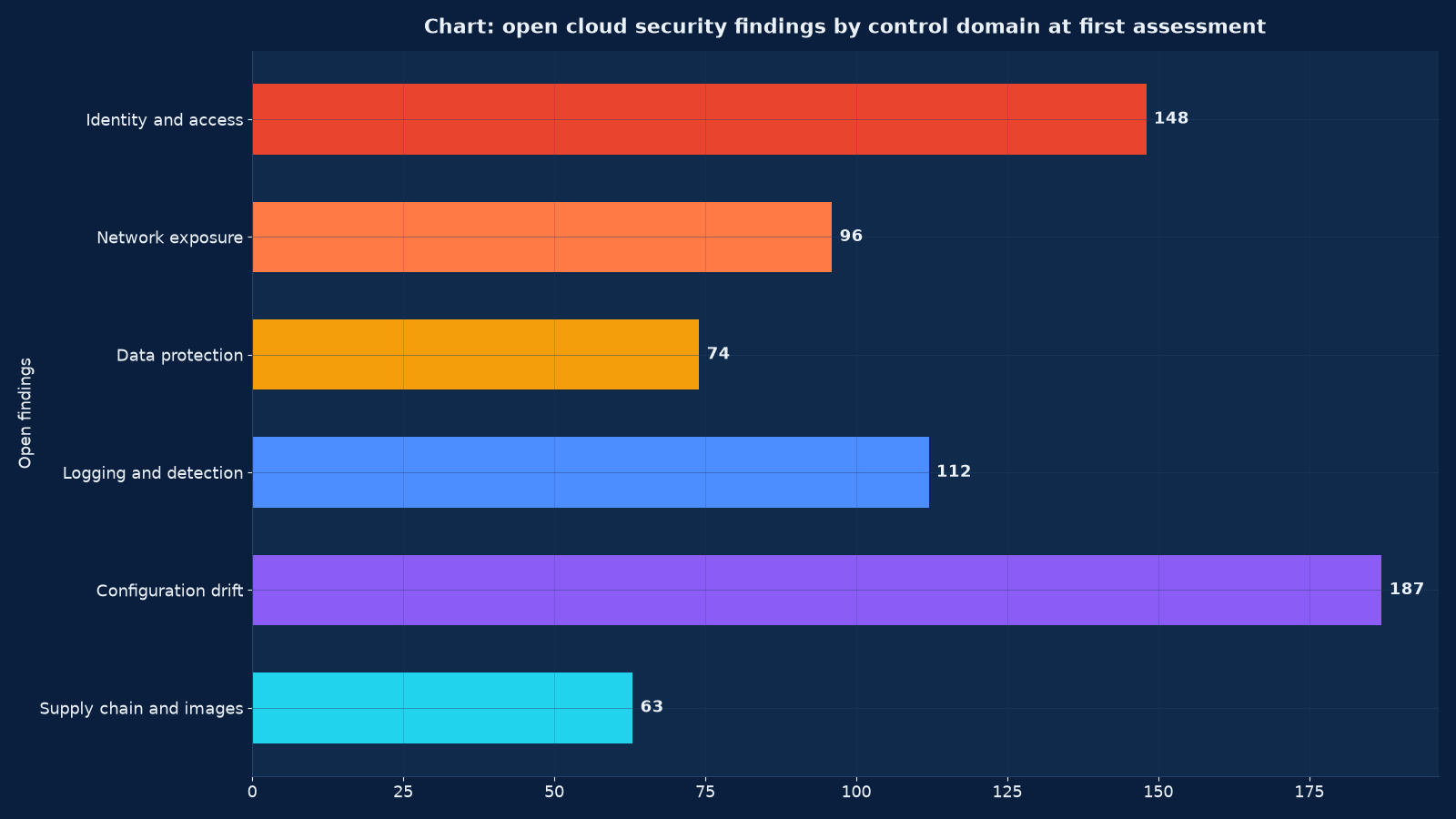
Chart values are an illustrative planning model based on typical UMC engagements and published industry benchmarks. They are not a guarantee of results on any specific project.
A firewall tells you what happened at the edge of a network that no longer has an edge. Cloud security is a configuration problem before it is a product problem: the breach usually starts with a storage bucket, a role, an exposed management port or an unrotated key that someone created eighteen months ago and nobody owns.
Cloud security posture management at Unified Management Consulting is the continuous work of knowing what your cloud estate actually looks like, comparing it against a control standard you have chosen deliberately, and closing the gap with remediation that has an owner and a deadline. It is not a product purchase. A scanner produces findings; a programme produces a smaller number of findings next quarter, evidence an auditor accepts, and an escalation path that works at two in the morning.
We work across AWS, Azure and Google Cloud, and across hybrid estates where part of the risk still sits on premises. Our starting point is an assessment of the whole estate — every account and subscription, not only the ones the technology team remembers — mapped against CIS benchmarks, the framework you are certified to or intend to be, and your own written policy. The output is a severity-ranked register with a named owner and a remediation window per finding, followed by preventive controls so the same finding cannot be recreated by the next person who needs something urgently.
🛡️ Cloud Security Posture Management — Quick Summary
| Component | What We Deliver |
|---|---|
| Estate discovery and inventory | Every account, subscription, project, region, workload, data store and third-party integration enumerated from the provider APIs, including shadow accounts, with an owner named per item. |
| Baseline assessment | Configuration compared against CIS benchmarks, your certification framework and your internal policy, producing a severity-ranked finding register rather than a raw scanner export. |
| Identity and access review | Role inventory, privilege paths, unused and over-broad permissions, federation design, break-glass accounts, key and certificate age, and a least-privilege target state. |
| Network exposure analysis | Publicly reachable resources, permissive security groups and firewall rules, management ports, private endpoint coverage and east-west segmentation gaps. |
| Data protection review | Where sensitive data lives, how it is classified, encryption at rest and in transit, key custody and rotation, storage permissions, and backup and restore verification. |
| Logging, detection and response | Audit log coverage, retention, tamper resistance, detection rules, alert routing and a tested incident response path with named responders. |
| Configuration drift control | Policy as code at the account and resource level, change detection against the approved baseline, and a registered exception process with expiry dates. |
| Supply chain and artefact security | Image and artefact provenance, vulnerability scanning in the pipeline, dependency patching service levels, and third-party access review. |
| Compliance mapping and evidence | Controls mapped to ISO 27001, SOC 2, PCI DSS and India’s DPDP Act obligations, with evidence collected continuously rather than assembled in the week before an audit. |
| Remediation delivery | Findings closed by our engineers alongside yours, with the fix applied as code so it survives the next change, and re-testing to confirm closure. |
| Governance and reporting | A monthly posture report for the technology lead and a quarterly risk review for the board or executive committee, in language that does not require a security background. |
| Continuous posture operation | Optional retainer covering scanning, triage, patching service levels, new-account onboarding and audit support with measured response times. |
What a Posture Assessment Covers
The assessment is organised by control domain rather than by product, because the same weakness appears in different services and a product-by-product review misses the pattern. Each domain below produces findings with a severity, an owner, a remediation window and a preventive control that stops it recurring.
| Control domain | What we examine | The finding we most often report first |
|---|---|---|
| Identity and access | Users, roles, groups, federation, service principals, access keys, permission boundaries, break-glass procedure, joiner-mover-leaver process | Standing administrative access held by individuals who no longer need it, and access keys older than the policy allows |
| Network exposure | Public endpoints, security group and firewall rules, management ports, load balancer configuration, private endpoints, DNS records pointing at decommissioned services | A permissive rule created for a temporary test that has been in place for a year |
| Data protection | Storage services and their permissions, database exposure, encryption settings, key custody and rotation, backups, data classification and retention | Sensitive data in a store whose access policy was set at creation and never reviewed |
| Logging and detection | Audit trail coverage, log retention, central aggregation, tamper resistance, detection rules, alert routing, response evidence | Audit logs enabled in some regions only, with no central store and no detection content |
| Configuration and drift | Baseline conformity, change history, infrastructure-as-code coverage, exception register, account proliferation | Console changes that diverge from the code that was supposed to define the estate |
| Supply chain and artefacts | Image sources, pipeline scanning, signing, dependency patching, third-party and vendor access, marketplace subscriptions | Base images that are neither pinned nor scanned, and vendor access that outlives the contract |
| Resilience and recovery | Backup configuration, restore testing, redundancy, failure modes, incident history | Backups enabled but never restored, which is a recovery plan that has not been tested |
| Governance | Policy documents, risk register, ownership, training records, review cadence, board reporting | A policy written for a certification audit that does not describe how the estate is actually operated |
Every domain is assessed against three references at once: the CIS benchmark for the provider, the framework you are certified to or aiming for, and your own internal policy. Where the three disagree we report the disagreement, because it usually means the internal policy has not been updated since the estate changed shape.
CSPM, CWPP, CIEM, CNAPP: What the Acronyms Actually Buy
Vendors sell overlapping categories with confident acronyms. The categories describe real capabilities, but buying all of them is not a strategy and usually produces four dashboards and no remediation. The table is how we decide what you need.
| Category | What it does | When you need it | When it is the wrong first purchase |
|---|---|---|---|
| CSPM — cloud security posture management | Continuously assesses cloud configuration against a benchmark and reports misconfiguration | Almost always first: it covers the largest share of real exposure and works without agents | Rarely wrong first, but it will not protect a workload from a runtime attack on its own |
| CWPP — cloud workload protection | Agent or kernel-level protection of running workloads: malware, exploit prevention, integrity monitoring | Where workloads run long-lived, are internet-facing, or sit in a regulated environment requiring host detection | As a substitute for configuration hygiene; an agent cannot fix a public storage bucket |
| CIEM — cloud infrastructure entitlement management | Analyses identity permissions, finds unused privilege, models least-privilege target roles | Where identity has grown across many accounts and teams, typically after a merger or after several years of organic growth | Before you know how many accounts and roles exist — do the inventory first |
| CNAPP — cloud-native application protection platform | A suite combining posture, workload, identity and code-to-runtime risk in one product | Where a single vendor relationship is preferable and the estate is large enough to justify the licence | As a way to avoid deciding priorities; a suite configured badly produces more findings than a focused tool |
| Vulnerability management and scanning | Finds known vulnerabilities in operating systems, containers, dependencies and infrastructure code | Always, in the pipeline and on running assets, with remediation service levels by severity | When the output has no owner; a scan without a service level is a report nobody reads |
| Secrets and key management | Stores, rotates and audits credentials, certificates and encryption keys | Wherever credentials exist, which is everywhere; embedded secrets are the most common source of a real compromise | Never — this is foundational, not optional |
Our usual recommendation for a mid-sized estate is posture management and vulnerability scanning first, secrets management immediately after, workload protection where the risk profile justifies it, and entitlement analysis once the account and role inventory is accurate. That sequence closes the most exposure per rupee spent, and it produces evidence for the wider security programme described in Cybersecurity Services & Solutions.
From Findings to a Smaller Number of Findings
The first assessment produces a register. The value of the programme is what happens to it. Figure 2 shows the trajectory across six months of continuous posture management on an estate that started with the findings in Figure 1: critical findings fall from 42 to 3, mean days to remediate fall from 34 to 6, and new findings raised per week fall from 58 to 11 as preventive policy starts blocking the mistakes that used to be detected afterwards.
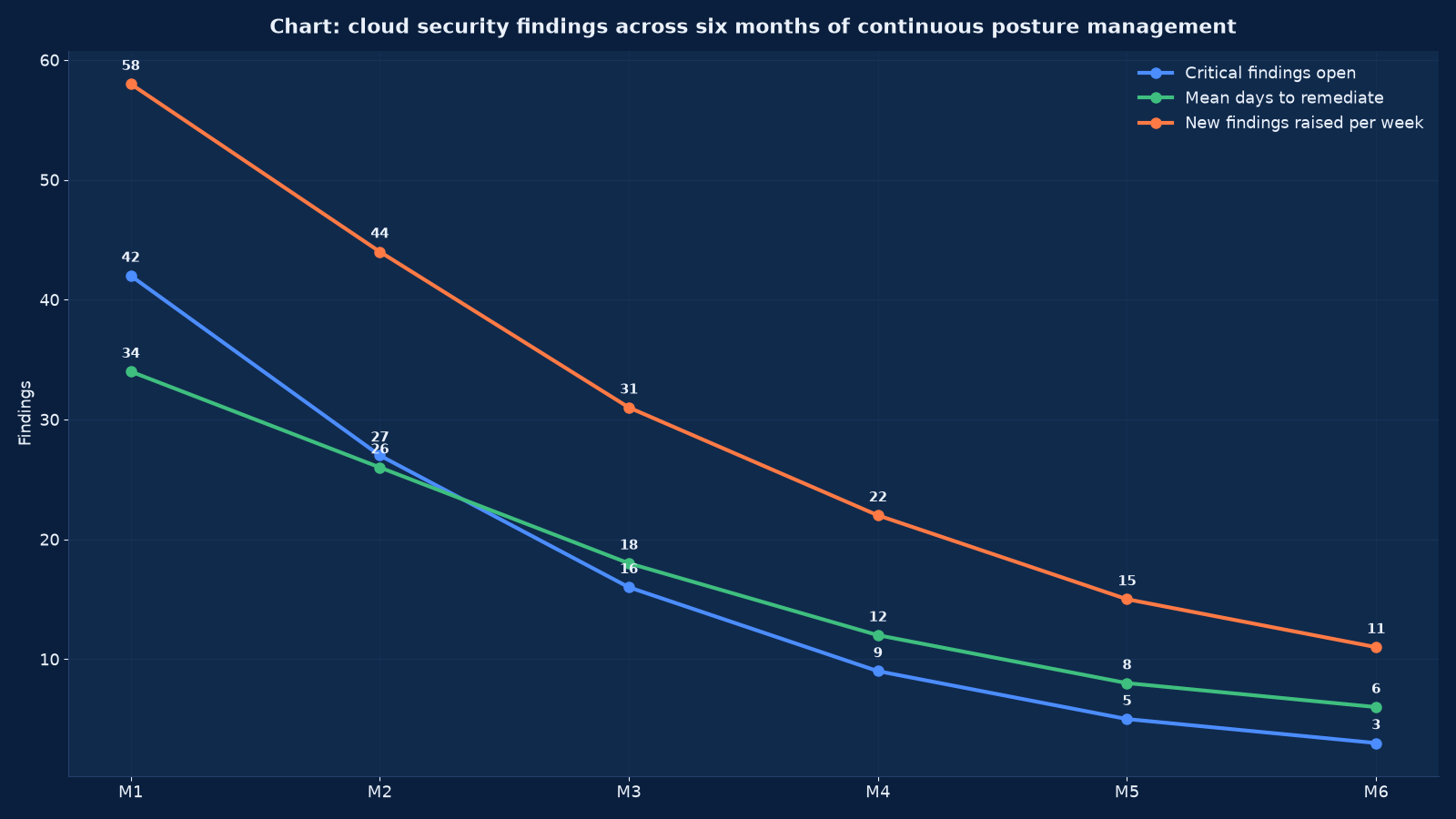
Chart values are an illustrative planning model based on typical UMC engagements and published industry benchmarks. They are not a guarantee of results on any specific project.
| Severity | Definition used in our register | Remediation window | Escalation if missed |
|---|---|---|---|
| Critical | Externally exploitable now, or credential or key exposure with administrative reach, or sensitive data publicly readable | 24 hours to contain, 5 working days to close | Technology head and, where customer data is involved, the executive sponsor the same day |
| High | A control absent that your framework requires, with a plausible path to exploitation | 10 working days | Monthly posture review, with the finding aged on the report |
| Medium | A control weaker than the standard: over-broad permissions, missing encryption on non-sensitive data, logging gaps | 30 working days | Quarterly risk review |
| Low | Hygiene and best practice: naming, tagging, unused resources, documentation gaps | 90 working days or the next planned change | Tracked, not escalated |
| Exception | A finding deliberately accepted with a compensating control and an expiry date | Reviewed at expiry, never open-ended | Expired exceptions are re-raised at the original severity |
Remediation is delivered as code wherever the resource is managed as code, and as a documented console procedure with a verification step where it is not. A fix applied by hand to a resource that is later rebuilt will silently disappear, which is how the same finding returns in the next quarter’s report.
Identity Is the Perimeter
In a cloud estate, most serious incidents begin with credentials rather than with a network exploit. Identity work is therefore the highest-value part of the programme, and it is also the part that most often meets internal resistance, because least privilege is felt as friction by the people who currently have more access than they need.
| Area | What we change | How we prove it |
|---|---|---|
| Federation and directory | Cloud access through your identity provider with conditional access; local cloud users reduced to break-glass accounts only | A user list per account showing local identities, each with a documented reason |
| Role design | Roles derived from actual usage rather than from managed policies attached for convenience; separation of production and non-production | A role matrix mapping each role to the people and services holding it, reviewed quarterly |
| Least privilege | Unused permissions removed, wildcard actions replaced with specific ones, permission boundaries applied where a team creates its own roles | A before-and-after permission diff per role, with a rollback path if a team is blocked |
| Service identities | Workload identity federation replacing embedded access keys; short-lived credentials everywhere | An inventory of remaining long-lived keys with an age and an owner per key |
| Privileged operations | Just-in-time elevation for administrative tasks, with approval and a recorded reason | Elevation logs reviewed monthly, with the count and the reasons summarised |
| Joiners, movers, leavers | Access provisioning and removal tied to the HR process, with a monthly reconciliation | A reconciliation report showing access held by people who have left or changed role |
| Multi-factor and device posture | Multi-factor authentication enforced for all human access, device compliance where the estate allows it | An authentication policy report and a test of an unenrolled device being refused |
| Break-glass | Two documented emergency accounts, credentials split and stored offline, usage alerted | A rehearsed break-glass exercise, performed once and recorded |
Where the estate includes on-premises directories, VPN concentrators and firewall administrators, the identity work has to cover them too: Routing, Switching, Firewall & Network Engineering is the practice we design the hybrid access model with.
Network Exposure, Data Protection and Encryption
Two domains produce most of the externally visible risk: resources reachable from the internet that should not be, and data stored without encryption or with encryption keys held by the same people who hold the data. Both are cheap to fix and expensive to leave.
| Risk | How it arises | What we implement |
|---|---|---|
| Public storage | A bucket or container created for a migration, a report export or a vendor handover, left with public read | Account-level block on public access, inventory of every store with its ACL, and a detection alert on any policy change |
| Exposed management interfaces | SSH, RDP, database ports and admin consoles reachable from anywhere for convenience during a project | Private endpoints and bastion or session-manager access, default-deny rules, and an alert on any rule widening to 0.0.0.0/0 |
| Permissive east-west traffic | One large security group or subnet shared by every workload because segmentation was deferred | Segmentation by tier and function, service-level rules, and a documented exception for anything that cannot be segmented yet |
| Unencrypted data at rest | Databases, volumes, backups and object stores created before the encryption standard existed | Encryption enforced by policy at creation, an inventory of unencrypted resources with a migration plan, and provider-managed or customer-managed keys chosen by sensitivity |
| Key custody and rotation | Keys created by the same team that uses the data, no rotation, no separation of duties | Customer-managed keys for sensitive data, a rotation schedule, key policy reviewed separately from data access, and deletion protection |
| Data in transit | Internal service-to-service calls over unencrypted channels, expired or self-signed certificates | TLS enforced internally where the workload supports it, certificate inventory with expiry alerting, and automated renewal |
| Backup exposure | Backups stored in the same account and region as the source, with the same access policy | Separate backup account, immutability where the provider offers it, restore testing on a schedule — see Backup & Disaster Recovery |
| Data residency and classification | Personal data replicated to regions or services chosen for cost or convenience | A classification scheme, region constraints enforced by policy, and a record of where each class of data lives |
Classification is the step most estates skip and then pay for. Without it, every store is treated the same, which means either everything is protected expensively or nothing is protected adequately. We define four or five classes, map the estate to them, and let the class drive the control set.
Logging, Detection and Response
Posture management reduces the number of ways an attacker can get in. Detection determines how long they stay if they do. Most estates we assess have logging enabled somewhere and detection content almost nowhere, which means the audit trail exists for a forensic team you would have to hire rather than for the people on call.
| Layer | What we build | Why it matters |
|---|---|---|
| Audit trail | Provider audit logging enabled in every region, delivered to a dedicated log account, retention set by obligation rather than by storage cost | Without a complete trail, an incident becomes an argument about what happened |
| Log aggregation and protection | Central store with write-once retention, access restricted to the security function, integrity monitoring | An attacker who can delete their traces has not been detected, only delayed |
| Detection content | Rules for credential misuse, privilege escalation, public access changes, unusual region or API activity, and data exfiltration patterns | Detection without content is a dashboard; content is what turns logs into alerts |
| Alert routing and triage | Alerts routed to a named responder with a severity, a runbook reference and a response clock | Unrouted alerts are read by nobody and create the fatigue that hides the real incident |
| Incident response plan | A written plan with roles, decision rights, containment procedures per scenario, communication templates and legal and regulatory notification triggers | The plan is used under pressure; improvising at that point costs hours |
| Rehearsal | A tabletop exercise and at least one technical containment rehearsal per year, with lessons recorded | An untested plan is a document, and the gaps are found during the incident instead |
| Forensic readiness | Snapshot and isolation procedures, evidence handling, chain of custody, and a named external partner for a major incident | Containment destroys evidence unless the procedure captures it first |
| Post-incident review | A blameless review within five working days producing changes with owners and dates | The only mechanism that reliably prevents a repeat |
Detection and response for the whole organisation, including endpoint, email, testing and 24×7 coverage, sits with Cybersecurity Services & Solutions. Posture management feeds it: the estate inventory is what tells the detection team which resources should exist at all.
Configuration Drift and Policy as Code
Drift is the mechanism by which a secure estate becomes an insecure one without any decision being made. It is also the most preventable category in Figure 1, because prevention is a matter of putting the standard in the pipeline rather than in a document.
| Preventive control | How it works | What it stops |
|---|---|---|
| Account-level guardrails | Deny policies applied at the management group or organisation level: no public storage, no region outside the approved list, no disabling of audit logging | A mistake in any single account, including an account created last week by a team you have not met |
| Policy as code in the pipeline | Infrastructure code scanned before apply, with the same rules that run in the cloud | A misconfiguration being deployed at all, which is cheaper than detecting it afterwards |
| Approved patterns | Reference modules and templates for the common resources: storage, database, compute, network, identity | Each team inventing its own configuration, which is how 41 accounts acquire 14 different storage standards |
| Change detection and reconciliation | Continuous comparison of live configuration against the approved baseline, with drift raised as a ticket | Console changes made during an incident and never reverted |
| Exception register | A single register with the finding, the compensating control, the approver and the expiry date | Exceptions becoming permanent, which is the normal lifecycle of an unregistered exception |
| Tagging and ownership | Mandatory owner, environment and cost-centre tags enforced at creation | Resources that cannot be attributed, which can be neither remediated nor decommissioned |
| Periodic access recertification | Quarterly review of who holds which role, with removal as the default for non-response | Access accumulating through project after project |
- Guardrails are applied from the top down: organisation first, then accounts, then workloads, so a new account inherits the standard instead of acquiring it later.
- Every deny policy is tested by attempting the denied action and recording the refusal — an untested policy is an assumption.
- Drift tickets carry the same service levels as findings, otherwise drift is measured but never corrected.
- The exception register is reviewed at the quarterly risk forum, and expired exceptions are re-raised at their original severity automatically.
Supply Chain and Third-Party Access
A meaningful share of cloud incidents arrive through something you did not build: a base image, a dependency, a marketplace subscription, a vendor’s access to your account, or a SaaS integration granted by one enthusiastic colleague. This domain is assessed separately because the owner is usually not the technology team.
| Vector | What we check | Control we put in place |
|---|---|---|
| Base images and artefacts | Which images are used, whether they are pinned and current, whether they are scanned and signed | An approved internal registry, pinned and regularly rebuilt base images, signature verification at admission |
| Dependencies | Known vulnerabilities in application and infrastructure dependencies, with patch age | Automated dependency updates in the pipeline and a patching service level by severity |
| Infrastructure code modules | Third-party modules and their provenance, version pinning, review status | A vendored and reviewed module set, with updates treated as a change rather than a pull |
| Marketplace and SaaS integrations | Every third-party application granted access to cloud data, and by whom | An integration inventory, admin consent controls, and a quarterly review of granted scopes |
| Vendor and contractor access | Named individuals, the roles they hold, the contracts they belong to, and the expiry of each | Time-bound federated access tied to the engagement, removed at contract end by process rather than by memory |
| CI/CD credentials | How pipelines authenticate to cloud accounts, and what happens when a pipeline secret leaks | Short-lived workload identity for pipelines, no long-lived keys, and rotation on suspicion rather than on schedule alone |
| Shadow accounts and subscriptions | Accounts created outside the standard process, often for a trial or a proof of concept | Organisation-level inventory, a creation process that is faster than the workaround, and periodic reconciliation against finance records |
Shadow accounts are the most common discovery in our first assessment and the reason estate discovery comes before anything else. A control standard applied to thirty accounts while eleven exist outside it is not a control standard; it is a coverage figure.
Compliance Mapping: ISO 27001, SOC 2, PCI DSS and the DPDP Act
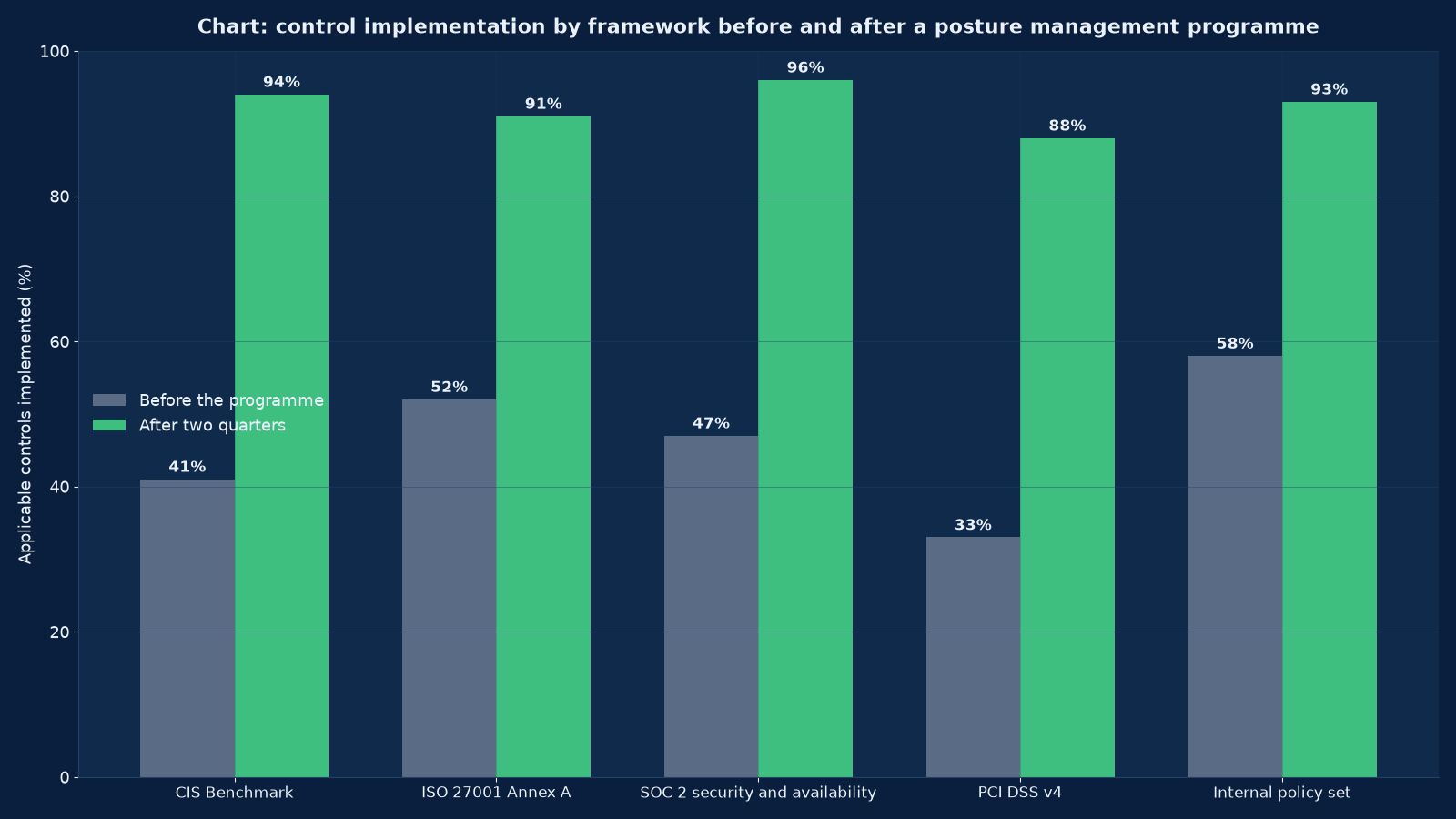
Chart values are an illustrative planning model based on typical UMC engagements and published industry benchmarks. They are not a guarantee of results on any specific project.
| Framework or obligation | What it requires of a cloud estate | How continuous posture helps |
|---|---|---|
| CIS Benchmarks | Prescribed configuration settings per provider service, with a defined profile level | Assessed automatically and continuously; the benchmark is the scanner’s native language, so conformity is a report rather than a project |
| ISO 27001 Annex A | Access control, cryptography, operations security, logging, supplier relationships, incident management | Technical controls evidenced from configuration data, leaving the statement of applicability to be argued rather than assembled |
| SOC 2 (security and availability) | Controls operating effectively over a period, with evidence collected throughout it | Continuous evidence collection, which is what turns a two-week audit scramble into a review of data you already have |
| PCI DSS version 4 | Segmentation of the cardholder data environment, encryption, access restriction, logging, vulnerability management and quarterly testing | Segmentation and exposure verified continuously, with scope documented from live configuration rather than from a diagram |
| India’s DPDP Act 2023 and rules | Lawful processing of personal data, purpose limitation, security safeguards, breach notification, and obligations on significant data fiduciaries | A data inventory showing where personal data lives and how it is protected, which is the prerequisite for answering any regulator or principal’s question |
| Sector expectations | Regulators in banking, insurance, capital markets and healthcare publish their own cyber risk, outsourcing and data localisation expectations | Controls mapped once and reported many times, so a sector questionnaire is answered from the same evidence set |
| Customer contractual commitments | Security schedules, right-to-audit clauses, sub-processor lists and notification windows | A single source of configuration truth that can be quoted in a response rather than reconstructed |
Certification and audit delivery is a separate practice with its own methodology: IT Audit & Compliance (ISO, SOC 2). Posture management supplies the technical evidence that practice needs, and the two are planned together so the evidence is collected continuously instead of being hunted for in the fortnight before an audit.
The Twelve-Week Programme
A first programme runs twelve weeks from discovery to continuous operation. The structure is the same whether the estate has three accounts or forty: discovery, baseline, prioritised remediation, preventive controls, then governance handed to you.
| Weeks | Workstream | Deliverable and decision gate |
|---|---|---|
| 1–2 | Estate discovery and inventory: accounts, subscriptions, resources, data stores, identities, integrations, vendors | An inventory with an owner per item; the gate is agreement that this is the whole estate |
| 2–4 | Baseline assessment across all seven control domains, severity ranking and deduplication of scanner output | A finding register with severity, owner, remediation window and a preventive control per finding |
| 3–5 | Identity and access review: role inventory, privilege paths, key age, federation design, break-glass | A least-privilege target state and a role matrix approved by the technology head |
| 5–7 | Critical and high remediation, delivered as code, with re-testing to confirm closure | Zero critical findings open and a documented rollback for every change made |
| 6–8 | Network exposure and data protection: public access removal, segmentation, encryption and key custody | An exposure report showing no unintended public resource and encryption coverage by data class |
| 8–9 | Logging, detection content and incident response path, including a tabletop exercise | Audit coverage in every region, detection rules live, and a response plan with named responders |
| 9–10 | Preventive controls: organisation guardrails, policy as code, approved patterns, exception register | Each guardrail proven by an attempted violation, with the refusal recorded |
| 10–11 | Compliance mapping and evidence pack for the frameworks you hold or intend to hold | A control-to-framework map and an evidence index an auditor can be handed directly |
| 11–12 | Governance handover: posture report format, risk forum, service levels, training, and the operating decision | A signed governance model naming the owner of posture, of remediation and of exceptions |
Weeks five to seven are where programmes are most often delayed, and rarely for technical reasons. Remediation touches production resources, so it needs change windows, application owner agreement and occasionally a vendor call. We schedule those conversations in week two, while the assessment is still running.
Governance: Who Owns Which Risk
Posture decays without governance, and governance fails without named owners. This is the minimum structure we leave behind, and it costs almost nothing to run once it exists.
| Forum or role | Cadence | Decisions taken |
|---|---|---|
| Posture owner | Continuous | Triage of new findings, assignment of owners, service-level enforcement, exception recommendations |
| Remediation review | Weekly during a programme, fortnightly in operation | Which findings are being closed this sprint, what is blocked and by whom, and whether a fix needs a change window |
| Monthly posture report | Monthly | Trend by severity and domain, aged findings, coverage of new accounts, and the cost of remediation versus the cost of the risk |
| Quarterly risk forum | Quarterly | Exception approvals and expiries, framework gaps, budget for preventive work, and the acceptance of risks that will not be remediated |
| Executive or board summary | Quarterly or semi-annually | The estate’s posture in five measures, the material risks, and what has changed since the last report |
| Audit liaison | As required | Evidence provision, auditor questions, and corrective action plans arising from findings |
| Change advisory input | Per significant change | Whether a proposed change introduces exposure that the guardrails should have caught, and why it did not |
The governance model is written into your existing management rhythm rather than added to it. A new committee meets four times and then stops; a standing item in an existing meeting survives.
What We Measure and Report
Ten measures, extracted automatically wherever possible, reported monthly and trended quarterly. Each one is chosen so that a non-specialist can tell whether it is improving.
| Measure | Definition | Direction of travel |
|---|---|---|
| Open findings by severity | Count of register items not closed, aged into buckets | Critical and high falling to near zero and staying there |
| Mean time to remediate | Days from finding raised to fix verified, by severity | Falling, with the critical window held inside 24 hours to contain |
| New findings per week | Findings raised in the period, excluding first-assessment backlog | Falling as preventive controls take effect — the key programme indicator |
| Estate coverage | Accounts and subscriptions under continuous assessment, over all that exist | 100 per cent, with any gap explained by name |
| Guardrail effectiveness | Violations attempted and refused by policy | A falling count, with each refusal traced to a conversation rather than a workaround |
| Identity hygiene | Local cloud identities, keys older than policy, unused privileged roles | All three falling; unused privilege removed rather than documented |
| Public exposure | Resources reachable from the internet without an approved reason | Zero unapproved, with the approved list reviewed quarterly |
| Encryption and key coverage | Data stores encrypted, keys rotated inside policy | 100 per cent for classified sensitive data |
| Detection coverage | Regions and accounts with audit logging and live detection rules | Complete coverage, verified by a test alert per quarter |
| Exception ageing | Count of open exceptions and how many are past their expiry | Falling, with zero expired — an expired exception is an unmanaged risk |
We publish the definitions with the report. A measure whose definition changes between quarters is not a measure, and boards notice.
Constraints We Design Around Rather Than Ignore
Security programmes fail when they are written for an organisation that does not exist. These are the constraints we plan for explicitly, most of them commercial or human rather than technical.
| Constraint | How it presents | How the programme adapts |
|---|---|---|
| Limited internal security headcount | One person, often with infrastructure duties as well, or nobody at all | Automated assessment and triage, remediation delivered by our engineers, and a governance model that fits in a few hours a month |
| Multiple vendors already in place | A managed service provider, an application vendor and a cloud reseller, each with access | An access inventory with contract-linked expiry, federated time-bound access, and one posture standard applied to all of them |
| Legacy and hybrid estate | Applications on premises that cannot move, connected to cloud services that assume they can | A single control standard covering both, with the hybrid boundary documented and monitored rather than treated as out of scope |
| Budget cycles | Preventive work competes with delivery commitments that have revenue attached | Remediation sequenced by exposure per unit of effort, with the first month’s work chosen to be affordable inside the current cycle |
| Audit and customer deadlines | A certification surveillance audit or a customer security questionnaire with a fixed date | Evidence-first sequencing so the audit-critical controls are closed and documented before the date, and the rest continues afterwards |
| Regulatory obligations | Data localisation, sector cyber expectations and personal data protection duties that constrain architecture | Obligations mapped to controls in the baseline, so residency and classification are design inputs rather than late discoveries |
| Developer velocity concerns | Teams fearing that policy as code will slow delivery | Guardrails that refuse only the genuinely unsafe, approved patterns that are faster than the workaround, and adoption measured before enforcement is tightened |
| Acquired or newly onboarded accounts | An estate that grows by acquisition or by a new business unit bringing its own cloud accounts | An onboarding checklist applied within the first month of any new account, with discovery run before remediation |
Where the constraint is a shortage of people rather than a shortage of design, the answer is usually a retainer with defined service levels rather than a recruitment plan: Managed IT Infrastructure & AMC describes the operating model, and IT Helpdesk & End-User Support the first-line layer that catches the human side of security.
Evidence From Our Work
The engagements below are published case studies and insight from this practice, each described by the subject its own page documents. Infrastructure and regulated-sector work dominates, because that is where configuration and access control are easiest to justify and hardest to defer.
- Enterprise IT infrastructure management for Star TV — a 24×7 monitoring, patching and support contract for a media and broadcasting company: continuous operation of an estate, delivered as a service.
- Switching, routing and server-room setup for Global Hospitals — network infrastructure and a server room for a multi-location healthcare network, where segmentation and physical access are part of the control set.
- Cisco 802.11n WiFi feasibility study for Apollo Hospitals — a wireless coverage and feasibility assessment across a hospital network: the kind of exposure review that precedes any access control design.
- IT infrastructure support for Marriott Hotel and IT infrastructure for Fern Hotels & Resorts — multi-property hospitality estates where the same standard has to hold across sites that were built at different times.
- Full-service digital marketing for a bank’s credit-facility products — a regulated-sector engagement delivered against a high-traffic martech stack, where availability and evidence obligations are contractual.
- Cybersecurity career roadmap: skills, certifications and hands-on learning — the capability question behind every control: who operates this, and what do they need to know.
- Shadow AI: risks, discovery and governance — ungoverned services adopted by staff, which is the same failure mode as a shadow cloud account.
- AI infrastructure capacity and capital intensity — what new infrastructure suppliers mean for third-party risk and data flows.
- Tech stack consolidation: the business case for unified systems — fewer runtimes means fewer configurations to secure, which is a security argument as much as a cost one.
- The Technology insight archive — further writing on infrastructure, security and engineering practice.
Engagement Models and Commercials
Four shapes cover the work. Most clients start with the assessment, because the register it produces is what makes the remediation budget arguable internally.
| Model | Best when | Duration and structure | What you receive |
|---|---|---|---|
| Posture assessment | You need an independent picture of the estate before committing to remediation spend | Three to five weeks, fixed fee | Estate inventory, finding register with severity and owners, identity and exposure reports, compliance gap map, and a prioritised remediation plan with effort and cost |
| Remediation programme | The register exists and the findings need closing, with preventive controls behind them | Eight to twelve weeks, staged, joint team | Findings closed as code, guardrails and policy as code, exception register, detection content, governance model and re-test evidence |
| Compliance evidence programme | A certification, surveillance audit or customer security questionnaire has a date attached | Six to ten weeks to the audit date | Control-to-framework mapping, continuous evidence collection, audit liaison, and corrective action plans for anything the auditor raises |
| Continuous posture retainer | The controls exist and need operating: scanning, triage, patching, new accounts, reporting | Monthly, three-month minimum, measured service levels | Continuous assessment, triage within agreed windows, remediation delivery, monthly posture report, quarterly risk forum support and audit evidence on demand |
Assessments are fixed fee and are the entry point we recommend. We do not quote remediation against an unexamined estate, because the price would be padded for unknowns and you would pay for that padding whether or not the unknowns materialised. Where the assessment concludes that your exposure is smaller than you feared, you receive that conclusion in writing.
Frequently Asked Questions About Cloud Security Posture Management
Is this different from the cybersecurity services we already buy?
Yes, and they complement each other. Cybersecurity covers the organisation’s whole control set: endpoint, email, testing, incident response, awareness and governance. Posture management is the continuous assessment and correction of cloud configuration — identity, exposure, encryption, logging and drift. Most breaches in a cloud estate start with a configuration weakness that an endpoint product will never see. See Cybersecurity Services & Solutions for the wider practice.
We already have a cloud security tool. What does this add?
Usually three things: an accurate estate inventory, remediation delivered rather than reported, and governance with named owners. A tool produces findings; findings without owners and service levels accumulate. We work with the tool you have wherever it is adequate and will tell you when it is.
How long does the first assessment take?
Three to five weeks depending on the number of accounts and the quality of existing documentation. Discovery is the variable part: estates with undocumented accounts and third-party access take longer to inventory than to assess.
Will remediation break our applications?
It can, which is why every change has a rollback and the critical path is sequenced with application owners rather than announced to them. Removing public access, tightening roles and enabling encryption are the three changes most likely to surface a hidden dependency. We do them in non-production first, with a defined observation period.
What does it cost?
The assessment is a fixed fee. The remediation programme is quoted after the assessment because its scope depends on what the register contains. A continuous retainer is priced on estate size and the service levels you choose. We will not quote remediation against an unexamined estate.
Do you work with AWS, Azure and Google Cloud?
All three, and hybrid estates that include on-premises infrastructure. The control domains are the same; only the implementation differs. Where a workload spans providers we assess the boundary explicitly, because that is where standards diverge in practice.
How do you handle accounts we did not know existed?
Discovery runs from the billing and organisation level rather than from the technology team’s list, so trials, proofs of concept and acquired subscriptions appear. We then name an owner for each, assess it, and either bring it into the standard or close it. Finding eleven unknown accounts is a good outcome, not an embarrassment.
Can you help with ISO 27001, SOC 2 or PCI DSS?
Yes for the technical controls and the evidence, which is most of the work in a cloud estate. Certification strategy, the statement of applicability and audit management sit with IT Audit & Compliance (ISO, SOC 2), and the two are planned together so evidence is collected continuously rather than assembled before the audit.
What about India’s data protection obligations?
The DPDP Act 2023 and its rules require lawful processing, purpose limitation, reasonable security safeguards and breach notification, with additional duties for significant data fiduciaries. Our contribution is the technical half: a data inventory showing where personal data lives, how it is classified, encrypted, accessed and retained, and the evidence that safeguards operate. Legal interpretation remains with your counsel.
Do you take over our security function?
No. We build the controls, deliver the remediation and set up the governance, then operate alongside your team under a retainer if you want cover. The posture owner should be your person by the end of the programme, with our service levels behind them where headcount is thin.
How quickly would you respond to an active incident?
Under a retainer with incident cover, we respond inside the agreed window, typically one hour for a confirmed compromise during business hours and four hours out of hours, and we work to the response plan built in week nine. Without a retainer we will still help, but the arrangement should be agreed before you need it, not during.
What is the single most useful thing we could do this month?
Inventory the estate and remove unintended public access. Discovery tells you what you actually own, and public exposure is the shortest path from a configuration mistake to a breach. Both are achievable in a month on most estates, and both produce evidence you can show a customer, an auditor or a board.
Commission a Cloud Security Posture Assessment
Send us the number of cloud accounts or subscriptions you believe you have, the frameworks you hold or intend to hold, and the deadline that is worrying you most. Within five weeks you will have a complete estate inventory, a severity-ranked finding register with owners and remediation windows, identity and exposure reports, a compliance gap map, and a costed remediation plan sequenced by exposure per unit of effort — including the option of operating it yourselves and what that would require.
Contact Unified Management Consulting to arrange a confidential first conversation.
Related Services
Cloud security posture management is delivered with the practices around it:
- Cybersecurity Services & Solutions — the organisation-wide control set, testing, detection and incident response this feeds
- IT Audit & Compliance (ISO, SOC 2) — certification strategy, audit management and corrective action planning
- Cloud Services & Migration (AWS, Azure, GCP) — the accounts, landing zone and architecture the controls are applied to
- DevOps & CI/CD Engineering — pipelines where policy as code and artefact scanning are enforced
- Backup & Disaster Recovery — immutable backups, restore testing and the recovery side of resilience
- Cloud Cost Optimisation & FinOps Services — because control decisions have cost consequences that need an owner too
- Routing, Switching, Firewall & Network Engineering — hybrid boundaries, segmentation and firewall governance
- Risk, Governance & Business Continuity — the enterprise risk register the technology risks roll up into
- AI Governance, Risk & Compliance — the equivalent discipline for model and data use
- Kubernetes & Container Platform Engineering — landing zone, cluster baseline, golden paths, CI/CD to a signed image registry, admission policy, observability, quotas and cost controls, all delivered as code with a rehearsed handover
- Site Reliability Engineering (SRE) & Observability — service inventory, SLOs and error budgets, metrics, logs and traces, dashboards with owners, alert routing, on-call design and blameless incident review
- Cloud-Native Application Modernisation — portfolio assessment and disposition, target architecture, strangler extraction, managed service and data migration, rehearsed cutover with a tested rollback, and hypercare