
In today’s digital landscape, content is the foundation of every successful marketing strategy. But creating content isn’t enough—you need a data-driven content marketing strategy that attracts the right audience, builds authority, and converts readers into customers. Our content marketing services combine strategic planning, expert creation, and performance optimization to deliver measurable results for your business.
Content marketing generates 3x more leads than outbound marketing and costs 62% less. Yet 70% of businesses lack a documented content strategy, leaving massive growth on the table. We help you capture that opportunity with end-to-end content marketing that drives traffic, generates leads, and builds lasting brand authority.
📋 Content Marketing Services — Quick Summary
At a glance: everything we deliver through our content marketing services.
| Service | What We Do |
|---|---|
| Content Strategy | Audience research, keyword mapping, topic clusters, editorial calendars, and distribution planning |
| Content Creation | Blog posts, pillar pages, case studies, whitepapers, infographics, videos, and podcasts |
| SEO Optimization | On-page SEO, content refresh, E-E-A-T signals, featured snippets, and AI search optimization |
| Distribution & Link Building | Email, social media, outreach, digital PR, paid amplification, and community engagement |
| Analytics & Reporting | Traffic, engagement, conversions, ROI tracking, and monthly strategy reviews |
| Industries Served | B2B/SaaS, Healthcare, E-commerce, Financial Services, Real Estate |
| Key Results | 150-300% traffic increase, 3-5x more leads, 40-60% lower cost per lead |
| Investment | $3,000-$30,000/month based on scope |
The State of Content Marketing in 2026: Key Statistics
Before diving into our services, consider these data points that demonstrate why content marketing is essential:
| Statistic | Data Point | Source |
|---|---|---|
| Content marketing generates more leads | 3x more than outbound marketing | Demand Metric |
| Cost compared to traditional marketing | 62% less expensive | Content Marketing Institute |
| Businesses with documented strategy | Only 30% have one | CMI 2025 Report |
| Conversion rates from content marketing | 6x higher than non-content methods | Aberdeen Group |
| Year-over-year growth in content demand | 30% annual growth | Semrush 2025 |
| B2B marketers using content marketing | 91% of B2B marketers | CMI |
| Content marketing ROI | $3.50 for every $1 spent | Kaplan |
Why Content Marketing Is Essential for Your Business
Content marketing isn’t just about writing blog posts—it’s a comprehensive growth engine that fuels every other marketing channel. Here’s why leading businesses invest heavily in content:
- SEO Foundation: Quality content is the #1 factor for organic search rankings. Without content, there’s nothing for search engines to rank. Google’s Helpful Content Update rewards comprehensive, expert-driven content that truly serves searchers.
- Lead Generation: Gated content (whitepapers, guides, webinars) captures qualified leads at scale. Content-driven lead generation costs 62% less than outbound methods while producing 3x more leads.
- Brand Authority: Thought leadership content positions your brand as an industry expert. 89% of B2B marketers say content marketing builds brand awareness and credibility more effectively than any other channel.
- Sales Enablement: Content shortens sales cycles by educating prospects before they talk to sales. Companies with strong content report 25% shorter sales cycles on average.
- Customer Retention: Ongoing content keeps customers engaged and reduces churn. Content-driven retention programs reduce churn by 25-30%.
- Social Media Fuel: Content provides the material for all social media channels. Brands that publish consistent content see 2x higher engagement rates on social platforms.
- Email Marketing: Content drives email engagement and newsletter subscriptions. Content-driven emails achieve 40% higher open rates than promotional-only emails.
- AI Search Visibility: With Google AI Overviews and generative search engines, authoritative content is cited by AI, driving a new type of referral traffic.
Our Content Marketing Services
1. Content Strategy & Planning
Every successful content program starts with a documented strategy. We build your content foundation with a rigorous, research-driven approach:
- Audience Research: Deep buyer persona development with pain points, goals, content preferences, and decision-making criteria. We interview your customers and sales team to build accurate personas.
- Competitive Analysis: Content gap analysis identifying opportunities your competitors are missing. We audit competitor content libraries, backlink profiles, and keyword rankings.
- Keyword Strategy: Comprehensive keyword research mapped to the buyer’s journey. We identify high-value keywords at awareness, consideration, and decision stages.
- Topic Cluster Architecture: Pillar pages and supporting content organized for topical authority. Our cluster strategy helps you dominate entire topic areas rather than individual keywords.
- Editorial Calendar: 90-day content plan with topics, formats, channels, publishing schedule, and responsible team members.
- Content Distribution Plan: Multi-channel strategy for maximum reach and engagement including organic, email, social, paid, and outreach channels.
2. Content Creation & Production
Our team of expert writers, designers, and videographers produce high-quality content across all formats:
- Blog Posts & Articles: SEO-optimized, expert-written content (1,500-3,000 words) that ranks and converts. Every post includes original research, expert quotes, and actionable advice.
- Pillar Pages & Ultimate Guides: Comprehensive 3,000-10,000 word resources that establish topical authority and serve as hub pages for content clusters.
- Case Studies: Customer success stories that build trust and drive conversions. Our case studies follow a proven Problem → Solution → Results framework with specific metrics.
- Whitepapers & E-books: Gated content for lead generation and thought leadership. Original research, data analysis, and expert insights that attract high-quality leads.
- Infographics: Visual content that earns backlinks and social shares. Our infographics earn 3x more links than text-only content.
- Video Content: Explainer videos, tutorials, product demos, and brand storytelling for YouTube, social media, and website embedding.
- Podcasts: Audio content for thought leadership and audience building. We handle scripting, recording, editing, and distribution.
- Interactive Content: Calculators, quizzes, assessments, and tools that generate engagement and qualified leads.
3. Content Optimization & SEO
We ensure every piece of content performs at its maximum potential through continuous optimization:
- On-Page SEO: Title tags, meta descriptions, headers, internal linking, image alt text, and schema markup optimized for each piece of content.
- Content Refresh: Updating existing content every 6-12 months to maintain and improve rankings. Fresh content gets 106% more traffic than outdated content.
- Content Pruning: Removing or consolidating underperforming content that dilutes your site’s authority and wastes crawl budget.
- E-E-A-T Optimization: Building Experience, Expertise, Authority, and Trust signals through author bios, citations, credentials, and first-hand expertise.
- Featured Snippet Optimization: Structuring content with clear answers, lists, and tables to capture position zero in search results.
- AI Search Optimization (GEO): Optimizing for Google AI Overviews, ChatGPT, and Perplexity by including structured data, original research, and authoritative citations.
4. Content Distribution & Amplification
Creating great content is only half the battle. We amplify your content across all channels for maximum reach:
- Email Marketing: Newsletter distribution and content-driven email sequences that drive traffic and engagement.
- Social Media: Platform-specific content adaptation and scheduling for LinkedIn, Twitter/X, Facebook, Instagram, and Reddit.
- Link Building: Outreach campaigns to earn high-quality backlinks from authoritative sites. We use HARO, guest posting, broken link building, and digital PR.
- Paid Amplification: Boosting top-performing content through paid social, native advertising (Taboola, Outbrain), and Google Ads.
- PR & Media Outreach: Getting your content featured in industry publications, news sites, and authoritative blogs.
- Community Engagement: Sharing content on Reddit, Quora, industry forums, and Slack communities where your audience actively participates.
5. Content Analytics & Performance Measurement
We track, measure, and optimize content performance continuously:
- Traffic Analytics: Organic sessions, page views, unique visitors, and traffic growth trends by content piece and topic cluster.
- Engagement Metrics: Time on page, scroll depth, pages per session, and bounce rate analysis.
- Conversion Tracking: Form submissions, downloads, demo requests, and revenue attributed to content.
- SEO Performance: Keyword rankings, search visibility, featured snippets won, and backlinks earned.
- ROI Reporting: Cost per lead, content-attributed pipeline, and revenue generated per content piece.
- Monthly Strategy Reviews: Data-driven insights and strategic adjustments based on performance trends.
Content Marketing ROI Comparison by Channel
| Channel | Cost per Lead | Time to Results | Long-term Value | ROI Score |
|---|---|---|---|---|
| Content Marketing (SEO) | $10-$50 | 3-6 months | ⭐⭐⭐⭐⭐ | 9.5/10 |
| Google Ads (PPC) | $30-$200 | Immediate | ⭐⭐ | 7/10 |
| Social Media Ads | $20-$100 | 1-2 weeks | ⭐⭐ | 6.5/10 |
| Email Marketing | $5-$25 | Immediate | ⭐⭐⭐⭐ | 9/10 |
| Traditional Advertising | $100-$500 | Weeks | ⭐ | 3/10 |
Content Marketing by Industry
B2B Technology & SaaS
SaaS companies depend on content to educate prospects through long buying cycles and establish technical credibility:
- Technical whitepapers, product documentation, and integration guides
- Webinar series and thought leadership content for decision-makers
- Case studies demonstrating ROI and implementation success with specific metrics
- Comparison content and buyer’s guides for competitive positioning
- API documentation and developer resources for technical audiences
- Industry benchmark reports and original research for thought leadership
Healthcare & Medical
Healthcare content must balance patient education with compliance requirements:
- Patient education content and health awareness articles reviewed by medical professionals
- Physician thought leadership and medical expertise content for referral building
- Compliance-reviewed content for regulated healthcare communications (HIPAA)
- Condition-specific landing pages and treatment guides with patient testimonials
- Healthcare technology content for B2B medical device and health IT companies
E-commerce & Retail
Retail brands use content to drive product discovery and reduce returns through education:
- Product guides, buying guides, and comparison articles that help shoppers decide
- Seasonal content campaigns and gift guides aligned with shopping patterns
- User-generated content strategies and customer story programs
- Video product reviews, unboxing content, and styling guides
- Size guides, care instructions, and usage tutorials that reduce returns
Financial Services
Financial content builds trust while meeting strict regulatory requirements:
- Educational content on investing, retirement planning, and financial literacy
- Market commentary and economic analysis for thought leadership
- Compliance-reviewed content for regulated financial communications (SEC, FINRA)
- Client success stories and wealth management case studies
- Calculator tools and interactive assessments for financial planning
Real Estate
Real estate content drives local visibility and buyer education:
- Neighborhood guides and area-specific market analysis
- Home buying and selling guides for first-time buyers and sellers
- Market trend reports and pricing analysis for local markets
- Property showcase content with virtual tours and photo galleries
- Investment property analysis and ROI calculators
Content Formats That Drive the Most Results
| Content Format | Best For | Avg. Leads/Month | Production Cost | SEO Value |
|---|---|---|---|---|
| Blog Posts (1,500-3K words) | SEO traffic, education | 10-50 | $300-$800 | ⭐⭐⭐⭐⭐ |
| Pillar Pages (3K-10K words) | Authority, link building | 30-100 | $1,500-$5,000 | ⭐⭐⭐⭐⭐ |
| Case Studies | Conversions, trust | 5-25 | $500-$2,000 | ⭐⭐⭐⭐ |
| Whitepapers/E-books | Lead generation | 50-200 | $2,000-$8,000 | ⭐⭐⭐ |
| Infographics | Links, social shares | 15-60 | $500-$2,000 | ⭐⭐⭐⭐ |
| Videos | Engagement, demos | 20-80 | $1,000-$10,000 | ⭐⭐⭐⭐ |
| Interactive Tools | Engagement, links | 40-150 | $3,000-$15,000 | ⭐⭐⭐⭐⭐ |
Our Content Marketing Process
Phase 1: Discovery & Strategy (Weeks 1-3)
- Kickoff meeting: Business goals, KPIs, target audience, and competitive landscape review
- Stakeholder interviews with sales, customer success, and leadership teams
- Customer research: surveys, interviews, and review analysis
- Competitive content audit: analyzing top 5 competitors’ content libraries
- Keyword research and topic cluster mapping (500+ keywords analyzed)
- Content strategy document with editorial calendar and distribution plan
Phase 2: Foundation Building (Weeks 3-6)
- Content brief templates and style guide development
- Writer onboarding and brand voice calibration
- Technical SEO audit and content infrastructure setup
- Analytics and conversion tracking implementation
- First pillar pages and cluster content published
Phase 3: Execution & Scaling (Ongoing)
- Regular content production cadence (4-12 pieces per month)
- Weekly editorial meetings and content reviews
- Link building and digital PR campaigns
- Multi-channel content distribution
- Content refresh and update scheduling
Phase 4: Measurement & Optimization (Monthly)
- Comprehensive monthly performance reports
- Content ROI analysis and attribution modeling
- A/B testing of headlines, formats, and distribution channels
- Strategy refinement based on data insights
- Quarterly strategy reviews with leadership
Content Marketing Growth Timeline: What to Expect
| Timeline | Traffic Growth | Lead Generation | Key Milestones |
|---|---|---|---|
| Month 1-3 | 10-30% increase | Initial leads flowing | Strategy set, first content published, early rankings |
| Month 3-6 | 50-100% increase | Consistent lead flow | First pillar pages ranking, backlinks building |
| Month 6-12 | 150-300% increase | Scaling lead volume | Topical authority established, compounding growth |
| Month 12-24 | 300-500%+ increase | Revenue engine running | Industry authority, self-sustaining growth |
Content Marketing Technology Stack
| Category | Tools We Use | Purpose |
|---|---|---|
| SEO Research | Semrush, Ahrefs, SurferSEO, Clearscope | Keyword research, content optimization, SERP analysis |
| Content Management | WordPress, Webflow, Contentful | Publishing and content management |
| Analytics | GA4, Search Console, Mixpanel | Performance tracking and attribution |
| Design | Figma, Canva, Adobe Creative Suite | Visual content creation and branding |
| Distribution | HubSpot, Buffer, Mailchimp | Multi-channel distribution and scheduling |
| AI Tools | ChatGPT, Claude, Jasper | Research acceleration and ideation |
| Link Building | Hunter.io, Pitchbox, BuzzStream | Outreach and relationship building |
| Project Management | Asana, Notion, Monday.com | Workflow management and collaboration |
Content Marketing ROI & Results
Our content marketing clients typically achieve:
- 150-300% increase in organic traffic within 6-12 months
- 3-5x more qualified leads from content-driven inbound marketing
- 40-60% reduction in cost per lead compared to paid advertising
- 25-40% improvement in email engagement rates
- 2-4x increase in brand search volume and domain authority
- 50% shorter sales cycles through content-enabled selling
- $3.50+ ROI for every $1 invested in content marketing
- 10-20 high-quality backlinks earned per month through content outreach
Content Marketing Pricing
| Package | Includes | Investment |
|---|---|---|
| Starter | 4 blog posts/month, basic SEO, social distribution, monthly reporting | $3,000-$5,000/month |
| Growth | 8 blog posts/month, 1 pillar page/quarter, link building, email newsletter, bi-weekly reporting | $5,000-$10,000/month |
| Scale | 12+ posts/month, video content, case studies, PR outreach, advanced analytics | $10,000-$18,000/month |
| Enterprise | Full content program, dedicated team, multi-channel, podcast, interactive content | $18,000-$30,000/month |
Related Web Engineering Services
These offerings are delivered alongside this service. Website strategy, accessibility, performance, maintenance and platform engineering are usually combined rather than bought separately, and most engagements start with a paid diagnostic.
- Website Strategy & Information Architecture — task analysis, full content inventory, card sorts and tree tests, content model, navigation and governance
Related Digital Marketing Services
These offerings are delivered alongside this service. Channel work is usually combined rather than bought separately: paid media with measurement, organic with content, and campaigns with the lifecycle that follows them. Most engagements start with a paid assessment or audit.
- Account-Based Marketing (ABM) Services — Account-based marketing for B2B: ICP and tiering, named account lists, intent scoring, coordinated channels, sales handover and pipeline reporting
- Digital PR & Link Building Services — Digital PR and link building: newsworthy campaigns, data studies, outreach to publishers, authority repair and links measured against rankings
- Lead Nurturing & Drip Programme Services — Lead nurturing and drip programmes: stage definitions, lead scoring, sequences by buying stage, CRM handover, recycling rules and holdout testing
- Technical SEO Audits & Site Migration Services — Technical SEO audits and site migrations: crawl and index control, Core Web Vitals, structured data, migration mapping and pre-launch validation
Frequently Asked Questions
How long does content marketing take to show results?
Most businesses see meaningful traffic growth within 3-6 months, with significant results in 6-12 months. Content marketing compounds over time, delivering increasing returns month after month. The first content pieces begin ranking within 4-8 weeks for long-tail keywords.
How many blog posts should I publish per month?
For competitive markets, 8-12 high-quality posts per month is ideal. However, consistency and quality matter more than quantity. Even 4 excellent posts per month can deliver strong results if they target the right keywords and topics.
Do you use AI to write content?
We use AI tools for research, outlines, and first drafts, but all published content is written, edited, and reviewed by human experts. Every piece includes original insights, expert knowledge, and fact-checking. Google rewards content with E-E-A-T signals.
What makes your content different from freelancers?
Our content is backed by strategy, SEO expertise, and performance tracking. We don’t just write—we plan, optimize, distribute, and measure. Every piece serves a specific business goal and is part of a larger content ecosystem.
How do you measure content marketing ROI?
We track organic traffic growth, keyword rankings, lead generation, conversion rates, revenue attribution, backlinks earned, and brand search volume. Monthly reports show exactly how content contributes to your bottom line.
Can you work with our existing content team?
Absolutely. We can supplement your team with strategy, SEO optimization, and specialized content types, or manage the entire content program end-to-end.
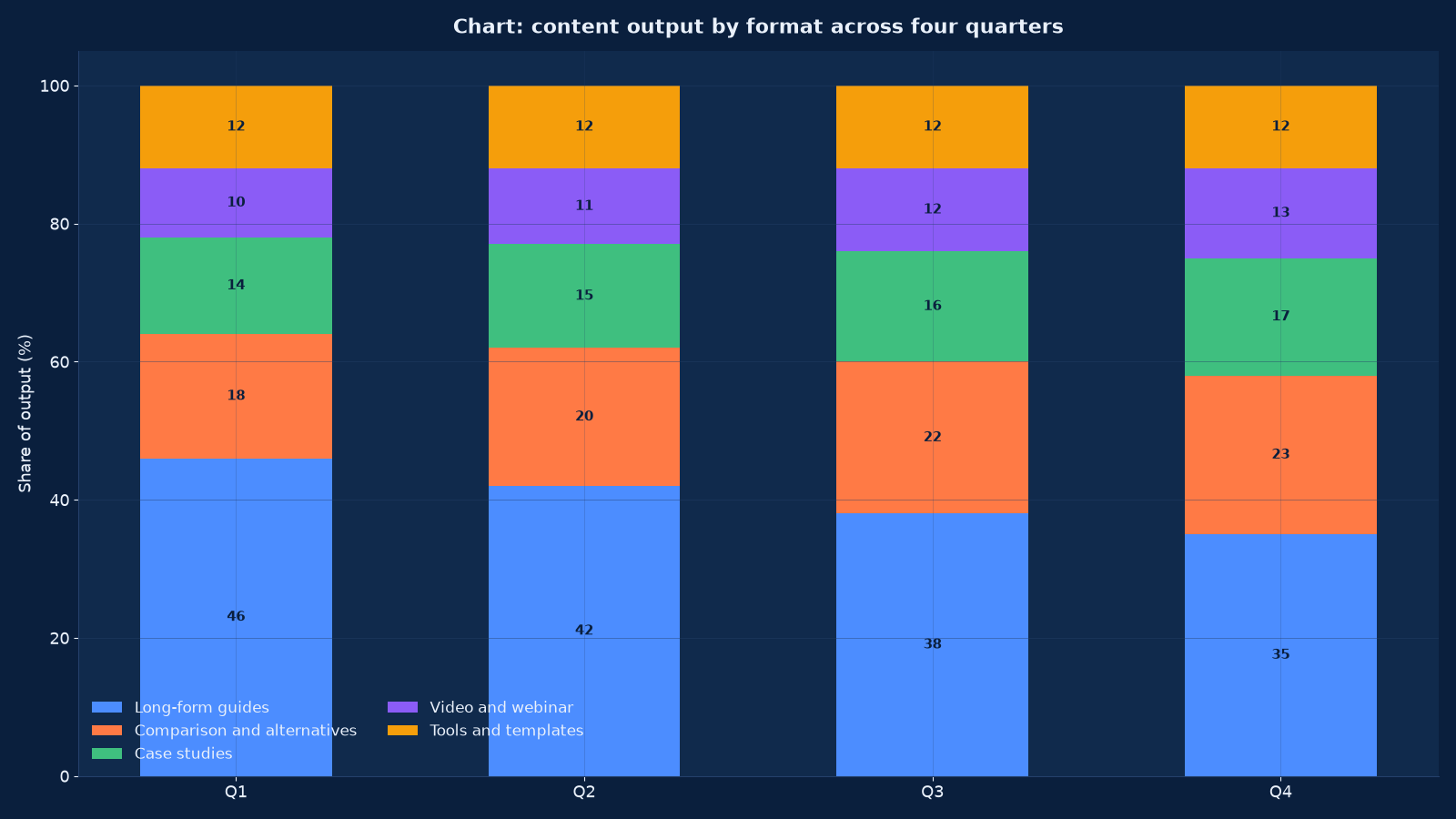
Chart values are an illustrative planning model based on typical UMC engagements and published industry benchmarks. They are not a guarantee of results on any specific project.
A content programme is an editorial operation with a commercial objective, and it fails in the same way operations fail: no brief, no owner, no standard, no review. The businesses that get results from content are not the ones publishing most. They are the ones whose every article was written against a documented search intent, by a named author, with a next step attached, and reviewed a year later.
Content marketing strategy at Unified Management Consulting covers the programme end to end: a content and search audit, topic clusters mapped to documented intent, a brief template that makes quality repeatable, author selection with expertise and authority signals, an editorial calendar with an approval flow that does not stall, production waves, internal linking, a refresh cycle that fights decay, distribution, and measurement in enquiries and pipeline rather than in pageviews. We run these for B2B technology and industrial sellers, professional services, e-commerce and retail, healthcare, education and hospitality, and for businesses whose content has been published for years without a brief behind any of it.
The engagement is built around the brief rather than around the writing. Almost every content problem we are asked to fix — articles that rank and do not convert, articles that contradict each other, articles nobody can update because nobody knows what they were for — traces back to content produced without a document that stated the intent, the audience, the argument and the next step. Figure 2 shows the effect of installing that discipline: briefs with a documented search intent rise from 26 to 94 per cent, and articles ranking in the top ten rise from 9 to 41 per cent across three quarters.
What This Service Actually Covers
The service covers strategy, production systems and measurement. It is delivered as a fourteen-week build followed by a standing programme, or as a strategy-and-systems engagement where the client’s team writes to our briefs.
| Component | What we do | What you keep | Duration |
|---|---|---|---|
| Content and search audit | Every existing page classified by intent, performance and condition | A register that says what to keep, merge, refresh or retire | 1–2 weeks |
| Topic clusters and intent map | Clusters built around a documented search intent, with the pillar and supporting pages defined | A map that prevents two articles competing for one query | 2–3 weeks |
| Brief template | A brief per article: intent, audience, argument, evidence, structure, next step | A template that makes quality repeatable by any writer | 1 week |
| Authors and expertise | Author selection, credentials, bylines and review roles | An author register with the expertise behind each cluster | 1 week |
| Editorial calendar | A rolling calendar with waves, owners and an approval flow | A plan that survives a busy quarter | Ongoing |
| Production | Writing, editing, design, data and review against the brief | Published work that matches the brief it was written against | Ongoing |
| Internal linking | A linking rule per cluster, applied at publish and at refresh | A structure where authority flows to the pages that need it | Ongoing |
| Refresh cycle | Decay detection and a scheduled refresh with a documented change log | A library that does not rot | Ongoing |
| Distribution | Email, social, sales enablement and partner routes per article | A distribution step inside the calendar rather than after it | Ongoing |
| Measurement | Rankings, traffic, engagement, enquiries and pipeline per cluster | A monthly pack that names which cluster is paying | Monthly |
The audit is the component clients most often want to skip and most often regret skipping. Without it the programme adds articles to a library that already contains three pieces competing for the same query, and the new work cannibalises the old.
Why Content Programmes Produce Output and Not Results
| Symptom | The underlying cause | The fix |
|---|---|---|
| Articles published every week, enquiries unchanged | No documented intent, so the articles answer questions nobody is asking commercially | An intent map, and a rule that every brief states the commercial job of the article |
| Traffic grows and rankings fall | Duplicate and overlapping articles competing with each other | A cluster model with one page per intent, and merges where the audit finds overlap |
| Content that ranks but does not convert | No next step in the brief, and no offer matched to the stage | A next step per article, matched to the intent stage it serves |
| Nobody can update an old article | No brief, no owner and no change log | An owner per cluster and a change log per refresh |
| Articles contradict each other | No editorial standard and no review | A review role with authority to reject, and a claims register |
| A year’s output and no case studies | The easiest format chosen rather than the most persuasive | A mix target, as in Figure 1, with case studies scheduled deliberately |
| Writing that reads as though nobody knows the subject | An author with no expertise and no reviewer | Named authors with credentials, and a subject expert reviewing before publish |
| Content that search engines summarise but users never visit | Articles written to answer a question in one sentence, with nothing worth clicking for | Depth, original data and a reason to visit rather than a reason to be quoted |
Search Intent and the Cluster Model
A cluster is one commercial subject with one pillar page and several supporting pages, each serving a distinct intent. The model exists to prevent the two failures that ruin most libraries: cannibalisation and orphaning.
| Intent type | What the searcher wants | The page that serves it | The next step |
|---|---|---|---|
| Informational | To understand a problem or a concept | A guide or explainer, deep and current | A related tool, template or comparison |
| Commercial investigation | To compare options and narrow a choice | A comparison or alternatives page, honest about limitations | A case study or an assessment offer |
| Transactional | To buy or enquire now | A service or product page with the terms stated | The enquiry form or the booking path |
| Navigational | To reach a specific brand or page | The brand page, with the route obvious | The most useful next page, not the home page |
| Local | To find a provider near them | A location page with real coverage and contact detail | A call or a direction request |
| Problem-led | To fix something that has broken | A troubleshooting page that solves it, then names the deeper cause | A service that addresses the cause |
| Peer-validation | To see whether somebody like them succeeded | A case study with numbers and a named situation | A conversation offer |
- One page per intent. Two pages serving one query split the signals and neither ranks.
- Every supporting page links to its pillar, and the pillar links to every supporting page, with descriptive anchor text rather than “read more”.
- Each cluster has one owner who is accountable for its performance and its refresh.
- The cluster map is reviewed quarterly, because search behaviour and the product both move.
- Cannibalisation is checked before publishing, not diagnosed six months later.
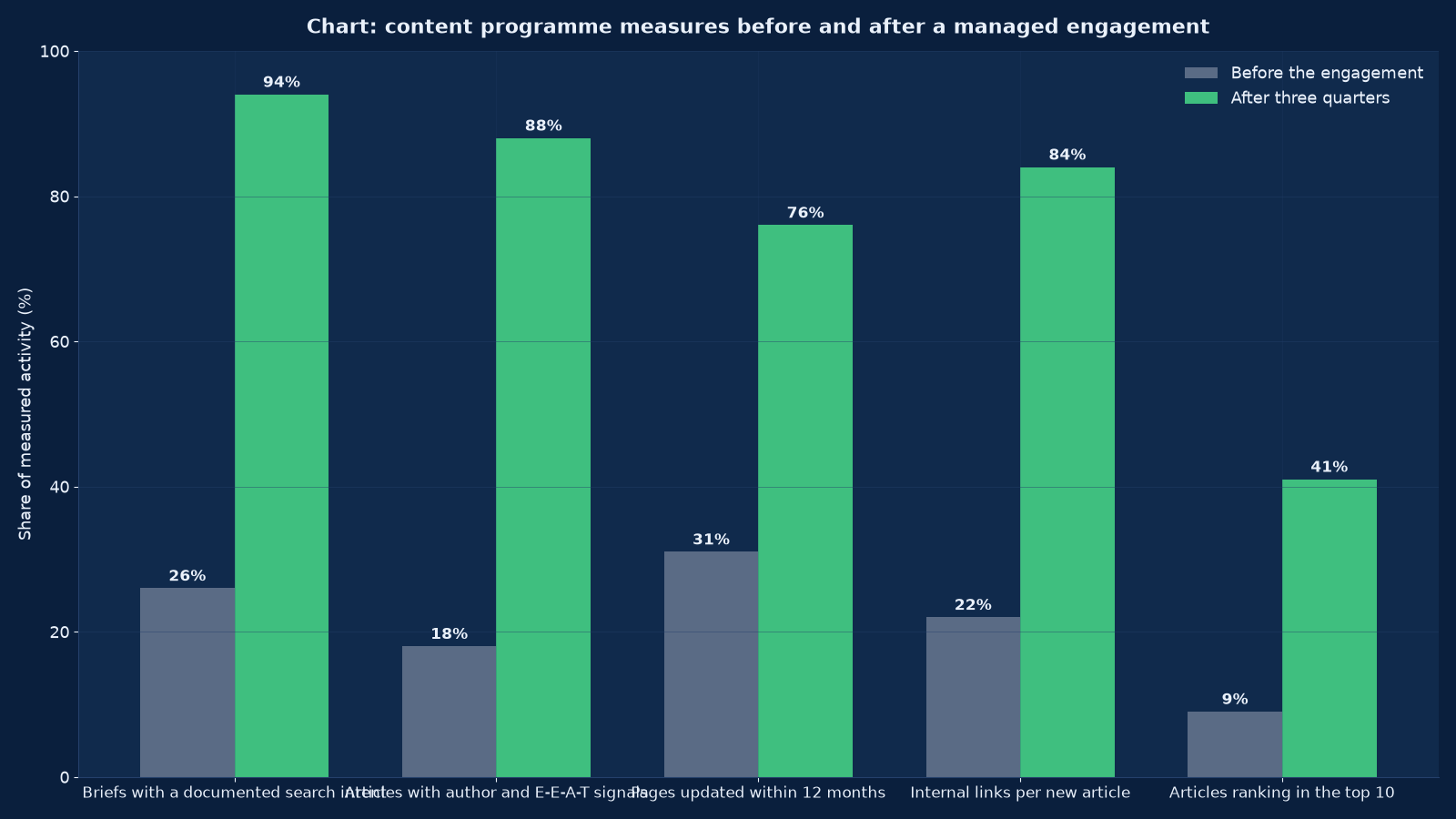
Chart values are an illustrative planning model based on typical UMC engagements and published industry benchmarks. They are not a guarantee of results on any specific project.
The Brief: the Artefact That Decides Quality
| Brief field | What it must state | The failure it prevents |
|---|---|---|
| Search intent | The query or queries served, the intent type and what the searcher is trying to do | An article that answers a question nobody asked |
| Audience and stage | Who reads it and where they are in the decision | Content pitched at the wrong level of familiarity |
| The argument | The position the article takes, in one sentence | A survey of the topic with no point of view |
| Evidence required | The data, examples, quotations or original research that supports it | Assertions with nothing behind them |
| Structure | The sections, the order and what each must accomplish | A writer inventing a structure that suits them rather than the reader |
| What must not be claimed | Restricted claims, competitor statements and anything requiring verification | A legal or reputational problem published at scale |
| Next step | The single action the reader is offered at the end | Traffic that reads and leaves |
| Internal links | The pillar and the supporting pages to link, with anchor text | An orphaned article that ranks and passes nothing on |
| Author and reviewer | Who writes it and who verifies the subject matter | Content with no expertise behind it and nobody accountable |
| Refresh date | When the article is reviewed, set at brief stage | A library that decays silently |
In Figure 2 the share of briefs with a documented search intent rises from 26 to 94 per cent. That single measure is the best available predictor of the rest, because a writer working from a complete brief produces work that a reviewer can judge, and a reviewer who can judge it can improve it.
Authors, Expertise and Authority Signals
| Element | Standard | Why it matters |
|---|---|---|
| Named author | A real person with a biography and a photograph | Anonymous content cannot carry expertise, and readers know it |
| Credentials | The qualification or experience that entitles the author to the subject | The difference between an opinion and an assessment |
| Subject reviewer | A second named person who verifies the technical claims | Accuracy at scale, and a route to correct an error quickly |
| Author page | A page listing the author’s work, role and credentials | A verifiable identity rather than a byline |
| First-hand experience | Where the article describes work, the work is the client’s own | The signal that generic content cannot manufacture |
| Original data | Numbers from the business’s own engagements, surveys or measurements | A reason for anyone to link to or cite the page |
| Currency | A published date and a reviewed date, both accurate | Readers and search systems both discount stale material |
| Corrections | A stated process, with corrections logged on the page | Trust survives an error; it does not survive a silent edit |
Editorial Calendar, Waves and the Approval Flow
| Element | Design | The bottleneck it removes |
|---|---|---|
| Waves | Content produced in batches by cluster rather than one article at a time | Research repeated per article and quality varying by week |
| Calendar depth | A rolling twelve weeks, with the next quarter sketched | A plan that cannot survive a busy month |
| Approval stages | One approver per stage: brief, draft, subject review, publish | A draft circulating between four people who each want a change |
| Approval windows | A stated period per stage, with a default pass on silence | Content held indefinitely by somebody who is merely busy |
| Capacity honesty | Volume set against the real hours available, including review | A calendar that is permanently behind and permanently apologetic |
| Dependencies | Design, data, legal and customer permissions scheduled into the wave | An article finished and waiting for a screenshot for three weeks |
| Distribution slots | Email, social and sales enablement booked at planning time | Publishing that nobody hears about |
| Refresh slots | A fixed share of each wave reserved for updating existing pages | New content crowding out the library that already earns |
Internal Linking: the Multiplier Nobody Runs
| Rule | What it does | The check |
|---|---|---|
| Every new article links to its pillar | Passes authority to the page that carries the commercial intent | Counted per article; Figure 2 shows this rising from 22 to 84 per cent |
| Every pillar links to its supporting pages | Distributes authority back out and gives the reader a path | Reviewed at each refresh, since new articles are added continuously |
| Descriptive anchor text | Tells the reader and the system what the destination is about | No “read more”, “click here” or bare URLs |
| Cross-cluster links where genuinely relevant | Connects related subjects without diluting the cluster | Justified by the argument, not by a linking quota |
| Orphan detection | Finds pages with no internal links pointing at them | Run monthly; an orphan is a page that cannot rank |
| Depth control | Keeps important pages within a few clicks of a hub | Checked against the site structure, not assumed |
| Anchor consistency | Avoids ten different anchors for one destination in one cluster | Reviewed at refresh |
| Link maintenance on refresh | Fixes links to retired or merged pages | Part of the refresh checklist, since a broken internal link is a lost path |
Internal linking is the cheapest improvement available in content marketing and the one most often skipped, because it produces no visible artefact. It is a rule applied at publish and re-applied at refresh, and in our programmes it accounts for more ranking movement than any single on-page change.
Content Decay and the Refresh Cycle
| Decay signal | What it indicates | The refresh action |
|---|---|---|
| Ranking fall with stable traffic elsewhere | The page has been overtaken on depth or currency | Expand the sections the newer pages cover better, and update the data |
| Traffic fall with stable ranking | The query’s demand has changed, or the snippet lost the click | Re-examine the intent and rewrite the title, description and opening |
| Rising bounce on an old article | The content no longer answers what the searcher now wants | Rewrite against the current intent, and merge if a newer page covers it |
| A factual claim now wrong | The subject moved | Correct it, log the correction and update the reviewed date |
| A screenshot or example showing an old interface | The article visibly dates | Replace the asset; readers judge currency visually before they read |
| Links pointing to retired pages | The library has drifted | Repoint or remove, and check the cluster’s link structure |
| No refresh in over twelve months | The page is unowned | Assign an owner or retire the page deliberately |
In Figure 2 the share of pages updated within twelve months rises from 31 to 76 per cent. A refresh is usually cheaper and faster than a new article and frequently outperforms one, because the page already has authority, links and a ranking history to build on.
The Fourteen-Week Build
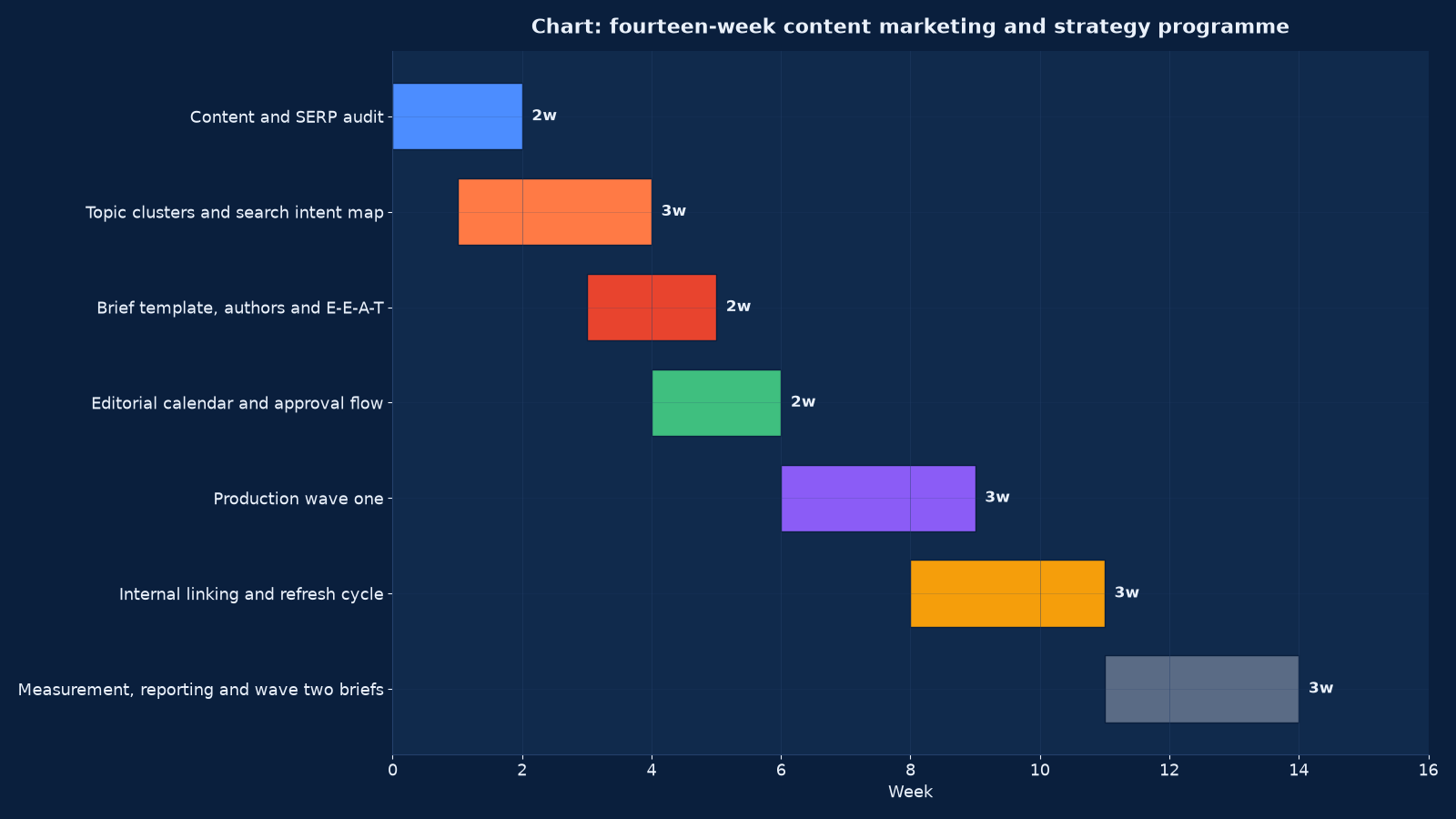
Chart values are an illustrative planning model based on typical UMC engagements and published industry benchmarks. They are not a guarantee of results on any specific project.
| Weeks | Workstream | Gate to pass |
|---|---|---|
| 1–2 | Content and search audit | Every page classified, with keep, merge, refresh and retire decisions recorded |
| 2–4 | Topic clusters and intent map | Clusters defined with one page per intent, owners assigned, cannibalisation checked |
| 4–5 | Brief template, authors and expertise | A template in use, an author register with credentials, and a reviewer role defined |
| 5–6 | Editorial calendar and approval flow | A twelve-week calendar loaded with waves, owners, approval windows and distribution slots |
| 7–9 | Production wave one | The first wave published against briefs, with internal links applied |
| 9–11 | Internal linking and refresh cycle | Orphans resolved, pillar links complete, and the first refreshes shipped with change logs |
| 12–14 | Measurement, reporting and wave two | Per-cluster reporting live, and wave two briefed from what wave one produced |
Fourteen weeks builds the system and proves it with one wave. The following quarters are what produce the movement in Figure 2, because content performance compounds slowly and a programme judged at week fourteen is being judged before it has published enough to measure.
Measurement: From Rankings to Pipeline
| Measure | Definition | What it tells you |
|---|---|---|
| Briefs with documented intent | Share of published work written against a complete brief | Whether the discipline is real |
| Indexation and coverage | Pages indexed against pages published | Whether the library is visible at all |
| Rankings per cluster | Positions for the cluster’s queries, weighted by demand | Which clusters are working, rather than which articles |
| Organic traffic per cluster | Sessions attributed to the cluster’s pages | Demand captured, separated from the site’s other traffic |
| Engagement | Time on page, scroll depth and internal clicks | Whether the article answers the question it was written for |
| Featured and summarised presence | Appearance in answer boxes and AI summaries, with the click behaviour alongside | Whether visibility is converting into visits or being consumed on the results page |
| Enquiries attributed to content | Enquiries with a content page as the entry or a substantial path step | The commercial result, and the number that should head the report |
| Assisted pipeline | Opportunities where content appears in the path | Content’s contribution to deals it did not close |
| Refresh performance | Ranking and traffic change after a refresh | Whether refreshing is a better investment than publishing |
| Cost per attributed enquiry | Programme cost over attributed enquiries | Comparability with paid channels, over a longer horizon |
We report per cluster rather than per article. An article-level report flatters the pieces that were easy to write and hides the clusters that are carrying the programme, and it makes the refresh decision impossible because there is no unit to compare against.
Distribution: What Happens After Publishing
| Route | How it is used | The discipline |
|---|---|---|
| The article sent to the segment it was written for, not to the whole list | One article per send, with a reason for that segment to read it | |
| Social | Cut into platform-native posts: a quote, a data point, a short video, a document | Native formats, not a link with a caption |
| Sales enablement | Given to sales with a note on when to send it and to whom | Articles written with a forwarding use in mind |
| Newsletter and resource library | Filed where a visitor can find the rest of the cluster | A structure that matches the clusters, not the calendar |
| Partner and syndication | Shared with partners whose audience matches, with canonical handling agreed | Canonical and attribution terms settled before syndication |
| Community and forums | Answered with the article as a reference where it genuinely helps | Contribution first; a link dropped without an answer damages the brand |
| Paid amplification | The articles that already earned engagement promoted to a proven audience | A test allocation per article, scaled on cost per result |
Content for Different Business Models
| Model | What the audience reads | The formats that pay | The measurement horizon |
|---|---|---|---|
| B2B technology and industrial | Specification, comparison, implementation detail and proof | Long-form guides, comparison pages, case studies with numbers, technical documents | Two to four quarters, because the cycle is long |
| Professional services | Analysis, regulation, risk and what a good decision looks like | Explainers with a named author, client stories, briefings | Two to three quarters |
| E-commerce and retail | Buying guidance, comparison, use and care | Buying guides, product-led articles, video demonstration | One to two quarters |
| Healthcare and clinics | Condition, treatment, cost and what the visit is like | Factual explainers reviewed by a clinician, process pages | One to two quarters, with claims kept strictly factual |
| Education | Outcomes, entry requirements, funding and student experience | Course guides, outcome data, student stories | Aligned to the intake calendar rather than to quarters |
| Hospitality | Occasion, place, price and the experience | Visual guides, local and seasonal content, guest stories | Seasonal |
| SaaS and apps | Problem, workflow, integration and alternatives | How-to documentation, comparison and alternatives pages, templates | One to two quarters, with activation as the intermediate measure |
AI-Assisted Production: Where It Helps and Where It Fails
| Use | Verdict | The condition |
|---|---|---|
| Research summarisation | Genuinely useful | Every claim verified against a primary source before it enters a brief |
| Outline and structure drafts | Useful as a starting point | The brief, not the model, decides the structure |
| First-draft prose | Useful for commodity sections, risky for arguments | A named author revises and owns it; the byline is not decorative |
| Original analysis and opinion | Not substitutable | This is the part that earns the ranking, the link and the enquiry |
| Data and statistics | Unreliable without verification | Never published from a model’s recall; sourced or dropped |
| Bulk page generation | Actively harmful | Scaled thin pages are identified and discounted, and they damage the rest of the library |
| Meta descriptions and titles | Useful in volume | Reviewed against the intent, since the model optimises for plausible rather than for accurate |
| Translation and localisation | Useful with review | A native reviewer for anything published in a market the business serves |
Our position is that AI changes the cost of production and not the requirement for expertise. A programme that uses it to produce more articles without briefs, authors or review produces more of the problem in Figure 2’s left-hand column, faster.
Governance and Handover
| Cadence | Activity | Owner | Output |
|---|---|---|---|
| Weekly | Production status, approval windows, distribution slots | Editorial lead | A calendar that is actually met |
| Monthly | Cluster performance, orphan and broken-link check, refresh candidates | Programme owner | A ranked refresh list and a linking fix list |
| Quarterly | Cluster map review, cannibalisation check, mix review against Figure 1 | Programme owner with the client | A revised map and a corrected format mix |
| Annually | Full audit, author register review, brief template review | Programme owner | A library classified again, with retirements decided |
Handover delivers the audit register, the cluster map with owners, the brief template, the author register, the calendar process, the linking rules, the refresh checklist and the reporting pack, with training on each. A content programme that depends on an agency’s judgement rather than on documented standards stops when the retainer does.
Failure Modes We Are Called In To Fix
| What we find | Why it happened | What we do |
|---|---|---|
| Hundreds of articles, no enquiries | No intent documentation and no next step | An audit, a cluster map, and next steps added to the pages that already rank |
| Two articles ranking for the same query | No cannibalisation check before publishing | Merge or differentiate, then re-map the cluster |
| A library nobody can update | No owners, no briefs and no change log | An owner per cluster, briefs reconstructed for the top pages, and a refresh cycle started |
| Content written by people who do not know the subject | Volume bought at the lowest price | An author register with credentials, and a subject reviewer per cluster |
| Rankings lost after a platform update | Thin, undifferentiated content at scale | A depth and originality review, with retirement where the page earns nothing |
| Internal links pointing at retired pages | No link maintenance at refresh | An orphan and broken-link sweep, then the check added to the monthly cadence |
| Reporting in pageviews only | Nothing else was instrumented | Per-cluster enquiry attribution and an assisted-pipeline view |
| Every quarter spent on new articles | No refresh slots in the calendar | A fixed refresh share per wave, which usually outperforms the new work |
Content Marketing and the Rest of the Stack
Content supplies the substance every other channel distributes. We plan it with the channels and the measurement rather than as a standalone publishing activity.
- Search Engine Optimisation (SEO) Services — the technical and on-page layer that decides whether the library can be found at all.
- AI Engine Optimisation (AIEO) Services — how the same content is surfaced, quoted and cited by AI answer systems.
- Voice Search Optimisation Services — the question-shaped queries a guide cluster is well placed to answer.
- Analytics & Attribution (GA4) Services — the instrumentation that makes per-cluster enquiry attribution possible.
- Conversion Rate Optimisation (CRO) Services — the next step at the end of every article, tested rather than assumed.
- Email Marketing Campaign Services — the distribution route that reaches the segment an article was written for.
- LinkedIn Marketing Services — the B2B distribution and the author’s own voice alongside the brand’s.
- YouTube Advertising & Video Marketing Services — the video and webinar share of the mix in Figure 1.
- Influencer Marketing Services — expert and creator voices where the subject needs a person rather than a brand.
- Website Strategy & Consulting Services — the site structure a cluster model has to be built into.
Evidence From Our Work
The engagements and writing below are published on this site, each described by the subject its own page documents. They are listed because content programmes are usually commissioned by a business that has published consistently for years and cannot connect any of it to revenue.
- Content marketing execution plan — the production system behind a calendar: briefs, waves, approval windows and the capacity honesty that makes the plan survive a busy quarter.
- Keyword research for businesses: how to find the right keywords — the research that produces the intent map a cluster model is built from.
- Semantic keywords: what they are and how to find and use them — how a cluster is defined by subject coverage rather than by a list of phrases.
- E-E-A-T for SEO — the experience, expertise, authoritativeness and trust signals the author register and review roles exist to produce.
- Title tag rewrites: what an 8,000-page case study reveals — what happens when a large library’s metadata is rebuilt systematically rather than page by page.
- How to rank higher on Google — the on-page and structural factors a refresh cycle addresses.
- Targeted-impact link building: how to build links to the pages that matter — how the library earns the external authority its internal links then distribute.
- AI Overviews optimisation checklist — how visibility in an answer layer changes the click, and what a content programme should do about it.
- How to track your brand’s presence in AI search — the citation behaviour a content library either supports or does not.
- The SEO insight archive — further writing on search, structure and measurement.
Frequently Asked Questions About Content Marketing Strategy
How much content do we need to publish?
Enough to cover the clusters your buyers actually search, and no more. Volume is an output of the cluster map rather than a target in itself. A programme publishing weekly with no intent documentation produces the left-hand column of Figure 2; one publishing monthly against briefs with owners and refresh dates produces the right-hand column.
How long until content produces enquiries?
Two to four quarters for most B2B programmes, one to two for transactional categories. In Figure 2 the share of articles in the top ten rises from 9 to 41 per cent across three quarters, and it moves last because it depends on everything else moving first. A programme judged at week fourteen is being judged before it has published enough to measure.
Should we refresh old content or write new?
Both, with a fixed refresh share in every wave. A refresh is usually cheaper and faster than a new article and often outperforms one, because the page already has authority, links and a ranking history. In Figure 2 the share of pages updated within twelve months rises from 31 to 76 per cent.
What is a topic cluster and why does it matter?
One commercial subject with a pillar page and supporting pages, each serving a distinct intent, linked to each other with descriptive anchors. It matters because the alternative is several articles competing for one query, splitting the signals so that none of them ranks, plus orphaned pages that no internal link reaches.
Do we need named authors?
Yes. A named author with credentials and a biography is what makes expertise verifiable, and anonymous content cannot carry it. In Figure 2 articles with author and expertise signals rise from 18 to 88 per cent, and the reviewer role is what keeps the claims accurate at volume.
How does internal linking help?
It distributes authority to the pages that carry the commercial intent and gives readers a path through the cluster. It is the cheapest improvement available and the most often skipped, because it produces no visible artefact. We count links per article: in Figure 2 that measure rises from 22 to 84 per cent.
Can AI write our content?
It can assist with research summarisation, outlines, commodity sections, titles and descriptions, provided every claim is verified against a primary source and a named author revises and owns the result. It cannot substitute for original analysis, first-hand experience or the argument that earns the link and the enquiry. Bulk generation is actively harmful.
What mix of formats should we produce?
One driven by what your buyers read, then corrected by measurement. In Figure 1 long-form guides fall from 46 to 35 per cent of output across a year while comparison pages, case studies and video rise, because the reporting showed which formats produced enquiries rather than impressions.
How do we measure content when attribution is unclear?
Per cluster: rankings weighted by demand, organic sessions, engagement, enquiries attributed to a content page as entry or as a substantial path step, and assisted pipeline. We report attributed enquiries rather than pageviews, and we state plainly where attribution is directional rather than precise.
What happens to our existing content?
It is audited and classified: keep, merge, refresh or retire, with the decision recorded. Most libraries contain overlapping articles competing for the same query and pages that have not been touched in years. Merging and retiring is uncomfortable and it is usually where the ranking recovery comes from.
Can our internal team write it?
Yes, and often better than an external writer, because the expertise is internal. What the team needs is the brief template, the cluster map, the author register, the approval flow and the refresh cycle — which is exactly what the strategy-and-systems engagement delivers.
What does it cost?
Quoted against the number of clusters, the production volume and whether writing is included or the client’s team writes to our briefs. A fourteen-week build is a fixed fee; the standing programme is monthly and banded by volume. There is no charge per article, because that incentive produces the volume problem this page exists to solve.