
Chart values are an illustrative planning model based on typical UMC engagements and published industry benchmarks. They are not a guarantee of results on any specific project.
Every migration loses something. The discipline is deciding in advance what you are willing to lose, measuring it, and making sure the list does not include the things that pay for the project.
Website migration and replatforming is the engineering and governance discipline of moving a live digital estate from one platform, structure, domain, hosting environment or content model to another without losing the demand, data, function or trust it has accumulated. Unified Management Consulting runs migrations for organisations moving off end-of-life platforms, consolidating acquired brands, changing domains after a rebrand, leaving a vendor, upgrading a CMS major version, or adopting a new commerce or content architecture — on estates from a few hundred pages to several hundred thousand, in India and internationally.
We are usually brought in for one of two reasons: the migration is planned and somebody wants it to go right, or it has already happened and organic demand, forms or data have gone missing. The second case is more expensive and less pleasant, and it is almost always traceable to the same four omissions — no inventory, no redirect map, no rehearsal and no parity check. This engagement exists to make those four things unavoidable.
🚚 Website Migration & Replatforming — Quick Summary
| Component | What We Deliver |
|---|---|
| Migration assessment and strategy | What is being moved, what is being retired, which of the four migration types applies, and what the risk profile and rollback position look like. |
| Full estate inventory | Every URL, template, content item, media asset, form, integration, redirect, tag and subdomain enumerated and counted — not sampled, and not taken from the sitemap alone. |
| URL and redirect mapping | One-to-one mapping for every URL carrying demand, with named exceptions, and a rule for the long tail rather than a bulk redirect to the homepage. |
| Content model and template mapping | Old template to new template, old field to new field, with the transformation rules and the business sign-off on every ambiguous case. |
| Data and media migration | Products, customers, orders, documents, media and metadata extracted, transformed, loaded and reconciled with control totals. |
| Functional parity specification | Every behaviour the estate currently has — forms, search, filters, logins, payments, downloads, calculators — written down and tested, so nothing is discovered missing after launch. |
| Technical and SEO parity | Metadata, canonical rules, structured data, hreflang, robots, XML sitemaps, indexation control and internal links verified page by page on the templates that carry demand. |
| Integration and third-party migration | Analytics, tag management, advertising pixels, payment gateways, chat, CRM connectors, email services and API consumers repointed and verified. |
| Dry-run migrations and rehearsals | At least two full rehearsals against production copies, timed, with a reconciliation report and an exception list per run. |
| Staged cutover and rollback | A cutover runbook with a named decision maker, a decision time, verification steps per critical journey, and a rollback path that has been tested rather than written. |
| Hypercare and monitoring | Elevated monitoring of availability, errors, forms, transactions, indexation and organic demand, with daily reconciliation for the first fortnight. |
| Post-migration verification and reporting | A closure report against the baseline: redirects verified, coverage and clicks tracked, functional parity confirmed, and the losses that were accepted documented as accepted. |
The four kinds of migration, and why they need different plans
Migration is treated as one activity in most organisations, and it is four. They differ in what is at risk, how long the work takes and what the rollback position is. Conflating them is why a domain change gets planned like a content refresh and loses half its demand.
| Type | What changes | Principal risk | Rollback position | Typical duration |
|---|---|---|---|---|
| Platform replatforming | The CMS, commerce engine or framework changes; URLs and content may be preserved | Functional and template parity: behaviours and rendering that existed and are silently absent; performance regression | Good — the old platform can usually be kept warm and DNS reverted | Twelve to twenty-four weeks |
| Restructure or re-architecture | URLs, information architecture and templates change on the same platform | Redirect coverage and internal link integrity; organic demand tied to URLs that no longer exist | Moderate — reversible if redirects have not been indexed and cached | Eight to sixteen weeks, usually alongside a strategy engagement |
| Domain or brand migration | The domain changes, sometimes with a rebrand, a merger or a country consolidation | Total demand transfer: every signal — links, brand queries, listings, email links, print material — must move or redirect | Weak once DNS and redirects propagate; the old domain must be retained for years | Ten to twenty weeks plus a long tail of third-party updates |
| Hosting or infrastructure migration | The server, cloud, region or delivery architecture changes; the application does not | Availability during cutover, DNS time-to-live handling, TLS certificates, database integrity, environment differences | Good — parallel running is usually possible and should be insisted on | Four to ten weeks |
Most real projects are a combination — a replatforming that also restructures, on a new domain, moving to a new host. That is the hardest configuration and the one where staging the changes rather than performing them simultaneously matters most. Where a client insists on a single big-bang change of all four, we record the risk in writing, price the contingency, and recommend the staged alternative with the evidence for it.
Why migrations go wrong
The failure modes are remarkably consistent, and almost none of them are technical surprises. They are omissions made under schedule pressure, each of which is cheap to prevent and expensive to repair.
| Failure | How it happens | What it costs | The control that prevents it |
|---|---|---|---|
| No complete inventory | The sitemap is used as the source of truth; pages excluded from it, subdomains, parameter URLs and orphan pages are never enumerated | Content disappears at cutover and is discovered by a customer or a search console report weeks later | A full crawl plus server logs plus the database, reconciled into one counted inventory |
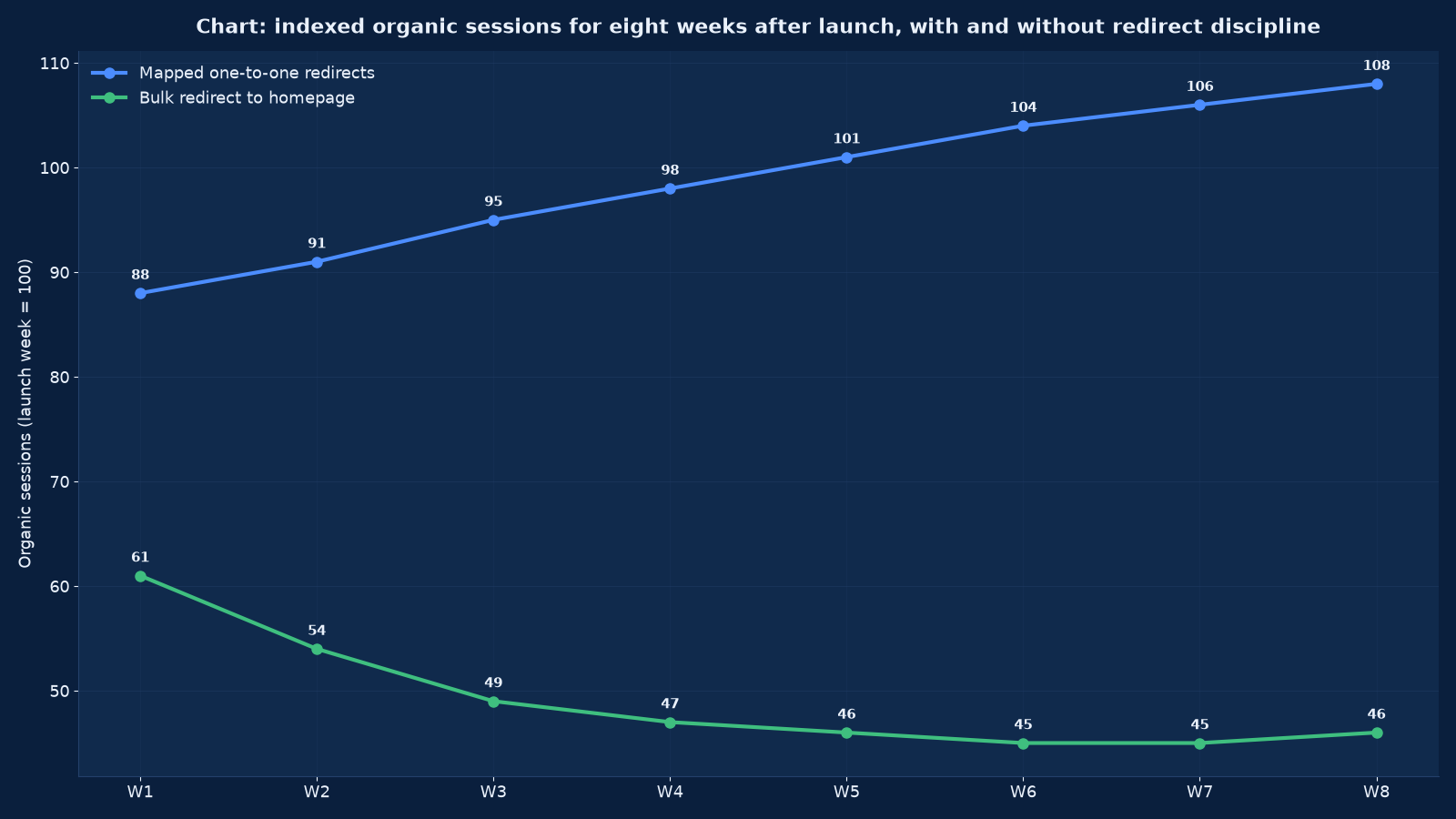
| Bulk redirect to the homepage | The redirect map is judged too much work in the final fortnight, so old URLs point at the root | The pattern in Figure 1: demand falls and does not recover, because a redirect to an unrelated page is a soft 404 in practice | A URL-level map reviewed against Search Console demand, treated as an acceptance criterion rather than a task |
| Redirect chains and loops | New redirects are added on top of historical ones from earlier migrations nobody documented | Link equity diluted, crawl budget wasted, and some URLs never resolving | A redirect audit of the existing estate before the new map is written, then a chain test after launch |
| Functional parity never specified | The project tests the new platform’s features rather than the old platform’s behaviours | A calculator, filter, form, download, login or integration quietly stops working; revenue and support volume move before anyone notices | A parity specification written from the old estate and tested against the new one |
| Metadata and structured data lost | Titles, descriptions, canonical rules, schema and hreflang are not carried into the new templates | Rankings and click-through fall without any error appearing, because nothing is technically broken | A page-by-page parity check on the money templates, executed pre-launch and re-checked post-launch |
| No rehearsal | The migration scripts are run for the first time against production during the cutover window | A window that overruns, a cutover abandoned half-complete, or data corrupted with no verified restore | Two dry runs minimum against production copies, timed, with reconciliation reports |
| Third parties not repointed | Analytics, tags, pixels, payment callbacks, CRM connectors, email service webhooks and API consumers still point at the old domain or old endpoints | Measurement goes dark, payments fail, integrations break, and attribution for the migration becomes impossible | A third-party register with an owner and a verification step per entry |
| Performance regression | The new platform renders dynamically what the old one cached, or the theme ships unoptimised | Conversion falls, ad costs rise, and the migration is judged a failure for reasons unrelated to its purpose | Performance baselines captured pre-migration and budgets enforced pre-launch |
| No rollback path | Rollback is assumed rather than tested; DNS, database and content changes make it impossible | A failed cutover becomes a prolonged incident with no exit | A tested rollback procedure with a named decision maker and a decision time in the runbook |
| Nobody watching after launch | The project team disbands on launch day; monitoring is business as usual | Problems are found by customers and by monthly reports rather than by the people who caused them | A defined hypercare period with daily reconciliation and elevated on-call cover |
Every one of these controls is cheap in week two and expensive in week eleven. That is the entire argument for involving somebody independent at the start rather than at the post-mortem.
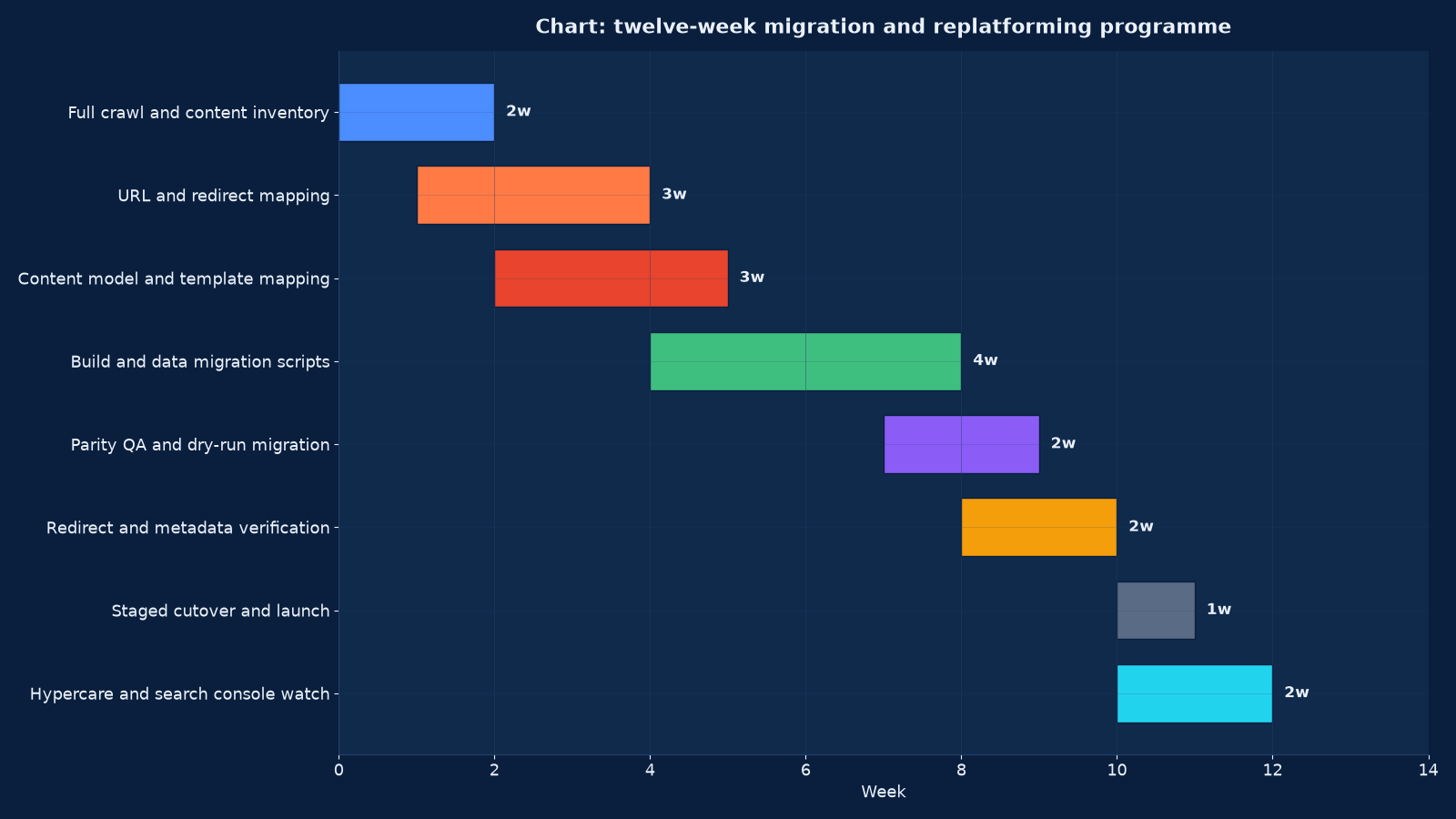
Chart values are an illustrative planning model based on typical UMC engagements and published industry benchmarks. They are not a guarantee of results on any specific project.
The inventory: counting everything before moving anything
The inventory is the foundation of every other control, and it is the deliverable clients most often believe is already done. It is almost never complete, because a sitemap describes what the site intends to expose, not what exists.
| Source | What it reveals | What it misses | How we reconcile |
|---|---|---|---|
| Full crawl of the live estate | Reachable URLs, templates, status codes, metadata, internal links, redirects already in place, assets and their sizes | Pages that are unreachable by link — orphans, parameter variations, paginated deep pages, content behind filters | Union with the database export and the log analysis |
| Database or CMS export | Every content record including unpublished, scheduled, expired and orphaned items, plus revisions and taxonomy | Anything generated at runtime, and any content stored outside the CMS | Compared against the crawl to find records with no URL and URLs with no record |
| Server and CDN logs | What is actually requested — including by crawlers, scrapers, old links and campaigns that ended years ago | Requests that never reached the origin because a cache served them | Used to find demanded URLs that neither the crawl nor the database shows |
| Search Console and analytics | URLs with impressions, clicks and sessions — the demand map that prioritises the redirect effort | Anything with no search or analytics presence, which may still matter contractually or legally | Joined to the inventory so every URL carries a demand value |
| Existing redirect rules | Historical redirects from previous migrations, plugins, server configuration and CDN rules | Rules that are shadowed, duplicated or no longer reachable | Audited for chains and loops before the new map is designed |
| Subdomains and separate applications | Blogs, portals, help centres, staging environments, campaign microsites and legacy systems on the same domain | Nothing, if asked — but they are routinely forgotten because they are owned by another team | A DNS and certificate review, which finds everything that resolves |
| Media and file assets | Documents, downloads, images and video, including assets referenced from email, print and third-party sites | Assets linked from outside the estate, which will break silently | A hotlink and referer analysis from logs, plus a permanent redirect rule for asset paths |
| Third-party integrations | Analytics, tags, pixels, payment callbacks, CRM connectors, email webhooks, API consumers, marketplace feeds | Integrations configured by a vendor who has left, discoverable only in logs or in an invoice | A register with a named owner and a verification step, built from logs and configuration review |
The output is a single counted inventory: every URL with its template, status, demand, owner and migration verdict. It is the document the redirect map, the parity specification and the reconciliation report are all derived from, and it is what makes “we moved everything” a checkable statement rather than an assurance.
The redirect map: the highest-value artefact in the project
Redirects are where organic demand is preserved or forfeited. The rules are simple, the discipline is not, and the work is usually underestimated because it scales with estate size rather than with project complexity.
| Rule | What it means | Why |
|---|---|---|
| One-to-one wherever demand exists | Every URL with impressions, clicks, sessions, inbound links or a contractual reference maps to the single closest successor | A redirect to a relevant successor transfers the signal; a redirect to an unrelated page does not, whatever the status code says |
| 301 permanent for real moves | Permanent moves use 301; temporary states use 302 and are cleaned up | Search engines treat them differently, and a long-lived 302 leaves the old URL indexed |
| One hop only | Old URL to final URL directly; never old to intermediate to final | Each hop costs crawl budget, latency and signal, and chains accumulate silently across migrations |
| No bulk redirect to the homepage | The homepage redirect is reserved for URLs with genuinely no successor, and even then a section page is better | It is the mechanism behind the collapse in Figure 1: users and crawlers land somewhere unrelated, and the demand is not transferred |
| Retired content handled explicitly | Pages being retired get a documented decision: redirect to the closest relevant page, return 410 where the removal is deliberate and permanent, or keep with a canonical | An undocumented 404 on a page with inbound links is a wasted asset and a poor user experience |
| Mapped against demand, not against convenience | The map is prioritised by Search Console and analytics demand, and by inbound link value | Effort goes where the traffic is, and the long tail gets a rule rather than individual attention |
| Patterns for generated URLs | Parameter, pagination, filter and faceted URLs are handled by rule at server or CDN level | Enumerating generated URLs is impossible; a pattern rule is testable and complete |
| Asset and download paths preserved | Document, image and download URLs keep working, permanently, with redirects that never expire | They are linked from emails, printed material, other sites and internal documents nobody will update |
| Verified after launch | Every entry in the map is tested against the live estate, with chains and loops checked, and coverage re-examined in Search Console | A map that was written correctly and deployed incorrectly produces the same outcome as no map at all |
We deliver the map as a versioned artefact with the demand value attached to each row, so the client can see what was prioritised and why. Where a client’s internal team insists on a shortcut — usually in the final two weeks, usually for the long tail — we record the decision, the affected URLs and the demand at stake in writing. That record is what turns an argument into a decision.
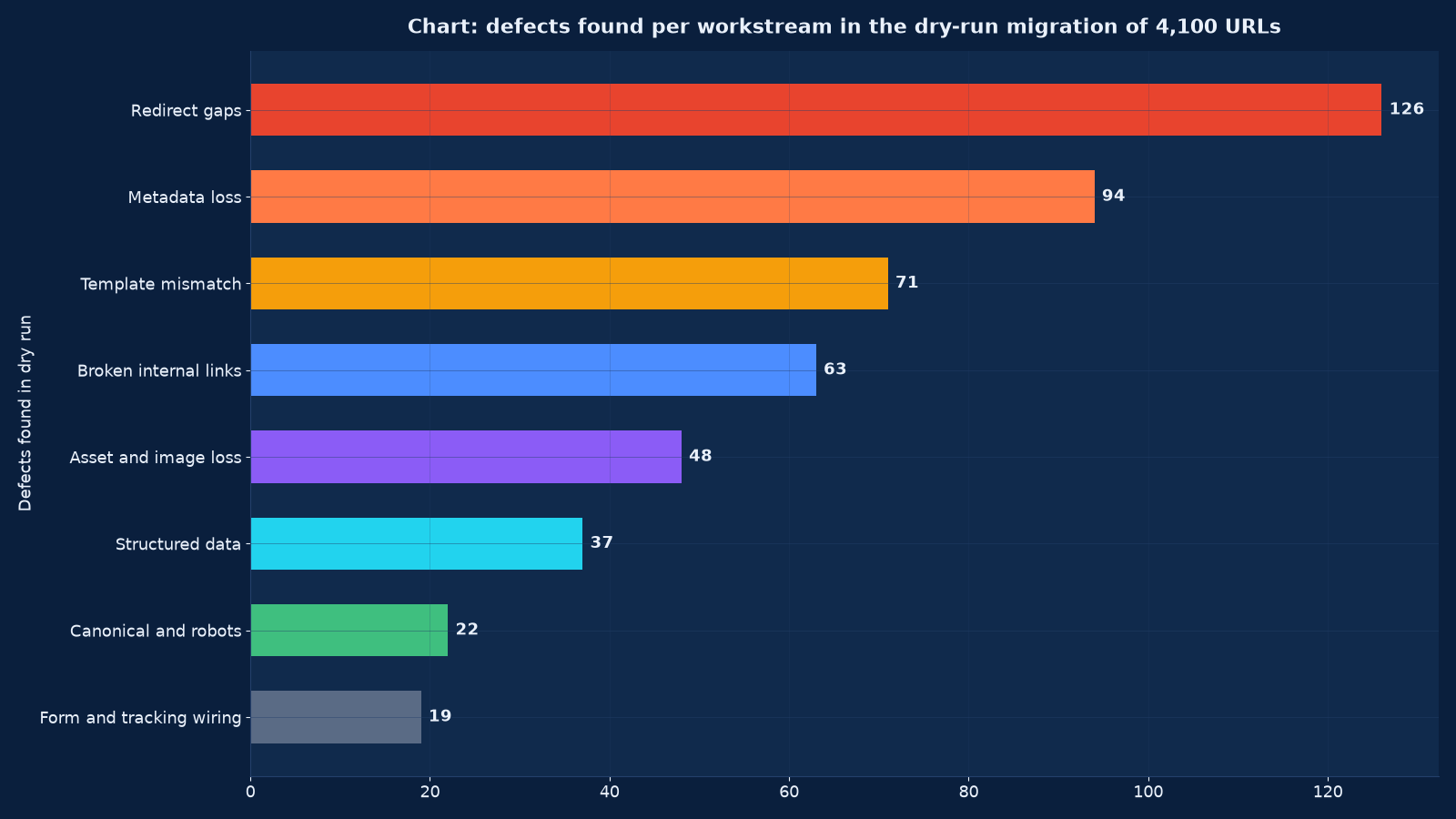
Chart values are an illustrative planning model based on typical UMC engagements and published industry benchmarks. They are not a guarantee of results on any specific project.
Functional and technical parity
Parity is the discipline of listing what the estate does today and proving the new estate does it too. It is separate from testing the new platform, and it is the part most often skipped because the new platform’s own features are more interesting to test.
| Parity area | What we enumerate and test | Common silent loss |
|---|---|---|
| Forms and submissions | Every form, its fields, validation, destination, notification recipients, auto-response, spam protection and storage location | Notification recipients from three years ago still configured, or submissions stored but no longer emailed |
| Search and filtering | On-site search behaviour, facets, filters, sorting, result counts and zero-result handling | Filters that existed on the old platform and are absent on the new one, reducing findability without any error |
| Authentication and accounts | Registration, login, password reset, session behaviour, account data, order history and entitlements | Password hashes that cannot be migrated, forcing a reset campaign that is never planned |
| Commerce behaviours | Cart persistence, pricing, promotions, tax, shipping rules, payment methods, order states, refunds and returns | A promotion or shipping rule that lived in configuration and was never documented |
| Downloads and documents | Every downloadable asset, its URL, access control and the documents that link to it | Document URLs changing, breaking links in emails, printed material and other sites |
| Calculators, tools and interactive features | Anything that computes, quotes, compares or configures | A quoting tool rebuilt as a static page, with the commercial function quietly gone |
| Metadata and structured data | Titles, descriptions, canonical rules, robots directives, schema per template, hreflang and Open Graph | Structured data dropped during template mapping; no error appears, only a rich-result loss |
| Performance | Field metrics per template before and after, plus payload and request budgets | A dynamic new platform replacing a cached old one, with the regression blamed on the season |
| Accessibility | Conformance level of the old estate and the target for the new one, tested on the priority journeys | An accessible old platform replaced by a non-conforming new one, in a tender-bound organisation |
| Integrations and APIs | Every inbound and outbound interface, its consumer, contract, authentication and failure behaviour | An API consumer nobody knew about, discovered when it starts failing |
| Analytics, tags and measurement | Events, goals, conversions, pixels, server-side containers, dashboards and reports | Measurement going dark at cutover, so the migration’s own effect cannot be evaluated |
| Legal and consent | Cookie consent behaviour, privacy notices, data retention, and any statutory content that must remain available | Consent configuration not carried over, creating a compliance exposure at launch |
The parity specification is written from the old estate, not from the new platform’s feature list, and it is tested against the staging build before cutover. It is also the document that settles post-launch disputes about whether something was ever there.
Rehearsal: the control that decides the cutover
A migration that has been rehearsed twice is a routine operation. A migration that has never been run is a schedule with an intention. We treat the dry run as a deliverable with its own report, not as a step in somebody’s task list.
| Rehearsal element | What happens | What the report contains |
|---|---|---|
| Full data migration against a production copy | Every migration script runs end to end against a recent copy of production data, at production volume | Duration per stage, record counts per entity, failures and retries, and total window required |
| Redirect deployment and testing | The complete redirect map is deployed to the rehearsal environment and every entry tested, including pattern rules | Entries tested, entries failing, chains and loops detected, and the exceptions with owners |
| Parity test execution | The functional and technical parity specification is executed against the rehearsal build by testers who did not build it | Pass and fail per item, severity, and the defect list that must close before cutover |
| Reconciliation | Control totals compared between source and target: counts, financial totals, per-module totals, sampled records verified field by field | A signed reconciliation record with the variance explained per entity |
| Third-party repointing rehearsal | Analytics, tags, payment callbacks, webhooks and API consumers repointed to the rehearsal environment and verified | Verification status per integration, with the owner who confirmed it |
| Cutover runbook dry run | The runbook is executed literally, with the timings recorded and the roles staffed by the people who will perform them | Actual durations against planned, the steps that need rewriting, and the decision points clarified |
| Rollback rehearsal | The rollback procedure is executed for real in the rehearsal environment, from a deliberately failed cutover state | Rollback duration, data implications, and confirmation that the estate returns to a working state |
The defect profile in Figure 3 is typical of a first dry run on a 4,100-URL estate: 480 defects across eight workstreams, dominated by redirect gaps and metadata loss. A second dry run after remediation usually finds fewer than fifty, concentrated in the areas touched by the fixes. That trajectory — not a launch date — is what tells us a migration is ready.
Cutover, rollback and hypercare
Cutover is a runbook with named people, timed steps, verification checkpoints and a decision point. It is not a meeting. The rollback path is part of the runbook, with a named decision maker and a time by which the decision must be made.
| Phase | Activity | Verification | Decision |
|---|---|---|---|
| Pre-cutover | Content freeze agreed and enforced, final delta migration prepared, DNS time-to-live lowered in advance, certificates issued and tested, stakeholders briefed, support cover arranged | Freeze compliance checked; rehearsal defect list closed; rollback path re-confirmed as available | Go or no-go, taken by a named executive at a scheduled meeting, against published criteria |
| Cutover | Final delta data migration, redirect deployment, DNS or routing change, third-party repointing, cache and CDN purge, search console change-of-address where the domain moved | Every critical journey verified on production by somebody who did not build it; forms, payments, logins, downloads, search and one money template per class | Continue or roll back, against the criteria agreed pre-cutover and the verification results |
| Immediate post-cutover | Elevated monitoring: availability, error rates, form submissions, transactions, response times, indexation and crawl behaviour | Hourly checks for the first day; business transaction monitoring rather than infrastructure monitoring alone | Rollback window kept open for a defined period, with the criteria for closing it written down |
| Hypercare fortnight | Daily reconciliation of redirects, coverage, submissions, transactions and errors; rapid defect resolution; stakeholder reporting | Daily report against the pre-migration baseline, with variance explained | Exit hypercare only when the measures are stable, not when the calendar says so |
| Post-migration verification | Full redirect map re-tested, chains checked, Search Console coverage and demand tracked against baseline, parity specification re-executed on a sample | A closure report with the baseline comparison, the accepted losses and the residual actions | Project closure, or a remediation sprint with an owner and a date |
Two rules we do not bend. First, the rollback path stays available until the verification criteria are met, which means the old environment is kept warm and funded for the hypercare period. Second, cutover is not scheduled before a peak, a campaign, a statutory deadline or a Friday, whatever the internal pressure. Those two rules have prevented more incidents than any amount of testing.
Measuring the outcome against the baseline
A migration is judged on whether the estate still works and still earns, compared with a baseline captured before the work started. Capturing that baseline is a week-one activity, because after cutover the old numbers are no longer available anywhere except in a report nobody wrote.
| Measure | Baseline source | What good looks like after launch | What a problem looks like |
|---|---|---|---|
| Organic sessions and clicks | Analytics and Search Console, 16 months, per template class | A dip of up to roughly 10 to 15 per cent in week one, recovering to baseline within four to eight weeks and usually exceeding it | A fall beyond 20 per cent that does not recover by week four — the Figure 1 pattern |
| Indexed URL count and coverage | Search Console coverage and sitemap submission counts | Indexed count close to the intended estate size, with the retired URLs dropping out cleanly | A collapsing indexed count, or the old URLs remaining indexed alongside the new ones |
| Redirect health | The map, plus a crawl of the live estate after launch | Every mapped URL returning a single 301 to the intended successor, with no chains or loops | 404s on URLs that carried demand, or chains that appeared when the CDN rules met the application rules |
| Conversions and enquiries | Analytics and CRM, per journey, 12 months | Conversion rates stable or improved; enquiry volume recovering with traffic | Traffic stable but conversions down — usually a form, tracking or journey defect rather than a search problem |
| Form submissions and transactions | Pre-migration volumes by form and by day of week | Volumes consistent with the seasonal expectation within days | A silent fall to zero on one form, which is the most common undetected defect |
| Performance | Field Core Web Vitals per template at the 75th percentile | Equal to or better than baseline, against the budgets agreed pre-launch | A regression on the money templates, discovered through conversion rather than monitoring |
| Support contacts | Ticket volume and themes, 12 months | A brief spike settling to baseline | A sustained rise in “I cannot find” and “my login does not work” contacts |
| Availability and errors | Monitoring history and error rates | No change in availability; error rate at or below baseline | New error signatures appearing per release, indicating environment or integration drift |
The closure report states the outcome against every one of these, including the measures that did not recover, with the cause and the remediation owner. A migration report that only describes what went right is a marketing document, and it leaves the next migration with no evidence base.
Engagement models and fees
Four models. Each begins with a paid assessment, because a migration quoted without an inventory is quoted against an assumption about estate size that is usually wrong by a factor.
| Model | Duration | Included | Best for |
|---|---|---|---|
| Migration assessment and plan | Two to four weeks | Full inventory and demand map, migration type and strategy, risk register, redirect approach, parity specification outline, rehearsal plan, cutover and rollback design, and a dated programme | A migration that has been decided but not planned, or one where an internal team needs an independent plan |
| Migration assurance | Alongside your project | Independent review of the inventory, redirect map, parity specification, rehearsal reports and cutover runbook, with a go or no-go recommendation against published criteria | An organisation running its own migration that wants a second pair of eyes at the decision points — the cheapest form of insurance available |
| Full migration delivery | Eight to twenty-four weeks | Everything in the Quick Summary: assessment, inventory, mapping, content model, data and media migration, parity, integrations, rehearsals, cutover, hypercare and the closure report | A replatforming, restructure, domain or hosting move where the client wants one accountable party |
| Migration rescue | Two to six weeks | Diagnosis of what was lost after a migration that has already happened, redirect and metadata repair, recovery of missing content and function, and a demand recovery plan with tracking | The post-launch case: demand collapsed, forms broke, or content vanished and nobody owns the explanation |
Fees are quoted after the assessment, based on estate size, migration type, integration count and the required rehearsal depth. We publish the assumptions — particularly the URL count and the number of integrations — and the mechanism for revising them, because those two numbers are what move. Where a client wants a fixed price before an inventory exists, we explain that the price would be padded for the unknown, and that the inventory is cheaper than the padding.
The questions that determine whether a migration succeeds
These are asked in week one. The answers shape the plan more than any technical decision, and three or more unanswered questions is a reliable predictor of trouble.
| Question | Why it decides the outcome |
|---|---|
| Who is accountable for the migration outcome, by name? | Migrations fail across team boundaries. An accountable owner with authority over content, engineering, marketing and the vendor is the single strongest predictor of success. |
| What is the estate size, counted rather than estimated? | Effort scales with URLs, templates, integrations and records, not with the platform choice. An estate ten times larger than assumed does not take ten times longer — it takes a different plan. |
| What are we willing to lose? | Every migration retires something. Deciding in advance which content, URLs and features are acceptable losses turns an accident into a decision and shortens the argument. |
| Who signs off the redirect map? | Somebody must own the trade between completeness and effort. If nobody does, the map is shortened in the final fortnight by whoever is under most pressure. |
| What is the rollback position, and how long is it funded? | Keeping the old environment warm costs money. Deciding that after a failed cutover costs far more, and the decision is usually made under duress. |
| Which peak, campaign or statutory period must we avoid? | Cutover timing is a commercial decision masquerading as a technical one. The wrong week converts a routine dip into a material loss. |
| Who verifies the critical journeys after cutover? | Not the people who built them. An independent verifier with a written list and the authority to stop the launch is what prevents a broken checkout from running for a day. |
| What will we measure, and what is the baseline? | Without pre-migration numbers there is no way to distinguish a normal dip from a failure, and the argument is settled by whoever is most confident. |
| What happens to the old domain, platform and data? | Retained for how long, at what cost, with what access. Old domains must usually be held for years, and old data for as long as retention obligations require. |
| Who is telling us it will be easy? | The party with the largest commercial interest in the migration proceeding is the party whose estimate deserves the most scrutiny. An independent plan exists for exactly this reason. |
Where the answers are not available, the assessment produces them. That is its purpose: not to delay a migration, but to make the delay measurable and the subsequent decision informed.
Recovering demand after a migration that has already gone wrong
Roughly a third of our migration work is remedial: the cutover happened, the project was declared a success, and six weeks later somebody noticed that enquiries halved. Recovery is possible and it is time-sensitive — the longer a faulty state stays indexed, the longer the repair takes to be recognised.
| Step | What we do | Why it works | Typical timescale |
|---|---|---|---|
| Reconstruct the before state | Rebuild the pre-migration estate from server and CDN logs, cached copies, backups, the old database, analytics history and Search Console exports | You cannot map what you cannot enumerate, and the old site is usually still recoverable from at least two of these sources | Three to seven days |
| Diagnose the loss mechanism | Classify the damage: missing redirects, redirect chains, bulk homepage redirects, lost metadata, lost structured data, lost content, canonical errors, robots exclusions, sitemap faults, broken internal links, or a performance regression | Each mechanism has a different repair and a different recovery curve; treating them as one “SEO problem” wastes the window | One week |
| Repair redirects and metadata first | Deploy a URL-level redirect map for every URL that carried demand, remove chains, restore titles, descriptions, canonical rules and structured data on the money templates | These are the highest-value repairs and the fastest to verify, and they stop the bleeding while slower work proceeds | One to two weeks |
| Restore missing content and function | Recover retired pages that carried demand, rebuild broken forms, filters, downloads and integrations, and re-verify functional parity against the reconstructed inventory | Content that no longer exists cannot rank, and a broken form converts nothing however well it ranks | Two to four weeks |
| Re-submit and re-verify indexation | Corrected sitemaps submitted, coverage monitored per template, internal links repaired, indexation verified page by page on the money templates | A repaired page that is not re-crawled produces no recovery; verification is what closes the loop | Two to six weeks of monitoring |
| Address the performance regression | Where the new platform is slower than the old one, run the performance work against the captured baseline rather than against an industry benchmark | A migration that traded a cached monolith for a dynamic platform loses conversion as well as rankings — see the performance method and our speed optimisation guide | Two to eight weeks |
| Track recovery against the reconstructed baseline | Organic sessions, clicks, indexed count, conversions, enquiries and form submissions reported weekly against the reconstructed before state, with the residual gap explained | It converts “is it recovering?” from an argument into a measurement, and it identifies the pages that will not recover and need rewriting instead | Eight to sixteen weeks |
| Rewrite rather than restore where the demand has moved | Some queries no longer have a viable successor page; for those, new content is commissioned against the demand evidence rather than the old structure being resurrected | Restoring a page whose intent has been consolidated elsewhere reproduces the cannibalisation the restructure was meant to remove — the judgement described in redesign versus refresh | Ongoing, prioritised by demand value |
Two things determine whether recovery succeeds. The first is speed: every week a bulk redirect stays live is a week in which the old signals decay. The second is evidence: without a reconstructed baseline, improvement cannot be demonstrated and the argument about whether the migration caused the fall continues indefinitely. Both are available in the first fortnight, which is why a rescue engagement starts with reconstruction rather than with fixes. Where the residual gap is commercial rather than technical, the follow-up work belongs with our SEO practice and conversion rate optimisation rather than with the migration team.
Frequently Asked Questions About Website Migration and Replatforming
How long does a migration take?
Twelve weeks is typical for a mid-sized estate changing platform and structure; eight weeks for a hosting migration with no URL change; ten to twenty weeks for a domain migration with a rebrand; and up to twenty-four weeks for a large estate with deep integration and commerce. The duration is driven by estate size, integration count and rehearsal depth, not by the choice of new platform.
Will we lose rankings?
A well-executed migration produces a temporary dip — typically up to 10 to 15 per cent of organic sessions in week one — recovering to baseline within four to eight weeks and usually exceeding it once the new structure and performance take effect. What destroys demand is a bulk redirect to the homepage, missing metadata, or lost content: the pattern in Figure 1, where sessions fall to 45 and stay there.
Can you fix a migration that has already gone wrong?
Yes — the rescue engagement. We diagnose what was lost by comparing the current estate against logs, caches, archives, backups and Search Console history, then repair redirects, metadata, missing content and broken function, and track recovery against the reconstructed baseline. Speed matters: the longer the faulty state is indexed, the longer recovery takes.
Do you migrate the content too, or only the platform?
Both, and they cannot be separated. Content migration includes the model, the transformation rules, the media, the metadata and the reconciliation. Where the content is also being restructured, that work belongs with the information architecture engagement and is sequenced before the migration rather than during it.
What if the new platform cannot reproduce a feature we have?
Then it is discovered in the parity specification, in week four, rather than at launch. The options are to rebuild the feature, to replace it with a different approach, or to accept its loss deliberately with the commercial consequence written down. All three are manageable when they are decisions; only the fourth option — discovering it afterwards — is expensive.
How do you handle a domain change?
With a full demand inventory of the old domain, one-to-one redirects retained indefinitely, a Search Console change of address, updated third-party listings and campaign destinations, new certificates, email and DNS handling, and a plan for the long tail of links you do not control. The old domain must be retained and renewed for years — letting it lapse forfeits everything the redirects were protecting.
Can we migrate in stages rather than all at once?
Usually yes, and we prefer it. Section-by-section cutover, parallel running, or a hybrid approach where high-value surfaces move first all reduce risk, at the cost of a longer period with two systems live. Big-bang cutover is right when parallel running is impossible or when the estate is small enough to verify completely in one window.
What does it cost?
The two to four week assessment is a fixed fee. Delivery is quoted after it, on estate size, migration type, integration count and rehearsal depth. Assurance-only engagements are quoted per decision point, and rescues per week. We will not quote delivery against an uncounted estate, because the number would be padded and you would pay for the padding.
Do you work with our existing vendor or agency?
Regularly. Assurance engagements exist for exactly that arrangement: your vendor builds, we review the inventory, the redirect map, the parity specification, the rehearsal reports and the cutover runbook, and we give a go or no-go recommendation against published criteria. It is a smaller fee than the migration and it is the cheapest risk reduction available.
How do we keep measurement running through the migration?
Analytics, tags, pixels and server-side containers are in the third-party register with an owner and a verification step each, repointed during the rehearsal and confirmed at cutover. We also capture the pre-migration baseline in week one, so the migration’s own effect can be evaluated even if measurement is interrupted briefly.
What happens to the old platform and data afterwards?
Decided before cutover, not after. Typically the old environment is kept warm and funded through hypercare as the rollback path, then archived: a final full export, a database dump, the media library, the redirect rules and the documentation, stored where retention obligations and future audits can reach it. Licences are cancelled on a dated plan rather than drifting.
Commission a Migration Assessment and Plan
Send us the current URL, the destination platform or domain, and the date you are working towards. Within four weeks you will have a counted inventory of every URL, template, asset and integration, a demand map showing what must not be lost, the migration type and strategy, a redirect approach, a parity specification outline, a rehearsal and cutover plan with a tested rollback, a risk register with owners, and a dated programme you can hold a vendor to.
Contact Unified Management Consulting to arrange a confidential first conversation.
Related Services
Migration and replatforming is executed with the practices that own each layer of the change:
- Website Development Services — the destination build, where we are also delivering the new platform
- Full-Stack WordPress Development — the most common destination platform, and the most common source
- Full-Stack React Development — where the migration is onto a decoupled or headless front end
- Ecommerce Development Services — commerce replatforming with product, order and customer data migration
- Enterprise Systems Integration — the interfaces that must be repointed and verified
- Search Engine Optimization Services — demand protection, coverage monitoring and the recovery plan if something is lost
- Cloud Services & Migration — hosting and infrastructure migrations, including parallel running and DNS strategy
- Backup & Disaster Recovery — the verified restore that underpins every rollback position
- Website Strategy & Information Architecture — task analysis, full content inventory, card sorts and tree tests, content model, navigation and governance
- Accessibility (WCAG) Remediation & Compliance — WCAG 2.2 Level AA audits, severity-ranked defect registers, design-system remediation, assistive-technology verification and accessibility statements
- Core Web Vitals & Performance Engineering — field instrumentation, LCP, INP and CLS engineering, third-party governance, performance budgets and a pipeline regression gate
- Web Application Maintenance & Support — patching, monitoring, verified backups, defect management, committed change capacity and monthly service reporting
- PHP & Laravel Development — legacy assessment, domain modelling, strangler-fig modernisation, APIs, test automation and CI/CD on modern PHP
- Headless & Composable Commerce — readiness assessment, capability mapping, storefront engineering, integration layer, migration rehearsals and cost governance
- Portal Development & Self-Service Platforms — entitlement modelling, single sign-on, source-system integration, self-service journeys and adoption instrumentation