
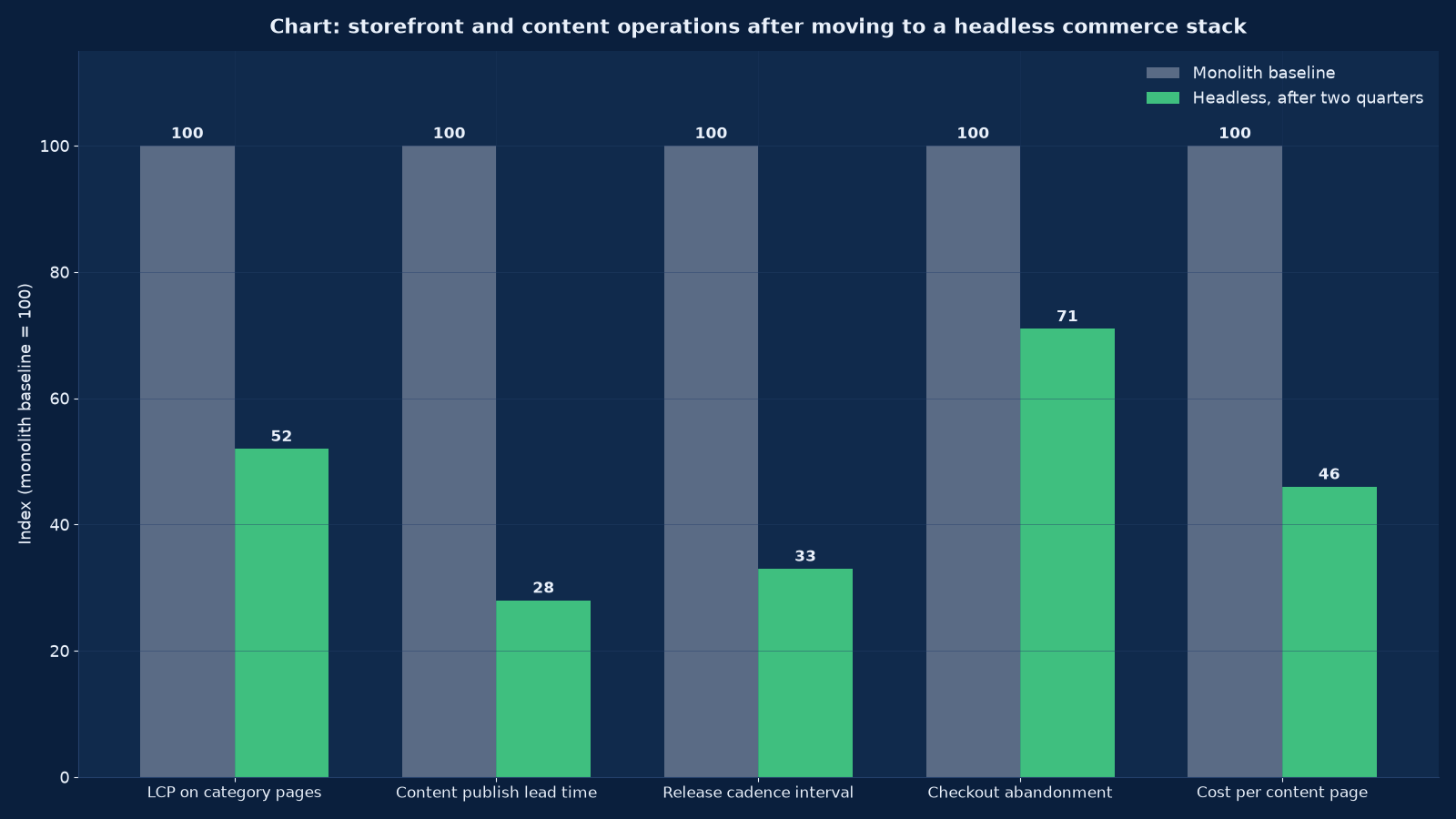
Chart values are an illustrative planning model based on typical UMC engagements and published industry benchmarks. They are not a guarantee of results on any specific project.
Composable commerce is not a technology you buy. It is an operating decision: you accept responsibility for integrating best-of-breed services in exchange for no longer being limited by the slowest one.
Headless and composable commerce separates the storefront from the commerce engine and assembles the platform from services chosen for the job: a commerce or commerce-engine back end, a content platform, a search and merchandising service, a front end you own, and an integration layer that makes them behave like one system. Unified Management Consulting designs, builds and operates these platforms for retailers, distributors, manufacturers selling direct, media and publishing businesses with commerce, hospitality groups, and export and B2B businesses whose buying process does not fit a standard checkout.
We are equally willing to recommend against it. Composable commerce costs more to integrate, more to operate and more to govern than a monolith, and it is worth that premium only when a specific constraint — performance, content velocity, channel variety, international expansion or integration depth — is genuinely binding. Our first deliverable is therefore an assessment that quantifies the constraint and prices both routes, not a platform proposal.
🧩 Headless & Composable Commerce — Quick Summary
| Component | What We Deliver |
|---|---|
| Composable readiness assessment | The binding constraints quantified, the total cost of ownership of both routes modelled, and a recommendation with the conditions under which it would change. |
| Capability map and service selection | Every commerce capability mapped to a service, with selection criteria, contract terms, exit costs and the integration burden of each candidate. |
| Commerce engine implementation | Catalogue, pricing, promotion, inventory, tax, payment, order and returns logic configured or built, with the business rules documented rather than discovered. |
| Storefront engineering | A front end you own — server-rendered or statically generated, component-based, with performance budgets and accessibility built in rather than retrofitted. |
| Content platform and structured content | A content model with types, fields and previews, so editors publish without a developer and without a release window. |
| Search and merchandising | Query understanding, faceting, synonym and typo handling, ranking rules, collections, merchandising controls and search analytics. |
| Integration layer and event architecture | API contracts, event-driven synchronisation, retries and idempotency, dead-letter handling, and observable failure — the part that determines whether composable becomes coherent or chaotic. |
| ERP, PIM, OMS and warehouse integration | Master data ownership decided per field, with synchronisation direction, conflict rules and reconciliation reporting. |
| Payments, tax and compliance | Gateway and orchestration design, tokenisation, 3-D Secure, GST and multi-jurisdiction tax, invoicing, and the audit trail finance and statutory auditors will ask for. |
| Performance and Core Web Vitals | Edge caching, static and incremental generation, image delivery, API response caching and field monitoring against an explicit budget. |
| Migration and cutover | Product, customer, order and content migration with rehearsals, URL and redirect mapping, SEO parity verification and a tested rollback. |
| Operate and improve | Monitoring across every service, incident ownership, cost governance, release management and a continuous improvement backlog against conversion and margin. |
What headless and composable actually mean
The vocabulary in this market is used loosely, often deliberately. These are the definitions we use in contracts and assessments, because a client cannot evaluate a proposal whose terms shift between meetings.
| Term | Precise meaning | What it is not | Why the distinction matters |
|---|---|---|---|
| Headless | The presentation layer is separated from the commerce back end and consumes it through APIs; the front end is yours to build and deploy | Not a synonym for “modern”, and not automatically faster — a badly built head is slower than a well-configured monolith | Determines who controls performance, content and experience, and who must be consulted for a change |
| Composable | The platform is assembled from independent best-of-breed services selected per capability, with a deliberate integration architecture | Not merely “multiple SaaS tools”; a monolith with six marketing tags is not composable | Composable shifts cost from licence fees to integration and governance — the trade must be priced before it is chosen |
| API-first | Every capability is exposed as a documented, versioned API designed for external consumers | Not a private API that happens to exist; undocumented internal endpoints are not API-first | Determines whether you can add channels and services without a vendor change request |
| MACH | Microservices, API-first, cloud-native, headless — an architectural set of properties, not a product category | Not a compliance standard, and not achievable in full by most mid-market businesses at reasonable cost | Useful as a direction of travel; harmful as a procurement checkbox |
| Monolith suite | One vendor provides storefront, commerce, content and often search, integrated by design | Not obsolete — it remains the correct answer for many businesses | Lower integration and governance cost, at the price of the vendor’s release cadence and capability ceiling |
| Hybrid or progressive decoupling | Parts of the experience are decoupled first — typically content-heavy landing, category or campaign pages — while the rest stays on the existing platform | Not a failure to commit; often the highest-return route | Delivers most of the performance and content gains at a fraction of the risk and cost |
The honest summary: headless is a coupling decision, composable is a sourcing decision, and they are independent. A business can be headless on a monolith, or composable with a conventional storefront. Conflating them produces platforms that carry both costs and neither benefit.
The readiness assessment: is the constraint real?
Composable commerce should be adopted to relieve a constraint you can name and measure. We quantify each candidate constraint on your estate and price both routes, because the premium for composable is real and must be earned by a specific gain.
| Candidate constraint | How we measure it | Evidence that justifies composable | Evidence that does not |
|---|---|---|---|
| Storefront performance | Field Core Web Vitals per template at the 75th percentile, split by device and connection; conversion rate by speed cohort | A monolith that cannot cache category or landing pages, with measured conversion loss attributable to speed | A slow storefront caused by third-party tags and unoptimised images, which headless does not fix |
| Content velocity | Median days from brief to published page; share of content changes requiring a developer or a release window | Editors blocked by release cadence, with a quantified backlog of campaigns and pages | A content process that is slow because of approvals, not tooling |
| Channel and experience variety | Number of surfaces needing commerce: web, app, kiosk, marketplaces, WhatsApp, B2B portals, in-store | Three or more surfaces with different experiences needing one catalogue, price and inventory source | A single web channel, where the abstraction layer is pure overhead |
| Release cadence and engineering throughput | Deployment frequency, lead time for change, change failure rate, share of engineering time on platform maintenance | A vendor release calendar that gates your roadmap, with commercial cost attached to the delay | A slow internal release process caused by absent testing and pipeline, which follows you to any platform |
| International or multi-brand expansion | Number of locales, currencies, tax jurisdictions, catalogues and brands to support, and the cost of adding one more | Adding a country or brand requires a new instance or a vendor project each time | Expansion planned but unfunded and undated — architecture for a hypothetical is the most expensive kind |
| Integration depth | Number and complexity of ERP, PIM, OMS, warehouse, CRM and finance integrations, and where master data lives | Deep enterprise integration where the monolith’s connector limits what the business can do | Integration complexity that is really a master-data ownership problem, which no platform solves |
Where two or fewer constraints are evidenced, we usually recommend hybrid decoupling or staying on the monolith with an engineering programme. That recommendation costs us the build, which is precisely why it is credible.
Total cost of ownership: the comparison most proposals omit
Platform comparisons are habitually presented as licence fees against licence fees. The real comparison includes integration, hosting, engineering, governance and exit cost across three to five years, and the ranking frequently changes when they are included.
| Cost line | Monolith suite | Composable stack | The line most often omitted |
|---|---|---|---|
| Licence and subscription | One platform fee, often a share of revenue or a tier by order volume | Several subscriptions: commerce engine, content platform, search, hosting, middleware, observability | Search and content subscriptions, which are frequently larger than the commerce engine |
| Implementation | Configuration and theme work; lower engineering hours | Storefront build, integration layer, event architecture, per-service configuration; substantially higher engineering hours | The integration layer, which is quoted as a line item and then grows |
| Ongoing engineering | Vendor-supplied upgrades; internal effort on configuration and extensions | Continuous integration maintenance, version management across services, contract tests, observability | The permanent engineering cost of owning an integration layer |
| Hosting and delivery | Usually bundled or vendor-managed | Front-end hosting, CDN, edge functions, per-service infrastructure and egress | Egress and request volume, which scale with success |
| Testing and quality | Regression testing largely within one platform | Contract testing between services, end-to-end journeys spanning vendors, sandbox and preview environments per service | Cross-service end-to-end testing, which is expensive and non-optional |
| Governance and vendor management | One contract, one renewal, one support relationship | Several contracts, renewals, support matrices, escalation paths and accountability arguments between vendors | The human cost of arbitrating whose fault an incident is |
| Security and compliance | Vendor carries much of the surface; you inherit their posture | You own the composed surface: authentication between services, secrets, data flows and audit trails | Data-flow mapping for privacy obligations across multiple processors |
| Exit cost | Data export limits and a theme you cannot take with you | Portability varies per service; content models and integration logic are partly reusable | Exit cost is rarely priced before signing, and it is what determines your negotiating position at renewal |
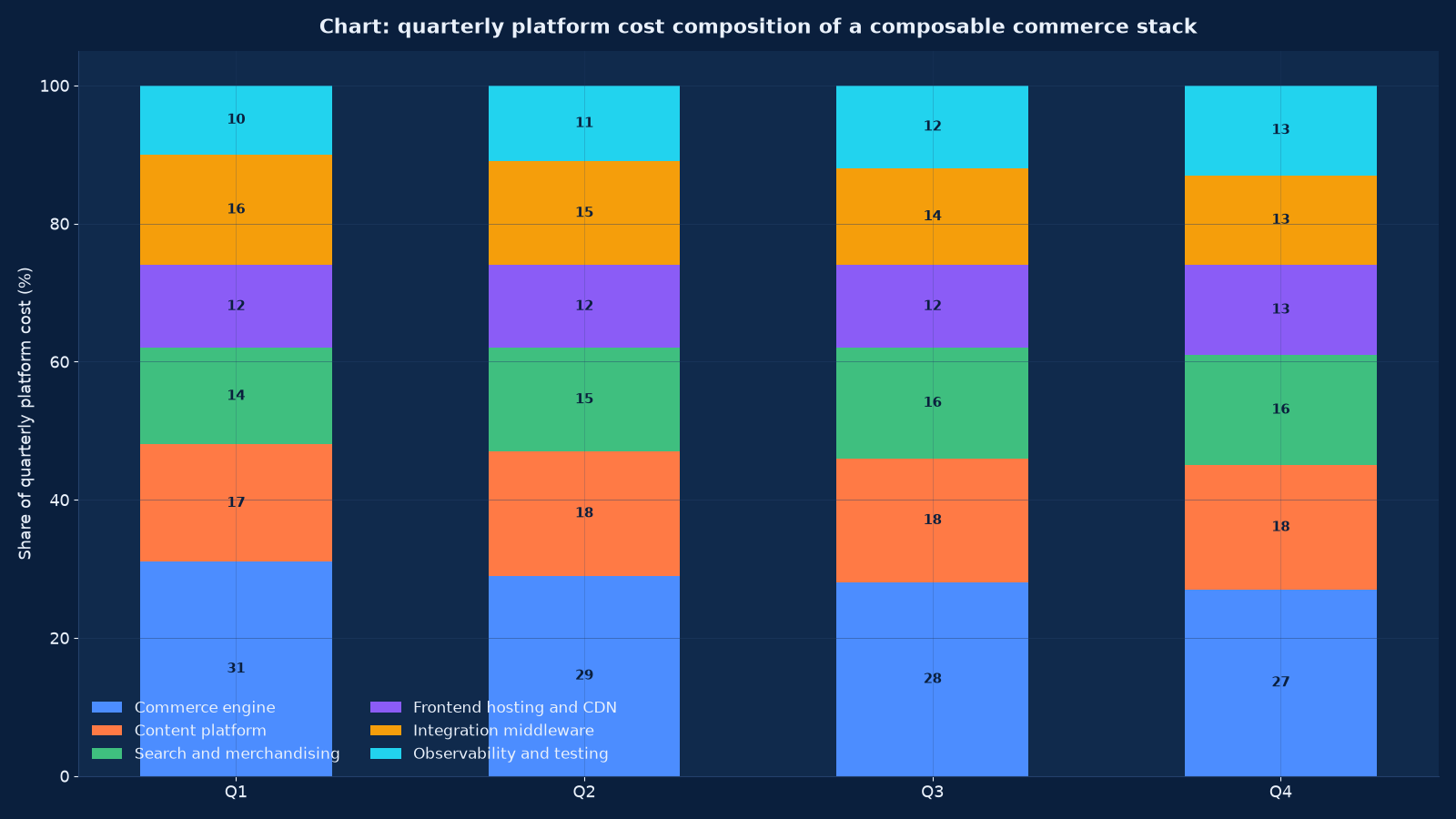
Chart values are an illustrative planning model based on typical UMC engagements and published industry benchmarks. They are not a guarantee of results on any specific project.
Capability map: which service does which job
A composable platform is defined by the capability map before it is defined by vendors. We write the map first, decide master-data ownership per field, and only then evaluate services against it — which reverses the usual sequence where a demo determines the architecture.
| Capability | What it must do | Typical owner in the stack | Selection criteria that matter |
|---|---|---|---|
| Product information | Attributes, variants, relationships, media, localisation, enrichment workflows and versioning | A PIM where the catalogue is rich or multi-channel; the commerce engine where it is simple | Import and export openness, attribute modelling depth, workflow and approval support, API completeness |
| Catalogue and pricing | Price lists, customer-specific and quantity pricing, promotions, bundles, currency and tax interaction | Commerce engine, with pricing rules documented | B2B pricing flexibility, promotion engine limits, and whether a change needs a developer |
| Inventory and availability | Stock positions across locations, reservations, safety stock, backorder and allocation rules | ERP or OMS as master, commerce engine as consumer | Synchronisation latency, oversell behaviour, and reconciliation reporting |
| Search and merchandising | Query understanding, faceting, synonyms, typo tolerance, ranking rules, collections, banners and search analytics | A dedicated search service — the highest-return component in most composable builds | Relevance tuning control, indexing latency, merchandising UI for non-technical staff, cost at your query volume |
| Content | Structured content types, editorial workflow, preview, localisation, personalisation hooks and reuse across channels | A headless content platform | Editor experience, preview fidelity, content model flexibility, and API rate limits |
| Storefront | Rendering strategy, component library, performance budget, accessibility, personalisation, SEO control | Your own front end, built by us or your team | Total control — which is the point, and also the cost |
| Cart and checkout | Cart persistence, guest and account checkout, address and shipping logic, payment, validation, fraud signals, order creation | Commerce engine with a storefront you control; checkout may stay hosted where compliance requires | Latency, failure modes, payment method coverage, and how much of the flow you can change without a vendor |
| Payments | Gateways, orchestration across providers, tokenisation, 3-D Secure, retries, refunds, reconciliation | A payment service or orchestrator, integrated with finance systems | Indian payment method coverage, failure-rate handling, settlement reporting and PCI scope |
| Tax and invoicing | GST and multi-jurisdiction tax, invoice generation, e-invoicing requirements, credit notes | A tax service or the ERP, with statutory reporting | Jurisdiction coverage, statutory filing support, and audit trail quality |
| Order management and returns | Order states, split and partial fulfilment, returns and exchanges, refunds, customer communication | OMS or ERP, with the commerce engine as a view | State model fit to your operations, and whether exceptions need manual intervention |
| Customer and identity | Accounts, authentication, B2B organisations with users and roles, addresses, preferences, consent | An identity service or the commerce engine, synchronised with CRM | B2B account modelling, single sign-on, and privacy controls |
| Analytics and experimentation | Event collection, attribution, product and funnel analytics, A/B testing, merchandising insight | Analytics platform with a server-side or edge collection route | Event schema control, data ownership, and whether experimentation can run without a release |
Note how many capabilities have a plausible owner in two places. Those decisions — who is master for a field, who is a consumer — are the architecture. Getting them wrong is what produces two systems that disagree about price or stock in front of a customer.
The integration layer: where composable succeeds or fails
Everything difficult about composable commerce is integration. A composed platform without a deliberate integration architecture is a set of services that disagree, and the disagreement becomes visible at the worst moment: during a sale, in front of a customer, in the price or the stock position.
| Design decision | The options | What we usually recommend | Consequence of getting it wrong |
|---|---|---|---|
| Synchronisation style | Point-to-point API calls, an integration platform, or an event-driven architecture with a message broker | Event-driven for data that changes often and must propagate widely; direct API calls for request-time reads | A mesh of point-to-point calls that cannot be reasoned about, where one service’s outage cascades |
| Master-data ownership | Per field, not per system: one owner, defined consumers, and a conflict rule | ERP or PIM owns product and price master; OMS owns inventory truth; the content platform owns editorial copy; the commerce engine consumes | Two systems writing the same field, and a reconciliation project that never ends |
| Idempotency and retries | Every write operation must be safely repeatable, with bounded retries and backoff | Idempotency keys on orders, payments and stock updates; retries with jitter; a dead-letter queue with alerting | Duplicate orders, double refunds and stock drift that is discovered by a customer |
| Failure visibility | Per-service monitoring is not enough; the flow between services must be observable | Correlation identifiers end to end, flow-level dashboards, alerts on synchronisation lag, and a reconciliation report finance can read | Silent divergence: the storefront shows stock the warehouse does not have |
| Consistency model | Strong consistency is rarely available across services; eventual consistency must be designed | Explicit tolerance per data type: price and stock tight, editorial content relaxed, with customer-facing behaviour defined for the lag | Selling at a stale price or promising unavailable stock, then discovering the policy was never decided |
| Caching and invalidation | Cache at the edge, at the API layer and in the storefront, with invalidation driven by content and catalogue events | Event-driven invalidation with cache keys designed to survive personalisation and locale | Either no caching and slow pages, or caching that serves yesterday’s promotion |
| Versioning and contracts | Every service API is versioned, with contract tests in the pipeline | Contract tests per integration, version pinning, and a documented upgrade path per vendor | A vendor release breaking your storefront with no test to catch it |
| Environments and sandboxes | Each service needs a non-production environment; composed environments must be reproducible | Infrastructure as code for the composed environment, seeded data, and preview environments per pull request | Testing in production, because a faithful staging environment was too expensive to assemble |
This layer is not a middleware product. It is a set of engineering decisions with tests and monitoring attached, and we build it with our systems integration practice and DevOps engineering rather than leaving it to whoever happens to own the storefront.
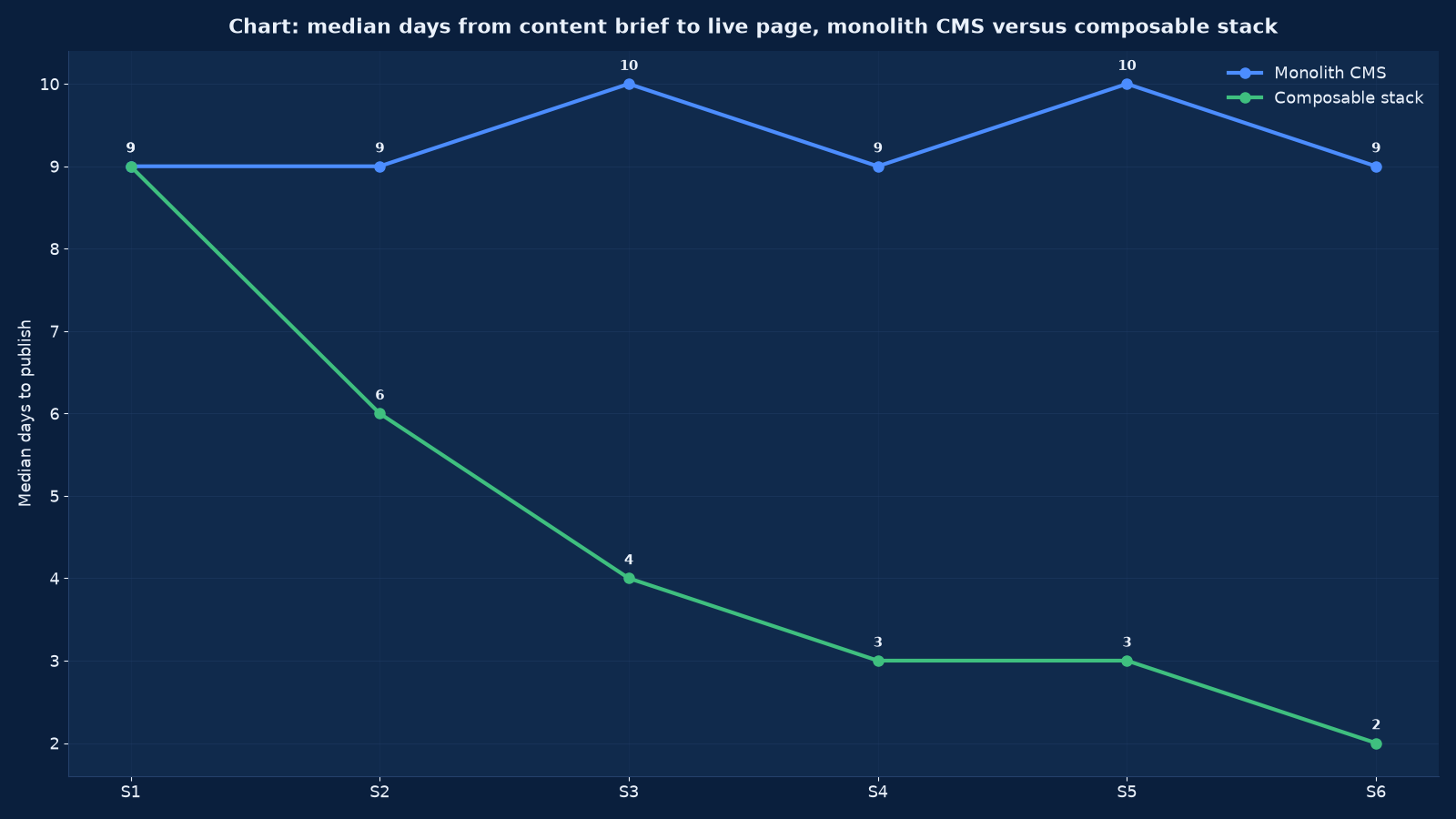
Chart values are an illustrative planning model based on typical UMC engagements and published industry benchmarks. They are not a guarantee of results on any specific project.
Storefront engineering and performance
The storefront is where a headless investment is realised or wasted. Owning the front end means owning its performance, accessibility, SEO behaviour and release quality — all of which a monolith handled for you, badly or well depending on the vendor.
| Decision | Options | Our default | Why |
|---|---|---|---|
| Rendering strategy | Client-side rendering, server-side rendering, static generation, incremental regeneration, or a mix per route | Static or incremental generation for catalogue, category and content routes; server-side rendering for account, cart and checkout; minimal client-side JavaScript everywhere | It puts the performance budget under your control and keeps the expensive routes dynamic only where they must be |
| Framework | React with Next.js, Vue with Nuxt, or a lighter component approach for simpler estates | React and Next.js where the team and the requirement support it; otherwise a server-rendered component approach | Ecosystem maturity, hiring availability in India, and the fact that a framework is a commitment your team will maintain |
| Component and design system | A shared component library with tokens, states and documentation, aligned to the design system | One library, versioned, with accessibility and performance tests per component | Prevents the divergence that makes multi-channel reuse impossible |
| Performance budget | Named limits per route for payload, requests, JavaScript, milliseconds and main-thread work | Budgets set in discovery and enforced in the pipeline, measured in the field | A headless storefront with no budget becomes slower than the monolith it replaced |
| Accessibility | Conformance standard agreed up front, verified with assistive technology, gated in the pipeline | WCAG 2.2 Level AA designed into components rather than audited afterwards | Retrofitting accessibility onto a custom front end is more expensive than on a mature platform |
| SEO control | Rendering mode, metadata per template, structured data, canonical rules, internal linking, sitemap and indexation control | Server-rendered or generated HTML, metadata from the content model, structured data per content type, and an internal-link rule set | Search visibility is the asset being migrated; it must be designed, not hoped for |
| Personalisation and experimentation | Edge personalisation, server-side decisioning, or client-side experimentation | Server-side or edge decisioning with cache keys designed for it; experiments that do not require a release | Client-side experimentation usually costs the performance gain the platform was bought to achieve |
| International and multi-brand | One codebase with locale and brand configuration, or separate deployments | One codebase, configuration-driven, with per-locale content models and hreflang handled explicitly | Duplicated storefronts multiply maintenance cost and diverge within a year |
We hand over a storefront your team can develop, with a documented component library, a performance budget in the pipeline and field monitoring live. A headless build that only its vendor can change is a monolith with extra steps and a larger invoice.
Content operations: the gain that justifies the cost
For most clients the decisive benefit of composable is not performance but publishing velocity — the ability of a marketing team to ship a campaign without an engineering ticket. That benefit only materialises if the content model is designed for editors rather than for developers.
| Element | What good looks like | What bad looks like | Effect |
|---|---|---|---|
| Content types | A small set of well-defined types — landing page, category page, editorial, campaign, product story — each with required and optional fields | One flexible “page” type with forty optional fields that editors combine differently every time | Consistency, reusability across channels, and rendering that can be tested |
| Structured versus rich text | Structured fields for anything rendered or reused; rich text confined to genuine prose | Layout expressed inside rich text with inline styles and pasted HTML | Whether the front end controls presentation, or the editor’s clipboard does |
| Preview | A faithful preview of the live rendering, including draft content and personalisation states | No preview, or a preview that does not resemble the storefront | Editorial confidence, and fewer releases spent fixing layout |
| Workflow and approval | Draft, review, approve, schedule, publish, with roles and an audit trail | Anyone with a login can publish anything at any time | Control for regulated categories, and a record when something goes wrong |
| Localisation | Locale as a field with translation status, not as a duplicated content tree | A separate tree per language that drifts and duplicates | Whether international expansion is a configuration or a project |
| Reuse across channels | The same content served to web, app, kiosk and messaging through APIs | Content copied into each channel by hand | The actual payoff of headless; without it you have two systems and double the work |
| Governance and ownership | A named owner per content type, a review cadence, and a rule for adding fields | Fields added on request, forever, by whoever asked last | Whether the content model is an asset or an accumulation |
The measure in Figure 3 — median days from brief to published page — is the one we ask clients to capture before the project starts. If nobody can tell you how long publishing takes today, the velocity benefit cannot be claimed later, and the business case becomes an article of faith. the case for consolidating systems makes the parallel argument at enterprise level.
Migration and cutover
A composable migration is a replatforming exercise with more moving parts, because the data is distributed across services rather than concentrated in one database. The controls are the same as any migration and they are not optional.
| Stage | Activity | Control | Common failure |
|---|---|---|---|
| Inventory | Products, categories, customers, orders, content, URLs, redirects, media, promotions and integrations enumerated and counted | Counts agreed with the business before migration design starts | Discovering a product type or customer segment during cutover |
| Mapping | Field-by-field mapping per entity, with transformation rules and documented decisions for unmappable records | Business sign-off on every ambiguous mapping | Engineers inventing commercial rules to make the data fit |
| URL and redirect mapping | Every indexed URL mapped one-to-one to its successor, with exceptions named | A redirect map reviewed against Search Console demand before launch | Bulk-redirecting old URLs to the homepage, which forfeits the organic demand the platform was meant to grow |
| Dry runs | Full migration executed against production copies, timed, with results verified | At least two rehearsals with a reconciliation report per run | A cutover window that turns out to be three times longer than planned |
| Reconciliation | Row counts, financial totals, control totals per module, sampled record comparison, and business verification of the records that matter | A signed reconciliation record per entity | “It looks right” as the acceptance criterion |
| SEO parity | Metadata, structured data, canonical rules, internal links, sitemap, robots and indexation verified page by page on the money templates | A parity checklist executed pre-launch and re-checked post-launch | Losing structured data or titles silently, discovered six weeks later in a traffic report |
| Cutover and rollback | Staged cutover with DNS or routing control, verification of every critical journey, and a tested rollback path | Rollback tested, not merely written; a decision point with a named decision maker and a time | A cutover that cannot be reversed once a problem is found |
| Hypercare | Elevated monitoring and support across every service, with per-vendor escalation contacts already agreed | Daily reconciliation and flow monitoring for at least two weeks | Blame circulating between vendors while the customer-facing symptom persists |
The vendor escalation matrix is specific to composable and worth preparing before launch. When an incident spans a storefront, a commerce engine and a search service, the time is not spent diagnosing — it is spent establishing whose support queue it belongs in. We pre-agree the contacts, the evidence each vendor requires and the escalation path, and we hold the correlation identifiers that make the argument factual.
Operating a composed platform
Launch is the point at which the operating cost begins. A composed platform needs one owner for the whole experience, a single incident path, and cost governance across subscriptions — otherwise the benefits are consumed by coordination overhead.
| Operating discipline | What it requires | Cadence |
|---|---|---|
| Single accountable owner | One role accountable for the composed experience end to end, with authority over every service’s configuration and release timing | Permanent |
| End-to-end monitoring | Synthetic journey monitoring across services, flow-level synchronisation lag alerts, reconciliation reporting, and field performance monitoring against budget | Continuous |
| Incident management with a vendor matrix | One incident path, correlation identifiers, pre-agreed escalation contacts and evidence requirements per vendor | Per incident |
| Release and change control | A composed release calendar: which service versions, which storefront release, which configuration change, with contract tests before any vendor upgrade | Per release, with a vendor-upgrade review monthly |
| Cost governance | Subscription, request-volume, egress and search-cost tracking per service against budget, with renewal dates diarised | Monthly, with a quarterly renegotiation review |
| Security and privacy | Data-flow mapping across processors, secrets and service-to-service authentication, dependency patching on a service level, access reviews | Continuous, with a quarterly access and configuration review |
| Capability review | Whether each service still earns its cost and integration burden, and whether a capability should move between services | Annually, alongside the technology health assessment |
| Continuous improvement | A backlog against conversion, margin, publishing velocity and cost — not against features | Monthly prioritisation with the business |
We operate these disciplines for clients under a retainer, or hand them over with runbooks, dashboards and training where an internal team will run them. What we do not do is leave a composed platform with nobody accountable for the composition — that is the failure mode behind most unhappy composable commerce stories.
Engagement models and fees
Four models, all beginning with a paid assessment. A composable platform quoted without an assessment is a quote that will change, and the change will arrive after the decision has been announced internally.
| Model | Duration | Included | Best for |
|---|---|---|---|
| Composable readiness assessment | Three to four weeks | Constraint quantification, capability map draft, five-year total cost of ownership for both routes, service selection criteria, a recommendation with the conditions that would change it | Deciding whether to go composable at all — and the answer is sometimes no |
| Hybrid decoupling | Eight to fourteen weeks | Decoupling the highest-value surfaces — content, category and campaign pages — onto a storefront you own, integrated with the existing commerce engine, with performance budgets and SEO parity verified | Capturing most of the performance and content gain at a fraction of the risk and cost |
| Full composable build | Six to twelve months | Capability map, service selection and contracting support, storefront, content platform, search, integration layer and event architecture, payments and tax, migration with rehearsals, cutover, hypercare and operating handover | Two or more evidenced constraints, the engineering capacity or budget to own the integration layer, and a multi-year horizon |
| Operate and improve retainer | Twelve months | End-to-end monitoring, incident management with the vendor matrix, release and cost governance, security upkeep, and a conversion and margin improvement backlog | A live composed platform where nobody internal owns the composition |
Fees are quoted per stage after the assessment, with the assumptions published. We will also review a composable proposal you have received from a platform vendor or another firm — as a short fixed-fee engagement — because the total cost of ownership line is the one most often missing, and it is the one that decides the outcome.
Mistakes we see repeatedly
Each of these has been expensive for somebody, and each is avoidable with a decision made in writing before the build starts.
| Mistake | How it happens | The prevention |
|---|---|---|
| Choosing composable for prestige | A platform decision made because competitors mention it, or because an architecture diagram impressed an executive | The readiness assessment with quantified constraints; no build without two evidenced constraints |
| Underestimating the integration layer | Quoted as a line item, built by whoever is free, tested at the end | Integration designed as a first-class workstream with contracts, idempotency, dead-letter handling and flow monitoring, specified before the storefront |
| No master-data decision | Every service allowed to write product or price data because nobody arbitrated | Master-data ownership per field, in writing, with the conflict rule and the reconciliation report |
| A headless storefront that is slower | Client-side rendering, eager API calls, no caching strategy, and third-party tags carried over unchanged | Performance budgets per route set in discovery, enforced in the pipeline, measured in the field |
| Content model designed by developers | Fields mirroring the database rather than the editorial task, so editors still need a developer | Content types designed with the editors who will use them, and the publishing lead time measured as an acceptance criterion |
| Search treated as an afterthought | The commerce engine’s default search used because a search service seemed like an extra subscription | Search relevance quantified in the assessment; on most estates it is the highest-return component in the stack |
| Migration rehearsed once, or not at all | Schedule pressure at the end of a long programme, so the dry run is shortened | Two rehearsals minimum with a signed reconciliation record, and a tested rollback path |
| Nobody owns the composition | Each service has a vendor and an internal contact, but the end-to-end experience has no owner | A single accountable owner named before launch, with authority over release timing across services |
| Exit cost ignored at signing | Contracts signed on the strength of a demo, with data export and portability unexamined | Exit cost priced per service during selection, and export capability tested before commitment |
The pattern is consistent: composable commerce fails on governance and integration, not on technology. Every service in a failed project worked exactly as its vendor described. What failed was the composition, and the composition is a management discipline that has to be staffed and funded like any other.
Frequently Asked Questions About Headless and Composable Commerce
Should we go headless?
Only if you can name and measure the constraint it relieves. Where storefront performance, publishing velocity, channel variety or vendor release cadence is genuinely binding, headless earns its cost. Where the problem is third-party tags, unoptimised images, an approval process or a weak content operation, headless will relocate the problem at a higher price. The readiness assessment answers this with numbers rather than opinion.
Is composable commerce more expensive?
Upfront and in ongoing engineering, yes: integration, contract testing, observability, vendor management and cross-service environments all cost money that a monolith absorbs. Over three to five years the comparison depends entirely on whether the relieved constraint was worth the premium, which is why we model total cost of ownership for both routes before recommending either.
Can we do it in stages?
Yes, and we usually recommend it. Hybrid decoupling takes the highest-value surfaces — content, category and campaign pages — onto a storefront you own while the existing commerce engine keeps serving cart and checkout. It delivers most of the performance and content gain at a fraction of the risk, and it produces the evidence needed to justify going further.
Which commerce engine or content platform do you recommend?
Whichever fits the capability map, your team’s ability to operate it, and the exit cost. We are independent of the vendors and we evaluate against criteria agreed with you in writing — API completeness, B2B pricing flexibility, indexing latency, editor experience, support terms and data portability. We will shortlist, score and attend the demos, and we will tell you when a cheaper option meets the requirement.
What happens to our SEO during a migration?
It is protected by design: every indexed URL mapped one-to-one, metadata and structured data parity verified per template, canonical rules and indexation control specified, and the redirect map reviewed against Search Console demand before launch. We verify parity pre-launch and monitor coverage and clicks afterwards. Bulk-redirecting to the homepage is the single most expensive shortcut available in this work, and we refuse it.
How do you handle GST, invoicing and Indian payment methods?
Through the tax and payment components of the capability map: GST and multi-jurisdiction tax calculation, e-invoicing requirements, invoice and credit-note generation, settlement reconciliation with finance, and payment coverage including UPI, cards, net banking, wallets and EMI, with 3-D Secure and failure-rate handling designed rather than defaulted. The audit trail is specified with finance and statutory auditors in mind.
Can our small team operate a composed platform?
Honestly assessed: a composed platform needs more operational discipline than a monolith, and a two-person team will feel it. The options are to reduce the number of services, to take the operate-and-improve retainer so we hold the composition, or to stay on a monolith and invest in engineering discipline instead. We recommend whichever the assessment supports, including when it is not the build.
Do we lose the ability to make changes quickly?
You gain it in content and storefront, and you lose it where a change requires coordination across services. That trade is worth making when marketing velocity is the constraint and it is not when the constraint is commercial logic, which changes less often and now spans more vendors.
How long does a full composable build take?
Six to twelve months for a mid-market platform with real integration depth, of which the integration layer, migration rehearsals and cutover account for more time than clients expect. A hybrid decoupling runs eight to fourteen weeks. Anything promised substantially faster is usually omitting migration rehearsal or the operating handover.
What about marketplaces, WhatsApp and B2B ordering?
They are channels in the capability map, served by the same catalogue, price and inventory source through the integration layer. That reuse is one of the genuine benefits of composable: a WhatsApp ordering flow, a dealer portal or a marketplace feed becomes an integration rather than a separate system, provided master-data ownership was decided properly at the start.
How do we avoid being locked in again?
By pricing exit cost during selection rather than at renewal: data export capability tested before commitment, content models and integration logic kept portable, contracts with export and termination terms reviewed by your counsel, and an annual capability review that asks whether each service still earns its cost. Composable reduces single-vendor lock-in but multiplies the number of contracts, so the discipline has to be deliberate.
Commission a Composable Commerce Readiness Assessment
Send us your storefront URL, your current platform and vendor contracts, and the constraint you believe is holding the business back. Within four weeks you will have that constraint quantified, a capability map with master-data ownership decided per field, a five-year total cost of ownership for the composable and monolith routes, shortlisted services scored against written criteria, and a recommendation — which may well be hybrid decoupling, or staying where you are.
Contact Unified Management Consulting to arrange a confidential first conversation.
Related Services
Headless and composable commerce is delivered with the practices that own each layer:
- Ecommerce Development & Marketing Services — the commerce engineering and growth practice this sits inside
- Full-Stack React Development — the storefront engineering, component library and rendering strategy
- Enterprise Systems Integration — ERP, PIM, OMS, warehouse and CRM contracts and event flows
- Website Development Services — the content and marketing estate around the storefront
- Conversion Rate Optimization Services — journey-level measurement that turns platform gains into commercial evidence
- Analytics & Attribution Services — event schema, server-side collection and attribution across a composed stack
- Search Engine Optimization Services — metadata, structured data and indexation parity through the migration
- DevOps & CI/CD Engineering — composed environments, contract tests and release management
- Website Strategy & Information Architecture — task analysis, full content inventory, card sorts and tree tests, content model, navigation and governance
- Accessibility (WCAG) Remediation & Compliance — WCAG 2.2 Level AA audits, severity-ranked defect registers, design-system remediation, assistive-technology verification and accessibility statements
- Core Web Vitals & Performance Engineering — field instrumentation, LCP, INP and CLS engineering, third-party governance, performance budgets and a pipeline regression gate
- Web Application Maintenance & Support — patching, monitoring, verified backups, defect management, committed change capacity and monthly service reporting
- PHP & Laravel Development — legacy assessment, domain modelling, strangler-fig modernisation, APIs, test automation and CI/CD on modern PHP
- Website Migration & Replatforming — full estate inventory, one-to-one redirect maps, functional parity, dry-run rehearsals, staged cutover and tested rollback
- Portal Development & Self-Service Platforms — entitlement modelling, single sign-on, source-system integration, self-service journeys and adoption instrumentation