
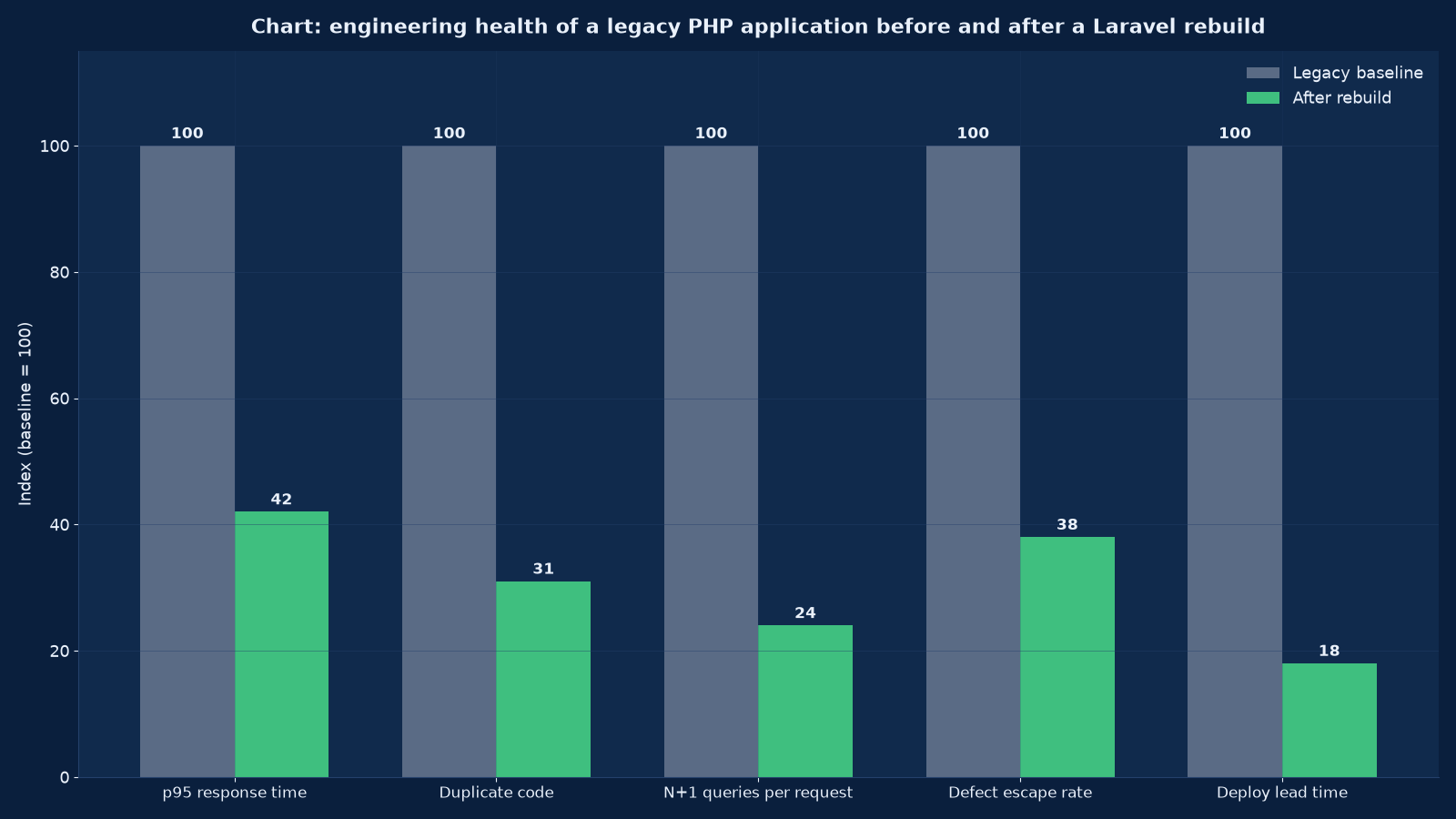
Chart values are an illustrative planning model based on typical UMC engagements and published industry benchmarks. They are not a guarantee of results on any specific project.
PHP runs most of the commercial web and a large share of Indian enterprise software. The problem is almost never the language. It is an application built without a framework’s discipline, maintained by whoever was available, and now too expensive to change and too important to replace.
PHP and Laravel development at Unified Management Consulting covers three situations that look different and share one root cause. First, a legacy PHP application — hand-rolled, CodeIgniter, CakePHP, Zend, an old custom CMS or a vendor product that has been patched for a decade — that still runs a core business process and can no longer be changed safely. Second, a new application where PHP and Laravel is the right answer on cost, hiring, hosting and time-to-market, and the client wants it built to a standard rather than to a deadline. Third, a Laravel estate that was built quickly and now needs engineering discipline: tests, a pipeline, a service layer, performance work and documentation.
We build with modern PHP — typed, strict where it matters, PSR-compliant — on Laravel, with a service layer, queued work, a real migration and seed strategy, automated tests and a deployment pipeline. We also maintain and rescue PHP estates we did not build, and we will tell you when the correct answer is not a rebuild: sometimes it is an enclosure, a strangler-fig migration, or a two-sprint stabilisation followed by disciplined incremental change.
🐘 PHP / Laravel Development Services — Quick Summary
| Component | What We Deliver |
|---|---|
| Legacy assessment and archaeology | Code, schema, integrations, deployment path and business rules recovered from a running application, with a risk register and a supportability verdict. |
| Domain and schema design | The business model expressed as entities, relationships and invariants, with migrations, seed data and a documented schema rather than a spreadsheet. |
| Laravel application engineering | Typed modern PHP, service layer, Eloquent models with correct relationships, form requests, policies, events, and queues for anything off the request path. |
| Admin and back office | Role-based administration for the people who run the process, built as part of the application rather than bolted on at the end. |
| API design and delivery | REST or GraphQL APIs with versioning, contract documentation, token-based authentication, rate limiting and pagination designed for real consumers. |
| Integration engineering | ERP, accounting, CRM, payment gateways, SMS and WhatsApp, logistics, government portals and legacy databases — with contracts, retries, idempotency and observable failure. |
| Legacy modernisation and strangler migration | Incremental replacement of a legacy application behind a stable interface, with data migration, dual-running and a rollback path at every stage. |
| Test automation and CI/CD | Unit, feature and browser tests, static analysis, a pipeline with review environments, and deployment lead time measured rather than hoped for. |
| Performance engineering | Query profiling, N-plus-one elimination, opcache and PHP-FPM tuning, Redis caching, queue offloading and response caching for read-heavy routes. |
| Security hardening | Authentication and authorisation, input validation, mass-assignment protection, encryption at rest, secrets management, audit logging and dependency patching. |
| Hosting, deployment and DevOps | Environment design, infrastructure as code, zero-downtime deployment, monitoring, backup and restore verification. |
| Handover, documentation and support | Architecture and runbook documentation, developer onboarding, and a maintenance retainer with measured service levels. |
When PHP and Laravel is the right choice
Framework and language decisions are usually made on familiarity rather than evidence, in both directions: teams rebuild in a fashionable stack because the current one is embarrassing, and teams stay on a dying platform because a rebuild is frightening. The honest test is about cost, hiring, hosting and change frequency.
| Situation | Why Laravel fits | Why it might not | What we recommend |
|---|---|---|---|
| Line-of-business applications: operations, service management, back office, vendor and dealer portals | Rapid development of CRUD-heavy domain logic, strong ecosystem for auth, queues, notifications and admin, cheap and simple hosting, deep talent pool in India | Very high concurrency with heavy real-time requirements, or a domain better served by an existing product | Laravel, with the domain model designed properly and queues used for everything off the request path |
| Commerce and marketplaces on a budget | Full control of checkout and catalogue logic without platform licence fees; integrates with payment gateways and Indian logistics providers readily | Where a mature platform’s merchandising, tax and multi-currency features would take years to rebuild | Laravel for bespoke flows, or a commerce engine with a Laravel integration layer — decided against our commerce engineering evidence |
| Legacy PHP estates carrying core processes | The team, the hosting and the data stay familiar while the architecture is modernised; migration risk is staged rather than concentrated | Where the underlying business process is the problem and a rewrite would faithfully reproduce it | Assessment first, then strangler-fig modernisation or an enclosure around the legacy core |
| API-first products and internal platforms | Laravel’s API tooling, Sanctum and Passport, resource transformations and queue workers suit service back ends well | Where a polyglot microservice estate already exists with different standards | Laravel as a service, with contracts and versioning treated as first-class deliverables |
| High-traffic consumer properties | With caching, queues and a CDN, Laravel serves substantial traffic comfortably | Where per-request work cannot be cached and horizontal scaling is constrained by stateful design | Laravel with an explicit performance budget, or a different runtime for the hot path only |
| Teams without PHP capability | Hiring PHP and Laravel developers in India is materially easier and cheaper than most alternatives | Where the internal team is committed to another ecosystem and can maintain it properly | Match the stack to the team that will own it in year three, not the team that builds it in month three |
The decisive question is not which framework is better. It is who will maintain this in three years, what they will cost, and whether the application will still be worth maintaining. the business case for consolidating a tech stack is the reasoning we apply at portfolio level, and it usually argues for fewer platforms rather than newer ones.
Legacy PHP assessment: what we look at, and what we usually find
A legacy assessment is not a code review. It is an investigation into what the application actually does, what it depends on, what would break if it were changed, and whether it can be supported at all. We produce a verdict and a costed plan, and the verdict is sometimes unwelcome.
| Area | What we examine | Typical finding | Consequence |
|---|---|---|---|
| Framework and runtime | PHP version, framework and version, end-of-life status, extension dependencies, composer or absence of dependency management | PHP 5.6 or 7.x with a framework abandoned years ago, and libraries vendored directly into the tree | No security patches available; hosting providers refusing the runtime; an upgrade that is effectively a rewrite |
| Architecture | Separation of concerns, presence of a service layer, business logic location, global state, coupling between presentation and data | Business rules embedded in templates and in stored procedures simultaneously, with no single source of truth | Every change is risky, and no test can be written without refactoring first |
| Database and schema | Schema documentation, migrations or manual SQL, foreign keys and constraints, indexing, duplicate and orphaned data, growth rate | Schema changed by hand over years; no migrations; constraints absent; several tables nobody can explain | Data migration becomes the hardest part of any replacement, and it is discovered late |
| Authentication and security | Password storage, session handling, authorisation checks, input validation, SQL construction, file upload handling, admin exposure | Unsalted or weakly hashed passwords, string-concatenated queries, authorisation enforced only in the interface | Immediate risk requiring remediation before any other work is planned |
| Integrations | Every external system, protocol, credential, failure mode and retry behaviour | Undocumented point-to-point integrations, credentials in code, silent failures with no alerting | A replacement must reproduce interfaces nobody documented; discovery cost dominates |
| Deployment and environments | How code reaches production, environment parity, version control discipline, rollback capability | Files edited directly on the server; no staging; version control that does not match production | No safe way to change anything, and no reliable baseline to compare against |
| Testing and quality | Test presence and coverage, static analysis, code duplication, complexity hotspots | No automated tests; duplication above 30 per cent; a few functions of several thousand lines | Defect escape rate stays high whatever is done, until tests exist |
| Business criticality | Which processes depend on it, transaction volumes, what happens if it is down for a day | It runs payroll, dispatch, billing or statutory reporting, and nobody has written that down | Determines whether the strategy is stabilise, enclose, modernise or replace |
The output is a risk register with severity and exposure, a supportability verdict, and three costed options. We include the option of doing nothing, with its measured cost, because it is the option that will otherwise be chosen by default.
Three modernisation strategies, compared
Rewrite, refactor and replace are not equivalent, and the choice is the most consequential decision in the engagement. We recommend one with evidence and we will argue against our own commercial interest when the evidence points that way — a stabilisation sprint is a smaller fee than a rebuild and often the better answer.
| Strategy | What it means | Risk profile | When it is right | When it is wrong |
|---|---|---|---|---|
| Stabilise and enclose | Patch, secure, test the critical paths, put the legacy application behind a stable interface and stop changing its internals | Low. No data migration, no cutover, no retraining | The application works, the business rules are stable, and the problem is supportability rather than capability | The platform cannot be secured or hosted much longer, or new capability is genuinely needed |
| Strangler-fig modernisation | Build the new application alongside the old, route capability by capability to it, and retire the legacy code incrementally with dual-running where needed | Moderate and staged. Each stage is reversible; data consistency needs explicit design | A large estate where a big-bang cutover would be reckless, and where value can be delivered in stages | A small application where the coordination overhead exceeds the rebuild cost |
| Full rebuild on Laravel | Re-model the domain, rebuild the application, migrate the data, cut over with a tested rollback path | High but bounded, if the assessment was honest. Requirements discovered late are the classic failure | The legacy platform is end-of-life, capability is constrained, or the process itself is being redesigned | The business rules are undocumented and only exist in the running code, with nobody available to verify them |
| Replace with a product | Adopt a commercial or open-source product and integrate it, retiring custom code | Moderate. Vendor lock-in and configuration limits replace maintenance cost | The process is standard enough that a product does it well, and the customisation is genuinely marginal | The custom logic is the competitive advantage, in which case a product will be bent until it breaks |
Whichever is chosen, the sequencing rule is the same: security and backup remediation first, tests around the behaviour that must be preserved second, and architecture third. Rebuilding on top of an unverified understanding of the current behaviour is how a twelve-month project becomes a twenty-month one.
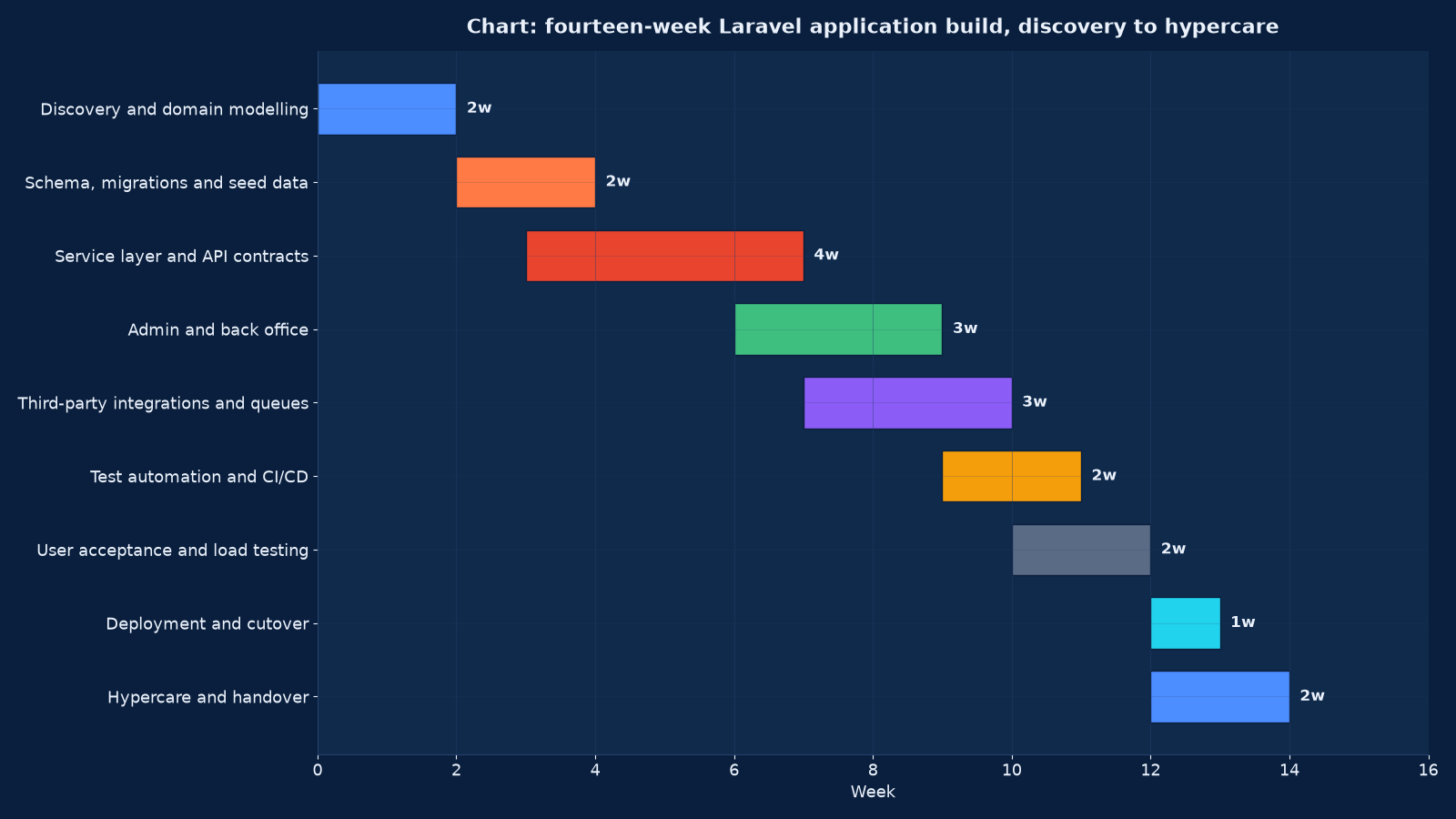
Chart values are an illustrative planning model based on typical UMC engagements and published industry benchmarks. They are not a guarantee of results on any specific project.
How we build: the fourteen-week programme
A typical mid-complexity Laravel application — twenty to sixty domain entities, a handful of integrations, an admin back office and an API — is delivered in fourteen weeks. Larger programmes extend discovery, integration and migration phases; the sequence does not change.
| Phase | Weeks | Work | Deliverable and acceptance |
|---|---|---|---|
| Discovery and domain modelling | 1 to 2 | Process mapping with the people who do the work, entity and invariant identification, integration inventory, non-functional requirements, security and compliance constraints | A domain model, a requirements document with acceptance criteria, and a dated plan. Signed off before any code is written |
| Schema, migrations and seed data | 3 to 4 | Schema design with keys, constraints and indexes; migrations; seed and factory data; a data dictionary | A reproducible database built from migrations, with seeded environments and a documented dictionary |
| Service layer and API contracts | 4 to 7 | Domain services, Eloquent models and relationships, form requests and validation, policies and authorisation, events and listeners, API resources and versioning | Working services with contract documentation and feature tests covering the acceptance criteria |
| Admin and back office | 7 to 9 | Role-based administration, data management screens, workflow states, audit trail, bulk operations, reporting views | An admin a non-technical operator can use, tested against real workflow scenarios |
| Integrations and queues | 8 to 10 | ERP, accounting, CRM, payment, messaging and legacy database integrations; queued jobs; webhooks; retries, idempotency and dead-letter handling | Each integration with a contract, observable failures, and a test that proves the failure mode behaves correctly |
| Test automation and CI/CD | 10 to 11 | Unit, feature and browser test suites; static analysis; pipeline with linting, tests, review environments and automated deployment | A pipeline that deploys on merge with a rollback path, and coverage reported per release |
| User acceptance and load testing | 11 to 12 | UAT against acceptance criteria with real users, data migration dry runs, load and endurance testing at a realistic multiple of peak | A signed UAT record, a migration rehearsal report, and load results against the agreed thresholds |
| Deployment and cutover | 13 | Production deployment, data migration, DNS or routing cutover, verification of every critical journey | A live application with a tested rollback executed or explicitly not needed, and a cutover log |
| Hypercare and handover | 13 to 14 | Elevated support, defect resolution, documentation, developer onboarding, runbook and transition to the retainer | Documentation, a runbook, a handover session, and a support arrangement with measured service levels |
Two disciplines distinguish this from a typical build. First, acceptance criteria are written during discovery and are the thing UAT tests against, so scope arguments are settled by a document rather than by memory. Second, the data migration is rehearsed before cutover — unrehearsed migrations are the single largest cause of failed cutovers in our experience.
Application architecture we hold to
Laravel makes good structure easy and bad structure invisible. These are the rules we apply on every build, because they are what allow a different team to maintain the application in year three.
| Layer | Rule | Why it matters | How it is enforced |
|---|---|---|---|
| Domain and services | Business rules live in typed service classes, not in controllers, models or views | Rules become testable in isolation and reusable across web, API, queue and console entry points | Static analysis plus a code-review checklist; controllers kept thin by convention and review |
| Models and persistence | Eloquent models express relationships and invariants; schema changes only through migrations; no ad-hoc SQL in application code | The database can be rebuilt from source, and the schema history is auditable | Migrations required in review; production database write access restricted |
| Validation and requests | Form requests validate and authorise at the boundary; nothing unvalidated reaches a service | Input handling is consistent and the validation rules are documented by their existence | Feature tests per endpoint; mass-assignment protection enabled and audited |
| Authorisation | Policies and gates express permissions; roles are data, not code branches | Access rules can change without a release, and can be reviewed as a matrix | An authorisation matrix tested per role, including negative cases |
| Queues and scheduled work | Anything slow, external or retryable runs in a queued job with idempotency and a dead-letter path | Request latency stays predictable and failures become visible rather than silent | Job monitoring with queue depth and failure alerts; retries and backoff configured per job |
| Events and side effects | Domain events trigger notifications and integrations; side effects are not embedded in services | Behaviour can be extended without modifying tested core logic | Listeners are individually tested; event flow documented |
| API and contracts | Versioned endpoints, resource transformations, token-based auth, rate limiting, pagination and documented error shapes | Consumers can upgrade on their own schedule and errors can be handled programmatically | Contract tests plus published documentation generated from the code |
| Testing | Feature tests per acceptance criterion, unit tests for domain logic, browser tests for critical journeys, static analysis in the pipeline | Defect escape rate falls and refactoring becomes safe — the change that makes the others in Figure 1 durable | Coverage and static-analysis gates in the pipeline; no merge without them |
| Configuration and secrets | Environment-based configuration, secrets in a managed store, no credentials in code or history | Environments are reproducible and a leaked repository is not a leaked system | Secret scanning in the pipeline; credential rotation on a schedule |
| Observability | Structured logging, error tracking with release tagging, request and query metrics, business transaction monitoring | Incidents are diagnosed from evidence rather than reproduced by guesswork | Alert thresholds agreed at handover and reviewed monthly under the retainer |
Where an application must integrate with a broader enterprise estate, we deliver the contracts with systems integration engineering and the pipeline with DevOps and CI/CD services rather than improvising either inside the application team.
Performance and run cost
PHP applications are cheap to run when they are built for it and expensive when they are not. The difference is usually four things: caching, queries, queues and configuration — none of which requires a platform change.
| Lever | What we do | Typical effect | Watch out for |
|---|---|---|---|
| Opcache and runtime | Correct opcache sizing and validation settings, a supported PHP version, tuned PHP-FPM pool sizing | Double-digit percentage response-time improvement for free | Opcache validation settings that serve stale code after a deploy — use a proper release process |
| Query discipline | N-plus-one elimination with eager loading, index coverage, avoiding SELECT of unused columns, pagination on large sets, slow-query logging in every environment | The largest single gain on legacy estates; query counts often fall by more than half | Eager loading applied blindly can over-fetch; profile rather than assume |
| Caching layers | Redis for application cache, sessions and queues; response caching on read-heavy routes; fragment caching for expensive components | Order-of-magnitude reductions on repeated reads, and lower database load | Invalidation must be explicit or you will serve stale prices, stock and balances |
| Queue offloading | Emails, notifications, exports, integrations, image processing and report generation moved off the request path | Request latency becomes predictable under load; peak traffic stops timing out | Queue depth and failure monitoring must exist, or delays become invisible |
| Payload and front end | Asset compilation and versioning, compression, modern image formats, minimal JavaScript on server-rendered pages | Faster perceived performance, particularly on mid-tier mobile devices | Server-rendered pages are not automatically fast — measure field data |
| Infrastructure right-sizing | Correct instance sizing, database separation, managed services where they earn their cost, and a CDN for static assets | Lower and more predictable monthly cost at the same or better performance | Scaling out an inefficient application multiplies the inefficiency; fix queries first |
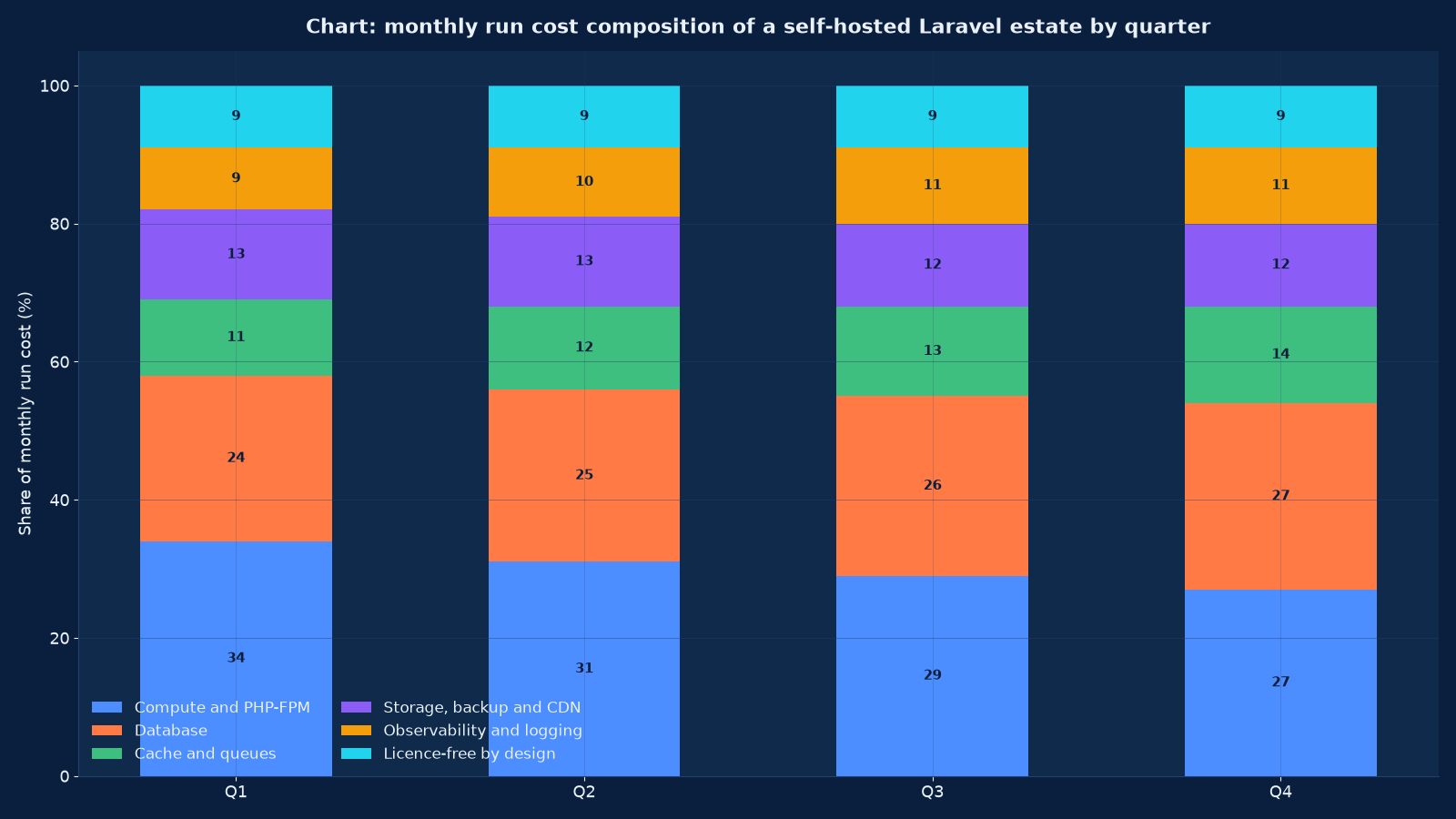
Chart values are an illustrative planning model based on typical UMC engagements and published industry benchmarks. They are not a guarantee of results on any specific project.
Security in PHP applications
PHP’s reputation for insecurity was earned by applications that concatenated user input into queries and stored passwords in plain text. Modern Laravel removes most of that surface by default, and the residual risk is in the places frameworks cannot help you: authorisation design, secrets, dependencies and configuration.
| Threat | How it arises | Our control | Verification |
|---|---|---|---|
| SQL injection | Raw queries with concatenated input, usually in legacy code or a reporting feature added quickly | Query builder and Eloquent with bound parameters; raw expressions reviewed and parameterised; static analysis flagging raw query use | Static analysis gate plus targeted injection testing per release |
| Broken authorisation | Interface-level hiding without server-side checks; object references that can be guessed (insecure direct object references) | Policies and gates on every action, ownership checks on every record access, negative test cases per role | An authorisation matrix tested with a low-privilege account attempting every high-privilege action |
| Cross-site scripting | Unescaped output, rich-text fields, file names rendered into HTML, third-party embeds | Escaped by default, explicit and reviewed unescaped output, content sanitisation on user-supplied HTML, restrictive Content-Security-Policy | Automated scanning plus manual testing of every user-content rendering path |
| Cross-site request forgery and session attacks | Missing token verification, predictable session handling, cookies without secure flags | Framework CSRF protection enabled and verified, secure and HTTP-only cookies, session regeneration on privilege change, idle and absolute timeouts | Configuration review per environment plus automated checks in the pipeline |
| Insecure file upload | Uploads accepted by extension only, stored in a web-accessible path, executed by the server | Content-type and content validation, size limits, storage outside the web root or in object storage, no execution permission on upload paths | Upload-path testing including polyglot files |
| Secrets and credential exposure | Credentials in code, in the repository history, or in environment files committed by accident | Secrets in a managed store, secret scanning in the pipeline, least-privilege database and service accounts, scheduled rotation | Repository history scanning and a credential inventory reviewed quarterly |
| Dependency and runtime vulnerabilities | Unpatched packages, abandoned libraries, end-of-life PHP versions | Composer dependency auditing, a patching service level, end-of-life register with an upgrade plan | Monthly dependency scan with triage recorded, under the maintenance retainer |
| Mass assignment and data integrity | Model binding of unfiltered request data, allowing a user to set roles, prices or ownership | Guarded and fillable attributes explicit, form requests whitelisting fields, invariant checks in services | Feature tests attempting privilege and price escalation through the API |
Security is delivered as a set of controls with verification, not as a claim. Where certification or a customer audit is the objective, the retainer’s evidence feeds ISO 27001 and SOC 2 readiness and our cybersecurity practice directly.
Data migration: the part that decides success
On legacy modernisation, the code is usually the easy half. The data carries a decade of business history, undocumented rules, duplicated records and edge cases that only appear at volume. We treat migration as an engineering workstream with rehearsals, not as a script written in the final week.
| Stage | Activity | Output | Failure mode avoided |
|---|---|---|---|
| Source profiling | Full profiling of the legacy database: row counts, null and orphan analysis, duplicate detection, referential integrity, value distributions and unmappable records | A data quality report with the size of each problem | Discovering during cutover that forty per cent of records violate a constraint the new schema enforces |
| Mapping and rules | Field-by-field mapping with transformation rules, business sign-off on ambiguous cases, and a documented decision for every unmappable record | A mapping specification the business has approved | Engineers inventing business rules to make the migration work |
| Deduplication and cleansing | Merge rules for duplicate customers, vendors and records; standardisation of names, addresses, phone formats and identifiers | A cleansed source dataset with a merge log | Migrating duplicates into a new system where they are more visible and more expensive to fix |
| Migration build and dry runs | Idempotent, resumable migration scripts run against full production copies, with timing measured and results verified | A rehearsal report: duration, record counts, exception list, verification results | A cutover window that turns out to need nine hours rather than two |
| Verification and reconciliation | Row counts, financial totals, control totals per module, sampled record comparison, and business-user verification of the records that matter most | A signed reconciliation record | “It looks right” becoming the acceptance criterion |
| Dual running and rollback | Where risk justifies it, the old and new systems run in parallel with reconciliation, and a documented rollback path exists until verification is complete | A rollback plan that has been tested, not written | A cutover that cannot be undone once a problem is found |
The rehearsal is the control that matters. A migration that has run successfully three times against production copies, with measured timings and a known exception list, is a routine operation. A migration that has never run is a gamble with the business’s history as the stake.
Team, standards and how we work with yours
Delivery is by a named team with defined roles, working in your tooling where you have it and ours where you do not. We do not rotate people through a project to fill a timesheet, and we do not subcontract.
| Role | Responsibility | Typical allocation |
|---|---|---|
| Engagement lead | Scope, plan, commercial governance, escalation, and the honest conversation when evidence contradicts the plan | Part-time, present at every review |
| Solution architect | Domain model, integration architecture, non-functional requirements, technical decisions and their recorded rationale | Heavy in discovery and integration phases, available throughout |
| Senior Laravel engineers | Service layer, APIs, integrations, queues, performance work, code review | Full-time during build |
| Front-end engineer | Server-rendered interfaces, Blade or Inertia components, accessibility and performance budgets on the front end | Full-time during interface phases |
| QA engineer | Test strategy, feature and browser test suites, UAT facilitation, load testing, regression management | From week three, not week twelve |
| Data engineer | Source profiling, mapping, migration scripts, reconciliation and rehearsal | Concentrated in migration phases |
| DevOps engineer | Environments, pipeline, infrastructure as code, monitoring, backup and restore verification | Early and continuous — environments exist before features do |
Where you have an internal team, we work alongside it: your developers in our review process, our standards adopted in your pipeline, and a handover designed so the application is yours rather than ours. Where you need capacity instead of a project, staff augmentation supplies named engineers into your process. Documentation is written as we go — architecture decisions, runbooks, API contracts and onboarding guides — because documentation produced at the end of a project is a summary of what everybody has forgotten.
Engagement models and fees
Four models. Each begins with an assessment or a scoped discovery, because a fixed price quoted against an unexamined legacy estate is a price that will be renegotiated.
| Model | Duration | Included | Best for |
|---|---|---|---|
| Legacy assessment | Two to four weeks | Code, schema, security, integration, deployment and criticality assessment; risk register; supportability verdict; three costed options including doing nothing | Any organisation that does not know what it owns — which describes most legacy estates |
| New application build | Ten to twenty weeks depending on scope | Discovery, domain and schema design, application, admin, API, integrations, tests, pipeline, load testing, deployment, hypercare and documentation | A defined process that needs software, where PHP and Laravel are the right stack on cost and hiring grounds |
| Modernisation programme | Four to nine months | Stabilisation, test enclosure around existing behaviour, strangler-fig replacement by capability, data migration with rehearsals, and legacy retirement | A critical legacy estate that cannot be replaced in one step and cannot be left as it is |
| Support and improvement retainer | Twelve months | Patching, monitoring, backups, defect management, committed change capacity, performance and security upkeep, monthly reporting and an annual health assessment | A live application with nobody internal owning it — delivered by our maintenance practice |
Fees are quoted per engagement after discovery. We publish the assumptions the quote rests on and the mechanism for changing them, so a scope conversation is a documented variation rather than a dispute. Where a client wants a fixed price against an unassessed legacy estate, we will do the assessment first and explain why the fixed price would otherwise be padded to cover unknowns — which costs more than the assessment.
Questions we are asked before every PHP engagement
Answering these early prevents the two most common failures in this market: a rebuild that reproduces the old process faithfully, and a project that runs out of budget during data migration.
| Question | Why we ask it | What changes based on the answer |
|---|---|---|
| Who does this work today, and can we interview them? | The business rules live with the people who do the process, not in the code or the documentation | Whether discovery takes two weeks or six, and whether a rebuild is safe at all |
| What happens if the application is unavailable for a day? | Criticality determines the migration strategy, the service levels and the rollback requirements | Whether we dual-run, whether we need 24 by 7 cover, and how much rehearsal is justified |
| Which reports and exports does the business actually use? | Legacy applications accumulate reporting that is either essential or dead, and rebuilding both is expensive | Scope: often a third of the reporting surface is retired with the business’s agreement |
| What are the integrations, and do we have credentials and contacts? | Undocumented integrations are where modernisation schedules are lost | The integration phase duration, and whether a stabilise-and-enclose strategy is needed first |
| Who owns the data, and what are the retention obligations? | Migration and retention rules must be designed, not inherited | Schema design, audit logging, and the archival strategy |
| Who will maintain this in three years? | The stack should match the maintaining team, not the building team | Framework and language choice, documentation depth, and the handover design |
| What is the peak load, and when does it occur? | Indian estates often have sharp seasonal peaks that a steady-state design will fail | Caching strategy, queue capacity, load-test targets and infrastructure sizing |
| What has been tried before, and why did it fail? | Previous attempts carry information that is not in any document | Risk register, stakeholder management and the acceptance criteria we insist on |
If you cannot answer three or more of these, the assessment is the right first purchase. It is a small fee relative to the cost of discovering the answers during a build, and it is the difference between a project with a plan and a project with an intention.
Frequently Asked Questions About PHP and Laravel Development
Is PHP still a sensible choice for a new application?
For a large class of business applications, yes. It has the deepest talent pool and the lowest hiring cost in the Indian market, cheap and simple hosting, no per-seat licence fees, and a mature framework in Laravel with first-class support for authentication, queues, APIs and administration. The cases where we recommend against it are heavy real-time concurrency, polyglot estates with established standards, and domains where a mature product beats custom code.
Which PHP and Laravel versions do you build on?
Currently supported versions only — a supported PHP release with opcache properly configured, and a supported Laravel release. We will not start a build on an end-of-life runtime, and where a client’s hosting constrains the version, we resolve that in discovery rather than in month nine.
Can you take over an application another vendor built?
Yes, and it is most of our work. We begin with the legacy assessment: code, schema, security, integrations and deployment path, producing a risk register and a supportability verdict. Where the code is unsupportable we say so with evidence and cost the alternatives, rather than taking a retainer fee against an application we cannot keep reliable.
Do you work with CodeIgniter, CakePHP, Zend or custom legacy code?
Yes. We maintain and modernise all of them, and we migrate from them to Laravel where the evidence supports it. The migration path is usually a strangler-fig: stabilise and secure the existing application, wrap it behind a stable interface, then replace capability by capability with dual-running and rollback at each stage.
How do you handle a database with no schema documentation?
By profiling it. We reconstruct the schema, relationships, constraints and value distributions from the running database, produce a data dictionary and a data quality report, and have the business confirm the ambiguous cases. This is standard work on legacy estates, and it is why the assessment precedes any quote.
What will it cost?
A two to four week assessment is a fixed fee. A new application build is quoted after discovery, typically ten to twenty weeks for a mid-complexity application. A modernisation programme is quoted in stages, because the second stage depends on what the first reveals. We do not quote a fixed price against an unexamined legacy estate; that price would be padded for unknowns and would cost you more than the assessment.
How long does a rebuild take?
Fourteen weeks is typical for a mid-complexity application with a handful of integrations and an admin back office. Legacy modernisation runs four to nine months because it is staged with data migration rehearsals and dual-running. Anything promised substantially faster than that is usually omitting discovery, testing or migration rehearsal.
Do you write tests?
Yes, and they are in the acceptance criteria rather than an optional extra. Feature tests per acceptance criterion, unit tests for domain logic, browser tests for critical journeys, and static analysis in the pipeline. Test coverage rising from nine to 71 per cent in Figure 1 is what makes the other improvements durable, because it is what allows the next team to change the code safely.
Can you host and support it afterwards?
Yes. We design the infrastructure, build the pipeline, verify backups with restore tests, and operate the application under a maintenance retainer with measured service levels. We are platform-neutral and equally willing to deploy into your existing hosting or cloud accounts, working with our cloud practice where the architecture needs it.
How do you keep it secure?
With controls that have verification attached: policies and gates on every action, escaped output, parameterised queries, secrets in a managed store, dependency auditing on a patching service level, upload validation, session hardening and an authorisation matrix tested with negative cases. Security work is reported in the monthly service report rather than asserted at handover.
Will you work with our internal developers?
That is the preferred arrangement. Your developers join our review process, our standards are adopted in your pipeline, and the handover is designed so your team owns the application from the start. Where you need capacity rather than a project, we supply named engineers through staff augmentation working to your prioritisation.
Commission a PHP and Laravel Assessment
Send us the application URL, whatever documentation exists, and the process it runs. Within four weeks you will have a code and schema assessment, a security risk register with severity and exposure, an integration and end-of-life inventory, a supportability verdict, and three costed options — stabilise and enclose, strangler-fig modernisation, or full rebuild — including the option of doing nothing with its measured cost.
Contact Unified Management Consulting to arrange a confidential first conversation.
Related Services
PHP and Laravel development is delivered with the practices around it:
- Website Development Services — the wider build practice this sits inside
- Full-Stack React Development — where a Laravel API is paired with a component front end
- Full-Stack .NET Development and Full-Stack Java Development — the enterprise estates a Laravel service usually integrates with
- Enterprise Systems Integration — ERP, accounting, CRM and legacy database contracts
- DevOps & CI/CD Engineering — environments, pipelines and zero-downtime deployment
- Cloud Services & Migration — hosting architecture, scaling and cost control
- Cybersecurity Services — hardening, vulnerability management and incident response
- Custom CRM Development & Integration — the most common application domain we build in PHP and Laravel
- Website Strategy & Information Architecture — task analysis, full content inventory, card sorts and tree tests, content model, navigation and governance
- Accessibility (WCAG) Remediation & Compliance — WCAG 2.2 Level AA audits, severity-ranked defect registers, design-system remediation, assistive-technology verification and accessibility statements
- Core Web Vitals & Performance Engineering — field instrumentation, LCP, INP and CLS engineering, third-party governance, performance budgets and a pipeline regression gate
- Web Application Maintenance & Support — patching, monitoring, verified backups, defect management, committed change capacity and monthly service reporting
- Headless & Composable Commerce — readiness assessment, capability mapping, storefront engineering, integration layer, migration rehearsals and cost governance
- Website Migration & Replatforming — full estate inventory, one-to-one redirect maps, functional parity, dry-run rehearsals, staged cutover and tested rollback
- Portal Development & Self-Service Platforms — entitlement modelling, single sign-on, source-system integration, self-service journeys and adoption instrumentation