
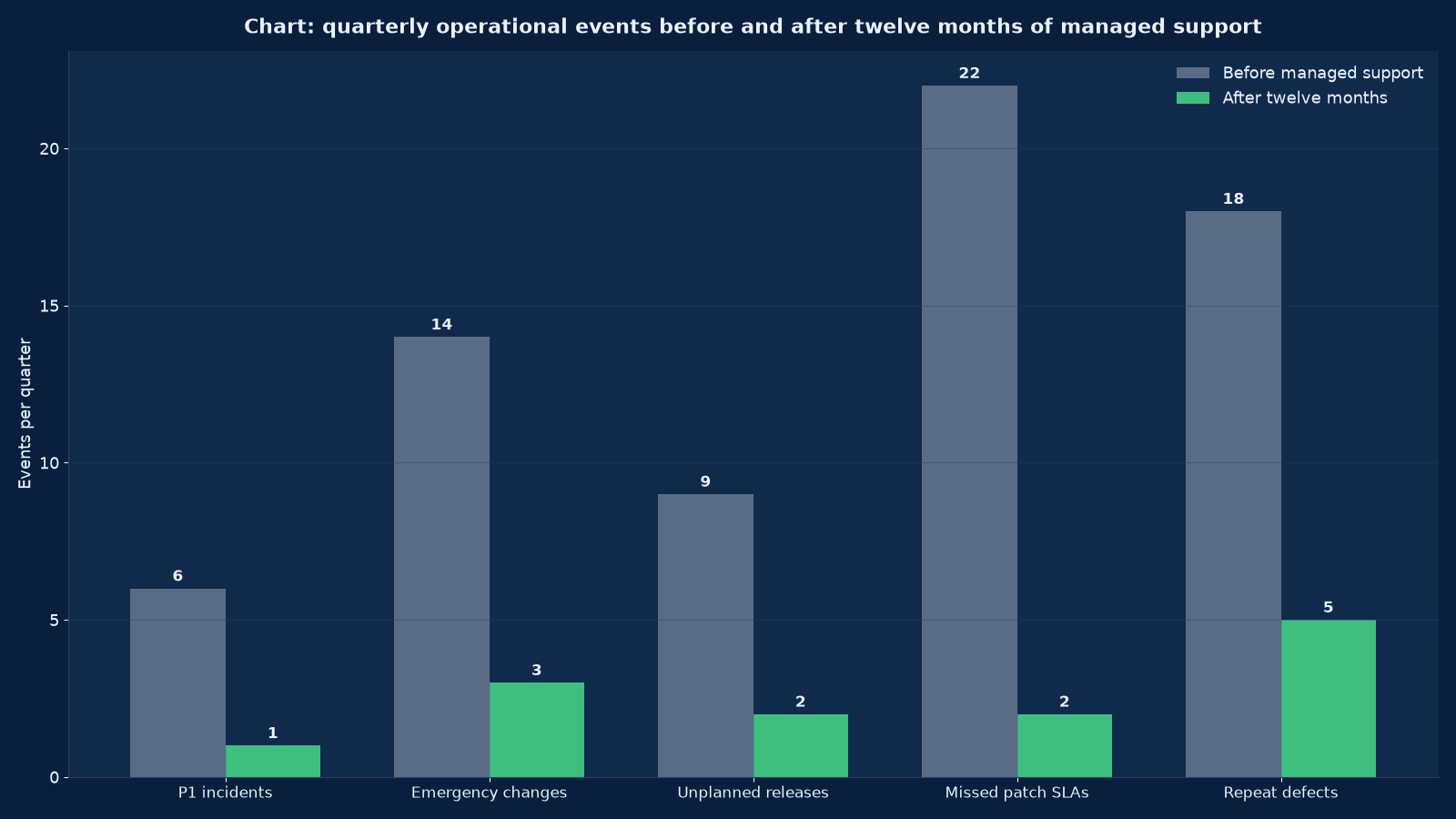
Chart values are an illustrative planning model based on typical UMC engagements and published industry benchmarks. They are not a guarantee of results on any specific project.
Software does not stay still because you are not touching it. The runtime, the dependencies, the certificates, the search engines and the threat landscape all move around it, and an untouched application gets worse every month at somebody else’s pace.
Web application maintenance and support is the discipline of keeping a live digital estate secure, available, correct and improvable after launch — with a named owner, a defined response time, a triaged intake and evidence that the work happened. Unified Management Consulting runs retainers for organisations whose websites, portals, commerce platforms and internal applications have outlived the project that built them: the vendor has moved on, the team has turned over, the documentation is a folder of Word files, and every small change is an emergency.
We support WordPress and WooCommerce estates, Laravel and PHP applications, React and Next.js front ends, Java and .NET enterprise platforms, headless commerce stacks and custom portals — including estates we did not build, which is the majority of the work. Every retainer begins with a paid handover assessment rather than a conversation about hours, because the honest price of supporting an unknown application depends on what is inside it.
🔧 Web Application Maintenance & Support — Quick Summary
| Component | What We Deliver |
|---|---|
| Handover assessment | Code, infrastructure, credentials, dependencies, documentation and deployment review, producing a risk register and a supportability verdict before any retainer is quoted. |
| Runbook and knowledge base | How to deploy, roll back, restart, purge, restore, rotate credentials and reach every third party — written down, tested, and owned. |
| Security patching | Core, plugin, framework, dependency, runtime and operating-system patching against a defined service level, with emergency out-of-cycle handling for critical advisories. |
| Uptime and availability monitoring | External synthetic monitoring, error tracking, log aggregation, alert routing and an on-call arrangement with escalation. |
| Backup, restore and disaster recovery | Automated backups with verified restores, defined recovery point and recovery time objectives, and a tested recovery run each quarter. |
| Defect management | Triage, severity classification, reproduction, fix, verification and release, with a backlog your team can see and prioritise. |
| Small feature and change work | A committed monthly capacity for changes that do not justify a project: new fields, new templates, integrations, reporting, copy and structural changes. |
| Performance and reliability upkeep | Slow-query and payload monitoring, cache effectiveness, error budgets, and continuous work against the performance baseline. |
| Accessibility and standards upkeep | New templates assessed against the accessibility standard, component regressions caught, and the conformance record kept current. |
| Content, SEO and analytics hygiene | Redirects, metadata, broken links, indexation, schema, tag integrity and analytics continuity maintained as part of the run rather than as projects. |
| Dependency and licence management | End-of-life tracking for runtimes, frameworks and third-party services, with a renewal and upgrade plan rather than a surprise. |
| Reporting and governance | A monthly service report against the agreed measures, a quarterly service review, and an annual technology health assessment with a costed improvement plan. |
Why applications decay
The decay is not mysterious and it is not usually caused by bad code. It is caused by change in the environment around the code, combined with the absence of anybody whose job is to notice. Understanding the mechanism is what makes a retainer cheaper than a rescue.
| Driver of decay | What actually happens | How it surfaces | Cost of ignoring it |
|---|---|---|---|
| Dependency and runtime drift | The language runtime, framework, libraries and plugins release updates; the application stays on a version that stops receiving security fixes | A deprecation warning becomes a fatal error after a hosting change; a critical advisory arrives with no supported upgrade path | Emergency upgrade under pressure, or a compromise, or both |
| Security exposure | Unpatched components, stale credentials, over-permissive admin access, exposed development endpoints and forgotten subdomains accumulate | Defacement, data exposure, spam injection, malware, or a finding in an audit | Incident response, notification obligations, lost trust, and remediation at several times the cost of patching |
| Certificate, domain and third-party expiry | TLS certificates, domain renewals, API keys, payment gateway credentials and plugin licences expire on dates nobody tracks | A hard outage with a browser warning, or a checkout that silently stops working | Public outage during a peak, and an urgent scramble for credentials |
| Data growth | Tables, logs, sessions, revisions and media accumulate; queries that were fast become slow | Progressive slowdown, timeouts on reports, backup windows overrunning, storage cost creep | A performance programme that could have been a quarterly hygiene task |
| Content and structural drift | Pages are added by whoever needs them, links break, metadata is copied, templates diverge | Duplicate and orphan pages, cannibalised queries, an estate nobody can navigate internally | Search visibility erodes and the eventual rebuild inherits the mess |
| Knowledge loss | The people who built it leave; the deployment process lives in somebody’s head; the documentation stops matching reality | Every change takes three times longer and carries a rollback risk nobody can quantify | Change freezes, the business routes around the application, and shadow solutions appear |
| Business change | New products, markets, regulations, payment methods, tax rules and reporting needs arrive | The application no longer reflects how the business operates; workarounds are invented by users | Manual processes grow around the system until the system is decorative |
Note that only two of these seven are about code quality. The rest are about environment, knowledge and business change — which is why a maintenance retainer is mostly governance with engineering attached, and why an hours-only contract usually fails.
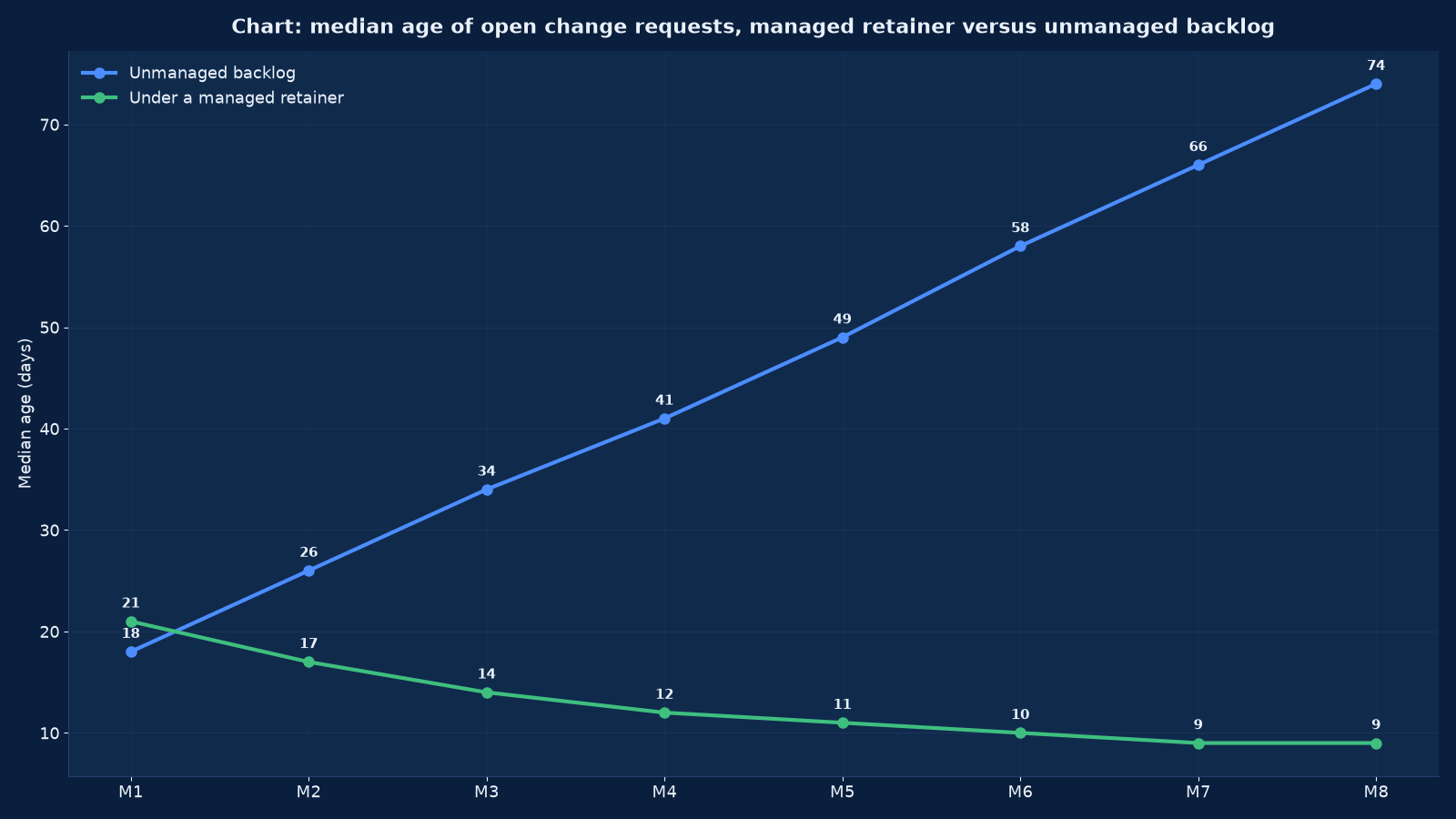
Chart values are an illustrative planning model based on typical UMC engagements and published industry benchmarks. They are not a guarantee of results on any specific project.
The handover assessment: what we do in the first three weeks
We do not quote a retainer for an application we have not opened. The assessment is a fixed-fee engagement that produces a supportability verdict, a risk register and a costed plan — and it is yours to keep whether or not you appoint us.
| Area | What we inspect | What we produce |
|---|---|---|
| Code and repositories | Repository access, branching model, commit history quality, test presence and coverage, build reproducibility, secrets in history, code ownership and documentation | A supportability score per application, and the list of things that must be fixed before support can be guaranteed |
| Infrastructure and hosting | Server or platform topology, environments, configuration management, scaling behaviour, network and DNS control, backup location and restore procedure | An infrastructure map with named owners, and the credential inventory |
| Dependencies and lifecycle | Runtime, framework, plugin, package and third-party service versions against their end-of-life dates | An upgrade roadmap with risk and effort per item, ordered by exposure |
| Security posture | Patch currency, authentication and access control, admin exposure, TLS configuration, secrets handling, logging and monitoring coverage, known vulnerabilities | A risk register with severity, and immediate remediation for critical items |
| Operations and monitoring | What is monitored, what alerts exist, who receives them, whether backups are verified, how deploys and rollbacks actually happen | A runbook, a monitoring gap list, and a tested restore record |
| Data and integrations | Database size and growth, slow queries, integration inventory, interface contracts, failure modes and retry behaviour | An integration register with owners and a failure-mode assessment |
| Content, search and analytics | Estate size, indexation health, redirects, metadata patterns, tag and analytics integrity, ownership of content | A hygiene backlog and the baseline numbers the retainer will be judged against |
| Commercials and contracts | Existing vendor contracts, licences, service levels, renewal dates and exit terms | A renewal calendar and a note on where contractual obligations constrain the support model |
The verdict is one of three: supportable as-is, supportable after a defined remediation sprint, or not supportable without a rebuild or replatforming decision. The third verdict is rare and unwelcome, and it is the one that saves the most money, because it arrives with evidence rather than after two years of retainer fees on an application that cannot be made reliable.
Service levels that mean something
A service level is only useful if it is measured, reported and consequential. We define response and resolution targets per severity, agree the clock, and publish performance against them every month. Vague commitments such as “best endeavours” protect nobody.
| Severity | Definition | Response target | Resolution or workaround target | Clock |
|---|---|---|---|---|
| P1 — Critical | The application or a revenue-bearing journey is unavailable, or data is exposed or being corrupted | 30 minutes, 24 by 7 where agreed | Continuous work until restored; workaround within four hours, root cause within three working days | Runs continuously until service is restored |
| P2 — Major | A significant function is broken or degraded with no workaround; a security advisory requires urgent patching | Two business hours | Workaround within one working day, fix within five | Business hours, extended where the client requires |
| P3 — Minor | A defect with a workaround, a non-critical page fault, or a cosmetic error affecting some users | One business day | Scheduled into the next release window | Business hours |
| P4 — Request | A change, enhancement, content update or question that is not a defect | Two business days for triage | Delivered from committed monthly capacity in priority order | Business hours |
| Security advisory — critical | A published vulnerability with a known exploit affecting a component in use | Four hours from advisory or detection | Patched, mitigated or isolated within 24 hours; verification within 48 | Runs continuously |
Two clauses make these real. First, the client receives the same monthly report we use internally, including the months we missed a target and why. Second, sustained failure triggers a service review with a remediation plan and, if agreed, a fee credit. A service level without a consequence is a marketing sentence.
What the retainer hours actually go on
Clients are often surprised by the distribution, because the visible work — features and fixes — is under half of it. Publishing the mix is part of the governance: it is how you know whether your estate is stabilising or consuming itself.
| Activity | What it covers | Healthy steady-state share | What a high share tells you |
|---|---|---|---|
| Security patching and dependency updates | Core, framework, plugin, package, runtime and OS patching, plus testing after each update | 15 to 20 per cent | Above 25 per cent usually means the estate is behind and catching up, or has too many fragile dependencies |
| Defect fixing | Reproduction, diagnosis, fix, verification and release of faults | 15 to 25 per cent | A rising share indicates underlying quality or integration problems, not a busy month |
| Small feature and change work | Committed capacity for enhancements that do not justify a project | 20 to 30 per cent | A falling share means the estate is in survival mode and the business is routing around it |
| Monitoring, on-call and incident response | Alert handling, synthetic checks, log review, incident management and post-incident review | 12 to 18 per cent | Above 20 per cent suggests the monitoring is noisy or the platform is unstable |
| Content, SEO and analytics hygiene | Redirects, metadata, broken links, indexation, schema, tag and analytics integrity | 10 to 15 per cent | Below 8 per cent usually means the estate is drifting quietly and search visibility will follow |
| Performance, accessibility and reliability upkeep | Baseline monitoring, budget enforcement, new-template accessibility checks, cache effectiveness | 8 to 12 per cent | Zero per cent is how an estate passes an audit one year and fails it the next |
| Governance, reporting and planning | Service reports, quarterly reviews, roadmap maintenance, vendor and licence management | 5 to 10 per cent | Below 5 per cent means decisions are being made without evidence |
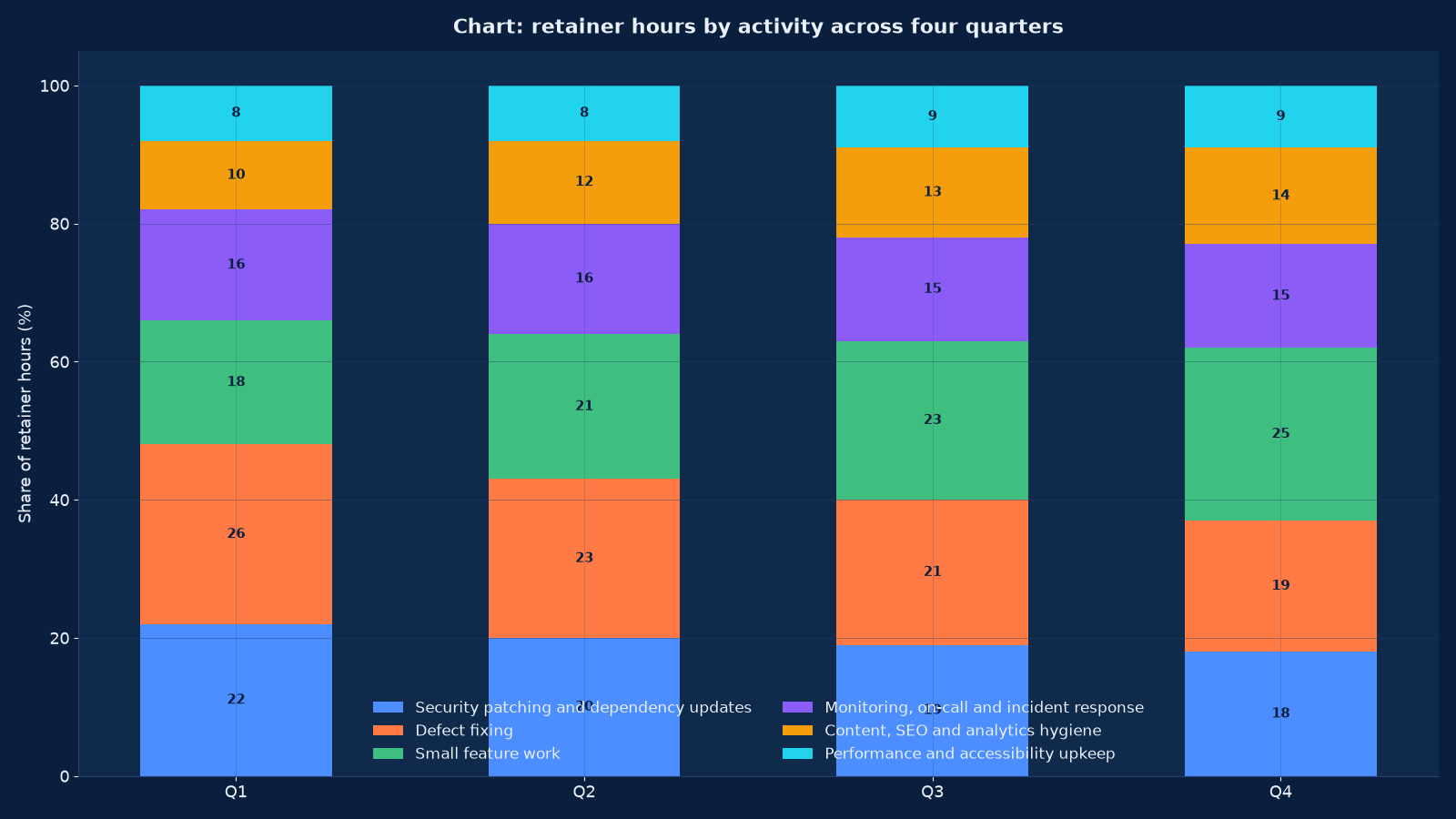
Chart values are an illustrative planning model based on typical UMC engagements and published industry benchmarks. They are not a guarantee of results on any specific project.
Intake and triage: the rule that fixes the backlog
The single highest-leverage change in an unsupported organisation is not more engineers. It is an intake rule. Unmanaged backlogs age because every request arrives with equal urgency and capacity is allocated by whoever shouts last — the mechanism visible in Figure 2.
| Stage | What happens | Who decides | Output |
|---|---|---|---|
| Single intake channel | All requests — from any department, vendor or user — enter one queue with a mandatory description, affected users and business impact | Service owner | One backlog instead of eleven inboxes and a WhatsApp group |
| Triage within one working day | Each item is classified as defect, change, question or incident, assigned a severity, and either scheduled, rejected with a reason, or sent back for information | Delivery lead | A severity and an owner for every item; nothing unclassified |
| Prioritisation against capacity | Committed monthly capacity is allocated: security and defects first, then agreed change work in priority order | Client product owner with the delivery lead | A published sprint plan the business can see and argue with |
| Change control for risky items | Changes touching payments, authentication, data structure or integrations require a stated rollback plan and a test record before release | Delivery lead, escalating to the client for P1-adjacent work | Fewer emergency changes, which is the measure that improves fastest |
| Release windows | Scheduled releases with a defined freeze period before known peaks, plus an emergency path that is documented rather than improvised | Delivery lead | Predictability, and a reason to say no to a Friday deploy |
| Closure and verification | Every item is closed with evidence: what changed, how it was tested, and what the requester should now see | Delivery lead | No repeat defects from unverified fixes |
The client product owner role is not optional and it is not us. Somebody on your side must be able to say which of two legitimate requests matters more. Where that role does not exist, we help appoint it — often through a unified management arrangement — because a retainer without a decision maker becomes a queue with a fee.
Backup, restore and disaster recovery
A backup that has never been restored is a hypothesis. Our standard is automated backups with documented retention, offsite copies, encryption, and a restore test performed on a schedule with the result recorded. Where the recovery objective cannot be met by the current platform, we say so during the assessment rather than after an incident.
| Control | Standard | Why it matters | How it is evidenced |
|---|---|---|---|
| Backup frequency and scope | Database at least daily and before every release; files and media on a defined schedule; configuration and infrastructure-as-code under version control | Partial backups are the common failure: the database is restored and the media library is not | Backup job logs plus a manifest of what each backup contains |
| Offsite and immutable copies | At least one copy in a separate location or account, protected from deletion by compromised credentials | Ransomware and compromised admin accounts specifically target reachable backups | Storage configuration review and a restore from the offsite copy |
| Retention | Defined retention per backup class — typically 30 daily, 12 weekly, 12 monthly — aligned to any regulatory obligation | A corruption discovered six weeks later cannot be fixed by last night’s backup | Retention policy plus a test restore of an aged backup |
| Recovery point and time objectives | Explicit RPO and RTO per application, agreed with the business rather than assumed | Without a number, nobody knows whether the current design is adequate | The objectives, and the measured time of each restore test against them |
| Scheduled restore testing | A full restore into a staging environment each quarter, with data verification | Restore procedures fail for boring reasons: missing credentials, changed storage, expired certificates | A dated restore record with duration, verifier and findings |
| Incident and compromise response | A documented path for defacement, injected spam, malware and credential compromise, including isolation and clean-restore decisions | Speed of isolation determines the scale of the incident | The runbook, plus a post-incident review after any real event |
| Disaster recovery for platform loss | A rebuild-from-scratch path: infrastructure definition, deployment pipeline, data restore and DNS cutover | Hosting providers and platforms fail, or a contract ends abruptly | An annual rebuild exercise, or at minimum a documented and tested recovery path |
Where the estate needs a stronger posture than a retainer can provide — regulated data, payment card scope, critical infrastructure — we deliver it with backup and disaster recovery services and cybersecurity services, and the retainer operates the controls rather than defining them.
Security patching and vulnerability management
Patching is the least glamorous and most consequential part of the retainer. The service level matters more than the intent: an estate patched within days of an advisory is a different risk profile from one patched when somebody notices.
| Activity | Cadence | Scope | Evidence |
|---|---|---|---|
| Routine patching | Weekly or fortnightly, in a scheduled release window | CMS core, plugins and themes, framework and package dependencies, runtime versions, server packages | A patch log per release with versions before and after, and the test record |
| Critical advisory response | Within the agreed critical service level, out of cycle | Any component with a published exploit or a critical severity rating affecting the estate | Timestamped advisory receipt, action taken, and verification |
| Dependency and licence review | Quarterly | End-of-life dates, abandoned packages, licence compliance, and packages that can be removed entirely | A lifecycle register with a decision per item |
| Vulnerability scanning | Monthly, and before any major release | Application and infrastructure scanning, plus known-vulnerability checks on the dependency tree | Scan reports with triage: accepted risk, remediated, or false positive with reasoning |
| Access and credential hygiene | Quarterly, and on any staff or vendor change | Admin accounts, API keys, deployment credentials, database users, third-party access, multi-factor coverage | A credential inventory with rotation dates and an offboarding record |
| Security configuration review | Twice yearly | TLS configuration, security headers, admin exposure, file permissions, debug settings, exposed endpoints and forgotten subdomains | A configuration baseline with deviations recorded and dated |
| Penetration test support | As required by your audit cycle | Remediation of findings, retesting, and evidence for the auditor | A closure record per finding, linked to the test report |
We do not sell fear and we do not inflate findings. Where a scan reports an issue that cannot be exploited in your configuration, we record it as an accepted risk with the reasoning, which is what an auditor wants to see. IT audit and ISO 27001 / SOC 2 readiness is the engagement to pair with the retainer where certification is the objective.
Monitoring and observability
Monitoring that produces noise is worse than no monitoring, because it trains everybody to ignore the alert channel. We define what is watched, what threshold matters, who is told, and what they do — then we measure the alert volume itself as a service metric.
| Layer | What is monitored | Alert threshold | First action |
|---|---|---|---|
| Availability | External synthetic checks on the homepage, one money page, the login and the checkout or booking journey, from multiple locations | Any failed check confirmed by a second location | Page the on-call engineer; classify as infrastructure, application or third party |
| Error tracking | Application exceptions, failed requests, queue failures and integration errors, with release tagging | A new error signature, or an error rate above the agreed baseline | Triage against the last release; roll back if the release caused it |
| Performance | Response times at the 75th and 95th percentile, slow queries, cache hit rates, payload and field Core Web Vitals | Sustained degradation beyond the performance budget | Identify the layer — origin, database, cache or third party — before changing anything |
| Infrastructure | CPU, memory, disk, connection counts, queue depth, certificate expiry, domain and licence renewal dates | Threshold breach, or any expiry within 30 days | Scale or clean up; the expiry alerts are the ones that prevent public outages |
| Logs and audit trail | Authentication events, admin actions, data exports, deployment events and security-relevant changes | Anomalies: repeated failures, privilege changes, unusual export volumes | Investigate as a potential security event, not as a support ticket |
| Business function | Form submissions, orders, payments, registrations, integration throughput — the transactions that matter | A drop below the expected volume for the time of day and week | Treat as P1 even if every technical check is green; a silent checkout failure looks healthy to infrastructure monitoring |
That last row is the one most estates lack, and it is the reason a payment gateway misconfiguration can run for a day. Technical monitoring proves the server is answering; business monitoring proves the business is working. We instrument both, with analytics and attribution carrying the measurement layer.
Continual improvement, not just continuity
A retainer that only keeps the lights on is a cost centre, and it will be cut in the first budget review. Ours carries a committed improvement capacity and an annual technology health assessment, so the estate is measurably better in month twelve than in month one.
| Instrument | Cadence | Content | Outcome |
|---|---|---|---|
| Monthly service report | Monthly | Uptime, incidents, service-level performance, defects opened and closed, backlog age, releases, security patching status, and the hours mix | A shared factual record; the document that settles disputes about what happened |
| Quarterly service review | Quarterly | Trend analysis, dependency lifecycle, capacity review, backlog prioritisation for the next quarter, and the risk register | A re-prioritised plan and a decision on capacity |
| Annual technology health assessment | Annually | Code quality, test coverage, architecture fitness, infrastructure cost, security posture, performance and accessibility against baseline, plus a costed three-year outlook | The evidence for a rebuild, replatform or continued investment decision |
| Improvement backlog | Continuous | Technical debt items with measured cost: the slow query, the fragile integration, the untested module, the manual process | Debt reduced deliberately rather than discovered during an incident |
| Post-incident review | After every P1 and P2 | Timeline, root cause, contributing factors, what worked, and the specific changes that prevent recurrence | Repeat defects falling — the measure in Figure 1 that improves fastest |
| Cost review | Twice yearly | Infrastructure, licences, third-party services and retainer capacity against actual usage | Savings or a justified increase, with the numbers rather than an opinion |
The annual assessment is deliberately blunt. If the honest conclusion is that the application should be replaced, we write that down with the evidence and the cost comparison, and we help you plan the transition — which is the behaviour that makes the preceding eleven months of advice worth trusting.
Engagement models and fees
Four models. All begin with the handover assessment; none is quoted on hours alone, because hours without a supportability verdict is how both sides end up disappointed.
| Model | Shape | Included | Best for |
|---|---|---|---|
| Managed support retainer | Monthly fee with committed capacity, agreed service levels and a named delivery lead | Everything in the Quick Summary: patching, monitoring, backups, defect management, committed change capacity, hygiene, reporting and the annual assessment | A live estate the business depends on, where nobody internal owns it |
| Care-plan retainer | Lower monthly fee with defined scope and no committed change capacity | Patching, monitoring, backups, verified restores, defect triage, monthly report; changes quoted separately | A stable estate with low change volume and an internal team that can implement |
| Staff augmentation into your team | Engineers embedded in your process, on your tooling, to your standards | Capacity and skills, with your prioritisation and your governance; we supply the runbook discipline and the security practices | An internal team that needs hands or specific expertise, delivered through staff augmentation |
| Rescue and stabilisation | Fixed-fee, four to eight weeks | Incident resolution, security remediation, backup and restore verification, monitoring stood up, runbook written, and a decision paper on the future of the application | An estate in crisis: compromised, abandoned by its vendor, or failing repeatedly |
Fees are set after the assessment, based on estate size, application count, criticality, third-party complexity and the required service levels. We publish what is in scope and what is not, including the awkward exclusions — a rebuild, a replatforming exercise, or a major integration are projects and are quoted as projects, not absorbed silently into a retainer.
Transitioning an estate to us
Transition is a project with a plan, not an email exchange about credentials. The typical sequence runs six weeks and overlaps the outgoing vendor’s contract rather than starting after it ends.
| Week | Activity | Risk managed |
|---|---|---|
| 1 | Assessment complete; credential, licence and contract inventory; access granted to repositories, hosting, DNS, analytics, monitoring and third parties | Being unable to act during an incident because access was never transferred |
| 2 | Monitoring and alerting stood up; backup verification and a restore test; runbook drafted from what actually happens rather than what the documentation claims | Blind spots during the handover window |
| 3 | Deployment path proven: a change is made, tested, released and rolled back in staging and production | Discovering during an emergency that nobody can deploy |
| 4 | Critical patching and end-of-life items addressed; security configuration review; credential rotation | Inheriting an unpatched estate and being blamed for it later |
| 5 | Intake channel live with the client product owner; backlog imported, classified and prioritised; service levels agreed and published | The first month becoming an unmanaged flood of requests |
| 6 | Steady state begins: first monthly report, first release window, first quarterly review scheduled | Ambiguity about who owns what, which is the usual cause of a failed transition |
Where the outgoing vendor is uncooperative — which happens — the assessment week is extended and we work from what the estate itself tells us: the deployed artefacts, the database, the infrastructure and the traffic. It is slower and more expensive, and we quote it honestly rather than discovering it in month two.
Frequently asked commercial questions, answered plainly
These are the questions that decide whether a retainer is the right instrument, and we would rather answer them before the contract than during a dispute.
| Question | Our position |
|---|---|
| Do you support applications you did not build? | Yes — most of our retainer clients come to us that way. The handover assessment exists precisely for this case, and we will decline an estate we cannot support safely rather than take the fee and fail. |
| What if the estate is built on something obscure or abandoned? | We assess it and tell you the truth: supportable, supportable after remediation, or not supportable. Where a dependency is abandoned, the options are to fork it, replace it or accept the risk in writing, and we cost all three. |
| Who owns the code and the work you produce? | You do. Work product, documentation, runbooks and credentials belong to the client, and we do not hold your estate hostage to our tooling. Exit is planned from day one. |
| Can we reduce or end the retainer? | Yes, on the agreed notice period, with a structured handover including documentation, credentials and a transition call. A retainer you cannot leave is not a service, it is a trap. |
| Do you subcontract? | No. The engineers on your estate are ours, named in the runbook, with the security and confidentiality obligations that implies. |
| What is not included? | Rebuilds, replatforming, major new integrations, net-new applications, and third-party licence costs. Each is quoted as a project with its own acceptance criteria. |
| How do we know we are getting value? | From the monthly report against the agreed measures: uptime, service-level performance, backlog age, repeat defects, patching currency, incident count and the hours mix. If those are not improving, the conversation is about the retainer, not about the invoice. |
We also publish, in the first month, the measures we will be judged on and their baselines. Choosing the measures after the fact is how service relationships become arguments about opinion.
The economics: retainer, rescue or rebuild
Three options are usually in front of a client considering this page, and they are frequently compared badly — a retainer fee against a rebuild quote, with the rescue cost left out because it has not happened yet. The honest comparison includes all three, plus the cost of doing nothing, which is the option that is actually chosen when no decision is made.
| Option | Cost shape | What it buys | When it is the right answer |
|---|---|---|---|
| Managed retainer | Predictable monthly fee with committed capacity; small year-on-year increase | Continuity: patching, monitoring, verified backups, incident response, committed change capacity and an annual health assessment | The application is fit for purpose and the business depends on it — the common case |
| Rescue and stabilisation | Fixed fee over four to eight weeks, usually several times a month of retainer | Recovery from a crisis: compromise, abandonment, repeated failure, or a vendor that has disappeared | Something has already broken, or the assessment verdict is that the estate is one incident away from breaking |
| Rebuild or replatform | A project fee, typically an order of magnitude above a year of retainer, plus migration risk | A new capability set, a maintainable architecture and a lower future run cost | The annual health assessment shows the run cost and the risk exceeding the cost of replacement — not merely that the technology is old |
| Doing nothing | Zero today, and the largest of the four in expectation | Nothing. Decay continues at the environment’s pace until it produces an incident, a compromise or an emergency upgrade | Never — though it is the default wherever nobody owns the estate |
The arithmetic that changes minds is simple. Compare twelve months of retainer against the cost of one rescue engagement plus the business impact of the outage that prompted it, and against the probability of that outage in an unpatched, unmonitored estate. We publish the numbers from your own assessment rather than an industry average, because the variance between estates is larger than any benchmark. the hidden cost businesses forget to budget for sets out the same argument for smaller estates, and the signs your website needs a redesign rather than a refresh is how to tell a maintenance problem from a rebuild problem.
What a good maintenance contract contains
Most disputes in this market come from contracts that describe goodwill rather than obligations. These are the clauses we put in ours, and the ones we recommend you look for in anybody else’s.
| Clause | Why it matters | The weak version to watch for |
|---|---|---|
| Defined scope, in and out | Both sides know what the fee covers; projects are quoted as projects | “Support as required”, which means every change becomes an argument |
| Measured service levels with a consequence | Response and resolution targets per severity, reported monthly, with a service review or fee credit on sustained failure | “Best endeavours” and “commercially reasonable”, which are unenforceable |
| Committed capacity, not only availability | A stated monthly allocation for change work, so improvements happen without a fresh negotiation each time | An hours pool that is consumed entirely by incidents, leaving no capacity for improvement |
| Client obligations | Access, a named product owner, decision turnaround times, and environment availability | A contract where every delay is the vendor’s fault by construction |
| Intellectual property and work product | The client owns the code, documentation, runbooks and credentials produced | Vendor-owned tooling or documentation that makes leaving expensive |
| Security and confidentiality obligations | Named controls: least-privilege access, credential handling, background checks, incident notification timelines, data-handling restrictions | A one-line confidentiality clause with no operational content |
| Subcontracting position | Whether work may be passed to third parties, and on what terms | Silence, which usually means it may be |
| Exit and handover | Notice period, structured handover, credential rotation and transfer, open-item summary, and a transition call | No exit clause, or one that requires the vendor’s cooperation to leave |
| Change control for the contract itself | How scope, capacity and fees are reviewed — typically at the annual assessment | Automatic uplift clauses with no evidence requirement |
| Liability and insurance | Proportionate liability, professional indemnity and cyber cover stated, with exclusions listed | A liability cap so low that a serious incident leaves the client carrying all of it |
We will review a maintenance contract you have been offered by somebody else, as a short fixed-fee engagement. It is a cheap piece of work relative to what a bad one costs in year two, and it is often the moment a client discovers that the “unlimited support” they bought excludes every category of work they actually need.
Frequently Asked Questions About Web Application Maintenance and Support
What does a maintenance retainer cost?
It depends on estate size, application count, criticality and the service levels you require, and we quote it after the handover assessment rather than before. What we will not do is quote an hourly rate against an unknown application and then renegotiate in month three when the unknown turns out to be difficult.
How quickly can you take over an existing site?
Six weeks for a normal transition, overlapping the outgoing vendor’s contract. A compromised or failing estate gets the rescue and stabilisation route instead, where monitoring, backups and patching are stood up in the first two weeks and the rest of the transition follows.
Do you provide 24 by 7 cover?
Where agreed and priced. Critical incidents on revenue-bearing or statutory systems usually justify it; a marketing brochure site usually does not. We will tell you which category you are in rather than selling cover you do not need.
Can you work alongside our internal developers?
Yes, and it is the best arrangement where you have capacity. We take the operational load — patching, monitoring, backups, incidents, hygiene — and your team takes the product work, or we supply additional capacity through staff augmentation under your prioritisation.
What happens if something breaks during a change you made?
We roll back. Every change above a defined risk level has a rollback plan before it is released, and the release windows exist so that a rollback is a scheduled action rather than a crisis. The incident is then reviewed and the cause addressed, which is why repeat defects fall over time.
Do you handle hosting and infrastructure too?
We can operate your existing hosting, or design and run the infrastructure where that is part of the scope, working with cloud services, DevOps and CI/CD and managed infrastructure and AMC. We are platform-neutral and we will recommend against a migration that has no measurable benefit.
How do you keep our site’s search performance from decaying?
Redirects, metadata, broken links, indexation, schema and tag integrity are in the hygiene allocation — typically ten to fifteen per cent of retainer hours — and the baseline is captured in the assessment. Where a full search programme is needed, that is delivered with our SEO practice as a project rather than absorbed into the retainer.
Will you maintain accessibility and performance standards?
Yes. New templates are checked against the accessibility standard and the performance budget before release, and the conformance record and field metrics are kept current. This is the cheapest possible time to do it: retrofitting either, years later, costs several times more.
What reporting will we get?
A monthly service report covering uptime, incidents, service-level performance, defects, backlog age, releases, patching status and the hours mix; a quarterly service review with trend analysis and re-prioritisation; and an annual technology health assessment with a costed three-year outlook. You get the same report we use internally, including the months we missed a target.
Can you support an estate with no documentation and no access to the original vendor?
Yes. The assessment reconstructs the documentation from the deployed artefacts, the database, the infrastructure and the traffic, and produces the runbook. It takes longer and costs more than a documented handover, and we quote that difference honestly instead of pretending the estate is ordinary.
How do we exit if we want to?
On the agreed notice period, with a structured handover: documentation, runbooks, credentials rotated and transferred, a transition call with the incoming team, and a written summary of open items and known risks. You own everything we produced, and we plan the exit from the first month rather than negotiating it at the end.
Commission a Handover Assessment Before You Commit to a Retainer
Send us the URL, whatever documentation exists, and the credentials you can grant. Within three weeks you will have a supportability verdict for every application, a risk register with severity and exposure, an upgrade roadmap ordered by end-of-life date, a runbook drafted from what actually happens, a verified restore, and a costed retainer proposal with the service levels we are prepared to be measured against.
Contact Unified Management Consulting to arrange a confidential first conversation.
Related Services
Maintenance retainers operate the controls that these practices design:
- IT Helpdesk & End-User Support — the user-facing support layer alongside application support
- Managed IT Infrastructure & AMC — the infrastructure and hardware estate underneath the applications
- Backup & Disaster Recovery — recovery objectives, immutable copies and tested restores
- Cybersecurity Services — vulnerability management, hardening and incident response
- IT Audit, Compliance & ISO 27001 / SOC 2 Readiness — certification programmes that the retainer’s evidence supports
- DevOps & CI/CD Engineering — the pipeline, environments and release automation the retainer depends on
- Website Development Services — the change and feature capacity beyond committed retainer hours
- Risk, Governance & Business Continuity Support — where application dependency becomes an enterprise risk to be registered and owned
- Website Strategy & Information Architecture — task analysis, full content inventory, card sorts and tree tests, content model, navigation and governance
- Accessibility (WCAG) Remediation & Compliance — WCAG 2.2 Level AA audits, severity-ranked defect registers, design-system remediation, assistive-technology verification and accessibility statements
- Core Web Vitals & Performance Engineering — field instrumentation, LCP, INP and CLS engineering, third-party governance, performance budgets and a pipeline regression gate
- PHP & Laravel Development — legacy assessment, domain modelling, strangler-fig modernisation, APIs, test automation and CI/CD on modern PHP
- Headless & Composable Commerce — readiness assessment, capability mapping, storefront engineering, integration layer, migration rehearsals and cost governance
- Website Migration & Replatforming — full estate inventory, one-to-one redirect maps, functional parity, dry-run rehearsals, staged cutover and tested rollback
- Portal Development & Self-Service Platforms — entitlement modelling, single sign-on, source-system integration, self-service journeys and adoption instrumentation