
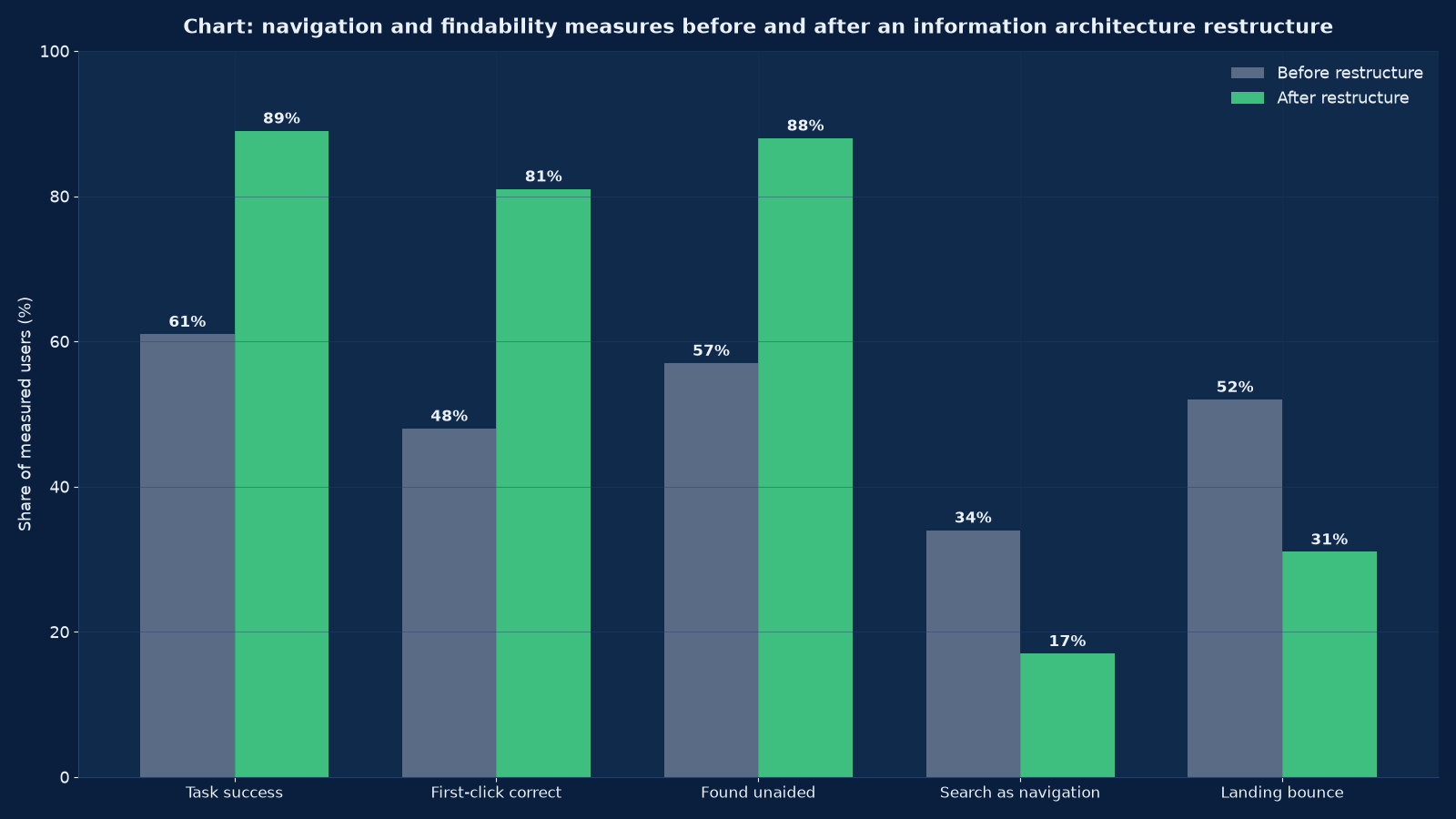
Chart values are an illustrative planning model based on typical UMC engagements and published industry benchmarks. They are not a guarantee of results on any specific project.
A website rarely fails because the design was ugly. It fails because nobody could say which six things the site was for, so it became all of them at once, and the structure showed it.
Website strategy and information architecture is the work that happens before a single page is designed: establishing what the site must do for the business, which tasks the audience actually arrives with, what content already exists and what each page is worth, and then turning that into a structure, a content model, a navigation system and a governance arrangement that a team can run without you. Unified Management Consulting runs this for manufacturers, hospitals and clinic groups, universities and coaching networks, financial services firms, export houses, hospitality groups, public-sector undertakings and software companies — usually on estates of eighty to twelve thousand pages, usually at the moment when a rebuild, a rebrand, a merger or a decade of accumulated additions has made the site unusable by its own owners.
We are deliberately not a design studio and not a development shop in this engagement. We produce the specification, the evidence and the decision framework; your team or ours then builds to it. That separation is what makes the output honest — an agency that is about to sell you a build has a structural incentive to conclude that a build is what you need.
🧭 Website Strategy & Information Architecture — Quick Summary
| Component | What We Deliver |
|---|---|
| Discovery and evidence base | Stakeholder interviews, analytics and search console forensics, support-ticket and sales-call mining, and a competitive structure review — the questions the site is currently failing. |
| Task analysis and user research | The eight to fifteen jobs people actually arrive with, ranked by volume and by value, with the evidence for each and the pages that currently serve them badly. |
| Full content inventory | Every URL crawled and scored on traffic, engagement, conversion, freshness, duplication and ownership — not a sample, and not a guess from the sitemap. |
| Disposition and consolidation plan | Keep, rewrite, merge, retire-and-redirect or create, page by page, with the redirect map that protects the organic demand the estate already earns. |
| Information architecture | The structure decision: grouping logic, depth, naming, faceting and the URL scheme, tested with card sorts and tree tests before anyone argues about a menu. |
| Navigation and findability model | Global, sectional and contextual navigation, plus on-site search behaviour, metadata patterns and the internal-link rules that make deep pages reachable. |
| Content model and template set | Named content types with required and optional fields, the templates that render them, and the editorial rules that keep them consistent after launch. |
| Priority journey wireframes | Low-fidelity wireframes for the six to ten journeys that carry the revenue, so the structure is proven against real content rather than lorem ipsum. |
| Technical and SEO handover spec | The requirements a build team needs and cannot infer: URL scheme, canonical rules, schema per content type, rendering constraints, performance budgets and migration redirects. |
| Governance and decision rights | Who owns each content type, who approves a new page, what the review cadence is, and what stops the estate re-growing into the mess you just cleared. |
| Measurement plan | A KPI tree that connects structure to outcomes — task success, first-click correctness, search reliance, assisted conversions — with baselines captured before the work starts. |
| Handover and 90-day review | Editor training, a pattern library, a backlog of structure debt, and a scheduled review against the baselines so the strategy is measured, not merely delivered. |
Why websites fail before anyone designs anything
The failure is almost never visual. Across the estates we audit, the same six causes account for most of the measurable loss, and all six are structural — which is why they survive three redesigns, because a redesign changes the skin and keeps the skeleton.
| Failure mode | How it shows up in the data | What it costs |
|---|---|---|
| Nobody can state the site’s job | Traffic spread thinly across thousands of pages; no page carries a conversion path; stakeholder interviews produce eleven different answers | Every subsequent decision is an opinion, so the loudest voice wins and the site accumulates competing purposes |
| Structure mirrors the org chart | Navigation labels match department names; users search instead of browsing; first-click correctness below 50 per cent | Visitors must know how you are organised before they can buy from you — they do not, and they leave |
| Ten years of accumulated additions | Duplicate and near-duplicate pages, orphan pages with no internal link, four templates for one content type | Crawl budget wasted, keyword cannibalisation, and an editorial team that cannot find its own content |
| No content model, only pages | Each page hand-built; fields live in body copy; listings cannot be sorted, filtered or syndicated | Every new page is a project, so publishing slows to a crawl and the site goes stale |
| No owner, no review cycle | Pages quoting last year’s prices, dead phone numbers, discontinued products still listed | Trust damage in exactly the moments that decide a purchase, and remediation cost later |
| Metrics that cannot be acted on | Reporting is sessions and bounce rate by channel with no task-level view | The team optimises what it can see, which is not what matters, and the rebuild is justified by aesthetics |
The consequence is a particular kind of wasted money: a rebuild that reproduces the existing structure in a new theme. It looks like progress in the launch photographs, and the analytics look flat six weeks later because nothing that determined behaviour was changed.
What this engagement produces
A website strategy and information architecture engagement produces eleven artefacts. They are listed here with the decision each one exists to support, because an artefact that does not settle an argument is decoration.
| Artefact | What it contains | The decision it settles |
|---|---|---|
| Evidence brief | Analytics and Search Console forensics, ticket and call themes, competitive structure review, stakeholder positions | What the site must stop doing, and what it must start doing |
| Task inventory | Ranked jobs-to-be-done with volume, value, current success rate and the pages that serve them | Which six to ten journeys get designed first and funded properly |
| Content inventory and scoring | Every URL with traffic, engagement, conversions, freshness, duplication, owner and verdict | What is kept, rewritten, merged, retired or created |
| Redirect map | Old URL to new URL, one-to-one wherever demand exists, with the exceptions named | How organic demand is protected through the change |
| Sitemap and IA model | Grouping logic, depth, labels, faceting, URL scheme, and the rejected alternatives with reasons | The structure itself — the one decision everything else depends on |
| Navigation specification | Global, sectional and contextual navigation, menu depth rules, mega-menu behaviour, breadcrumbs, mobile pattern | How people move, on every breakpoint |
| Content model | Content types, required and optional fields, validation rules, relationships and the templates that render them | How content is produced after launch, by non-specialists |
| Priority wireframes | Low-fidelity layouts for the funded journeys, annotated with field names and states | Whether the structure survives contact with real content |
| Technical and SEO specification | Rendering constraints, canonical and pagination rules, schema per type, performance budgets, internal-link rules | What the build team must not decide for itself |
| Governance model | Ownership by content type, approval flow, review cadence, backlog and pattern library rules | Who is allowed to add a page, and on what evidence |
| Measurement plan | KPI tree, baseline values, instruments, reporting cadence and the 90-day review agenda | How success will be judged, agreed before the work starts |
Every artefact is delivered in an editable form your team can maintain. We do not deliver a locked document, a proprietary tool subscription or a diagram that only its author can update.
The evidence base: what we measure before we recommend
Recommendations in this discipline are cheap; evidence is what makes them defensible in a room where three directors have three different websites in their heads. We build the evidence base from six sources, and we publish the numbers even when they contradict what the sponsor expected.
| Source | The question it answers | What we typically find |
|---|---|---|
| Analytics, 24 months | Where demand actually goes, and which pages earn it | Between 62 and 91 per cent of sessions land on fewer than forty pages, while the estate holds thousands |
| Search Console, 16 months | What the site is asked for, and what it fails to answer | Query clusters with impressions and no click share — demand the structure does not serve; plus cannibalised clusters where four pages split one intent |
| On-site search logs | What people could not find by browsing | The top twenty search terms are usually a specification of the navigation that should exist |
| Support tickets and sales calls | What people ask a human because the site did not answer | Repeated questions that are structural, not editorial — pricing, eligibility, coverage, comparison |
| Session recordings and five-user tests | Where the structure breaks in practice | First-click errors concentrate at the second level, where department logic meets user logic |
| Competitive structure review | What the market’s winners have already settled | Two or three grouping conventions dominate a sector; deviating from all of them is a cost, not a differentiator |
We also record what cannot be measured. If a journey has no instrumented event, we say so and specify the event, rather than substituting a proxy that will be quoted as a result later. See our Search Console field guide for the query-level method, and what actually moves rankings for how structure interacts with the rest of search performance.
Task analysis: the eight jobs that decide the structure
An information architecture is a hypothesis about what people arrive to do. We convert that hypothesis into a ranked task inventory, and the ranking — not the org chart — drives the top two levels of the structure. Tasks are ranked on volume, on value per completion, and on how badly the current site serves them, which is where the largest gains usually hide.
| Task class | Example | Structural implication |
|---|---|---|
| Understand and qualify | “Is this the right kind of supplier for a 400-bed hospital?” | Needs a category page with proof, not a brochure page; capability pages must be comparable side by side |
| Compare options | “Which of these three services fits a 40-outlet retail chain?” | Needs a comparison pattern and consistent field names across sibling pages |
| Price and scope | “What will this cost and what is included?” | Needs an honest pricing pattern per service; hiding it converts traffic into emails to a sales team that answers the same question daily |
| Verify credibility | “Have they done this for someone like us?” | Needs case studies reachable from every service page, filterable by sector and by problem |
| Transact or book | “Book an assessment / request a proposal / buy” | Needs one conversion path per task with the fewest fields that will still qualify the lead |
| Self-serve after purchase | “Where is my invoice / ticket / report?” | Belongs behind authentication; mixing it into the public structure is why portals get rebuilt |
| Learn and evaluate | “What does this actually mean for my business?” | Needs editorial content mapped to task stages, not a blog that only ranks |
| Contact a human | “I have a question this site did not answer” | Needs routing by intent and location, and the query itself is a defect report on the structure |
Two of these classes are usually missing entirely from sites we audit: comparison and post-purchase self-service. The first is why sales teams repeat the same explanation, and the second is why a customer, employee or vendor portal eventually becomes unavoidable — and why its requirements belong in this document, while the tasks are still being counted.
Information architecture: the structure decision
Four grouping patterns cover almost every website we work on. Choosing one is the central decision of the engagement, and it should be made with evidence and tested with users, not settled by preference in a workshop. We document the alternatives we rejected and why, because the rejected option will be proposed again in month nine by someone who was not in the room.
| Pattern | Best when | Fails when | Depth and URL consequence |
|---|---|---|---|
| By audience | Distinct segments with genuinely different needs — patients and doctors, students and employers, retail and enterprise | Segments overlap, or one segment produces most revenue and the others become stubs | Two levels to a segment home, then task pages; URLs carry the segment |
| By task or job | A service business where buyers arrive with a problem to solve | Visitors do not know the vocabulary of the task yet and need educating first | Shallow and wide; short URLs; strong internal linking between adjacent tasks |
| By product or capability | A catalogue, a platform portfolio, or a manufacturing range | Products mean nothing without the problem context, so pages rank but do not convert | Deeper, faceted; needs filter design and canonical discipline |
| By lifecycle stage | Long consideration cycles — healthcare, education, financial services, industrial capital goods | The organisation cannot produce content for every stage, so stages are empty | Two levels; strong editorial dependency; excellent for assisted conversion |
Most estates we rebuild end up hybrid: a primary pattern at level one, a secondary pattern at level two, and facets — sector, location, service line — expressed through filters and internal links rather than through the navigation tree. Expressing a facet as a level of navigation is the most common structural error in mid-market websites, because it multiplies pages without multiplying value, and it is what produces four near-identical pages competing for one query.
Testing the structure before anyone builds it
A structure that has not been tested is a preference. We run three cheap instruments that settle arguments which would otherwise consume a steering committee, and we run them on the proposed labels rather than on the finished design.
| Instrument | Participants | What it proves | Typical duration |
|---|---|---|---|
| Open card sort | 15 to 25 target users, unmoderated | How the audience naturally groups your offerings, and which labels they use for them | One week |
| Closed card sort | 12 to 20 target users | Whether your proposed groups are recognisable, and which items are consistently misfiled | Four days |
| Tree test | 20 to 40 target users, eight to twelve tasks | First-click correctness, directness and time-to-find for the funded tasks | One week |
| First-click and five-user moderated test | Five participants per priority segment | Why the structure fails where the numbers say it does — the reasoning behind the click | Two days |
Tree tests are the instrument that changes minds. A first-click correctness score of 44 per cent on “find the price of a maintenance contract” ends a debate about menu labels faster than any opinion, and it costs a fraction of a single day of design. We report the scores per task with the misfiled destinations, because the wrong answers tell you what the label actually means to your audience.
Content inventory: scoring every page, not sampling
We crawl the entire estate — including the pages nobody remembers publishing — and score every URL against seven dimensions. The output is a disposition decision per page and a redirect map. This is the part of the work clients underestimate most, and the part that determines whether the rebuild inherits the old site’s problems or its demand.
| Dimension | Measure | How it influences disposition |
|---|---|---|
| Demand | Sessions and unique pageviews, 24 months | High demand pages are never retired without a redirect and a replacement |
| Search value | Impressions, clicks, average position, query clusters | Pages ranking for money queries are rewritten, not merged, even with low traffic |
| Conversion contribution | Assisted and last-click conversions, goal completions | Assisted-only pages are kept and better linked; they are the reason a purchase happened |
| Engagement | Scroll depth, time on page, next-page path | Low engagement on a high-demand page is a content defect, not a retirement case |
| Duplication | Title, template and body similarity against the estate | Near-duplicates are merged into one canonical page with a redirect from the losers |
| Freshness and accuracy | Last substantive edit, presence of dates, prices, names, links | Stale pages with demand get a scheduled rewrite; stale pages without demand get retired |
| Ownership | Named owner, review date, editorial access | Unowned pages are the ones that become liabilities; ownership is assigned before launch |
Disposition then follows five rules rather than taste: keep when demand and accuracy both hold; rewrite when demand holds and content does not; merge when two or more pages split one intent; retire and redirect when neither demand nor purpose remains; and create when a funded task has no page at all. Across the estates we have scored, the typical outcome is roughly four fifths of URLs kept or rewritten, and one fifth merged or retired — and the retired fifth usually holds under three per cent of demand, which is precisely why it grew unchecked.
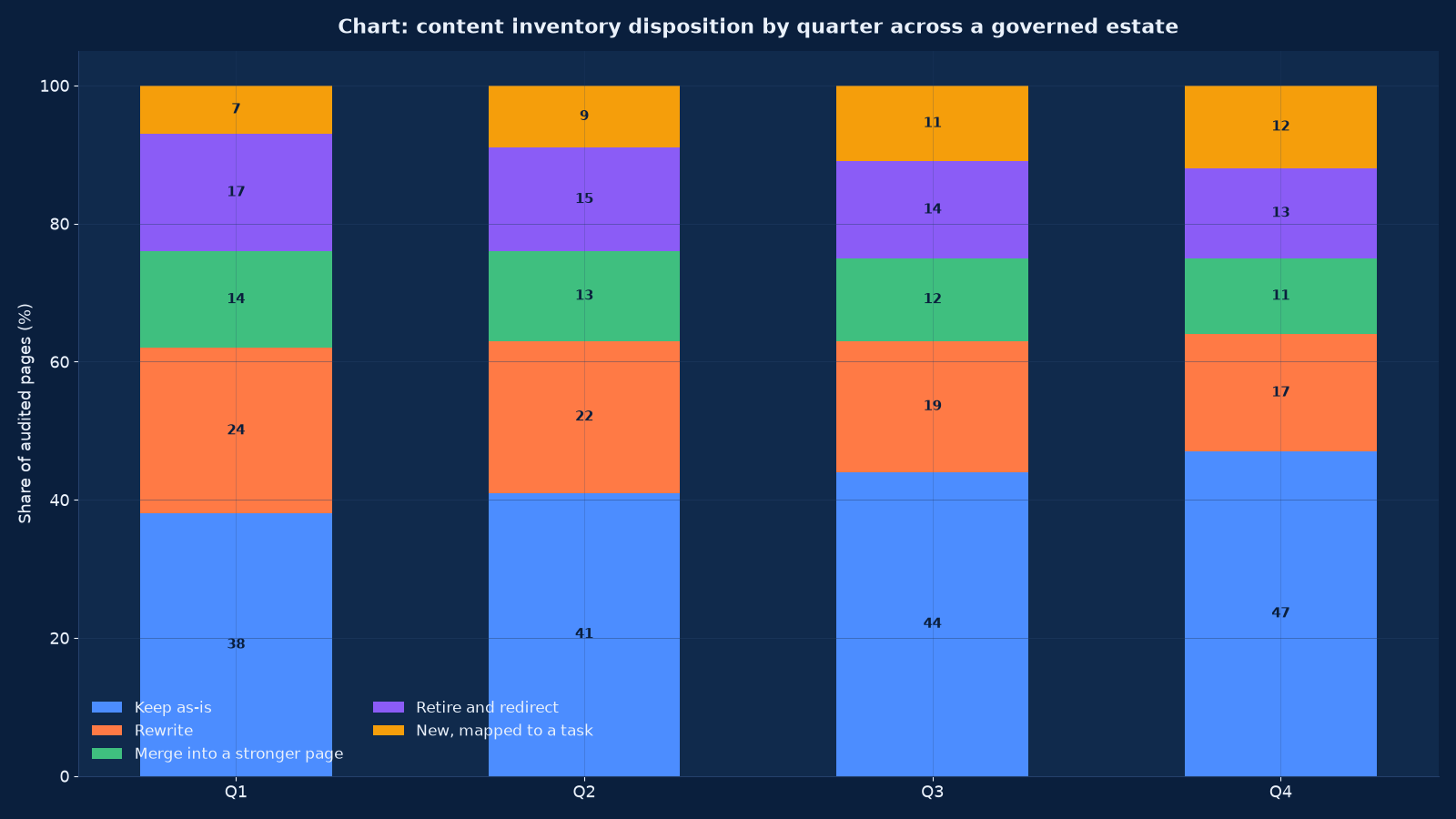
Chart values are an illustrative planning model based on typical UMC engagements and published industry benchmarks. They are not a guarantee of results on any specific project.
Navigation, findability and the internal-link rules
Navigation is the visible part of the structure and the least of it. Most findability failures we diagnose are not menu failures; they are metadata, search and internal-link failures on pages that are correctly placed but unreachable.
| Lever | What we specify | Measure and target |
|---|---|---|
| Global navigation | Six to eight level-one items, task language not department language, one mega-menu pattern with a defined hover and touch behaviour | First-click correctness above 80 per cent on the top ten tasks |
| Sectional navigation | In-page navigation for long capability and product pages, generated from the content model rather than hand-maintained | Scroll-to-section usage; time-to-answer on qualification tasks |
| Breadcrumbs and path | Structural breadcrumbs reflecting the IA, not the click path, with schema markup | Breadcrumb click-through; crawl depth of every funded page under four clicks |
| On-site search | Query logging, synonym and spelling handling, zero-result recovery, and search results themselves treated as a content gap report | Search usage below 20 per cent of sessions; zero-result rate below 4 per cent |
| Internal links | Rule-based links from the content model: every service page to its case studies, every case study back to its services, every editorial page to one money page | Orphan pages at zero; median internal links per indexable page above four |
| Metadata patterns | Title and description templates per content type with field substitution, and a rule for when a human overrides the template | Duplicate titles below two per cent; click-through improvement on rewritten templates |
The internal-link rule matters more than it sounds. An estate with correct structure and no link rules still leaves its best pages unreachable, and the fix is mechanical once the content model exists — which is why we specify the links as fields, not as editorial goodwill. Keyword cannibalisation and a large-scale title rewrite are the two patterns we see most often when this is left unspecified.
The ten-week programme
The engagement runs ten weeks with two decision gates. Weeks are indicative and we publish a dated plan at kick-off; the gates are not negotiable, because a structure approved without an evidence base is the failure mode this programme exists to prevent.
| Week | Workstream | Output | Decision gate |
|---|---|---|---|
| 1 to 2 | Analytics, Search Console and content audit | Evidence brief; full crawl and inventory scoring under way | — |
| 2 to 3 | Stakeholder and task interviews; support and sales mining | Draft task inventory with volume and value estimates | — |
| 4 to 5 | Open and closed card sorts | Natural groupings, label vocabulary, misfiled items | Gate 1: agree the primary grouping pattern |
| 5 to 6 | Sitemap, URL scheme and navigation model | IA model with rejected alternatives documented | — |
| 6 to 8 | Content model and template definitions | Content types, fields, validation, ownership per type | — |
| 7 to 8 | Priority journey wireframes | Six to ten annotated low-fidelity journeys | — |
| 8 to 9 | Tree test and moderated first-click test | Per-task correctness scores and the failures explained | Gate 2: approve structure and labels, or iterate once |
| 9 to 10 | Technical and SEO specification, redirect map, governance model | Build-ready specification; redirect map; governance and measurement plan | — |
| 10 | Handover, editorial training, backlog definition | Trained editors, pattern library seeded, structure-debt backlog prioritised | Schedule the 90-day review |
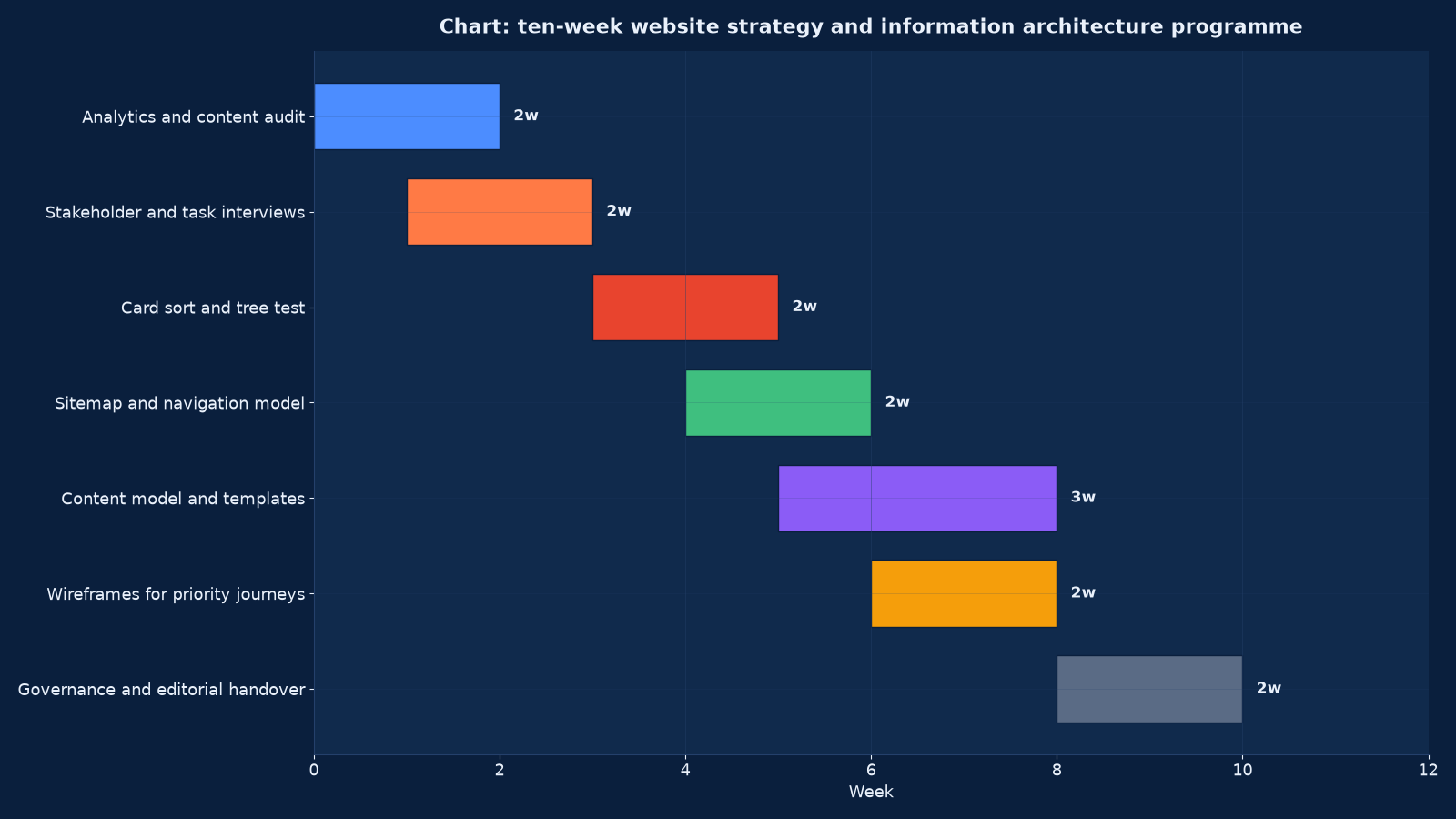
Chart values are an illustrative planning model based on typical UMC engagements and published industry benchmarks. They are not a guarantee of results on any specific project.
Governance: keeping the estate from growing back
Every unmaintainable website we audit was once a good website. What changed was not the design but the absence of a rule about who may add a page. Governance is therefore part of the strategy deliverable, not an appendix, and it is specified as decision rights with a forum and a cadence.
| Decision | Owner | Consulted | Forum and cadence |
|---|---|---|---|
| Add a new page or content type | Digital lead | Content owner, SEO | Weekly editorial board; rejected without a task and an owner |
| Change level-one navigation | Digital lead with marketing director | Sales, support, SEO | Quarterly structure review; requires tree-test evidence |
| Retire or merge a page | Content owner | SEO, digital lead | Monthly; requires a redirect decision recorded |
| Approve copy on money pages | Service-line owner | Content, legal where relevant | Per change; two working day turnaround committed |
| Change the content model or fields | Digital lead with engineering | Editors, SEO | Per release; migration cost stated before approval |
| Accept a structural exception | Marketing director | Digital lead | Recorded in an exception register with a review date — exceptions are allowed, silent exceptions are not |
We also hand over a pattern library seeded with the templates defined in the content model, and a prioritised structure-debt backlog. The backlog matters: it gives the team a lawful place to put requests that would otherwise become one-off pages, which is how the estate re-grows.
Measurement: how the work is judged
Baselines are captured in week one, before any recommendation is made, so that improvement cannot be argued about later. The KPI tree connects structure to commercial outcomes through three layers — findability, task success and contribution — and each layer has an instrument that exists today rather than one that will exist after a development sprint.
| Layer | Metric | Instrument | Typical 12-month target |
|---|---|---|---|
| Findability | First-click correctness on the top ten tasks | Tree test, re-run at 90 days and 12 months | 44 to 55 per cent baseline → above 80 per cent |
| Findability | Share of sessions using on-site search as navigation | Search logs | 34 per cent baseline → below 18 per cent |
| Findability | Orphan pages and median internal links per page | Crawl | Zero orphans; median above four |
| Task success | Task completion rate on funded journeys | Instrumented events and five-user tests | 61 per cent baseline → above 85 per cent |
| Task success | Landing-page bounce on money templates | Analytics | 52 per cent baseline → below 35 per cent |
| Task success | Support contacts per thousand sessions for structural questions | Ticket tagging | Down 30 per cent |
| Contribution | Assisted and last-click conversions by journey | Analytics with GA4 attribution configured correctly | Journey-level view replacing channel-level reporting |
| Contribution | Organic clicks on money queries | Search Console | Up without adding pages — consolidation usually lifts it |
| Contribution | Qualified enquiries per thousand sessions | CRM with CRM integration on form submissions | Up 20 to 40 per cent on the same traffic |
The five findability and task measures in Figure 1 are the ones the 90-day and 12-month reviews are judged on. Baselines are captured in week one; if a baseline cannot be captured, the metric is replaced rather than estimated.
We report against the baseline with the instrument named, and we publish the metrics that did not move. A strategy engagement that only reports wins is not a measurement, it is marketing.
Running this in an Indian market
Structure decisions in India carry three constraints that a template imported from a Western SaaS site does not anticipate. They are not edge cases; they are the majority of the estates we work on.
| Constraint | What it means structurally | How we handle it |
|---|---|---|
| Mobile-first reading, mid-tier devices | Deep navigation is unusable at 360 pixels and on a patchy connection; long pages with in-page navigation outperform deep trees | Maximum three levels to any funded page; in-page sectional navigation; image and script budgets specified against field Core Web Vitals thresholds (the performance method) |
| Tier-2 and tier-3 demand | Buyers outside metros research harder, compare more and need pricing and eligibility stated plainly; they also arrive through different queries | Location and sector expressed as facets and internal links, not as duplicate page trees |
| Language and script variety | Hindi, Tamil, Telugu, Bengali and Marathi queries arrive on English pages; transliterated search is common | Hreflang and language strategy defined per content type; translation governed as a content model field, never as a separate site |
| WhatsApp and phone as a conversion path | A large share of intent converts by conversation, not by form | Conversation entry points treated as first-class conversion paths and measured as such, with WhatsApp marketing carrying the follow-up |
| Long buying committees | Six to nine people read the same page for different reasons | Layered pages: a summary block for the decision maker, detail for the evaluator, specification for the technical reviewer |
The tier-2 point is the one most often missed. why tier-2 businesses are investing in websites faster than metros and what B2B buyers in tier-2 cities expect before they enquire both describe an audience that arrives with more questions and less patience for structure that assumes they already know your market.
Engagement models and fees
Four models cover almost every situation. All of them begin with a paid diagnostic rather than a free audit, because a diagnostic produces a decision-grade artefact and a free audit produces a sales conversation.
| Model | Duration | Included | Best for |
|---|---|---|---|
| Structure diagnostic | Two to three weeks | Evidence brief, crawl and inventory scoring of a defined segment, task inventory draft, a prioritised finding list and a costed option set | Deciding whether to restructure, rebuild or do nothing — and the honest answer is sometimes nothing |
| Full strategy and IA | Ten weeks | All eleven artefacts, card sorts and tree tests, wireframes for six to ten journeys, governance and measurement plan, handover and training | A rebuild or replatforming about to be commissioned, where the specification must exist before the tender |
| Strategy plus build supervision | Ten weeks plus build duration | The full engagement, plus specification defence, weekly build review, acceptance criteria and a pre-launch structural audit | Teams without an internal product owner who can hold a build team to the specification |
| Retained structure governance | Quarterly, twelve months minimum | Structure review, tree-test re-runs, editorial board facilitation, exception register and backlog grooming | Large estates where the risk is re-growth rather than redesign |
Fees are quoted per engagement after the scoping call and are fixed for the diagnostic and the full strategy. We will tell you when a diagnostic is enough: if the estate is small, the tasks are clear and the problem is content quality rather than structure, the right recommendation is a rewrite programme and not this engagement.
What makes a strategy document actually get used
We measure our own output by one test: whether the document changes a decision in the following quarter. These are the failure modes we have seen in other firms’ strategy deliverables, and the countermeasure we build in.
| Why strategies get shelved | The countermeasure |
|---|---|
| It describes an ideal site rather than the transition from this one | Every recommendation is expressed as a change from a named current state, with the redirect, owner and cost attached |
| It has no numbers, so it cannot be argued with — or for | Baselines captured in week one, targets per metric, instruments named |
| It is delivered as a deck, and decks do not survive contact with a build team | The specification is a document with acceptance criteria; the deck is a summary of it |
| It assumes a budget that was never agreed | Three costed options per major recommendation, including the do-nothing option with its measured cost |
| It leaves ownership ambiguous | Named owner per content type and per decision, with the forum and cadence written down |
| Nobody outside the project reads it | Editorial training and a pattern library are part of the handover, not an optional extra |
If you would like to see the shape of the output before commissioning it, the signs your website needs a redesign rather than a refresh describes the diagnostic in public, and a website roadmap for a traditional business shows how the same method reads at a smaller scale.
Frequently Asked Questions About Website Strategy and Information Architecture
How is this different from a website redesign?
A redesign changes how the site looks and often re-skins the existing structure. This engagement changes what the site is for and how it is organised, and produces the specification a redesign or rebuild should be built to. In practice we are usually commissioned before a rebuild, and the reason clients give is that the last rebuild reproduced the same problems in a new theme.
Do you design and build the site afterwards?
We can, through our website development practice or a React build, but the strategy engagement is scoped and priced separately and you are free to tender the build elsewhere. That separation is deliberate: it is what allows us to recommend against a rebuild when the evidence says a rewrite programme is enough.
How long does the full engagement take?
Ten weeks for a typical estate of a few hundred to a few thousand pages, with two decision gates. Very large or multi-country estates run fourteen to sixteen weeks because the card sorts and tree tests must be run per segment and per language.
What do you need from us?
Analytics and Search Console access, a crawl of the live estate, six to nine stakeholder hours in total, support-ticket or call recordings if they exist, and a named decision maker for each of the two gates. If analytics access cannot be granted, we say so in week one and the evidence base is weaker in a documented way.
Can you work with our existing content team?
That is the preferred arrangement. The content model and governance deliverables are written for your editors, and the handover includes training. Where there is no internal team, we can supply editorial capacity through content marketing services, but ownership still has to sit with a named person on your side.
Will restructuring hurt our rankings?
Consolidation usually helps, because pages that were splitting one intent stop competing with each other. The risk is entirely in execution: a one-to-one redirect map, preserved internal links and correct canonicals. We publish the redirect map as a deliverable and verify every entry against Search Console coverage after launch — the same verification discipline our replatforming work uses.
How do you handle multiple languages?
Language is treated as a field in the content model and as a URL and hreflang decision, not as a separate site. Translated versions inherit the structure; they do not invent their own. Where only part of the estate is translated, we specify which content types are in scope and which are not, so the pattern is consistent.
What if our structure is dictated by a franchise or head office?
Then the engagement works at the level you control: local task pages, local findability, local governance and the internal-link rules that make your pages reachable inside a structure you did not choose. We document the constraints rather than pretending they are absent.
Do you use AI to generate the inventory or the structure?
We use it for clustering queries, detecting near-duplicate content and drafting field definitions, and we verify the output. We do not let it decide the structure, and we do not generate inventory scores without a crawl behind them. Our position on unsupervised AI output explains where we draw that line and why.
What does the diagnostic cost, and is it credited?
The two to three week structure diagnostic is priced as a fixed fee after scoping, and it is credited in full against the full engagement if you proceed within ninety days. It is designed to be worth keeping on its own: the inventory scoring and the prioritised finding list are usable regardless of what you decide next.
How do we know it worked?
Against the baselines captured in week one, at 90 days and 12 months: first-click correctness, search-as-navigation share, task completion on funded journeys, orphan pages, and qualified enquiries per thousand sessions. If a metric does not move, we report it with the reason rather than substituting a metric that did.
Commission a Website Strategy and Information Architecture Diagnostic
Send us your URL, your analytics access and the three things your sales team is tired of explaining. Within ten working days you will have a full crawl and scored inventory of a defined segment, a ranked task inventory, the evidence brief that shows where the current structure loses money, and three costed options — including the option that says restructure rather than rebuild, or rewrite rather than either.
Contact Unified Management Consulting to arrange a confidential first conversation.
Related Services
Website strategy and information architecture sits at the front of the delivery sequence, and it is specified so the teams below can build to it:
- UX & UI Design Services — the design discipline that turns the approved structure and content model into interfaces
- Website Development Services — the build that implements the specification
- Full-Stack WordPress Website Development — the usual build route for a governed editorial estate
- Full-Stack React Website Development — where the content model needs a component front end
- Search Engine Optimization Services — the search programme the structure exists to support
- Conversion Rate Optimization Services — journey-level testing once the structure is stable
- Analytics & Attribution Services — instrumenting the KPI tree before the baselines are captured
- Market Research & Competitive Analysis — the demand evidence behind the task inventory
- Accessibility (WCAG) Remediation & Compliance — WCAG 2.2 Level AA audits, severity-ranked defect registers, design-system remediation, assistive-technology verification and accessibility statements
- Core Web Vitals & Performance Engineering — field instrumentation, LCP, INP and CLS engineering, third-party governance, performance budgets and a pipeline regression gate
- Web Application Maintenance & Support — patching, monitoring, verified backups, defect management, committed change capacity and monthly service reporting
- PHP & Laravel Development — legacy assessment, domain modelling, strangler-fig modernisation, APIs, test automation and CI/CD on modern PHP
- Headless & Composable Commerce — readiness assessment, capability mapping, storefront engineering, integration layer, migration rehearsals and cost governance
- Website Migration & Replatforming — full estate inventory, one-to-one redirect maps, functional parity, dry-run rehearsals, staged cutover and tested rollback
- Portal Development & Self-Service Platforms — entitlement modelling, single sign-on, source-system integration, self-service journeys and adoption instrumentation