
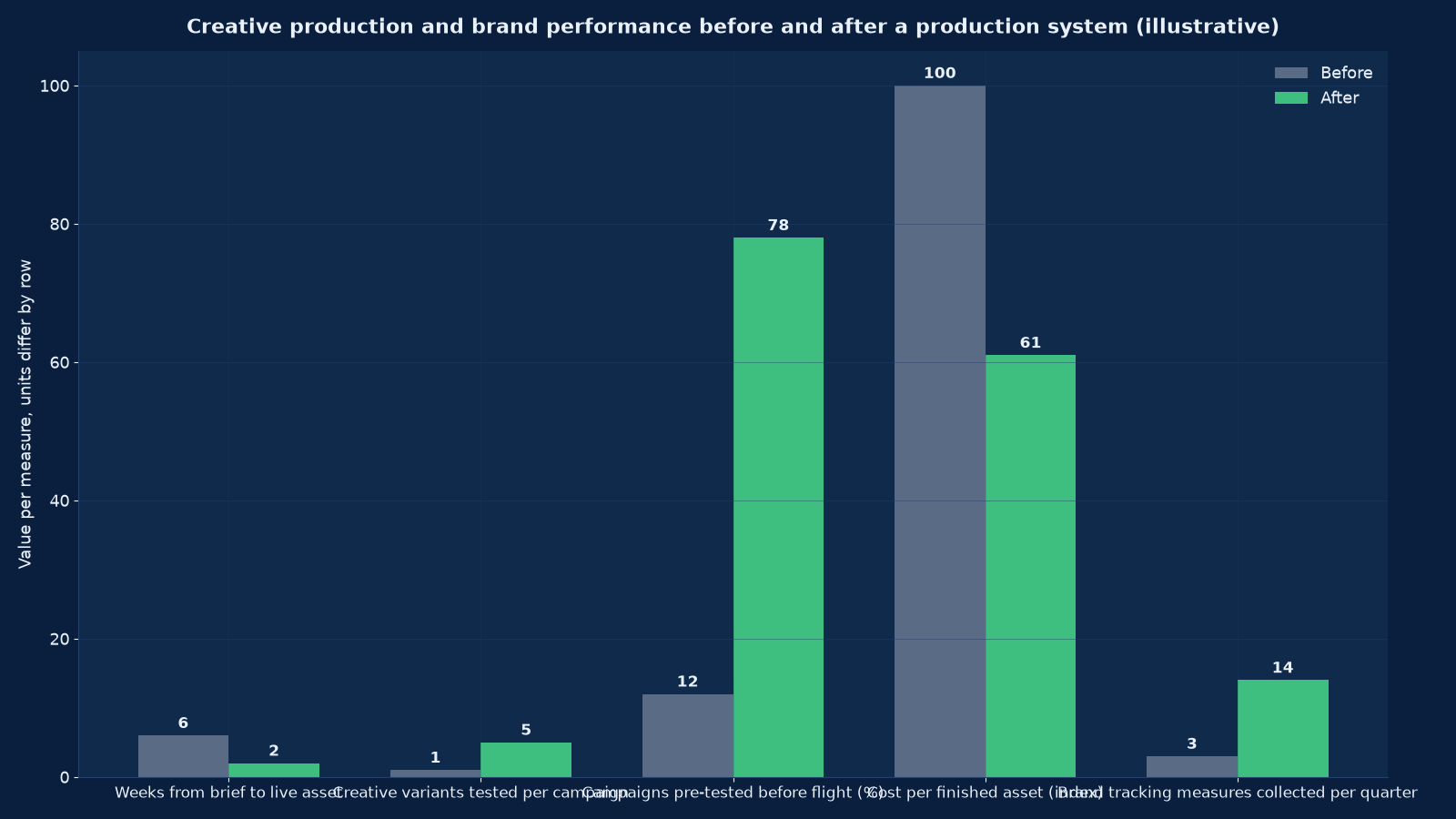
Chart values are an illustrative planning model based on typical UMC engagements and published industry benchmarks. They are not a guarantee of results on any specific project.
Brand and performance are not two budgets with two logics. They are one budget, one audience and two time horizons — and the creative is the thing that either connects them or wastes both.
Brand performance and creative production is the discipline that makes creative a managed input rather than a matter of taste: a measurement system that tracks what the brand is doing, a production system that supplies assets at the volume and speed modern channels require, a testing regime that decides what runs before money is committed to it, and a rights and versioning framework that keeps both lawful. Unified Management Consulting builds this for businesses whose creative is currently produced campaign by campaign, judged by opinion, and paid for at rates nobody has benchmarked.
🎬 Brand Performance & Creative Production — Quick Summary
| Component | What We Deliver |
|---|---|
| Brand measurement system | Awareness, consideration, association, preference and advocacy tracked on a defined cadence, with exposed and unexposed samples so movement can be attributed. |
| Brand-performance linkage | One model connecting brand measures to demand, so upper-funnel investment is judged on evidence rather than defended on faith. |
| Creative platform and idea architecture | A durable central idea with a documented system of execution, so campaigns are variations on a theme rather than unrelated one-offs. |
| Production system | Brief, concept, production, post and adaptation as stages with defined outputs, owners and controls — a pipeline, not a series of commissions. |
| Pre-flight creative testing | Concepts and finished assets tested against the objective before budget is committed, with a documented decision rule. |
| Fatigue and refresh management | Decay thresholds and a refresh trigger per channel, so assets are retired on measurement rather than on boredom. |
| Asset architecture and versioning | One master producing every format, language and platform version, tracked in a library with metadata. |
| Rights, talent and licensing | Usage windows, territories, media, moral clauses and secondary-edit rights contracted before production, not renegotiated afterwards. |
| Cost benchmarking and governance | A cost per finished asset by type and complexity, benchmarked, with a variation procedure — so creative spend is managed like any other procurement. |
This service supplies the creative layer that every channel we manage depends on: YouTube & Video Advertising, Meta Advertising, Influencer Marketing Management, Programmatic Advertising and OTT & Connected TV. Measurement is shared with Marketing Mix Modelling & Attribution and Market Research & Competitive Analysis, and the cost governance belongs with Cost Rationalisation & Margin Recovery.
Brand Versus Performance: A False Split With a Real Cost
Four positions. Three are comfortable and one is defensible. The cost of the false split is concrete: activation spend rises in efficiency terms while the brand that made it efficient quietly erodes, and the erosion shows up eighteen months later as a cost-per-acquisition problem nobody connects to the creative decisions that caused it.
| Position | What it argues | What it gets right | What it gets wrong |
|---|---|---|---|
| Pure performance | Spend only where return is attributable within the quarter | Accountability, speed, and a clear link between spend and result | It harvests demand it did not create; as brand weakens, cost per acquisition rises until the channel stops working |
| Pure brand | Build the brand and demand will follow | Long-term pricing power, resilience and lower acquisition cost over time | It is unfalsifiable in the short run, which is why it is the first budget cut and the hardest to defend in a downturn |
| The 60/40 convention | A fixed split between brand and activation | A useful starting heuristic and a way to stop activation consuming everything | It is a ratio borrowed from other markets and other categories, presented as a law; the right split depends on category, purchase cycle and existing brand strength |
| One budget, two horizons | A single commercial objective served by short-horizon activation and long-horizon brand investment, measured on different cadences against one model | Both horizons are accountable, and the trade-off between them is explicit and evidence-based | It requires measurement that most businesses do not yet have — which is what this service builds |
What we do instead. One objective, two horizons, one model. Short-horizon activation is measured on incremental contribution within the quarter. Long-horizon brand investment is measured on tracked brand metrics and on its effect on acquisition cost over four to eight quarters. Both feed a single model that says what the next rupee should buy — which is exactly the allocation question Marketing Mix Modelling & Attribution answers with spend data, and which cannot be answered at all without the brand measures this service installs. Our CEO confidence and cost-pressure survey insights explains why this argument gets harder, not easier, when costs rise.
The Brand Measurement System
Ten constructs. The discipline is not the instrument; it is choosing the cadence you will actually maintain, keeping the sample comparable across waves, and publishing the uncertainty rather than the headline number alone.
| Construct | What it measures | Method | Cadence |
|---|---|---|---|
| Awareness | Aided and unaided recall of the brand in the category | Quantitative tracking with a representative sample per market | Quarterly, or monthly during heavy investment |
| Consideration | Willingness to include the brand in a purchase set | Same tracking instrument; the measure that usually moves first | Quarterly |
| Association | Which attributes the market connects to the brand, and how strongly | Attribute rating plus open-ended elicitation; free-association for the unprompted layer | Half-yearly, with the attribute set reviewed annually |
| Preference and intent | Stated choice against named competitors, and purchase intent | Forced-choice and probability-of-purchase questions | Quarterly |
| Advocacy and referral | Willingness to recommend, and actual referral behaviour | Stated likelihood plus observed referral and review data where available | Quarterly, joined to transaction data where possible |
| Distinctive assets | Whether the brand’s colours, sounds, characters and formats are recognised without the logo | Branding-removed exposure tests — the measure most often skipped and most revealing | Annually, and after any identity change |
| Salience in buying situations | Whether the brand comes to mind at the moment of purchase, in the relevant situation | Situation-cued questioning rather than category-cued | Half-yearly |
| Share of search and voice | Branded search volume, share of category conversation, and citation in AI-generated answers | Search data, social listening, and structured AI-answer monitoring | Monthly — cheap, fast, and a genuine leading indicator |
| Creative effectiveness | Whether the advertising itself works: attention, message take-out, likeability, brand linkage | Pre-testing before flight and post-testing during it, with exposed and unexposed samples | Per campaign |
| Price perception and value | Willingness to pay, and perceived value against alternatives | Price-sensitivity measurement alongside the main tracking instrument | Half-yearly, and before any pricing change |
Two rows do most of the work. Distinctive-asset recognition tells you whether your creative is building the brand or merely being seen — an advertisement that is remembered but not connected to the brand is a donation to the category. Share of search is the cheapest leading indicator available and it moves weeks before tracking does. Our guide to tracking brand presence in AI search and how B2B brands get cited in AI answers cover the newest form of that row, which most brand trackers have not yet incorporated.
The Production System: Ten Stages With a Control Each
Creative production fails as a system long before it fails as craft. Each stage below has one control, and the controls are what turn a sequence of commissions into a pipeline.
| Stage | Output | Owner | Control that prevents waste |
|---|---|---|---|
| Commercial brief | One objective, one audience, one proposition, one measure of success, and the constraint set | Marketing leadership with commercial input | A brief that cannot be signed off in one page is not finished; a brief with three objectives produces three mediocre campaigns |
| Creative platform check | Whether the work extends the existing platform or requires a new one, and why | Brand lead | New platforms are approved at a higher level than executions, because they are the expensive decision |
| Concept development | Two or three concepts, each with a rationale tied to the objective | Creative team or agency | Concepts are tested before production, not after — the cheapest place to kill a bad idea |
| Pre-production | Treatment, storyboard, casting, locations, schedule, budget and rights clearances | Production lead | Rights and talent clearances confirmed in writing before a shoot day is booked |
| Production | Principal photography or recording, with a defined shoot ratio and coverage plan | Production company, supervised | A supervisor on set with authority to flag deviation from the treatment, and a daily cost report |
| Post-production | Edit, grade, sound, versioning and delivery of the master plus all required formats | Post house | Versioning specified up front; retro-fitting formats from a badly planned master is where post costs double |
| Adaptation and localisation | Language, market, platform and format versions produced from the master | Production or a localisation partner | A documented adaptation rule, so resizing is production work rather than redesign |
| Asset registration | Every version entered into the library with metadata: rights, expiry, usage, talent, version | Marketing operations | No asset is released to a channel before it is registered — the rule that prevents expired talent usage |
| Distribution and flight | Assets delivered to channels against a specification check per platform | Media team | A specification check per platform, because a rejected asset delays a flight |
| Performance and refresh | Decay monitoring against thresholds, refresh decisions logged | Media and creative jointly | A pre-agreed threshold, so retirement is a rule rather than an argument |
The two stages most often skipped are the second and the eighth. Skipping the creative-platform check is why a brand’s work stops resembling itself; skipping asset registration is why a campaign keeps running three months after the talent’s usage window expired. Neither requires budget. Both require somebody to own the stage. The pipeline logic is the same as AI Product Engineering Services applies to software: defined stages, defined outputs, a control at each handover.
Creative Testing: Deciding Before the Money Is Committed
Eight methods at different points in the pipeline. Testing is not a single activity; it is a set of decisions, each with a cheaper moment at which to make it.
| Method | When it runs | What it decides | Cost and speed |
|---|---|---|---|
| Concept screening | Before production, on rough ideas | Which concepts proceed; the cheapest place to stop a bad one | Low cost, days; qualitative or small-sample quantitative |
| Animatic or rough-cut test | After storyboard or first assembly | Whether the narrative holds attention and delivers the message | Moderate, one to two weeks |
| Finished-asset pre-test | Before flight, on the graded and mixed asset | Attention, message take-out, likeability, and — critically — brand linkage | Moderate to high, two to three weeks |
| Distinctive-asset test | With branding removed | Whether the work is recognisably yours without a logo | Low, and rarely done; disproportionately informative |
| In-flight decay monitoring | Continuously during the flight | When to refresh, and which asset to refresh first | Low; uses data the channels already produce |
| Post-flight effect read | After the flight, with exposed and unexposed samples | What moved in brand measures and in demand | Moderate to high, and the only read that supports the next investment case |
| A/B and multivariate testing | In-market, on live channels | Which version performs better on a real commercial measure | Low to moderate; requires volume, and honesty about what a small difference proves |
| Social and creator content testing | Before paid amplification of organic or creator assets | Which organic assets deserve paid spend behind them | Low, fast, and the most underused test in the whole table |
The economics are unambiguous. A concept killed in screening costs a fraction of a production day. An asset killed after production costs the production. An asset killed after flight costs the production and the media. Most businesses test nothing and are therefore paying the most expensive price for the same information. Where volume exists, in-market A/B testing is cheaper than any study and closer to the commercial truth — provided the difference is large enough to be real, which is the caveat usually omitted from a winner announcement.
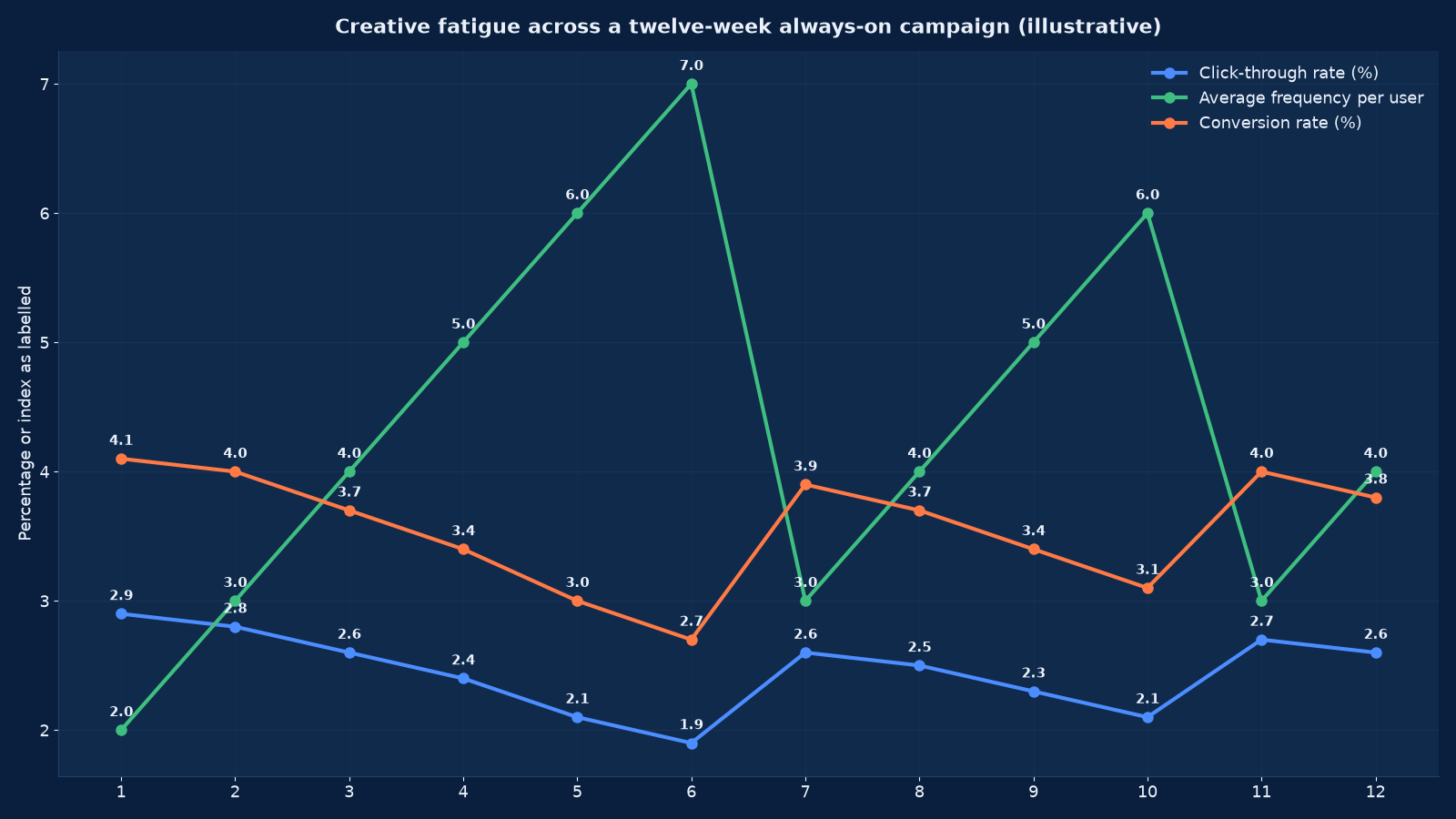
Chart values are an illustrative planning model based on typical UMC engagements and published industry benchmarks. They are not a guarantee of results on any specific project.
Fatigue and Refresh: The Predictable Part of Creative
Seven signals, each with a threshold and an action. Fatigue is not a surprise; it is a schedule that most businesses discover reactively.
| Signal | How it is measured | Threshold that triggers action | Action |
|---|---|---|---|
| Click-through or engagement decay | Rate against the asset’s own first-week baseline | A fall of a stated proportion from baseline, sustained over a defined window | Refresh the asset, or rotate to the next variant in the library |
| Frequency saturation | Average exposures per user per period | Above the effective-frequency ceiling for the channel and objective | Cap frequency, widen the audience, or rotate creative |
| Conversion-rate decay independent of traffic | Conversion rate on unchanged landing experience | Falling while traffic quality is stable | Creative-to-landing mismatch, or message exhaustion — diagnose before replacing |
| Cost-per-action creep | Trend against the asset’s own baseline, not against other assets | Rising beyond the band set from contribution margin | Retire, or reduce bid and reallocate to a fresher variant |
| Negative sentiment or complaint volume | Comment sentiment, complaint counts, ad-feedback signals | A step change rather than noise | Pause and review; a fatigued asset can become an actively resented one |
| Share of voice decline | Impression share or presence in the category conversation | Falling while spend is flat | Auction pressure or creative weakness — distinguish before spending more |
| Distinctive-asset erosion | Branding-removed recognition measured periodically | Falling across waves | The work is being seen but not attributed; a platform problem, not an asset problem |
The planning consequence. If an asset decays predictably, refresh is a planned production cost with a known cadence, not an emergency. Always-on campaigns need a refresh calendar and a standing variant library; seasonal campaigns need a rotation plan within the flight. Either way the cost belongs in the annual budget. The commonest failure is an always-on campaign budgeted for one asset, which then runs the same creative until it is resented. Our social media trends and best-practices guide and our campaign optimisation guide both cover the execution side of this; the production side is what this service supplies.
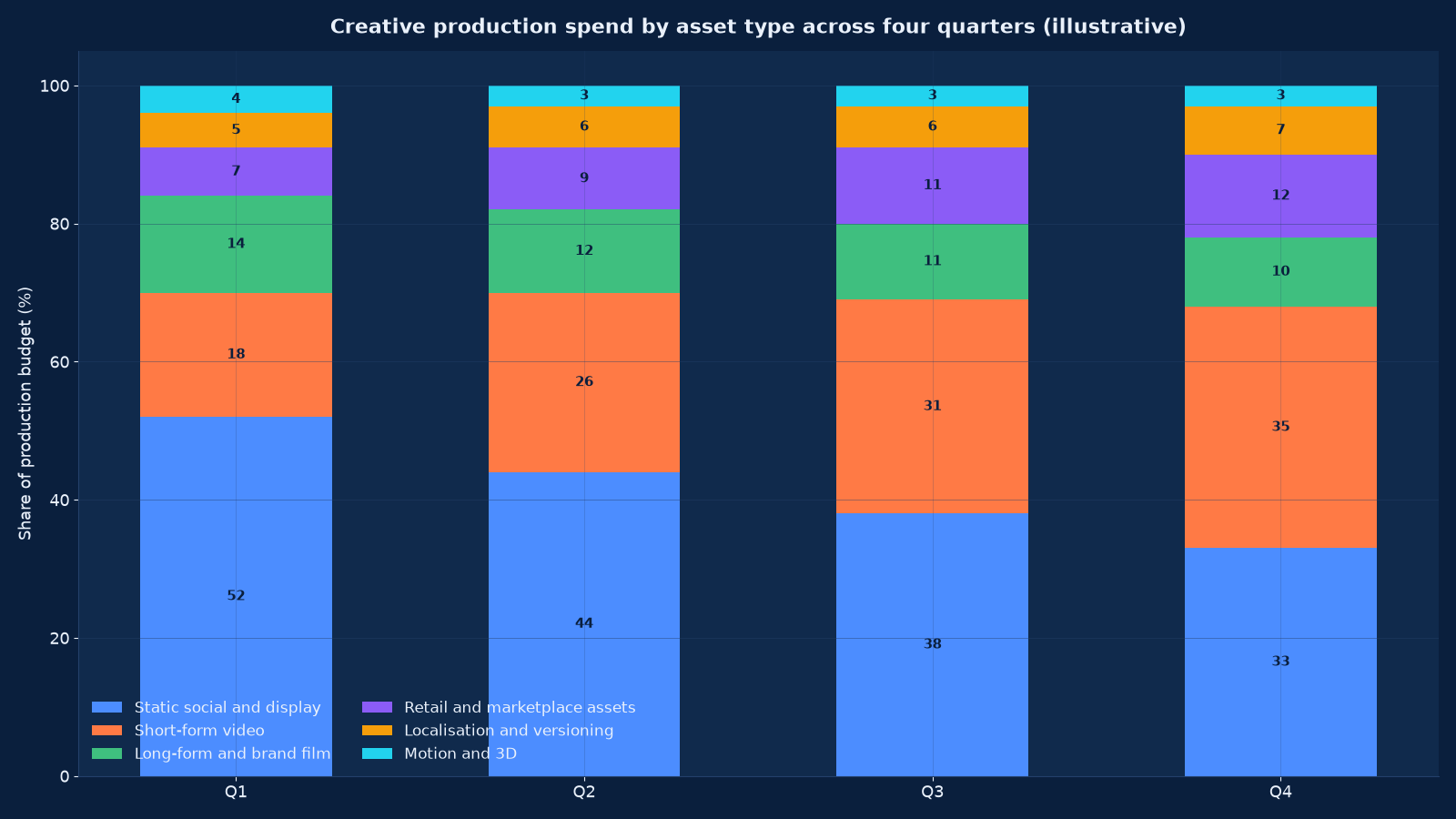
Chart values are an illustrative planning model based on typical UMC engagements and published industry benchmarks. They are not a guarantee of results on any specific project.
Production Cost: Nine Drivers and How Each Is Controlled
Creative is the largest non-media marketing cost in most businesses and the least benchmarked. Every driver below has a control, and most controls are contractual rather than creative.
| Cost driver | Why it varies | How it is controlled |
|---|---|---|
| Concept and development | Number of concepts, rounds of revision, and whether a new platform is required | A fixed number of concept rounds in the brief, and platform changes approved at a higher level than executions |
| Talent and celebrity | Profile, usage window, territory, media and exclusivity | Rights scoped to actual need rather than bought maximally; a shorter window and narrower media can halve the fee |
| Crew, equipment and locations | Shoot days, unit size, location fees and permits | A treatment with a defined shoot ratio and coverage plan; additional days are the single biggest overrun source |
| Post-production | Edit rounds, grade, sound design, visual effects and versioning | Versioning specified up front, and edit rounds capped in the contract |
| Localisation and adaptation | Number of languages, markets and platform formats | A master shot and edited for adaptation: safe framing, separable graphics, clean audio stems |
| Music and stock licensing | Term, territory, media and whether the licence permits paid amplification | Licence scope matched to the media plan; a cheap licence that excludes paid use is expensive |
| Creator and influencer content | Usage rights beyond organic posting, whitelisting and paid amplification | Usage rights contracted at the outset — retro-fitting paid rights to creator content is routinely refused or repriced |
| Asset library and operations | Storage, metadata, rights tracking and retrieval | A library with metadata from the start; the alternative is re-producing assets that already exist |
| Agency and production margin | Fee structure, and whether margin is embedded in third-party costs | Disclosed fees, third-party costs passed through at cost with the vendor named, and a variation procedure |
The unit that makes it manageable is cost per finished asset by type and complexity. Once a business knows what a six-second static, a fifteen-second cutdown, a thirty-second hero film and a localised version each cost, budgeting becomes arithmetic and variation becomes visible. Without it, every production is a negotiation from zero and every invoice is unfalsifiable. The same unbundling logic — disclosed fee, third-party costs at cost, vendor named — is what our media planning service applies to buying, and what Cost Rationalisation & Margin Recovery applies to the whole cost base.
Rights, Talent and Licensing: Ten Things to Contract Before You Shoot
Rights are the most common source of unbudgeted cost and legal exposure in creative production, and every one of these ten is cheaper to settle before production than after.
| Right | What must be specified | Common gap |
|---|---|---|
| Usage media | Which channels and formats the asset may run in, including paid amplification of organic or creator content | Broadcast and out-of-home rights bought, digital paid rights omitted — then discovered when the campaign is ready to launch |
| Territory | Geographic scope, including whether digital delivery respects borders | A national licence used on a campaign that reaches diaspora audiences abroad |
| Term | Start and end dates, with a rule for assets still in flight at expiry | Expiry passing unnoticed because no register holds the date |
| Talent and celebrity | Profile, category exclusivity, conflict restrictions, moral and conduct clauses, approval rights over usage | No moral clause, or an exclusivity that quietly prevents a second endorsement in an adjacent category |
| Music and sound | Composition and master rights, term, territory, media, and whether editing or dubbing is permitted | A library track licensed for organic use only, then amplified with paid spend |
| Third-party footage and stock | Licence scope, transferability, and whether it survives into derived versions | Stock embedded in a master that is later localised beyond the licence |
| Creator and influencer content | Organic posting, whitelisting, paid amplification, editing rights, duration, and whether the brand may re-use in other media | Assuming a post can be boosted; usually it cannot without a separate agreement |
| Derivative and secondary edits | Whether the brand may cut down, re-version, translate or adapt without further approval or payment | Every cutdown requiring renegotiation, which makes adaptation prohibitively slow |
| Ownership of the master | Who owns the underlying work, and whether source files and project files are delivered | A production company retaining project files, so future edits must be bought back from it |
| Moral, cultural and regulatory compliance | Content standards, self-regulatory code compliance, and approval processes for sensitive categories | An asset approved commercially but non-compliant with the advertising code, discovered after flight |
The register is the control. Every asset carries its rights metadata — media, territory, term, talent, music, derivatives — and no asset is released to a channel before it is registered. Expiry dates generate alerts. This is unglamorous operations work and it prevents the two failures that actually hurt: a campaign pulled because a usage window closed, and a talent fee renegotiated under time pressure because a flight was already live. The same register discipline is what AI Governance, Risk & Compliance applies to model and data assets, and it is a documented control rather than institutional memory.
The Operating Cadence
Six forums, each with one decision and the evidence required to make it. A cadence without specified evidence becomes a status meeting; a cadence with specified evidence becomes governance.
| Cadence | Forum | Decision taken | Evidence required |
|---|---|---|---|
| Weekly | Creative and media stand-up | Which assets are refreshed, retired or promoted to paid amplification | Decay signals against thresholds, and cost per action against bands |
| Fortnightly | Production review | Pipeline status, cost against budget per asset, rights clearances outstanding | A production schedule with variance and a rights register with gaps flagged |
| Monthly | Brand and performance review | Reallocation between horizons, and whether the creative platform still holds | Share of search, campaign performance, and brand measures where the cadence allows |
| Quarterly | Brand tracking review | What moved in awareness, consideration and association, and what it implies for the next quarter’s creative | Tracking wave with exposed and unexposed comparison, published with its uncertainty |
| Half-yearly | Creative platform and portfolio review | Whether the central idea is still earning its place, and which asset types to invest in | Distinctive-asset recognition, production cost per asset by type, and channel performance by format |
| Annually | Brand and commercial strategy review | The brand-performance split, the production budget, and the agency and vendor structure | Full tracking history, contribution modelling, benchmarked production costs, and a rights and asset audit |
This is the same operating rhythm our BI dashboards service installs for commercial metrics, and it works for the same reason: the decision is named, the evidence is defined, and the person accountable is present. Creative teams frequently resist it as a constraint on craft. In practice it does the opposite — it removes the argument about whether work is good and replaces it with a question about what the work is for, which is the question craft can actually answer.
The Sixteen-Week Programme
| Phase | Weeks | Activities | Output |
|---|---|---|---|
| Baseline and audit | 1–3 | Brand measures established or audited, production spend reconciled and benchmarked, asset library and rights position reviewed, current creative assessed against the platform | A baseline: what the brand is doing, what creative costs, what exists, and what is expiring |
| Objective and platform | 3–5 | Commercial objective agreed, creative platform tested or defined, distinctive assets identified, adaptation rules written | A platform with a documented system of execution and a rule for deviation |
| Measurement system design | 4–6 | Constructs selected, instrument designed, cadence and sample fixed, brand-performance linkage modelled, leading indicators connected | A tracking system that will actually be maintained, with a stated uncertainty per wave |
| Production system design | 5–8 | Ten-stage pipeline defined with owners and controls, vendor structure and rate cards benchmarked, cost per asset by type established, variation procedure agreed | A production pipeline with benchmarked unit costs rather than negotiated ones |
| Rights and asset operations | 7–9 | Rights register built, expiring usages identified, library and metadata standards set, release control implemented | Every asset registered with its rights, and nothing released unregistered |
| Testing regime | 8–10 | Methods selected per decision point, thresholds and decision rules documented, first tests run on live work | A testing calendar with a rule for what each test decides |
| First production cycle | 9–14 | A live campaign run through the full pipeline: brief, platform check, concept, test, produce, adapt, register, distribute, monitor | A worked example, with actual cost per asset against the benchmark |
| Cadence, handover and ownership | 13–16 | Six forums established with their evidence requirements, owners named, reporting built, training delivered | An operating rhythm owned inside the business |
Where Brand and Creative Programmes Fail
Ten failure modes. None is a craft failure; all are governance, measurement and contracting failures, and all are cheaper to prevent in the first three weeks than to repair in the fourth quarter.
| Failure mode | How it presents | Prevention |
|---|---|---|
| No brand measurement | Brand investment defended on conviction and cut first in a downturn | A tracking system on a cadence that will be maintained, with the linkage to demand modelled |
| Three objectives in one brief | Work that is remembered but sells nothing, or sells but builds nothing | One objective per campaign, signed off in a one-page brief |
| Testing after production | A finished asset nobody believes in, launched anyway because it is paid for | Concept screening before production, and a documented rule for what a failed test means |
| No refresh plan for always-on | The same creative runs until it is resented, and performance decays unexplained | Decay thresholds, a refresh calendar, and refresh cost budgeted as a standing line |
| One artwork, many formats | Assets rejected by platforms, or scaled work that reads badly | A master designed for adaptation, with format specifications checked before release |
| Rights settled after the shoot | A campaign delayed, or a talent fee renegotiated under time pressure | Ten right types contracted before production, held in a register with expiry alerts |
| No asset library | Assets re-produced that already exist; expired usages re-used by accident | A library with metadata, and a release control that requires registration |
| Production cost never benchmarked | Every production negotiated from zero, with no way to test an invoice | Cost per finished asset by type and complexity, benchmarked, with a variation procedure |
| Embedded agency margin | Third-party costs marked up invisibly inside a total | Disclosed fees, pass-through at cost with the vendor named, and a right to see invoices |
| Creative judged by opinion | The loudest voice in the room decides, and nothing is learned | A decision rule per test, a decision log, and a post-flight read published regardless of the answer |
The last row is the one that determines whether the other nine are fixed permanently. A decision log that records what was tested, what it showed and what was done anyway is the mechanism by which an organisation learns about its own creative. Without it, each campaign restarts from opinion and the business accumulates spend without accumulating knowledge — the same failure our predictive analytics service describes for planning models, in a different guise.
Running This in India
Conditions that change the system rather than merely the schedule.
Festival creative cycles are extreme. A large share of annual creative volume is produced for a small number of festival and national-day windows, with short lead times, high vendor demand and premium rates. Planning the festival calendar a full quarter ahead, committing vendor capacity early, and holding a standing library of adaptable assets is what separates a business that survives the festive quarter from one that overpays for it.
Language versioning is a production requirement, not a translation task. A national campaign typically needs several language versions, and a dubbed or re-typeset version is visibly inferior to one designed for adaptation. Shooting and editing with versioning in mind — safe framing, separable graphics, clean audio stems, text-free masters where possible — costs little at production and saves materially at adaptation.
Talent and celebrity economics are significant and contractual. Fees vary widely with profile, and the cost is driven as much by usage window, territory, media and exclusivity as by the shoot itself. Scoping rights to actual need, insisting on a moral clause, and registering expiry dates are the three controls that prevent both overspend and the embarrassing campaign that continues running after a talent incident.
Cricket and tent-pole association carries a premium with a short window. Tournament association delivers concentrated reach at a price that reflects it, and the creative must be ready before the window opens. Businesses that commit to association without a production plan end up paying for reach they cannot use effectively.
Cultural and regulatory sensitivity is a real production constraint. Religious, regional and political imagery carries genuine risk, and the advertising self-regulatory code applies. A compliance review inside the production pipeline, before distribution rather than after complaint, is inexpensive insurance — and Risk, Governance & Business Continuity Support is where the wider reputational exposure belongs.
Short-form volume has changed the cost curve. Reels, Shorts and in-feed video require a far higher asset volume than a traditional campaign, at lower cost per asset but greater total production load. The response is a system: a master idea producing many small variants, creator content licensed for amplification, and a library that makes re-use routine. Businesses still producing one hero film a quarter cannot supply the channels they are buying. Our content marketing strategy guide and our social media trends piece both describe the demand side of this shift; the hospitality social advertising case study and our multi-site dealership programme are examples of it supplied at volume.
Engagement Models
| Model | Duration | Deliverables | Best when |
|---|---|---|---|
| Brand and creative audit | 3–4 weeks | Brand measure baseline, production spend reconciled and benchmarked, asset and rights position reviewed, creative assessed against platform, prioritised findings | You cannot say what the brand is doing or what creative costs per asset |
| Full sixteen-week programme | 16 weeks | Measurement system, creative platform and adaptation rules, ten-stage production pipeline, rights register and library, testing regime, first production cycle, six-forum cadence and handover | The standard engagement |
| Brand measurement system only | 6–8 weeks | Construct selection, instrument design, cadence and sample, brand-performance linkage model, first wave reported | Brand investment needs defending with evidence, and nothing else is broken |
| Production system and benchmarking | 6–10 weeks | Ten-stage pipeline with owners and controls, vendor structure, cost per asset by type, variation procedure, rights register | Creative spend is material and unmanaged |
| Creative platform development | 8–12 weeks | Central idea, distinctive assets, execution system, adaptation rules and the first campaign built on it | A rebrand, a launch, or work that has stopped resembling itself |
| Managed brand performance | Monthly | Ownership of tracking, the refresh calendar, decay monitoring, rights expiry alerts, the production pipeline and the six-forum cadence | You want the discipline maintained without the internal headcount |
What Good Looks Like After Sixteen Weeks
The programme has worked when creative decisions stop being arguments.
- Brand measures are tracked on a cadence that is actually maintained, with exposed and unexposed comparison and published uncertainty.
- There is one commercial objective per campaign, and a one-page brief that somebody signed.
- A creative platform exists with documented adaptation rules and a named approver for deviations.
- Concepts are screened before production, and a failed test has a documented consequence.
- Decay thresholds and a refresh calendar exist, and refresh is a budgeted standing cost.
- Masters are produced for adaptation, and every format specification is checked before release.
- Every asset is registered with its rights, and expiry dates generate alerts.
- Cost per finished asset is known by type and complexity, benchmarked, and variations follow a procedure.
- Agency and production fees are disclosed, third-party costs pass through at cost with the vendor named.
- Six forums run with defined evidence, and a decision log records what was tested and what was done.
Two follow-ons usually apply. Where the measurement system reveals that brand and activation are competing for the same budget with no common model, Marketing Mix Modelling & Attribution supplies it. Where the asset library and rights register grow beyond what spreadsheets can hold, Data Warehouse & Lakehouse Build is the platform that makes marketing operations data usable, and BI Dashboards & Executive Reporting is where the six forums get their evidence. Our piece on how industries must operate in the AI era sets out how much of the production pipeline is now automatable, which changes what the team around it should look like; our guide to building a personal brand applies the same platform thinking at individual level.
Frequently Asked Questions About Brand Performance & Creative Production
Do you produce the creative yourselves?
We design and govern the production system — the platform, the pipeline, the testing regime, the rights register, the cost benchmarks and the vendor structure — and we supervise production, but we do not usually make the work in-house. That separation is deliberate: an adviser who also produces cannot benchmark a production cost honestly or enforce a control against itself. Where a business has no creative resource at all, we will assemble and manage a vendor panel on a disclosed fee, with third-party costs passed through at cost and the vendor named.
How do you measure brand without it taking a year?
By choosing the cadence you will maintain and the indicators that move early. A quarterly tracking wave with a comparable sample produces its first usable read in one quarter, not a year. Alongside it, share of branded search, share of category conversation and citation rates move monthly and cost almost nothing. The mistake is commissioning an annual study with a sample too small to detect the movement it was designed to find — which is the most common way brand measurement is discredited internally.
Is a 60/40 brand-to-activation split right for us?
Probably not, and it is worth being suspicious of any ratio quoted without a category behind it. The right split depends on purchase cycle, existing brand strength, competitive intensity and how much demand you are harvesting versus creating. We derive it from your own data: contribution modelling on the activation side, tracking on the brand side, and the effect of brand measures on acquisition cost over four to eight quarters. The number that comes out is yours, and it usually changes as the brand strengthens.
How much should a piece of creative cost?
There is no meaningful answer without a type and a complexity. The useful answer is a benchmark for your own portfolio: cost per finished asset by type — static, cutdown, hero film, localised version, creator asset — established from reconciled historical spend and tested against the vendor market. Once you hold that, an invoice becomes comparable and a variation becomes visible. Section six lists the nine drivers that explain most of the spread between two assets that look similar.
Can creative testing really predict performance?
It predicts some things well and others not at all, and the honest use is screening rather than prophecy. Testing reliably detects work that fails to hold attention, fails to deliver the message, or fails to link to the brand — and those failures are expensive. It predicts market performance only weakly, because a test cannot reproduce competition, frequency or context. We use tests to remove bad work and to choose between acceptable options, and we use in-flight measurement to decide what actually happened.
How do we stop our creative drifting away from the brand?
With a platform and an adaptation rule rather than with a guideline document. A creative platform states the central idea and the distinctive assets that carry it; the adaptation rule states what may be resized, what may never be omitted, and who approves a deviation. Then a distinctive-asset test — branding removed — measures whether the work is still recognisably yours. Drift is almost always caused by deviation being approved informally, many times, by whoever is closest to the deadline.
What about AI-generated creative?
It changes the cost curve on volume assets — variants, adaptations, static and short-form — far more than it changes hero work. The governance questions are real and must be settled before use: training-data provenance, output ownership, disclosure obligations, brand-safety control, and the human approval gate. AI Governance, Risk & Compliance covers the control framework, AI Readiness Assessment & Roadmap the capability question, and AI Product Engineering Services the engineering of a production pipeline that uses it. Our position is that AI belongs in the adaptation and variant layers first, where volume is high and risk is contained.
Who should own the talent and celebrity contracts?
Legal and procurement jointly, with marketing holding the usage plan — because the fee is driven by usage, and usage is a marketing decision. The four things that must be settled before a shoot day is booked are the media and territory scope, the term with its expiry date, category exclusivity, and a moral or conduct clause with a defined consequence. The register then holds the expiry date, because the expensive failure is not a bad contract; it is a good contract whose window closed while the campaign was still running.
How do creator and influencer assets fit in?
As a licensed supply into the same system, not as a separate activity. The critical distinction is between organic posting rights and paid amplification rights: most creator agreements cover the first and not the second, and retro-fitting paid rights is routinely refused or repriced. Whitelisting, editing rights, duration and re-use in other media are contracted at the outset, and the resulting assets enter the library with their rights metadata like everything else. Influencer Marketing Management Services is the channel-side engagement this connects to.
Can this work for a small business with a small budget?
In reduced scope, yes, and the parts that matter most are the cheapest. A one-page brief discipline, a documented creative platform, concept screening before production, a rights register with expiry dates, and a cost-per-asset record require no budget at all — only an owner. What does not make sense at small scale is a full quarterly tracking study; share of search and simple customer questions substitute well until the spend justifies the instrument. Our guide to digital marketing costs makes the same argument about measurement generally: benchmark unit costs before buying studies.
What should we do first?
A three-to-four-week brand and creative audit. It establishes a brand-measure baseline, reconciles and benchmarks twelve months of production spend to a cost per finished asset by type, reviews the asset library and rights position including everything expiring in the next year, and assesses current work against whatever platform exists. It requires no new spend and no agency change, and it answers the two questions that usually turn out to be unanswerable: what is the brand doing, and what does our creative actually cost per asset?
Start With a Brand and Creative Audit
Give us twelve months of production invoices, your current tracking data if you have any, and access to your asset library. In three to four weeks we will establish a brand-measure baseline, benchmark your cost per finished asset by type, review every right that expires in the next year, and tell you whether your creative is building the brand or merely being seen.
Contact Unified Management Consulting to arrange a confidential first conversation.
Related Services
Brand performance and creative production is delivered alongside our media, measurement and governance services:
- Global Advertising & Promotional Campaigns — the campaign layer this supplies creative to
- YouTube & Video Advertising Services — the largest consumer of video asset volume
- Facebook & Meta Advertising Management — short-form and static variant demand
- Influencer Marketing Management Services — creator content licensed into the same system
- UX & UI Design Services — the design-system discipline behind adaptation rules
- Market Research & Competitive Analysis — the tracking instrument and sample design
- Marketing Mix Modelling & Attribution — connecting brand measures to demand and spend
- BI Dashboards & Executive Reporting — the evidence layer for the six-forum cadence
- AI Governance, Risk & Compliance — the control framework for AI-generated creative and rights registers
- AI Product Engineering Services — engineering a production pipeline with stage controls
- Cost Rationalisation & Margin Recovery — creative cost governance within the wider cost base
- Signage Planning & Production Consulting — multi-site audits, statutory approvals, substrate specification, competitive tendering, install sequencing and maintenance
- Media Planning & Buying — audience-first channel mix, negotiated rate cards, frequency and brand-safety controls, live pacing and an independent post-campaign audit
- Retail Media Networks & Marketplace Advertising — sponsored product governance, ACOS discipline, retail media measurement and off-site audience extension
- Out-of-Home & Digital OOH Advertising — corridor selection, CPM benchmarking, flighting, creative duration discipline and geofenced measurement