
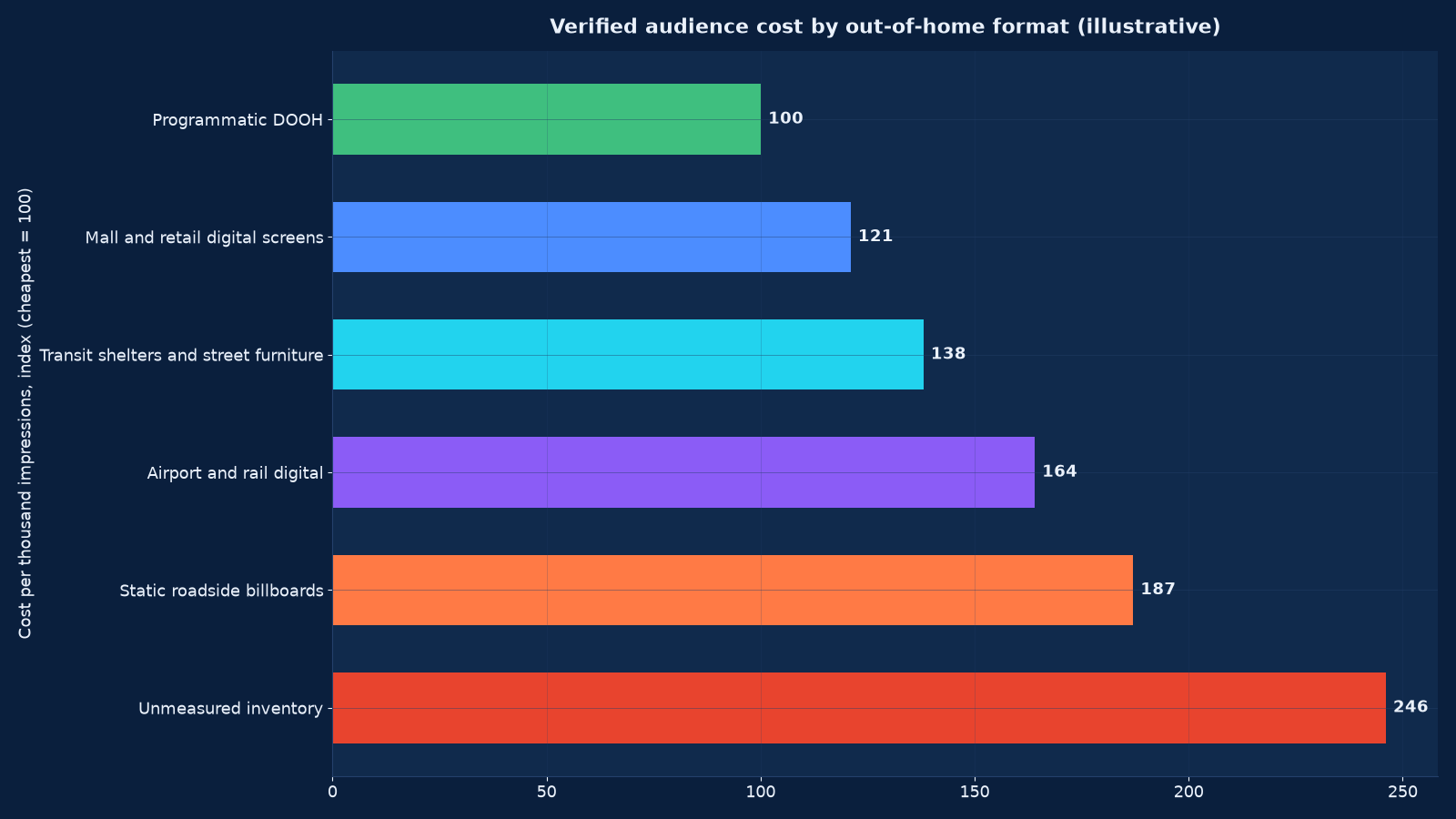
Chart values are an illustrative planning model based on typical UMC engagements and published industry benchmarks. They are not a guarantee of results on any specific project.
Out-of-home is the oldest advertising medium and the least honestly measured. The businesses that get value from it are not the ones that buy the most sites — they are the ones that can say how many people saw them.
Out-of-home and digital OOH covers every advertisement a person encounters outside their home: roadside billboards and hoardings, transit shelters and vehicle panels, metro and rail, airport, mall and retail digital screens, cinema, street furniture, and programmatic DOOH bought across many of them at once. Unified Management Consulting plans and buys OOH on verified audience rather than site count, engineers the structural and permission position that keeps it lawful and standing, adapts creative to each format’s dwell time, and measures it against something other than the site owner’s estimate.
🏙️ Out-of-Home & Digital OOH — Quick Summary
| Component | What We Deliver |
|---|---|
| Objective and geography | One commercial objective and a defined catchment per market, so reach is measured against a population rather than against a national average. |
| Format selection | Billboards, hoardings, transit, metro, airport, mall digital, cinema, street furniture and programmatic DOOH chosen by the job each does in the catchment. |
| Audience estimation | Traffic and pedestrian counts, mobility data, transit ridership and footfall sensors, triangulated rather than taken from a single vendor estimate. |
| Site selection and audit | Sites scored on visibility, dwell, illumination, obstruction, structural condition and permission status — then physically audited before renewal. |
| Programmatic DOOH buying | Daypart, weather, audience and location triggers bought across screens, with frequency control and verified delivery. |
| Structural and permission compliance | Stability certificates, municipal and highway consents, illumination curfews and insurance verified per site, with expiry dates owned. |
| Creative adaptation | Message, type size and dwell-time rules per format, with versions produced rather than one artwork scaled. |
| Flight and daypart planning | Continuous, pulsed or event-weighted delivery, with dayparts matched to when the catchment actually passes the site. |
| Measurement | Brand tracking with exposed and unexposed samples, footfall or search correlation, and a post-flight read that states what was and was not provable. |
OOH is planned inside the cross-channel mix rather than beside it, and the physical estate a business already owns is its most underused out-of-home inventory — which is why this service sits alongside our signage planning and production offering. Reach and frequency logic is shared with OTT & Connected TV Advertising, verification discipline with Programmatic Advertising Services, and contribution measurement with Marketing Mix Modelling & Attribution.
Formats: What Each One Buys and What Constrains It
Ten formats. Dwell time is the variable that decides what a format can say, and the constraint column is what decides whether a plan survives contact with a municipality.
| Format | Audience and dwell | What it is good for | Constraint to plan around |
|---|---|---|---|
| Roadside billboards and hoardings | High-volume vehicular traffic; two to five seconds of dwell at speed | Mass awareness in a defined corridor, frequency on a commute route | Permission and structural risk, obstruction by foliage and new construction, illumination curfews, and in several cities a restriction on new rooftop structures |
| Transit shelters and street furniture | Pedestrian and waiting passengers; thirty seconds to several minutes of dwell | Longer messages, local retail catchments, directional information | Municipal concession contracts change hands; maintenance and cleanliness vary by operator |
| Bus, metro and rail panels | Captive commuters; ten to forty minutes of dwell | Considered messages, lead generation with a response mechanism, recruitment | Inventory is concession-controlled, so availability and pricing are negotiated rather than auctioned |
| Metro stations and platforms | Very high daily footfall with predictable peaks | Frequency at scale in a metro market, brand presence with civic credibility | Approval processes, content restrictions and long lead times; premium pricing at interchange stations |
| Airport | Affluent, business-weighted audience with long dwell in lounges and jet bridges | B2B and premium consumer brands, launch announcements, recruitment | Single-concession control, high cost per thousand, and creative approval by the operator |
| Mall and retail digital screens | Shoppers in a purchase mindset; dwell of minutes at food courts and atria | Retail promotion, footfall driving, seasonal campaigns with daypart targeting | Screen quality and uptime vary widely; audience claims come from the mall operator |
| Cinema | Captive, undistracted audience; thirty to sixty seconds per exposure | Emotional brand storytelling, regional launches, high-impact frequency in a short window | Content and certification rules, seasonal release dependency, and declining reach in some markets |
| In-store and point-of-sale media | Shoppers at the decision point | Conversion, basket building, new-product trial | Retailer-controlled and often bundled with trade terms rather than bought as media |
| Programmatic DOOH | Aggregated screens bought by daypart, location, weather and audience triggers | Efficient reach with frequency control, tactical bursts, test-and-learn across markets | Supply quality varies; verification is thinner than in digital display, and screen audits are rare |
| Owned-site and dealership OOH | Customers and passers-by at premises the business already occupies | The cheapest out-of-home inventory most businesses own, and the least managed | Permission, structural and illumination obligations still apply; see the signage discipline |
The overlooked row is the last one. A retailer, dealership network, hospital or manufacturer already occupies out-of-home positions at every site it operates, usually without treating them as media. Standardising and measuring that estate is often cheaper than buying new inventory, and it is the reason our signage planning work and this service are planned together rather than separately.
The Measurement Problem, Stated Honestly
Out-of-home has no single audience currency. Eight approaches exist, each producing something real and each unable to produce what a media owner would like it to.
| Measurement approach | What it produces | Cost and lead time | Honest limitation |
|---|---|---|---|
| Traffic and pedestrian counts | Vehicular or footfall volumes past a site, by daypart | Low cost; counts available from municipal or operator data, or commissioned directly | Counts people passing, not people seeing; obstruction and sightline must be assessed separately |
| Mobility and location data | Estimated audience reach and frequency from anonymised device movement | Moderate; requires a data vendor and a defined catchment | Panel bias, opt-in coverage and accuracy in dense urban canyons; must be treated as an estimate with a range |
| Transit and venue ridership data | Passenger or visitor volumes for metro, rail, airport, mall and cinema | Low; usually published or obtainable from the operator | Operator-supplied, unaudited, and measured as entries rather than exposures |
| Footfall sensors and site cameras | Counts and dwell at a specific site or store entrance | Moderate capital, then continuous data | Privacy obligations, calibration drift, and it measures presence rather than attention |
| Brand tracking with exposure modelling | Awareness, consideration and association shifts among exposed and unexposed groups | Higher cost; needs a sample large enough per market | Exposure is modelled from residence and movement, not observed, so attribution carries uncertainty |
| Search and web correlation | Branded search or site-visit movement in the catchment during and after a flight | Low; uses data you already hold | Confounded by everything else happening in the period; useful as corroboration, not proof |
| Store footfall and sales correlation | Sales or visits in catchments with sites against matched catchments without | Low; uses your own data, needs a matched comparison set | The strongest practical read for a retailer, and still correlational unless catchments are genuinely matched |
| Post-flight survey in the catchment | Recall and recognition among people who passed the sites | Moderate; needs careful sampling to avoid self-selection | Recall is influenced by the survey itself; claims of advertising effect from recall alone are weak |
What we do. Triangulate rather than rely: a site is scored on independently commissioned counts, operator data and, where the budget justifies it, mobility estimates — and the three are published with their ranges. Campaign effect is then measured on the matched-catchment method, which uses data the advertiser already owns and is the only read that survives scrutiny. An OOH plan that quotes a single vendor’s impression estimate as though it were measurement has not measured anything; it has repeated a sales document. Our attribution models guide makes the same argument across channels, and Market Research & Competitive Analysis is where the tracking study is designed properly.
Site Selection: Ten Criteria That Decide Value
Site selection is where OOH budgets are won or lost, and it is almost always done on price and relationship rather than on these ten criteria.
| Criterion | How it is scored | Why it changes the decision |
|---|---|---|
| Catchment definition | The population and trade area the site is meant to reach, drawn from drive-time or radius rather than administrative boundary | Without it, reach cannot be expressed as a percentage of anything, and cost per thousand is meaningless |
| Visibility and sightline | Unobstructed viewing distance and angle, measured at the site, with foliage, gantries and new construction recorded | A site with good traffic and poor sightline delivers a fraction of its counted audience |
| Dwell and congestion | Whether traffic slows or stops near the site — signals, junctions, queues | A congested site can carry a message three times longer than a free-flowing one at the same price |
| Direction of travel | Which carriageway or pavement the site faces | Determines which half of the catchment sees it, and therefore whether it serves your store or your competitor’s |
| Illumination and curfew | Lit or unlit, illumination hours permitted, actual uptime measured at night | An unlit or illegally lit site loses or risks a large share of its exposure, and a dark sign is a negative brand asset |
| Structural condition and certification | Age, corrosion, fixing integrity, and whether a stability certificate exists and is current | The difference between an asset and a liability; also the item an insurer and an authority ask for first |
| Permission status and expiry | Licence held, its conditions, and its renewal date | An unpermitted or lapsed site can be removed at the advertiser’s cost, mid-flight |
| Competitive adjacency | What else is visible in the same sightline, including clutter and category competitors | A site in a dense cluster competes for the same two seconds; a solitary site does not |
| Creative compatibility | Aspect ratio, size, single or multi-panel, digital or static, motion permitted | Determines whether one artwork can serve or whether a version must be produced |
| Cost per verified thousand | Total cost including production, permissions and maintenance, divided by triangulated audience | The only figure that makes sites comparable, and the one never volunteered by a site owner |
The rule we apply. No site is renewed or bought without a physical audit recording sightline, obstruction, illumination uptime and structural condition, and no site is valued on the owner’s audience estimate alone. For a large estate we audit a sample first and extrapolate, which usually finds enough lapsed permissions and obstructed sightlines to change the negotiation. A physical audit is inexpensive relative to a year’s spend on a site that cannot be seen.
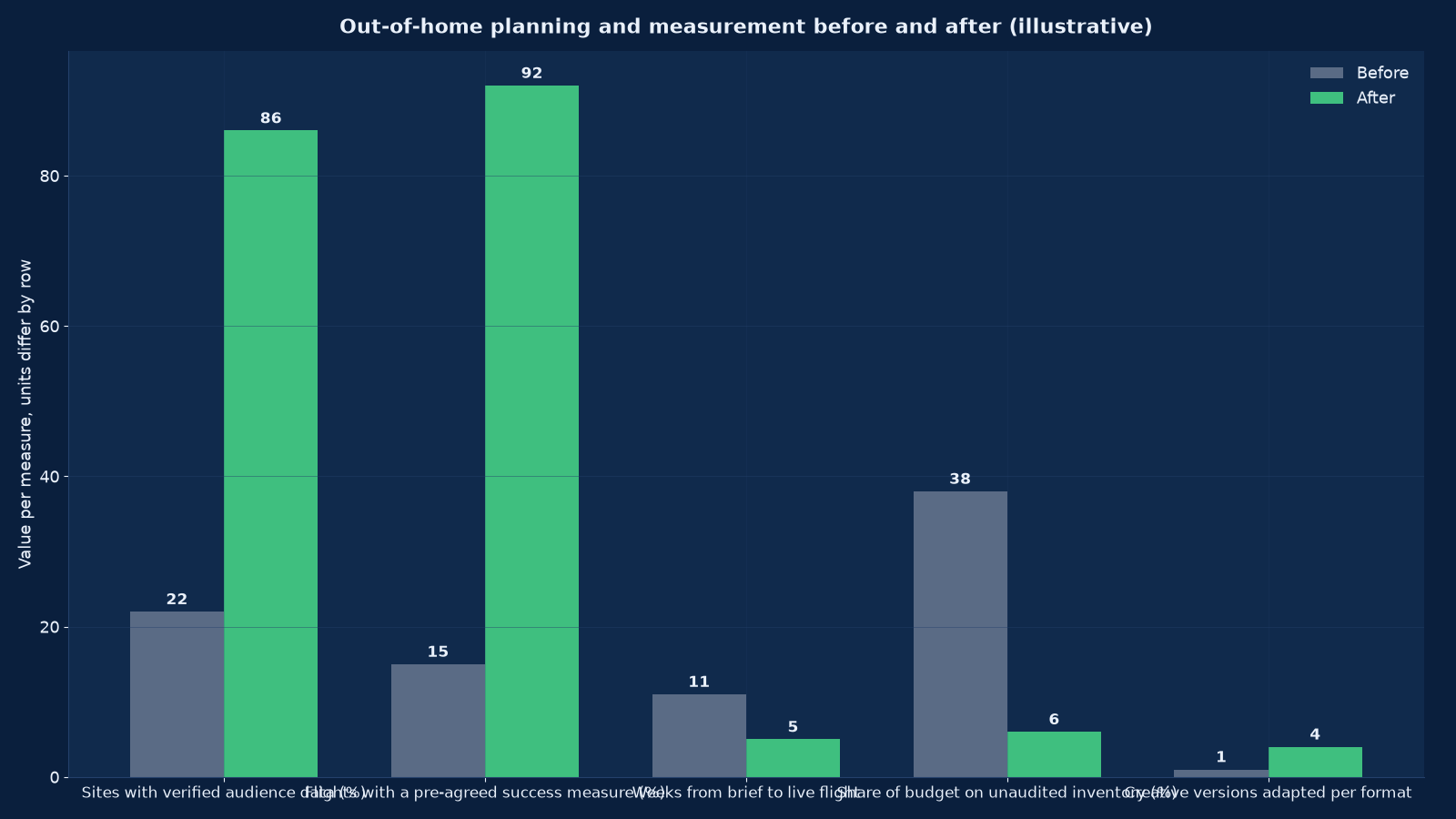
Chart values are an illustrative planning model based on typical UMC engagements and published industry benchmarks. They are not a guarantee of results on any specific project.
Programmatic DOOH: How It Actually Works
Programmatic DOOH applies digital display buying mechanics to physical screens. It brings efficiency, daypart control and test-and-learn to a medium that was previously bought as fixed annual contracts — and it imports digital display’s transparency problems wholesale.
| Element | How it works | What to insist on |
|---|---|---|
| Supply sources | Screen owners and site operators make inventory available via a supply-side platform or an aggregator | Named supply sources with a documented screen list, not an opaque pool |
| Buying platform | A demand-side platform buys impressions across screens by daypart, location and audience | Advertiser-owned account access, so the buy is inspectable and portable |
| Triggers and dayparts | Delivery can be conditioned on time of day, weather, audience movement or events | Triggers defined before the flight and evaluated afterwards, not adjusted continuously without a record |
| Frequency control | Caps on exposures per device or per person per period | A stated cap; uncapped DOOH around a small catchment produces waste and irritation |
| Creative rotation | Multiple assets rotated in a loop, often with a fixed slot length | Slot length confirmed per screen, because a ten-second asset in an eight-second loop is truncated |
| Verification and delivery reporting | Impressions delivered, by screen and daypart, from the platform | Independent verification where available, and a screen-level report reconciled to the invoice |
| Screen audit | Physical confirmation that a screen exists, works, is where it claims, and is lit | A sample audit at minimum; unverified screen lists are the DOOH equivalent of unaudited inventory |
The central caveat. An impression in programmatic DOOH is one play of a slot on a screen to an estimated number of people passing it. Nothing observes the people. That is not a reason to avoid it — it is still usually cheaper per verified thousand than static inventory, and its flexibility is genuinely valuable — but it is a reason to buy from named supply with a screen list you can audit, and to treat platform-reported impressions as a delivery record rather than as an audience measurement.
Creative Adaptation: One Artwork Does Not Serve Ten Formats
The commonest production error in OOH is scaling one artwork across formats with dwell times that differ by a factor of a hundred. Adaptation is a design discipline with rules, not a resizing exercise.
| Format | Typical dwell | Message rules | Production note |
|---|---|---|---|
| Roadside billboard at speed | 2–5 seconds | One idea, under seven words, one dominant visual, brand mark large enough to read at distance | Type size calculated from viewing distance; a design that works at arm’s length fails at eighty metres |
| Transit shelter | 30 seconds to several minutes | Can carry a secondary message, a response mechanism and detail, but still needs a three-second read | Layered design: a fast read for passers-by, depth for those waiting |
| In-vehicle panel | 10–40 minutes | Long copy is viable; a response mechanism (number, code, address) works better than on any other format | Lighting inside the vehicle, and material durability against handling and cleaning |
| Metro platform and concourse | 1–10 minutes | Brand presence plus a directional or informational element; repetition across a journey | Operator approval cycles are long; submit early and expect content restrictions |
| Mall and retail digital | Minutes at dwell points | Offer-led with a clear call to visit a store; daypart the message to the shopping mission | Slot length and loop position determine whether the asset is seen complete |
| Cinema | 30–60 seconds, captive | Emotional storytelling works; sound design matters more than anywhere else | Certification and content rules apply; aspect and loudness standards are enforced |
| Airport lounge and jet bridge | 5–30 minutes | Considered B2B and premium messages, with detail and a response route | Premium production expected; a low-resolution asset is disproportionately damaging here |
| Digital roadside | 2–8 seconds | One idea per slot; motion draws attention but too much motion destroys legibility | Brightness and glare must be specified for direct sun, and dimmed for night to satisfy curfew and safety rules |
Adaptation cost is routinely underestimated in OOH budgets, and it belongs in the plan rather than being discovered in production. It is also where a well-run brand system pays: a documented adaptation rule — what may be resized, what may never be omitted, who approves a deviation — turns a four-week argument into a two-day job. The same logic governs a physical sign estate in our signage planning service, and UX & UI Design Services applies it to responsive digital surfaces.
Permissions, Structure and Safety: The Non-Negotiable Layer
Ten obligations, held by different parties, all of which can stop a campaign or cause harm. Advertisers routinely assume these are the site owner’s problem until an authority writes to them.
| Obligation | Held by | Applies to | Consequence of neglect |
|---|---|---|---|
| Municipal outdoor advertising licence | Site owner, with advertiser exposure | Hoardings, billboards, facade and rooftop structures | Removal at cost, penalty, and a campaign that stops mid-flight |
| Highway or road-adjacent consent | Highway authority or PWD | Any structure visible from or within a road right-of-way | Compulsory removal and blacklist risk for repeat offenders |
| Structural stability certificate | Licensed structural engineer | All freestanding, cantilevered and rooftop structures | No certificate means no lawful structure, and no insurer will pay after a failure |
| Wind-load and design compliance | Structural designer | Every site, with the zone’s wind and cyclone loading | Collapse in storm conditions — the failure mode that has driven municipal restrictions on rooftop hoardings |
| Illumination permission and curfew | Municipal authority | Lit sites and digital screens | Disconnection, penalty, and resident complaints that escalate to removal |
| Electrical sanction and safety | Distribution licensee | All illuminated sites | Unsafe connection, fire risk, insurance void |
| Insurance | Site owner and advertiser | All structures | Third-party injury or property damage falling on the advertiser where the owner is uninsured or untraceable |
| Content compliance | Advertiser | All sites | Self-regulatory code breach, objectionable content complaints, and removal orders during sensitive periods or elections |
| Landlord or concession consent | Property owner, mall, transit operator | Sites on private or concession land | Access revoked, or a contract that does not permit the intended use |
| Maintenance and uptime obligation | Site owner, contractually | All sites, especially illuminated and digital | A dark or broken site is a negative brand asset that continues to be paid for |
The contractual fix. Every site agreement should carry a warranty that the structure is permitted, certified and insured; an obligation to produce the certificate on request; an uptime commitment with a rent abatement for dark days; and an indemnity for third-party claims arising from structural failure. These four clauses cost nothing to ask for and are refused only by owners with something to hide. Risk, Governance & Business Continuity Support is the discipline that turns this into a controlled register rather than a filing cabinet, and our signage planning service holds the equivalent obligations for a business’s own estate.
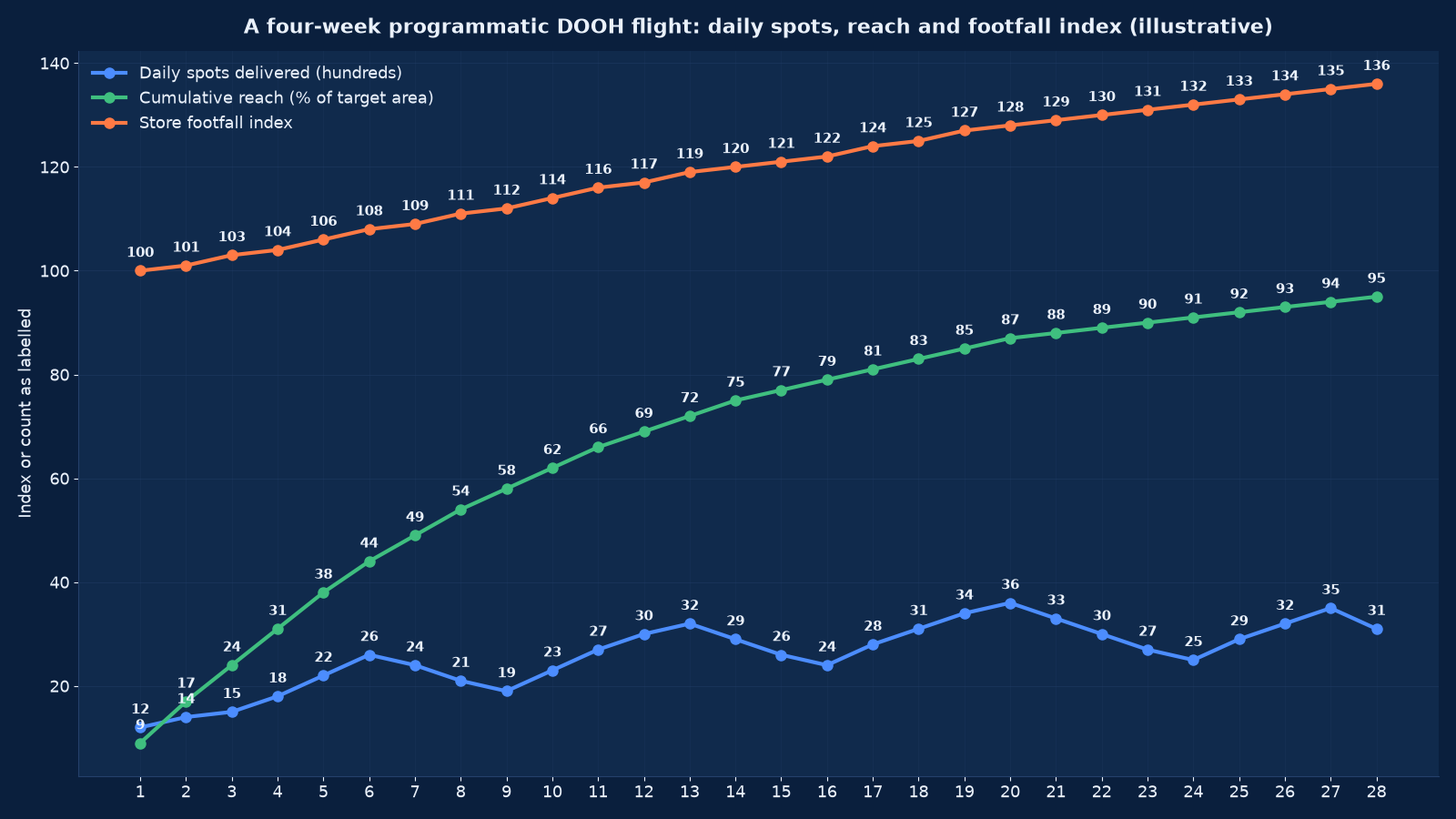
Chart values are an illustrative planning model based on typical UMC engagements and published industry benchmarks. They are not a guarantee of results on any specific project.
Flighting Patterns
Six patterns. The choice follows from purchase cycle, category seasonality and — the part usually skipped — whether the budget can reach effective frequency in the catchment at all.
| Pattern | How it works | Use it when | Avoid it when |
|---|---|---|---|
| Continuous | Even delivery across the whole flight | Short purchase cycles, retail catchments, always-on presence | The budget is too thin to reach effective frequency continuously |
| Pulsing | Continuous at a base level with periodic intensification | A category with regular peaks but year-round demand | Peaks are unpredictable, in which case the pulses land in the wrong weeks |
| Burst or flighting | Concentrated delivery in short windows with gaps between | Launches, events, festival periods, and considered purchases with a decision moment | A low-involvement category where presence decays between bursts |
| Seasonal or festival-weighted | Delivery concentrated in known demand periods | Categories whose demand is genuinely festival-driven | Auction and production costs in the peak are ignored, which they often are |
| Tactical or reactive | Short-notice buys responding to weather, events or competitor action | Programmatic DOOH makes this genuinely possible for the first time | There is no reserved contingency, so a tactical buy displaces planned reach |
| Test-and-learn | Matched catchments, one with sites and one without, compared over a defined window | You have never measured OOH and intend to spend materially on it | Catchments are not genuinely matched, in which case the test proves nothing |
The frequency question comes first. A budget that reaches a catchment once is not a weak campaign; it is not a campaign. Establishing the effective frequency range for the category and pricing the reach required to hit it, before choosing a pattern, is what separates a plan from a media buy. Where the budget cannot reach effective frequency in the chosen catchment, the right answer is usually to narrow the geography rather than to spread it thinly — a decision that is far easier to defend with the arithmetic in front of you. Our campaign optimisation guide covers the equivalent logic for digital flights.
Cost Structure and the Eight Things That Are Not the Site Price
Site rental is the only OOH cost that gets compared. The other seven determine whether the campaign is economical, and several are invisible in a site owner’s quotation.
| Cost driver | Typical behaviour | How it is controlled |
|---|---|---|
| Site or screen rental | The visible cost; varies by city, corridor, format and tenure length | Longer tenure for always-on sites, shorter for tactical; cost per verified thousand rather than per site as the comparison |
| Production and installation | Print, framing, mounting and de-mounting; frequently quoted separately and underestimated | A standard specification per format, reused artwork frames, and installation included in the tender rather than added later |
| Creative adaptation | Versioning across formats and languages | A documented adaptation rule and a versioned asset library, so adaptation is production not design |
| Permissions and compliance | Licence fees, certificates, insurance | Verified before commitment, and treated as a cost of the site rather than an unexpected extra |
| Maintenance and illumination | Cleaning, repairs, lighting uptime | A contractual uptime commitment with rent abatement for dark days |
| Measurement and research | Counts, mobility data, tracking studies, matched-catchment analysis | Scoped once and reused across flights; the cheapest line in the budget relative to what it protects |
| Agency or buying fee | Percentage, fixed, or embedded in the site price | Disclosed and separated from media, with a right to see the site owner’s rate card |
| Contingency | Weather damage, obstruction, permission delay, opportunistic availability | A stated percentage held back, with a rule for who may release it |
The disclosure question. In OOH the intermediary margin is frequently embedded in the site price rather than shown as a fee, so an advertiser cannot tell what the owner received. Insisting on a disclosed fee and the right to see the owner’s rate card is the equivalent of the audit right in cross-channel media buying, and it is resisted for the same reason. Cost Rationalisation & Margin Recovery applies the same unbundling logic to the wider marketing cost base, and our guide to digital marketing costs makes the benchmarking argument for unit costs rather than percentages of turnover.
The Eighteen-Week Programme
| Phase | Weeks | Activities | Output |
|---|---|---|---|
| Objective, catchments and baseline | 1–2 | Commercial objective defined, catchments drawn per market, current OOH spend and sites reviewed, baseline footfall and search data captured | A catchment model and a baseline against which any effect can be measured |
| Site audit and permission review | 2–4 | Physical audit of existing and candidate sites, sightline and obstruction recorded, illumination uptime measured, permissions and certificates verified with expiry dates | A scored site list with a compliance status per site, and a remediation list |
| Audience estimation and costing | 3–5 | Counts, operator data and mobility estimates triangulated, cost per verified thousand computed, production and permission costs added | Sites compared on one honest metric rather than on rental price |
| Format and flighting strategy | 5–6 | Formats selected by job, effective frequency established, flighting pattern chosen, dayparts and triggers defined | A strategy that states what each format must achieve and how often the audience must be reached |
| Creative adaptation and production | 6–8 | Message rules per format, type sizes from viewing distance, versions produced, material and installation specifications agreed | Format-correct artwork with a production and installation schedule |
| Contracting and compliance | 7–9 | Site agreements with permission warranty, uptime commitment, indemnity and rate-card disclosure; insurance verified | Contracts that transfer the right risks to the right parties |
| Launch and in-flight management | 9–16 | Installation verified, night-time illumination checks, programmatic pacing against plan, obstruction and damage monitoring, reallocation against thresholds | A live campaign managed against a decision log |
| Measurement and next flight | 14–18 | Matched-catchment analysis, brand tracking, footfall and search correlation, cost per verified thousand restated, next-flight recommendation | A measured result with a stated uncertainty, and the next plan |
Where OOH Programmes Fail
| Failure mode | How it presents | Prevention |
|---|---|---|
| Buying sites rather than audiences | A long site list, a low rental, and no idea how many people were reached | Cost per verified thousand as the comparison metric, with triangulated audience data |
| Accepting the owner’s impression estimate | Reported reach that never reconciles to footfall, search or sales movement | Independent counts and a matched-catchment read; treat owner estimates as a starting point only |
| No physical audit | Sites obstructed, unlit, damaged or already removed, still being paid for | An audit before renewal or purchase, and a night-time illumination check during the flight |
| Permissions assumed to be the owner’s problem | A removal notice mid-flight, or a penalty addressed to the advertiser | A contractual permission warranty with a certificate produced on request |
| No structural certificate | A storm, a collapse, and an uninsured claim | Certificates required for every freestanding and rooftop structure, verified before commitment |
| One artwork across all formats | A billboard message nobody can read at speed, and a shelter panel wasting its dwell time | Message rules and type sizes derived from dwell time and viewing distance per format |
| Budget too thin to reach frequency | A campaign that reaches everyone once and changes nothing | Effective frequency established first, then geography narrowed if the budget cannot meet it |
| No matched comparison | Sales rose during the flight, and so did everything else | Matched catchments agreed before the flight, not found afterwards |
| Intermediary margin embedded in the site price | Quotes that cannot be compared and no visibility of what the owner received | A disclosed fee and the right to see the owner’s rate card |
| No uptime obligation | Dark or broken sites paid for at full rate | A contractual uptime commitment with rent abatement, monitored by night checks |
Running This in India
Conditions that change the plan rather than merely the price.
Municipal policy is local and it moves. Outdoor advertising is regulated city by city, and several municipalities have restricted or banned new rooftop hoardings after structural failures. Policies, fees, illumination curfews and permission lead times differ materially between cities, so a national plan needs a city-by-city permissions matrix that is refreshed rather than written once. Anything relying on a single national assumption will be wrong somewhere.
Monsoon and storm exposure. Wind loading, cyclone risk in coastal states, water ingress into illuminated and digital units, and print degradation in humidity all raise the specification floor. Sites that fail are usually the ones specified as though they were inland and sheltered. Material and structural specifications must be set for the worst month, not the average one.
Transit and concession inventory is relationship-bought. Metro, rail, airport and bus advertising is largely sold through concessions, so availability, pricing and approval processes are negotiated rather than auctioned, with long lead times and content restrictions. Planning six months ahead for a festival flight is normal, and a tactical buy on concession inventory is usually not possible at any price.
Programmatic DOOH is real but young. Screen supply, verification and audit practices are less mature than in digital display, and screen lists are rarely independently verified. Buying from named supply with a screen list you can sample-audit, with frequency caps and slot lengths confirmed, is the discipline that makes it efficient rather than merely cheap.
Festival and election periods distort supply. Festive demand raises prices and reduces availability, and elections impose advertising restrictions that can suspend inventory entirely in some categories. Both belong in the annual plan as known constraints rather than being discovered when the buy is attempted.
Language versioning is a production requirement. A national flight typically needs several language versions, and a scaled translation rather than a designed one is visibly worse and measurably less effective. Versioning cost belongs in the budget from the start — see our social media strategy guide for the same problem in digital creative, and our hospitality social advertising case study for how a location-dependent business handles local relevance.
Engagement Models
| Model | Duration | Deliverables | Best when |
|---|---|---|---|
| OOH audit and site review | 3–4 weeks | Physical site audit, permission and certificate status, cost per verified thousand restated, contract terms reviewed, prioritised findings | You hold sites you cannot justify, or cannot say what they cost per person reached |
| Full eighteen-week programme | 18 weeks | Catchment model, audited and scored site list, audience estimation, format and flighting strategy, creative adaptation, compliant contracts, launch management and measured post-flight read | A market entry, a national flight, or a reset of how OOH is bought |
| Programmatic DOOH buying | 6–12 weeks | Named supply selection, screen audit sample, daypart and trigger design, frequency capping, advertiser-owned account, delivery reconciliation | You want tactical flexibility and test-and-learn across markets |
| Measurement build | 6–10 weeks | Matched-catchment design, footfall and search correlation, brand tracking with exposure modelling, and the reporting cadence that maintains it | OOH spend is significant and has never been measured |
| Compliance and permission remediation | 4–8 weeks | Permissions matrix by city, certificates obtained or sites removed, contract clauses renegotiated, register with expiry dates and a named owner | An authority notice, an acquisition due diligence, or a storm-related incident |
| Managed OOH | Monthly | Ownership of the site register, permissions and uptime monitoring, flight pacing, reallocation against thresholds, and quarterly measurement | You want the discipline maintained without the internal headcount |
What Good Looks Like After Eighteen Weeks
The programme has worked when the OOH conversation stops being about sites.
- Every site has a catchment, a triangulated audience estimate with a stated range, and a cost per verified thousand.
- Every site was physically audited: sightline, obstruction, illumination uptime, structural condition.
- Permissions and stability certificates are verified, held in a register with expiry dates and a named owner.
- Site agreements carry a permission warranty, an uptime commitment with rent abatement, an indemnity and rate-card disclosure.
- Creative was designed to each format’s dwell time, with type sizes derived from viewing distance.
- The flighting pattern was chosen after effective frequency was established, not before.
- Programmatic buys come from named supply with a screen list and a sample audit.
- A matched-catchment comparison was agreed before the flight and measured after it.
- Intermediary fees are disclosed and separated from site cost.
- Somebody inside the business owns the site register, the permissions calendar and the measurement.
Two follow-ons usually apply. Where the audit shows the business’s own premises are its best out-of-home positions, the investment shifts from rented inventory to a managed sign estate, which is our signage planning and production service. Where OOH proves its contribution but the rest of the mix cannot be compared to it, Marketing Mix Modelling & Attribution is the engagement that makes them commensurable — and BI Dashboards & Executive Reporting is where the site register and flight metrics become a quarterly board view.
Frequently Asked Questions About Out-of-Home & Digital OOH
Can OOH actually be measured?
Yes, but not in the way digital is, and anyone claiming otherwise is selling something. Audience can be estimated credibly by triangulating commissioned traffic and pedestrian counts, operator ridership data and mobility estimates, each published with its range. Effect can be measured on matched catchments — stores or areas with sites compared against similar ones without — using footfall, sales or branded search movement. What cannot be done is observing an individual exposure, so a claimed deterministic attribution should be treated as a model, not a measurement.
How is OOH different from our own signage?
Signage is out-of-home inventory you own at premises you occupy; OOH is inventory you rent where other people pass. They share permissions, structural, illumination and creative-adaptation disciplines, and they are usually planned together badly or not at all. Most multi-site businesses underuse their own positions, which are the cheapest out-of-home reach available to them, while paying a premium for rented sites nearby.
Is programmatic DOOH better than traditional billboards?
Different, not better. Programmatic DOOH brings daypart control, weather and event triggers, shorter commitments and test-and-learn, and it is usually cheaper per verified thousand. Traditional billboards bring permanence, dominance in a corridor, and a presence that a rotating digital slot cannot match. The right answer is usually both, with each doing the job it is suited to — and with the programmatic supply named and audited rather than bought as an opaque pool.
What budget makes OOH worthwhile?
Enough to reach effective frequency in a defined catchment. That is the whole test, and it is a geography question before it is a budget question. If the budget cannot reach the required frequency across a city, narrow to one corridor or one catchment where it can, and measure that properly. A thin national presence is the most common way to spend real money on OOH and learn nothing from it.
Who is responsible if a hoarding falls?
Legally and practically, several parties: the site owner as occupier and structure owner, the engineer who certified it, the municipality that licensed it, and — where the advertiser commissioned or benefited from the structure — potentially the advertiser. This is why we require a permission warranty, a current structural stability certificate produced on request, and a third-party indemnity with verified insurance in every site agreement. Those clauses cost nothing to request and their refusal is highly informative.
How do we know a site is still there and lit?
You visit it, at night. A physical audit records sightline, obstruction by foliage or new construction, structural condition and illumination, and during a flight we run night checks on a sample plus a contractual uptime commitment with rent abatement for dark days. Photographic proof from the site owner is not evidence; owners photograph sites when they are working.
Can OOH drive online response?
It can, and the mechanism is measurable: branded search volume and direct site traffic from the catchment during and after a flight, compared against matched areas. What OOH does badly is carrying a long response mechanism — a URL or code on a billboard read at speed performs poorly, while the same message on an in-vehicle panel with forty minutes of dwell performs well. Format decides whether a response route is viable.
How do you handle elections and sensitive periods?
As known constraints in the annual plan. Election periods bring advertising restrictions and, in some categories, suspension of inventory; religious and cultural sensitivities affect site proximity rules and content approval in several cities. A flight planned without checking the electoral and municipal calendar risks paying for inventory it cannot use, which is a real cost in a medium bought on long commitments.
What does OOH cost relative to digital?
On a cost-per-verified-thousand basis, well-run programmatic DOOH and mall digital are frequently comparable to or cheaper than digital display, while premium roadside, metro interchange and airport positions are materially more expensive and bought for impact rather than efficiency. The trap is comparing them on nominal cost per thousand: digital figures are usually platform-reported and include invalid traffic, while OOH figures are estimates of people passing rather than people seeing. Compare on verified, viewable reach in the catchment you care about, or do not compare at all.
Can you buy OOH for us, or only advise?
We plan, audit, negotiate and manage, and we will execute the buy on a disclosed fee with advertiser-owned accounts and rate-card visibility. We take no margin from site owners, no commission embedded in the site price and no rebate, which is what allows us to tell you that a site you have renewed for six years is obstructed, unpermitted and poor value. Where you prefer your existing owner relationships, we work alongside them on the same disclosed basis.
What should we do first?
A three-to-four-week OOH audit and site review. We physically audit your current and candidate sites, verify permissions and structural certificates, restate every site’s cost per verified thousand using triangulated audience data, review your contracts for the four protective clauses, and give you a prioritised list of what to renew, renegotiate, remediate or walk away from. It requires no new spend and it usually pays for itself in the first renewal cycle.
Commission an OOH Site Audit
Give us your site list and contracts. In three to four weeks we will physically audit each site, verify its permissions and structural certification, restate its cost per verified thousand using independently triangulated audience data, and tell you which sites to renew, which to renegotiate and which to walk away from.
Contact Unified Management Consulting to arrange a confidential first conversation.
Related Services
Out-of-home and digital OOH is planned alongside our other physical-presence, media and measurement services:
- Programmatic Advertising Services — the buying mechanics and verification discipline shared with DOOH
- OTT & Connected TV Advertising Services — the other screen-based reach channel, planned on the same frequency logic
- Google Ads Management Services — capturing the branded search an OOH flight generates
- Influencer Marketing Management Services — local credibility where a catchment needs persuasion rather than presence
- UX & UI Design Services — the design-system thinking behind creative adaptation rules
- Risk, Governance & Business Continuity Support — structural, permission and third-party exposure
- Market Research & Competitive Analysis — the brand tracking study design that measures exposure effect
- Marketing Mix Modelling & Attribution — making OOH commensurable with the rest of the mix
- BI Dashboards & Executive Reporting — the site register and flight metrics as a board view
- Cost Rationalisation & Margin Recovery — unbundling embedded intermediary margin
- Signage Planning & Production Consulting — multi-site audits, statutory approvals, substrate specification, competitive tendering, install sequencing and maintenance
- Media Planning & Buying — audience-first channel mix, negotiated rate cards, frequency and brand-safety controls, live pacing and an independent post-campaign audit
- Retail Media Networks & Marketplace Advertising — sponsored product governance, ACOS discipline, retail media measurement and off-site audience extension
- Brand Performance & Creative Production — one narrative, a modular creative system, production economics, media-weighted testing and always-on optimisation