
Chart values are an illustrative planning model based on typical UMC engagements and published industry benchmarks. They are not a guarantee of results on any specific project.
An auditor does not ask whether you do the right thing. They ask whether you can prove you did it, on the date in question, by the person who was authorised to do it. Most organisations fail the second question long before the first.
IT audit and compliance readiness is the work of turning informal good practice into evidenced, documented, testable control. That means a scoped statement of applicability, a risk assessment that someone actually owns, policies people have read, technical controls configured and logged, and an evidence trail that survives sampling. Unified Management Consulting runs gap assessment through to audit liaison for ISO 27001, SOC 2 Type I and II, and sector or customer-driven control frameworks.
🛡️ IT Audit, Compliance & ISO 27001 / SOC 2 Readiness — Quick Summary
| Component | What We Deliver |
|---|---|
| Gap assessment | Control-by-control assessment against the target framework with an evidence test, not a questionnaire — producing a scored gap register and a costed remediation plan. |
| Scope & statement of applicability | Boundaries defined defensibly: which systems, sites, people and services are in scope, and a justified inclusion or exclusion per control. |
| Risk assessment & treatment | Asset register, threat and vulnerability identification, risk scoring with a stated methodology, treatment plan and accepted-risk sign-off by a named owner. |
| Policy & ISMS documentation | The document set the framework requires, written to be operable rather than to be filed, with version control and acknowledgement records. |
| Technical control implementation | Access control, logging and monitoring, encryption, backup, vulnerability management, change control and secure configuration — configured and evidenced. |
| Awareness & competence | Role-based training with attendance and comprehension records, plus the competence evidence an auditor will sample. |
| Internal audit & management review | An independent internal audit against the framework, findings raised and closed, and a minuted management review — both mandatory before Stage 2. |
| Audit liaison & remediation | Preparation for Stage 1 and Stage 2 or the SOC 2 examination, evidence provision, finding response and corrective action plans. |
| Ongoing evidence | The cadence that keeps certification alive: control testing, access reviews, log review, supplier assessment and annual surveillance preparation. |
This service is the assurance layer over Cybersecurity Services and pairs directly with Risk, Governance & Business Continuity Support. Where the control set has to cover AI systems specifically, see AI Governance, Risk & Compliance.
Why Organisations Pursue Certification
The driver determines the scope, the pace and the minimum viable control set. Knowing which one you have avoids building for the wrong audience.
| Driver | What is actually being asked for | How to respond |
|---|---|---|
| Customer contract requirement | A current ISO 27001 certificate or a SOC 2 Type II report as a condition of doing business | Confirm the exact framework, scope wording and report period the customer needs before committing to a date |
| Regulatory or sector obligation | Sector rules requiring demonstrable information security management | Map the regulatory obligations onto the framework once, rather than running parallel control sets |
| Insurance condition | Cyber insurer requiring specific controls as a condition of cover or of a claim | Obtain the control list in writing and evidence against it — claims fail on evidence gaps |
| Internal or board directive | Assurance that risk is managed, without a specific external framework | Adopt a framework anyway; an unbenchmarked internal standard cannot be tested or compared |
| Incident aftermath | Proof that the cause has been addressed and will not recur | Remediate against a framework so the fix is auditable, not just announced |
| Acquisition or investment due diligence | A buyer’s technical and security review of the estate | Prepare the evidence pack in advance; diligence rewards preparation disproportionately |
The most common mistake is choosing the framework after the customer has specified it. A SOC 2 report and an ISO 27001 certificate overlap heavily but are not interchangeable: a customer asking for one will rarely accept the other, and the scope wording matters as much as the certification itself. Establish the requirement in writing before starting.
Choosing the Right Framework
These are the frameworks we are asked about most often. They are not equivalent, and the wrong choice costs a year.
| Framework | What it is | Audit shape | Best for |
|---|---|---|---|
| ISO/IEC 27001 | International standard for an information security management system, with Annex A controls and a mandatory risk assessment | Stage 1 (documentation review) then Stage 2 (implementation audit), annual surveillance, recertification at three years | Organisations selling internationally, or where a certificate is the contractual requirement |
| SOC 2 (Type I / Type II) | AICPA attestation against trust services criteria — security is mandatory, plus availability, confidentiality, processing integrity and privacy as selected | Type I is a point-in-time design opinion; Type II tests operating effectiveness over a period, usually three to twelve months | SaaS and service providers selling into North American enterprises |
| ISO 22301 | Business continuity management systems standard | Same staged structure as ISO 27001 | Where continuity obligations are contractual or regulated |
| Cyber Essentials / CE Plus | UK government scheme covering five technical control areas, with CE Plus adding a technical audit | Annual certification | A fast, low-cost baseline, often a prerequisite for public-sector work |
| NIST CSF | A framework rather than a certification: identify, protect, detect, respond, recover | Self-assessed or third-party assessed; no certificate issued | Structuring a programme without committing to certification yet |
| PCI DSS | Card data security standard, mandatory where cardholder data is stored, processed or transmitted | Annual assessment; level determines self-assessment versus on-site audit | Any business touching card payments — not optional |
Where a customer has specified a framework, follow it. Where you have a choice, ISO 27001 is the more portable credential and SOC 2 Type II is the more persuasive sales artefact in North America. Many organisations eventually hold both, and roughly seventy per cent of the control implementation is shared if the programmes are designed together rather than sequentially.
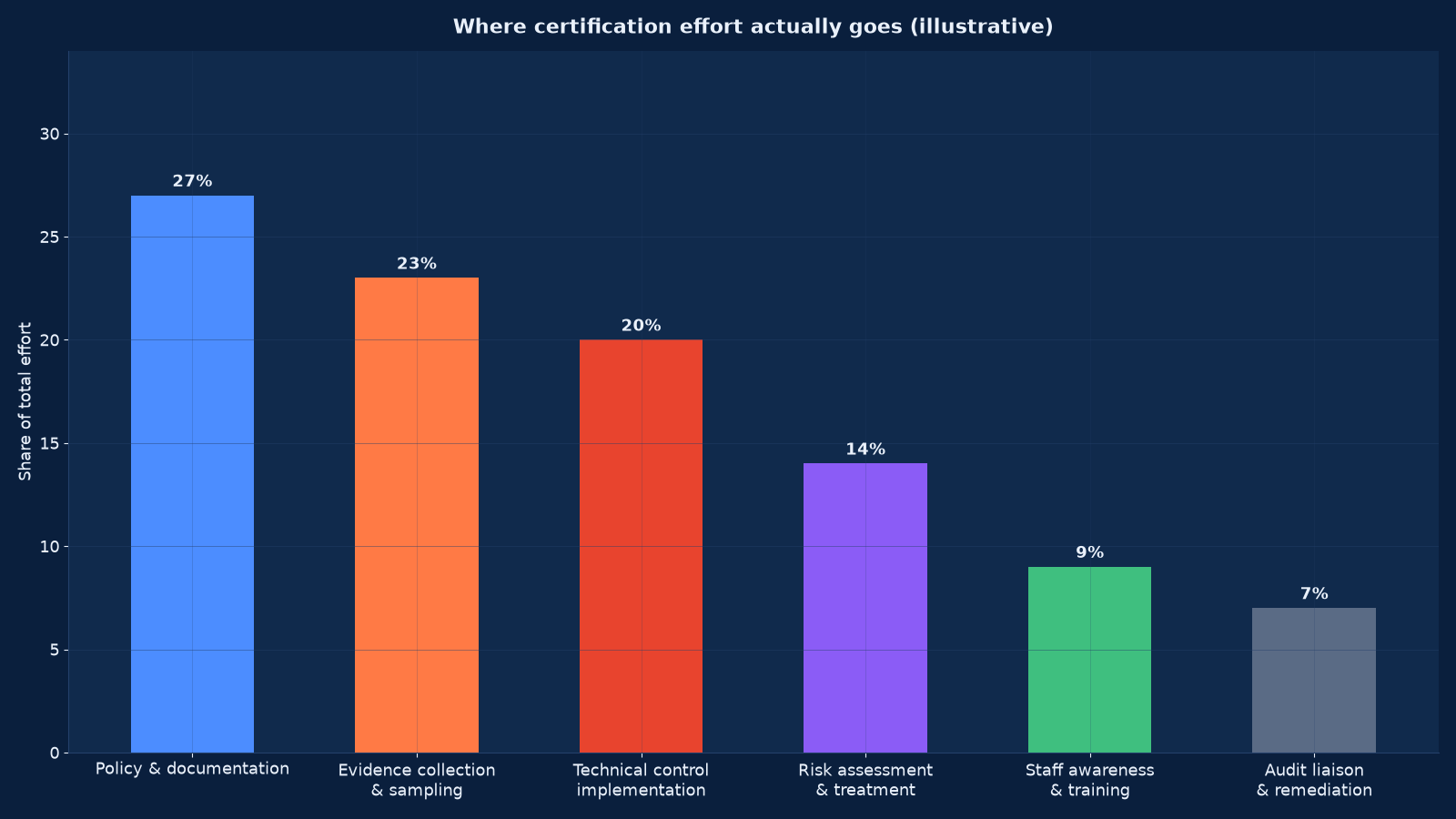
Chart values are an illustrative planning model based on typical UMC engagements and published industry benchmarks. They are not a guarantee of results on any specific project.
The Typical Gap Register
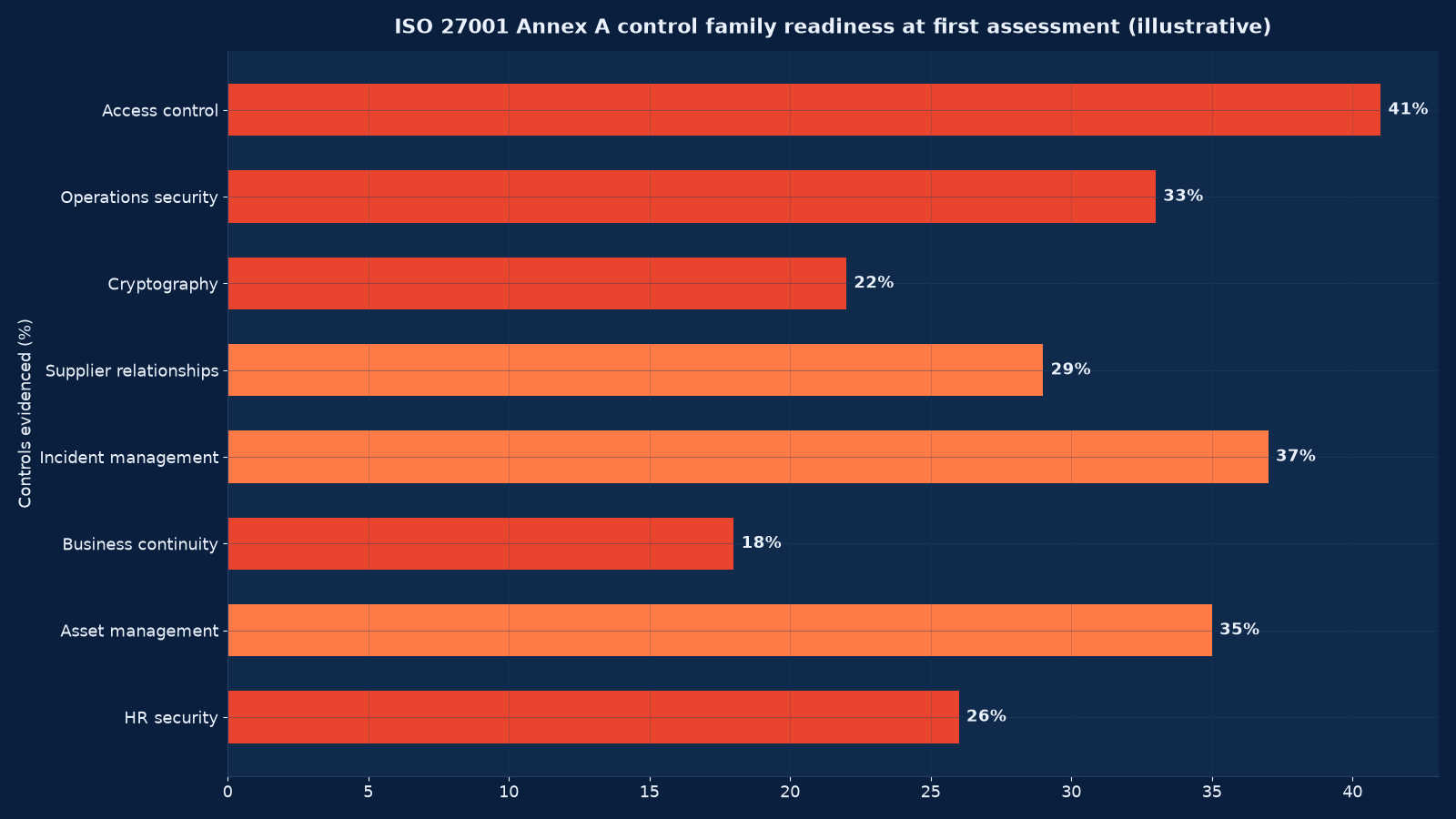
Across first assessments the findings are remarkably consistent, and most are documentation and process gaps rather than technical ones. Figure 1 shows the readiness profile; this table shows what sits behind it.
| Gap found | Typical evidence shortfall | Remediation |
|---|---|---|
| No current risk assessment | A risk register exists but is undated, unowned or written for a different scope | Re-run to a stated methodology with asset owners, treatment decisions and accepted-risk sign-off |
| Policies unwritten or unread | No version control, no acknowledgement records, content not matching practice | Rewrite to be operable, publish with version control, record acknowledgement per person |
| Access not reviewed | No periodic review of who has access to what, no leaver process evidence | Quarterly access review with sign-off, plus automated de-provisioning on leaver events |
| Logging insufficient or unreviewed | Logs exist but are not retained, not protected from tampering, and nobody reviews them | Define retention and protection, and schedule log review with recorded outcomes |
| No supplier assurance | Suppliers hold data or access with no assessment and no contractual security terms | Supplier register, risk tiering, assessment per tier, and security clauses at renewal |
| Change control informal | Changes made without record, approval or rollback plan | A proportionate change process with categories, approvals and evidence retained |
| No internal audit | Mandatory for ISO 27001 and expected for SOC 2; frequently absent | Independent internal audit to a plan, findings raised, closed and tracked |
| Management review not minuted | The meeting happens but there is no record of inputs, decisions or actions | A standing agenda with minuted outputs — cheap to fix, always sampled |
| Incident process untested | A documented process that nobody has exercised | Tabletop exercise with a written record of actions and improvements |
| Backup and continuity unevidenced | Backups run but restores are untested; no business impact analysis | Restore test schedule with results, plus a tiered BIA — see our DR service |
The encouraging part is that the majority of these gaps are inexpensive to close. The expensive ones are technical — logging, encryption, access control — and they are also the ones that improve security rather than merely evidencing it.
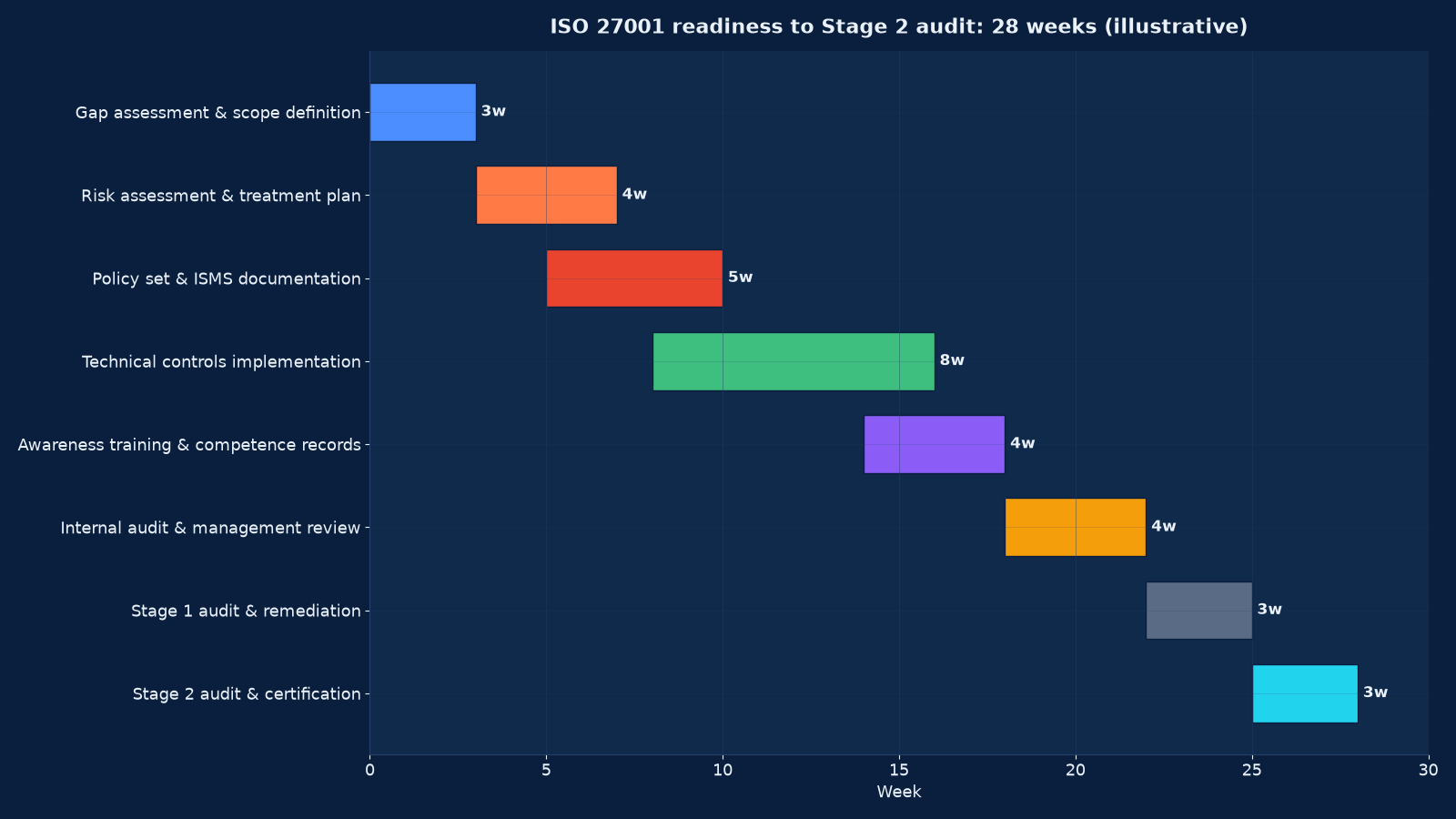
Chart values are an illustrative planning model based on typical UMC engagements and published industry benchmarks. They are not a guarantee of results on any specific project.
Delivery Programme: Gap Assessment to Certification
| Phase | Weeks | Activities | Output |
|---|---|---|---|
| Gap assessment & scope | 1–3 | Control-by-control assessment with evidence testing, scope definition, statement of applicability drafted | Scored gap register, scope document, costed remediation plan |
| Risk assessment | 3–7 | Asset register, threat and vulnerability identification, scoring, treatment plan, accepted-risk sign-off | Risk assessment and treatment plan approved by the risk owner |
| Documentation | 5–10 | Policy set, procedures, records templates, ISMS manual, version control | Published document set with acknowledgement records |
| Technical controls | 8–16 | Access control, logging, encryption, backup, vulnerability management, change control, secure configuration | Controls implemented, configured and producing evidence |
| Awareness & competence | 14–18 | Role-based training, phishing simulation, competence records | Training completion and comprehension evidence per person |
| Internal audit | 18–22 | Independent audit to a plan, findings raised and closed | Internal audit report with corrective actions tracked |
| Management review | 22–23 | Review of all mandated inputs, decisions and actions minuted | Minuted management review record |
| Stage 1 audit | 22–25 | Documentation review by the certification body, readiness opinion | Stage 1 report and any actions closed |
| Stage 2 audit | 25–28 | Implementation audit with evidence sampling | Certification decision, with any minor nonconformities closed |
Evidence: What Auditors Actually Sample
Preparation is mostly about being able to produce the right record quickly. This is the sampling pattern we prepare clients for.
| Control domain | What the auditor samples | Evidence to have ready |
|---|---|---|
| Access control | A sample of users against their entitlements; joiners, movers and leavers in the period | Access review records with sign-off, joiner and leaver tickets, privileged access list, MFA enforcement report |
| Risk management | The methodology, the register, treatment decisions | Dated risk assessment, treatment plan, accepted-risk sign-off by a named owner |
| Supplier relationships | The supplier register and assessments for the highest-risk suppliers | Register with tiering, assessment records, contractual security clauses |
| Incident management | Incidents in the period and how they were handled | Incident log, root-cause records, notification evidence, lessons-learned actions |
| Business continuity | The BIA, the plans, and whether they were tested | BIA with tiering, recovery plans, test records with dates and outcomes |
| Operations security | Logging, monitoring, malware protection, vulnerability management | Log review records, scan results with remediation dates, patch compliance report |
| Change management | A sample of changes against approvals | Change records with approval, testing evidence and rollback plans |
| Human resources security | Screening, terms of employment, training and disciplinary process | Screening records, signed acceptable-use terms, training completion data |
| Cryptography | The policy and its actual implementation | Encryption inventory, key management procedure, certificate register with expiry tracking |
| Asset management | The asset register and acceptable use | Register with owners and classification, disposal records, inventory reconciliation |
One principle covers all of it: evidence must be dated, attributable and contemporaneous. A screenshot with no date, a review with no signature, and a policy reconstructed the week before the audit are the three most common reasons for a nonconformity.
Scope: The Decision That Shapes Everything
Scope is where programmes are won or lost. Too wide and the cost and effort become unsustainable; too narrow and the certificate does not satisfy the customer who asked for it.
- Start from the customer requirement. If the certificate exists to satisfy a contract, the scope must cover the service that contract describes. A certificate scoped to one office while the service is delivered from three is worthless to that customer.
- Include the people, not just the systems. Scoping out contractors, support staff or an outsourced function creates a boundary an auditor will probe, and usually unfavourably.
- Be explicit about shared responsibility. Where hosting is outsourced, the provider’s controls matter. Either bring them into scope through supplier assurance or obtain their own certification.
- Keep the scope statement short and precise. It appears on the certificate. Vague wording invites challenge at every renewal and every customer review.
- Plan for growth. A scope that has to be widened at the first surveillance audit costs more than one defined properly at the start.
Where the estate is mid-consolidation, sequence the two programmes deliberately. Retiring systems before the audit reduces scope and evidence burden; retiring them during it produces findings about change control. Our systems integration service covers that sequencing.
Choosing a Certification Body
| Question | Why it matters | What to look for |
|---|---|---|
| Is the certification body accredited? | An unaccredited certificate may not be accepted by your customer or regulator | Accreditation by a recognised national body, and the mark on the certificate |
| Do they have sector experience? | An auditor who understands your systems asks better questions and finishes faster | Named auditor with relevant sector and technology background |
| What is included in the fee? | Stage 1, Stage 2 and surveillance are often quoted separately | A three-year total cost including surveillance visits |
| How long are the surveillance visits? | Annual surveillance is mandatory; underestimating it distorts the internal effort forecast | Visit duration and scope stated in the proposal |
| What happens on a nonconformity? | Major nonconformities can delay or prevent certification | The process and timescale for closure and re-audit |
| Will they also do SOC 2? | Using one provider for both reduces duplicated effort | Attestation capability and shared evidence tooling |
Common Reasons Certification Is Delayed
- Internal audit not done, or not independent. It is mandatory for ISO 27001 and must be performed by someone independent of the work being audited. Auditing your own implementation does not count.
- Management review missing or unminuted. Cheap to fix, always sampled, and a routine cause of a Stage 1 finding.
- Risk assessment not accepted by anyone. A register with no treatment decisions and no signed accepted risks is not a risk assessment.
- Controls implemented but not evidenced. Doing the right thing without a record is indistinguishable from not doing it.
- Scope creep mid-programme. Adding a site or a service after Stage 1 usually means restarting part of the audit.
- Staff unaware. If the people sampled cannot describe the policy that governs their work, awareness training has not landed, whatever the attendance sheet says.
- Supplier assurance absent. Outsourced functions in scope without assessment produce findings that are hard to close quickly, because they depend on a third party.
Every one of these is visible at gap assessment, which is why running the assessment early is worth more than running it thoroughly. The cybersecurity skills and certifications roadmap covers the competencies needed to keep the programme staffed afterwards.
After Certification: Keeping It Alive
Certification is a maintenance obligation, not an achievement. The cadence below is what surveillance audits expect.
| Activity | Cadence | Evidence produced |
|---|---|---|
| Access review | Quarterly | Review records with sign-off per system |
| Log and alert review | Monthly | Review records with outcomes and actions |
| Vulnerability scanning and remediation | Monthly scan, remediation to SLA | Scan reports with dates and closure evidence |
| Backup restore test | Quarterly, or per tier schedule | Test records with results |
| Supplier assessment | Annual, or on change | Assessment records per tier |
| Incident review | Per incident, plus a quarterly trend review | Incident records, root cause, corrective actions |
| Risk assessment refresh | Annual, or on material change | Dated risk assessment with treatment plan |
| Internal audit | Annual, covering all controls over the cycle | Audit plan, report and corrective action tracking |
| Management review | At least annual | Minuted review with inputs, decisions, actions |
| Awareness training | Annual, plus onboarding | Completion and comprehension records |
| Surveillance audit | Annual by the certification body | Surveillance report |
The organisations that struggle at surveillance are the ones that treated certification as a project with an end date. Budget the cadence as a standing operational cost — typically a fraction of the first-year effort — and assign it to a named owner. Where that owner also runs the infrastructure, the managed IT service in this category is what makes the evidence production sustainable.
Engagement Models
| Model | Duration | Deliverables | Best when |
|---|---|---|---|
| Gap assessment | 2–4 weeks | Control-by-control assessment with evidence testing, scored gap register, costed remediation plan, framework and scope recommendation | Before committing to certification, or to satisfy a customer questionnaire honestly |
| Full readiness programme | 20–28 weeks | Risk assessment, documentation, technical controls, training, internal audit, management review and audit liaison | Certification is required within the year |
| Technical controls only | 8–14 weeks | Access control, logging, encryption, backup, vulnerability and change management implemented and evidenced | Documentation exists but the controls do not |
| Internal audit as a service | 2–4 weeks per cycle | Independent audit to a plan, findings report, corrective action tracking | You lack an independent auditor internally |
| SOC 2 Type II readiness | 12–20 weeks plus the observation period | Trust services criteria mapping, control implementation, evidence collection over the period, examination liaison | A North American customer requires an attestation report |
| Surveillance support | Annual | Evidence pack preparation, pre-audit review, audit day support, finding response | You are certified and want the annual visit to be uneventful |
IT Audit Beyond Certification
Not every audit is for a certificate. Three other kinds are common and worth commissioning deliberately.
General IT controls review. Access, change, operations and backup controls assessed without a certification framework, usually for a board, an investor or an insurer. Faster and cheaper than certification, and it produces the same remediation list.
Customer security questionnaire support. Answering a two-hundred-question vendor assessment accurately requires knowing your own controls. Where you hold a certification, most answers come from the evidence pack; where you do not, answering honestly requires the gap assessment first.
Post-incident control review. After a security event, establishing which controls failed and why. This is the most valuable audit an organisation ever commissions and the one most often skipped in favour of moving on.
All three feed the same artefact: a control register with owners, evidence and test dates. Build it once and it answers every subsequent question — certification, customer, insurer, board or regulator.
Cost, Effort and the Realistic Timeline
The external cost is the smaller number. Certification body fees for a mid-sized organisation run across Stage 1, Stage 2 and two surveillance visits over three years, and the internal effort is usually several times the advisory fee.
Plan the internal effort explicitly: a programme owner at meaningful part-time allocation throughout, control owners in each function for evidence production, engineering time for technical remediation, and everyone’s time for training and interviews. The programmes that slip are the ones where this was assumed to be spare capacity.
The realistic timeline from a standing start to a certificate is six to nine months, per Figure 3. Faster is possible where the control environment is already strong and only evidence is missing. Slower is usual where scope is contested or where technical remediation turns out to be substantial. For SOC 2 Type II, add the observation period — a minimum of three months, more commonly six — during which controls must operate and be evidenced.
One planning point that saves money: if both ISO 27001 and SOC 2 are foreseeable, design the control set once against both. Roughly seventy per cent of the implementation is shared, and doing them sequentially duplicates most of the documentation work.
What a Mature Control Environment Looks Like
Twelve months after certification, the difference between an organisation that treats it as a badge and one that treats it as an operating system is visible in four ways.
- Evidence is produced by the systems, not by people. Access reviews come from an identity report, patch compliance from a management console, backup verification from test records. Manual evidence collection does not survive staff turnover.
- Findings are closed on time. A tracked corrective action list with owners and dates, reviewed monthly, is a better maturity indicator than the certificate itself.
- New projects pass through the control set. Change control, supplier onboarding and risk assessment happen because the process requires them, not because someone remembered.
- People can describe their own obligations. Sample any five staff and they can say what the policy requires of them. This is the hardest thing to fake and the first thing an auditor tests.
That last point is where AI Training & Enablement and general security awareness converge: competence evidence is a control requirement, and it is produced by training that is actually delivered and measured. Risk, Governance & Business Continuity Support carries the enterprise risk view into which the IT risk assessment feeds, and our guide to enterprise computer networks describes the operational environment the controls have to cover.
Frequently Asked Questions About IT Audit, ISO 27001 and SOC 2 Readiness
How long does ISO 27001 certification take?
Six to nine months from a standing start for a mid-sized organisation, per Figure 3. The variables are scope size, the technical remediation backlog and how much internal time is actually allocated. Where controls are already in place and only evidence is missing, three to four months is achievable. Where scope is contested or logging and access control need building, twelve months is realistic.
What is the difference between SOC 2 Type I and Type II?
Type I is a point-in-time opinion that your controls are suitably designed. Type II tests whether they operated effectively over a period, typically three to twelve months, and requires evidence from across that window. Most enterprise customers ask for Type II, because Type I can be achieved with controls that were implemented last week.
Can we be ISO 27001 certified and SOC 2 attested at the same time?
Yes, and it is more efficient together than sequentially. Roughly seventy per cent of the control implementation and much of the documentation is shared. Design the control set once against both, then run the audits in a compatible order. Doing them a year apart duplicates most of the documentation effort.
Do we need to certify the whole company?
No. Scope can cover a defined service, system or site, and many organisations certify the service their customers buy. The constraint is that the scope must genuinely cover what the customer is buying — a certificate scoped to one office while the service is delivered from three will not satisfy a contract.
What does it cost?
Three components: advisory and implementation support, internal effort, and certification body fees covering Stage 1, Stage 2 and two surveillance visits over three years. Internal effort is usually the largest and is the one most often left out of the budget. We quote the advisory element after a gap assessment, because quoting before it is guesswork.
What is a statement of applicability?
It is the ISO 27001 document listing every Annex A control with a justification for whether it applies to your scope. Excluding a control requires a reason, and “we do’t do that” is only acceptable if it is true and evidenced. It is one of the first things an auditor reads and it should be written early, not at the end.
We already have policies. Is that enough?
Policies are necessary and rarely sufficient. An auditor tests whether practice matches the policy and whether records exist. A well-written policy with no evidence of implementation produces a worse finding than no policy at all, because it establishes a standard you are measurably not meeting.
What happens if we get a nonconformity?
Minor nonconformities are normal and are closed with a corrective action plan within an agreed timescale. A major nonconformity can delay or prevent certification and requires a re-audit of the affected area. Most can be anticipated at Stage 1, which is precisely what that visit is for — treat its findings as a free rehearsal.
How much work is it after certification?
Less than the first year, but it never stops. Annual surveillance, a rolling internal audit programme, at least one management review, and the monthly and quarterly control cadence in section nine. Budget a standing allocation with a named owner; the organisations that lose certification are the ones that treated it as a finished project.
Can a managed service provider help us get certified?
Yes, and it changes the evidence picture. A provider with their own certification supplies assurance over the infrastructure layer, which reduces your implementation scope — but you still have to assess them as a supplier and you still own the ISMS. Outsourcing operations does not outsource accountability.
Which should we do first, ISO 27001 or Cyber Essentials?
Cyber Essentials first if you need something quickly and cheaply, particularly for public-sector work; it covers five technical control areas and takes weeks rather than months. ISO 27001 if the requirement is contractual, international or strategic. They are not alternatives — Cyber Essentials is a subset of the technical work ISO 27001 requires anyway.
Book an IT Compliance Gap Assessment
We will assess your controls against the framework your customer or regulator has asked for, test the evidence rather than accept the description, and give you a scored gap register with a costed remediation plan and a realistic certification date. Most organisations find the technical position is better than they feared and the documentation position is worse.
Contact Unified Management Consulting to arrange an initial assessment of your environment.
Related Services
IT audit and compliance sits across our security, risk and operations services:
- Cybersecurity Services & Solutions — the technical controls that produce most of the audit evidence
- Risk, Governance & Business Continuity Support — the enterprise risk framework the IT risk assessment feeds into
- AI Governance, Risk & Compliance — control and assurance for AI systems specifically
- Computing, Server, Storage & Data Centre Engineering — the infrastructure the controls are implemented on
- Routing, Switching, Firewall & Network Engineering — network segmentation and secure configuration
- AI Training & Enablement for Teams — competence and awareness evidence an auditor will sample
- Cybersecurity Career Roadmap: Skills and Certifications — the competencies behind a sustainable compliance function
- Managed IT Infrastructure & IT AMC — 24×7 monitoring, patching, backup verification and monthly SLA reporting at a fixed cost
- Enterprise Systems Integration & Tech-Stack Consolidation — application inventory, integration architecture, decommissioning and measured savings
- Backup, Disaster Recovery & Business Continuity — business impact analysis, RTO and RPO tiering, immutable copies and tested runbooks
- Cloud Cost Optimisation & FinOps — tagging, allocation, showback, right-sizing, commitments and a monthly cadence
- IT Helpdesk & End-User Support — tiered service desk, published SLAs, knowledge management and shift-left automation
- Accessibility (WCAG) Remediation & Compliance — WCAG 2.2 Level AA audits, severity-ranked defect registers, design-system remediation, assistive-technology verification and accessibility statements