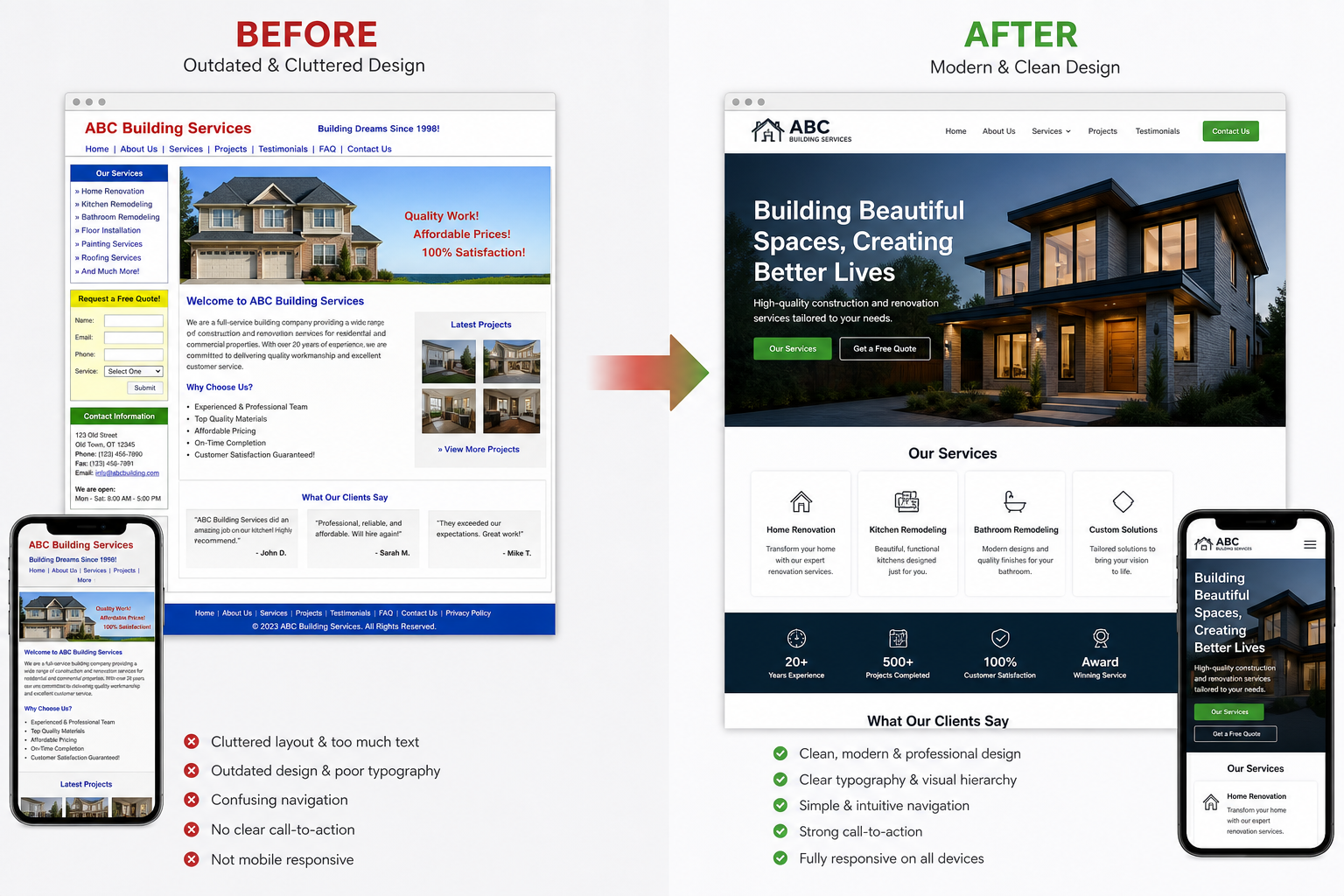
A website redesign transforms an outdated, cluttered site (left) into a modern, conversion-optimised experience (right) — the difference is immediately visible to every visitor.
There’s a difference between a website that needs a fresh coat of paint and one that needs to be rebuilt from the ground up. Getting that distinction wrong can cost you months of wasted effort — or worse, a website that still doesn’t deliver results after you’ve invested time and money into “fixing” it.
A refresh tweaks the surface — new colours, updated images, rearranged sections, perhaps a new hero banner. A redesign rethinks the foundation — your site architecture, user experience, technology stack, conversion strategy. A professional website development company in Lucknow handles this entire process, content hierarchy, and brand positioning.
Many businesses default to a refresh because it’s faster, cheaper, and less disruptive. But if the underlying problems are structural, a refresh is like painting over water damage — it looks better for a while, but the rot continues underneath.
Knowing which approach you need starts with an honest assessment. Here are the clear, specific signs that your website has outgrown a simple refresh and needs a proper redesign.
1. Your Website Was Built More Than 3–4 Years Ago
Web technology moves fast — faster than most business owners realize. A website built in 2021 or 2022 was designed for a fundamentally different internet:
Different screen sizes — Foldable phones, ultra-wide monitors, and new tablet form factors didn’t exist or weren’t mainstream
Different browser capabilities — Modern CSS features like container queries, :has() selector, and native CSS nesting weren’t available
Different user expectations — Users now expect instant loading, smooth animations, dark mode support, and intuitive interactions as standard
Different Google ranking factors — Core Web Vitals, page experience signals, and AI-driven search have fundamentally changed what Google rewards
Different accessibility standards — WCAG 2.2 requirements and growing legal enforcement mean accessibility is no longer optional
If your website is more than 3–4 years old, it’s likely running on outdated code, missing modern performance features (like lazy loading, image format optimization with WebP/AVIF, and efficient JavaScript bundling), and using a design language that feels dated to today’s visitors.
The technology stack matters too. Older WordPress themes built with shortcodes and page builders like WPBakery are significantly harder to maintain, slower to load, and more difficult to update than modern block-based themes or custom builds.
The test:
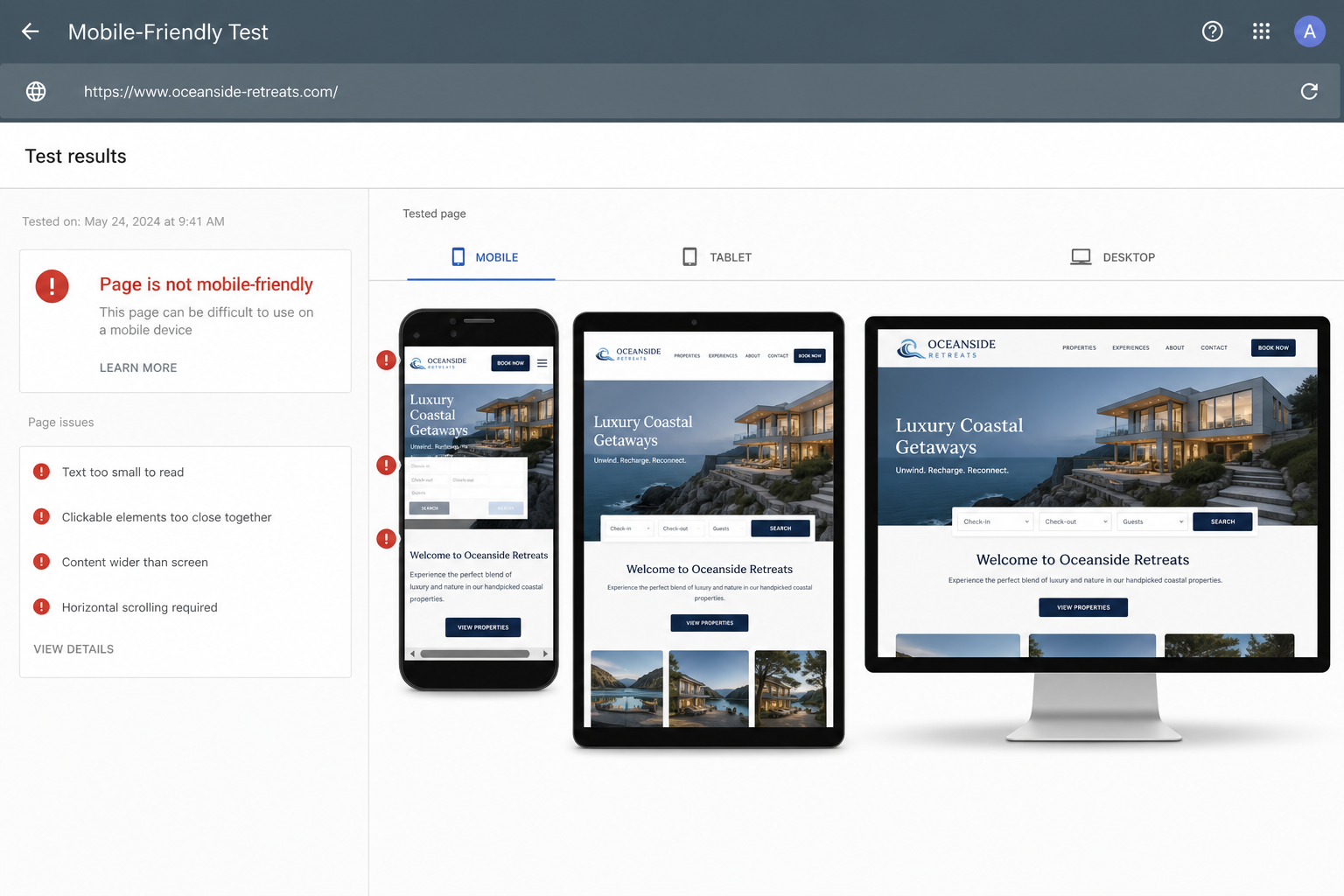
Mobile responsiveness testing: if your website looks like this on phones — with tiny text, overlapping elements, and horizontal scrolling — it is time for a redesign that puts mobile first.
Open your website on a phone, a tablet, and a desktop. Does it feel equally modern and fast on all three? Compare it side-by-side with a website built in 2025. If the difference is obvious, it’s time for a redesign.
The cost of waiting: Every year you delay, the gap between your current site and modern standards grows wider — making the eventual redesign more complex and expensive.
2. Your Bounce Rate Is High and Conversions Are Low
Beautiful design means nothing if visitors leave without taking action. Your website exists to serve a business purpose — generate leads, drive sales, build credibility, or educate your audience. If it’s not doing that, it’s failing regardless of how good it looks.
If your analytics show a
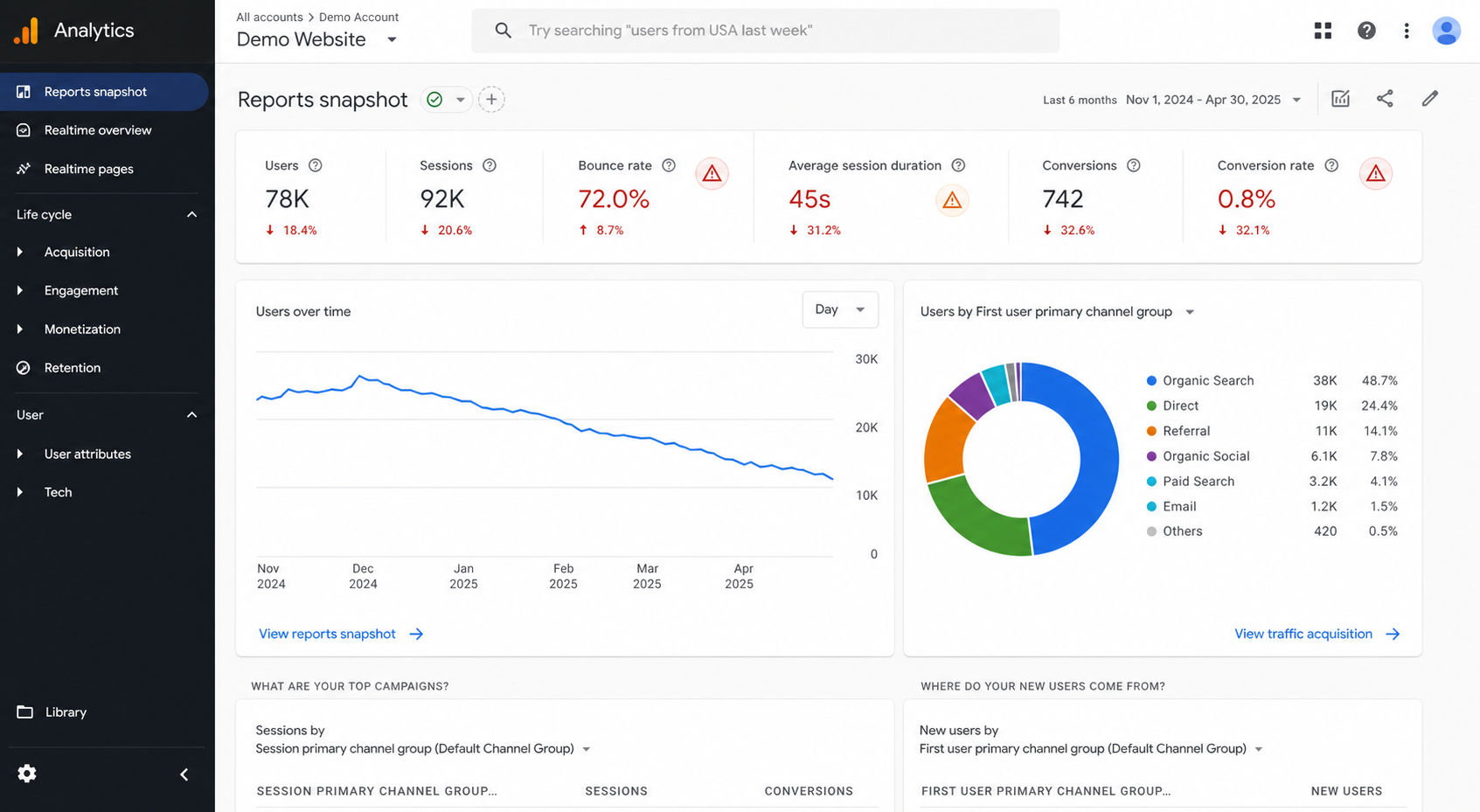
Analytics dashboard revealing the telltale signs of a website that needs redesigning: high bounce rate (72%), low session duration, and declining traffic — all indicators that your website is failing to engage visitors.
bounce rate above 60–70% and conversion rates below 1–2%, the problem likely goes deeper than aesthetics. These numbers indicate fundamental issues with how your website communicates, navigates, and persuades.
Common underlying issues that a refresh can’t fix:
Poor Information Architecture
Your website’s structure determines whether visitors can find what they need. If your navigation is confusing, your page hierarchy doesn’t match how people think about your services, or your most important content is buried three clicks deep, no amount of visual refresh will solve the problem.
Weak Conversion Funnels
Conversion isn’t accidental — it’s engineered. A well-designed website guides visitors through a deliberate journey: awareness → interest → consideration → action. If your website lacks clear calls-to-action, doesn’t address objections, or fails to build trust progressively, visitors will leave without converting.
Messaging Misalignment
Your website copy needs to speak directly to your ideal customer’s pain points, desires, and decision-making criteria. If your messaging is generic, jargon-heavy, or focused on what YOU do rather than the RESULTS you deliver, visitors won’t connect — and they won’t convert.
Slow Page Speeds
Visitors leave before the page finishes loading. This isn’t a design issue — it’s an architectural one. Heavy themes, unoptimized assets, excessive plugins, and poor hosting all contribute. A refresh won’t address these root causes.
Lack of Trust Signals
Before someone fills out a contact form or makes a purchase, they need to trust you. Trust is built through strategic placement of testimonials, case studies, certifications, social proof, team photos, and clear contact information. If these elements are missing or poorly presented, a visual refresh won’t help.
The test: Run a user testing session. Ask 5 people (preferably from your target audience) to complete your most important conversion action while thinking aloud. Watch where they get stuck, confused, or frustrated. If the issues are structural (can’t find information, don’t understand the offering, don’t trust the site), you need a redesign.
3. Your Business Has Changed but Your Website Hasn’t
Businesses evolve. The company you are today may look very different from the company that launched the current website. Consider whether any of these apply:
You’ve pivoted your services or added new service lines
You’ve expanded into new markets or geographies
You’ve rebranded or updated your visual identity
Your target audience has shifted — different industry, different company size, different decision-makers
You’ve merged with or acquired another company
Your competitive positioning has changed — you’re now premium, or you’ve moved upmarket
You’ve added new capabilities — proprietary technology, new certifications, new partnerships
Your team has grown significantly and you need to reflect that scale
If your website still reflects who you were two or three years ago instead of who you are today, it’s actively hurting your business. Prospects who land on a website that doesn’t match your current positioning will leave confused — and they won’t come back.
This is especially critical for consulting and B2B services firms. Your website is often the first interaction a potential client has with your brand. If it says “small local firm” when you’re now a national practice, or if it highlights services you no longer offer, you’re sending the wrong message to the right people.
The test: Hand your website URL to someone who doesn’t know your business. Ask them to describe: (1) what you do, (2) who you serve, and (3) what makes you different. If their answers don’t match your current reality, you need a redesign.
4. You’re Embarrassed to Share Your Website URL
This one is simple but powerful — and more common than you’d think.
If you hesitate before sharing your website with a prospect, investor, or partner — if you find yourself saying “we’re working on updating it” or “it looks better in person” or “we’re about to launch a new version” — your website is failing its most basic job.
Your website should be your proudest sales asset. It should make you excited to share it. It should reinforce the credibility you’ve built in conversations and presentations. When someone visits your website after meeting you, their impression should be “yes, this is exactly the professional I thought I was dealing with.”
If the opposite is true — if visiting your website actually undermines the credibility you’ve built elsewhere — that’s a serious business problem. Every time you share your URL, you risk undoing the good work your team has done in person.
A refresh might improve the colours and images, but it won’t fix the fundamental issue if the structure, content, and experience are what’s making you cringe.
The test: Rate your pride in your website on a scale of 1–10. If it’s below 7, a refresh won’t get you where you need to be.
5. Your CMS Is Difficult to Use (or Broken)
How long does it take your team to publish a new blog post? Update a service page? Add a new team member? Create a landing page for a campaign?
If the answer is “too long,” “we need to call the developer every time,” or “we just don’t update the website because it’s too complicated” — your content management system isn’t working for you.
This problem creates a vicious cycle:
Your CMS is hard to use
Your team avoids updating the website
Content goes stale
Visitors see outdated information
Your SEO suffers (Google prefers fresh content)
Your website becomes less relevant
You invest less in the website because it’s not performing
The cycle continues
A modern CMS should make content updates effortless. Your marketing team should be able to:
Publish and edit blog posts without technical knowledge
Update service pages and team profiles
Create landing pages for campaigns
Add testimonials and case studies
Manage downloadable resources
Update pricing and offerings
If your current setup requires technical knowledge for basic changes, you’re wasting time and money — and your website content is probably stale as a result.
A redesign gives you the opportunity to migrate to a CMS architecture that your team can actually use — one that makes publishing content as easy as writing an email. Modern WordPress with the block editor (Gutenberg), combined with custom block patterns and reusable templates, can dramatically simplify content management.
The test: Ask your marketing team (or whoever manages content) to rate the CMS experience on a scale of 1–10. If it’s below 6, the CMS architecture needs to change — and that requires a redesign.
6. Your Website Doesn’t Work Well on Mobile
In 2026, over 65% of web traffic in India comes from mobile devices. This isn’t a trend — it’s reality. If your website wasn’t designed mobile-first, you’re serving a degraded experience to the majority of your audience.
Mobile issues go far beyond “does it fit on the screen.” Common mobile problems that require a redesign include:
Touch targets too small — Buttons and links that are difficult to tap accurately on a phone screen
Text too small to read — Requiring pinch-to-zoom to read content
Forms that are impossible to complete — Dropdown menus, tiny checkboxes, and input fields that don’t trigger the right keyboard
Navigation that doesn’t work on mobile — Mega menus that break, dropdowns that don’t close, hamburger menus that hide critical items
Images that don’t scale — Overflowing containers, cropped content, or massive images that kill load times
Pop-ups that block content — Modal windows that can’t be closed on mobile
Horizontal scrolling — Content that requires side-to-side scrolling to read
Google uses mobile-first indexing, meaning it primarily evaluates your mobile site when determining search rankings. A poor mobile experience doesn’t just lose visitors — it actively hurts your visibility in search results. You could have a perfect desktop site and still rank poorly because your mobile experience is substandard.
Fixing mobile issues often requires fundamental changes to layout, navigation, and interaction design — changes that go far beyond what a responsive CSS refresh can handle.
The test: Use Google’s PageSpeed Insights tool and check your mobile score. Also test with real users on real phones. If your mobile score is below 50, or if users report frustration, your mobile experience needs a redesign.
7. Your Website Is Slow — Really Slow
Page speed isn’t just a technical metric — it’s a business metric that directly impacts your bottom line. And it’s one of the areas where a refresh almost never solves the problem.
Here’s what the research tells us:
0–1 second load time: Average conversion rate of 3.05%
1–2 second load time: Average conversion rate drops to 2.08% (32% decrease)
2–3 second load time: Average conversion rate drops to 1.27% (58% decrease)
3+ second load time: You’ve lost 40% of visitors before the page even loads
If your website is slow, the causes are almost always architectural:
Heavy theme — Premium themes with dozens of built-in features load massive CSS and JavaScript files on every page
Bloated plugins — Each plugin adds its own scripts, styles, and database queries
Unoptimized images — Large, uncompressed images served in outdated formats
No caching strategy — Every page load requires fresh server processing
Poor hosting — Shared hosting can’t handle the resources your site needs
Render-blocking resources — CSS and JavaScript files that prevent the page from displaying until they’re fully loaded
Too many HTTP requests — Each element on the page requires a separate server request
No Content Delivery Network — Assets served from a single location, slow for distant visitors
A visual refresh won’t address any of these. You need a redesign that addresses performance at the architectural level — choosing a lightweight theme, implementing proper caching, optimizing assets, and building with performance as a core requirement rather than an afterthought.
The test: Run your website through PageSpeed Insights and GTmetrix. If your desktop score is below 70 or your mobile score is below 50, performance issues are architectural and require a redesign.
8. Your Competitors’ Websites Make Yours Look Outdated
Take an honest look at your top 3–5 competitors’ websites. How does yours compare?
In consulting and B2B services, credibility is everything. Before a potential client ever speaks with your team, they’ve likely visited your website and formed an opinion. In many cases, they’ve compared your website directly with your competitors’.
If their sites feel modern, fast, and professional while yours feels dated and clunky, you’re losing business to them before a conversation even starts. The prospect assumes — fairly or not — that if your website is outdated, your thinking might be too.
This is particularly important in 2026, where AI-powered tools have made it easier than ever for businesses to create polished, professional websites. The baseline expectation for website quality has risen dramatically. What looked cutting-edge three years ago looks average today — and what looked average looks outdated.
Ask yourself:
Would a prospect choose my competitor based solely on website impression?
Does my website convey the same level of expertise and professionalism as my competitors?
Am I losing deals to competitors who aren’t necessarily better — just better presented?
If the answer to any of these is “yes” or “maybe,” your website needs a redesign to restore your competitive position.
9. Your Website Doesn’t Support Your Current Marketing Strategy
Your marketing strategy has probably evolved since your website was built. Maybe you’ve started investing in content marketing, launched a podcast, added webinars, or started running paid campaigns.
If your website wasn’t built to support these activities, you’re creating friction everywhere:
No blog infrastructure — Publishing content is difficult or the blog looks like an afterthought
No landing page templates — Every campaign requires custom development
No lead magnet delivery — Offering downloadable resources is cumbersome
No integration with marketing tools — CRM, email marketing, and analytics don’t connect properly
No conversion tracking — You can’t measure which pages and content drive results
No personalization — Every visitor sees the same experience regardless of their stage in the buyer journey
A redesign allows you to build your website as a marketing machine — designed from the ground up to support your current strategy and scale with your future plans.
10. You’re Spending More Time Working Around Your Website Than Working With It
This is the ultimate tell. If your team regularly encounters situations where they need to:
Create workarounds because the website can’t do what they need
Use third-party tools because the website doesn’t support native functionality
Manually duplicate effort because the website lacks automation
Avoid updating certain pages because “they always break”
Apologize to prospects for website issues
…then your website is a liability, not an asset. You’re spending time and energy fighting your own tools instead of serving your customers.
Refresh vs. Redesign: A Comprehensive Decision Framework
Factor
Choose a Refresh If…
Choose a Redesign If…
Age
Website is less than 2–3 years old
Website is 3+ years old with outdated technology
Performance
Conversions are acceptable, could improve
Bounce rate is high, conversions are low
Business alignment
Business model hasn’t changed significantly
Business has pivoted, rebranded, or expanded
CMS usability
Your team can use the CMS without frustration
CMS is frustrating and content goes stale
Mobile experience
Mobile experience is decent (score 60+)
Mobile experience is poor or broken (score below 50)
Page speed
Page speed scores are above 70
Page speed scores are below 50
Brand alignment
Brand looks slightly dated but recognizable
Brand has evolved significantly or rebranded
Competitive position
Your site holds its own against competitors
Competitors’ sites make yours look outdated
Marketing support
Website supports current marketing activities
Website creates friction for marketing efforts
Team satisfaction
Team is mostly happy with the website
Team works around the website constantly
Budget
You need quick improvements with limited budget
You’re ready to invest in long-term results
Timeline
You need results in 2–4 weeks
You can invest 6–12 weeks for a proper build
Rule of thumb: If you checked 3 or more items in the “Redesign” column, a refresh won’t solve your problems. You need a redesign.
What a Proper Website Redesign Process Looks Like
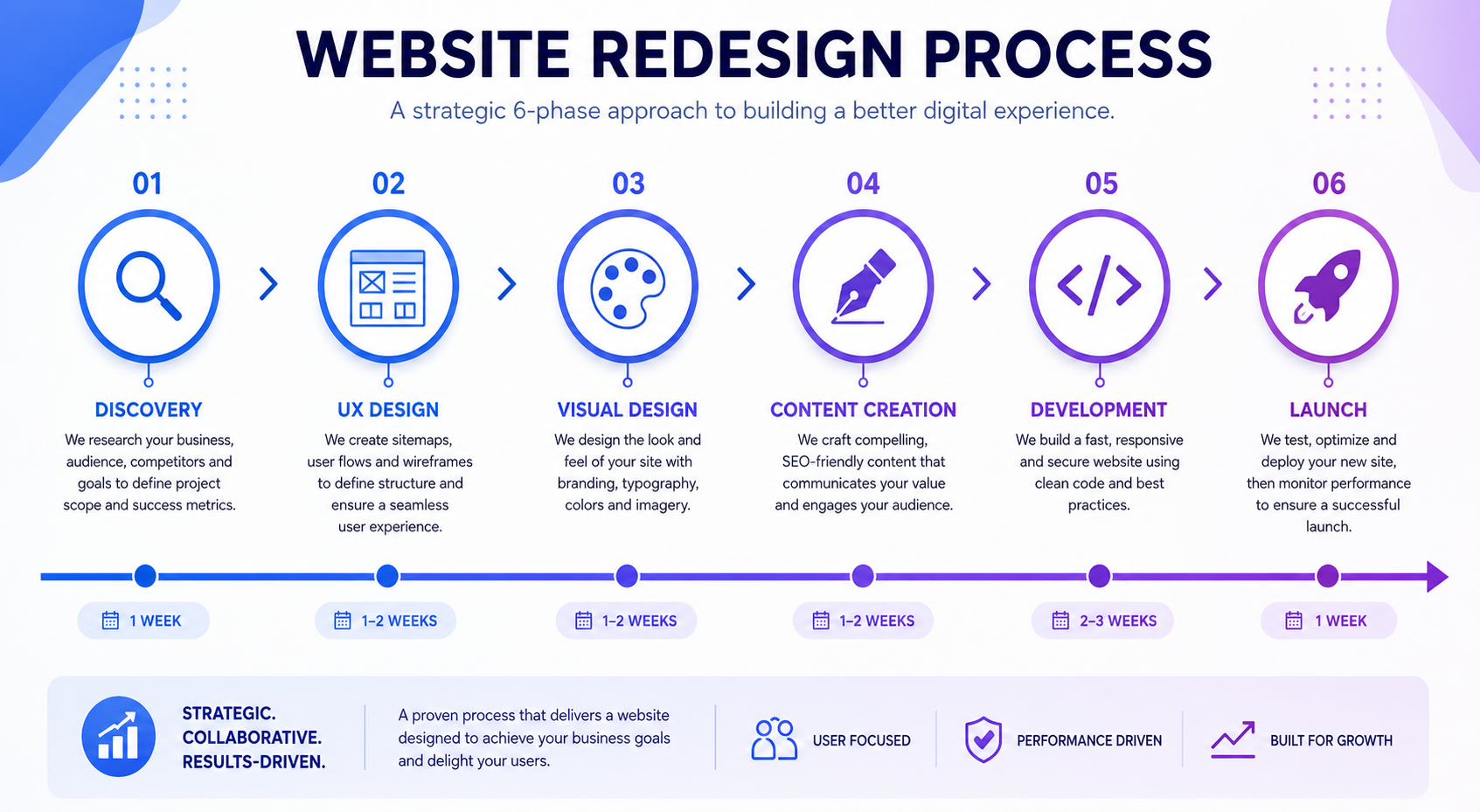
A well-executed website redesign isn’t just about making things look pretty. It’s a strategic, research-driven process that typically unfolds in six phases:
A professional website redesign follows a structured 6-phase process from discovery to launch — each phase building on the previous to ensure a strategic, high-performing result.
Phase 1: Discovery and Strategy (2–3 weeks)
Stakeholder interviews to understand business goals, challenges, and vision
Audience research — who visits your site, what they need, and how they behave
Competitor analysis — what’s working in your market and where are the opportunities
Content audit — what existing content to keep, update, or retire
Analytics deep-dive — traffic patterns, conversion data, user behaviour flows
Technical audit — current technology stack, performance benchmarks, integration requirements
Soft launch — testing with a small audience before full rollout
Go-live — DNS switch and monitoring
Post-launch monitoring — watching for issues, tracking performance
Analytics setup — goals, events, and conversion tracking
Iteration plan — data-driven improvements based on real user behaviour
How Much Does a Website Redesign Cost?
Website redesign costs vary significantly based on scope, complexity, and who you work with. Here’s a realistic framework for the Indian market:
Project Type
Investment Range
Timeline
Best For
Template-Based Redesign
₹1,00,000 – ₹3,00,000
4–6 weeks
Small businesses needing a modern look quickly
Custom Design + WordPress
₹3,00,000 – ₹8,00,000
8–12 weeks
Mid-size businesses needing a strategic, high-performing website
Premium Custom Build
₹8,00,000 – ₹20,00,000+
12–20 weeks
Enterprises and agencies needing complex functionality
Remember: the cheapest option isn’t always the most cost-effective. A ₹3,00,000 redesign that generates ₹30,00,000 in additional annual revenue is a far better investment than a ₹1,00,000 redesign that doesn’t move the needle.
Making the Case for Redesign: How to Get Buy-In
If you need to convince stakeholders (partners, management, board members) that a redesign is worth the investment, here’s a framework:
1. Quantify the Current Cost
Calculate what your current website is costing you in lost revenue, wasted team time, and missed opportunities. Use real analytics data.
2. Benchmark Against Competitors
Show side-by-side comparisons of your website versus competitors. Visual evidence is compelling.
3. Project the ROI
Estimate the improvement in leads, conversions, and revenue a redesigned website would generate. Even conservative estimates often show strong ROI.
4. Factor in Risk
Highlight the risks of NOT redesigning — continued ranking losses, increasing competitive disadvantage, growing technical debt.
5. Present a Phased Approach
If budget is a concern, propose a phased redesign that delivers value incrementally rather than requiring the full investment upfront.
The Bottom Line
A refresh is a band-aid. A redesign is a transformation. If your website is showing multiple signs from this list, investing in a redesign isn’t just about looking better — it’s about performing better, converting more, and staying competitive in a market that never stands still.
The most successful businesses don’t wait until their website is broken to invest in it. They treat their website as a strategic asset — one that deserves ongoing investment, regular evaluation, and periodic transformation when the time is right.
The question isn’t whether your website will eventually need a redesign. It will. The question is whether you’ll be proactive about it — redesigning when it gives you a competitive advantage — or reactive — redesigning when the damage is already done and you’re playing catch-up.
Your website is the centre of your digital presence. Make sure it’s working as hard as you are.
Unified Management Consulting helps businesses align their digital presence with their strategic goals — from website redesigns to complete digital transformation. We combine strategic thinking with execution excellence to deliver websites that don’t just look great but drive measurable business results. Let’s talk about your website and explore whether a redesign is the right move for your business.
Frequently Asked Questions About Website Redesign
How do I know if my website needs a redesign?
Your website needs a redesign if it shows multiple signs: it is more than 3-4 years old, has a bounce rate above 60-70 percent, does not reflect your current business, performs poorly on mobile with a score below 50, loads slowly in more than 3 seconds, uses a CMS your team finds frustrating, or looks outdated compared to competitors. If you check 3 or more of these signs, a visual refresh will not be enough and you need a full redesign.
What is the difference between a website refresh and a redesign?
A website refresh changes the surface with new colours, updated images, and rearranged sections while keeping the same underlying structure, technology, and architecture. A website redesign rebuilds the foundation by rethinking site architecture, user experience, technology stack, content hierarchy, conversion strategy, and brand positioning. Choose a refresh for minor visual updates and choose a redesign when structural problems are causing poor performance.
How much does a website redesign cost in India?
In India, website redesign costs range from Rs.1,00,000 to Rs.20,00,000+ depending on scope. Template-based redesigns cost Rs.1,00,000 to Rs.3,00,000 over 4-6 weeks. Custom WordPress redesigns cost Rs.3,00,000 to Rs.8,00,000 over 8-12 weeks. Premium enterprise builds cost Rs.8,00,000 to Rs.20,00,000+ over 12-20 weeks.
How long does a website redesign take?
A website redesign typically takes 8-16 weeks for most businesses. The process includes discovery and strategy over 2-3 weeks, information architecture and UX design over 2-3 weeks, visual design over 2-3 weeks, content creation over 2-4 weeks overlapping with design, development and testing over 3-5 weeks, and launch and optimization over 1-2 weeks.
How often should a website be redesigned?
A website should be redesigned every 3-5 years for most businesses. This timeline accounts for changes in web technology, evolving user expectations, Google algorithm updates, and shifts in your business. However, you should redesign sooner if your business has significantly changed, your website performance is declining, or competitors have significantly upgraded their digital presence.
Will a website redesign hurt my SEO?
A website redesign can temporarily affect SEO if not done properly, but a well-executed redesign should improve your SEO long-term. To protect your rankings during a redesign: implement proper 301 redirects for all changed URLs, maintain or improve page speed, keep or improve content quality, preserve internal linking structure, set up proper canonical tags, and submit an updated sitemap to Google Search Console immediately after launch.
What should I look for in a website redesign agency?
When choosing a website redesign agency, look for: (1) A strategic research-driven process not just design, (2) Portfolio of similar B2B or consulting websites, (3) Clear project management and communication, (4) SEO expertise built into the process, (5) Performance-focused development that is fast accessible and mobile-first, (6) Post-launch support and optimization, and (7) Transparent pricing with a detailed scope of work.
What is the ROI of a website redesign?
The ROI of a website redesign typically ranges from 200 percent to 1,000 percent+ within the first year. Businesses commonly see 50-200 percent increase in organic traffic, 30-100 percent improvement in conversion rates, 40-60 percent reduction in bounce rates, and significant improvements in lead quality.
Key Takeaway
A refresh is a band-aid. A redesign is a transformation. If your website is 3+ years old, performing poorly, or no longer reflects your business, invest in a proper redesign. Redesign every 3-5 years and treat your website as the strategic asset it is.
Related Services by UMC in Lucknow
Whether you need a complete website redesign or ongoing digital marketing to maximise your new website’s potential, Unified Management Consulting in Lucknow delivers end-to-end solutions:


4 comments