
Move from AI ideas to reliable systems that work inside your business. Unified Management Consulting provides AI forward-deployed engineering services that combine embedded technical delivery, domain discovery, data engineering, model integration, agent development, workflow automation, security, evaluation, MLOps, and change management.
AI forward-deployed engineering is an embedded delivery model in which experienced engineers work closely with a customer’s teams, systems, data, and operating environment. Instead of delivering a generic prototype and leaving implementation to the client, a forward-deployed engineering team studies the real workflow, works with subject-matter experts, integrates with existing technology, tests measurable outcomes, and helps move the solution toward production.
📋 AI Forward-Deployed Engineering — Quick Summary
| Service | What We Do |
|---|---|
| Embedded Teams | AI engineers deployed within your organization for hands-on implementation |
| Rapid Prototyping | 2-4 week AI proof-of-concepts to validate business value before scaling |
| Production AI | End-to-end AI system development from prototype to production deployment |
| Knowledge Transfer | Team training, documentation, and capability building for long-term AI independence |
| Key Results | 3x faster AI delivery, 60% lower AI project failure rate, in-house AI capability |
| Investment | $15,000-$50,000/month per deployed engineering team |
The work may involve retrieval-augmented generation, internal knowledge assistants, document intelligence, forecasting, classification, recommendation, workflow agents, customer-service automation, developer tools, computer vision, speech systems, or decision-support applications. The technical solution must fit the organization’s data, permissions, processes, infrastructure, risk profile, and adoption capacity.
Unified Management Consulting combines engineering execution with management consulting. We help leaders choose the right problem, define a measurable business case, make responsible architecture decisions, and create an operating model for long-term AI performance.
At-a-Glance AI Engineering Delivery Framework
| Delivery stage | What we manage | Key technical signals | Business outcome |
|---|---|---|---|
| Discover | Workflow, data, users, risks, and opportunity | Process map, baseline metrics, use-case score | Prioritized AI opportunity |
| Design | Architecture, model, integration, and controls | Technical design, data contracts, threat model | Feasible production plan |
| Build | Pipelines, prompts, tools, UI, APIs, and services | Working increments, tests, latency, cost | Usable AI capability |
| Evaluate | Quality, safety, accuracy, and business acceptance | Eval scores, human review, error taxonomy | Evidence of reliability |
| Deploy | Cloud, security, observability, rollout, and support | Uptime, trace quality, alerts, adoption | Production operation |
| Improve | Feedback, retraining, prompt changes, and workflow tuning | Quality trend, cost per task, adoption | Continuous value |
Illustrative AI Delivery Efficiency Graph
This graph is an illustrative planning model, not a guarantee. Actual results depend on data readiness, workflow complexity, integrations, security requirements, adoption, and implementation speed.
textIllustrative production readiness and business value

100 |                                      ███████████████████████  Scale
 85 |                                ███████████████████           Production rollout
 70 |                          █████████████████                   Evaluation and pilot
 55 |                    ███████████████                           Integrated prototype
 40 |              ███████████                                     Data and workflow design
 25 |        ██████                                                Discovery and baseline
 10 |  ███                                                         Starting point
     +-------------------------------------------------------------------
       Week 1       Week 4       Week 8       Week 12      Week 16
The fastest route to value is not always the fastest route to a demo. Forward-deployed engineering creates short delivery loops while preserving the testing, security, data, and operational work required for a dependable production system.
The Forward-Deployed AI Engineering Journey
textBusiness problem and workflow discovery
                    ↓
Data, system, user, and risk assessment
                    ↓
Use-case prioritization and measurable baseline
                    ↓
Architecture, model, integration, and security design
                    ↓
Working prototype with real user feedback
                    ↓
Evaluation, red teaming, observability, and acceptance testing
                    ↓
Production deployment, training, and operating ownership
                    ↓
Continuous optimization of quality, cost, latency, and adoption
What Are AI Forward-Deployed Engineering Services?
AI forward-deployed engineering services provide embedded technical expertise to design, build, integrate, deploy, and improve AI systems in a customer’s real operating environment. Services may include:
- AI use-case discovery and prioritization.
- Workflow observation and process redesign.
- Data readiness assessment.
- Data engineering and document pipelines.
- Retrieval-augmented generation systems.
- Enterprise search and knowledge assistants.
- AI agents and tool-using workflows.
- Classification, extraction, and summarization systems.
- Forecasting and predictive models.
- Recommendation and personalization systems.
- Computer vision and image analysis.
- Speech recognition and voice workflows.
- Customer-service and operations automation.
- Developer and internal productivity tools.
- Model, provider, and architecture selection.
- Prompt, tool, and context engineering.
- Model evaluation and quality assurance.
- Fine-tuning or adaptation assessment.
- API, SaaS, ERP, CRM, and data-platform integration.
- Cloud deployment and infrastructure as code.
- MLOps, LLMOps, observability, and incident response.
- Security, privacy, access, and governance.
- Human-in-the-loop workflow design.
- Adoption, training, and operating-model development.
Forward-deployed engineers work with business users, data owners, product leaders, security teams, developers, operations, and executives. The goal is to deliver an AI capability that is technically sound and operationally useful.
Why AI Projects Need Forward-Deployed Engineering
Many AI pilots fail to create sustained value because they are disconnected from real workflows. A prototype may use clean sample data, a simplified process, generous human review, and an ideal user. Production systems encounter incomplete records, changing policies, ambiguous language, access restrictions, integration failures, latency constraints, user skepticism, and edge cases.
Forward-deployed engineering closes the gap between a promising demonstration and an operating system. The team works where the problem occurs, observes how people actually perform the task, identifies exceptions, connects the solution to existing tools, and learns from real feedback.
This model is particularly useful when:
- The workflow is complex or domain-specific.
- Data is distributed across systems.
- Users need answers grounded in internal information.
- Existing software cannot easily support the use case.
- Quality depends on human judgment.
- The cost of incorrect output is material.
- Security and permissions are important.
- The business needs measurable productivity or revenue impact.
- The organization has limited internal AI engineering capacity.
AI is not a single software feature. It is a system of data, models, prompts, tools, policies, interfaces, people, and feedback loops. Forward-deployed engineering helps align those pieces.
Our AI Engineering Delivery Process
1. Business and Workflow Discovery
We begin with the user and the operational problem, not with a preferred model or technology. We interview stakeholders, observe tasks, map inputs and outputs, review existing tools, identify decision points, and measure the current process.
Discovery questions may include:
- Who performs the task?
- What information do they need?
- Where does the information live?
- How often does the task occur?
- What is the current cycle time?
- What errors or delays are common?
- Which decisions require expert judgment?
- What happens when information is missing?
- What must be logged or approved?
- What is the cost of failure?
- What would users do with time saved?
- How will business value be measured?
The output is a use-case definition with users, workflow, baseline, data sources, constraints, risks, acceptance criteria, and an initial delivery plan.
2. AI Opportunity Prioritization
Not every problem needs generative AI. Some problems are better solved through conventional software, rules, search, analytics, process redesign, or improved data quality. We evaluate use cases according to:
| Evaluation factor | Questions |
|---|---|
| Business impact | Will the system increase revenue, reduce cost, improve service, or reduce risk? |
| Feasibility | Are the data, integrations, skills, and infrastructure available? |
| Quality tolerance | What error rate is acceptable for this task? |
| Adoption | Will users trust and incorporate the system into their workflow? |
| Security | What data, permissions, and regulatory controls are required? |
| Time to value | Can a useful version be delivered within a realistic period? |
| Operating cost | Are model, storage, retrieval, support, and review costs sustainable? |
| Strategic value | Will the capability create reusable data, workflows, or differentiation? |
We prioritize use cases that have a clear owner, measurable baseline, accessible data, appropriate risk, and a credible path to adoption.
3. Data and System Readiness Assessment
AI quality depends heavily on the quality, availability, structure, freshness, and permissions of the data provided to the system. We assess structured databases, documents, PDFs, tickets, emails, CRM records, ERP data, APIs, knowledge bases, audio, images, spreadsheets, logs, and external information.
The assessment examines:
- Data ownership and access.
- Data classification and sensitivity.
- Source quality and completeness.
- Duplicates and conflicting records.
- Metadata and timestamps.
- Version and expiration information.
- Document parsing and OCR quality.
- API availability and rate limits.
- Data lineage and transformations.
- Update frequency.
- Retention and deletion requirements.
- Ground-truth labels and evaluation sets.
- Integration and identity constraints.
A model cannot reliably answer questions from information it cannot access, cannot interpret, or is not authorized to use. In many projects, data preparation creates more value than model experimentation.
4. Architecture and Model Selection
We design the system around the use case rather than selecting a model first. Architecture decisions may include:
- Hosted model versus self-hosted model.
- General model versus specialized model.
- Text, image, audio, video, or multimodal capability.
- Retrieval-augmented generation versus fine-tuning.
- Batch processing versus real-time inference.
- Synchronous versus asynchronous workflow.
- API integration versus embedded application.
- Cloud, private cloud, on-premise, or hybrid deployment.
- Deterministic rules around probabilistic model output.
- Human approval before external action.
We compare quality, latency, context window, tool support, reliability, privacy, cost, availability, vendor dependency, and operational complexity. The most powerful model is not always the best production choice.
Retrieval-Augmented Generation Engineering
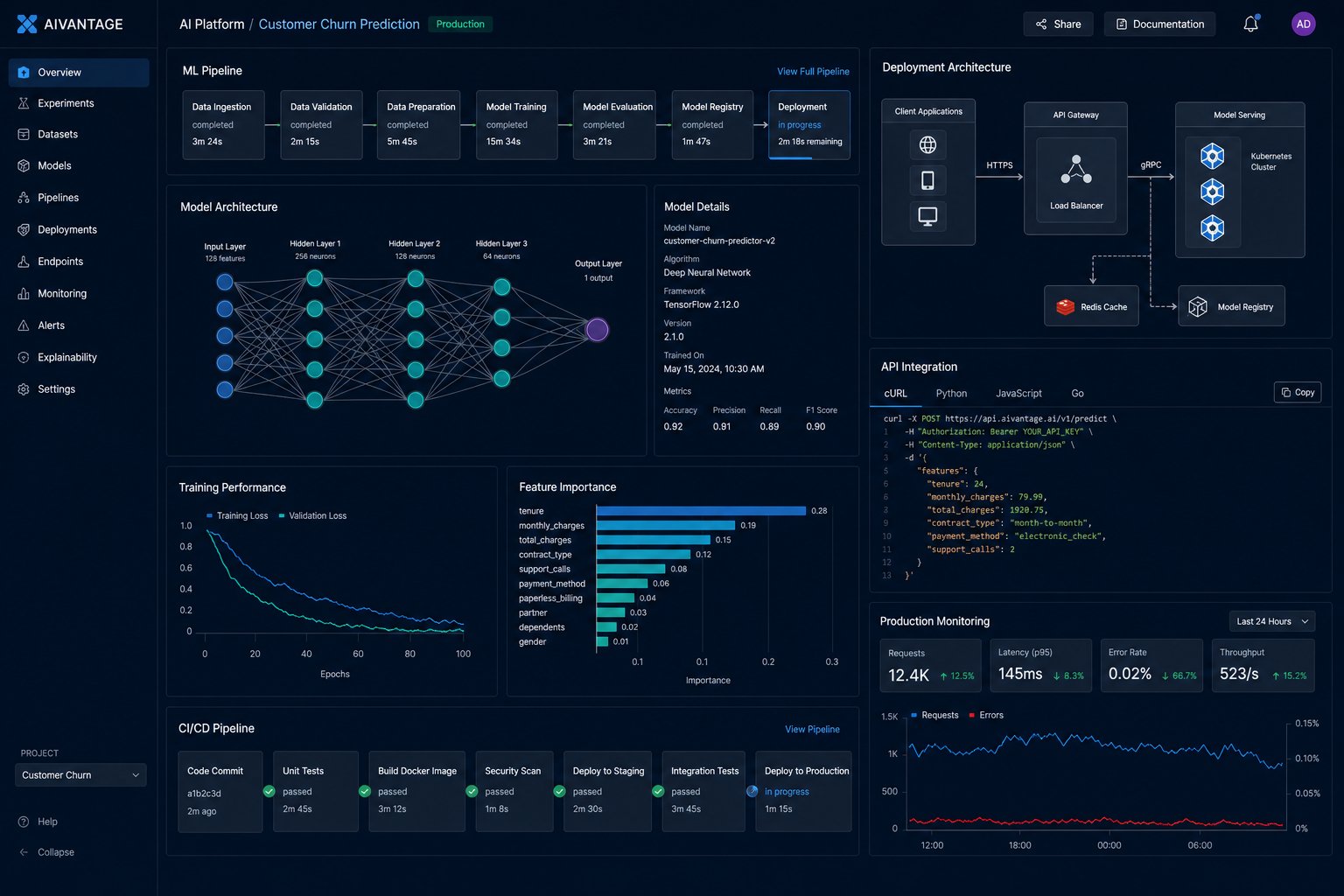
Retrieval-augmented generation, or RAG, combines a language model with a retrieval layer that finds relevant information from approved sources. Instead of relying only on model pretraining, the system retrieves current or private information and provides it as context for the answer.
A production RAG system may include:
- Source connectors.
- Document ingestion.
- Text extraction and OCR.
- Cleaning and normalization.
- Chunking strategy.
- Metadata enrichment.
- Embedding generation.
- Vector or hybrid search.
- Filtering and permission checks.
- Reranking.
- Context assembly.
- Prompt and response generation.
- Citation or source display.
- Evaluation and monitoring.
Chunking and Metadata
Chunking is not simply splitting text into equal character lengths. Chunks should preserve meaning, headings, tables, procedures, definitions, version information, and relationships. Metadata can include document type, department, product, country, role, version, effective date, confidentiality, and source authority.
Poor chunking may separate a policy exception from the rule, detach a table from its heading, or remove the conditions required to interpret an answer. We test chunk size, overlap, semantic boundaries, metadata filters, and retrieval quality using representative queries.
Hybrid Retrieval and Reranking
Semantic vector search can find conceptually similar content, while lexical search can handle exact product names, error messages, codes, and technical terms. Hybrid retrieval combines signals. A reranker can reorder candidate documents according to query relevance before context is sent to the model.
We evaluate retrieval recall, precision, ranking quality, latency, context size, source diversity, and citation accuracy. A fluent answer is not sufficient if the wrong document was retrieved.
Access-Controlled Retrieval
Enterprise assistants must respect user permissions. Retrieval filters should prevent unauthorized documents from entering model context. We review identity propagation, document-level permissions, group membership, access changes, cache behavior, citations, logging, and test cases for privilege escalation.
AI Agents and Tool-Using Workflows
An AI agent can interpret a goal, plan steps, call approved tools, observe results, and continue or request human approval. Agents can support ticket triage, research, operations, scheduling, workflow routing, document processing, sales assistance, and internal knowledge tasks.
A reliable agent system requires more than a prompt. It may include:
- Explicit task boundaries.
- Tool schemas and parameter validation.
- Permission controls.
- State and memory design.
- Planning limits.
- Retry and timeout policies.
- Idempotency for actions.
- Human approval gates.
- Transaction rollback or compensation.
- Output validation.
- Audit logs.
- Cost and token budgets.
- Failure and escalation paths.
We distinguish between read-only tools and action-taking tools. An agent may safely retrieve information but require approval before sending an external email, changing a record, issuing a refund, modifying production data, or committing financial activity.
Agent Evaluation Table
| Agent capability | Test condition | Acceptance signal |
|---|---|---|
| Tool selection | User requests a supported task | Correct tool chosen |
| Parameter handling | Missing or ambiguous input | Clarifying question or safe refusal |
| Permission control | User lacks required access | Action blocked and logged |
| Multi-step reasoning | Workflow includes dependencies | Steps completed in correct order |
| Error recovery | Tool returns failure | Retry, alternative, or escalation |
| External action | Message or record change | Approval and audit trail |
| Cost control | Long or repetitive task | Token and tool limits respected |
| Safety | Prompt injection or malicious input | Untrusted instruction isolated |
Prompt and Context Engineering
Prompt engineering includes system instructions, task instructions, examples, output schemas, policies, tool descriptions, retrieved context, user information, and conversation state. We design prompts as versioned software assets rather than informal text stored in a spreadsheet.
We test:
- Instruction hierarchy.
- Context ordering.
- Source citation requirements.
- Refusal and uncertainty behavior.
- Output format and schema adherence.
- Few-shot examples.
- Long-context behavior.
- Prompt injection resistance.
- Multilingual instructions.
- Sensitive-data handling.
- Regression after model or prompt changes.
The best prompt cannot compensate for missing data or an unsuitable workflow. Prompt changes should be evaluated against a fixed test set and real user feedback.
Model Evaluation and Quality Assurance
AI systems need task-specific evaluation. Generic benchmark scores do not tell a business whether its assistant correctly answers internal policy questions, extracts invoice fields, routes tickets, or drafts compliant responses.
We create evaluation sets from representative tasks, historical examples, synthetic edge cases, expert questions, adversarial inputs, and failure scenarios. Metrics may include:
- Answer correctness.
- Groundedness.
- Citation precision.
- Retrieval recall.
- Completeness.
- Relevance.
- Instruction adherence.
- Factual consistency.
- Structured-output validity.
- Classification precision and recall.
- False-positive and false-negative rates.
- Human preference or expert score.
- Latency and cost per task.
- Escalation rate.
Evaluation Workflow
textRepresentative task and test-set creation
                    ↓
Baseline system measurement
                    ↓
Error taxonomy and failure analysis
                    ↓
Prompt, retrieval, model, or workflow change
                    ↓
Automated regression evaluation
                    ↓
Expert review and user acceptance testing
                    ↓
Controlled rollout and production monitoring
Evaluation should include difficult cases, not only examples that the system handles well. We test ambiguity, missing information, contradictory documents, outdated content, prompt injection, unauthorized requests, unusual formatting, multilingual input, and long documents where relevant.
MLOps, LLMOps, and Production Operations
A prototype becomes a production service only when it can be deployed, monitored, updated, secured, and supported. We design operational practices for models, prompts, retrieval indexes, data pipelines, tools, and application code.
MLOps and LLMOps services may include:
- Version control for code, prompts, models, and datasets.
- CI/CD pipelines.
- Infrastructure as code.
- Environment separation.
- Model and provider configuration.
- Evaluation gates before deployment.
- Feature or embedding pipeline management.
- Index refresh and deletion workflows.
- Secrets and key management.
- Observability and tracing.
- Cost and usage monitoring.
- Incident response.
- Rollback and fallback models.
- Data and model lineage.
- Change approval.
- Service-level objectives.
Observability
We monitor more than uptime. AI observability can include request volume, latency, token usage, model errors, retrieval traces, source selection, tool calls, output validation, user feedback, refusal rate, hallucination reports, safety events, and cost per successful task.
Logs must be designed carefully to avoid exposing sensitive prompts, documents, personal information, credentials, or proprietary data. Redaction, retention, access controls, and sampling should be part of the observability design.
Security, Privacy, and Responsible AI
AI systems can create new security and privacy risks. We assess the data, model, application, users, tools, and deployment environment.
Controls may include:
- Identity and role-based access.
- Least-privilege tool permissions.
- Encryption in transit and at rest.
- Secret and key management.
- Tenant isolation.
- Data-loss prevention.
- Prompt and output filtering.
- PII detection and redaction.
- Retention and deletion policies.
- Vendor and model-provider review.
- Audit logs.
- Human approval.
- Abuse and rate-limit controls.
- Prompt-injection defenses.
- Secure document ingestion.
- Model and dependency scanning.
- Incident response and escalation.
Prompt Injection and Untrusted Content
Retrieved documents, web pages, emails, and user inputs may contain instructions intended to manipulate the system. We separate data from instructions, label untrusted content, constrain tools, validate outputs, limit authority, and test adversarial scenarios.
A system should not treat retrieved text as permission to take an action. Tool calls should be authorized by policy, user identity, workflow state, and explicit parameters.
Human-in-the-Loop Design
Human review is appropriate when the cost of error is high, the action is irreversible, the request is ambiguous, the evidence conflicts, or policy requires approval. We design escalation paths that provide the reviewer with evidence, sources, model output, uncertainty indicators, and a clear decision interface.
Data Engineering and Integration Services
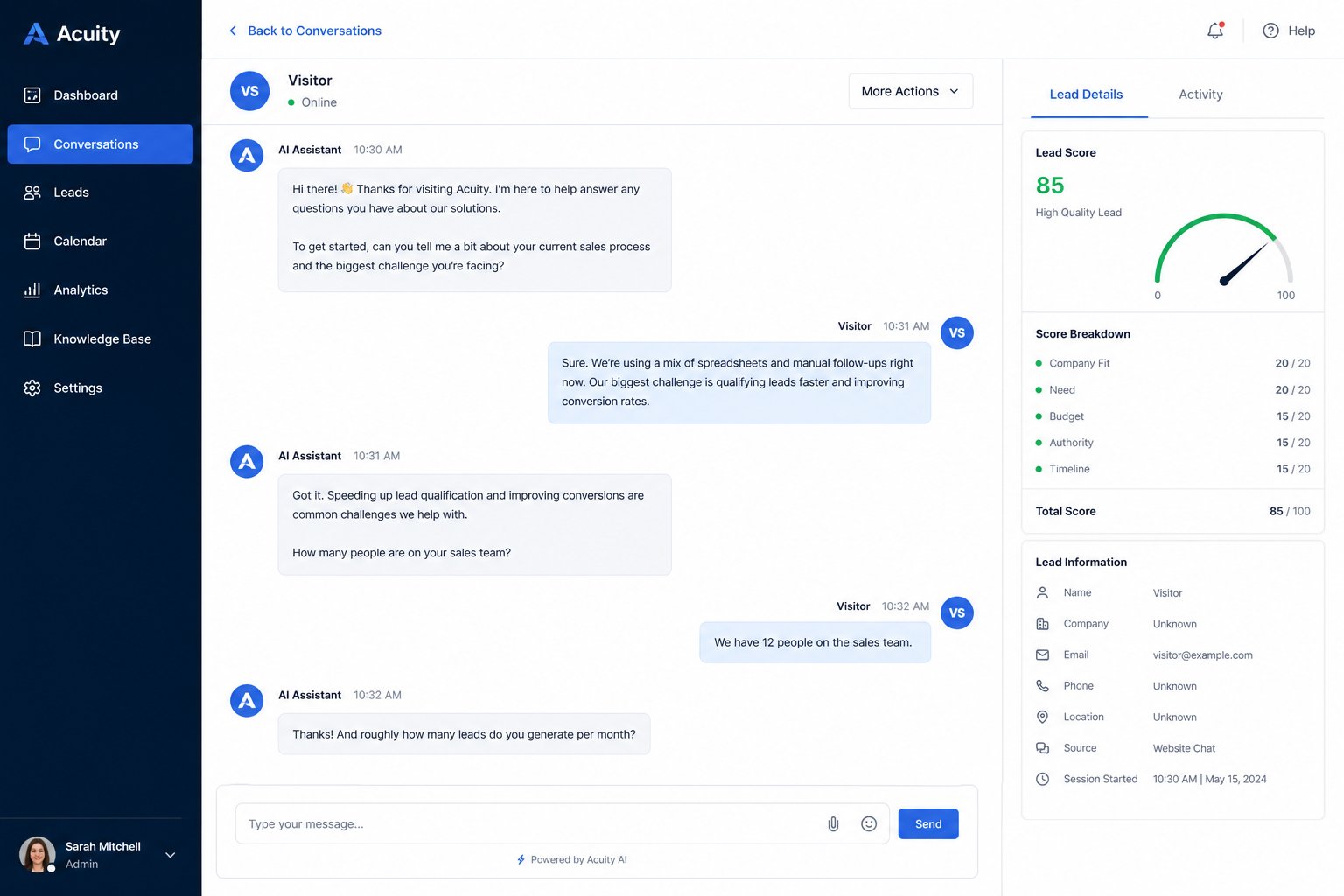
Forward-deployed engineering often involves connecting AI systems to the tools employees already use. Integrations may include CRM, ERP, ticketing, document management, communication, data warehouses, APIs, file storage, identity providers, workflow platforms, and internal applications.
We review:
- API authentication.
- Rate limits and retries.
- Webhooks and event processing.
- Data contracts.
- Schema evolution.
- Idempotency.
- Error queues.
- Backfills.
- Reconciliation.
- Monitoring.
- Ownership and support.
- Test and production separation.
Data pipelines should be reliable independently of the model. An AI service cannot be dependable if source data arrives late, duplicates records, loses identifiers, or fails without an alert.
Cloud and Deployment Architecture
Deployment choices depend on data sensitivity, latency, availability, region, model access, cost, and internal engineering standards. We may design cloud, private-cloud, on-premise, hybrid, containerized, serverless, or managed-service architectures.
Architecture considerations include:
- Network boundaries.
- Private endpoints.
- Compute and autoscaling.
- Queues and asynchronous processing.
- Object storage and databases.
- Vector and search infrastructure.
- Model gateways.
- Secrets management.
- Observability.
- Disaster recovery.
- Backups and data retention.
- Cost controls.
- Regional deployment.
- High availability.
We document trade-offs rather than treating one deployment pattern as universally correct.
Product and User Experience Design
An AI system needs a useful user experience. The interface should communicate what the system can do, what information it used, how confident or uncertain the result is, and what the user should do next.
UX considerations include:
- Clear task boundaries.
- Suggested prompts or workflows.
- Source citations and document links.
- Editable drafts rather than silent automation.
- Feedback controls.
- Correction and escalation.
- Loading and progress states.
- Error messages.
- Empty and ambiguous states.
- Accessibility.
- Mobile or embedded workflow support.
- User training and change management.
A technically accurate answer can still fail if users cannot understand it, trust it, or incorporate it into their work.
Business Value and ROI Measurement
AI value should be measured against a baseline. Depending on the use case, metrics may include:
- Time per task.
- Tasks completed per employee.
- First-response time.
- Resolution time.
- Deflection rate.
- Data-extraction accuracy.
- Sales conversion rate.
- Revenue per employee.
- Customer satisfaction.
- Error and rework rate.
- Compliance review time.
- Cost per successful task.
- Model and infrastructure cost.
- Adoption and weekly active users.
- Retention and repeat usage.
Illustrative AI Value Funnel
| Value stage | Example metric | Management question |
|---|---|---|
| Adoption | Weekly active users or workflow usage | Are intended users using the system? |
| Task completion | Successful tasks or accepted outputs | Does it complete useful work? |
| Quality | Expert score, accuracy, groundedness | Is the output reliable enough? |
| Efficiency | Time saved or cycle-time reduction | Is the process faster? |
| Business impact | Revenue, cost, service, or risk metric | Does the improvement matter commercially? |
| Sustainability | Cost per task, support, maintenance | Can the system operate economically? |
We avoid reporting “AI usage” as value without verifying the quality and business result of the work performed.
AI Forward-Deployed Services for Different Business Models
B2B and Professional Services
AI can support research, proposal preparation, knowledge retrieval, document analysis, client reporting, meeting preparation, contract review, and internal expertise discovery. Access control, source citations, confidentiality, and human review are central.
Ecommerce and Retail
AI systems can improve product discovery, support, catalogue enrichment, customer service, demand forecasting, merchandising, recommendations, and returns processing. Product data, inventory, margin, and customer experience must be integrated.
Financial, Legal, and Regulated Organizations
These organizations require strong controls around accuracy, privacy, explainability, records, human approval, auditability, vendor review, and data residency. We design workflows that support professionals rather than silently replacing regulated judgment.
Healthcare and Sensitive Services
Healthcare and other sensitive domains require careful data handling, clinical or expert review, safety escalation, access control, and clear limitations. A prototype should not be deployed into a high-risk workflow without appropriate validation and governance.
Manufacturing and Operations
AI can support maintenance, quality inspection, production planning, document retrieval, incident analysis, supply-chain forecasting, and technician assistance. Integration with operational systems and real-world edge cases is essential.
SaaS and Technology Companies
Technology businesses can use forward-deployed engineering to build customer-specific integrations, AI copilots, agents, support automation, developer tools, and vertical workflows. Reusable platform components should be balanced with the customer’s immediate need.
Why Choose Unified Management Consulting?
Embedded Delivery and Strategic Perspective
We work with users and technical teams in the real operating environment. This allows us to connect an AI solution to workflow, data, systems, security, adoption, and management priorities.
Production, Not Demo, Orientation
We plan for evaluation, permissions, observability, deployment, support, rollback, maintenance, and cost from the beginning. A prototype is a learning milestone, not the final product.
Clear Technical Communication
We explain architecture, risks, trade-offs, and expected outcomes in language appropriate for executives, engineers, operators, and subject-matter experts.
Customized Engineering
We do not force every use case into the same model, framework, vector database, agent pattern, or cloud architecture. We design around the problem and constraints.
Responsible AI Delivery
We include privacy, security, access control, human review, evaluation, incident response, and data governance in the delivery plan.
Management Consulting Perspective
AI does not automatically create value. It must be connected to a workflow, adopted by users, measured against a baseline, and managed over time. Our consulting approach helps leadership make the organizational decisions required for durable impact.
AI Forward-Deployed Engineering Services Pricing
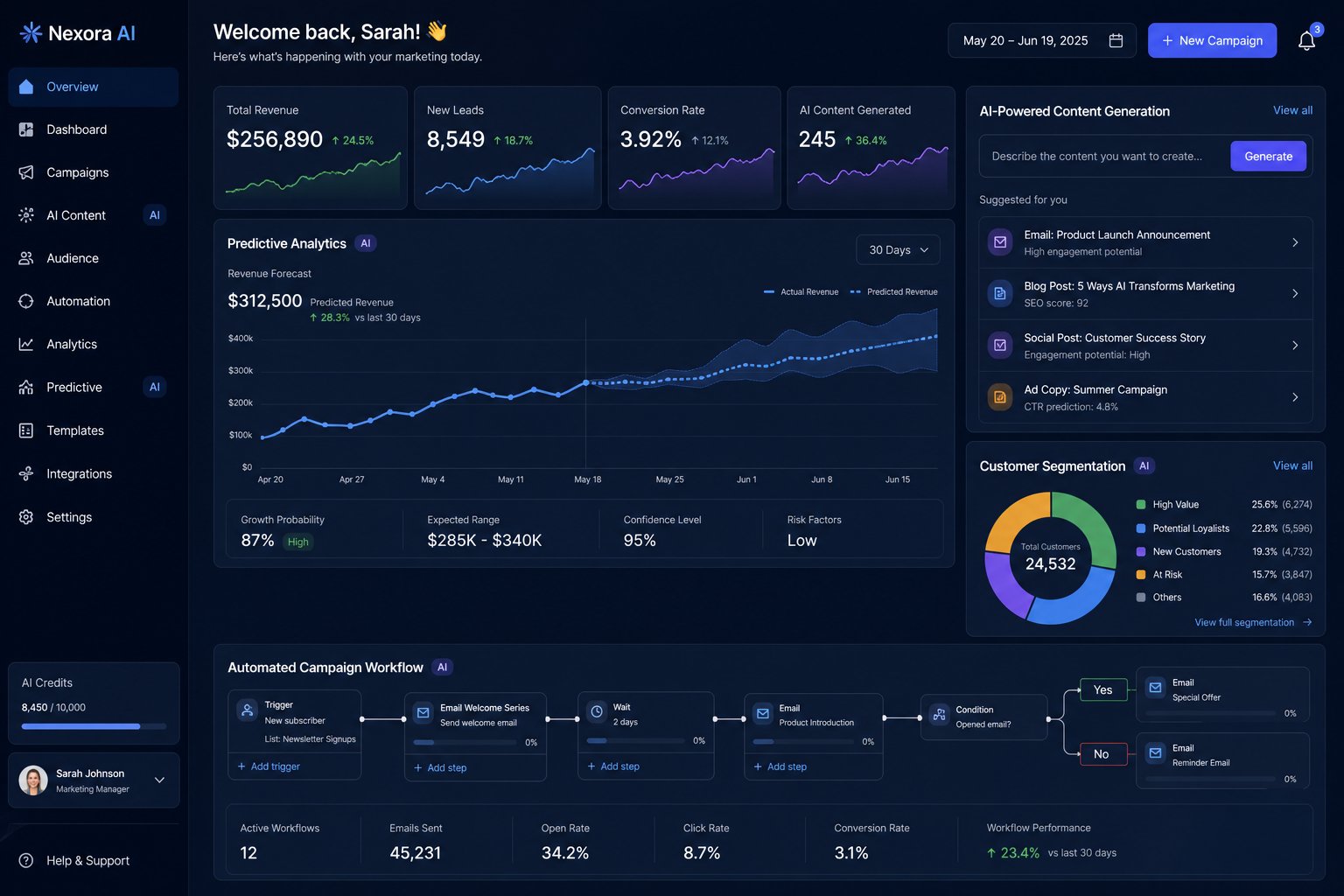
Fees depend on the number of engineers, project duration, data complexity, model and infrastructure requirements, integrations, security controls, evaluation depth, deployment environment, user count, support needs, and level of embedded collaboration.
Before choosing a provider, clarify whether the engagement includes:
- Business and workflow discovery.
- Use-case prioritization and business-case design.
- Data and system readiness assessment.
- Architecture and model selection.
- RAG, agent, predictive, or multimodal engineering.
- Data pipelines and document processing.
- Prompt, context, and tool engineering.
- Application and API development.
- CRM, ERP, ticketing, or data-platform integration.
- Security, privacy, and access design.
- Evaluation datasets and regression testing.
- Cloud deployment and infrastructure as code.
- MLOps, LLMOps, observability, and cost monitoring.
- User acceptance testing and training.
- Production rollout and support.
- Documentation and knowledge transfer.
Cloud usage, model-provider fees, data tools, software licenses, specialist review, and ongoing support may be separate costs. Ownership of code, prompts, evaluation sets, data pipelines, infrastructure, and documentation should be defined contractually.
How AI Engineering Performance Is Evaluated
No responsible provider can guarantee a fixed productivity improvement, model accuracy, cost saving, or revenue result without controlling the data, workflow, adoption, infrastructure, and business environment.
Early work may focus on discovering the right use case, establishing a baseline, validating data, and building a representative prototype. Later evaluation can measure quality, adoption, task completion, time saved, cost per task, risk reduction, revenue, customer experience, and sustainability.
An AI assistant with a high answer score may still have low business value if users do not adopt it. A system with modest automation may create substantial value if it removes a repetitive bottleneck safely. Metrics must be interpreted within the workflow.
Technical Audit Checklist
Before deploying an AI system into production, we assess:
- Whether the use case has a clear owner, baseline, and business metric.
- Whether the data is accessible, accurate, current, and authorized.
- Whether source documents and metadata are structured for retrieval.
- Whether the selected model and architecture fit the quality, latency, privacy, and cost requirements.
- Whether RAG retrieval, chunking, filtering, and reranking are evaluated.
- Whether agent tools have schemas, permissions, limits, and audit logs.
- Whether prompts, models, datasets, and indexes are versioned.
- Whether quality, groundedness, safety, and regression tests exist.
- Whether prompt injection and adversarial inputs are tested.
- Whether sensitive data is protected and appropriately retained.
- Whether production deployment has monitoring, alerting, rollback, and incident response.
- Whether model, token, storage, and infrastructure costs are monitored.
- Whether users receive sources, uncertainty, feedback, and escalation paths.
- Whether integrations handle retries, errors, duplicates, and schema changes.
- Whether human approval is present for high-risk or irreversible actions.
- Whether adoption, task completion, quality, and business value are measured.
- Whether the organization can own, maintain, and improve the system.
Frequently Asked Questions About AI Forward-Deployed Engineering
What is forward-deployed engineering?
Forward-deployed engineering is an embedded delivery model in which engineers work closely with a customer’s team, data, systems, and workflow to solve a specific operational problem. The team combines technical implementation with domain understanding and helps move the solution toward production.
How is it different from an AI consulting project?
A consulting project may provide strategy or recommendations. Forward-deployed engineering includes hands-on discovery, building, integrating, testing, deploying, and improving a working system in the customer environment. The exact scope depends on the engagement.
Do you build AI agents?
We can design and build agentic workflows where they are appropriate. We define tool permissions, task limits, validation, human approval, logging, retries, and escalation rather than treating an agent as an unrestricted autonomous system.
Do you build RAG systems?
Yes. RAG work may include source connectors, document processing, chunking, metadata, embeddings, vector or hybrid retrieval, reranking, permission filters, context assembly, citations, evaluation, and monitoring.
Is fine-tuning always necessary?
No. Fine-tuning may be useful for certain behaviors, formats, classifications, or domain adaptation, but retrieval, prompting, workflow design, data quality, or a smaller specialized model may be more appropriate. We select the simplest architecture that meets the requirement.
Can AI engineering integrate with existing systems?
Yes. Integrations may include CRM, ERP, ticketing, document management, identity, data warehouses, APIs, communications tools, ecommerce systems, and internal applications. We design for authentication, retries, data contracts, monitoring, and ownership.
How do you protect sensitive data?
We assess data classification, permissions, encryption, retention, redaction, provider terms, access controls, audit logs, environment separation, and human review. The appropriate controls depend on the data, industry, deployment model, and risk.
How do you evaluate AI quality?
We use representative evaluation sets, expert review, automated tests, groundedness and citation checks, structured-output validation, adversarial cases, regression testing, user feedback, latency, cost, and workflow outcomes.
Can you guarantee AI accuracy?
No system is perfect, particularly when inputs are ambiguous, data is incomplete, or the task requires judgment. We define acceptable quality, test failure cases, add controls, expose sources and uncertainty, and create escalation paths.
What happens after deployment?
Production systems require monitoring, support, evaluation updates, data and index refreshes, prompt or model changes, security review, cost management, user feedback, and incident response. We can provide knowledge transfer and ongoing support according to the engagement.
Build a Production-Ready AI Capability
Artificial intelligence creates value when it is connected to a real problem, reliable data, appropriate architecture, safe workflows, measurable outcomes, and users who can trust and adopt the system. Forward-deployed engineering provides the bridge between strategic ambition and production reality.
Unified Management Consulting helps organizations identify the right use case, work with domain experts, build the technical system, integrate it into existing operations, evaluate it rigorously, and create the governance required for long-term performance.
Contact Unified Management Consulting for an AI use-case assessment, RAG or agent architecture review, data-readiness audit, production deployment plan, AI evaluation framework, or customized forward-deployed engineering engagement.
Suggested SEO Metadata
SEO title: AI Forward-Deployed Engineering Services | Unified Management Consulting
Meta description: Build production-ready AI with forward-deployed engineering services covering RAG, agents, data pipelines, integrations, evaluation, security, MLOps, LLMOps, and deployment.
Suggested URL slug: /ai-forward-deployed-engineering-services/
Primary keyword: AI forward-deployed engineering services
Secondary keywords: forward-deployed AI engineers, AI engineering services, AI implementation services, RAG development, AI agent development, LLMOps services, MLOps consulting, AI systems integration, enterprise AI engineering, production AI deployment
Suggested Calls to Action
- Request an AI use-case and readiness assessment
- Build a production-ready RAG system
- Design a secure AI agent workflow
- Review your AI architecture and data pipeline
- Create an AI evaluation and governance framework
- Integrate AI with your existing business systems
- Schedule an AI forward-deployed engineering consultation