
Build a website that looks credible, works reliably, converts visitors, and grows with your business. Unified Management Consulting provides website development services covering strategy, UX/UI design, frontend and backend engineering, CMS implementation, ecommerce, integrations, accessibility, SEO foundations, security, analytics, deployment, and ongoing optimization.
A business website is more than a digital brochure. It may be a sales channel, ecommerce store, service-booking system, customer-support resource, content platform, recruitment hub, investor communication tool, or operational interface. Its performance depends on the relationship between strategy, design, content, technology, speed, security, search visibility, analytics, and the customer journey.
📋 Website Development — Quick Summary
| Service | What We Do |
|---|---|
| Custom Development | WordPress, React, Next.js, and custom web applications built for performance |
| E-commerce | Shopify, WooCommerce, and custom online stores with payment integration |
| UI/UX Design | User research, wireframing, visual design, prototyping, and usability testing |
| Performance | Core Web Vitals optimization, sub-2-second load times, and SEO-ready architecture |
| Key Results | 83% higher conversion rates, 2-3x faster load times, mobile-first design |
| Investment | $5,000-$100,000+ depending on complexity and features |
Unified Management Consulting helps organizations plan, design, build, launch, and improve websites that support measurable business goals. We combine management consulting with product strategy, user experience, software engineering, data, marketing, and technical operations.
Whether you need a new corporate website, a conversion-focused landing-page system, a content-managed platform, a custom web application, an ecommerce store, a portal, or a redesign and migration, we create a practical delivery plan around your users, technology, content, budget, and growth objectives.
At-a-Glance Website Development Framework
| Website stage | What we manage | Key technical signals | Business outcome |
|---|---|---|---|
| Discover | Goals, users, content, systems, requirements | Brief, journey map, success metrics | Clear digital strategy |
| Design | UX, UI, information architecture, prototypes | Usability, accessibility, design system | Easier customer journeys |
| Build | Frontend, backend, CMS, integrations | Code quality, test coverage, API reliability | Working digital product |
| Optimize | Speed, SEO, conversion, mobile UX | Core Web Vitals, CVR, accessibility | More usable and discoverable site |
| Launch | Hosting, security, analytics, migration | Uptime, tracking, redirects, monitoring | Controlled production release |
| Grow | Content, experiments, maintenance, features | Leads, sales, retention, release quality | Sustainable digital performance |
Illustrative Website Performance Graph
This graph is an illustrative planning model, not a guarantee. Actual results depend on scope, content, technology, implementation, market, traffic quality, and customer behavior.
textIllustrative website performance and conversion readiness

100 |                                      ███████████████████████  Growth optimization
 85 |                                ███████████████████           Launch and measurement
 70 |                          █████████████████                   QA and performance
 55 |                    ███████████████                           Integrated build
 40 |              ███████████                                     UX and architecture
 25 |        ██████                                                Discovery and content
 10 |  ███                                                         Starting point
     +-------------------------------------------------------------------
       Week 1       Week 4       Week 8       Week 12      Week 16
A website launch is not the finish line. After launch, teams should monitor performance, accessibility, search visibility, conversion behavior, security, content quality, and technical errors. Continuous improvement helps the website adapt to customers and business priorities.
The Website Development Journey
textBusiness goals, users, and current-site assessment
                    ↓
Information architecture, content, UX, and technical requirements
                    ↓
Wireframes, design system, prototypes, and validation
                    ↓
Frontend, backend, CMS, ecommerce, and integration development
                    ↓
SEO, accessibility, performance, security, and analytics QA
                    ↓
Staging, user acceptance testing, migration, and launch
                    ↓
Monitoring, conversion optimization, content, and maintenance
What Are Website Development Services?
Website development services cover the strategic, design, engineering, content, technical, deployment, and maintenance work required to create a reliable digital experience.
Depending on your business, services may include:
- Website strategy and discovery.
- Website audits and redesign planning.
- Information architecture.
- User research and journey mapping.
- UX and UI design.
- Wireframes and interactive prototypes.
- Design systems and component libraries.
- Responsive frontend development.
- Backend and API development.
- CMS implementation.
- Headless CMS architecture.
- Corporate and service websites.
- Ecommerce stores and checkout systems.
- Membership and customer portals.
- Booking and appointment platforms.
- Landing-page systems.
- Web applications and dashboards.
- CRM, ERP, payment, marketing, and analytics integrations.
- Search engine optimization foundations.
- Accessibility implementation and testing.
- Core Web Vitals and performance optimization.
- Security, authentication, and permissions.
- Quality assurance and user acceptance testing.
- Hosting, deployment, monitoring, and backups.
- Website migration and redirect planning.
- Content population and governance.
- Conversion-rate optimization.
- Ongoing maintenance and feature development.
The best architecture depends on business requirements. A brochure website may need a content management system and high-performance templates. An ecommerce business may need product data, inventory, payments, shipping, customer accounts, and analytics. A complex organization may need a headless architecture, multiple locales, role-based publishing, APIs, and governance.
Our Website Development Process
1. Business, Customer, and Website Discovery
We begin with the business objective and customer journey. We review your products, services, target users, competitive environment, current website, marketing channels, sales process, operations, content, technology, and constraints.
Discovery questions may include:
- What should the website help the business achieve?
- Who are the most important users?
- What information do they need before taking action?
- Which pages generate leads, sales, calls, or bookings today?
- Where do users abandon the journey?
- Which systems must the website connect with?
- Who owns content and approvals?
- What languages, regions, products, or service areas are required?
- What security, privacy, and compliance needs exist?
- How will website success be measured?
The output is a website brief that defines goals, audiences, page types, content requirements, functional scope, technical constraints, measurement, risks, and delivery priorities.
2. Existing Website Audit and Redesign Assessment
If a website already exists, we assess the current experience before recommending a rebuild. The audit may include:
- Analytics and conversion data.
- Search Console and SEO performance.
- Content quality and page inventory.
- Information architecture.
- User journeys and navigation.
- Mobile experience.
- Page speed and Core Web Vitals.
- Accessibility.
- CMS and publishing workflow.
- Code quality and dependencies.
- Hosting and deployment.
- Security and permissions.
- Forms, payments, and integrations.
- Broken links and redirects.
- Duplicate or outdated pages.
- Technical debt and maintenance cost.
A full rebuild is not always the best answer. Sometimes targeted UX, content, performance, or conversion improvements create more value with lower risk. When a rebuild is justified, we document what should be retained, improved, migrated, retired, or redesigned.
Information Architecture and Content Strategy
Information architecture organizes content, features, products, services, locations, and user journeys. A clear structure helps users navigate and gives search engines and systems a better understanding of the website.
We plan:
- Primary navigation.
- Secondary and utility navigation.
- Page hierarchy.
- Service and product categories.
- Location structures.
- Content hubs.
- Blog and resource architecture.
- Search and filtering.
- Breadcrumbs.
- Internal linking.
- Calls to action.
- User account and portal paths.
- Footer and legal navigation.
Content Inventory Table
| Page type | User purpose | Business purpose | Key technical requirement |
|---|---|---|---|
| Homepage | Understand the organization | Position brand and route users | Clear hierarchy and strong performance |
| Service page | Evaluate an offering | Generate enquiry or booking | Message match, proof, CTA, schema |
| Product page | Research and buy | Generate ecommerce revenue | Product data, price, availability, checkout |
| Resource page | Learn or solve a problem | Build authority and demand | Search structure, internal links, lead path |
| Location page | Find local service | Generate calls and visits | Local data, map, hours, service area |
| Case study | Assess proof and outcomes | Support sales confidence | Structured story and measurable evidence |
| Contact page | Start a conversation | Capture a lead | Accessible form, routing, tracking |
Content should be planned before development begins. Placeholder content can hide layout, accessibility, SEO, and conversion problems. We help define content owners, approval workflows, review dates, media requirements, and migration rules.
UX and UI Design Services
User Experience Design
UX design focuses on how users understand, navigate, and complete tasks. We map journeys, identify friction, design page structures, prototype interactions, and validate important flows.
UX work may include:
- User interviews.
- Persona or audience definitions.
- Jobs-to-be-done analysis.
- Journey mapping.
- Task analysis.
- Wireframes.
- Prototype testing.
- Navigation testing.
- Form and checkout analysis.
- Mobile journey design.
- Error and empty-state design.
- Accessibility planning.
User Interface Design
UI design translates structure into a consistent visual system. We develop color, typography, spacing, components, icons, imagery, buttons, forms, cards, tables, alerts, navigation, and responsive states.
A design system can improve consistency and reduce development time. It should include component behavior, states, accessibility requirements, responsive rules, content guidance, and usage examples—not only a collection of visual screenshots.
Conversion-Focused Design
A marketable website makes the value proposition clear and gives users a relevant next step. We review:
- Headline and offer.
- Trust signals.
- Differentiators.
- Calls to action.
- Form and booking friction.
- Pricing and availability.
- Testimonials and proof.
- Contact options.
- Mobile interaction.
- Follow-up expectations.
Conversion design should not manipulate users. It should reduce confusion, communicate value, answer objections, and make the desired action easy.
Frontend Web Development
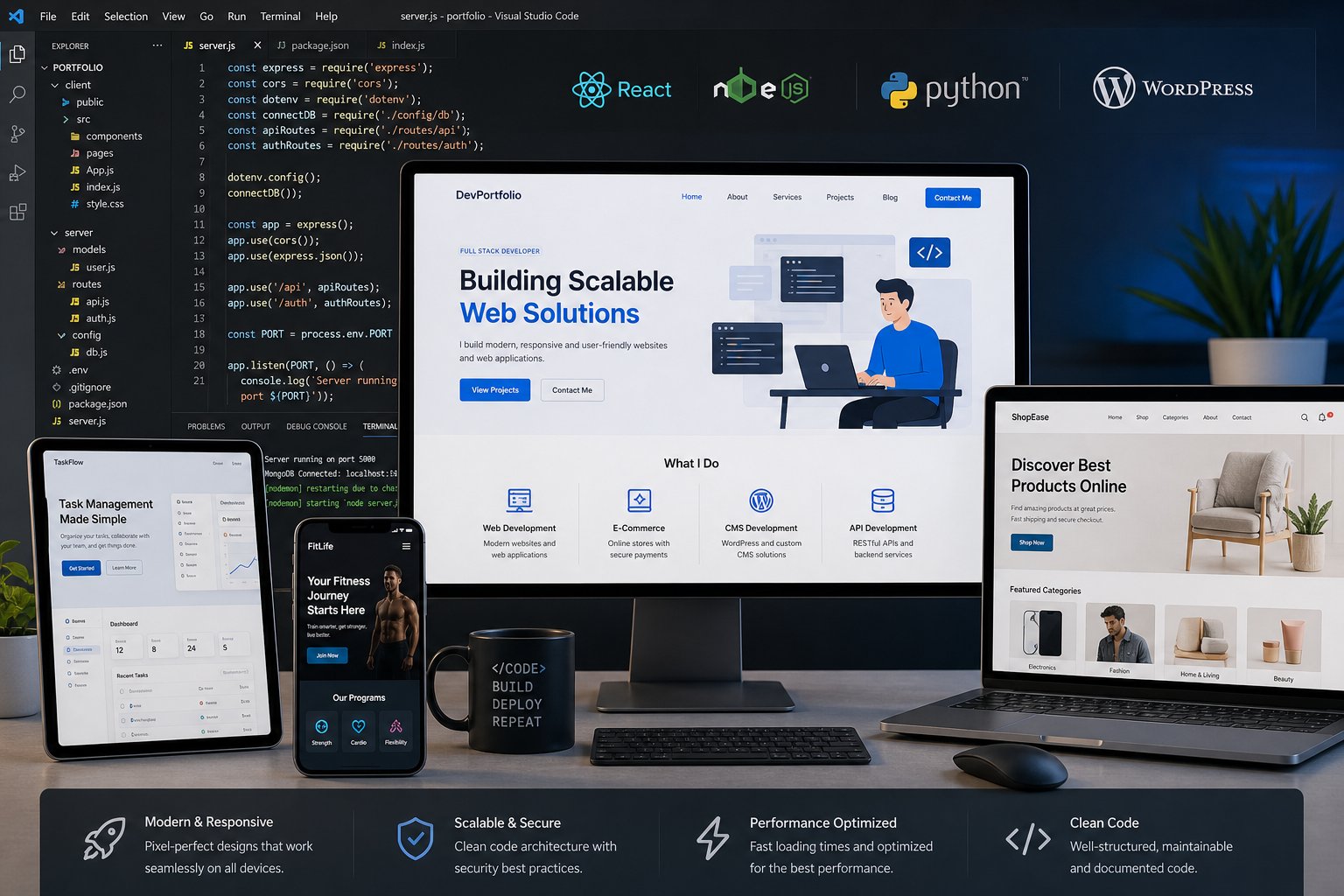
Frontend engineering builds the interface users interact with. We may use modern component-based frameworks or server-rendered approaches according to the performance, content, hosting, team, and maintenance requirements.
Frontend services may include:
- Responsive layouts.
- Component libraries.
- Design-system implementation.
- Semantic HTML.
- CSS architecture.
- Forms and validation.
- Interactive elements.
- Client- and server-side rendering.
- Progressive enhancement.
- Image and media optimization.
- Accessibility behavior.
- State management.
- Error and loading states.
- Analytics events.
- Browser and device compatibility.
We focus on maintainable code and clear component boundaries. A visually accurate interface should also be resilient to longer headings, translated content, new products, different devices, keyboard users, and real data.
Backend, APIs, and Custom Web Applications
Backend engineering supports data, business logic, authentication, workflows, integrations, and application services. We may build or integrate:
- REST or GraphQL APIs.
- Authentication and authorization.
- User accounts and roles.
- Content and product services.
- Search and filtering.
- Booking and scheduling.
- Payments and subscriptions.
- Notifications.
- File upload and processing.
- Webhooks.
- Background jobs.
- Reporting services.
- Admin interfaces.
- Audit logs.
We consider validation, rate limiting, error handling, retries, idempotency, caching, database indexes, API versioning, logging, and monitoring. Backend reliability affects the entire user experience.
CMS and Headless Website Development
A content management system allows authorized teams to create, edit, approve, schedule, and maintain content. We select a CMS according to content types, editors, workflows, localization, integrations, hosting, performance, security, and ownership.
Traditional CMS
A traditional CMS can provide a unified content editing and website-rendering experience. It may be practical for marketing teams that need familiar publishing and a manageable technology stack.
Headless CMS
A headless CMS separates content management from the frontend presentation layer. It can support multiple channels, structured content, custom frontend performance, and reuse across applications, but it requires more technical ownership and architecture discipline.
CMS Governance
We define:
- Content types and fields.
- Required and optional data.
- Roles and permissions.
- Draft, review, approval, and publication states.
- Scheduled publishing.
- Version history.
- Media management.
- Localization.
- SEO fields.
- Redirect management.
- Content expiration and review.
- Preview and staging.
A CMS should make good content practices easier, not create a complex form that editors avoid.
Ecommerce Website Development
Ecommerce development connects product discovery, catalogue data, customer accounts, cart, checkout, payment, fulfilment, support, analytics, and retention.
We review:
- Product and category architecture.
- Product variants and options.
- Inventory and availability.
- Pricing, discounts, tax, and currency.
- Cart and checkout.
- Payment provider integration.
- Shipping and delivery.
- Returns and refunds.
- Customer accounts.
- Reviews and ratings.
- Product search and filters.
- Product recommendations.
- Order and fulfilment systems.
- Purchase and revenue tracking.
- Security and fraud controls.
The purchase event should record a unique transaction ID, order value, currency, product details, and appropriate status. Duplicate purchases, failed payments, refunds, and cancellations can distort advertising and business reporting if not handled correctly.
Integrations and Data Connections
A website often needs to connect with other systems. Integrations may include:
- CRM.
- ERP.
- Marketing automation.
- Email and SMS.
- Payment gateways.
- Booking systems.
- Inventory and logistics.
- Customer support.
- Analytics and tag management.
- Search and recommendation services.
- Authentication providers.
- Social platforms.
- Data warehouses.
- AI and automation services.
We design integrations around authentication, data contracts, field mapping, retries, error handling, duplicate prevention, webhooks, monitoring, and ownership. A form that appears to submit successfully but fails to reach the CRM is a business-critical defect.
Website Performance and Core Web Vitals
Performance affects user experience, accessibility, conversion, and search visibility. We assess real-user data and lab diagnostics where available.
Technical improvements may include:
- Faster server response.
- Better hosting or caching.
- Content delivery network configuration.
- Image compression and responsive formats.
- Lazy loading for non-critical media.
- Preloading critical resources.
- Code splitting.
- Removing unused JavaScript and CSS.
- Deferring third-party scripts.
- Font optimization.
- Layout stability.
- Efficient API calls.
- Database and query optimization.
- Caching and invalidation strategy.
Core Web Vitals should be treated as user-experience signals rather than a score-chasing exercise. We prioritize changes that improve real interaction and business performance.
Accessibility and Inclusive Web Development
Accessible websites help more people use the product and reduce avoidable barriers. We consider recognized accessibility practices and applicable requirements for your market and organization.
Accessibility work may include:
- Semantic HTML.
- Keyboard navigation.
- Focus management.
- Color contrast.
- Visible focus indicators.
- Form labels and error messages.
- Screen-reader support.
- Alternative text.
- Captions and transcripts.
- Reduced-motion preferences.
- Accessible tables and dialogs.
- Touch target size.
- Clear language.
- Zoom and responsive behavior.
Automated scanners are useful but cannot detect every usability problem. We combine automated checks with keyboard, screen-reader, browser, and user-flow testing.
SEO-Ready Website Development
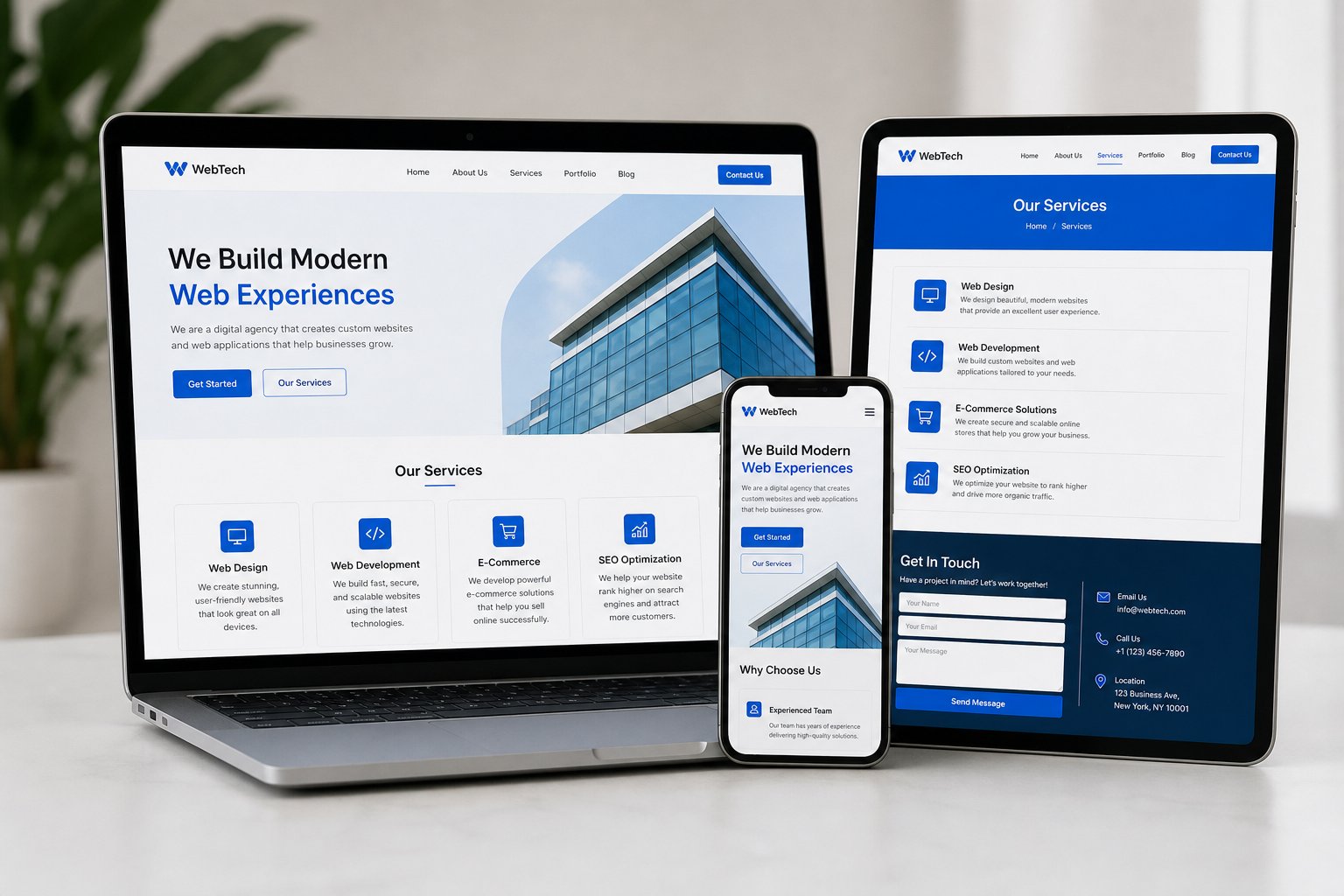
Website development should establish a strong foundation for organic visibility. We review:
- Crawlable HTML.
- Indexable page templates.
- URL structure.
- Page titles and headings.
- Meta descriptions.
- Canonical tags.
- XML sitemaps.
- Robots directives.
- Structured data.
- Internal linking.
- Image SEO.
- Rendering behavior.
- Mobile experience.
- Core Web Vitals.
- Redirects and migration paths.
- Analytics and Search Console.
SEO-ready development does not guarantee rankings. It makes pages more accessible and understandable while giving content and marketing teams a maintainable foundation.
Security and Privacy
Website security is a continuous practice. We consider:
- HTTPS and certificates.
- Authentication and authorization.
- Role-based permissions.
- Secure password and session handling.
- Input validation.
- Output encoding.
- Protection against common web vulnerabilities.
- Dependency and package updates.
- Secret management.
- Rate limiting.
- File-upload controls.
- Payment security.
- Data encryption.
- Backup and recovery.
- Security headers.
- Logging and incident response.
- Privacy and consent controls.
Security requirements depend on the website, data, users, integrations, and risk profile. We identify whether specialist penetration testing, compliance review, or security certification is required.
Quality Assurance and Testing
Quality assurance should cover both technical behavior and real user outcomes. We create a test plan around the website’s risk and complexity.
Testing may include:
- Unit testing.
- Integration testing.
- API testing.
- End-to-end testing.
- Browser and device testing.
- Responsive testing.
- Accessibility testing.
- Performance testing.
- Security testing.
- Form and email testing.
- Payment and checkout testing.
- Analytics and event testing.
- Migration and redirect testing.
- Content and link testing.
- User acceptance testing.
- Regression testing after releases.
Website Launch Checklist
| Launch area | Checks |
|---|---|
| Content | Final copy, images, legal pages, metadata, links |
| SEO | Redirects, canonicals, sitemap, robots, structured data |
| Analytics | Page views, conversions, forms, calls, purchases |
| Performance | Speed, caching, images, scripts, Core Web Vitals |
| Accessibility | Keyboard, contrast, labels, focus, captions |
| Security | HTTPS, permissions, secrets, headers, backups |
| Integrations | CRM, email, payment, booking, inventory, webhooks |
| Devices | Mobile, tablet, desktop, browsers, screen sizes |
| Operations | Monitoring, support, rollback, ownership, documentation |
Analytics, Conversion Tracking, and Optimization
A website should measure what matters to the business. Tracking may include:
- Form submissions.
- Phone clicks and calls.
- Bookings.
- Product views.
- Add-to-cart.
- Checkout.
- Purchases and revenue.
- Downloads.
- Account registrations.
- Search and filter actions.
- Video engagement.
- Chat or message actions.
- Qualified leads and CRM stages.
We review tag management, data layers, event naming, transaction IDs, consent behavior, cross-domain journeys, payment referrals, call tracking, CRM imports, and reporting reconciliation.
Illustrative Website Conversion Funnel
| Funnel stage | Example volume | Example rate | Management question |
|---|---|---|---|
| Qualified visits | 100,000 | — | Are the right users arriving? |
| Engaged sessions | 55,000 | 55.0% | Does the site match user intent? |
| Product or service views | 25,000 | 45.5% | Is navigation working? |
| Lead, cart, or booking actions | 2,500 | 10.0% | Is the offer persuasive? |
| Completed conversion | 750 | 30.0% | Is form, checkout, or follow-up effective? |
| Qualified customer outcome | 225 | 30.0% | Is traffic creating business value? |
Illustrative example only. Actual rates depend on industry, traffic source, offer, page type, and customer journey.
Conversion-rate optimization can include testing headlines, page layouts, forms, proof, pricing presentation, calls to action, navigation, and checkout. Tests should be based on evidence and a clear hypothesis.
Deployment, Hosting, and Maintenance
A website needs a reliable path from development to production. We plan:
- Development, staging, and production environments.
- Version control.
- Continuous integration and deployment.
- Environment variables and secrets.
- Database migrations.
- Backups and restore testing.
- CDN and caching.
- Uptime monitoring.
- Error tracking.
- Security updates.
- Release approvals.
- Rollback procedures.
- Incident response.
- Ownership and support.
Maintenance may include content updates, dependency updates, security patches, performance reviews, feature development, analytics checks, backups, accessibility improvements, and technical support.
Website Migration and Redesign Services
Migrations can improve technology and brand experience but create risks for traffic, links, tracking, content, and conversions. We plan:
- Existing URL inventory.
- Page and content mapping.
- One-to-one redirect rules.
- Canonical and sitemap updates.
- Metadata migration.
- Structured-data validation.
- Analytics and conversion continuity.
- Staging and crawl testing.
- Launch monitoring.
- Search Console review.
- Broken-link and status-code monitoring.
- Post-launch performance comparison.
A migration is not complete when the new site goes live. We monitor traffic, index coverage, rankings, conversions, errors, redirects, and user behavior after launch.
Website Development for Different Business Models
Corporate and Professional Services
Corporate websites should communicate positioning, expertise, services, proof, locations, people, resources, and contact paths. Content governance and lead tracking are important.
Ecommerce and Retail
Ecommerce sites require reliable catalogue, search, product data, checkout, payment, shipping, fulfilment, returns, customer accounts, analytics, and retention systems.
B2B and SaaS
B2B and SaaS websites often need solution pages, integrations, documentation, case studies, demo flows, lead routing, account-based experiences, and CRM measurement.
Local Businesses
Local websites should make services, service areas, hours, prices or estimates, reviews, calls, directions, and bookings easy to find on mobile devices.
Membership and Portals
Membership websites require authentication, roles, subscriptions, content access, payments, account settings, support, security, and clear user journeys.
Education, Healthcare, and Sensitive Services
These websites require careful attention to accessibility, privacy, accuracy, content review, forms, security, consent, and user trust.
Why Choose Unified Management Consulting?

Strategy, Design, and Engineering Together
We connect business goals, customer journeys, UX, visual design, code, content, SEO, analytics, security, integrations, and operations.
Built for Performance and Growth
We consider speed, mobile experience, accessibility, conversion, search foundations, content governance, and maintainability from the beginning.
Clear Communication
We explain scope, architecture, dependencies, trade-offs, risks, ownership, and next steps so stakeholders can make informed decisions.
Customized Technology
We do not force every organization into the same CMS, framework, ecommerce platform, hosting model, or integration pattern. We choose according to requirements and long-term ownership.
Management Consulting Perspective
A website is part of a wider operating system. Sales follow-up, content production, customer service, fulfilment, analytics, and leadership priorities affect whether the website creates value. Our consulting approach considers those connections.
Website Development Services Pricing
Website development fees depend on scope, page and template count, UX requirements, custom functionality, CMS, ecommerce, integrations, content, languages, accessibility, security, migration, hosting, testing, and ongoing support.
Before choosing a provider, clarify whether the service includes:
- Strategy and discovery.
- UX research and information architecture.
- Wireframes and prototypes.
- UI design and design system.
- Frontend development.
- Backend and API development.
- CMS or headless CMS.
- Ecommerce and payment integration.
- CRM, ERP, booking, email, and analytics integration.
- Content population and migration.
- SEO foundations.
- Accessibility.
- Performance optimization.
- Security and privacy.
- QA and user acceptance testing.
- Hosting and deployment.
- Training and documentation.
- Maintenance and support.
Hosting, licenses, premium plugins, payment fees, content writing, photography, video, translation, specialist security testing, and ongoing maintenance may be separate costs. Ownership of code, designs, content, accounts, domains, analytics, and hosting should be documented.
How Website Performance Is Evaluated
No responsible provider can guarantee a fixed ranking, traffic volume, conversion rate, or revenue result without controlling market demand, traffic quality, offer, customer behavior, sales follow-up, fulfilment, and implementation.
Early work may focus on strategy, architecture, UX, technical reliability, content, performance, security, and measurement. Later evaluation can include qualified traffic, engagement, leads, bookings, purchases, revenue, conversion rate, accessibility, Core Web Vitals, uptime, and maintenance quality.
A visually impressive website may underperform if users cannot find information or complete the action. A technically fast website may underperform if the offer is unclear. We evaluate design, technology, content, and business outcomes together.
Technical Audit Checklist
Before launching or rebuilding a website, we assess:
- Whether the website has clear business goals and user journeys.
- Whether information architecture supports important tasks.
- Whether content, products, services, and locations are clearly organized.
- Whether the CMS supports required content workflows.
- Whether frontend and backend architecture are maintainable.
- Whether integrations have authentication, retries, monitoring, and error handling.
- Whether forms, payments, booking, and CRM routing work correctly.
- Whether pages are responsive, fast, and mobile-friendly.
- Whether accessibility requirements are addressed.
- Whether SEO foundations include URLs, metadata, sitemaps, redirects, and structured data.
- Whether analytics and conversion events are accurate and consent-aware.
- Whether security, permissions, secrets, backups, and recovery are implemented.
- Whether QA covers browsers, devices, APIs, performance, and real user journeys.
- Whether migrations include page mapping, redirect plans, and post-launch monitoring.
- Whether deployment has staging, version control, rollback, and ownership.
- Whether teams can publish and maintain content confidently.
- Whether ongoing performance, security, and conversion optimization are planned.
Frequently Asked Questions About Website Development Services
What are website development services?
Website development services include strategy, UX, design, frontend and backend engineering, CMS, ecommerce, integrations, SEO foundations, accessibility, security, testing, deployment, analytics, and ongoing maintenance.
Do you build websites from scratch or redesign existing websites?
Both. We can build a new website or assess an existing website to determine whether a redesign, rebuild, targeted improvement, migration, or performance project is the most appropriate option.
Can you build ecommerce websites?
Yes. Ecommerce work can include catalogue, product pages, search, filters, cart, checkout, payments, shipping, customer accounts, fulfilment, returns, analytics, product feeds, and marketing integrations.
Can you integrate a website with CRM and other systems?
Yes. We can integrate CRM, ERP, payments, booking, inventory, marketing automation, email, analytics, identity, customer support, and data platforms. We design for authentication, data mapping, retries, duplicates, monitoring, and support.
Do you provide CMS development?
Yes. We can implement a traditional or headless CMS according to editorial workflow, page types, localization, integrations, hosting, performance, security, and ownership needs.
Is website development separate from SEO?
They are related but distinct. Website development creates the technical and user-experience foundation, while SEO adds ongoing search research, content, authority, and optimization. We include SEO-ready development foundations and can provide broader SEO services separately.
Do you make websites accessible?
We design and test for accessibility through semantic structure, keyboard navigation, focus, contrast, labels, alternative text, captions, responsive behavior, and other applicable requirements. Automated scanning is combined with manual testing.
Can you improve website speed?
Yes. We review server response, hosting, caching, images, JavaScript, CSS, fonts, third-party scripts, database performance, and layout stability. Improvements are prioritized around real user experience and business value.
How long does website development take?
Timeframes depend on strategy, page count, content readiness, design complexity, functionality, integrations, approvals, testing, and migration. A focused landing-page system may be delivered much faster than an enterprise ecommerce or portal platform.
Do you provide maintenance after launch?
Yes. Maintenance can include security updates, backups, monitoring, content support, feature development, analytics checks, performance improvements, accessibility, and technical support.
Build a Website That Works for Your Business
A high-performing website combines clear strategy, useful content, thoughtful user experience, maintainable engineering, reliable integrations, strong security, accessibility, speed, search foundations, analytics, and continuous improvement.
Unified Management Consulting helps organizations plan, build, launch, and improve websites that support real business goals. We connect design and technology with marketing, sales, operations, customer experience, and management decisions.
Contact Unified Management Consulting for a website strategy workshop, redesign audit, ecommerce assessment, technical architecture review, performance audit, or customized website development engagement.
Suggested SEO Metadata
SEO title: Website Development Services | Unified Management Consulting
Meta description: Build a high-performance website with UX/UI design, frontend and backend development, CMS, ecommerce, integrations, SEO foundations, accessibility, security, and analytics.
Suggested URL slug: /website-development-services/
Primary keyword: website development services
Secondary keywords: web development services, website design and development, custom website development, ecommerce website development, CMS development, frontend development, backend development, web application development, responsive website development, website development company
Suggested Calls to Action
- Request a website development consultation
- Audit your current website
- Plan a website redesign or migration
- Build a high-performance ecommerce website
- Improve website speed and conversions
- Connect your website with CRM and business systems
- Schedule a website strategy workshop