Editorial note: This article acts as the organic-demand counterpart to UMC’s paid-media guides, focusing on how content compounds over time through visibility, relevance, and distribution.
What if your business could attract customers consistently without spending a single rupee on advertising? That is the promise of content marketing, and it is not a fantasy. Businesses that invest in strategic content creation build a sustainable engine that generates leads, builds authority, and compounds in value over time. Unlike paid advertising that stops delivering the moment you stop paying, content marketing keeps working for you for months and years after publication.
This guide explains how to build a content marketing strategy that attracts customers organically, specifically designed for businesses in Lucknow. Whether you run a coaching institute, a hospital, a real estate firm, or any other business, these principles will help you create content that ranks, engages, and converts.
What Is Content Marketing and Why It Works
Content marketing is the practice of creating and distributing valuable, relevant content to attract and retain a clearly defined audience, with the ultimate goal of driving profitable customer action. Unlike traditional advertising that interrupts people with sales messages, content marketing provides genuine value first, building trust and authority that naturally leads to business opportunities.
Content marketing works because it aligns with how modern customers make decisions:
70% of consumers learn about companies through articles rather than advertisements
Content marketing generates 3x more leads per rupee spent compared to paid advertising
61% of online consumers have made a purchase after reading a blog recommendation
Companies that blog receive 67% more leads per month than those that do not
Content assets compound over time: a well-ranked article can generate leads for years without additional investment
The
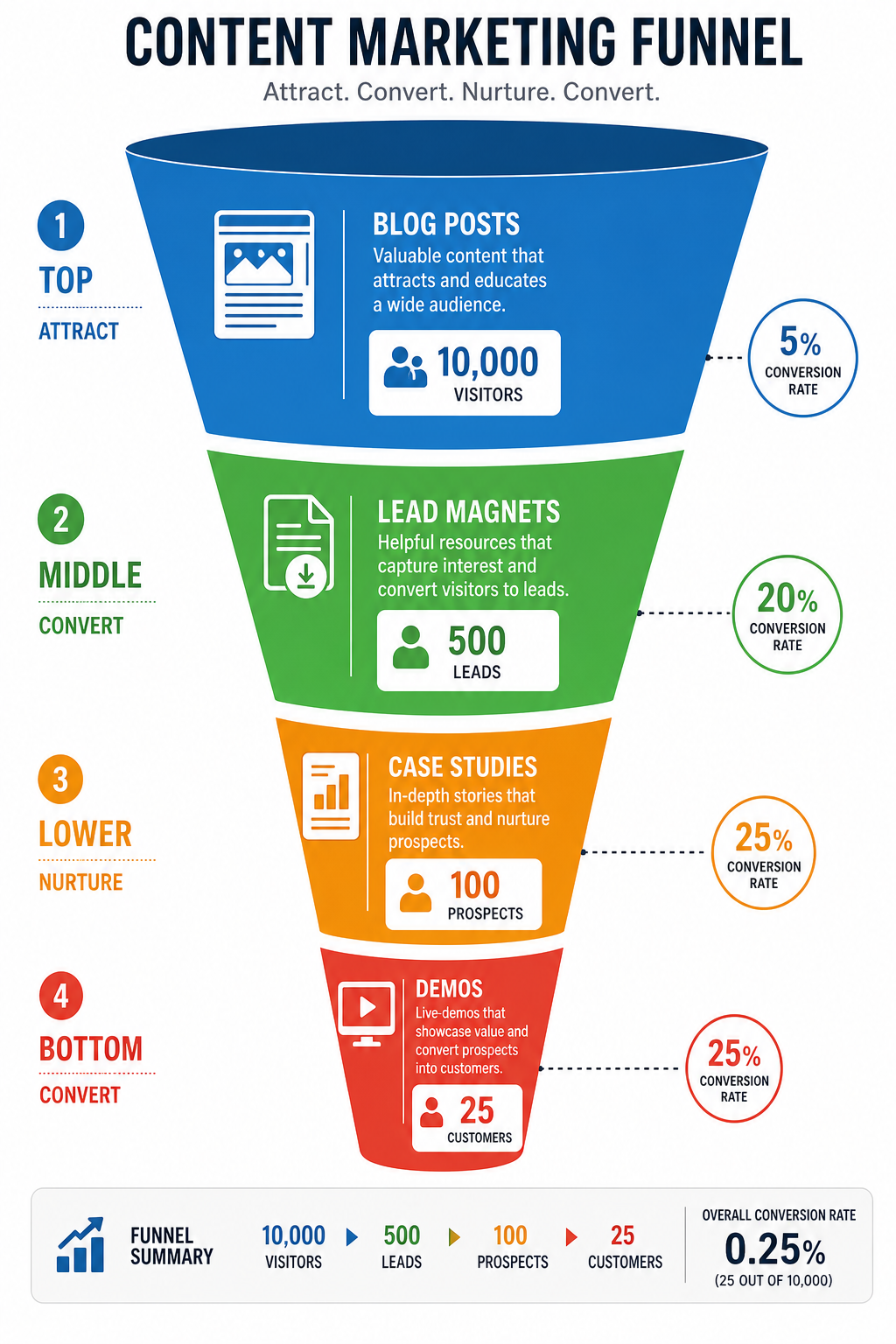
The content marketing funnel: blog posts and guides attract visitors at the top, lead magnets convert them in the middle, case studies nurture them further, and demos/consultations close the sale at the bottom.
Content Marketing Framework for Lucknow Businesses
Step 1: Define Your Content Objectives
Every piece of content should serve a clear business purpose. Common objectives include:
Effective content speaks directly to a specific person with specific problems. Create detailed audience personas that include:
Demographics: Age, location (specific areas of Lucknow), income level, education
Pain points: What problems keep them awake at night? What frustrations do they experience?
Information needs: What questions do they ask before making a purchase decision?
Content preferences: Do they prefer long articles, videos, infographics, or podcasts?
Search behaviour: What keywords and phrases do they use when searching for solutions?
Decision criteria: What factors influence their choice between competing businesses?
Step 3:
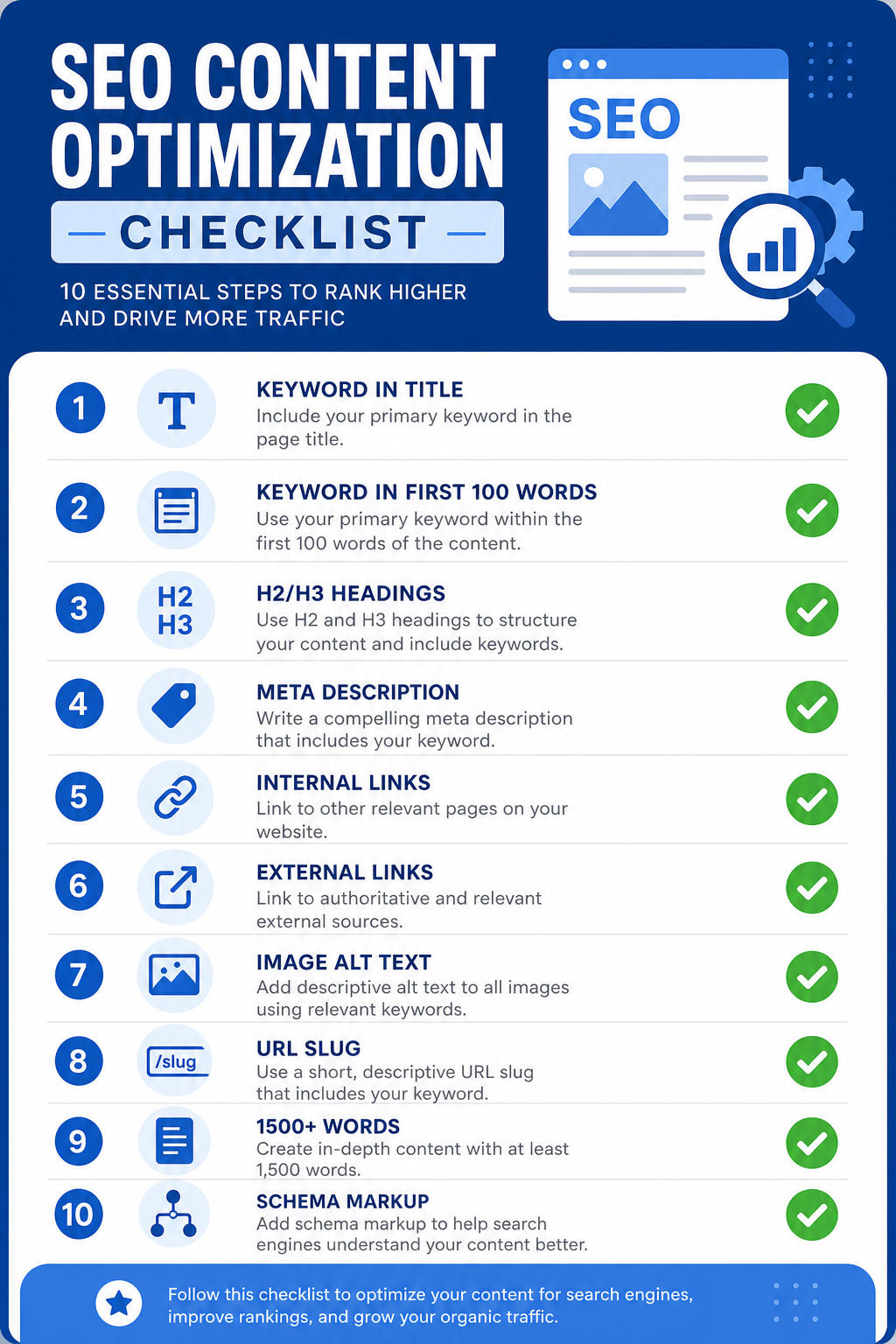
The essential SEO content checklist: ensure every piece of content includes these 10 optimisation elements before publishing to maximise search rankings and organic traffic.
Keyword Research and Content Planning
Keyword research is the foundation of content that ranks. Identify keywords that your audience searches for and that align with your business objectives:
Informational keywords: “how to choose a school in Lucknow”, “what is root canal treatment” (attract researchers)
Commercial keywords: “best coaching institute for IIT in Lucknow”, “top hospital for cardiac surgery” (attract decision-makers)
Transactional keywords: “book appointment dentist Lucknow”, “enroll in school online” (attract ready-to-act prospects)
Long-tail keywords: Specific, lower-volume phrases that are easier to rank for and convert better
Local keywords: Include “in Lucknow”, “near me”, and area-specific terms for local search visibility
Step 4: Create a Content Calendar
Consistency is the most important factor in content marketing success. Plan your content in advance with a structured calendar:
Content Types That Drive Results for Lucknow Businesses
1. Comprehensive Guides and Pillar Pages
Long-form guides (3,000-5,000+ words) that cover a topic comprehensively are the most powerful content assets. They rank for hundreds of related keywords, attract backlinks naturally, and establish your business as the definitive authority. Examples:
“Complete Guide to Choosing the Right School in Lucknow” for schools
“Everything You Need to Know About Dental Implants” for dental clinics
“First-Time Home Buyer’s Guide for Lucknow” for real estate
“Complete GST Registration and Filing Guide” for CA firms
2. Comparison and “Best Of” Content
Comparison content captures users who are actively evaluating options and close to making a decision:
“Is Your Website Outdated? Signs You Need a Redesign” (like our redesign guide)
4. Local Content for Lucknow
Content specifically targeting Lucknow searches builds local SEO authority and attracts geographically relevant traffic:
Area guides: “Living in Gomti Nagar: Complete Guide for Home Buyers”
Local event coverage: “Top Business Events in Lucknow This Month”
Local market analysis: “Lucknow Real Estate Market Report 2026”
Local business spotlights and partnerships
5. Case Studies and Success Stories
Case studies are the most persuasive content type for converting prospects into customers. They provide social proof, demonstrate results, and help prospects visualise similar outcomes for their business:
“How We Helped a Lucknow Restaurant Increase Footfall by 150% in 6 Months”
“From 0 to 500 Students: A Coaching Institute’s Digital Marketing Journey”
“How a Lucknow Hospital Generated 200+ Patient Enquiries Per Month Through SEO”
Content Distribution: Getting Your Content Seen
Creating great content is only half the battle. Distribution ensures your content reaches your target audience:
Owned Channels
Your website/blog: The foundation where all content lives and ranks in search engines
Email newsletter: Distribute new content to your subscriber list weekly
Social media: Share content across Instagram, Facebook, LinkedIn, and YouTube
WhatsApp broadcasts: Share relevant content with customer groups
Earned Channels
Backlinks: Earn links from other websites through guest posting, PR, and resource link building
Social shares: Create shareable content that audiences naturally distribute
Media mentions: Get featured in local publications and industry media
Paid Channels
Google Ads: Promote high-performing content to targeted search audiences
Meta Ads: Boost top-performing social content to reach new audiences
LinkedIn Ads: Promote B2B content to specific job titles and industries
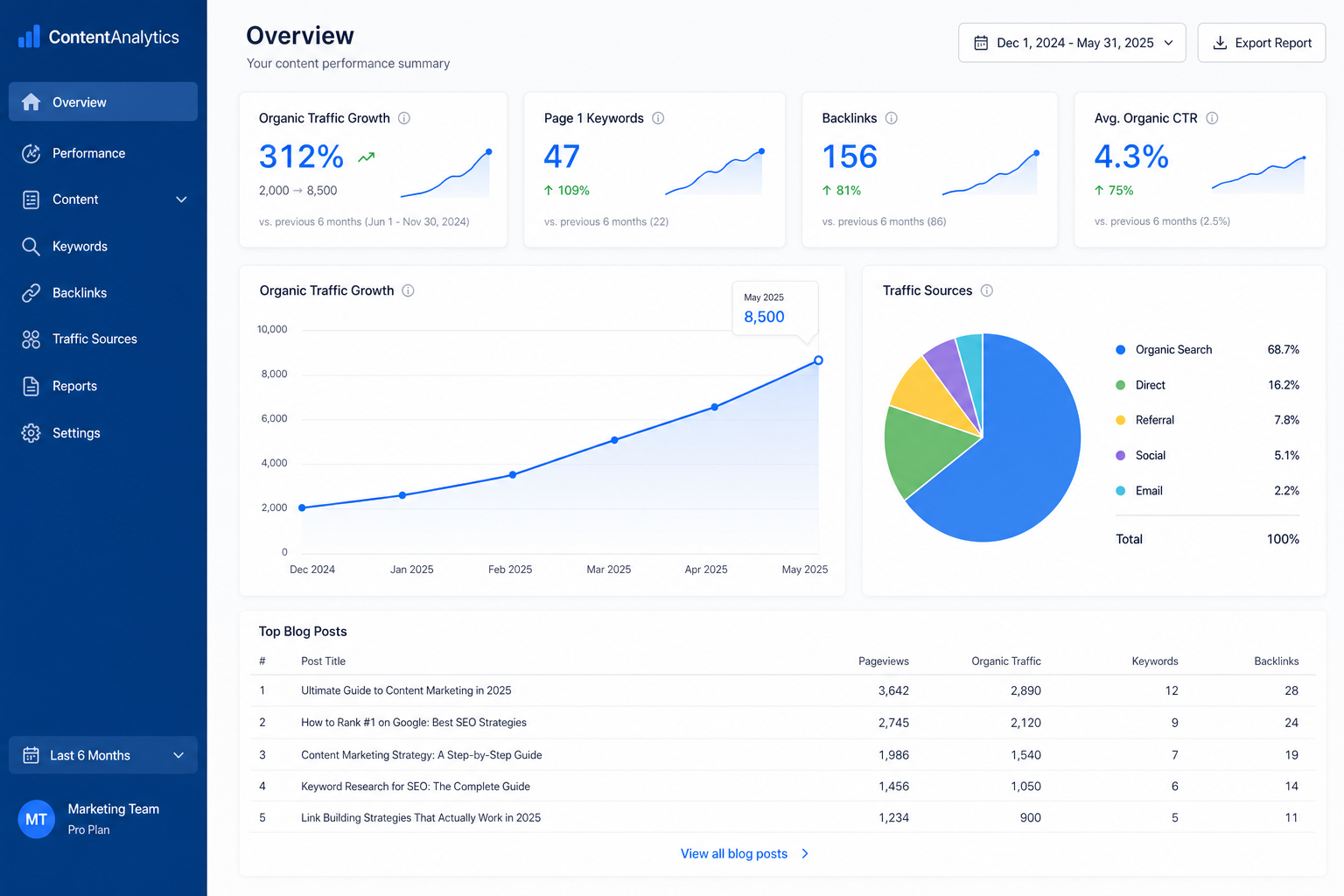
A content marketing analytics dashboard tracking organic traffic growth from 2,000 to 8,500 sessions over 6 months — the kind of compounding results that make content marketing so powerful.
Measuring Content Marketing ROI
Metric
What It Measures
Tools
Organic Traffic
How many visitors find you through search
Google Analytics, Search Console
Keyword Rankings
Positions for target keywords
SEMrush, Ahrefs, Rank Math
Content Engagement
Time on page, scroll depth, pages per session
Google Analytics
Lead Generation
Form submissions, downloads, enquiries from content
CRM, Google Analytics goals
Backlinks Earned
Authority signals from other websites
Ahrefs, Moz
Revenue Attribution
Revenue traced back to content touchpoints
CRM with UTM tracking
Content ROI
Revenue generated vs content creation cost
Spreadsheet with cost and revenue data
Content Marketing Budget for Small Businesses
Approach
Monthly Investment
Output
Timeline to Results
DIY (Founder writes)
Rs.0 + time
2-4 posts/month
6-12 months
Freelance writers
Rs.15,000-40,000
4-8 posts/month
4-8 months
Content marketing agency
Rs.40,000-1,50,000
8-16 pieces/month (multi-format)
3-6 months
Full-service with distribution
Rs.1,00,000-3,00,000
Full content + promotion + analytics
2-4 months
Common Content Marketing Mistakes
Writing for search engines, not humans: Content stuffed with keywords but lacking genuine value will not engage readers or earn links. Write for humans first, optimise for search engines second.
Inconsistency: Publishing 10 articles in one month then nothing for three months destroys momentum. Consistent publishing (even 2 articles per week) builds algorithmic favour and audience expectations.
No promotion: Creating content without a distribution plan means nobody sees it. Spend at least 30% of your content effort on promotion and distribution.
Ignoring analytics: Not tracking which content performs means you cannot double down on what works. Review analytics monthly and adjust your strategy based on data.
Thin content: Short, superficial articles (under 800 words) rarely rank or engage. Comprehensive content (1,500+ words) consistently outperforms thin content in both rankings and engagement.
No internal linking: Failing to link between your own content pieces misses SEO opportunities and fails to guide visitors through your content ecosystem. Always link to related content.
Not updating old content: Published content decays over time. Refresh and update top-performing content annually to maintain rankings and accuracy.
Frequently Asked Questions
How long does content marketing take to show results?
Content marketing typically shows initial traction within 3-4 months, meaningful traffic growth within 6-12 months, and compounding returns after 12-18 months. The timeline depends on content quality, publishing frequency, competition level, and existing website authority. Unlike paid advertising, content marketing rewards patience with compounding, sustainable results.
How many blog posts do I need to see results?
Most businesses need 30-50 high-quality blog posts before seeing significant organic traffic. This typically takes 6-12 months at a pace of 4-8 posts per month. Each post is a permanent asset that continues generating traffic indefinitely. After reaching 50+ posts, the compounding effect accelerates dramatically.
Should I write content myself or hire an agency?
If you have writing skills, industry expertise, and 5-10 hours per week, DIY content can work for starting out. However, a professional content marketing agency delivers better results through keyword research expertise, SEO optimisation skills, professional editing, consistent publishing schedules, and multi-format content creation (articles, videos, infographics) that most business owners cannot maintain alongside running their business.
How do I come up with content ideas?
Start with your customers’ questions (check sales calls, support tickets, and FAQs). Use keyword research tools to identify what your audience searches for. Analyse competitor content for gaps you can fill. Monitor industry news and trends for timely content opportunities. Review your analytics to identify topics that already perform well and create related content.
Does content marketing work for B2B businesses?
Content marketing is especially powerful for B2B businesses because B2B buyers conduct extensive research before making decisions. Manufacturers, exporters, consultants, and service providers all benefit from content that demonstrates expertise, builds trust, and educates prospects through long sales cycles. B2B content marketing typically generates higher-value leads than B2C.
How does content marketing work with other marketing channels?
Content marketing amplifies every other channel. It improves SEO rankings through fresh, keyword-rich content. It provides material for social media posts. It creates landing pages for Google Ads campaigns. It feeds email marketing sequences. It builds the authority that makes Meta Ads more effective. Content is the foundation that makes all other marketing work better.
Ready to Build a Content Marketing Engine?
Get a free content strategy consultation and discover the content opportunities your business is missing. Contact UMC today and start attracting customers through valuable content.
Editorial note: This article complements broader marketing automation planning by focusing specifically on buyer-side platform evaluation rather than channel execution alone.
Adobe Marketo Engage has long been the go-to for enterprise demand generation teams. But over the past few years, a growing number of marketing operations leaders have started asking a harder question: Is Marketo actually the best tool for us, or are there Marketo alternatives we should be aware of?