Editorial note: This article serves as the local implementation guide within UMC’s broader social media content cluster. It complements the evergreen overview Social Media Marketing: Trends, Strategies, and Best Practices by focusing specifically on the needs of small businesses in Lucknow.
Social media is where Lucknow lives online. From discovering new restaurants through Instagram Reels to finding the best salons through before-and-after photos, from researching schools through Facebook pages to watching coaching institute lectures on YouTube, social media platforms have become the primary channels where consumers discover, evaluate, and choose businesses. Yet most small businesses in Lucknow struggle to turn social media presence into actual revenue.
This guide provides a practical social media marketing strategy framework specifically designed for small businesses in Lucknow. Whether you are just starting or looking to improve existing efforts, these strategies will help you build a social media presence that drives real business results.
Why Most Small Business Social Media Fails
Before diving into what works, let us address why most small business social media efforts in Lucknow underperform:
No strategy: Posting randomly without clear objectives, target audience definition, or content pillars
Inconsistency: Posting daily for a week then disappearing for a month, destroying algorithm visibility and audience trust
Selling too much: Every post is a sales pitch, which audiences tune out and algorithms deprioritise
Ignoring analytics: Not tracking what works and what does not, repeating the same mistakes indefinitely
Poor visual quality: Low-resolution photos, inconsistent branding, and amateur design that undermines credibility
No community engagement: Treating social media as a broadcast channel rather than a two-way conversation
Wrong platforms: Spreading thin across every platform instead of dominating the ones where their audience actually lives
The Social Media Landscape in Lucknow
Understanding which platforms dominate in Lucknow helps you focus your efforts where they will have the most impact:
Platform
Active Users in Lucknow
Primary Audience
Best For
Instagram
20 lakh+
18-40 years, visual learners
Brand building, product showcase, Reels discovery
Facebook
28 lakh+
25-55 years, broader demographics
Community building, local groups, event promotion, older demographics
YouTube
25 lakh+
All ages, learning-oriented
Long-form content, tutorials, trust building, SEO benefits
WhatsApp Business
30 lakh+
All ages, communication-focused
Customer communication, order management, broadcasts
LinkedIn
5 lakh+
25-50 years, professionals
B2B marketing, thought leadership, recruitment
X (Twitter)
3 lakh+
20-45 years, news-oriented
News, customer service, real-time engagement
Step 1: Define Your Social Media Strategy Foundation
Choose Your Platforms Wisely
Do not try to be everywhere. Choose 2-3 platforms where your target audience is most active and where your content strengths align:
Every social media activity should connect to a business objective:
Objective
Key Metrics
Content Focus
Brand Awareness
Reach, impressions, follower growth
Engaging content, Reels, stories
Lead Generation
Form submissions, DM enquiries, calls
Lead magnets, CTAs, offers
Website Traffic
Link clicks, website sessions from social
Blog shares, link in bio, stories links
Sales / Bookings
Conversions, revenue attributed to social
Product posts, offers, shopping features
Community Building
Engagement rate, comments, shares, DMs
Interactive content, Q&A, polls, UGC
Step 2: Create a Content Strategy That Works
The 80/20 Content Rule
The most effective social media content follows the 80/20 rule: 80% of your content should educate, entertain, or inspire your audience, while only 20% should directly promote your products or services. This builds trust and engagement that makes the promotional content more effective when you do share it.
Content Pillars for Small Businesses
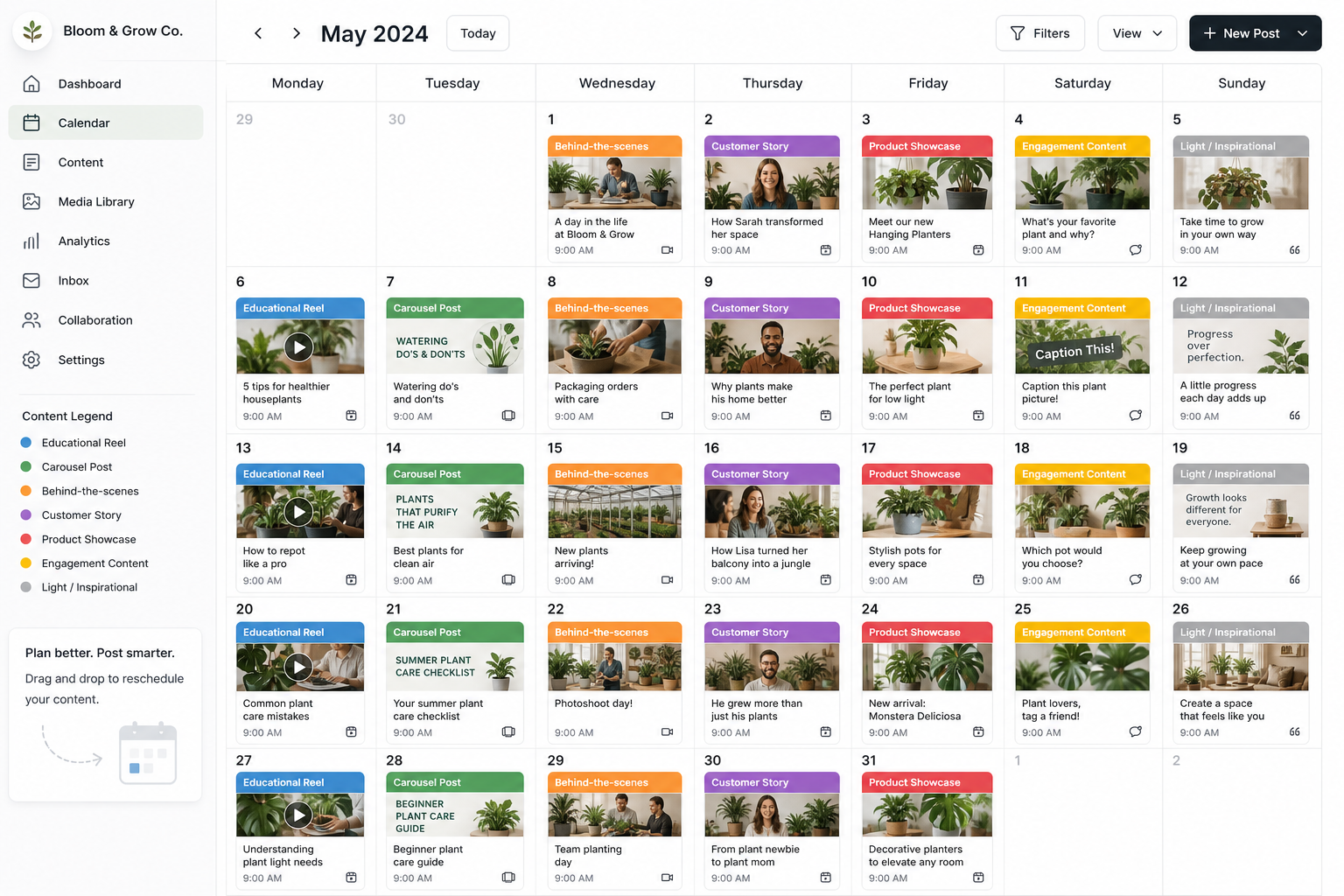
A social media content calendar with daily posting plan — each day assigned a specific content type to maintain consistency and balance across your content pillars.
Define 4-5 content pillars that guide everything you post:
Educational: Tips, how-tos, industry insights, myth-busting (builds authority)
Instagram is the most powerful platform for most small businesses in Lucknow. Here is how to use it effectively:
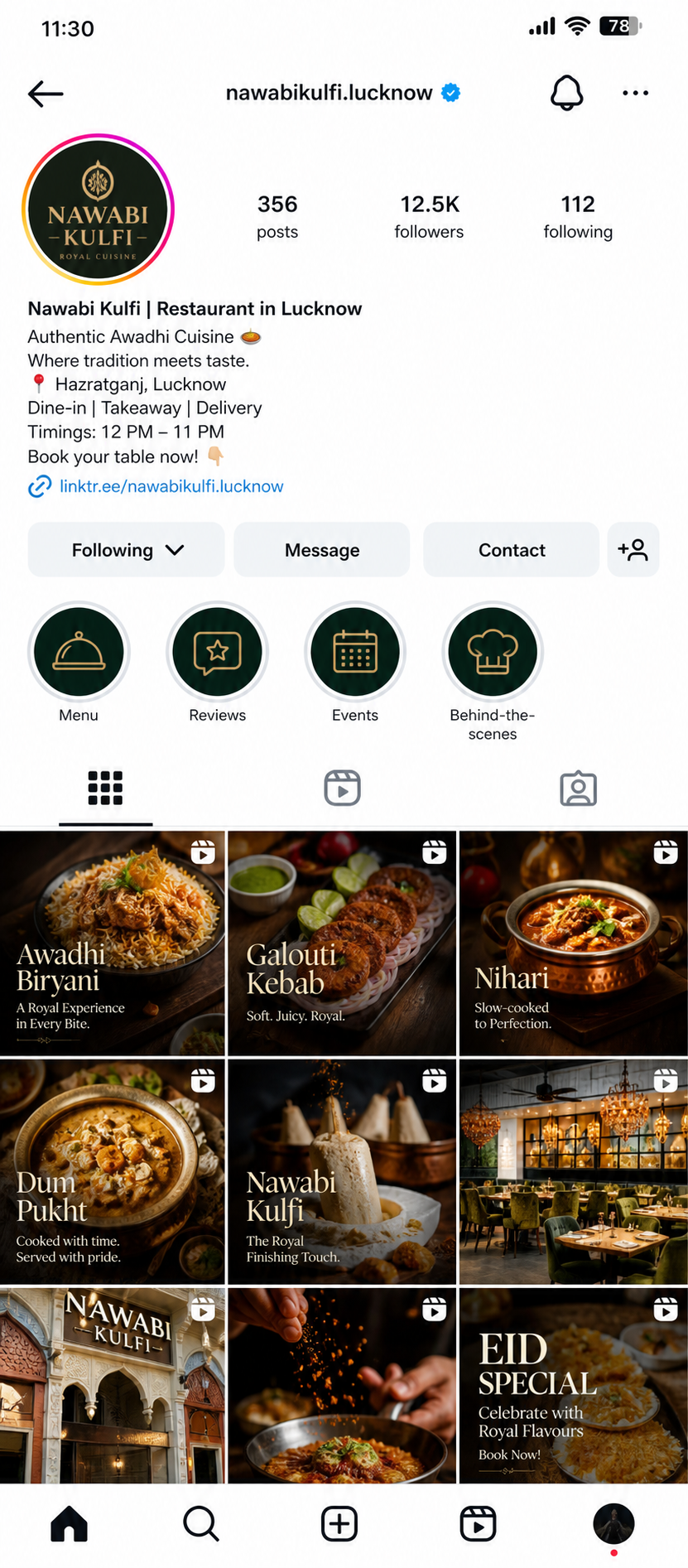
A fully optimised Instagram business profile: professional logo, clear bio with CTA, organised Story Highlights, and a visually cohesive feed that builds trust and drives action.
Profile Optimisation
Professional profile photo (logo for brands, headshot for personal brands)
Clear bio with what you do, who you serve, and your location
Link in bio pointing to your website, booking page, or latest offer
Story highlights organised by category (Services, Reviews, FAQ, Behind-the-Scenes)
Contact button with phone, email, and address
Reels Strategy
Reels are the highest-reach content format on Instagram. Create Reels that:
Solve a specific problem your audience faces
Show transformations or before-and-after results
Demonstrate your product or service in action
Share quick tips or hacks related to your industry
Use trending audio and formats adapted to your niche
Include text overlays since many viewers watch without sound
Stories Strategy
Stories maintain daily connection with your most engaged followers:
Start the day with a morning story (what you are working on, today’s special, etc.)
Use interactive stickers (polls, questions, quizzes) to boost engagement
Share customer photos and tag them for amplification
Post limited-time offers and flash sales exclusively in Stories
Use the countdown sticker for upcoming events or launches
Step 4: Leverage Paid Social Media Advertising
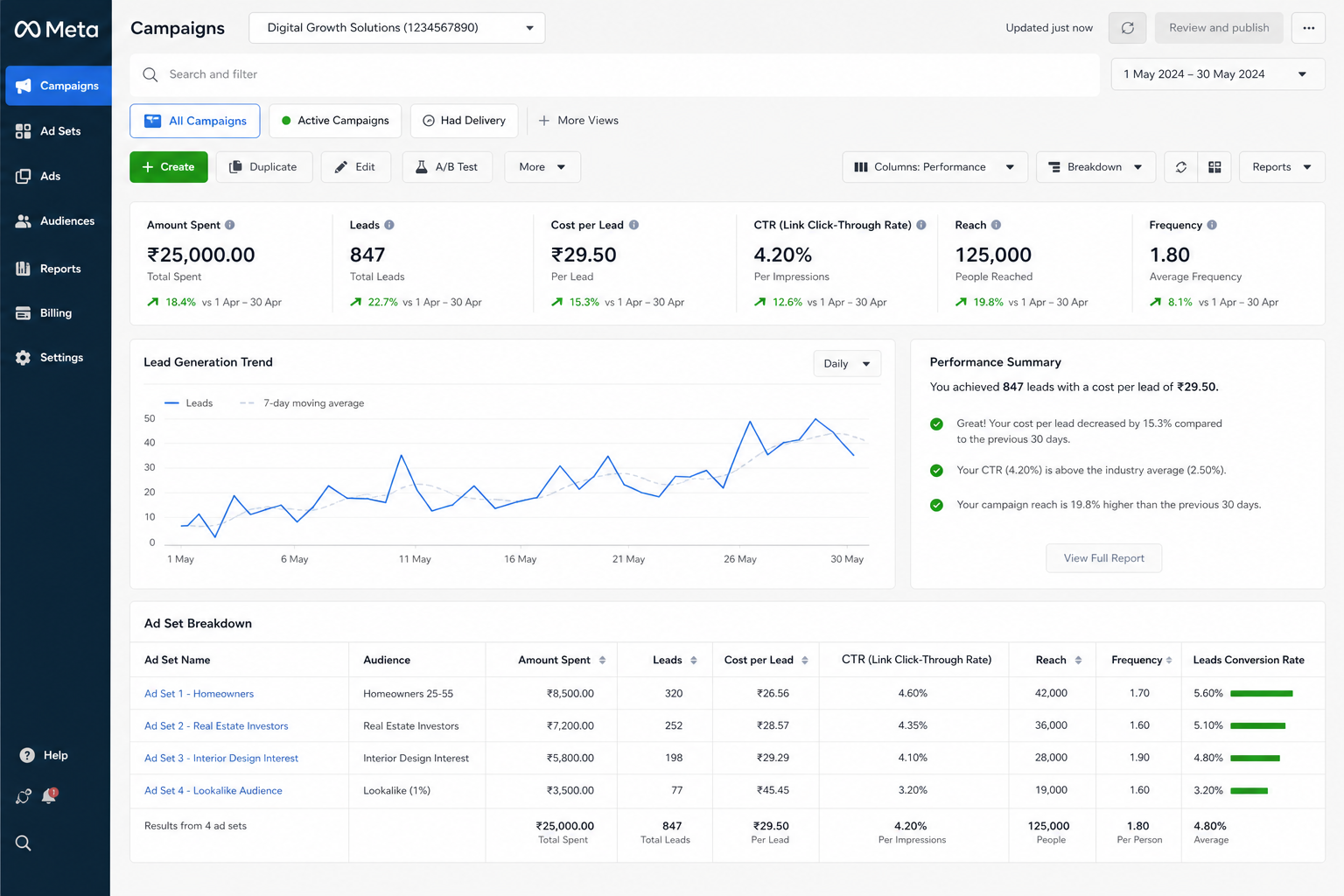
Organic reach alone is not enough for consistent business growth. Meta Ads (Facebook and Instagram advertising) amplify your best content and drive targeted results:
Meta Ads Manager showing real campaign results: 847 leads generated at Rs.29.5 cost per lead from a Rs.25,000 monthly budget — demonstrating the ROI of professional paid social advertising.
Ad Campaign Types by Objective
Awareness campaigns: Reach new audiences with your brand through video views and reach objectives
Traffic campaigns: Drive targeted visitors to your website or landing pages
Lead generation campaigns: Capture enquiries through in-app lead forms without requiring website visits
Sales campaigns: Drive purchases through product catalogue ads and conversion-optimised campaigns
Retargeting campaigns: Re-engage website visitors, video viewers, and social media engagers who have not yet converted
Budget Guide for Small Businesses
Business Size
Monthly Ad Budget
Expected Results
Micro Business (solo/1-3 people)
Rs.5,000 – Rs.15,000
50-150 leads/month or 20-50 sales
Small Business (4-15 people)
Rs.15,000 – Rs.50,000
150-500 leads/month or 50-200 sales
Growing Business (15-50 people)
Rs.50,000 – Rs.2,00,000
500-2000 leads/month or 200-800 sales
For a comprehensive paid advertising strategy, combine Meta Ads with Google Ads to capture both demand creation and demand capture simultaneously. Read our detailed comparison of SEO vs Google Ads for more guidance on channel selection.
Step 5: Build and Engage Your Community
Social media is a two-way channel. Businesses that actively engage with their audience build loyalty, trust, and word-of-mouth that no amount of advertising can buy:
Respond to every comment and DM within a few hours during business hours
Ask questions in your captions to encourage comments and conversation
Feature user-generated content by resharing customer photos and stories (with permission)
Run contests and giveaways that encourage participation and sharing
Create a Facebook Group for your most engaged customers to build deeper community
Go live regularly for Q&A sessions, behind-the-scenes, or tutorials
Collaborate with complementary businesses for cross-promotion to new audiences
Step 6: Track, Measure, and Optimise
Without measurement, you cannot improve. Track these metrics monthly:
Metric
What It Tells You
Target Benchmark
Follower Growth Rate
Whether your audience is expanding
3-5% monthly growth
Engagement Rate
How well your content resonates
3-6% on Instagram, 1-3% on Facebook
Reach
How many unique people see your content
Growing month over month
Website Clicks
How effectively social drives traffic
Track and improve monthly
Lead/Sale Conversions
Revenue generated from social media
Positive and improving ROI
Content Performance
Which content types and topics work best
Double down on top performers
Social Media Calendar Template for Small Businesses
Day
Content Type
Example
Monday
Educational Reel
Quick tip or how-to related to your industry
Tuesday
Carousel Post
Step-by-step guide or list of tips
Wednesday
Behind-the-Scenes
Team photo, process video, workspace tour
Thursday
Customer Story
Testimonial, transformation, review highlight
Friday
Product/Service Showcase
New arrival, feature highlight, offer announcement
Saturday
Engagement Content
Poll, Q&A, this-or-that, user-generated content
Sunday
Light/Inspirational
Motivational quote, weekend activity, community spotlight
Post Stories daily (5-10 per day) complementing your feed content with real-time updates, interactive elements, and casual behind-the-scenes content.
Common Social Media Mistakes to Avoid
Buying followers: Fake followers destroy your engagement rate and algorithm visibility. They also damage credibility when real people notice
Posting without a plan: Random posting without content pillars or objectives leads to inconsistent quality and confused audiences
Ignoring video: Video content (especially Reels and Shorts) receives 3-5x more reach than static posts. Avoiding video means missing the biggest growth opportunity
Over-promoting: If every post is a sales pitch, your audience will disengage. Follow the 80/20 rule
Not engaging back: Social media is social. Ignoring comments and DMs tells your audience you do not care about them
Copying competitors: Your brand should have its own voice and style. Copying others makes you forgettable
Neglecting your website: Social media drives traffic, but your website converts it. A poor website undermines all your social media efforts
Frequently Asked Questions
How much should a small business spend on social media marketing?
Small businesses should invest Rs.15,000-50,000/month for organic social media management (content creation, scheduling, community management) and Rs.10,000-50,000/month for paid advertising. Total investment of Rs.25,000-1,00,000/month typically delivers strong ROI for small businesses in Lucknow.
Which social media platform is best for my business?
It depends on your audience and content strengths. Most visual businesses (restaurants, salons, jewellery) thrive on Instagram. B2B businesses do best on LinkedIn. Educational businesses benefit most from YouTube. Most businesses need at least 2 platforms: one for discovery (Instagram/YouTube) and one for community (Facebook/WhatsApp). A social media marketing agency can help you identify the best platforms for your specific business.
How often should I post on social media?
Instagram: 4-7 feed posts per week plus 5-10 Stories daily. Facebook: 3-5 posts per week. YouTube: 1-2 long-form videos plus 3-5 Shorts per week. LinkedIn: 3-5 posts per week. Consistency matters more than volume. It is better to post 4 times per week consistently than 10 times one week and zero the next.
How long before social media marketing shows results?
Organic social media building takes 3-6 months to show meaningful business results. Paid advertising can generate leads within the first week. Brand awareness builds gradually over 2-3 months. Community engagement and loyalty develop over 6-12 months of consistent effort. Plan for a 6-month minimum commitment before evaluating overall ROI.
Should I hire an agency or manage social media in-house?
For basic posting and community management, an in-house team member can work if they have social media skills and sufficient time. For strategic growth including content strategy, paid advertising, analytics, and creative production, a professional social media agency delivers significantly better results. The expertise, tools, and processes that agencies bring typically generate 3-5x better ROI than in-house efforts by non-specialists.
How do I measure social media ROI?
Track revenue attributed to social media through UTM parameters, promo codes, lead source tracking, and platform analytics. Calculate total social media investment (agency fees + ad spend + content production) versus revenue generated. Also track leading indicators like follower growth, engagement rate, website traffic from social, and lead volume to identify trends before they show in revenue.
Ready to Transform Your Social Media Marketing?
Get a free social media audit and strategy session. Discover untapped opportunities and a clear roadmap for growth. Contact UMC today and start building a social media presence that drives real business results.
Editorial note: This article complements broader marketing automation planning by focusing specifically on buyer-side platform evaluation rather than channel execution alone.
Adobe Marketo Engage has long been the go-to for enterprise demand generation teams. But over the past few years, a growing number of marketing operations leaders have started asking a harder question: Is Marketo actually the best tool for us, or are there Marketo alternatives we should be aware of?




3 comments