Editorial note: This article serves as the e-commerce growth guide within UMC’s digital marketing cluster and connects acquisition, conversion, and retention decisions.
E-commerce in India is growing at 25% year-over-year, and Lucknow is emerging as a significant market with increasing online shopping adoption across all demographics. Whether you sell fashion, electronics, handicrafts, groceries, or any other product online, increasing your e-commerce sales requires a strategic approach that goes beyond simply listing products on a website. This guide covers the complete e-commerce marketing playbook for businesses in Lucknow looking to increase online sales and build sustainable e-commerce revenue.
The E-commerce Marketing Funnel
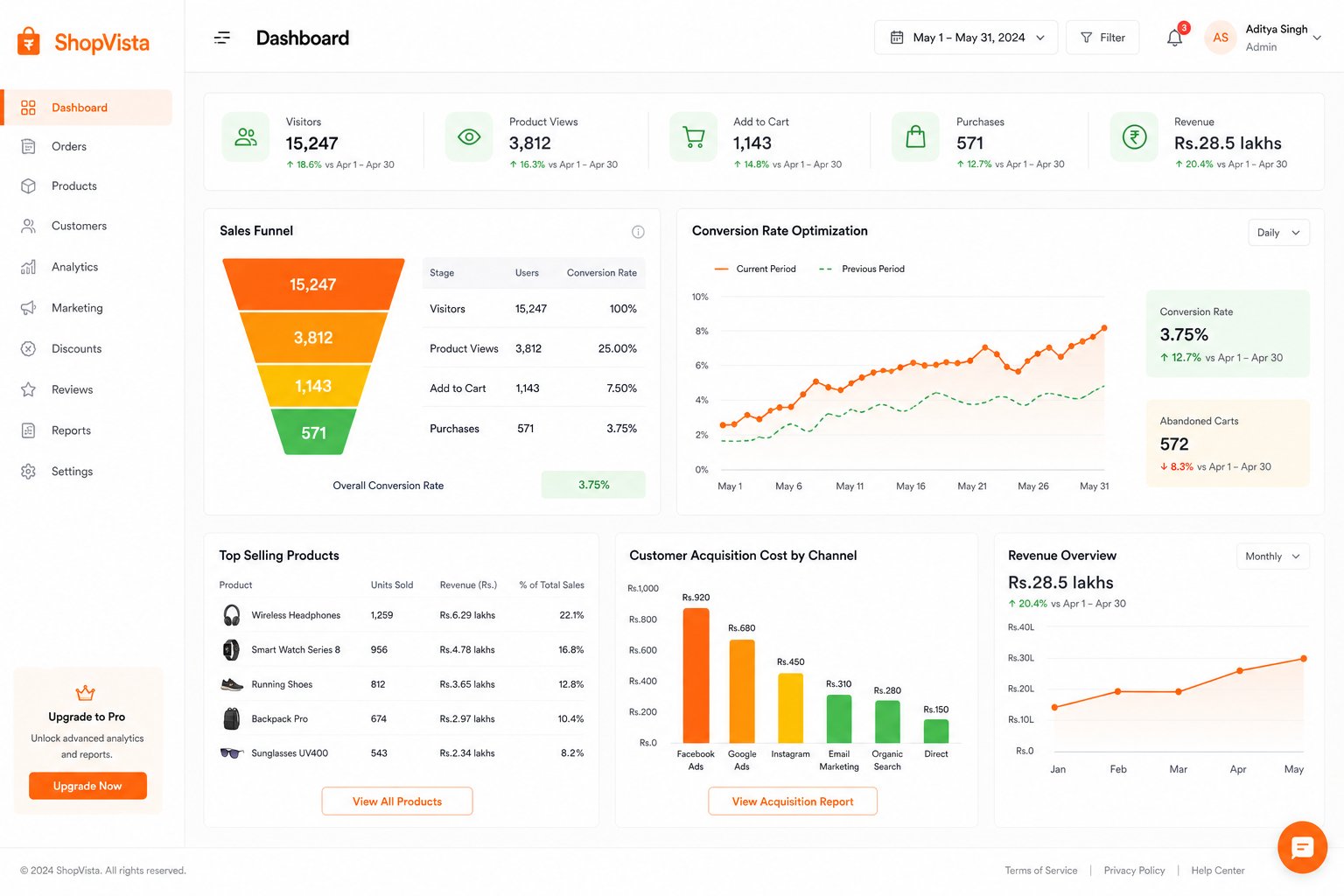
Successful e-commerce marketing follows a structured funnel that moves potential customers from awareness to purchase to repeat purchase:
| Stage | Goal | Key Channels | Metrics |
|---|---|---|---|
| Awareness | Get discovered by potential buyers | SEO, Social Media, Google Shopping Ads | Impressions, reach, traffic |
| Consideration | Engage and educate browsers | Retargeting, Content, Meta Ads | Time on site, page views, add-to-cart |
| Conversion | Turn browsers into buyers | Product pages, offers, checkout optimisation | Conversion rate, AOV, revenue |
| Retention | Drive repeat purchases | Email, WhatsApp, loyalty programmes | Repeat rate, LTV, churn |
| Advocacy | Turn customers into promoters | Reviews, referrals, UGC campaigns | NPS, referral rate, UGC volume |
Strategy 1: Product Page Optimisation
Your product pages are where buying decisions happen. Most e-commerce stores lose 60-80% of potential sales due to poorly optimised product pages. Here is what high-converting product pages need:
Essential Product Page Elements
- High-quality images: Minimum 5-8 images per product showing different angles, close-ups, lifestyle shots, and size references. Include zoom functionality and 360-degree views for premium products
- Product videos: Short videos showing the product in use, unboxing, or size demonstrations increase conversion rates by 20-30%
- Compelling descriptions: Benefit-focused descriptions that answer “What problem does this solve?” and “Why should I buy this?” rather than just listing specifications
- Customer reviews: Display star ratings prominently and show detailed reviews with photos. Products with 50+ reviews convert 4.6x better than those without
- Clear pricing: Show original price, discounted price, savings amount, and EMI options. Price transparency builds trust
- Stock urgency: “Only 3 left in stock” or “Selling fast” messaging creates urgency for high-demand products
- Trust badges: Secure checkout badges, return policy, warranty information, and authenticity guarantees
- Size guides: Detailed size charts with measurements reduce returns by 30-50% for fashion and apparel
Strategy 2: Google Shopping and Performance Max
Google Shopping Ads display your products directly in search results with images, prices, and ratings, capturing buyers at the exact moment they are searching for products like yours.
Setting Up Google Shopping
- Product feed optimisation: Your product feed is the foundation. Optimise titles (include brand, product type, key attributes), descriptions (include relevant keywords), and images (white background, high resolution)
- Product categorisation: Use Google’s product taxonomy correctly to ensure your products appear for relevant searches
- Custom labels: Tag products by margin, season, bestseller status, or clearance to control bidding strategy by product group
- Negative keywords: Exclude irrelevant searches that waste budget without converting
Performance Max Campaigns
Performance Max uses Google’s AI to serve your products across all Google surfaces (Search, Shopping, Display, YouTube, Gmail, Discover) from a single campaign. Provide high-quality asset groups with compelling headlines, descriptions, images, and videos, and let Google’s AI find the best combinations for maximum conversions.
Strategy 3: Meta Ads for E-commerce
Meta Ads (Facebook and Instagram) are essential for e-commerce because they allow visual product showcasing and sophisticated retargeting that drives purchases.
Key Meta Ad Strategies for E-commerce
- Dynamic Product Ads (DPA): Automatically show relevant products to people who viewed them on your website but did not purchase. DPAs use your product catalogue to personalise ads for each individual, showing them exactly the products they browsed
- Advantage+ Shopping Campaigns: Meta’s AI-powered shopping campaigns that automatically test creative variations, audiences, and placements to maximise purchases. These campaigns typically deliver 20-30% better ROAS than manual campaigns
- Collection Ads: Mobile-optimised ads that showcase multiple products in an immersive, instant-load experience. Users can browse products without leaving the app
- Carousel Ads: Show multiple products or product features in a swipeable format, perfect for showcasing product ranges or telling a product story
- Instagram Shopping: Tag products directly in your Instagram posts and Stories, allowing followers to tap and purchase without leaving the app
Strategy 4: Conversion Rate Optimisation (CRO)
Even small improvements in conversion rate dramatically impact revenue. A website converting at 2% that improves to 3% generates 50% more revenue without any additional traffic.
Key CRO Areas for E-commerce
| Area | Optimisation | Expected Impact |
|---|---|---|
| Site speed | Optimise loading to under 3 seconds on mobile | 20-40% reduction in bounce rate |
| Checkout flow | Reduce to 2-3 steps, offer guest checkout, auto-fill addresses | 15-30% reduction in cart abandonment |
| Trust signals | Display security badges, return policy, and reviews prominently | 10-20% increase in conversion |
| Payment options | Add UPI, wallets, EMI, COD alongside cards | 15-25% increase in completed purchases |
| Mobile experience | Ensure thumb-friendly navigation, large buttons, easy zoom | 20-35% improvement in mobile conversions |
| Search functionality | Implement predictive search with autocomplete and filters | 10-15% increase in product discovery |
Strategy 5: Cart Abandonment Recovery
Approximately 70% of e-commerce carts are abandoned before purchase. Recovering even 10-15% of these represents significant additional revenue:
- Exit-intent popups: When a user moves to leave with items in cart, show a popup offering free shipping, a small discount, or a reminder
- Abandoned cart emails: Automated 3-email sequence: reminder at 1 hour, social proof at 24 hours, and discount offer at 48 hours
- WhatsApp cart reminders: For Indian e-commerce, WhatsApp reminders often have 3-5x higher recovery rates than email
- Retargeting ads: Show abandoned products to cart abandoners through Meta Ads and Google Ads retargeting
- SMS notifications: Brief SMS reminders for time-sensitive offers or limited stock items
Strategy 6: Customer Retention and Repeat Purchases
Acquiring a new customer costs 5-7x more than retaining an existing one. E-commerce businesses that focus on retention build sustainable, profitable growth:
- Email marketing sequences: Post-purchase nurture, replenishment reminders for consumable products, and personalised product recommendations
- Loyalty programmes: Points-based rewards, tier-based benefits, and referral bonuses that incentivise repeat purchases
- Subscription models: For consumable products, offer subscription options with discounts that guarantee recurring revenue
- Personalised recommendations: AI-powered “You might also like” and “Customers who bought this also bought” sections that drive cross-sells
- Win-back campaigns: Target customers who have not purchased in 90+ days with compelling re-engagement offers
E-commerce SEO for Product Pages
Organic search is the most sustainable traffic source for e-commerce. Optimise your product pages for search:
- Product title format: Brand + Product Type + Key Attribute + Size/Colour (e.g., “Nike Air Max 270 Running Shoes – Black – Size 10”)
- Category page optimisation: Unique descriptions for each category page targeting broad commercial keywords
- Schema markup: Product schema with price, availability, ratings, and reviews for rich snippets in search results
- Image optimisation: Descriptive alt text, WebP format, and proper file naming for image search visibility
- Internal linking: Link related products, categories, and blog content to distribute authority across your site
- Content marketing: Buying guides, comparison articles, and how-to content that attract informational searches and funnel readers to product pages
E-commerce Marketing Budget Allocation
| Channel | Budget % | Role | Expected ROAS |
|---|---|---|---|
| Google Shopping / Performance Max | 30-40% | High-intent buyer acquisition | 3-8x |
| Meta Ads (DPA + Advantage+) | 25-35% | Retargeting + prospecting | 3-6x |
| SEO & Content | 15-20% | Long-term organic growth | 5-15x (compounding) |
| Email Marketing | 5-10% | Retention and repeat purchases | 30-40x |
| Influencer & Social | 5-10% | Brand awareness and trust | 2-5x |
Frequently Asked Questions
How much should I spend on e-commerce marketing?
Most e-commerce businesses spend 15-30% of revenue on marketing. For a store doing Rs.10 lakh/month in revenue, that means Rs.1.5-3 lakh/month in marketing investment. New stores may need to invest 30-50% of revenue initially to build traffic and customer base. The key metric is return on ad spend (ROAS) — aim for 3x+ across paid channels.
Which platform should I use: WooCommerce, Shopify, or custom?
The right platform depends on your needs. WooCommerce (WordPress) offers maximum customisation and SEO control at lower ongoing cost. Shopify is easier to manage with excellent app ecosystem but higher monthly fees. Custom builds are best for unique requirements but cost significantly more. For most Indian e-commerce businesses, WooCommerce offers the best balance of flexibility, cost, and SEO performance.
How do I reduce cart abandonment?
Reduce cart abandonment by simplifying checkout to 2-3 steps, offering guest checkout, displaying trust badges, showing free shipping thresholds, providing multiple payment options (UPI, wallets, EMI, COD), and implementing abandoned cart recovery through email, WhatsApp, and retargeting ads. Each improvement typically reduces abandonment by 5-15%.
How important are product reviews for e-commerce?
Extremely important. Products with reviews convert 3-5x better than those without. Products with 50+ reviews and 4+ star ratings see the highest conversion rates. Implement automated post-purchase review requests, offer incentives for photo reviews, and display reviews prominently on product pages. Never fake reviews — authenticity matters.
How do I compete with Amazon and Flipkart?
Compete on what marketplaces cannot offer: brand story, curated experience, personalised service, exclusive products, community, and loyalty rewards. Build a strong brand identity, offer superior customer service, create unique product bundles, and invest in digital marketing that drives direct traffic to your store. Many successful e-commerce brands use marketplaces for discovery while building direct relationships through their own website.
What is a good e-commerce conversion rate?
Average e-commerce conversion rates in India are 1-2%. Top-performing stores achieve 3-5%. Conversion rate depends on traffic quality, product pricing, website experience, and trust signals. Focus on improving conversion rate alongside driving traffic — a 1% improvement in conversion rate can double your revenue without any additional traffic investment.
Ready to Increase Your E-commerce Sales?
Get a free e-commerce marketing audit and discover exactly how to increase your online sales. Contact UMC today for a customised e-commerce growth strategy.
Related e-commerce and conversion resources
- Google Ads vs Meta Ads: Which Platform Delivers Better ROI? — channel-choice guidance for e-commerce acquisition.
- Landing Page Optimization: How to Convert More Visitors into Customers — conversion support for paid and organic e-commerce traffic.
- Campaign Optimization Strategies That Actually Work — performance improvement across running campaigns.
- Best Digital Marketing Company in Lucknow — buyer guidance for businesses seeking outside growth support.