Editorial note: This article serves as the local B2B strategy guide within UMC’s digital marketing cluster and complements execution-focused channel articles such as email, SEO, paid media, and website trust-building.
B2B marketing in Lucknow operates by fundamentally different rules than consumer marketing. Your buyers are not impulse shoppers scrolling Instagram. They are procurement managers, business owners, and decision-makers conducting thorough research, comparing multiple vendors, and requiring approval from multiple stakeholders before committing. For manufacturers, exporters, IT companies, professional service firms, and any business selling to other businesses, mastering B2B digital marketing is essential for sustainable growth.
How B2B Marketing Differs from B2C
Understanding these differences is the foundation of effective B2B marketing strategy:
| Factor | B2C Marketing | B2B Marketing |
|---|---|---|
| Decision makers | 1 person (individual buyer) | 3-7 stakeholders (committee decision) |
| Sales cycle | Minutes to days | Weeks to months (sometimes years) |
| Purchase value | Rs.100 – Rs.50,000 typically | Rs.50,000 – Rs.5 crore+ typically |
| Decision driver | Emotion, convenience, price | ROI, reliability, expertise, risk reduction |
| Content needs | Short, visual, entertaining | Detailed, educational, data-driven |
| Relationship | Transactional, often one-time | Long-term partnership, recurring revenue |
| Key platforms | Instagram, Facebook, YouTube | LinkedIn, Google Search, Email, Industry portals |
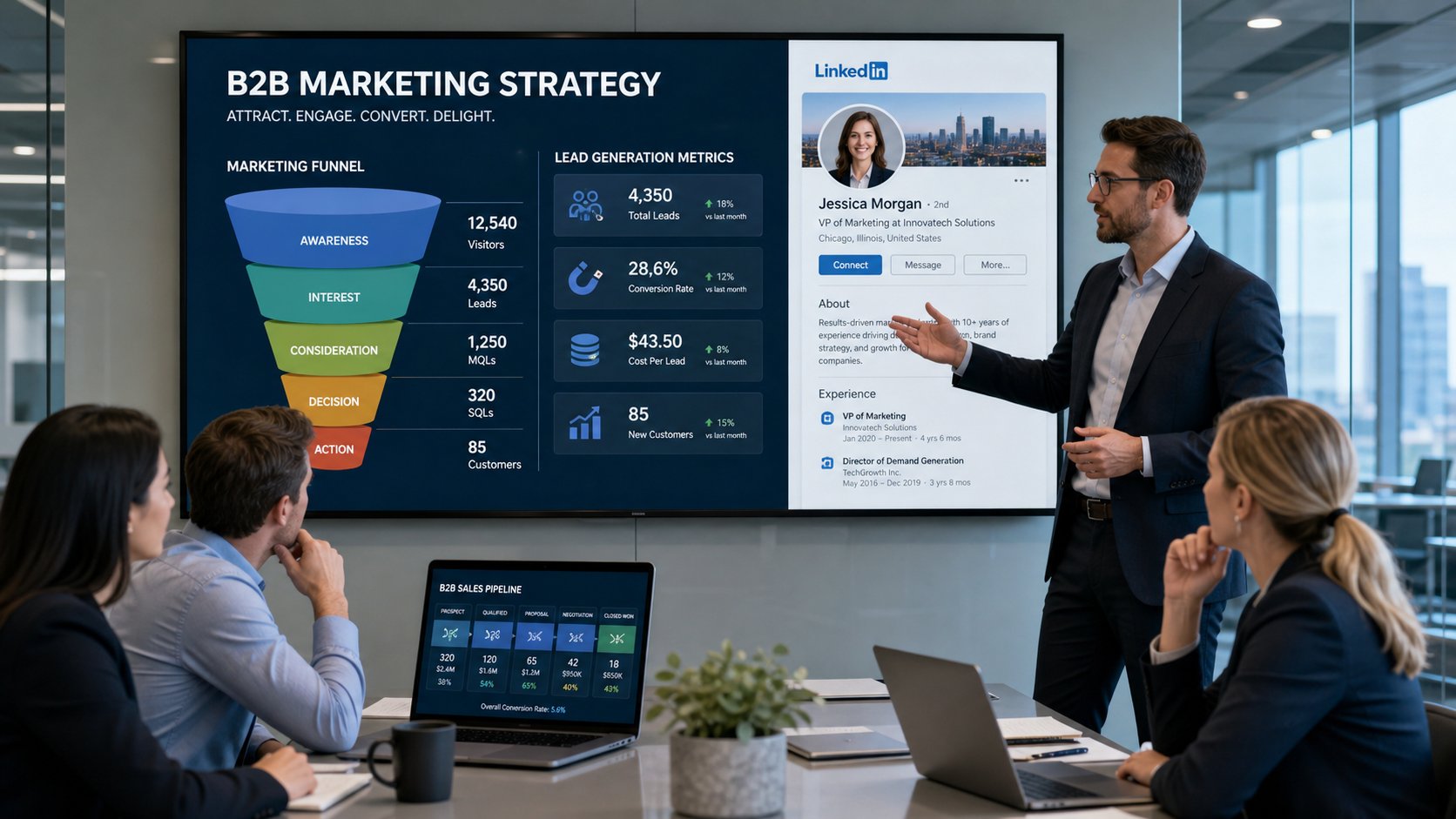
The B2B Marketing Funnel
B2B marketing follows a longer, more complex funnel than consumer marketing. Each stage requires different content and channels:
Stage 1: Awareness (Top of Funnel)
Potential buyers realise they have a problem and begin researching solutions. They are not evaluating vendors yet — they are educating themselves about their challenge.
- Content: Educational blog posts, industry reports, how-to guides, problem-awareness content
- Channels: SEO, LinkedIn articles, content marketing, industry publications
- Goal: Position your brand as a knowledgeable authority in your space
- Metrics: Organic traffic, content downloads, LinkedIn followers, brand searches
Stage 2: Consideration (Middle of Funnel)
Buyers have defined their problem and are now evaluating different solution approaches and potential vendors.
- Content: Comparison guides, case studies, webinars, product demonstrations, whitepapers
- Channels: Google Ads, LinkedIn Ads, email nurture sequences, retargeting
- Goal: Demonstrate why your solution is superior and reduce perceived risk
- Metrics: Lead form submissions, webinar registrations, demo requests, email engagement
Stage 3: Decision (Bottom of Funnel)
Buyers have shortlisted 2-3 vendors and are making their final selection.
- Content: Detailed proposals, pricing information, client references, ROI calculators, free trials
- Channels: Sales follow-up, personalised email, phone calls, in-person meetings
- Goal: Remove final objections and make choosing you the obvious decision
- Metrics: Proposal requests, trial signups, closed deals, revenue
Strategy 1: LinkedIn Marketing for B2B
LinkedIn is the undisputed king of B2B social media marketing. With over 100 million active professionals globally and growing adoption among Indian business decision-makers, LinkedIn offers unparalleled access to your target audience.
LinkedIn Company Page Optimisation
- Complete every section: company description, industry, size, specialties, and website link
- Use a professional logo and banner that communicates your value proposition
- Post 3-5 times per week sharing industry insights, company updates, and thought leadership
- Encourage employees to share and engage with company content to amplify reach
- Use LinkedIn Analytics to track which content resonates most with your audience
LinkedIn Personal Branding for Founders
In B2B, people buy from people. Founders and senior leaders who build strong personal brands on LinkedIn generate significantly more inbound enquiries:
- Post 3-5 times per week sharing industry expertise, business lessons, and client insights
- Write long-form LinkedIn articles (1-2 per month) demonstrating deep expertise
- Engage thoughtfully with posts from potential clients and industry peers
- Share case studies and results (with client permission) that demonstrate your capabilities
- Build a personal brand that positions you as the go-to expert in your industry
LinkedIn Advertising
LinkedIn Ads allow precise targeting of decision-makers by job title, company size, industry, and seniority:
- Sponsored Content: Promote your best content to targeted decision-makers in their feed
- Message Ads: Send personalised messages directly to prospects’ LinkedIn inboxes
- Lead Gen Forms: Collect enquiries without leaving LinkedIn using pre-filled forms
- Conversation Ads: Interactive chatbot-style ads that qualify prospects through conversation
Strategy 2: B2B SEO and Content Marketing
SEO and content marketing are the foundation of sustainable B2B digital marketing. B2B buyers conduct extensive online research before engaging vendors, and your content must be present at every stage of their research journey.
B2B Keyword Strategy
| Keyword Type | Example | Search Intent | Content Type |
|---|---|---|---|
| Problem-aware | “how to reduce manufacturing defects” | Researching a problem | Educational blog post |
| Solution-aware | “quality control software for manufacturing” | Exploring solutions | Comparison guide |
| Vendor-aware | “best quality control companies in India” | Evaluating vendors | Service page + case studies |
| Product-aware | “[Your Company] reviews” | Researching you specifically | Testimonials + results page |
High-Value B2B Content Types
- Case studies: Detailed accounts of how you solved specific problems for specific clients, including challenges, approach, results, and client testimonials. Case studies are the single most persuasive B2B content type
- Whitepapers: In-depth research reports on industry topics that demonstrate thought leadership and generate high-quality leads through gated downloads
- Webinars: Live or recorded educational sessions that build trust, demonstrate expertise, and generate highly qualified leads who have invested time learning from you
- Industry reports: Original research and data about your industry that positions your company as an authority and earns backlinks from publications
- ROI calculators: Interactive tools that help prospects calculate the potential return from working with you, making the business case tangible
- Product comparison pages: Honest comparisons between your solution and alternatives that help buyers in the evaluation stage
Strategy 3: Email Nurture Sequences
B2B sales cycles are long. Email nurture sequences keep your brand top-of-mind throughout the decision process without requiring constant sales effort:
The B2B Nurture Framework
- Emails 1-3 (Week 1-2): Deliver the lead magnet, introduce your company, share your most compelling case study
- Emails 4-6 (Week 3-4): Educational content addressing common challenges, industry insights, and additional case studies
- Emails 7-9 (Week 5-6): Deeper content: whitepapers, webinars, detailed product information
- Emails 10-12 (Week 7-8): Direct offers: free consultation, demo, trial, or audit with clear CTAs
- Ongoing (Monthly): Newsletter with industry insights, company updates, and periodic offers
Strategy 4: Google Ads for B2B
Google Ads capture B2B buyers at the exact moment they are searching for solutions:
- Search Ads for high-intent keywords: Target keywords like “best [service] provider in India”, “[service] company near me”, and “[product] supplier Lucknow” that indicate active buying intent
- Competitor keywords: Bid on competitor brand names to capture buyers comparing options
- Display remarketing: Show banner ads to website visitors across the Google Display Network, keeping your brand visible throughout their research process
- YouTube Ads: Video ads targeting professionals researching solutions in your industry
- Lead form extensions: Collect enquiries directly from search ads without requiring a website visit
Strategy 5: B2B Partnerships and Alliances
Strategic partnerships create lead generation channels that neither business could build alone:
- Complementary service partnerships: Partner with non-competing businesses serving the same clients. A manufacturing consultant partners with a logistics company; a web development agency partners with an SEO firm
- Channel partnerships: Create formal referral programmes where partners earn commissions for introducing qualified leads
- Industry association involvement: Active participation in industry bodies, chambers of commerce, and trade associations builds visibility and credibility with potential B2B clients
- Co-marketing campaigns: Joint webinars, co-authored content, and shared events that expose both brands to each other’s audiences
B2B Marketing Budget Allocation
| Channel | Budget % | Timeline to Results | Lead Quality |
|---|---|---|---|
| SEO + Content Marketing | 25-35% | 4-8 months | Highest |
| Google Ads | 20-30% | Immediate | High |
| LinkedIn Marketing + Ads | 15-25% | 2-4 months | High |
| Email Marketing | 10-15% | 1-3 months | High |
| Events + Partnerships | 10-15% | 3-6 months | Highest |
| Social Media (organic) | 5-10% | 3-6 months | Medium |
Frequently Asked Questions
How long does B2B marketing take to show results?
B2B marketing typically takes 4-8 months to show meaningful results due to longer sales cycles. Google Ads can generate enquiries within weeks, but closing those enquiries into revenue takes 1-6 months depending on your sales cycle. SEO and content marketing take 4-8 months to build momentum. Plan for a 12-month commitment before evaluating overall ROI. The compounding nature of B2B marketing means results accelerate significantly after the first year.
What is the average B2B customer acquisition cost?
B2B customer acquisition costs vary dramatically by industry and deal size. In India, typical ranges are: professional services Rs.5,000-25,000, manufacturing contracts Rs.10,000-50,000, SaaS subscriptions Rs.3,000-30,000, and enterprise deals Rs.50,000-5,00,000+. The key metric is CAC relative to customer lifetime value — aim for LTV:CAC ratio of 3:1 or higher.
Which is better for B2B: LinkedIn or Google Ads?
Both serve different purposes. Google Ads captures existing demand (people actively searching for solutions). LinkedIn Ads creates demand by reaching decision-makers who are not yet searching. For most B2B businesses, the optimal approach combines both: Google Ads for high-intent capture and LinkedIn for targeted awareness and retargeting. Start with Google Ads for faster results, then add LinkedIn as budget allows.
How important is content marketing for B2B?
Content marketing is essential for B2B. B2B buyers consume 3-7 pieces of content before engaging a vendor. Businesses with strong content marketing generate 3x more leads at 62% lower cost than outbound marketing alone. Content builds the trust and authority that B2B buyers require before making significant purchasing decisions. Without content, you are invisible during the research phase where most buying decisions are actually made.
Should B2B businesses use social media?
Yes, but selectively. LinkedIn is essential for virtually all B2B businesses. YouTube is valuable for educational content and product demonstrations. Twitter/X can be useful for industry conversations and thought leadership. Instagram and Facebook are less relevant for most B2B businesses unless your target audience is active there. Focus your social media effort on platforms where your decision-makers actually spend time.
How do I measure B2B marketing ROI?
Track the complete journey from first touch to closed deal: marketing-qualified leads (MQLs), sales-qualified leads (SQLs), opportunities created, deals closed, and revenue generated. Calculate customer acquisition cost (total marketing spend ÷ new customers), customer lifetime value, and LTV:CAC ratio. Use CRM integration with your website and marketing tools to attribute revenue to specific marketing activities and channels.
Ready to Build a B2B Marketing Engine?
Get a free B2B marketing strategy consultation and discover how to generate predictable, high-quality leads for your business. Contact UMC today and start building your B2B growth engine.
Related B2B growth resources
- B2B Marketing Strategies for Lucknow Businesses — this article works best when read alongside the supporting website and lead-conversion resources below.
- Lead Generation Strategies for Businesses in Lucknow — practical demand-generation support across channels.
- B2B Website Essentials for Tier-2 Cities — trust signals that improve shortlist conversion.
- Email Marketing for Small Businesses: Strategy, Automation, and ROI — nurture and follow-up systems for B2B pipelines.
- SEO vs Google Ads in Lucknow — channel-allocation guidance for local B2B growth.