
Editorial note: This article functions as an educational technology-resource page within UMC’s broader technology cluster, focusing on infrastructure trends, operational complexity, and the evolving role of network professionals.
Research-backed, multi-source guide
Introduction
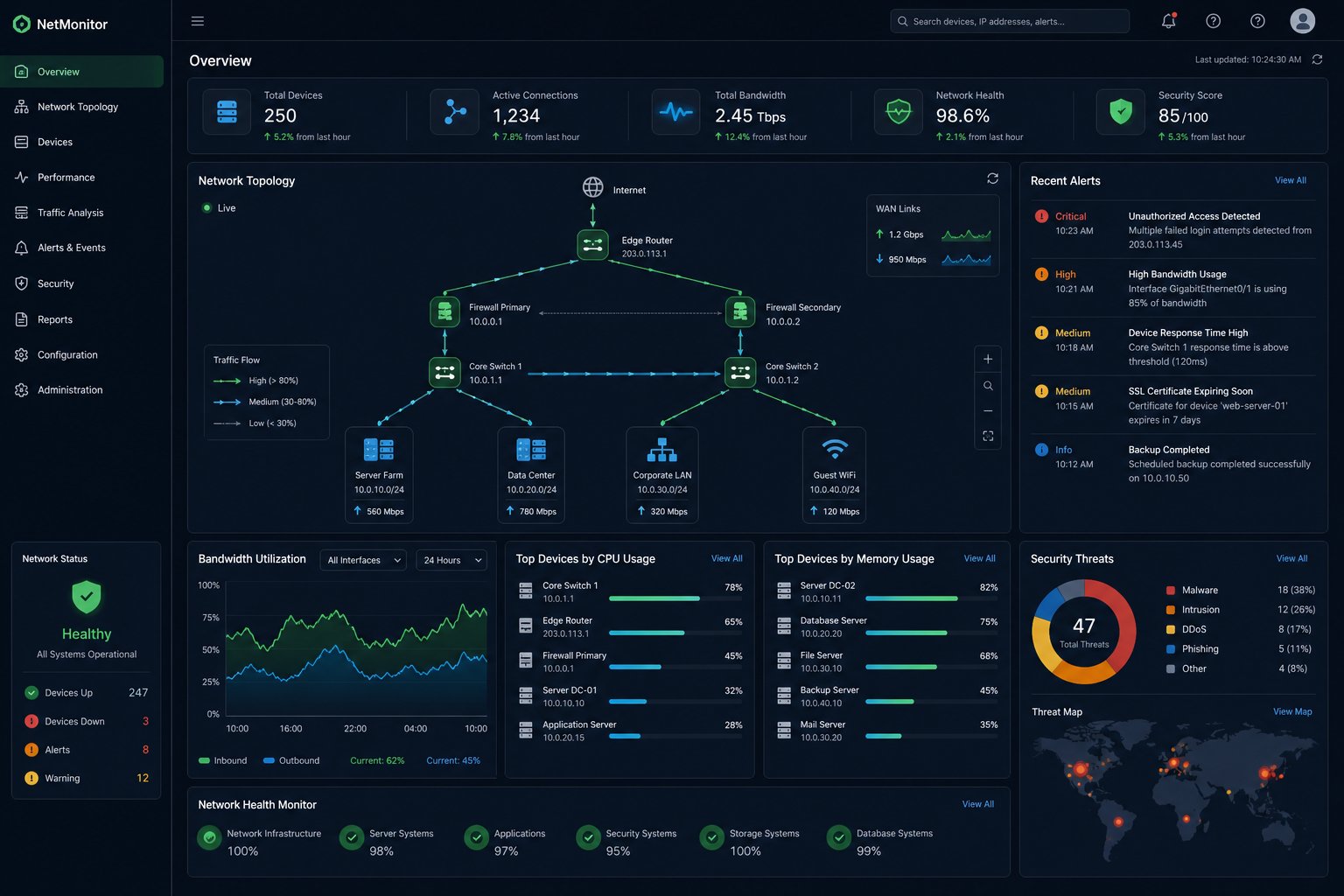
Enterprise Computer Networks:Enterprise computer networking is at an inflection point unlike anything the industry has seen since the transition from hub-based Ethernet to switched networks in the 1990s. Multiple forces — AI-driven workloads, hybrid workforces, cloud-first application delivery, and an unrelenting surge in cyber threats — are forcing organizations to rethink not just what their networks look like, but what a network engineer does every day.
The numbers tell the story. Global IT spending is projected to reach $6.15 trillion in 2026, a 10.8% jump from 2025, according to Gartner’s February 2026 forecast. Data center systems alone crossed $653 billion, driven almost entirely by AI infrastructure spending from hyperscale providers. Cumulative enterprise SASE (Secure Access Service Edge) spending is forecast at $97 billion over the 2025–2030 period — nearly three times the prior five years — according to Dell’Oro Group. And Wi-Fi 7 now accounts for nearly 40% of enterprise WLAN access point revenue, the fastest technology adoption curve of any Wi-Fi generation.
If you are a network or network security engineer, or if you are considering entering this field, the landscape you are walking into is both more complex and more rewarding than it has ever been. This blog covers the current state of enterprise networks, the key technologies reshaping the field, and the career scope available to network engineering and network security professionals right now.
Part 1: The Current State of Enterprise Networks
From the Datacenter Out: How Everything Changed
For decades, enterprise network architecture followed a predictable model: a centralized data center, branch offices connected by MPLS circuits, users who worked at desks in those offices, and a security perimeter defined by firewalls at the network edge. The architecture was stable, predictable, and — in hindsight — remarkably fragile to disruption.
The disruption came in layers. First, Software-as-a-Service (SaaS) applications like Microsoft 365, Salesforce, and Workday began routing enormous amounts of corporate traffic to the public internet rather than the corporate data center. Second, public cloud adoption (AWS, Azure, GCP) began moving workloads out of the data center entirely. Third, the COVID-19 pandemic accelerated remote work from a perk to a baseline expectation. By 2024, 87–90% of enterprises had deployed or were actively deploying SD-WAN to handle this new traffic reality, according to Telecom Review Americas. SD-WAN quickly became not a differentiator but a commodity baseline.
The result of all these forces is that in 2026, the “enterprise network” is no longer a place. It is a policy. It is a set of security and routing decisions that need to follow the user, device, and application — wherever they happen to be.
The MPLS Sunset and What Replaced It
MPLS (Multiprotocol Label Switching) was the gold standard for enterprise WAN connectivity for nearly two decades. It offered guaranteed quality of service, reliability, and predictable performance. It was also expensive, inflexible, and built on an assumption that traffic lived between a company’s offices and its data centers.
The transition away from MPLS is now well advanced. SD-WAN technology decouples the WAN control plane from the data plane, allowing organizations to combine multiple transport types — broadband internet, 4G/5G cellular, MPLS where it still exists — into a single intelligent, policy-driven overlay. SD-WAN crosses the $8 billion annual market mark in 2026, per industry analysis from FirstPassLab. Typical enterprise SD-WAN deployments show payback periods of 12–24 months, with the strongest ROI cases being those where expensive MPLS circuits are fully replaced.
However, a critical market shift is underway: standalone SD-WAN is no longer sufficient. Enterprise buyers who deployed SD-WAN three to five years ago are now discovering that what they thought was a simplified architecture has become a multi-vendor, policy-heavy environment requiring constant optimization. The answer the market has settled on is convergence.
The Rise of SASE: Convergence of Networking and Security
Gartner coined the term SASE (Secure Access Service Edge) in 2019, and it has moved from analyst buzzword to mainstream enterprise strategy with remarkable speed. SASE converges several previously siloed functions into a cloud-delivered, unified platform:
- SD-WAN — intelligent traffic routing across multiple transport links
- ZTNA (Zero Trust Network Access) — replacing VPN with identity-aware, least-privilege access
- CASB (Cloud Access Security Broker) — visibility and control over SaaS and cloud usage
- SWG (Secure Web Gateway) — internet access protection
- FWaaS (Firewall as a Service) — cloud-delivered next-generation firewall
The AvidThink 2026 Enterprise Connectivity Report describes the current moment succinctly: traditional frameworks relying on separate MPLS, SD-WAN, VPNs, firewalls, Ethernet LANs, Wi-Fi, and isolated security tools are no longer sufficient. The market has consolidated around major vendors — Cisco, Fortinet, Palo Alto Networks, Zscaler, Cato Networks, HPE Aruba, and Versa Networks — offering integrated stacks. Mid-size rollouts now run 9–18 months; large-enterprise programs 18–36 months.
The single-vendor SASE stack leads the market in 2026. Managed service partners dominate deployment delivery. This is the new shape of enterprise WAN.
Zero Trust: From Concept to Deployment Reality
Zero Trust is no longer an aspirational framework — it is an operational imperative. In a Zero Trust architecture, the guiding principle is “never trust, always verify.” No user, device, or workload is trusted by default, even if it sits inside the corporate network perimeter.
The practical implementation involves several interacting components: identity and access management (IAM), multi-factor authentication, device posture checking, microsegmentation, and — crucially for network professionals — ZTNA platforms that replace traditional VPNs. Instead of granting network-level access when a user authenticates, ZTNA grants application-level access based on continuous verification of user identity, device health, and contextual risk signals.
Real-world Zero Trust deployments are producing measurable results. Network security professionals in the field report reducing high-privileged remote access users by over 90% through risk-based governance, and ZTNA solutions that reduce overall attack surface by 60% compared to legacy VPN architectures. These are not pilot projects — they are production deployments securing tens of thousands of users globally.
Wi-Fi 7, Private 5G, and the Campus Network Renaissance
While WAN transformation gets most of the headlines, the campus and branch local area network is undergoing its own revolution. Wi-Fi 7 (802.11be) has achieved the fastest adoption curve of any Wi-Fi generation, capturing 39.7% of enterprise WLAN access point revenue in Q4 2025 (IDC). It delivers multi-gigabit speeds (up to 46 Gbps theoretical), dramatically reduced latency, and Multi-Link Operation (MLO) that simultaneously transmits across multiple frequency bands.
Private 4G/5G enterprise networks are moving from industrial use cases (manufacturing floors, logistics) into mainstream enterprise consideration. These networks provide deterministic latency and reliability characteristics that even Wi-Fi 7 cannot match for mission-critical IoT, robotics, and real-time control applications. The integration challenge — aligning policy between the cellular and Wi-Fi layers of a campus network — represents a significant ongoing engineering problem.
Campus NaaS (Network as a Service) is an emerging model that allows enterprises to consume their on-premises switching and wireless infrastructure as a subscription service managed by the vendor, similar to how cloud infrastructure works. This model is gaining traction among mid-market organizations that lack deep networking staff.
AI Infrastructure Networking: The Trillion-Dollar Problem
Perhaps the most significant emerging challenge for enterprise network engineers is the networking requirements of AI infrastructure itself. AI training and inference at scale require ultra-low-latency, high-bandwidth interconnects between GPUs that make traditional Ethernet and IP networking look primitive. The data center is being reinvented around non-blocking, high-radix topologies with 400G and 800G links, RDMA (Remote Direct Memory Access) over Converged Ethernet (RoCE), and InfiniBand fabrics.
For enterprises that are not hyperscalers but are deploying private AI — on-premise GPU clusters for inference, fine-tuning, or sensitive data processing — this translates to a significant network architecture investment. The network team is now a critical path dependency for enterprise AI programs.
Part 2: Emerging Technologies Reshaping the Field
AI-Driven Networking and Agentic NetOps
The networking industry is experiencing its own AI revolution, distinct from AI infrastructure networking. Vendors are embedding AI into network management platforms to automate monitoring, anomaly detection, root cause analysis, and even configuration remediation.
Extreme Networks launched Extreme Platform ONE in July 2025, which it describes as the first networking vendor to deliver conversational, multimodal, and agentic AI fully integrated into the networking experience. Early adopter results claimed reductions in manual work of up to 90% and resolution time cuts of up to 98%.
Gluware announced Gluware Titan in late 2025, an AI-powered, intent-based network automation platform designed for governed, verifiable AI operations across multi-vendor enterprise networks. The platform ensures every AI action is validated, auditable, and aligned with network intent.
In the research community, IETF Internet-Draft draft-cgfabk-nmrg-ibn-generative-ai-01 (October 2025) formally explores how to specialize AI models for Intent-Based Networking. Microsoft has a patent (US11968088B1) specifically for using large language models for network configuration. The trajectory is clear: the next generation of network management will be conversational and agentic.
For network professionals, this does not spell obsolescence — it spells transformation. The engineer who knows how to architect, govern, and troubleshoot AI-augmented network operations will be among the most valuable IT professionals in the enterprise.
Network Automation and Infrastructure as Code
Before AI takes over network operations entirely, the stepping stone is automation. Network automation using Python, Ansible, Terraform, and model-driven programmability (NETCONF, YANG, RESTCONF, gRPC/gNMI) has moved from optional skill to baseline expectation for mid-level and senior roles.
At Cisco Live 2026 (DEVNET-1280), the theme was Infrastructure as Code for networks — treating network device configurations as source code, tracked in Git, deployed through CI/CD pipelines, tested in staging before production. The tools are the same ones software development teams use: GitLab/GitHub, Ansible playbooks, Terraform providers for network devices, pyATS for network testing.
The salary differential is stark. Engineers who can automate networks command 30–50% salary premiums over those who can only configure devices manually via CLI. The market is not looking for people who know how to type show ip route — it is looking for people who can write an Ansible role that audits 600 firewalls globally and flags policy drift.
Part 3: Career Scope for Network Engineering Professionals
The Network Engineer Role in 2026
The network engineer role has bifurcated. On one side is the traditional “configure and maintain” role — managing switches, routers, firewalls, and WAN connectivity. These jobs still exist and will continue to exist, but they face downward salary pressure and automation risk at the lower end of the skill spectrum.
On the other side is the modern network engineer: someone who designs multi-cloud network architectures, automates infrastructure with code, integrates SD-WAN/SASE platforms, and understands how network decisions affect application performance, security posture, and AI workload efficiency. These engineers are among the most sought-after and well-compensated technical professionals in the industry.
Salary landscape (US, 2026):
| Role / Level | Annual Salary Range |
|---|---|
| NOC / Tier 1 (entry, no cert) | $38K – $55K |
| Junior Network Analyst (CCNA) | $55K – $80K |
| Mid-Level Network Engineer (CCNP) | $90K – $130K |
| Senior Network Engineer / Specialist (CCIE) | $140K – $200K+ |
| Cloud Network Engineer (AWS Advanced + Cisco) | $160K – $230K |
| Computer Network Architect (BLS median) | $130,390 |
Key skills employers are actively seeking:
- Cisco ISE + 802.1X + TrustSec for Zero Trust rollouts
- SD-WAN platforms (Cisco Viptela, Fortinet, Versa, Aruba EdgeConnect)
- Python scripting for network automation
- Ansible for multi-device configuration management
- Terraform for network infrastructure as code
- Cloud networking (AWS, Azure, GCP — VPC design, Transit Gateway, ExpressRoute)
- SASE/SSE platform experience (Zscaler, Netskope, Palo Alto Prisma)
- BGP, OSPF, EIGRP at expert level
- Network programmability: NETCONF, YANG, REST APIs
Certifications that move the salary needle:
- CCNA — entry gate; positions you at the 25th percentile
- CCNP Enterprise — mid-career essential; $15K–$30K premium over CCNA alone
- CCIE (any track) — expert credential; correlated with 90th-percentile compensation
- AWS Advanced Networking Specialty — among the top-paying certifications for network engineers
- Cisco DevNet Associate/Professional — automation and programmability credentials increasingly requested
Network Operations Center (NOC) Engineer
The NOC role is the traditional entry point into networking careers. NOC engineers monitor network performance, respond to alerts, execute initial troubleshooting, and escalate issues. The role is being transformed by automation — AIOps platforms are automating the detection and first-response actions that previously required human review, compressing traditional Tier 1 NOC functions.
Modern NOC roles increasingly require scripting ability (Python basics), familiarity with monitoring platforms (Splunk, PRTG, SolarWinds, Grafana), and understanding of cloud-delivered network services. The pure “watch the dashboard” NOC role is shrinking; the “automate the dashboard” NOC role is growing.
Cloud Network Engineer
This is arguably the fastest-growing and best-compensated specialization in network engineering. Cloud network engineers design and implement the network fabric connecting an organization’s on-premises infrastructure to its cloud environments, the connectivity between multiple clouds (multi-cloud networking), and the network security controls that govern traffic flows.
The technical scope includes: AWS/Azure/GCP virtual network design, direct connectivity services (AWS Direct Connect, Azure ExpressRoute, Google Cloud Interconnect), SD-WAN integration with cloud on-ramps, BGP peering between on-premises and cloud environments, and cloud-native firewall and routing policies.
Professionals combining a strong Cisco foundation (CCNP or CCIE) with cloud networking certifications (AWS Advanced Networking Specialty, Azure Network Engineer Associate) are among the highest earners in the networking field, commanding $160K–$230K in the US market.
Network Automation Engineer / NetDevOps Engineer
The NetDevOps engineer sits at the intersection of traditional networking and software engineering. This role is focused on treating network infrastructure as code — building automated workflows that provision, configure, test, and validate network devices the same way DevOps teams handle application deployment.
The toolchain includes Python (with libraries like Netmiko, NAPALM, Nornir), Ansible network collections, Terraform providers for network vendors, NETCONF/YANG for model-driven configuration, and gRPC/gNMI for streaming telemetry. The role increasingly involves integration with IT service management platforms (ServiceNow, NetBox) and CI/CD pipelines (GitLab, Jenkins).
This is a well-compensated specialization. The skill gap between engineers who have this capability and those who do not is where the salary premium lives in 2026.
Part 4: Career Scope for Network Security Engineering
Why Network Security is the Premier Engineering Specialization
Security engineers in networking consistently out-earn their pure networking counterparts by 15–25%. The reason is simple: the threat landscape is growing faster than the defensive capability to match it, creating genuine, persistent scarcity of expert talent. Security is one of the few IT verticals where headcount grew year-over-year through the 2024–2026 period despite broader tech sector layoffs.
The modern network security engineer operates at the intersection of networking knowledge and security architecture. They must understand how traffic flows — routing protocols, application behavior, cloud connectivity — and also how attackers exploit that traffic flow. The skill combination is rare and therefore highly rewarded.
Salary landscape (US, 2026):
| Role / Level | Annual Salary Range |
|---|---|
| SOC Analyst (Tier 2/3, CISSP) | $95K – $125K |
| Security Engineer (5–8 yrs) | $135K – $175K |
| Senior Security Engineer (7–10 yrs) | $165K – $215K |
| Security Architect (8+ yrs) | $180K – $240K |
| CCIE Security average | $177,260 |
| CISSP US median base | $151,200 |
| CISSP total comp average | $168,400 |
| CISO (enterprise Fortune 500) | $300K – $600K+ |
The CISSP certification commands roughly a 25% premium over equivalent uncertified senior security roles, with payback on the $749 exam fee occurring within approximately 14 months of passing. CCIE Security holders average $177K, with top performers in financial services exceeding $250K.
Network Security Engineer: Core Scope of Work
The day-to-day scope of a network security engineer in 2026 is vastly more complex than it was five years ago. Where earlier generations of security engineers primarily managed firewalls and VPNs, today’s professionals are responsible for:
Firewall and perimeter management: Next-generation firewall (NGFW) platforms from Palo Alto, Fortinet, and Cisco (FTD/FMC) with application-aware, user-aware policies. Managing large firewall estates — in some enterprise environments, 300–600 firewalls globally — using automation (Ansible-driven IaC pipelines) to eliminate manual configuration drift.
Zero Trust architecture implementation: Migrating organizations from legacy VPN to ZTNA platforms. This involves deploying platforms like Zscaler ZIA/ZPA, Netskope Security Cloud, or Palo Alto Prisma Access; integrating with identity providers (Okta, Microsoft Entra ID); configuring private service edges and cloud/app connectors; and building access policies that enforce least-privilege at the application layer rather than the network layer.
Cloud security architecture: Securing east-west traffic within cloud environments, designing secure ingress/egress patterns, implementing cloud-native WAF and DDoS protection, and ensuring consistent policy enforcement across on-premises, cloud, and edge environments.
SOC integration and threat hunting: Network security engineers increasingly work closely with Security Operations Center (SOC) analysts, providing network-layer context for incident response. Skills in SIEM platforms (Splunk, Microsoft Sentinel), EDR tools (CrowdStrike), and network traffic analysis feed into this collaborative role.
Automation and scripting: Building tools that automate security responses — including, in some advanced environments, “network kill-switch” architectures using REST APIs to isolate compromised network segments during active incidents. One documented example reduced breach containment costs by an estimated $500K per event.
SASE/SSE Specialist
The SASE/SSE (Security Service Edge) specialist role has emerged as one of the most in-demand networking-adjacent security positions. These professionals architect and deploy the cloud-delivered security stack: CASB, DLP, ZTNA, SWG, and FWaaS. They typically specialize on one or two major vendor platforms — Zscaler, Netskope, or Palo Alto Prisma — and are responsible for migrating organizations from legacy on-premises security stacks to cloud-delivered architectures.
Given that cumulative SASE spending is forecast at $97 billion through 2030, the demand for engineers who can plan and execute these migrations is structural and long-term. SASE/SSE specialists with platform certifications (Zscaler Digital Transformation Engineer, Palo Alto Prisma Access) and 3–8 years of experience are consistently among the highest-compensated professionals in the security engineering space.
Penetration Tester / Red Team Network Specialist
On the offensive side of network security, penetration testing and red team operations require a deep understanding of network architecture — not to defend it, but to attack it in authorized engagements that reveal real vulnerabilities before actual adversaries do. Network penetration testers test WAN/LAN configurations, VPN security, network device hardening, segmentation effectiveness, and wireless security.
This specialization commands premium compensation, particularly at senior levels in financial services, defense contracting, and critical infrastructure sectors. Certifications relevant to this path include OSCP (Offensive Security Certified Professional), CEH (Certified Ethical Hacker), and eJPT.
Governance, Risk, and Compliance (GRC) — Network Focus
Not all network security work is hands-on-keyboard technical. Organizations subject to regulatory frameworks (PCI-DSS, HIPAA, NIST CSF, ISO 27001, SOC 2) need professionals who can translate technical network security controls into compliance evidence. GRC analysts and managers with networking backgrounds earn $125K–$195K and are increasingly in demand as regulatory pressure on enterprise security documentation intensifies.
Part 5: Emerging Roles and Future Directions
Network AI/ML Engineer
An entirely new role is emerging at the intersection of machine learning and network operations: the network AI engineer. These professionals build, train, and operate the AI systems that make networking decisions — anomaly detection models, traffic classification engines, predictive capacity planning systems, and agentic automation frameworks.
This role requires programming skills (Python, PyTorch/TensorFlow), familiarity with network telemetry (streaming gRPC/gNMI data from devices), and understanding of both ML operations (MLOps) and network operations. It is nascent but growing rapidly as vendors like Extreme Networks, Cisco, Juniper (with Mist AI), and startups build AI-native networking platforms.
Private 5G Network Engineer
As enterprises deploy private 5G networks for industrial, logistics, and campus use cases, a new specialization is emerging around 3GPP radio access networks (RAN), core network functions (5G Core: AMF, SMF, UPF), and integration between 5G and enterprise IP networks. This role draws on both telecommunications engineering and traditional enterprise networking skills — a rare combination that commands significant premiums.
Cloud Networking Architect
Distinct from the operational cloud network engineer, the cloud networking architect operates at the design and strategy level — defining multi-cloud connectivity patterns, cloud-to-on-premises integration architectures, and the network security model for large-scale cloud environments. This role typically requires 10+ years of networking experience, deep cloud platform knowledge across at least two providers, and the ability to communicate architecture decisions to CISO, CTO, and CIO audiences.
Conclusion: The Path Forward for Network Professionals
Enterprise networks in 2026 are undergoing the most significant architectural transformation in a generation. The transition from MPLS to SD-WAN to SASE, the shift from perimeter-based to Zero Trust security, the rise of AI-driven network operations, and the explosion in cloud networking complexity are not temporary trends — they are the new baseline.
For professionals already in networking, the message is clear: the engineers commanding the highest salaries and best opportunities are those who have evolved beyond CLI configuration into automation, cloud, security convergence, and AI-augmented operations. The skill gap between engineers who adapt and those who do not is translating directly into a compensation gap that widens every year.
For those entering the field, the opportunity is substantial. There are genuinely more open positions than qualified candidates for mid-senior level network and security engineering roles. The certifications that matter most are those that demonstrate practical architecture and automation capability — CCNP Enterprise or Security, AWS Advanced Networking, Zscaler or Palo Alto platform certifications, and Cisco DevNet for automation tracks.
The fundamental truth about computer networking has not changed: everything digital runs on a network. That fact, combined with the complexity of modern multi-cloud, hybrid-work, AI-driven enterprise environments, means that expert network professionals will remain among the most essential — and most valued — people in the technology industry for the foreseeable future.
Key Takeaways
- Global IT spending hits $6.15T in 2026; SASE cumulative spend forecasted at $97B through 2030
- SD-WAN is now baseline infrastructure; the market has moved to integrated SASE/SSE stacks
- Zero Trust is a deployment reality, not a framework — ZTNA is replacing VPN at enterprise scale
- Network engineers with automation skills (Python, Ansible, Terraform) earn 30–50% more than those without
- Network security engineers earn 15–25% more than pure networking peers at equivalent experience levels
- CCIE Security average salary: $177K; CISSP median base: $151K; Cloud Network Engineers: $160K–$230K
- AI-native networking platforms are automating routine operations — the engineer’s value shifts to architecture, governance, and automation
- Private 5G, Wi-Fi 7, and AI infrastructure networking are emerging specializations with premium compensation
The file is also saved at personal/enterprise-networking-blog-2026.md in your workspace for future reference.
Related technology strategy resources
- Technology Services — broader support for infrastructure, systems, delivery, and digital execution.
- Best Technology Consulting Company in Lucknow: Strategy, Systems, and Partner Selection — how businesses evaluate technology planning partners.
- Best IT Company in Lucknow: What Growing Businesses Need from a Technology Partner — a complementary guide for broader IT partner expectations.
- Tech Stack Consolidation: The Business Case for Unified Systems — how infrastructure and systems choices affect complexity, cost, and control.



1 comment