Content Marketing: The Foundation of Digital Growth
Content marketing generates 3x more leads than outbound marketing and costs 62% less. Yet most businesses struggle to create content that actually drives results. The difference between content that gets traffic and content that drives revenue is strategy.
This comprehensive guide walks you through building a content marketing strategy that attracts qualified leads, builds authority, and converts readers into customers in 2026.
What Is Content Marketing (Really)?
Content marketing is the strategic creation and distribution of valuable, relevant content to attract and retain a clearly defined audience—and ultimately drive profitable customer action. It’s not about promoting your products directly; it’s about solving your customers’ problems and building trust.
Step 1: Define Your Goals and KPIs
Every successful content strategy starts with clear, measurable goals. Common content marketing objectives include:
- Brand Awareness: Measured by traffic, impressions, social shares, and brand searches
- Lead Generation: Measured by form submissions, email signups, and download rates
- Thought Leadership: Measured by backlinks, media mentions, and speaking invitations
- Customer Retention: Measured by engagement, repeat visits, and customer lifetime value
- Sales Enablement: Measured by content-assisted conversions and sales cycle length
Set specific, measurable targets for each goal. “Get more traffic” isn’t a goal. “Increase organic traffic by 50% in 6 months” is.
Step 2: Understand Your Target Audience
Create detailed buyer personas that go beyond demographics:
- Pain Points: What problems keep them up at night?
- Goals: What are they trying to achieve personally and professionally?
- Information Sources: Where do they go for answers and advice?
- Decision Factors: What criteria do they use when choosing solutions?
- Objections: What prevents them from buying?
- Content Preferences: Do they prefer blogs, videos, podcasts, or webinars?
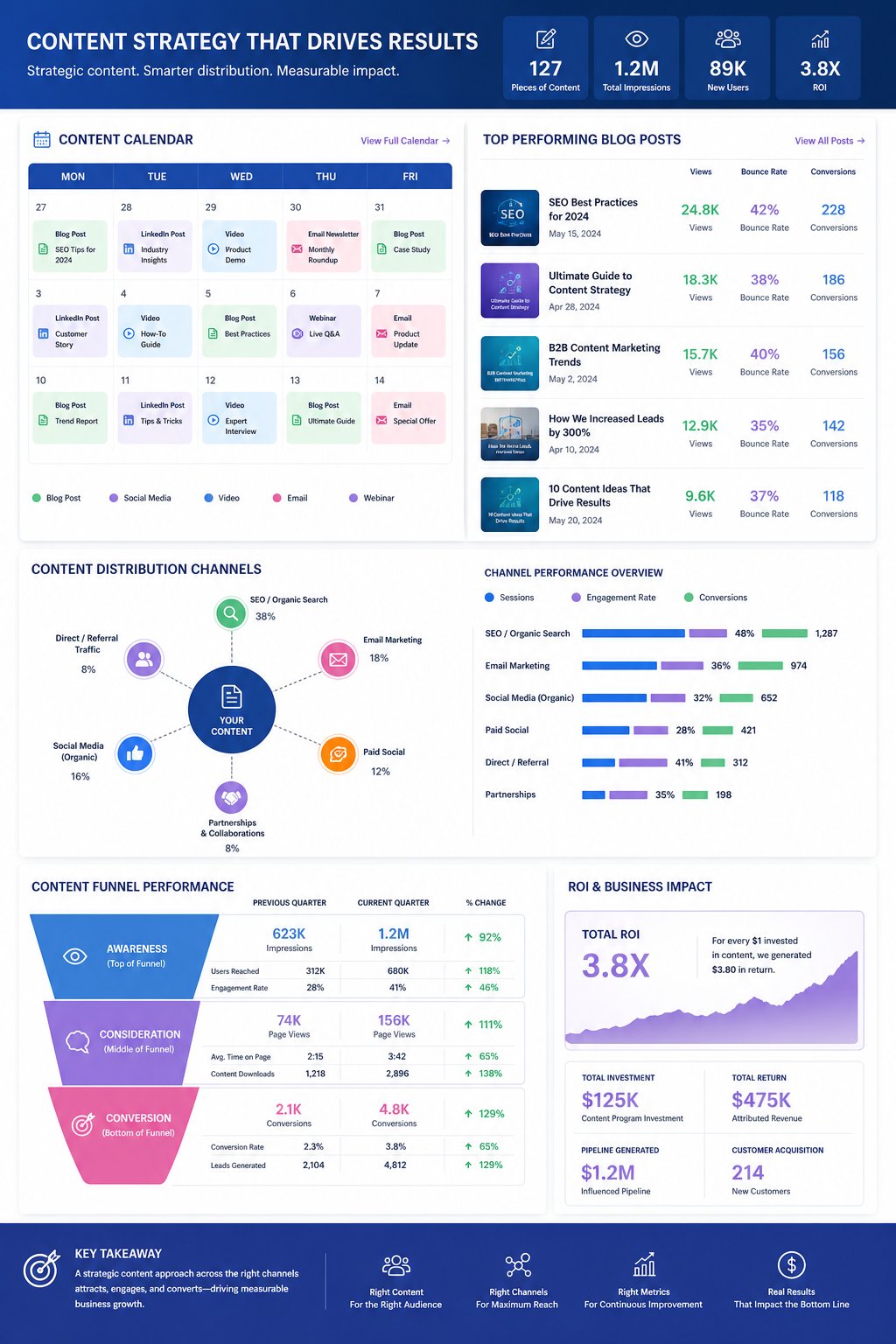
Step 3: Map Content to the Buyer’s Journey
Your audience needs different content at each stage of their buying journey:
Awareness Stage (Top of Funnel)
Prospects realize they have a problem but don’t know the solution:
- Blog posts answering common questions
- Educational guides and how-to articles
- Industry trend reports and statistics
- Infographics explaining concepts
- Short educational videos
Consideration Stage (Middle of Funnel)
Prospects are researching solutions and comparing options:
- In-depth guides and comparison articles
- Case studies showing real results
- Webinars and expert interviews
- White papers and research reports
- Product comparison pages
Decision Stage (Bottom of Funnel)
Prospects are ready to choose a provider:
- Customer testimonials and reviews
- Free trials and demos
- Pricing pages and ROI calculators
- Detailed product/service pages
- Implementation guides and onboarding content
Step 4: Keyword Research and Topic Clusters
Build your content strategy around topic clusters that establish topical authority:
Pillar Content
Long-form, comprehensive guides (3,000-5,000+ words) that cover a broad topic in depth. These serve as the hub of your content cluster.
Cluster Content
Supporting articles (1,500-2,500 words) that dive deep into specific subtopics. Each links back to the pillar page and to related cluster content.
Keyword Research Process
- Use tools like Semrush, Ahrefs, or Google Keyword Planner
- Identify high-volume, low-competition keywords for each topic
- Analyze search intent behind each keyword (informational, commercial, transactional)
- Map keywords to buyer journey stages
- Prioritize keywords based on business value and competition
Step 5: Content Creation Framework
Content Types That Drive Results
| Content Type | Best For | Typical Length |
|---|---|---|
| Blog Posts | SEO traffic, education | 1,500-3,000 words |
| Pillar Pages | Authority, link building | 3,000-10,000 words |
| Case Studies | Conversions, trust | 1,000-2,000 words |
| Videos | Engagement, demos | 2-15 minutes |
| Infographics | Shareability, backlinks | Visual with data |
| Podcasts | Thought leadership | 20-60 minutes |
Creating High-Quality Content
- Start with Research: Analyze top 10 ranking pages for your target keyword
- Create Better Content: More comprehensive, more current, better designed than competitors
- Add Original Data: Include your own research, statistics, and expert insights
- Optimize for Readability: Short paragraphs, bullet points, subheadings, and images
- Include CTAs: Guide readers toward the next step in their journey
- Update Regularly: Refresh content every 6-12 months to maintain rankings

Step 6: Content Distribution Strategy
Creating great content is only half the battle. You need a distribution plan:
Owned Channels
- Email newsletter featuring latest content
- Social media posts and stories
- Website blog and resource center
- Push notifications for mobile app users
Earned Channels
- Guest posting on industry publications
- PR outreach for newsworthy content
- Community engagement on Reddit, Quora, and forums
- Influencer collaborations and partnerships
Paid Channels
- Social media advertising to boost top content
- Google Ads for high-converting content pieces
- Native advertising on content discovery platforms
- Sponsored content on industry publications
Step 7: Measure and Optimize
Key Content Marketing Metrics
- Traffic: Organic sessions, page views, unique visitors
- Engagement: Time on page, scroll depth, pages per session
- Conversions: Form submissions, downloads, purchases
- SEO: Keyword rankings, organic traffic growth, backlinks
- Social: Shares, comments, reach, and follower growth
- ROI: Revenue attributed to content marketing efforts
Content Marketing Trends for 2026
- AI-Assisted Content: Use AI for research, outlines, and first drafts, but add human expertise and originality
- Video-First Strategy: Short-form video content drives engagement and SEO results
- Interactive Content: Quizzes, calculators, and tools generate more leads than static content
- E-E-A-T Focus: Experience, Expertise, Authoritativeness, and Trustworthiness are essential for rankings
- Content Repurposing: Turn one piece of content into 10+ formats for maximum reach
Get Professional Content Marketing Help
Building a content marketing strategy that drives real results requires expertise, consistency, and the right tools. Unified Management Consulting creates content strategies that generate traffic, leads, and revenue for businesses across the United States.
Learn more about our digital marketing services and how content marketing can transform your business growth.
Frequently Asked Questions
How long does content marketing take to work?
Most businesses see meaningful traffic within 3-6 months, with significant results in 6-12 months. Content marketing compounds over time, delivering increasing returns.
How often should I publish content?
Consistency matters more than frequency. Publishing 2-4 high-quality posts per week is ideal for competitive markets, but even 1-2 per week can deliver results if the content is excellent.
What’s the ideal blog post length for SEO?
Long-form content (1,500-3,000 words) tends to rank better, but quality and comprehensiveness matter more than word count. Write as much as needed to fully cover the topic.
Should I use AI to write my content?
AI is an excellent tool for research, outlines, and drafts, but published content should always include human expertise, original insights, and fact-checking for quality and E-E-A-T.