Editorial note: This article supports UMC’s social and retention cluster by focusing on community-led trust building rather than interruption-led promotion alone.
Facebook Groups represent one of the most underutilised social media marketing opportunities for businesses in Lucknow. While most businesses focus on Facebook Pages (which reach only 5-10% of followers organically), Facebook Groups can reach 40-60% of members with every post. Groups create communities around shared interests, build deep trust, and generate consistent leads through genuine relationships rather than interruptive advertising. This guide shows you how to leverage Facebook Groups to build a community that drives real business results.
Why Facebook Groups Outperform Pages
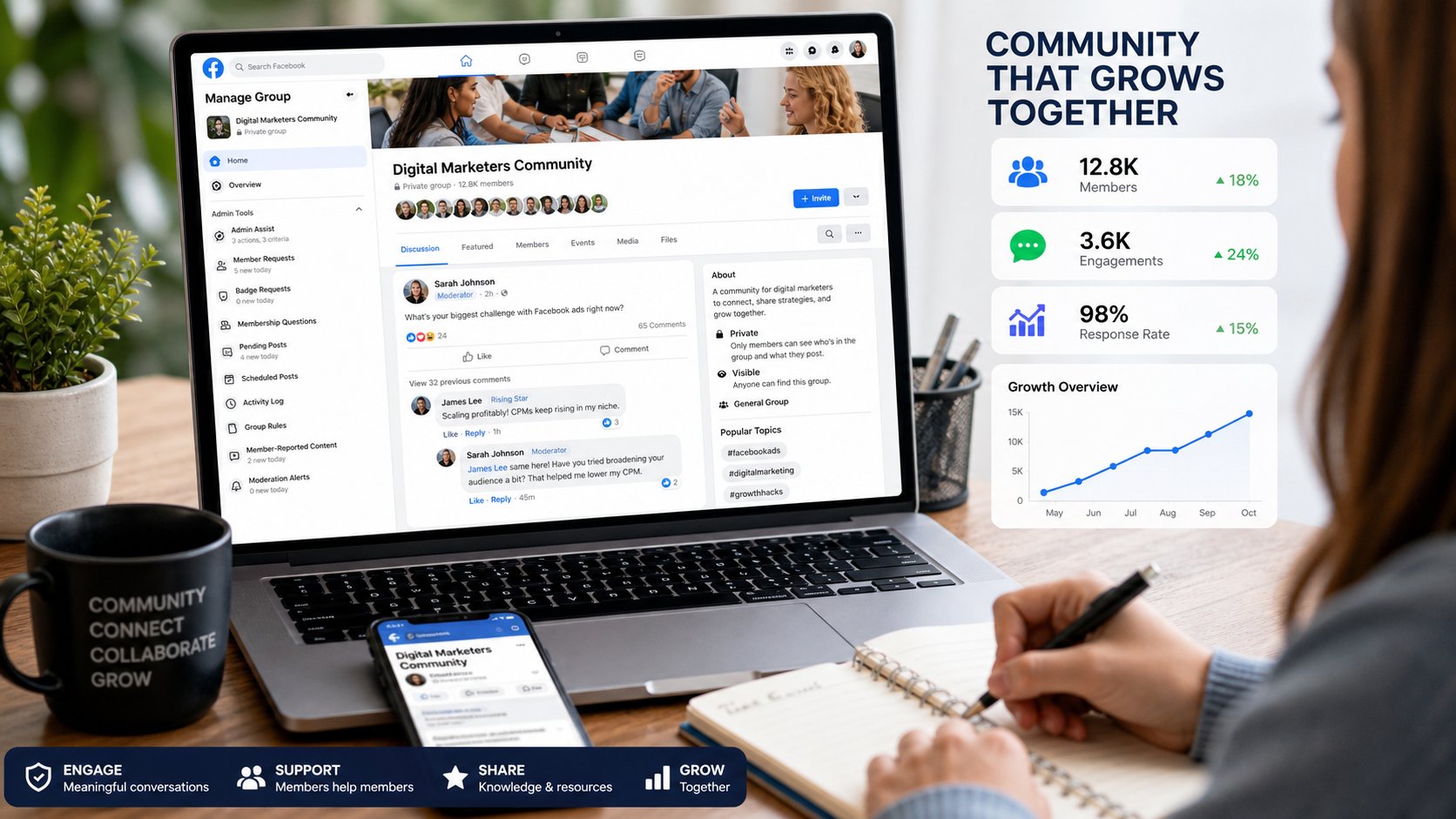
| Factor | Facebook Page | Facebook Group |
|---|---|---|
| Organic reach | 5-10% of followers | 40-60% of members |
| Algorithm priority | Low (Facebook deprioritises pages) | High (Facebook prioritises groups) |
| Engagement type | Passive (likes, occasional comments) | Active (discussions, questions, conversations) |
| Trust building | Low (feels like advertising) | High (feels like community) |
| Lead generation | Low (requires ads for results) | High (organic conversations generate leads) |
| Notifications | Most followers do not get notified | Members receive notifications for new posts |
| Content lifespan | Hours (disappears quickly from feeds) | Days (remains visible and searchable) |
Types of Facebook Groups for Businesses
1. Branded Community Groups
Create a group around your brand where customers and prospects gather to discuss topics related to your industry:
- For coaching institutes: “NEET/JEE Preparation Tips – Lucknow Students” where students share study tips, ask doubts, and discuss preparation strategies
- For restaurants: “Lucknow Food Lovers” where members share food experiences, discover new places, and discuss cuisine
- For real estate: “Lucknow Property Buyers & Investors” where members discuss properties, localities, and investment opportunities
- For salons/beauty: “Lucknow Beauty & Skincare Tips” where members share beauty routines, product reviews, and style inspiration
- For fitness businesses: “Lucknow Fitness Community” where members share workouts, nutrition tips, and transformation stories
2. Interest-Based Groups
Create groups around interests your target audience shares, even if not directly related to your product:
- A financial advisor creates “Lucknow Personal Finance & Investment” group
- A school creates “Lucknow Parents Community” for parenting discussions
- A healthcare provider creates “Lucknow Health & Wellness” for health discussions
3. Customer-Only Groups
Exclusive groups for existing customers that provide additional value and build loyalty:
- Priority support and faster response times
- Exclusive content, tips, and resources not available publicly
- Early access to new products, services, or features
- Direct access to your team for questions and feedback
- Customer-to-customer networking and community building
Building a Thriving Facebook Group: Step-by-Step
Step 1: Define Your Group’s Purpose
Every successful group has a clear, specific purpose that members understand immediately:
- Who is this group for? Be specific about your target member. “Small business owners in Lucknow” is better than “business people”
- What value will members get? Define the specific benefit: learning, networking, support, exclusive deals, or community
- What is the group NOT for? Set clear boundaries. “This is not a place for self-promotion or spam”
- What makes this group unique? Why should someone join your group instead of the 50 other similar groups?
Step 2: Optimise Your Group Setup
- Group name: Include your location and topic for discoverability. “Lucknow Digital Marketing Tips” is more discoverable than “Marketing Masters”
- Cover photo: Professional design that communicates the group’s purpose and value proposition
- Description: Detailed description with keywords, member benefits, and group rules
- Membership questions: 3 screening questions that filter out spammers and qualify genuine members. Ask about their role, their biggest challenge, and how they found the group
- Group rules: Clear, posted rules about self-promotion, respectful behaviour, spam, and content types allowed
- Privacy setting: Private (visible) groups work best for businesses — people can find the group but must request to join, creating exclusivity
Step 3: Create a Content Strategy
Consistent, valuable content is what keeps members engaged and attracts new members:
| Day | Content Type | Example |
|---|---|---|
| Monday | Discussion prompt | “What’s your biggest challenge with [topic] this week?” |
| Tuesday | Educational tip | Quick actionable tip related to your industry |
| Wednesday | Member spotlight | Feature a member’s success, question, or contribution |
| Thursday | Industry news/insight | Share and discuss relevant industry development |
| Friday | Fun/engagement | Poll, quiz, this-or-that, or behind-the-scenes content |
| Saturday | Resource sharing | Free tool, template, guide, or recommendation |
| Sunday | Weekly recap/planning | Summarise the week’s best discussions, preview next week |
Step 4: Drive Engagement
Groups thrive on member participation, not just admin posts:
- Ask questions: End every post with a question that invites responses. Questions generate 3-5x more engagement than statements
- Respond to every comment: Especially in the early stages, respond to every member comment to encourage further participation
- Welcome new members: Tag new members in a weekly welcome post and ask them to introduce themselves
- Feature member content: Highlight valuable member contributions to encourage others to participate
- Go live: Weekly Facebook Live sessions create real-time engagement and deeper connections
- Create challenges: 7-day or 30-day challenges that encourage daily participation and create shared experiences
Generating Leads from Facebook Groups (Without Being Spammy)
The key to generating leads from groups is providing so much value that members naturally want to work with you. Hard selling in groups destroys trust and drives members away.
Strategy 1: Authority Through Value
Consistently provide the most helpful, detailed, and actionable answers to member questions. When members see you as the most knowledgeable person in the group, they naturally think of you when they need professional help. This is the most powerful lead generation strategy because it builds genuine trust.
Strategy 2: Lead Magnet Offers
Periodically offer free resources (guides, templates, checklists) in exchange for email signups. Frame it as “I created this resource for the group — comment ‘SEND’ and I’ll DM you the link.” This generates leads while providing genuine value.
Strategy 3: Free Consultations and Audits
Offer free consultations or audits to group members. “This week I’m offering 5 free website audits to group members. Comment ‘AUDIT’ if you’d like one.” This generates qualified leads who have already experienced your expertise.
Strategy 4: Member-Only Offers
Create exclusive offers available only to group members. “Group members get 20% off our services this month.” This rewards engagement and generates leads while making members feel valued.
Strategy 5: Case Study Shares
Share detailed case studies of how you helped clients achieve specific results. Frame it as educational content, not a sales pitch. Members who relate to the case study will reach out privately to discuss working with you.
Group Growth Strategies
- Invite existing customers: Your existing customer base is the seed of a thriving community. Invite them personally and explain the value they will receive
- Cross-promote on your website: Add a “Join our community” widget to your website, blog posts, and thank-you pages
- Promote on other social media: Regularly mention your group on Instagram, LinkedIn, and your Facebook Page
- Email your list: Invite your email subscribers to join the group for additional community and resources
- Collaborate with complementary businesses: Partner with non-competing businesses serving the same audience to cross-promote each other’s groups
- Run Facebook Ads to the group: Small ad budgets (Rs.5,000-15,000/month) promoting group membership to targeted audiences can accelerate growth significantly
Common Facebook Group Mistakes
- Over-promoting: Groups where every post is a sales pitch lose members rapidly. Follow the 80/20 rule: 80% value, 20% promotion. Members join groups for community and learning, not to be sold to constantly
- Inconsistent posting: Groups that go quiet for days lose engagement momentum. Post at least once daily, ideally 2-3 times, to keep the community active and the algorithm favouring your group
- Not moderating: Groups without active moderation attract spam, self-promotion, and off-topic content that drives away valuable members. Review membership requests daily and enforce rules consistently
- Admin-only content: Groups where only admins post feel like pages, not communities. Encourage member posts, celebrate member contributions, and create formats that invite participation
- Ignoring analytics: Facebook Group Insights shows which content generates the most engagement, when members are most active, and which members are most engaged. Use this data to optimise your content strategy
- No onboarding: New members who are not welcomed and oriented rarely engage. Create a welcome sequence that introduces new members to the group culture and encourages their first post
Frequently Asked Questions
How long does it take to build a Facebook Group?
A group of 500-1,000 engaged members typically takes 3-6 months of consistent effort. Growth accelerates as the group becomes more active because engaged groups attract new members organically through Facebook’s algorithm. Focus on engagement quality over member quantity — a group of 500 active members generates more leads than a group of 5,000 inactive members.
Should I create my own group or join existing groups?
Both. Create your own group for long-term community building and brand authority. Simultaneously, join and actively participate in 5-10 existing groups where your target audience gathers. Providing genuine value in existing groups builds your personal brand and drives members to your own group. Never spam other groups with promotional content — provide value and let people discover you naturally.
How do I prevent spam in my group?
Use membership questions to filter applicants, set clear rules about self-promotion, enable post approval for new members, use Facebook’s spam filters, and have 2-3 active admins who review content daily. Remove spam immediately and warn or remove repeat offenders. A well-moderated group maintains quality that attracts valuable members and repels spammers.
Can I monetise my Facebook Group?
Yes, through multiple approaches: premium membership tiers with exclusive content, paid courses or programmes promoted to the group, affiliate partnerships with relevant products, sponsored content from complementary businesses, and using the group as a lead generation channel for your primary business services. The most sustainable monetisation is using the group to generate leads for your core business while providing genuine value to members.
How does a Facebook Group fit into my overall marketing strategy?
A Facebook Group is the community layer that amplifies all other marketing channels. Drive traffic to the group from your website, Google Ads, Meta Ads, email list, and social media. Use the group to nurture leads, build trust, generate referrals, and create brand advocates who promote your business organically. The group becomes a self-sustaining lead generation engine that compounds in value over time.
Ready to Build a Facebook Group That Generates Leads?
Get a free community marketing strategy consultation and discover how a Facebook Group can become your most powerful lead generation channel. Contact UMC today and start building a community that grows your business.
Related community and social resources
- Social Media Marketing Strategy for Small Businesses in Lucknow — the broader local social-planning guide.
- Video Marketing for Small Businesses: Beyond YouTube — content formats that increase engagement inside owned communities.
- Online Reputation Management for Businesses in Lucknow — a trust-building companion for public perception and reviews.
- Best Digital Marketing Company in Lucknow — partner guidance for businesses seeking multi-channel execution support.