Editorial note: This article sits at the intersection of UMC’s paid-media, website strategy, and conversion-optimization clusters by focusing on how traffic becomes enquiries and revenue.
You can have the best Google Ads campaigns, the most compelling Meta Ads, the highest-ranking SEO content, and the most engaging social media presence — but if your landing pages do not convert, all that traffic and all that advertising spend goes to waste. Landing page optimisation is the single highest-ROI activity in digital marketing because it improves the conversion rate of every traffic source simultaneously. A landing page that converts at 5% instead of 2% generates 150% more leads from the exact same traffic and advertising budget.
What Is a Landing Page and Why It Matters
A landing page is a standalone web page designed with a single objective: converting visitors into leads or customers. Unlike your website’s homepage, which serves multiple purposes and audiences, a landing page focuses entirely on one offer, one audience, and one call-to-action.
The difference between sending ad traffic to your homepage versus a dedicated landing page is dramatic:
| Factor | Homepage | Dedicated Landing Page |
|---|---|---|
| Average conversion rate | 1-2% | 5-15% |
| Message match | Generic (one message for all visitors) | Specific (matches the ad or link that brought them) |
| Distractions | Navigation, multiple CTAs, many links | Single CTA, no navigation, focused experience |
| Load speed | Often slower (more elements to load) | Typically faster (minimal, focused design) |
| Mobile experience | Variable quality | Optimised specifically for mobile conversion |
| Testing capability | Difficult to A/B test | Easy to test and optimise continuously |
The Anatomy of a High-Converting Landing Page
1. Compelling Headline
Your headline is the most important element on the page. It must immediately communicate the value of your offer and match the message that brought the visitor to your page:
- Match the ad: If your Google Ad says “Best NEET Coaching in Lucknow – Free Demo Class”, your landing page headline must reinforce that exact message
- Focus on benefit: “Double Your NEET Score in 6 Months” is more compelling than “NEET Coaching Classes Available”
- Be specific: “Join 2,500+ Students Who Scored 600+ in NEET” is more powerful than “Join Our Successful Students”
- Create urgency: “Limited Seats – Batch Starting Monday” drives immediate action
- Keep it short: Under 10 words for maximum impact and mobile readability
2. Persuasive Subheadline
The subheadline expands on the headline, providing additional context and addressing the visitor’s immediate question: “What exactly will I get?”
- Explain the specific offer in one sentence
- Address the primary pain point your offer solves
- Include a key differentiator or unique selling proposition
- Bridge between the headline and the supporting content below
3. Hero Image or Video
Visual content communicates faster than text and builds emotional connection:
- Product images: Show the actual product or service in use, not generic stock photos
- Result imagery: Show the outcome or transformation your offer delivers
- Video explanations: A 60-90 second video explaining the offer can increase conversions by 20-80%
- Social proof visuals: Customer photos, testimonial videos, and result screenshots
- Trust indicators: Certifications, awards, and partner logos displayed prominently
4. Benefit-Focused Copy
Your landing page copy should focus on benefits (what the customer gets) rather than features (what you offer):
| Feature-Focused (Weak) | Benefit-Focused (Strong) |
|---|---|
| “50+ experienced faculty members” | “Learn from teachers who have produced 200+ NEET toppers” |
| “Modern infrastructure” | “Study in air-conditioned classrooms designed for maximum focus and retention” |
| “Online test series included” | “Practice with 10,000+ questions that mirror actual NEET exam patterns” |
| “Small batch sizes” | “Get personal attention with maximum 30 students per batch — no one gets left behind” |
5. Social Proof Section
Social proof is the most powerful conversion element on any landing page. Include multiple forms:
- Customer testimonials: 3-5 detailed testimonials with photos, names, and specific results
- Star ratings: Display your Google or platform rating prominently (4.5+ stars)
- Result numbers: “2,500+ students trained”, “95% success rate”, “500+ 5-star reviews”
- Client logos: For B2B businesses, display logos of notable clients
- Media mentions: “As featured in” section with publication logos
- Video testimonials: 30-60 second customer video testimonials that build deep trust
6. Clear Call-to-Action (CTA)
Your CTA button is where conversion happens. Optimise every element:
- Action-oriented text: “Get My Free Demo Class” converts better than “Submit” or “Click Here”
- High contrast colour: Use a colour that stands out from the rest of the page
- Large size: Make the button large enough to tap easily on mobile (minimum 48px height)
- Above the fold: Place at least one CTA visible without scrolling
- Repeated: Include the CTA 2-3 times on longer pages (top, middle, bottom)
- Urgency element: Add micro-copy below the button: “Only 12 seats remaining” or “Offer expires tonight”
7. Lead Capture Form
If your landing page collects information, the form must be optimised for maximum submissions:
- Minimal fields: Only ask for what you absolutely need. Each additional field reduces conversions by 5-10%. Start with name, phone, and email
- Progressive profiling: Collect basic info first, then ask for more details in follow-up conversations
- Clear labels: Use descriptive labels that explain what information is needed and why
- Inline validation: Show errors immediately as users type, not after form submission
- Privacy assurance: Add “We respect your privacy” or “No spam, ever” near the submit button
- Mobile optimisation: Ensure form fields are large enough for thumbs and use appropriate keyboard types (phone keypad for phone numbers)
8. Trust Elements
Trust elements reduce anxiety and increase the likelihood of conversion:
- Security badges: SSL certificate badges, secure payment icons, and data protection assurances
- Guarantees: Money-back guarantees, satisfaction guarantees, or free trial offers that reduce risk
- Privacy policy: Clear, accessible privacy policy that explains how data is used
- Contact information: Phone number, physical address, and email that prove you are a real business
- Certifications: Industry certifications, awards, and accreditations that validate your expertise
Landing Page Optimisation for Different Industries
| Industry | Key Elements | Primary CTA | Critical Trust Signals |
|---|---|---|---|
| Coaching | Results showcase, topper photos, batch details | “Book Free Demo Class” | Results data, topper testimonials, faculty credentials |
| Real Estate | Property images, floor plans, location map, pricing | “Schedule Site Visit” | RERA registration, builder track record, delivery timeline |
| Healthcare | Doctor profiles, facility photos, treatment details | “Book Appointment” | Certifications, patient testimonials, success rates |
| Schools | Campus photos, curriculum details, results | “Apply for Admission” | Board affiliation, results, parent testimonials |
| Salons | Before/after photos, service menu, pricing | “Book Appointment” | Stylist credentials, product brands, hygiene standards |
| E-commerce | Product images, specifications, reviews, pricing | “Add to Cart” / “Buy Now” | Return policy, secure checkout, delivery information |
A/B Testing: The Key to Continuous Improvement
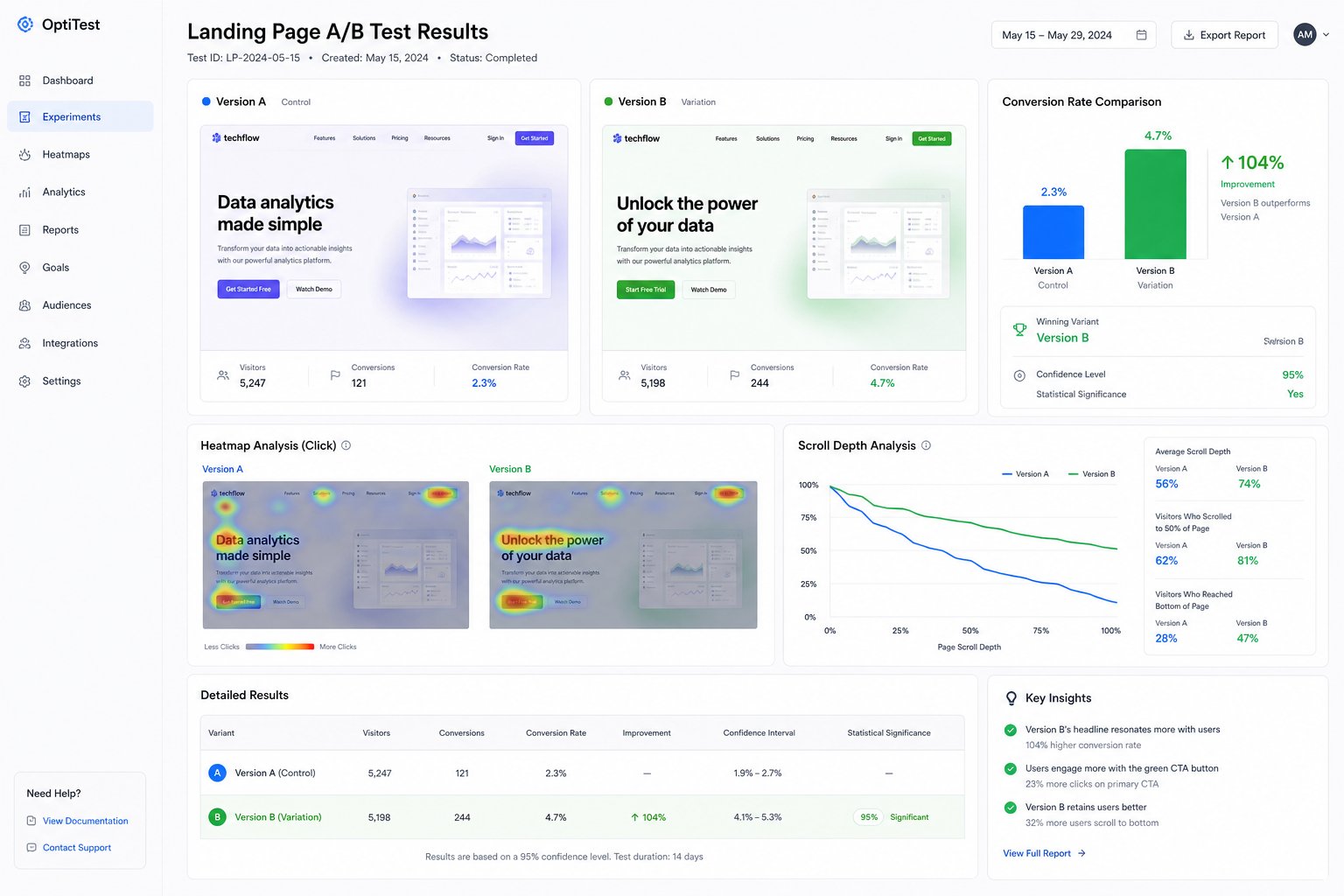
Landing page optimisation is not a one-time activity. It is an ongoing process of testing and improvement. A/B testing allows you to compare two versions of a page to determine which performs better:
What to Test (in Priority Order)
- Headline: The highest-impact element to test. Different value propositions, emotional appeals, and specificity levels
- CTA button text and colour: Action-oriented text variations and high-contrast colour options
- Hero image/video: Different visual approaches — product shots vs lifestyle images vs result imagery
- Form length: Test fewer fields vs more fields to find the optimal balance between lead volume and lead quality
- Social proof placement: Testimonials above vs below the fold, video vs text testimonials
- Page length: Short-form vs long-form pages depending on product complexity and audience sophistication
- Offer variations: Different incentives, discount levels, and bonus structures
A/B Testing Best Practices
- Test one element at a time to isolate the impact of each change
- Run tests for a minimum of 2 weeks or until statistical significance is reached (usually 100+ conversions per variation)
- Test big changes first (completely different headlines) before small changes (button colour)
- Document every test and its results to build institutional knowledge about what works for your audience
- Never stop testing. The best-performing pages are the result of dozens of tests over months of optimisation
Mobile Landing Page Optimisation
With 70%+ of ad clicks coming from mobile devices in Lucknow, mobile optimisation is not optional. It is where most of your conversions happen or fail:
- Speed: Mobile landing pages must load in under 3 seconds. Every additional second reduces conversions by 20%. Compress images, minimise code, and use speed optimisation techniques
- Thumb-friendly design: Place CTAs in the thumb zone (bottom third of screen), use large tap targets (minimum 48px), and ensure adequate spacing between clickable elements
- Simplified forms: Mobile forms should have maximum 3-4 fields. Use appropriate input types (tel for phone, email for email) to trigger the correct keyboard
- Sticky CTA: Keep the CTA button visible at all times with a sticky footer or floating button on mobile
- Readable text: Minimum 16px font size for body text, 24px+ for headlines. Ensure adequate line height and contrast
- Click-to-call: Include a prominent phone number that initiates a call with one tap for service businesses
Landing Page Performance Benchmarks
| Metric | Poor | Average | Good | Excellent |
|---|---|---|---|---|
| Conversion rate | Under 2% | 2-5% | 5-10% | 10%+ |
| Bounce rate | Over 70% | 50-70% | 30-50% | Under 30% |
| Time on page | Under 30s | 30s-2min | 2-5min | 5min+ |
| Form completion rate | Under 20% | 20-40% | 40-60% | 60%+ |
| Page load time | Over 5s | 3-5s | 1.5-3s | Under 1.5s |
Common Landing Page Mistakes
- Message mismatch: The ad promises one thing and the landing page delivers another. This is the #1 conversion killer. Ensure perfect message match between your Google Ads or Meta Ads and your landing page headline
- Too many CTAs: Multiple competing calls-to-action confuse visitors and reduce conversions. Each landing page should have exactly one primary objective
- Navigation links: Including your website navigation on a landing page gives visitors an escape route. Remove all navigation and links except the CTA
- Slow loading: Page speed issues cause 40%+ of visitors to abandon before seeing your content. Optimise images, minimise code, and use a CDN
- No social proof: Landing pages without testimonials, reviews, or trust badges convert 50-70% lower than those with strong social proof
- Generic stock photos: Authentic images of your actual business, team, and results build trust far more effectively than generic stock photography
- Not testing: Launching a landing page and never testing improvements leaves enormous conversion potential unrealised. A/B test continuously
- Ignoring mobile: Designing for desktop first and treating mobile as an afterthought loses the majority of your traffic. Design mobile-first for landing pages
Frequently Asked Questions
What is a good landing page conversion rate?
Average landing page conversion rates across industries are 2-5%. Well-optimised landing pages achieve 5-10%, and exceptional pages reach 10-20%+. Conversion rate depends on traffic quality (cold traffic converts lower than warm retargeting traffic), offer attractiveness, page design quality, and form complexity. Focus on improving your own conversion rate over time rather than comparing to industry averages.
How long should a landing page be?
It depends on the complexity of your offer and the awareness level of your audience. Simple offers to warm audiences (retargeting) work well with short-form pages (3-5 sections). Complex offers to cold audiences need long-form pages (7-12 sections) that educate, build trust, and overcome objections before asking for commitment. Test both approaches to find what works for your specific audience and offer.
Should I use a landing page builder or custom development?
For most businesses, a professional website development approach delivers better results than drag-and-drop builders because of superior speed, customisation, and integration capabilities. However, landing page builders like Unbounce, Leadpages, or Instapage can be effective for rapid testing and iteration. The best approach often combines custom-built pages for primary campaigns with builder-created pages for testing variations.
How many landing pages do I need?
Ideally, create a dedicated landing page for each campaign, audience segment, and offer. Businesses with 30-40 landing pages generate 7x more leads than those with fewer than 10. At minimum, create separate landing pages for each service/product, each advertising campaign, and each audience segment. Never send paid traffic to your homepage — always to a dedicated, campaign-specific landing page.
How do I improve my landing page conversion rate?
Follow this optimisation process: (1) Install analytics and heat mapping tools to understand visitor behaviour, (2) Identify the biggest drop-off points and friction areas, (3) Formulate hypotheses about what changes would improve conversions, (4) A/B test one change at a time, (5) Implement winning variations, (6) Repeat. The highest-impact improvements are usually headline changes, CTA optimisation, social proof additions, and form simplification.
How does landing page optimisation affect my advertising ROI?
Landing page optimisation is the highest-ROI activity in paid advertising. If your Google Ads campaign spends Rs.50,000/month generating 100 leads at Rs.500/lead with a 2% conversion landing page, improving the landing page to 4% conversion doubles your leads to 200 at Rs.250/lead — without spending an additional rupee on advertising. Every percentage point of conversion improvement compounds across all your traffic sources and campaigns.
Ready to Double Your Conversion Rates?
Get a free landing page audit and discover exactly how to improve your conversion rates. Contact UMC today and start converting more visitors into customers.
Related conversion and performance resources
- Google Ads Guide: How to Maximize ROI — paid-search traffic becomes more valuable when landing pages convert well.
- Google Ads vs Meta Ads: Which Platform Delivers Better ROI? — platform decisions matter less if post-click experience underperforms.
- Campaign Optimization Strategies That Actually Work — a broader performance-improvement companion.
- Why Every Small Business Needs a Professional Website — the wider business case for better digital conversion infrastructure.