
Editorial note: This guide complements the broader AI search ranking framework by focusing specifically on how B2B brands earn citations, recommendations, and shortlist visibility in AI-generated answers.
Two B2B companies publish equally well-researched pages on the same topic. Google ranks them roughly the same. But ask ChatGPT or Perplexity to recommend a vendor, and only one of them shows up. The other is simply never mentioned — not ranked lower, not buried on page two, just absent from the answer entirely. For a marketing or revenue team watching pipeline numbers, that absence doesn’t show up as a ranking report anomaly; it shows up as a deal that never entered the funnel at all.
That gap is now a pipeline problem, not a curiosity. Recent research puts the share of B2B buyers who discover new vendors through generative AI chatbots at roughly a third, with the average buyer starting from a shortlist of around 7–8 vendors and narrowing to 3–4 before a final decision — often before a salesperson is ever contacted. If your company isn’t part of that early AI-generated shortlist, you’re not losing a ranking position. You’re losing the deal before it starts.
This guide is built specifically for B2B teams that want real qualified traffic and pipeline from AI search, not general visibility for its own sake. It covers how the major AI platforms actually select sources, the content and technical factors the best current research ties to citation frequency, and a practical, sequenced plan for getting — and staying — inside the answers your buyers are already asking for.
The B2B buyer journey has already moved into AI chat
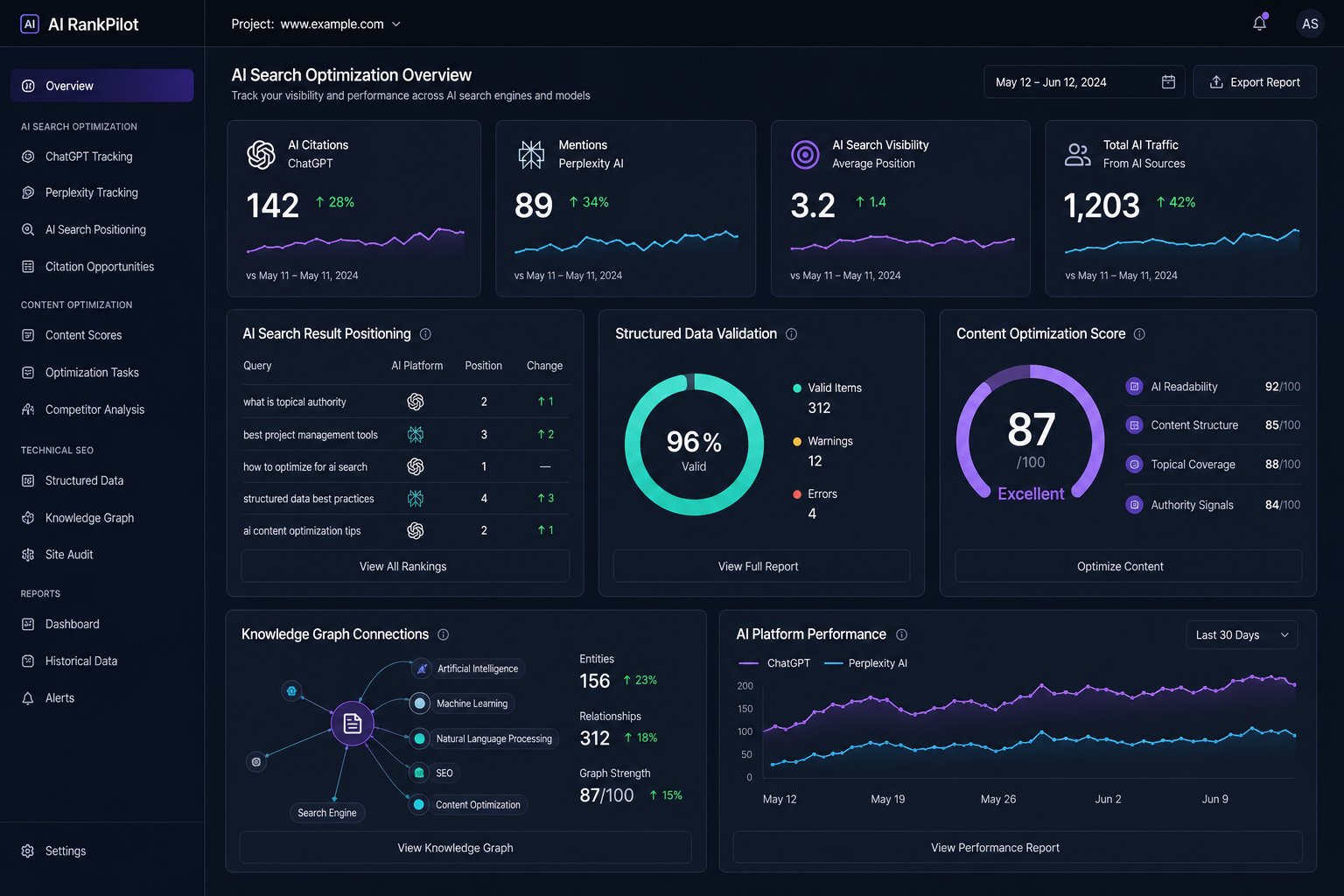
The scale of this shift is easy to underestimate if you’re only watching your own analytics. ChatGPT alone now serves several hundred million people weekly across its consumer and business products, and a meaningful share of that usage touches product and vendor research, even when the session never mentions “buy” or “vendor” explicitly.
| Behavior | What current research shows |
|---|---|
| Vendor discovery via AI chatbots | Roughly a third of B2B buyers now report discovering new vendors this way |
| Initial vendor consideration set | Buyers typically start with around 7–8 vendors in mind |
| Final shortlist size | Narrowed to roughly 3–4 vendors before a purchase decision |
| Google searches ending without a click | A majority of searches now end without a traditional click-through |
Put together, this means the “shortlist” moment — the point where a buyer decides which 3–4 companies are even worth a deeper look — increasingly happens without a website visit at all. A company can have an excellent site, strong SEO, and a great sales team, and still lose the deal before any of that gets a chance to matter, simply because it never made it into the AI-generated shortlist in the first place.
Why this matters more for B2B than almost any other category
B2B purchases involve committees, long evaluation cycles, and buyers who do a large share of their research before ever speaking to a salesperson. That research increasingly starts inside an AI chat window rather than a search results page — Google itself has noted that a growing share of daily searches are now longer, conversational questions, and a majority of searches now end without a click to any website at all.
For B2B specifically, this compresses an already-narrow funnel even further. If an AI system doesn’t surface your company when a buyer asks “what are the best [category] platforms for a mid-market manufacturer,” you don’t get a lower-ranked mention — you get left off the shortlist the buyer builds in their head before they’ve spoken to anyone. Everything downstream in your pipeline depends on being part of that initial set.
How AI search actually differs from traditional SEO
Traditional SEO optimizes for a ranked list of links a person scans and clicks. AI search optimizes for something structurally different: a single synthesized answer, assembled by retrieving candidate sources, evaluating which ones state the answer most clearly and credibly, and then citing a small number of them — sometimes with a link, increasingly without one.
| Dimension | Traditional SEO | AI search (AEO/GEO) |
|---|---|---|
| Goal | Rank position 1–10 in a results list | Be cited inside a synthesized answer |
| Unit of competition | Page vs. page for a keyword | Source vs. source for inclusion in one answer |
| User outcome | Click through to your site | Often zero-click; brand impression without a visit |
| Query pattern | Short keyword phrases | Longer, conversational, often reformulated multiple times per session |
| Volatility | Rankings shift gradually over weeks | Citations can shift significantly month to month |
One important nuance for B2B teams: this isn’t a replacement channel to chase instead of SEO. The two are converging. Content built well enough to rank in Google tends to be well-positioned to be cited in AI answers too, and the underlying discipline — clear structure, real expertise, verifiable claims — serves both. Treat AI visibility as an extension of a solid SEO foundation, not a parallel project competing for budget.
What the major AI platforms actually reward
The platforms your buyers use don’t all weigh the same signals the same way, which matters when you’re deciding where to focus first.
ChatGPT
ChatGPT tends to favor recency, factual accuracy, and clear, specific answers over broad claims. It never runs a query exactly as typed — research tracking thousands of prompts across ChatGPT, Copilot, and Perplexity found that AI engines routinely “fan out” a single user question into multiple reformulated searches behind the scenes, which means optimizing for one exact phrase is far less effective than covering a topic comprehensively enough to be found across many phrasings of the same underlying question. A notable recent shift: ChatGPT began hyperlinking recognized brand names directly to their websites, which has measurably increased referral traffic for brands it names — a meaningful change from the earlier “zero-click, no traffic” assumption many teams had written AEO off with.
Perplexity
Perplexity is the most transparent of the major platforms about its sourcing, displaying citations directly alongside its answers. That transparency makes it the easiest platform to audit directly: search a query you want to be cited for, and see exactly which sources it pulled from and how it framed the answer. Perplexity has also been associated with a stronger emphasis on citation frequency and clarity — sources that get cited elsewhere on the web tend to get cited by Perplexity too, reinforcing the value of genuine backlink authority alongside AEO-specific formatting.
Google AI Overviews
AI Overviews draw heavily from pages that already rank well organically and carry strong E-E-A-T signals, which is the clearest evidence that traditional SEO fundamentals remain the foundation even inside Google’s AI layer. A page with no organic ranking history is unlikely to suddenly appear in an AI Overview regardless of how well it’s formatted for AI extraction.
Gemini and Copilot
Gemini leans heavily on Google’s own structured, verified data sources. For business and local information specifically, this produces a real accuracy gap relative to platforms drawing from less consistently structured web data — one industry analysis found business profile accuracy on Gemini effectively grounded through Google’s own Maps data, versus meaningfully lower accuracy on platforms without that same direct grounding. Copilot, built on similar underlying technology to ChatGPT, tends to reward comparable signals, with an added emphasis on Microsoft ecosystem integration for enterprise-software queries specifically.
For most B2B teams, ChatGPT and Perplexity deserve the earliest attention, since they’re where the described “shortlist” behavior — a buyer explicitly asking for vendor recommendations — happens most directly and most often.
The content factors that actually correlate with AI citations
Independent research analyzing large sets of real AI citations — including one analysis covering roughly 7,000 citations across 1,600 URLs and a separate one built on 240 million ChatGPT citations — has identified specific, measurable patterns that correlate with getting cited. These aren’t guesses; they’re observed patterns worth building a content strategy around.
Answer the question in the first two sentences
AI systems consistently favor sources that state the direct answer immediately, rather than building up to it through a narrative introduction. A page that opens with “Answer engine optimization is the practice of structuring content so AI systems can find, trust, and cite it” gets cited more often for that query than a page that opens with a few paragraphs of scene-setting before getting to the point.
Format matters — a lot
Listicle-style content (numbered lists, structured comparisons) has been measured as disproportionately represented among AI citations relative to its share of the content on the web — one analysis found list-formatted content accounted for roughly a quarter of citations studied. Clear headings, short paragraphs, tables, and bullet points all make content easier for an AI system to extract cleanly, which is functionally the same reason they make content easier for a human to skim.
Define your terms and name your entities clearly
AI systems parse content for named entities — companies, products, defined concepts — and tend to cite whichever source most clearly and authoritatively defines a term when that term becomes relevant to a query. A page that includes a clean, quotable definition of a concept specific to your category has a real shot at becoming the default citation whenever that term comes up, independent of how much traffic the page gets from traditional search.
Cite your own sources
Including a specific statistic with its source (“32% of B2B buyers now discover vendors through generative AI chatbots, per [source]”) rather than an unsupported claim increases the odds an AI system cites you as the secondary source alongside the original research — you gain visibility without needing to be the primary researcher yourself.
Readability correlates with citation, especially for ChatGPT and Perplexity
Content scoring well on standard readability measures shows a positive correlation with citation frequency on the platforms studied. Dense, jargon-heavy B2B copy that reads well to an industry insider but poorly to a general readability score may be quietly working against its own AI visibility, even when the underlying expertise is genuinely strong.
Content citation factors, visualized
Directional summary based on published 2026 research analyzing AI citation patterns (Kevin Indig / Growth Memo; Profound AI Search Shift Research). Bar length reflects relative strength of correlation reported, not a precise percentage.
A step-by-step B2B AEO implementation plan
Step 1: Audit your current AI visibility
Before changing anything, find out where you already stand. Build a list of 15–25 real prompts your buyers would plausibly ask — category comparisons, “best for [use case]” questions, and specific problem-solution queries — and run them across ChatGPT, Perplexity, and Google AI Overviews in a clean, logged-out browser session. Record whether your brand is mentioned, whether you’re cited with a link, and which competitors appear instead. If you show up in fewer than roughly one in ten relevant, non-branded queries, treat that as a critical visibility gap, not a minor one.
Step 2: Map your content to the actual buyer question tree
Rather than optimizing existing pages piecemeal, map out the real sequence of questions a buyer works through: what does this category solve, which vendors exist, how do the top options compare, what does implementation actually involve, what does it cost. Middle-funnel evaluation and comparison content — the exact stage where a shortlist gets built — is where B2B AEO effort pays off fastest, more so than broad top-of-funnel awareness content.
Step 3: Rewrite for direct, specific answers
Go through your highest-priority pages and rewrite openings to state the direct answer immediately, in plain, specific language. Replace vague positioning language — “transformative,” “innovative,” “best-in-class” — with concrete, falsifiable statements about what the product or service actually does and for whom. AI systems have been shown to effectively ignore marketing superlatives in favor of specific, scenario-based descriptions when deciding what to cite.
Step 4: Build genuine comparison and evaluation content
B2B buyers explicitly ask AI systems to compare vendors, and if you don’t provide that comparison content yourself, a competitor’s version — or a third-party site’s version — becomes the source the AI system relies on instead. A well-built comparison page that fairly and specifically addresses how your offering fits different buyer scenarios is one of the highest-leverage content types for this stage of the funnel.
Step 5: Reinforce entity and authorship signals
Consistent naming of your company, product, and key terminology across your site — paired with clear author credentials and organization schema — gives AI systems a cleaner entity to recognize and cite confidently. This is the same E-E-A-T discipline that matters for traditional search; in AI search, ambiguous or inconsistent entity signals are a common reason a genuinely strong company gets skipped over in favor of a less capable but more clearly described competitor.
Step 6: Publish first-party data your competitors can’t replicate
Original benchmarks, proprietary research, or customer outcome data specific to your business give AI systems a citation-worthy source that no competitor can duplicate simply by writing similar copy. This is consistently identified as one of the highest-value content investments for competitive B2B and SaaS categories specifically, because it can’t be commoditized the way general advice content can.
Step 7: Monitor continuously, not once
AI citation patterns are genuinely volatile — research tracking citations over time found a substantial share change from one month to the next, even without any content change on the cited pages. A single audit is a starting point, not a finished project; ongoing tracking is what tells you whether your changes are actually working or whether a shift in citations reflects normal platform-level churn.
Content formats that consistently earn B2B citations
Comparison and “vs.” pages
When a buyer asks an AI system to compare vendors, it needs a source that already frames that comparison. If your company doesn’t publish an honest, specific comparison page, the AI system will rely on whatever third-party or competitor source does exist — often a review site or a competitor’s own framing of the comparison, neither of which is likely to favor you. A well-built comparison page addressing real buyer scenarios directly is one of the highest-leverage content types available for exactly this reason.
Definitional and category-education content
A clear, quotable definition of a term specific to your category can become the default citation whenever that term comes up, independent of how much direct traffic the page receives from search. This is a durable, compounding asset: once an AI system treats your definition as authoritative, it tends to keep citing it across many related queries, not just the one it was originally written for.
Original data and benchmarks
Proprietary research, customer outcome data, or benchmark studies specific to your business are citation-worthy in a way generic advice content can never be, simply because no competitor can publish the same data. This is consistently identified as one of the highest-value investments for competitive B2B and SaaS categories, where most competitors are otherwise producing similar advice content that AI systems have no strong reason to prefer over anyone else’s version.
FAQ-formatted content
Structuring genuinely common buyer questions as explicit question-and-answer pairs, with the answer stated immediately and completely, gives AI systems a directly extractable format that closely mirrors how they construct their own responses. This works best when the questions are the real questions buyers ask — pulled from sales call transcripts, support tickets, and search query data — rather than a generic template list.
Technical foundations that support AI visibility
Schema markup
Structured data remains one of the clearest, lowest-effort signals you can give AI systems about what your content and organization actually are. Organization, Product, FAQPage, and Review schema types are consistently recommended across current AEO guidance, and we cover full implementation detail in our schema markup guide.
Data consistency across the web
AI platforms cross-reference your business information across multiple sources, and inconsistencies — different descriptions, outdated details, mismatched positioning across your website, LinkedIn, review sites, and directories — measurably reduce how confidently a platform recommends you. Local-business research has found accuracy gaps of this kind directly correlate with how often a business gets recommended, and the same underlying dynamic applies to B2B entity consistency more broadly.
Crawlability for AI agents specifically
Confirm your robots.txt and any bot-management configuration aren’t inadvertently blocking the crawlers AI platforms use to index content, separately from your standard Googlebot allowances. It’s an easy technical gap to miss, and it silently removes you from consideration regardless of how strong the content itself is.
An llms.txt file, where it makes sense
A growing number of sites are experimenting with an llms.txt file — a simple, plain-text file at the site root that gives AI crawlers a curated summary of the site’s most important pages and content, similar in spirit to how a sitemap helps traditional search crawlers. Adoption and actual impact are still being established across the industry, so treat this as a low-cost, low-risk addition worth having rather than a guaranteed visibility lever on its own.
What this looks like in practice
Consider a mid-market B2B software company selling into manufacturing that ran the audit described above and found it appeared in zero of twenty relevant AI prompts, while two competitors appeared consistently. The pattern across those twenty prompts was clear: every one where a competitor appeared involved a specific evaluation question — “best X for a mid-market manufacturer,” “X vs. Y for manufacturing use cases” — and the company had no content addressing manufacturing specifically, only generic product marketing pages. Building three focused, specifically-titled comparison and use-case pages addressing exactly those manufacturing scenarios, rewritten to lead with direct answers rather than brand positioning, is the kind of targeted fix that tends to move AI visibility meaningfully faster than a broad, unfocused content refresh across the entire site.
Measuring B2B AEO like a pipeline channel, not a vanity metric
The teams getting real business value from this work don’t stop at tracking mention counts — they connect AI visibility to actual pipeline. A practical measurement structure:
| Metric | What it tells you | How to track it |
|---|---|---|
| Share of voice | How often you appear vs. competitors across your prompt panel | Manual audit or a dedicated AI visibility tool |
| Citation quality | Whether you’re accurately described, not just mentioned | Manual review of AI-generated descriptions of your company |
| AI-referred traffic | Direct visits attributable to AI platform citations | Referral traffic segmentation in GA4, isolating known AI platform domains |
| Pipeline from AI-influenced leads | Whether visibility is translating into qualified opportunities | CRM source/attribution tagging tied to “how did you hear about us” data |
If you’re already evaluating dedicated AI search analytics tools, this is exactly the kind of measurement they’re built to automate at scale — manual prompt-panel audits work for getting started, but they don’t scale to daily tracking across dozens of prompts and competitors.
Common mistakes B2B teams make chasing AI visibility
- Treating AEO as a separate initiative from SEO instead of an extension of it, duplicating effort and creating inconsistent entity signals across two workstreams that should be one.
- Optimizing only top-of-funnel content while ignoring the comparison and evaluation content that actually determines shortlist inclusion for B2B buyers specifically.
- Leaving marketing superlatives in place instead of rewriting toward specific, scenario-based descriptions AI systems can actually parse and cite confidently.
- Auditing once and stopping, missing the substantial month-to-month volatility in AI citations that ongoing monitoring is specifically designed to catch.
- Chasing visibility without connecting it to pipeline, leaving the initiative unable to demonstrate the business value that protects its budget at the next planning cycle.
- Copying B2C tactics wholesale. Consumer-focused AEO advice often emphasizes broad awareness and volume; B2B buying committees respond more to specific, evaluation-stage content than to broad top-of-funnel visibility plays.
Most of these mistakes come from treating AI visibility as a bolt-on tactic rather than a natural extension of existing content and SEO discipline. The teams seeing real pipeline impact are the ones who folded this into their existing content strategy rather than standing up a separate, disconnected workstream.
Frequently asked questions about ranking #1 in AI search
Is there really a “#1” ranking in AI search the way there is in Google?
Not in the same structural sense. AI answers typically cite a handful of sources rather than a ranked list of ten, so the more accurate goal is consistent inclusion in that citation set across your key buyer questions — high share of voice — rather than a single fixed position.
How is this different from what our SEO team is already doing?
It’s an extension, not a separate discipline. The content and technical fundamentals that support strong organic rankings — clear structure, genuine expertise, credible sourcing — are largely the same fundamentals that support AI citation. The differences are in emphasis: direct-answer openings, list/table formatting, and entity consistency matter even more for AI visibility specifically.
Which AI platform should a B2B team prioritize first?
ChatGPT and Perplexity are generally the highest-priority starting points for B2B vendor-discovery queries specifically, given how directly buyers use them to ask for recommendations and comparisons. Google AI Overviews is worth monitoring in parallel since it draws heavily from the same organic ranking signals your SEO program already targets.
How quickly can we expect to see results?
Some teams have reported meaningful visibility shifts within a few weeks of rewriting core pages toward direct, specific answers, but AI citation volatility means results should be evaluated over a period of months rather than days, with continuous monitoring rather than a single before-and-after snapshot.
Do we need a dedicated AEO agency, or can this be done in-house?
It depends on internal capacity across content, technical SEO, and measurement. In-house teams with existing SEO and content maturity can typically execute the fundamentals covered here directly, since much of the work is a rewrite and reprioritization of existing content rather than something requiring entirely new skills; an agency becomes more valuable when the work needs to span content, technical implementation, digital PR, and pipeline attribution simultaneously and no single internal owner can connect all of it.
Does this replace the need for a sales team following up on AI-sourced leads?
No. AI visibility influences whether your company makes the initial shortlist a buyer builds before ever reaching out; it doesn’t replace the qualification, discovery, and relationship-building work a sales team does once that buyer is ready to engage. Think of strong AI visibility as protecting your seat at the table, not as a substitute for the conversation that happens once you’re there.
Should smaller B2B companies bother with this, or is it only worth it for large enterprises?
Smaller, more specialized companies often have a real advantage here: a narrowly focused, deeply expert page on a specific use case can out-cite a broader competitor’s more general content, since AI systems favor specific, well-evidenced answers over broad brand authority alone. This is one of the few visibility channels where a smaller, more focused competitor can genuinely compete with a much larger one.
Being the answer is the new #1
For B2B companies, the shift from ranking to being cited isn’t a marginal channel update — it’s a change in where deals actually start. A shortlist built inside a ten-minute AI conversation now often determines who gets a sales call at all, and that shortlist is assembled from sources that answer clearly, define their terms precisely, and back their claims with real evidence.
Getting there isn’t about gaming a new algorithm. It’s the same discipline that’s always separated genuinely useful B2B content from marketing copy — just applied with the specific formatting, clarity, and entity consistency that AI systems have been shown to reward. Start with the audit, fix the highest-leverage comparison and evaluation content first, and treat ongoing monitoring as part of the job rather than a one-time project.
The companies that will still be invisible in AI search a year from now aren’t the ones lacking expertise — they’re the ones who assumed their existing SEO investment would automatically carry over, and never went back to check whether the buyers researching their category could actually find them in the conversation that increasingly happens before anyone picks up a phone.
Related AI visibility resources
- How to Rank in AI Search Results — the main evergreen visibility framework.
- Best AI Search Analytics Tools for Marketing Teams — tools for tracking citations, prompts, and share of voice.
- How to Get Indexed by ChatGPT and AI Search Tools — technical readiness for AI discovery.
- Digital Marketing Services — support for strategy, content systems, and measurement.


1 comment