
Search Console can tell you exactly how many clicks a page got from Google last month. It has nothing to say about the conversation your prospect just had with ChatGPT, where your competitor got named and you didn’t. That gap — real buying influence happening in a channel your existing analytics stack can’t see — is why AI search analytics tools have gone from a nice-to-have to a genuine budget line for marketing teams in 2026.
This category is still young and moving fast. Pricing pages change monthly, feature sets are being rebuilt in real time, and half the “reviews” online are written by a competing vendor with a rooting interest in the outcome. This guide cuts through that noise: what these tools actually measure, how the leading platforms compare on the dimensions that matter for a marketing team’s day-to-day work, and how to pick the one that fits your budget and stack rather than whichever one has the loudest marketing.
What AI search analytics tools actually measure
Traditional SEO analytics were built around a simple model: a person searches, sees a ranked list of blue links, and clicks one. Rank tracking, click-through rate, and organic traffic all flow from that model.
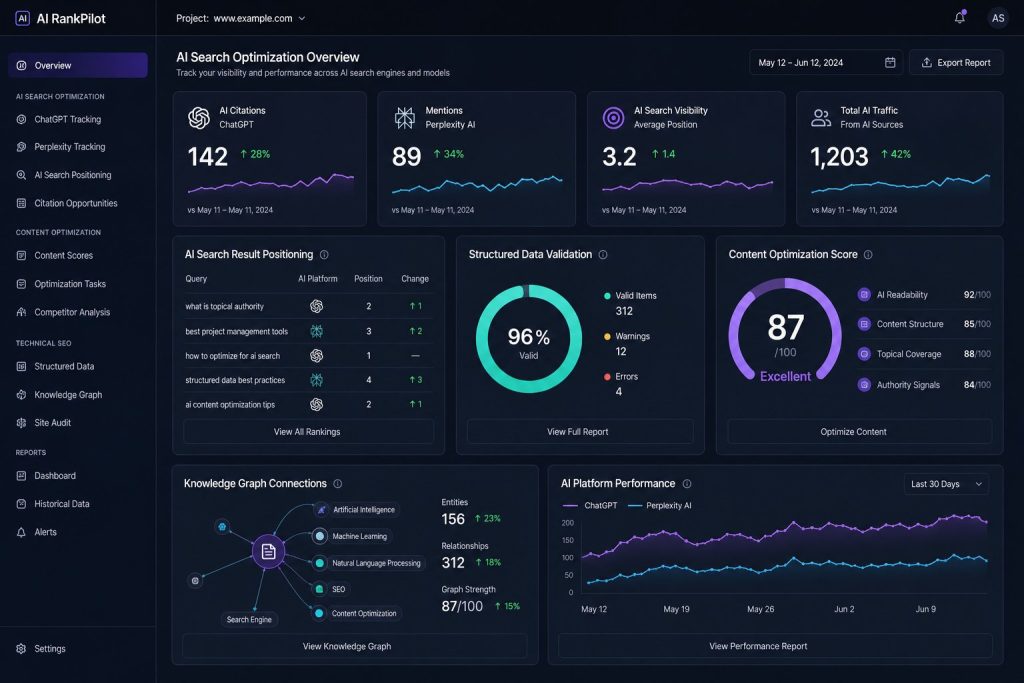
AI-powered answer engines break that model. When someone asks ChatGPT, Perplexity, or Google’s AI Overviews a question, the system synthesizes a direct answer and may recommend a small handful of brands or products by name — with no ranked list and no guarantee your business is even mentioned, let alone clicked. AI search analytics tools exist to make that invisible layer measurable. Broadly, they track:
- Brand mention frequency — how often a brand comes up across a defined set of prompts, tracked repeatedly over time.
- Citations and source attribution — which of your pages, if any, an AI system pulls from or links to when it mentions you.
- Share of voice — how your mention rate compares to named competitors across the same prompt set.
- Sentiment and context — not just whether you’re mentioned, but how favorably and in what framing.
- Cross-platform coverage — since ChatGPT, Perplexity, Gemini, Claude, Copilot, and Google AI Overviews can each describe a brand differently, tracking only one platform gives an incomplete picture.
A smaller number of platforms go a step further and add an execution layer — generating content briefs, flagging specific pages to update, or automating optimization tasks aimed at improving citation odds. Whether that’s worth paying extra for depends heavily on how much in-house content capacity your team already has.
It’s also worth being clear about what these tools generally do not do well yet: none of them can tell you with certainty why an AI system chose to mention one brand over another on a given prompt, since the underlying models don’t expose that reasoning directly. What they can do is show correlation — which sources tend to get cited, which content formats tend to appear more often, which competitors show up repeatedly — and it’s up to your team to turn that correlation into a content and SEO strategy worth testing.
How we evaluated these tools
Pricing and features in this category shift often enough that any specific number risks being stale within a quarter. The figures below reflect publicly available pricing and product documentation as of mid-2026 and should be re-verified directly with each vendor before a purchase decision — several of the platforms covered here have moved from published self-serve pricing to demo-gated enterprise pricing within the past year alone.
With that caveat in place, the comparison below weighs each platform on five criteria: how many AI platforms it actually tracks, whether pricing is transparent and predictable, how fresh the data is, whether the tool tells you what to do with the findings, and how well it fits into a stack marketing teams already use.
Comparison table: leading AI search analytics platforms
| Tool | Platform coverage | Starting price (approx.) | Pricing model | Best for |
|---|---|---|---|---|
| Profound | 8–9 platforms including ChatGPT, Perplexity, Gemini, Claude, Copilot, Grok, Meta AI | From ~$399/mo; largely custom enterprise pricing | Tiered, demo-led for most tiers | Large enterprise teams needing deep AEO data and crawler analytics |
| Semrush AI Visibility Toolkit | ChatGPT, Google AI, Gemini, Perplexity | ~$99/mo per domain (standalone); Semrush One bundle from ~$199/mo | Add-on or bundled subscription | Teams already using Semrush for core SEO work |
| Ahrefs Brand Radar | 6 platforms: Google AI Overviews, AI Mode, ChatGPT, Perplexity, Gemini, Copilot | Requires active Ahrefs plan (~$129/mo) plus $199–$699/mo add-on | Stacked add-on on top of core SEO plan | Existing Ahrefs power users wanting AI visibility inside the same platform |
| AthenaHQ | 8 platforms including ChatGPT, Claude, Perplexity, Gemini, Grok, Meta AI, DeepSeek | From ~$295/mo, credit-based | Credit-based self-serve; custom enterprise tier | Teams that want an action layer, not just a dashboard |
| OtterlyAI | 6 platforms: ChatGPT, Perplexity, Google AI Overviews/Mode, Gemini, Copilot | From ~$29/mo (Lite), scaling to ~$489/mo (Premium) | Prompt-volume-based tiers | Budget-conscious teams and agencies wanting a low entry point |
| Peec AI | Multiple major engines with cross-platform dashboards | Mid-market pricing (~$199/mo range reported) | Tiered subscription | Marketing teams wanting a clean, growth-stage-focused dashboard |
A quick reading note on that table: pricing structures in this category vary so much in shape — flat subscription, per-domain add-on, credit consumption, prompt-volume tiers — that the “starting price” column understates real-world cost for several of these tools once you add the platforms, domains, or prompt volume a typical mid-market team actually needs. The tool-by-tool breakdown below goes into that detail.
Starting price comparison, visualized
Approximate lowest published starting price per month, mid-2026. Bar width is scaled relative to Profound’s $399 entry point.
The chart above plots each platform’s lowest published entry point, not a realistic full-coverage cost — Ahrefs Brand Radar in particular looks far cheaper here than it does once the AI index add-ons needed for meaningful platform coverage are included, which can push a realistic monthly bill well past $800. Treat the entry price as a floor, not a total cost of ownership figure.
Profound: the enterprise standard
Profound has positioned itself as the deepest platform in this category, and its feature set backs that up: an Answer Engine Insights dashboard tracking citation patterns and sentiment, a Prompt Volumes feature showing what people are actually asking AI systems in a given category, and Agent Analytics that reads server logs to show which AI crawlers are visiting which pages on your site.
Key features:
- Answer Engine Insights covering citation authority, sentiment, and competitive share of voice
- Prompt Volumes showing real query demand behind a given topic or product category
- Agent Analytics connecting to CDN and server logs to show AI crawler activity by page
- Agents, a workflow feature that generates AEO-oriented content and can publish to a connected CMS
- SOC 2 Type II compliance and dedicated enterprise security features
Where it fits
Profound is built for large marketing organizations, regulated industries, and agencies managing enterprise clients — the kind of teams that need SOC 2 Type II compliance, dedicated account support, and the budget to match. Its pricing has shifted increasingly toward custom, demo-led enterprise quotes rather than transparent self-serve tiers, which is itself a signal about who the platform is built for now.
Trade-offs
Smaller teams and solo marketers are likely to find Profound more platform than they need, both in complexity and in cost. Support has also been reported as slower for lower tiers compared to leaner competitors, which matters if your team needs hands-on help interpreting the data rather than just access to it.
Semrush AI Visibility Toolkit: best for existing Semrush users
Rather than a standalone product, Semrush built its AI visibility features as a toolkit that sits inside the broader Semrush platform — Visibility Overview, Prompt Research, Brand Performance, Competitor Research, and an AI Search Site Audit, all backed by Semrush’s existing keyword and domain database.
Key features:
- Visibility Overview reporting on AI mentions across ChatGPT, Google AI, Gemini, and Perplexity
- Prompt Research built on a large existing prompt database, refreshed daily
- Competitor Research showing which rivals get recommended for the same prompts
- AI Search Site Audit flagging pages that rank well organically but are missing from AI answers
- Direct integration with Semrush’s core keyword, backlink, and content tools
Where it fits
If your team already relies on Semrush for keyword research, backlink analysis, or content workflows, the AI visibility layer slots into a tool you’re already paying for and already trained on, rather than adding an entirely separate login and workflow to the stack.
Trade-offs
Reviewers consistently flag that Semrush’s AI toolkit pricing scales awkwardly: additional users, additional domains, and additional tracked prompts are all separate line items, which can turn a seemingly affordable entry price into a much larger bill for a team tracking multiple brands or working across an agency’s client roster. For teams that don’t already use Semrush’s core SEO tools, buying the AI layer alone is a harder value case to make.
Ahrefs Brand Radar: broadest coverage, stacked pricing
Ahrefs Brand Radar tracks six AI platforms and layers in visibility data from YouTube, TikTok, and Reddit — a genuinely distinctive feature, since conversation on those platforms increasingly feeds the training and retrieval data behind AI-generated answers. The integration with Ahrefs’ existing backlink and keyword data also lets teams correlate traditional SEO signals with AI citation patterns in one place.
Key features:
- Coverage across Google AI Overviews, AI Mode, ChatGPT, Perplexity, Gemini, and Copilot
- Video and Reddit mention monitoring, distinctive among the platforms covered here
- Historical trend data showing how AI visibility has moved over months, not just current-state snapshots
- Direct correlation views between backlink profile strength and AI citation frequency
- Large underlying prompt database drawing on Ahrefs’ existing search index
Where it fits
Teams already deep in the Ahrefs ecosystem, particularly those with a Google AI Overviews and AI Mode-focused strategy, get real added value from Brand Radar without adopting an entirely new platform.
Trade-offs
Brand Radar is not a single price — it requires an active Ahrefs base subscription plus AI index add-ons priced per platform or bundled, and a realistic full-coverage configuration has been independently estimated in the $800–$1,150 per month range. That places it meaningfully above the category’s reported average cost, and reviewers have also noted accuracy gaps in its ChatGPT and Perplexity tracking along with the absence of Claude and Grok from its platform coverage.
AthenaHQ: the most action-oriented platform
AthenaHQ’s standout feature is its Action Center, which turns visibility findings into structured, assignable optimization tasks rather than leaving teams to interpret a dashboard on their own. It also offers geographic breakdowns of AI visibility, useful for global brands whose AI presence can vary sharply by region, and revenue attribution features that connect AI citations to actual site analytics and e-commerce platforms.
Key features:
- Action Center generating assignable, trackable optimization tasks from visibility findings
- 8-platform coverage included on all plans, including DeepSeek and Grok
- Geographic visibility breakdowns for brands operating across multiple regions
- Revenue attribution connecting AI citations to Shopify and GA4 data
- An AI copilot feature (“Ask Athena”) for querying visibility data conversationally
Where it fits
Teams that specifically want a tool to close the gap between “here’s your visibility data” and “here’s what to actually do about it” tend to rate AthenaHQ highly for exactly that reason — user reviews consistently cite its onboarding and action layer as standout strengths.
Trade-offs
AthenaHQ’s credit-based pricing model — where each tracked AI response consumes a credit — makes monthly costs less predictable than a flat subscription, and its entry price point of roughly $295 per month with no free trial puts it out of reach for very small teams or early-stage testing.
OtterlyAI: the accessible entry point
OtterlyAI has built its reputation on being the lowest-friction way into this category: fast setup, a clean interface, and an entry price around $29 per month that undercuts nearly every competitor covered here. Its core feature set includes ChatGPT and Perplexity tracking, GEO content audits with SWOT-style analysis, and prompt research tools, with a workflow explicitly built around researching prompts, monitoring visibility, auditing content, and applying optimization recommendations.
Key features:
- Daily tracking across ChatGPT, Perplexity, Google AI Overviews/Mode, Gemini, and Copilot
- GEO content audits with SWOT-style diagnostic output
- Net Sentiment Score tracking, rated on a -100 to +100 scale
- Unlimited brand reports and a Looker Studio connector on Standard tier and above
- A 14-day free trial requiring no credit card
Where it fits
Budget-conscious teams, agencies onboarding their first few clients into AI visibility tracking, and marketers who want to validate the category before committing to a larger platform tend to find OtterlyAI’s entry tier a sensible starting point.
Trade-offs
Pricing scales steeply as prompt volume grows, and two of its six tracked platforms are reported as paid add-ons rather than included by default. Teams that need to track a large, varied prompt set across multiple markets are likely to outgrow the lower tiers quickly, at which point the cost gap with more comprehensive platforms narrows considerably.
Peec AI and other mid-market options
Peec AI occupies similar territory to OtterlyAI and AthenaHQ — a mid-market platform aimed at growth-stage marketing teams that want cross-engine visibility dashboards without enterprise-level pricing or complexity. We’ve covered how it stacks up against Profound specifically in our dedicated comparison of AEO tools for growth-stage teams, which is worth reading in full if Peec AI or Profound are already on your shortlist.
A handful of other platforms are worth a mention for specific situations. Nightwatch and Knowatoa both track major AI platforms with a particular emphasis on sentiment and brand-perception analysis rather than raw mention counts — useful if your primary concern is how AI systems characterize your brand rather than simply whether they name it. HubSpot’s AEO tracking, built into its broader marketing platform, is a sensible option for teams already standardized on HubSpot who want AI visibility reporting alongside their existing campaign and CRM data rather than in a separate tool.
Feature matrix: what each platform emphasizes
Beyond raw platform coverage, these tools differentiate mainly on what they do with the data once it’s collected. The matrix below summarizes each platform’s relative strength across the dimensions marketing teams tend to care about most.
| Tool | Action/optimization layer | Sentiment analysis depth | SEO platform integration | Data refresh frequency |
|---|---|---|---|---|
| Profound | Strong (Agents, content workflows) | Strong | Standalone, API-first | Daily |
| Semrush AI Visibility Toolkit | Moderate (keyword opportunity lists) | Moderate | Native (Semrush ecosystem) | Daily |
| Ahrefs Brand Radar | Light (data-only, no built-in action layer) | Moderate | Native (Ahrefs ecosystem) | Varies by index |
| AthenaHQ | Strongest (dedicated Action Center) | Strong | Standalone, some CDN integrations | Credit-consumption based |
| OtterlyAI | Moderate (GEO audits with recommendations) | Strong (dedicated Net Sentiment Score) | Standalone; Semrush data integration available | Daily to weekly by tier |
Reading this matrix alongside the pricing table above tends to clarify the real trade-off in this category: the platforms with the strongest action layers and sentiment depth (Profound, AthenaHQ) are also the most expensive, while the most integrated, budget-friendly options (Semrush, Ahrefs, OtterlyAI) ask your team to do more of the interpretation and execution work itself.
Setting up your first AI visibility tracking program
Step 1: Define your actual prompt set
Before signing up for any platform, write down the real questions your buyers ask — not generic category terms, but the specific phrasing a prospect would type into ChatGPT or say to Perplexity when researching a purchase in your category. This list is the single most important input into any of these tools; a generic, vendor-supplied prompt template will produce generic, low-value data.
Step 2: Identify your must-track competitors
Decide which 3–5 competitors matter most for share-of-voice comparison. Most platforms cap the number of competitors tracked on lower tiers, so prioritizing the competitors that actually show up in your sales conversations is more useful than tracking every company in your category.
Step 3: Pick a platform based on your prompt volume and budget, not the longest feature list
Match your prompt set and competitor list from steps one and two against the pricing models covered above. A 15–25 prompt tracking need points toward a lower tier of nearly any platform in this category; a need to track 100+ prompts across multiple markets points toward the mid-market or enterprise tier regardless of which vendor you choose.
Step 4: Assign ownership of the findings
Visibility data left in a dashboard nobody checks doesn’t generate value. Assign a specific person or team to review findings on a fixed cadence — weekly is reasonable for an active tracking program — and connect any recommended actions to your existing content calendar rather than treating them as a separate workstream.
Step 5: Establish a baseline before making changes
Run tracking for at least two to four weeks before making any content or SEO changes intended to influence AI visibility. Without a clean baseline period, it becomes much harder to tell whether a later improvement in mention rate or sentiment actually came from your changes or from normal platform-level fluctuation.
Choosing the right tool for your team
Start with what you already pay for
Before evaluating a dedicated AI visibility platform, check whether your existing SEO stack already includes one. Teams on Semrush or Ahrefs may find the incremental cost of turning on the AI layer is lower than a new standalone subscription, even accounting for the add-on pricing structure both platforms use.
Match platform coverage to where your buyers actually are
Not every AI platform matters equally to every business. A B2B software company’s buyers may lean heavily on ChatGPT and Perplexity for vendor research, while a consumer brand might see more relevant traffic influence from Google’s AI Overviews. Audit which AI surfaces are actually likely to influence your specific buying journey before paying for broad coverage you won’t use.
Decide how much you need the tool to also tell you what to do
Pure monitoring tools are cheaper, but they leave the interpretation and action-planning work to your team. Platforms like AthenaHQ and Profound charge a premium partly because they’re trying to close that gap. If your team already has strong content and SEO operations, a lower-cost monitoring tool paired with your existing workflow may be the better value; if you’re short on execution capacity, the action-layer premium may pay for itself.
Budget for real usage, not the headline price
Nearly every platform in this category advertises an entry price that undersells what a typical team will actually spend once multiple domains, competitors, prompt volumes, or team seats are added. Model out a realistic 6–12 month usage scenario before comparing headline prices across vendors.
Common mistakes when evaluating these tools
- Comparing headline prices instead of full-coverage costs. A tool’s cheapest published tier rarely reflects what a real, multi-competitor, multi-platform tracking setup will actually cost.
- Ignoring platform coverage gaps. A tool that doesn’t track Claude or Grok may still be a fine choice — but only if your team has actually confirmed those platforms aren’t meaningfully influencing your category’s buying decisions.
- Treating AI mention count as the only metric that matters. A high mention count with negative or inaccurate framing can be worse for the brand than no mention at all; sentiment and context matter as much as raw frequency.
- Buying the platform before defining the prompt set. The value of any of these tools depends entirely on tracking the right prompts — the actual questions your buyers ask — not a generic template list the vendor provides by default.
- Treating AI visibility data as a stand-in for AI ROI measurement. Tracking mentions is the input, not the outcome; pairing this data with a genuine AI ROI framework is what turns visibility tracking into a defensible business case.
How AI search analytics connects to your broader AI strategy
AI visibility tracking doesn’t sit in isolation from the rest of a marketing organization’s AI decisions. The same evaluation discipline covered in our framework for choosing an AI model for your business — defining requirements before comparing options, testing against real use cases rather than trusting marketing claims, and revisiting the decision on a fixed cadence — applies just as directly to choosing an AI visibility platform as it does to choosing an underlying language model.
It’s also worth folding these tools into your organization’s existing AI tool governance. If your team has an AI governance policy already in place, an AI search analytics platform should go through the same vendor and data-handling review as any other AI tool before it’s connected to brand, competitor, or customer data.
Frequently asked questions about AI search analytics tools
Do I need a dedicated AI search analytics tool, or can I just check ChatGPT manually?
Manual spot-checks can work for a very small, occasional check-in, but they don’t scale to consistent tracking across multiple prompts, competitors, and AI platforms over time. Most marketing teams that rely on manual checks find they miss meaningful shifts in visibility simply because nobody was running the same prompt set on the same schedule.
Which AI platforms are most important to track?
It depends on your buyers, but ChatGPT and Google’s AI Overviews currently have the broadest reach for most categories, with Perplexity and Gemini also commonly cited as significant. B2B software and technical categories often see meaningful traffic from Claude as well. Audit your own web analytics referral data for AI platform traffic before assuming which ones matter most to your specific audience.
How accurate is AI visibility tracking data?
Accuracy varies by platform and by which AI engine is being tracked — some tools have documented gaps in specific engines, particularly ChatGPT and Perplexity tracking on certain platforms. Treat visibility scores as directional trend indicators rather than precise, audit-grade figures, and prioritize tools that are transparent about their data collection methodology.
Is it worth paying for a platform’s content optimization features, or should we handle that in-house?
This depends on your team’s existing content capacity. If you already have a strong content and SEO workflow, a pure monitoring tool paired with your own team’s execution is often more cost-effective. If content execution is a bottleneck, the built-in action layers some platforms offer can genuinely accelerate the loop from insight to published change.
How often should we re-evaluate our AI search analytics tool choice?
Given how quickly this category is evolving — several platforms covered here have changed their pricing structure within the past year alone — a semiannual review is reasonable, checking both whether your current tool’s coverage still matches where your buyers are and whether pricing or features have shifted enough to warrant a switch.
Can agencies use one of these tools across multiple client accounts?
Most of the platforms covered here support multi-client or multi-workspace setups, but the economics vary widely — some charge per additional domain or brand, while others bundle a set number of workspaces into a given tier. Agencies should model total cost across a realistic client roster before committing, since per-client add-on pricing can make an attractively priced entry tier much less competitive at scale.
Should we track AI visibility for individual products, or just the overall brand?
Both, if budget allows, but brand-level tracking is the more important starting point for most teams. Product-level tracking becomes worthwhile once you have a stable brand-level baseline and a specific reason to believe AI visibility differs meaningfully by product line — a diversified catalog or a category where competitors are unusually strong on a specific product are common triggers for adding that layer.
Visibility data only matters if someone acts on it
The right AI search analytics tool for your team depends less on which platform has the most features and more on an honest read of your budget, your existing stack, and how much execution capacity you actually have to act on what the data shows you. A comprehensive enterprise platform sitting mostly unused because nobody has time to work its findings is a worse outcome than a leaner tool whose insights genuinely make it into your content calendar every week.
Start with the platforms that already overlap with tools your team uses, define the real prompt set your buyers actually ask before comparing vendors, and revisit the decision on a fixed schedule rather than treating it as permanent — this category is changing too quickly for a choice made a year ago to still be the right one today.
Related AI search guides
For broader strategy and implementation context, continue with these connected resources:
- How to Rank in AI Search Results — the evergreen framework for visibility across ChatGPT, Perplexity, and Google AI Overviews.
- How B2B Brands Get Cited in AI Search — a support guide focused on vendor discovery, citations, and pipeline-oriented visibility.
- How to Get Indexed by ChatGPT and AI Search Tools — technical guidance on indexing, crawler access, and citation readiness.
- What Are AI Overviews and How to Rank in AI Overviews on Google — a dedicated guide for Google’s AI-generated search summaries.
- How to Measure and Grow Answer Engine Traffic — a companion article focused on traffic measurement and answer-engine performance.


4 comments