
Editorial note: This article is part of UMC’s CRM-development cluster and is positioned as an industry-specific guide rather than a generic CRM overview.
Why Logistics and Supply Chain Companies Need Custom CRM
The logistics and supply chain industry operates at the intersection of complex relationships—shippers, carriers, freight brokers, warehousing partners, customs agents, and end customers. Managing these relationships while coordinating global shipments, tracking KPIs, and maintaining service levels requires purpose-built technology that generic CRMs simply can’t provide.
A custom logistics CRM gives freight companies, 3PLs, and supply chain managers a unified platform to manage customer relationships, track shipments, optimize routes, and drive revenue growth across the entire logistics ecosystem.
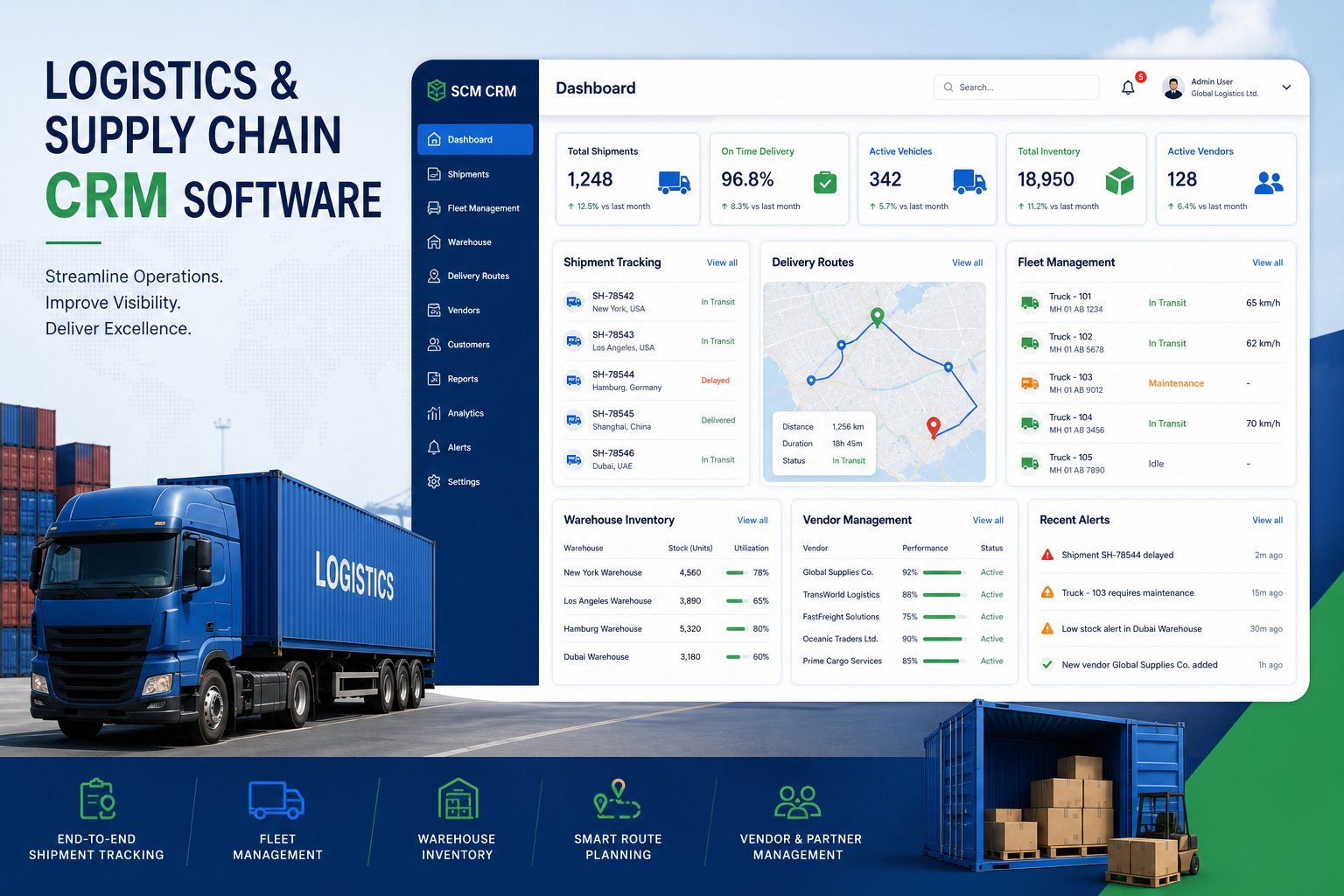
Key Logistics Challenges a Custom CRM Solves
1. Multi-Party Shipment Coordination
Every shipment involves multiple stakeholders who need real-time visibility:
- Customer shipment tracking with real-time status updates
- Carrier assignment and performance tracking per lane
- Freight forwarder and customs broker coordination
- Exception management with automated escalation workflows
- Proof of delivery capture and documentation
2. Customer and Lane Management
Logistics relationships are lane-specific and volume-driven:
- Customer volume tracking by lane, mode, and season
- Lane profitability analysis with cost and margin breakdowns
- Contract management with rate negotiation tracking
- Customer scorecards with on-time delivery and claims metrics
- Seasonal demand forecasting based on historical patterns
3. Carrier and Vendor Management
Manage your supply chain partner network effectively:
- Carrier onboarding with insurance, certification, and compliance verification
- Performance scorecards tracking on-time delivery, damage rates, and cost
- Capacity planning and carrier availability tracking
- Bid management for carrier contracts and spot market rates
- Vendor diversity and sustainability tracking
Essential Logistics CRM Features
| Feature | Description | Impact |
|---|---|---|
| Shipment Tracking | Real-time visibility across all modes | Customer transparency |
| Lane Analytics | Profitability and volume analysis per lane | Margin optimization |
| TMS Integration | Connect with Transportation Management Systems | Operational efficiency |
| Quote Management | Rate quoting with margin controls | Faster quoting |
| Claims Management | Freight claims tracking and resolution | Customer retention |
| Customer Portal | Self-service tracking and booking | Reduced support costs |
Logistics CRM by Business Model
Freight Brokerage
- Load matching and carrier sourcing tools
- Margin tracking per load with real-time cost updates
- Coverage tracking for uncovered loads
- Commission and agent performance management
3PL and Warehousing
- Multi-client inventory and order management
- Warehouse capacity planning and utilization tracking
- Value-added service tracking and billing
- SLA compliance monitoring per client
Ocean and Air Freight
- Booking management with carrier allocation tracking
- Container and ULD tracking with milestone updates
- Customs documentation and compliance management
- Freight audit and payment reconciliation
Technology Stack for Logistics CRM
- Backend: Node.js or Go for high-throughput shipment data processing
- Database: PostgreSQL with PostGIS for geospatial lane analysis
- Integration: EDI (X12/EDIFACT), REST APIs for TMS/WMS connectivity
- Real-Time: WebSocket connections for live shipment tracking
- Maps: Google Maps Platform or Mapbox for route visualization
- Mobile: React Native apps for drivers and field staff
ROI of Custom Logistics CRM
- 25% increase in customer retention through proactive communication
- 30% improvement in lane profitability through better pricing
- 40% reduction in customer status inquiries via self-service portal
- 20% increase in carrier utilization through performance tracking
- 35% faster quote-to-booking cycle time
At Unified Management Consulting, we build custom CRM solutions tailored to your industry’s unique needs. Explore our website development services to learn how we can help your business succeed with custom technology solutions.
Frequently Asked Questions
How much does a custom logistics CRM cost?
Custom logistics CRM development ranges from $45,000 to $250,000+ depending on TMS integrations, multi-modal requirements, and real-time tracking capabilities.
Can it integrate with our TMS?
Yes. Custom CRMs integrate with major TMS platforms including MercuryGate, TMW, Oracle TMS, and custom systems through APIs and EDI connections.
How does CRM help with freight claims?
Logistics CRM includes claims filing, documentation collection, carrier notification, and resolution tracking—all linked to the original shipment and customer record.
Can customers track shipments directly?
Yes. Custom customer portals provide real-time shipment tracking, document access, booking requests, and invoice viewing without requiring phone calls to your team.
Related CRM and operations resources
- Custom Manufacturing CRM Development — the closest companion where customer demand, production scheduling, and delivery coordination intersect.
- 6 Best CRMs for Wholesalers: Features, Fit, and Buying Criteria — buyer guidance where distribution and order-flow complexity overlaps with logistics needs.
- Custom Construction CRM Development — another environment where timing, vendors, and multi-party coordination shape outcomes.
- Tech Stack Consolidation: The Business Case for Unified Systems — systems strategy when operations data is fragmented across too many tools.
- Technology Services — implementation support for high-coordination operating environments.



1 comment