
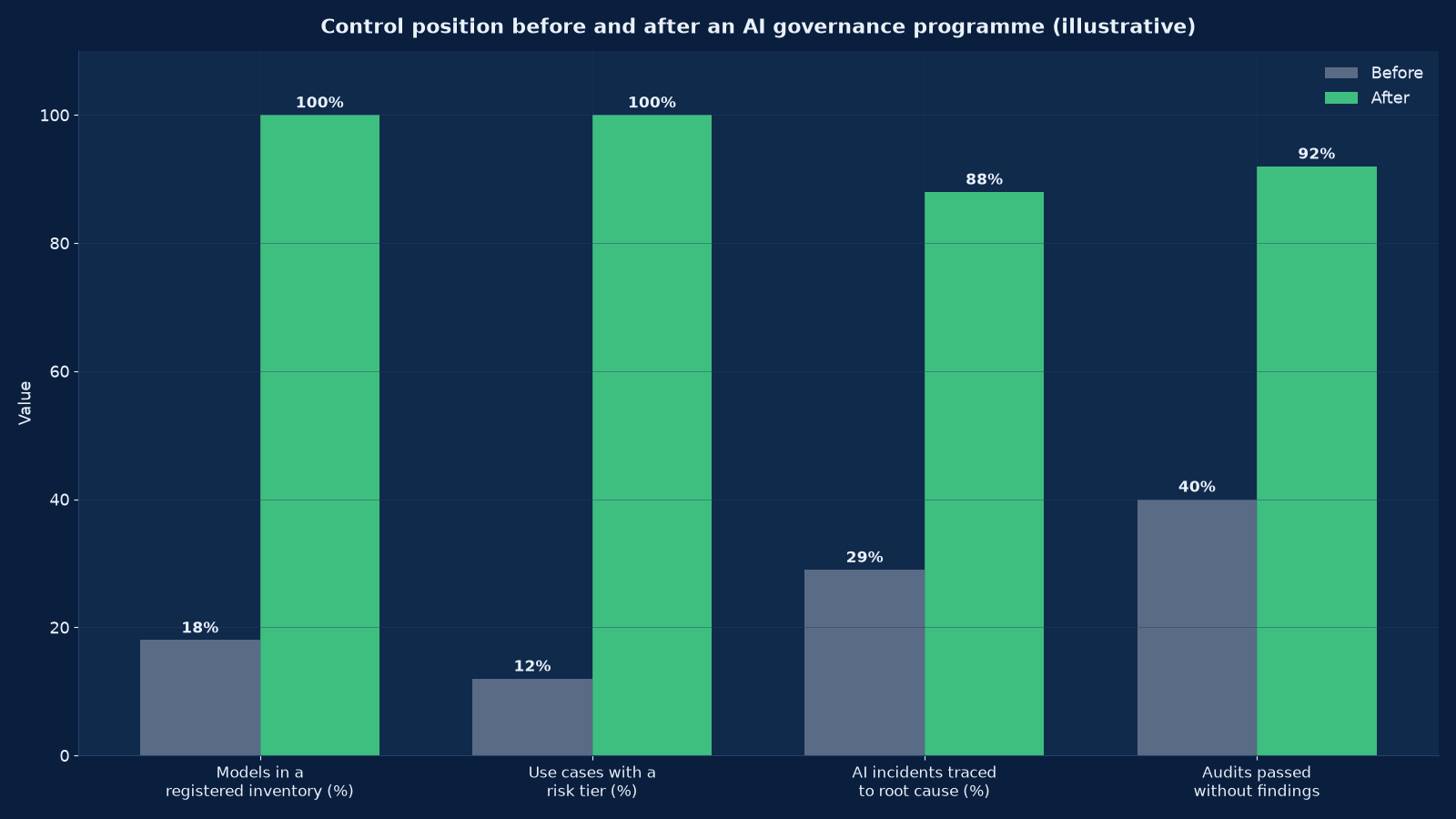
Make every AI system in your business accountable, explainable and auditable. Unified Management Consulting builds AI governance, risk and compliance programmes: model and use-case inventories, risk tiering, policy and acceptable-use frameworks, regulatory gap analysis, monitoring and audit trails, and the committee structure that keeps all of it operating after we leave.
AI governance is not a document. It is the set of controls that lets you answer, on demand, which AI systems are running, what data they consume, who approved them, what they are allowed to decide, how you would detect a degraded output, and how you would turn one off. Most organisations cannot answer those questions today, and the reason is structural: AI adoption has been faster than the approval machinery built for conventional software.
We build that machinery to fit the way you actually work. Controls that slow delivery get bypassed, so the design objective is a governance route that is faster than the informal one — clear risk tiers, proportionate review, and automated evidence collection so compliance is a by-product of operating the system rather than a separate exercise.
🛡️ AI Governance, Risk & Compliance — Quick Summary
| Component | What We Deliver |
|---|---|
| AI inventory & model register | Every AI system, model, vendor tool and internal prompt-based workflow recorded with owner, data sources, purpose and lifecycle state |
| Risk tiering | Use cases classified by decision impact, reversibility and regulatory sensitivity, so review effort is proportionate rather than uniform |
| Policy & acceptable use | Written AI policy, acceptable-use rules, prohibited practices, disclosure standards and the employee-facing guidance that makes them usable |
| Regulatory gap analysis | Your current position mapped against applicable obligations, with a remediation plan and named owners per gap |
| Controls & monitoring | Human review thresholds, output logging, drift and quality monitoring, incident definition, escalation and rollback paths |
| Governance operating model | Approval committee, decision rights, review cadence, evidence pack and training so the framework survives staff turnover |
Chart values are an illustrative planning model based on typical UMC engagements and published industry benchmarks. They are not a guarantee of results on any specific project.
Why AI Governance Cannot Wait Until After Deployment
The most common governance failure is not a badly designed control. It is discovering an AI system that nobody approved. Shadow AI arrives through individual productivity tools, departmental pilots and vendor features switched on by default, and it accumulates faster than any central register can track it without an explicit discovery process. By the time it is visible, the organisation is usually handling customer or employee data through a system with no owner, no data protection basis and no log.
Governance installed before deployment is also materially cheaper. Controls designed into a system cost engineering time during the build. Controls retrofitted cost the same engineering time plus a discovery exercise, plus the risk of finding that a system already in production cannot produce the evidence an auditor will ask for. Our AI governance policy framework guide covers the structure we install and the reasoning behind each layer.
- Know which AI systems are live, who owns them and what they are permitted to decide
- Apply proportionate review so low-risk uses are not blocked by controls designed for high-risk ones
- Produce evidence on demand for internal audit, regulators, insurers and enterprise customers
- Detect degraded, biased or unsafe output before a customer or a regulator detects it
- Give procurement a defensible position on vendor AI features and contractual liability
- Make the safe route the fast route, so teams do not route around governance
The AI Model and Use-Case Inventory
Everything else in the framework depends on the inventory being complete, which is why discovery is the first workstream and the longest. We do not rely on self-declaration alone. We combine a structured call for submissions with technical discovery: network and DNS egress review for external AI services, cloud billing analysis for inference spend, identity and SSO logs for AI tool sign-ins, code repository scanning for model and SDK dependencies, and vendor contract review for embedded AI features.
| Inventory field | Why it is recorded | Used by |
|---|---|---|
| System or model name and version | Identifies the specific artefact under review, including prompt and model version | Engineering, audit |
| Business owner and technical owner | Separates accountability for the outcome from responsibility for operation | Governance committee |
| Purpose and decision scope | Defines what the system is permitted to decide, and what is explicitly out of scope | Risk, legal |
| Data sources and categories | Establishes the data protection basis and identifies sensitive or regulated inputs | Data protection, security |
| Risk tier | Determines the proportionate control set and review cadence | Governance committee |
| Vendor and contract position | Captures liability, sub-processing, training-on-data terms and exit provisions | Procurement, legal |
| Human review arrangement | Records whether output is actioned directly, sampled, or approved per case | Operations |
| Monitoring and logging | States what is logged, retention period, and how degradation is detected | Engineering, audit |
| Lifecycle state | Pilot, production, paused, retired — prevents shadow systems persisting after a pilot ends | Governance committee |
An inventory that is not maintained becomes fiction within two quarters, so we design the update mechanism at the same time as the register: a change-triggered update on any new model, prompt, vendor or data source, plus a periodic reconciliation against technical discovery so undeclared systems surface automatically.
Risk Tiering: Proportionate Controls Instead of Blanket Review
Uniform review is what makes governance get bypassed. If a low-stakes internal summarisation tool faces the same approval process as a system that decides credit or affects a customer’s legal position, teams will avoid declaring either. We tier by impact and reversibility, then attach a defined control set to each tier.
| Tier | Characteristics | Required controls | Approval route |
|---|---|---|---|
| Tier 1 — Minimal | Internal, non-decisional, no personal data, output reviewed by the user before use | Register entry, acceptable-use acknowledgement, standard logging | Team lead, recorded in the register |
| Tier 2 — Moderate | Internal operational use, personal data present, output influences but does not make a decision | Data protection basis, access controls, output sampling, documented rollback | Function head plus data protection review |
| Tier 3 — Elevated | Customer-facing, or output actioned without individual human review, or affects service eligibility | Full evaluation harness, human review thresholds, drift monitoring, incident plan, disclosed use | Governance committee, pre-deployment |
| Tier 4 — High | Decisions with legal, financial, safety or employment consequence, or regulated activity | All Tier 3 controls plus explainability evidence, bias testing, formal audit trail, periodic revalidation | Committee plus executive sponsor and legal sign-off |
Tiering is applied per use case, not per technology. The same model can serve a Tier 1 internal assistant and a Tier 4 eligibility decision, and the controls attach to the use, not to the model. This is the distinction most organisations miss, and it is why platform-level approvals repeatedly fail to cover the actual risk.
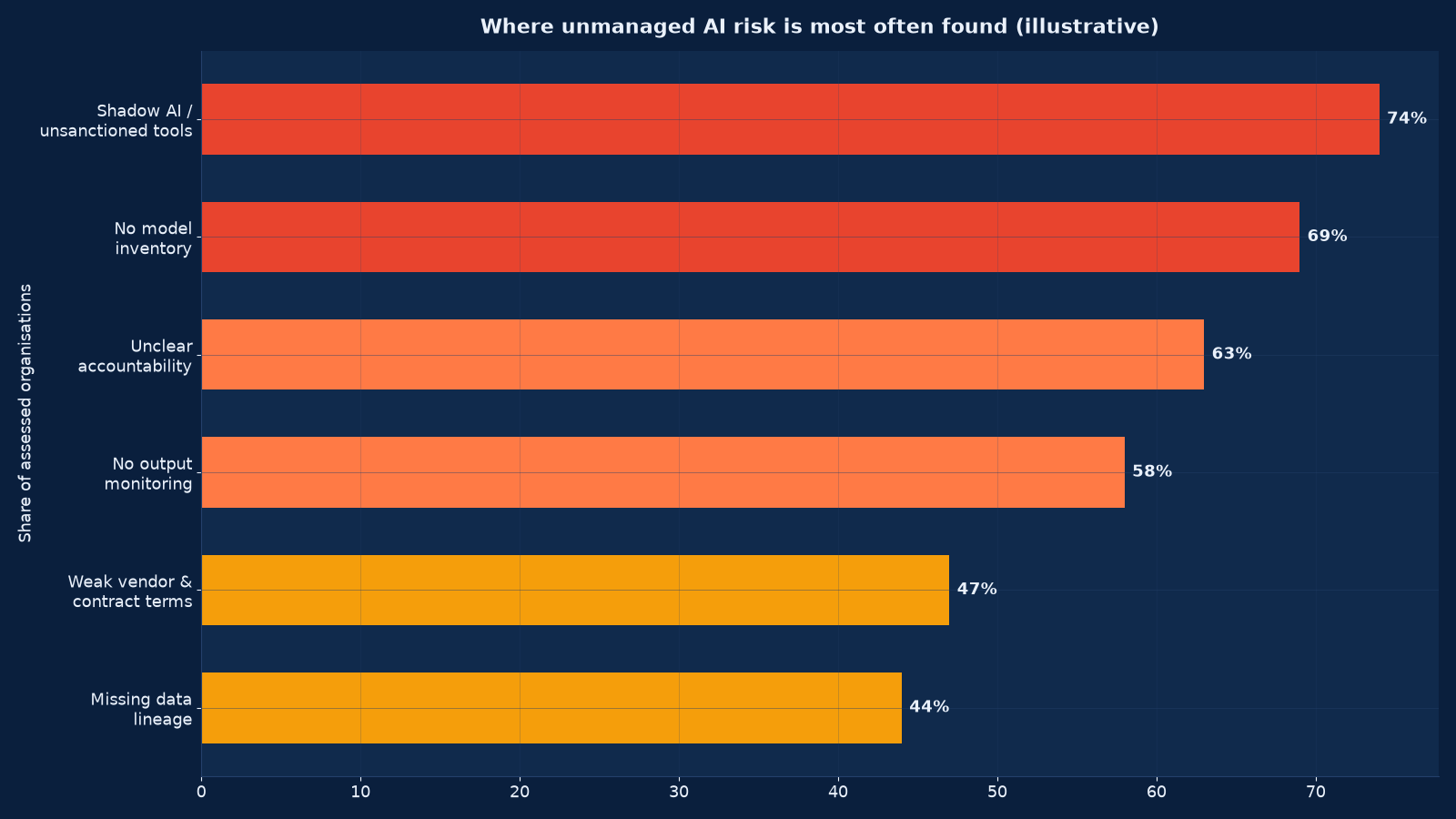
Chart values are an illustrative planning model based on typical UMC engagements and published industry benchmarks. They are not a guarantee of results on any specific project.
AI Policy and Acceptable-Use Framework
Policy only works if the people it constrains can apply it without asking permission for every decision. We write it in two layers: a short governing policy that states principles, ownership, tiers and consequences, and operational guidance that answers the questions employees actually have.
What the governing policy defines
- Scope — which systems, vendors, internal tools and prompt-based workflows are covered, and the definition of an AI system used
- Accountability — the executive owner, the governance committee, and the business and technical owner required for every system
- Prohibited practices — explicitly named, so that the boundary does not depend on interpretation
- Data rules — what may and may not be submitted to external AI services, and the approved channels for each data category
- Disclosure — when AI use must be declared to customers, employees or counterparties
- Human review — the thresholds at which output must be reviewed before it is actioned
- Incident and escalation — what counts as an AI incident, reporting timelines and the escalation path
- Consequences and enforcement — what happens when the policy is breached, stated plainly
What the operational guidance answers
- May I paste this document into a public AI assistant?
- How do I get a new AI tool approved, and how long will it take?
- Which AI platforms are already approved for which data categories?
- What do I do if an AI output looks wrong, biased or unsafe?
- Do I have to tell the customer that this was AI-assisted?
- How do I register a workflow my team built on top of an existing model?
Regulatory Gap Analysis
We map your current position against the obligations that actually apply to your sector, jurisdictions and use cases, then produce a remediation plan with a named owner per gap. The objective is a defensible position, not a claim of complete compliance — the distinction matters, because regulators and enterprise customers assess whether you can demonstrate control, not whether you assert it.
| Obligation area | What we assess | Typical evidence produced |
|---|---|---|
| Data protection | Lawful basis for each data category processed, transparency notices, retention, subject rights handling, cross-border transfers | Processing record entries per system, notice text, transfer position |
| Sector regulation | Industry-specific requirements on automated decisions, model risk, record-keeping and customer treatment | Control mapping to the applicable rulebook |
| Emerging AI law | Risk classification of each use case under applicable AI legislation, and the obligations that follow from that class | Tier-to-classification mapping with required documentation |
| Consumer and competition law | Disclosure, misleading representation, pricing and targeting constraints | Disclosure standard and marketing review checkpoints |
| Employment | Use of AI in recruitment, performance and monitoring, and the consultation obligations that follow | Employee-facing use register and review controls |
| Contractual and vendor | AI clauses in customer and supplier contracts, liability, sub-processing, training-on-data and exit terms | Clause positions and negotiation requirements |
| Audit and assurance | Whether your evidence would satisfy internal audit and an external assurance review | Evidence pack template and retention schedule |
Where your exposure sits in a jurisdiction we are not qualified to advise on, we say so and work alongside your counsel rather than substituting for them. Our contribution is the technical and operational control layer, mapped to the obligations your legal team confirms apply.
Technical Controls, Monitoring and the Audit Trail
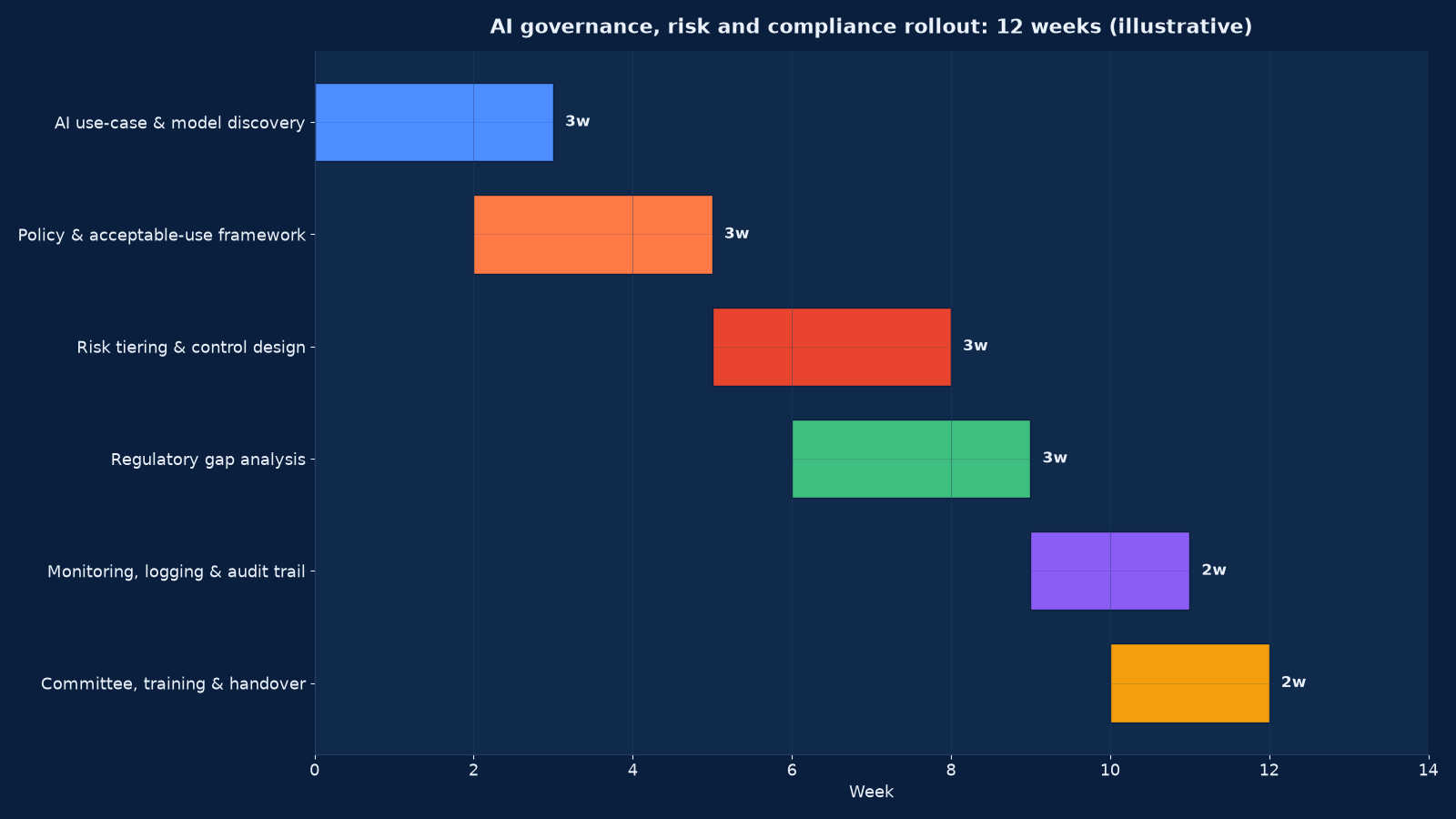
Chart values are an illustrative planning model based on typical UMC engagements and published industry benchmarks. They are not a guarantee of results on any specific project.
Governance that lives only in policy fails at the first incident. The controls have to be in the system: logging that captures prompt, model version, input reference and output for the retention period you have defined; monitoring that detects drift, refusal-rate change, latency degradation and output quality regression; and a rollback path that does not require an engineering project.
| Control | What it must capture or do | Failure mode it prevents |
|---|---|---|
| Prompt and output logging | System, model and prompt version, input reference, output, timestamp, user or process identity, decision taken | Inability to reconstruct what happened during an incident or audit |
| Evaluation harness | A versioned test set with pass thresholds run before every promotion, including adversarial and edge cases | Silent quality regression reaching production |
| Drift monitoring | Input distribution, output distribution, refusal and escalation rates against a recorded baseline | Gradual degradation discovered by customers |
| Human review gates | Sampling or per-case approval at the threshold defined by the risk tier, with reviewer recorded | Unreviewed automated decisions in a Tier 3 or 4 use case |
| Access and permission control | Least-privilege tool permissions for agents, scoped credentials, separation of environments | An agent or integration acting beyond its mandate |
| Kill switch and rollback | A documented, tested path to disable or revert a system within a defined time | A harmful system staying live while a fix is scheduled |
| Change control | Approval recorded for model, prompt, data source and vendor changes, with the tier re-assessed on change | A Tier 1 system silently becoming Tier 3 through a prompt change |
Security controls overlap heavily with this layer and should not be run as a separate programme. Our cybersecurity services covers the surrounding identity, network and application security work, and where AI systems are hosted in your own estate cloud services and migration provides the platform controls the audit trail depends on.
The Governance Operating Model
A framework without an operating model decays immediately. We define who decides, how often, on what evidence, and what happens when a decision is contested. In practice this is a small standing committee with real authority and a short evidence pack, not a monthly forum that reviews slides.
| Role | Responsibility | Typical holder |
|---|---|---|
| Executive AI owner | Owns the policy, chairs the committee, resolves contested tiering, accountable to the board | COO, CTO or a nominated executive |
| Governance committee | Approves Tier 3 and 4 use cases, reviews incidents, authorises changes to the framework | Risk, legal, data protection, IT, business function representation |
| Business owner | Accountable for the outcome of a specific system, funds it, decides whether it continues | Function or process owner |
| Technical owner | Operates the system, maintains logging and monitoring, executes rollback | Engineering lead |
| Data protection lead | Confirms lawful basis, transparency and retention per system | DPO or privacy counsel |
| Assurance reviewer | Tests that controls operate as documented, on a defined cadence | Internal audit or an external reviewer |
We also set the review cadence by tier: Tier 1 reviewed annually or on change, Tier 2 semi-annually, Tier 3 quarterly with monitoring reports, Tier 4 monthly with periodic revalidation. The cadence is written into the framework so it does not depend on someone remembering.
AI Incident Definition and Response
Organisations handle AI incidents badly because they have not decided in advance what one is. We define the categories, the severity thresholds, the reporting timelines and the response actions before the first occurrence, then test the process with a tabletop exercise.
| Incident category | Example | Immediate response |
|---|---|---|
| Harmful or unsafe output | Advice causing financial, physical or reputational harm; unsafe content reaching a customer | Disable or restrict the system, preserve logs, notify the executive owner |
| Bias or unfair treatment | Systematically different outcomes for a protected group | Pause the affected decision path, quantify the affected population, remediate before restart |
| Data exposure | Personal or confidential data submitted to an unapproved service, or leaked through output | Contain the channel, assess notification obligations, review the acceptable-use controls |
| Quality degradation | Accuracy, grounding or refusal rate moving outside the monitored baseline | Increase human review sampling, roll back to the last known-good version |
| Unauthorised system | An undeclared AI tool or workflow found processing business data | Register or disable, assess exposure retrospectively, address the discovery gap |
| Vendor failure | Model withdrawal, price change, terms change or supplier outage | Invoke the exit plan, confirm contractual position, switch or suspend the use case |
AI Governance Engagement Models
| Model | Best suited to | Typical duration | What is included |
|---|---|---|---|
| Governance foundation | No AI policy, no inventory, first systems approaching production | 8–12 weeks | Discovery, inventory, tiering, policy, approval route, committee charter |
| Regulatory readiness | A specific obligation, customer assurance request or audit finding to answer | 6–10 weeks | Gap analysis against the applicable obligations, remediation plan, evidence pack |
| Full programme | Multiple systems live, several functions involved, board reporting required | 12–16 weeks | Foundation plus technical controls, monitoring design, incident framework, training, operating model |
| Assurance and revalidation | An existing framework that needs independent testing | 3–4 weeks | Control testing, inventory reconciliation, tier re-assessment, findings report |
Frequently Asked Questions About AI Governance, Risk and Compliance
What is AI governance?
AI governance is the framework of ownership, policy, risk classification, technical controls and oversight that determines which AI systems may operate, what they are permitted to decide, how their behaviour is monitored, and how they are stopped. It exists so that AI use is deliberate and evidenceable rather than incidental.
How is AI governance different from IT governance?
IT governance assumes deterministic behaviour: a system does what it was coded to do, and testing proves it. AI systems produce probabilistic output that can drift, can be influenced by their input, and can be changed by a prompt edit without a code release. That requires evaluation harnesses, drift monitoring, tiered human review and change control over prompts and data sources, none of which conventional IT governance covers.
Do we need AI governance if we only use off-the-shelf tools?
Yes, and the scope is different rather than smaller. Your exposure shifts from model behaviour to data submitted, vendor terms, employee acceptable use and disclosure. Off-the-shelf tools are also where shadow AI originates, because a purchase is not required for a team to start using one.
What is shadow AI and how do we find it?
Shadow AI is unsanctioned AI use: personal accounts, unapproved tools, departmental pilots and vendor features enabled by default. We find it through technical discovery rather than self-declaration — network egress review, cloud billing analysis, identity and SSO logs, repository scanning and contract review. Our shadow AI workplace guide explains the patterns.
How do you tier AI risk?
By decision impact and reversibility, per use case rather than per technology. Tier 1 is internal and non-decisional; Tier 4 covers decisions with legal, financial, safety or employment consequence. Each tier has a defined control set and approval route, so review effort is proportionate and low-risk work is not blocked.
Will governance slow our AI delivery down?
Badly designed governance does, which is why we design the approved route to be faster than the informal one. Clear tiers, pre-approved platforms for defined data categories, and automated evidence collection mean most Tier 1 and 2 uses need only a register entry, while review effort concentrates on the systems where it matters.
Can you help us respond to a customer or auditor AI questionnaire?
Frequently. Enterprise customers increasingly issue AI assurance questionnaires as a condition of contracting. We build the evidence pack — inventory, tiers, controls, monitoring, incident process — so the answers are drawn from records rather than assembled under time pressure.
Do you provide legal advice on AI regulation?
No. We map your technical and operational position against the obligations your legal team or counsel confirms apply, and we build the controls and evidence needed to meet them. Where a question is genuinely legal, we work alongside your counsel rather than substituting for them.
How often should the AI inventory be updated?
On change, plus a scheduled reconciliation. Any new model, prompt version, data source, vendor or lifecycle change triggers an update; technical discovery runs periodically to catch undeclared systems. An inventory updated only annually will not reflect what is actually running.
How does this connect to your engineering services?
Governance defines the controls; engineering implements them. AI product engineering builds the evaluation harness, logging and monitoring to the control specification, and AI forward-deployed engineering embeds the controls in delivery so they are not retrofitted. Risk, governance and business continuity support provides the enterprise risk wrapper this framework sits inside.
Put Your AI Systems Under Control
If you cannot currently list every AI system touching your data, or you are facing an audit, a customer questionnaire or a new regulatory obligation, the first step is discovery. We will build the inventory, tier the risk, write the policy your teams can actually follow, and install the monitoring and approval route that keeps it true.
Request an AI governance assessment and tell us how many systems you believe are in scope. We will propose the engagement model, the discovery method and the timeline before any work begins.
Related Services
Governance is normally delivered alongside the engineering and risk work it constrains.
- Risk, Governance & Business Continuity Support — the enterprise risk framework an AI governance programme sits inside
- Cybersecurity Services & Solutions — identity, network and application security controls around AI systems
- AI Product Engineering Services — builds evaluation, logging and monitoring to the control specification
- AI Forward-Deployed Engineering Services — embeds governance in delivery rather than retrofitting it
- Data Science Services for Business Analytics — bias testing, validation and model performance analysis
- Cloud Services & Migration (AWS, Azure, GCP) — platform controls, logging retention and environment separation
- Business Strategy Consulting — where governance constraints have to be reconciled with the commercial plan
- AI ROI Measurement & Executive Scorecard Services — baseline capture, bottom-up benefit and cost models, instrumentation, the executive scorecard itself and the gate criteria that make AI spend auditable
- Data Engineering for AI: RAG & Knowledge System Services — source audit, ingestion connectors, cleaning and metadata, permission-aware retrieval and the evaluation harness that proves every answer is grounded
- AI Integration Services for ERP, CRM & Operations — embed AI into ERP, CRM and operational systems with mapped permissions, supervised writes, immutable action logging and a tested rollback path
- AI Training & Enablement Services for Teams — role-based enablement, a measured capability baseline, build clinics and a champion network that makes adoption stick after delivery